REVIEW 5 major objections 6 minor 63 references
Signatures of Fuzzy Dark Matter Inside Radial Critical Curves
T0 review · 5 major / 6 minor · reviewed 2026-08-07 · deepseek-v4-flash
Pith's one-line read The paper claims that fuzzy dark matter halos produce a distinctly higher probability of high magnification inside radial critical curves than cold dark matter does, even when CDM includes subhalos, and that this offers a new…
desk verdict The negative-fluctuation islands inside radial critical curves are a real qualitative FDM effect, but the quantitative p-value grid rests on an unvalidated GRF and should be treated as a proof of concept, not a constraint. read the letter →
The pith
A machine-rendered reading of the paper's core claim, the machinery that carries it, and where it could break.
The reading
What carries the argument
The machinery is a Gaussian random field (GRF) model for the projected column-density fluctuations of FDM, with power spectrum $P(k)\propto r_h(x)\,\lambda_{\rm dB}^3\exp(-\lambda_{\rm dB}^2 k^2/4)$ and a radial variance function $\sigma^2(x)$ derived from the NFW halo density along the line of sight, combined with a soliton core that follows the soliton--halo relation. The de Broglie wavelength $\lambda_{\rm dB}\propto m_\psi^{-1}M_h^{-1/3}$ sets the fluctuation scale and is the primary parameter controlling the strength of the effect. The argument proceeds by drawing random GRF realizations, adding the soliton and NFW plus S\'ersic components linearly, computing deflection angles analytically for the smooth profiles and numerically via FFT for the fluctuations, and then comparing magnification histograms within isomagnification contours scaled from the smooth CDM radial critical curve. The crucial ingredient is that FDM fluctuations can be negative relative to the mean density, whereas CDM substructure only adds positive mass, so FDM can locally restore the radial criticality condition that CDM substructure can only push further away.
What would settle it
Take a sample of well-modelled galaxy-scale lenses and measure how often compact sources near radial arcs are magnified by $\mu\ge10$. If the observed rate matches the smooth-CDM or CDM-with-subhalo predictions, with no excess inside the radial critical curve, the $10^{-22}$--$10^{-21}$ eV axion window in galaxy-mass halos is ruled out; a wave-mechanical simulation of a single galaxy halo would also settle whether the Gaussian-random-field variance assumed here reproduces the true projected fluctuations.
Extended reading notes
Core claim
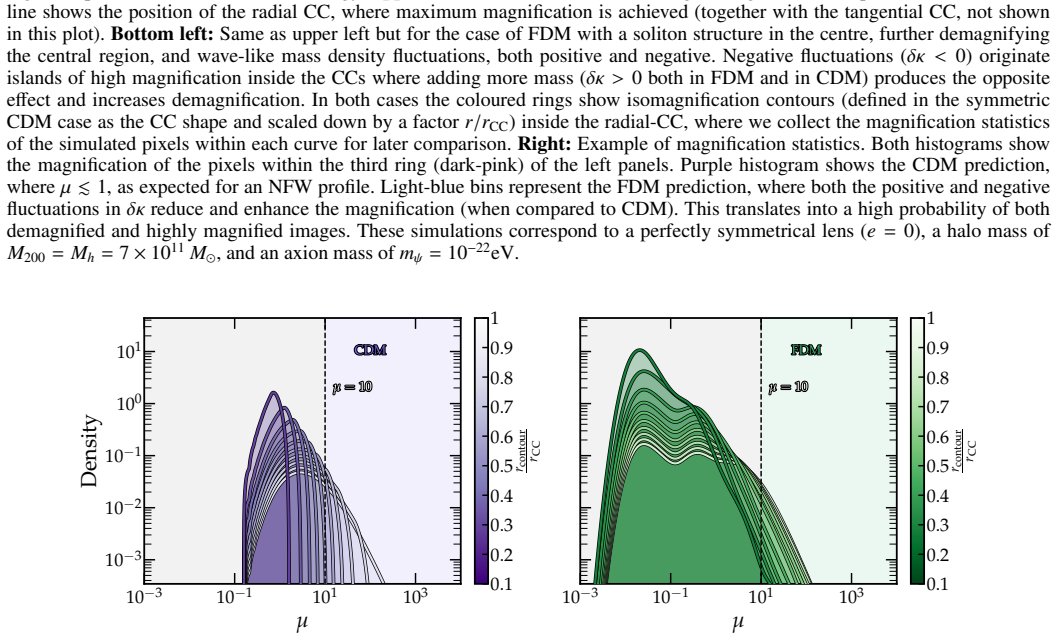
The central claim is that FDM produces enhanced and statistically distinctive magnification inside radial critical curves, uniquely because of negative density fluctuations. In a smooth CDM lens, the radial critical condition is $1-\kappa+\gamma\approx0$; adding substructure only adds mass, which increases $\kappa$ and drives the system further from criticality, demagnifying central images. In FDM, wave interference creates negative surface-density fluctuations that can locally restore $1-\kappa+\gamma\approx0$, producing new critical regions and islands of high magnification inside the radial critical curve. As a result, the probability of magnification $\mu\ge10$ inside the radial CC is orders of magnitude higher for axion masses $10^{-22}$--$10^{-21}$ eV than for CDM, and CDM subhalos of $10^6$--$10^8\,M_\odot$ placed at various radii cannot reproduce the enhancement. The paper also finds that the smallest axion masses considered ($0.4\times10^{-22}$ eV) distort the lens too strongly to have escaped detection, while $10^{-21}$ eV in lower-mass halos remains a viable and testable window.
Load-bearing premise
The load-bearing premise is that the line-of-sight column-density fluctuations of FDM are a Gaussian random field with the power spectrum and radial variance of Eqs. (19) and (21), and that baryons damp those fluctuations by only about 20%; if the real fluctuations are non-Gaussian, radially different, or more strongly damped, the quantitative p-values and the claimed axion-mass range lose support.
Editorial extensions
If this is right
- Radial arcs become a statistical dark-matter probe: the fraction of galaxy-scale lenses with central images magnified by $\mu\ge10$ should be markedly higher in an FDM universe than in CDM, with or without subhalos.
- The predicted effect is strongest for axion masses around $10^{-22}$ to $10^{-21}$ eV in lower-mass halos, giving upcoming wide-field surveys a concrete target population of lenses to examine.
- In the FDM case, radial images near arcs should appear asymmetric and broken into components on the de Broglie scale, unlike the smooth symmetric arcs produced by CDM even when subhalos are present.
- At $m_\psi=10^{-21}$ eV in massive halos, FDM behaves much like CDM, so the cleanest detections would come from lower-mass halos; conversely, the smallest axion masses already produce distortions that should have been observed, bracketing the testable range.
Reading between the lines
- The paper's GRF model is not validated against full wave simulations; a direct wave-mechanical simulation of a galaxy halo would either confirm the assumed variance and Gaussianity of Eqs. (19) and (21) or weaken the quantitative p-value claims.
- The same negative-fluctuation mechanism should also operate near tangential critical curves and in cluster-scale halos as a form of millilensing, which would extend the proposed test beyond radial arcs even though the paper does not explore those settings.
- A practical consequence the authors leave implicit is that targeted searches for central images of lensed quasars and supernovae in existing and upcoming lens samples could turn a modest number of systems into a constraint on the axion mass without requiring direct dark-matter detection.
- Because the p-values depend on the adopted soliton--halo relation, independent measurements of soliton masses in dwarf galaxies would sharpen or weaken the axion-mass interpretation.
Editorial analysis
A structured set of objections, weighed in public.
Referee Report
Summary. The manuscript studies strong lensing magnification statistics inside radial critical curves (CCs) for fuzzy dark matter (FDM) halos. The authors construct mock lenses from a smooth NFW + Sérsic mass model, add for FDM a soliton core and Gaussian random field (GRF) column-density fluctuations with power spectrum and radial variance given by Eqs. 19–21, and compute magnification maps for a grid of three halo masses (3×10^11 to 4×10^12 M_sun) and three axion masses (0.4, 1, and 10 × 10^-22 eV). They compare the probability P(μ≥10) of high magnification inside isomagnification contours within the radial CC for CDM and FDM, including CDM models with single NFW subhalos and models with ellipticity imposed by transforming the deflection field (Eq. 27). The central claim is that FDM predicts significantly enhanced high-magnification probability inside radial CCs, due to negative interference-driven density fluctuations that CDM cannot produce, and that axion masses in the range 10^-22 to 10^-21 eV in galaxy-mass halos yield distinctive, observationally testable magnification distributions for compact sources such as QSOs and supernovae.
Significance. If the quantitative predictions hold, the paper offers a genuinely complementary probe of ultralight axion dark matter: radial-arc interiors are rarely used as FDM discriminators, and the proposed statistic (P(μ≥10) versus contour fraction) is falsifiable and tied to a specific mass window. Strengths include the transparent lensing pipeline (analytic NFW/Sérsic deflections, FFT-based fluctuation deflections, an explicit resolution criterion of ten pixels per de Broglie wavelength), the systematic grid over halo and axion mass, the inclusion of ellipticity and subhalo comparisons, the use of the public soliton-halo code SHR, and a candid discussion of deferred effects (central SMBH, uncertain galaxy profiles) whose deferral is reasonable. However, the central quantitative claim depends on three ingredients that are not quantitatively secured: the assumed GRF fluctuation model of Eqs. 19–21 taken from prior work with heavily overlapping authorship, a handpicked 20% baryonic damping factor, and a CDM baseline with at most one subhalo per realization.
major comments (5)
- [§3.2.2 (Eqs. 19–21)] The quantitative FDM/CDM contrast in Fig. 4 rests entirely on the Gaussian random field (GRF) model for the projected density fluctuations, which is adopted by citing Amruth et al. (2023), Kawai et al. (2022), and Dalal et al. (2021) rather than validated in this manuscript. Because P(μ≥10) is a tail statistic driven by rare, strongly negative δκ excursions, both the assumed Gaussianity and the radial variance profile directly set the computed p-values; the paper offers no test of the GRF approximation against full Schrödinger–Poisson simulations or against projected densities from published FDM simulations. Given that the primary sources of the model share authors with the present paper, an independent calibration, or at minimum an explicit quantitative caveat, is needed before the 10^-22–10^-21 eV window can be presented as a robust prediction.
- [§3.2.2 and Fig. 6] There is an internal tension between the fluctuation variance implemented and the suppression the paper invokes. Eq. 21 is the NFW-based variance and grows as ~1/x toward the halo centre, whereas the smooth FDM profile of Eq. 16 replaces the NFW cusp with the flat soliton; the caption of Fig. 6 states that density fluctuations overlapping the soliton region 'are consequently suppressed,' yet Section 3.2.2 describes the realizations as modulated only by the radial variance of Eq. 21, with no suppression term specified. If no suppression was applied, the innermost radial bins of Fig. 4 are contaminated by artificially large fluctuation power; if it was applied, the text must give the modified variance and justify its form. The manuscript should resolve this and recompute the inner points with a soliton-consistent variance.
- [§4 and Fig. 4] Although the text states that several GRF realizations were performed to mitigate biases from a single realization, no error bars, confidence bands, or per-realization spread are shown on any p-value curve (Figs. 4, 7, 8, 9). Since P(μ≥10) counts rare events in apertures of moderate size, the realization-to-realization scatter can plausibly be comparable to the quoted FDM-CDM separations, and without this uncertainty the central claim that the two models differ significantly is not quantitatively established. Please add the scatter or confidence intervals throughout and state the number of realizations used per model.
- [§3.3] The 20% baryonic damping of the FDM fluctuation amplitude is a single handpicked value, introduced with 'we consider only a not so large dampening factor of ~20%,' with no sensitivity analysis and no physical model for how it varies with radius, baryon fraction, or axion mass. Because the damping scales the raw fluctuation amplitude linearly and the p-values are nonlinear tail probabilities, a change of even a factor of two in the damping could move the curves in Fig. 4 by amounts comparable to the claimed FDM-CDM separation. At minimum, the p-value curves should be recomputed for a plausible range of damping factors (e.g., 0–50%), and the adopted 20% value should be justified from the cited baryonic suppression literature.
- [§5.2 (Figs. 8–9)] The comparison against CDM with substructure uses at most one NFW subhalo per realization, with three masses and four positions. The abstract's claim that the FDM signal cannot be reproduced 'even when including subhalos' is stronger than this evidence: a realistic CDM halo contains a population of subhalos, and the single-subhalo runs already show that a 10^8 M_sun subhalo near the radial CC raises P(μ≥10) substantially in some bins. A population drawn from a CDM subhalo mass function, or a clear argument that many subhalos cannot build up the high-magnification tail, is needed to support the headline claim; otherwise the claim should be softened to 'single NFW subhalos of the masses considered.'
minor comments (6)
- [§4, Eq. 27] The ellipticity transformation rescales the Cartesian components of the circular deflection field rather than being the gradient of an elliptical lens potential; this is a nonstandard construction and should be validated against a direct computation of an elliptical mass distribution, at least at e=0.4.
- [Fig. 3] The vertical axes are labeled 'Density' but show normalized probability densities; please clarify the normalization, and note that in the two panels the histograms and contours have different meanings, which complicates direct comparison.
- [§5, Fig. 6] The black lines mark the smooth-CDM critical curves, but the FDM critical curves are not overplotted, so the claim of enhanced magnification at the interface between tangential and radial CCs is difficult to verify from the figure as presented.
- [§3.2.1] 'latter confirmed in other studies' should read 'later confirmed'; also, the discussion of scatter in the soliton-halo relation would benefit from a quantitative statement of the scatter amplitude from the cited works.
- [Appendix B] The source size is given as a Gaussian of width 0.8 pixels without the pixel scale in physical units; since the appendix's argument requires the source size to be comparable to the de Broglie wavelength, the conversion should be stated explicitly.
- [§3.2.2 and §5] The threshold μ≥10 is adopted without physical or observational motivation; a sentence on why this threshold was chosen, and how the conclusions change for other thresholds such as μ≥5 or μ≥20, would strengthen the statistical framing.
Circularity Check
No significant circularity: the lensing statistics are forward-model outputs from an explicitly stated FDM fluctuation model, with axion-mass dependence entering through the input de Broglie wavelength rather than through fitting the predicted magnification.
full rationale
The paper's quantitative claim is a forward lensing calculation: given a stated FDM mass model (NFW + soliton + GRF column-density fluctuations with P(k) from Eq. 19 and variance from Eq. 21), the deflection fields and magnification maps are computed and P(mu>=10) is measured from those maps. No parameter is fitted to the magnification statistic being predicted; the axion-mass dependence enters through lambda_dB as an input scale, which is ordinary parameter dependence, not a self-fulfilling construction. Equations 19 and 21 are adopted as an explicit model assumption citing Amruth et al. 2023, Kawai et al. 2022, and Dalal et al. 2021; although the first two have overlapping authorship, the paper labels the GRF as an assumption rather than as a theorem, and Dalal et al. 2021 is an external independent source. The soliton-halo relation is likewise taken from simulation-calibrated work with external confirmation, and the paper acknowledges scatter and alternative relations. The handpicked ~20% baryonic damping and the lack of validation against full wave simulations are correctness risks, not circular reductions: they affect the quantitative strength of the conclusion without making the conclusion equal to its input. The internal tension between the NFW-based variance of Eq. 21 and the soliton suppression described in Sec. 5 is a modeling inconsistency, not a circular step. Therefore no circular step meeting the quotation/reduction standard is present.
Assumptions & free parameters
free parameters (5)
- Baryonic damping factor =
~20% reduction of FDM surface density fluctuations
- Sérsic profile parameters =
values from HS 0810+2554 system (Amruth et al. 2023)
- Subhalo masses and positions =
1e6, 1e7, 1e8 solar masses at 0.3, 0.6, 0.9 r_CC
- Magnification threshold for p-values =
mu >= 10
- Pixel resolution =
at least 10 pixels per de Broglie wavelength
assumptions (4)
- domain assumption FDM column density fluctuations are a Gaussian random field with power spectrum P(k) (Eq. 19) and variance sigma^2(x) (Eq. 21)
- domain assumption Soliton-halo relation as in Liao et al. 2024 (Ms proportional to m_psi^-1 (1+z)^(1/2) Mh^(1/3))
- ad hoc to paper Ellipticity is imposed by transforming the deflection field (Eq. 27)
- domain assumption NFW + soliton + Sersic composition describes the galaxy mass distribution
Cite this review
Pith. "Pith review of Signatures of Fuzzy Dark Matter Inside Radial Critical Curves." pith.science (2026). https://pith.science/paper/AIR2RNTQ
@misc{pith2026250524373,
  author       = {Pith},
  title        = {Pith review of: Signatures of Fuzzy Dark Matter Inside Radial Critical Curves},
  year         = {2026},
  howpublished = {\url{https://pith.science/paper/AIR2RNTQ}},
  note         = {Machine review of arXiv:2505.24373}
}
abstract
We investigate the strong gravitational lensing properties of fuzzy dark matter (FDM) halos, focusing on the magnification properties near radial critical curves (CCs). Using simulated lenses we compute magnification maps for a range of axion masses and halo configurations. We show that FDM produces enhanced central magnification and secondary CCs that are not easily reproduced by standard cold dark matter (CDM), even when including subhalos. The strength and scale of these effects depend primarily on the de~Broglie wavelength, governed by the axion and halo masses. We find that axion masses in the range $m_\psi \sim 10^{-22}$--$10^{-21}\,\mathrm{eV}$ in galaxy-mass halos lead to distinctive magnification distributions. Our results suggest that observations of highly magnified, compact sources near radial arcs, such as quasars or supernovae, could serve as a powerful test for the presence of FDM.
Figures


Figures from the paper (5 more)


Reference graph
Works this paper leans on
-
[1]
, " * write output.state after.block = add.period write newline
ENTRY address archiveprefix author booktitle chapter edition editor howpublished institution eprint journal key month note number organization pages publisher school series title type volume year label extra.label sort.label short.list INTEGERS output.state before.all mid.sentence after.sentence after.block FUNCTION init.state.consts #0 'before.all := #1 ...
-
[2]
write newline
" write newline "" before.all 'output.state := FUNCTION n.dashify 't := "" t empty not t #1 #1 substring "-" = t #1 #2 substring "--" = not "--" * t #2 global.max substring 't := t #1 #1 substring "-" = "-" * t #2 global.max substring 't := while if t #1 #1 substring * t #2 global.max substring 't := if while FUNCTION word.in bbl.in " " * FUNCTION format....
-
[3]
2022, , 2022, 044, 10.1088/1475-7516/2022/11/044
Aja , B., Arguedas Cuendis , S., Arregui , I., et al. 2022, , 2022, 044, 10.1088/1475-7516/2022/11/044
-
[4]
2023, Nature Astronomy, 7, 736, 10.1038/s41550-023-01943-9
Amruth , A., Broadhurst , T., Lim , J., et al. 2023, Nature Astronomy, 7, 736, 10.1038/s41550-023-01943-9
-
[5]
2018, European Physical Journal C, 78, 203, 10.1140/epjc/s10052-018-5662-y
Arcadi , G., Dutra , M., Ghosh , P., et al. 2018, European Physical Journal C, 78, 203, 10.1140/epjc/s10052-018-5662-y
-
[6]
Armengaud , E., Palanque-Delabrouille , N., Y \`e che , C., Marsh , D. J. E., & Baur , J. 2017, , 471, 4606, 10.1093/mnras/stx1870
-
[7]
Boylan-Kolchin , M., Bullock , J. S., & Kaplinghat , M. 2011, , 415, L40, 10.1111/j.1745-3933.2011.01074.x
arXiv 2011
-
[9]
Broadhurst , T., De Martino , I., Luu , H. N., Smoot , G. F., & Tye , S. H. H. 2020, , 101, 083012, 10.1103/PhysRevD.101.083012
Show all 63 references
-
[10]
K., Alfred , A., et al
Broadhurst , T., Li , S. K., Alfred , A., et al. 2025, , 978, L5, 10.3847/2041-8213/ad9aa8
2025 doi
-
[12]
Cardone , V. F. 2004, , 415, 839, 10.1051/0004-6361:20031696
2004 doi
-
[13]
T., Ostriker , J
Chiang , B. T., Ostriker , J. P., & Schive , H.-Y. 2023, , 518, 4045, 10.1093/mnras/stac3358
2023 doi
-
[14]
T., Schive, H.-Y., & Chiueh, T
Chiang, B. T., Schive, H.-Y., & Chiueh, T. 2021, Phys. Rev. D, 103, 103019, 10.1103/PhysRevD.103.103019
2021 doi
-
[15]
W., & Tukey, J
Cooley, J. W., & Tukey, J. W. 1965, Mathematics of Computation, 19, 297. http://www.jstor.org/stable/2003354
1965
-
[16]
2021, , 2021, 076, 10.1088/1475-7516/2021/03/076
Dalal , N., Bovy , J., Hui , L., & Li , X. 2021, , 2021, 076, 10.1088/1475-7516/2021/03/076
2021 doi
-
[17]
2022, Phys
Dalal, N., & Kravtsov, A. 2022, Phys. Rev. D, 106, 063517, 10.1103/PhysRevD.106.063517
2022 doi
-
[18]
2017, Galaxies, 5, 17, 10.3390/galaxies5010017
Del Popolo , A., & Le Delliou , M. 2017, Galaxies, 5, 17, 10.3390/galaxies5010017
2017 doi
-
[19]
M., Li , S
Diego , J. M., Li , S. K., Amruth , A., et al. 2024, , 689, A167, 10.1051/0004-6361/202450474
2024 doi
-
[20]
A., & Macci \`o , A
Dutton , A. A., & Macci \`o , A. V. 2014, , 441, 3359, 10.1093/mnras/stu742
2014 doi
-
[21]
Eberhardt , A., Liang , Q., & Ferreira , E. G. M. 2024, arXiv e-prints, arXiv:2411.18051, 10.48550/arXiv.2411.18051
2024 doi
-
[22]
Ferreira , E. G. M. 2021, , 29, 7, 10.1007/s00159-021-00135-6
2021 doi
- [23]
-
[24]
d., Della Monica, R., & De Martino, I
Furlanetto, G. d., Della Monica, R., & De Martino, I. 2025, Class. Quant. Grav., 42, 075011, 10.1088/1361-6382/adc17f
2025 doi
-
[25]
2004, , 351, 903, 10.1111/j.1365-2966.2004.07836.x
Gentile , G., Salucci , P., Klein , U., Vergani , D., & Kalberla , P. 2004, , 351, 903, 10.1111/j.1365-2966.2004.07836.x
2004
-
[26]
M., Chessey , M
Goldberg , D. M., Chessey , M. K., Harris , W. B., & Richards , G. T. 2010, , 715, 793, 10.1088/0004-637X/715/2/793
2010 doi
-
[27]
2011, , 742, 76, 10.1088/0004-637X/742/2/76
Guedes , J., Callegari , S., Madau , P., & Mayer , L. 2011, , 742, 76, 10.1088/0004-637X/742/2/76
2011 doi
-
[28]
R., & Vives-Arias , H
Hartley , P., Jackson , N., Sluse , D., Stacey , H. R., & Vives-Arias , H. 2019, , 485, 3009, 10.1093/mnras/stz510
2019 doi
-
[29]
2000, Phys
Hu, W., Barkana, R., & Gruzinov, A. 2000, Phys. Rev. Lett., 85, 1158, 10.1103/PhysRevLett.85.1158
2000 doi
-
[30]
2021, Ann
Hui, L. 2021, Ann. Rev. Astron. Astrophys., 59, 247, 10.1146/annurev-astro-120920-010024
2021 doi
-
[31]
P., Tremaine, S., & Witten, E
Hui, L., Ostriker, J. P., Tremaine, S., & Witten, E. 2017, Phys. Rev. D, 95, 043541, 10.1103/PhysRevD.95.043541
2017 doi
-
[32]
G., Bolton , J
Ir s i c , V., Viel , M., Haehnelt , M. G., Bolton , J. S., & Becker , G. D. 2017, , 119, 031302, 10.1103/PhysRevLett.119.031302
2017 doi
-
[33]
2022, , 925, 61, 10.3847/1538-4357/ac39a2
Kawai , H., Oguri , M., Amruth , A., Broadhurst , T., & Lim , J. 2022, , 925, 61, 10.3847/1538-4357/ac39a2
2022 doi
-
[34]
R., Gaudi , B
Keeton , C. R., Gaudi , B. S., & Petters , A. O. 2003, , 598, 138, 10.1086/378934
2003 doi
-
[35]
V., Valenzuela , O., & Prada , F
Klypin , A., Kravtsov , A. V., Valenzuela , O., & Prada , F. 1999, , 522, 82, 10.1086/307643
1999 doi
-
[36]
2017, , 96, 123514, 10.1103/PhysRevD.96.123514
Kobayashi , T., Murgia , R., De Simone , A., Ir s i c , V., & Viel , M. 2017, , 96, 123514, 10.1103/PhysRevD.96.123514
2017 doi
-
[37]
Kulkarni, M., & Ostriker, J. P. 2021, Mon. Not. Roy. Astron. Soc., 510, 1425, 10.1093/mnras/stab3520
2021 doi
-
[38]
2022, Mon
Laroche, A., Gilman, D., Li, X., Bovy, J., & Du, X. 2022, Mon. Not. Roy. Astron. Soc., 517, 1867, 10.1093/mnras/stac2677
2022 doi
-
[39]
Leung , K. K. H., Ahmed , M., Alarcon , R., et al. 2019, in European Physical Journal Web of Conferences, Vol. 219, European Physical Journal Web of Conferences (EDP), 02005, 10.1051/epjconf/201921902005
2019
- [40]
-
[41]
Mazure , A., & Capelato , H. V. 2002, , 383, 384, 10.1051/0004-6361:20011751
2002 doi
-
[42]
G., Schaye , J., Font , A
McCarthy , I. G., Schaye , J., Font , A. S., et al. 2012, , 427, 379, 10.1111/j.1365-2966.2012.21951.x
2012
-
[43]
H., et al
Mocz, P., Vogelsberger, M., Robles, V. H., et al. 2017, Mon. Not. Roy. Astron. Soc., 471, 4559, 10.1093/mnras/stx1887
2017 doi
- [44]
-
[45]
1999, , 310, 1147, 10.1046/j.1365-8711.1999.03039.x
Moore , B., Quinn , T., Governato , F., Stadel , J., & Lake , G. 1999, , 310, 1147, 10.1046/j.1365-8711.1999.03039.x
1999
-
[46]
O., Drlica-Wagner , A., Bechtol , K., et al
Nadler , E. O., Drlica-Wagner , A., Bechtol , K., et al. 2021, , 126, 091101, 10.1103/PhysRevLett.126.091101
2021 doi
-
[47]
F., Frenk , C
Navarro , J. F., Frenk , C. S., & White , S. D. M. 1996, , 462, 563, 10.1086/177173
1996 doi
- [48]
-
[49]
2011, , 142, 24, 10.1088/0004-6256/142/1/24
Oh , S.-H., Brook , C., Governato , F., et al. 2011, , 142, 24, 10.1088/0004-6256/142/1/24
2011 doi
-
[50]
Perera , D., Williams , L. L. R., Liesenborgs , J., et al. 2025, , 536, 2690, 10.1093/mnras/stae2753
2025 doi
- [51]
-
[52]
2020, , 641, A6, 10.1051/0004-6361/201833910
Planck Collaboration , Aghanim , N., Akrami , Y., et al. 2020, , 641, A6, 10.1051/0004-6361/201833910
2020 doi
-
[53]
M., Vegetti , S., McKean , J
Powell , D. M., Vegetti , S., McKean , J. P., et al. 2023, , 524, L84, 10.1093/mnrasl/slad074
2023 doi
-
[54]
H., Lora, V., Matos, T., & S\'anchez-Salcedo, F
Robles, V. H., Lora, V., Matos, T., & S\'anchez-Salcedo, F. J. 2015, Astrophys. J., 810, 99, 10.1088/0004-637X/810/2/99
2015 doi
-
[55]
S., Bower , R
Schaller , M., Frenk , C. S., Bower , R. G., et al. 2015, , 451, 1247, 10.1093/mnras/stv1067
2015 doi
-
[56]
2020, , 124, 201301, 10.1103/PhysRevLett.124.201301
Schive , H.-Y., Chiueh , T., & Broadhurst , T. 2020, , 124, 201301, 10.1103/PhysRevLett.124.201301
2020 doi
-
[57]
2016, Astrophys
Schive, H.-Y., Chiueh, T., Broadhurst, T., & Huang, K.-W. 2016, Astrophys. J., 818, 89, 10.3847/0004-637X/818/1/89
2016 doi
-
[58]
2014, , 113, 261302, 10.1103/PhysRevLett.113.261302
Schive , H.-Y., Liao , M.-H., Woo , T.-P., et al. 2014, , 113, 261302, 10.1103/PhysRevLett.113.261302
2014 doi
-
[59]
Schneider , P., Ehlers , J., & Falco , E. E. 1992, Gravitational Lenses (Springer Berlin, Heidelberg), 10.1007/978-3-662-03758-4
1992 doi
-
[60]
J., Birrer , S., Treu , T., et al
Shajib , A. J., Birrer , S., Treu , T., et al. 2019, , 483, 5649, 10.1093/mnras/sty3397
2019 doi
-
[61]
P., Auger , M
Spingola , C., McKean , J. P., Auger , M. W., et al. 2018, , 478, 4816, 10.1093/mnras/sty1326
2018 doi
-
[62]
2018, , 730, 1, 10.1016/j.physrep.2017.11.004
Tulin , S., & Yu , H.-B. 2018, , 730, 1, 10.1016/j.physrep.2017.11.004
2018 doi
-
[63]
D., Bolton , J
Viel , M., Becker , G. D., Bolton , J. S., & Haehnelt , M. G. 2013, , 88, 043502, 10.1103/PhysRevD.88.043502
2013 doi
-
[64]
2015, , 447, 3189, 10.1093/mnras/stu2673
Xu , D., Sluse , D., Gao , L., et al. 2015, , 447, 3189, 10.1093/mnras/stu2673
2015 doi
-
[65]
Zhang , D., Ferreira , E. G. M., Obata , I., & Namikawa , T. 2024, , 110, 103525, 10.1103/PhysRevD.110.103525
2024 doi
Reviewed August 7, 2026 · model on record in the stance chip above.
Discussion (0). Continue with ORCID to comment.