REVIEW 3 major objections 5 minor 2 cited by
TIME: TabPFN-Integrated Multimodal Engine for Robust Tabular-Image Learning
T0 review · 3 major / 5 minor · reviewed 2026-08-07 · deepseek-v4-flash
Pith's one-line read This paper claims that a frozen TabPFN tabular encoder, fused with image features, beats task-trained tabular encoders in multimodal learning and that raw incomplete tables beat median-imputed ones.
desk verdict Useful recipe for injecting frozen TabPFN into multimodal fusion, but the training-set embedding protocol leaks labels and the evaluation misses the most relevant baseline. read the letter →
The pith
A machine-rendered reading of the paper's core claim, the machinery that carries it, and where it could break.
The reading
What carries the argument
The load-bearing object is the frozen TabPFN encoder $f_{\mathrm{TabPFN}}(X, D_{\mathrm{train}})$: a transformer-based tabular foundation model pretrained on synthetic tasks with in-context learning, which maps each tabular row to a 192-dimensional embedding while conditioning on the whole training set and natively tolerating missing entries. This embedding is fused with a ResNet-50 image embedding by concatenation, element-wise sum, element-wise maximum, or a DAFT transform, and the fused vector feeds a linear classifier or regressor. Keeping TabPFN frozen is what preserves its zero-shot generalization and missing-value behavior; only the projection layers and, optionally, the image encoder are trained.
What would settle it
A direct test is to take a medical dataset where missingness is known to be informative, such as lab results absent more often for severe cases, and compare TIME trained on raw incomplete tables against the same model trained on median-imputed tables. If the imputed version matches or beats the raw version, or if a strong imputation-based baseline does, then the claim that TabPFN's native missing-value handling is the source of robustness fails.
Extended reading notes
Core claim
On its own terms, the paper's central discovery is that a pretrained tabular foundation model can serve as a drop-in, frozen tabular encoder for multimodal learning: TIME, built by fusing TabPFN's 192-dimensional row embeddings with ResNet-50 image features, beats both a task-trained MLP and the NCART tree-based encoder on five datasets, and does so by larger margins on medical imaging data. The paper further reports that training TIME on raw, incomplete tabular data yields higher accuracy than training on median-imputed data across all three medical datasets, and that performance degrades only mildly when up to half the tabular entries are randomly masked. The claimed mechanism is that TabPFN's native missing-value handling and pretrained in-context representations transfer to the multimodal setting, so imputation, which can distort distributions, becomes unnecessary.
Load-bearing premise
The robustness conclusion relies on random missingness being a fair stand-in for the real missingness in medical tables, yet the paper never examines why values are missing in its medical datasets; if missingness carries information about the outcome, TabPFN's advantage over imputation may not transfer.
Editorial extensions
If this is right
- Adding tabular information through TIME improves over a vision-only ResNet on all five datasets, so the paper's recipe benefits natural images, paintings, and medical images alike.
- TIME's gains over MLP and NCART are largest on the three medical datasets, suggesting pretrained tabular embeddings matter most where data are small and heterogeneous.
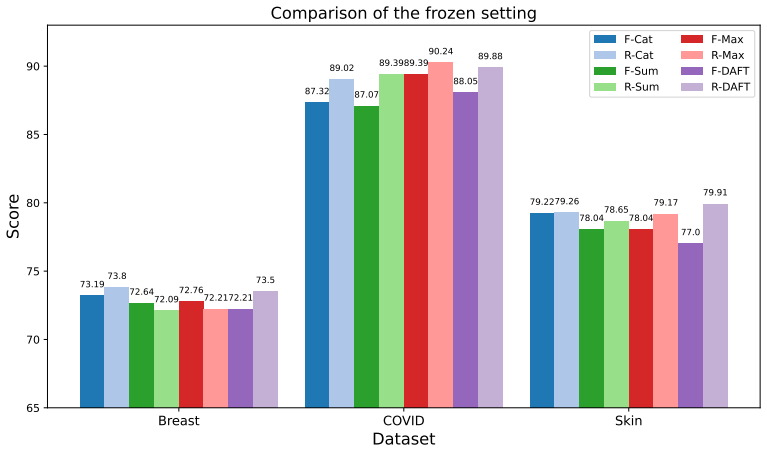
- Because raw incomplete inputs outperform median-imputed inputs in every medical dataset and fusion configuration, the paper implies that imputation is not just unnecessary but can be harmful in this pipeline.
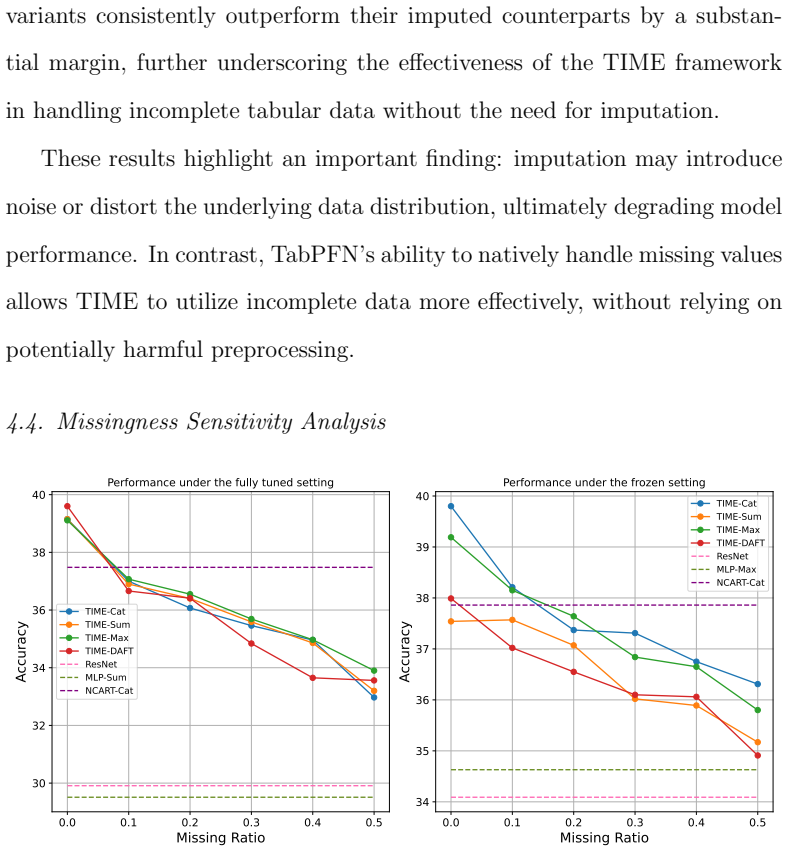
- Under random missingness up to 50%, TIME's accuracy stays near its complete-data level, with concatenation and max fusion the most resilient strategies.
- The best fusion strategy depends on encoder and setting, with concatenation and DAFT broadly strong and sum fusion excelling with TabPFN under full fine-tuning.
Reading between the lines
- A natural extension is to swap TabPFN for any future tabular foundation model with native missing-value support; the paper's architecture does not depend on TabPFN-specific details beyond the embedding output, so its core claim would be testable as better tabular pretraining arrives.
- Because TabPFN's embedding for one row depends on the entire training set via in-context conditioning, TIME's advantage may shrink as datasets approach TabPFN's stated limits of 10,000 samples, 500 features, and 10 classes; the paper acknowledges this constraint but does not test it.
- The sensitivity analysis masks only the Adoption dataset, so the paper's inference about medical missingness would be stronger if random masking were applied to the medical datasets and compared with missingness-correlated masking, which would test whether native missing-value handling survives informative missingness.
Editorial analysis
A structured set of objections, weighed in public.
Referee Report
Summary. The paper proposes TIME, a multimodal framework that uses a frozen TabPFN as a tabular encoder and combines its embeddings with pretrained ResNet image features through several fusion strategies (concatenation, sum, max, DAFT). The method is evaluated on five datasets (Adoption, Breast Cancer, Covid-19, Skin Cancer, Painting) under fully tuned and frozen image-encoder settings, and on three medical datasets with real missing values. The main empirical claims are that TIME outperforms MLP and NCART baselines on complete data, and that training directly on raw incomplete data gives better results than median imputation. The paper also reports a random-masking sensitivity analysis on the Adoption dataset.
Significance. If the results hold, TIME would be a useful demonstration that a pretrained tabular foundation model can serve as a drop-in tabular encoder for multimodal tabular-image learning, while also providing native handling of missing values. The paper has concrete strengths: experiments are repeated over five seeds with standard deviations, multiple fusion strategies and both frozen/fine-tuned settings are considered, the raw-vs-imputed comparison directly tests a practical claim, and the code is promised for release upon acceptance. However, a potentially load-bearing target-leakage issue in the embedding protocol, the absence of the most relevant missingness-aware baseline (TIP), and the narrow sensitivity analysis make the current evidence conditional rather than conclusive.
major comments (3)
- [§3.1–3.2, Eq. (3)] The manuscript defines the tabular embedding as E = f(X*, Dtrain) and explicitly states that X* may belong to training, validation, or test sets. When X* is a training row, its own label y_i is present in Dtrain. Since TabPFN is a transformer trained for in-context prediction, the embedding for that row can attend to its own label in the support set and thereby encode the target value. At test time the query label is absent, so the linear head in Eqs. (5)–(6) is trained on feature vectors whose distribution differs from the test distribution, while the MLP and NCART baselines never expose the label in their tabular features. This covariate shift can inflate TIME's apparent advantage in Table 1 even if TabPFN's representation is not genuinely better. The paper does not state that training embeddings are computed leave-one-out; please specify the exact protocol (e.g., leave-one-out support construction or a held-out support set) and, if leakage is present, rerun the comparison.
- [§2.2 and §4.3, Table 2] TIP [12] is cited in the related work as addressing missingness in downstream tabular data in a tabular-image setting, yet it is not included as a baseline in Table 2, and Section 2.2 claims to be 'the first to address tabular-image multimodal learning with missing values in a supervised setting.' Because the robustness evaluation in Table 2 compares TIME on raw data only against TIME on median-imputed data, the broader conclusion that TIME 'consistently outperforms competitive baselines' under missingness is not supported by the experiments. Please compare against TIP (or, if its code/data are unavailable, state this explicitly and justify the scope) and reconcile the novelty claim with the cited work.
- [§4.4 and Table A.3] The sensitivity analysis randomly masks tabular features on the Adoption dataset only, and the manuscript does not characterize the missingness mechanisms of the three medical datasets beyond the sample counts in Table A.3. The claim that TabPFN's native missingness handling is robust therefore rests on the untested assumption that random masking resembles real clinical missingness. Please report per-feature missing rates and, if feasible, evaluate under informative (e.g., outcome-dependent) missingness mechanisms or otherwise restrict the claim.
minor comments (5)
- [§4.2, Table 1] The sentence 'TIME models outperform both NCART and MLP baselines, achieving superior results in terms of both individual best scores and average performance' is too strong: on Painting in the frozen setting, NCART-Max (16.69) beats the best TIME variant (TIME-DAFT, 17.01). Please qualify the claim to reflect the few settings where a baseline wins.
- [§4.3 and Figures 4–5] The labels F- and R- are used in the figures for imputed versus raw data, but the text reuses them in a way that is confusing (e.g., 'F-Cat under the frozen setting' refers to a value that in Figure 5 is actually the raw R-Cat result, 73.81%). Consider renaming the conditions (e.g., Imputed vs Raw) and aligning the text with the figure labels.
- [Table 2 caption] The caption says 'the bold denotes the best average performance' but the bold formatting appears to mark the best result for each dataset; please clarify the formatting convention.
- [§4.1] The MLP and NCART baselines are trained only after median imputation; please state explicitly whether the same imputation was applied at test time and whether any hyperparameter tuning was performed for these baselines beyond the shared training schedule.
- [Figure 6] The caption refers to 'the three dotted lines' for baselines, but the baseline labels in the figure legend are not clearly visible in the printed version; add explicit line labels or a legend key so the comparison is readable.
Circularity Check
No circular derivation: the central claims are empirical comparisons against external baselines, and the only self-citation (NCART) is a comparator rather than a load-bearing premise.
full rationale
The paper makes no first-principles derivation whose output is equivalent to its input. Its central claims are (i) TIME outperforms MLP/NCART/ResNet baselines (Section 4.2, Table 1) and (ii) training on raw incomplete data beats median-imputed data (Section 4.3, Table 2). Both are direct empirical tests against external baselines or against an imputation baseline. TabPFN is an externally published frozen foundation model (Hollmann et al., Nature 2025), not a component built and then retroactively justified by this paper. The only self-citation is NCART [20] (Luo & Xu), used as a comparative tabular encoder; it is not cited as evidence for the method's correctness, so it is not load-bearing. The raw-versus-imputed experiment directly tests TabPFN's claimed native missing-value handling, so that conclusion is not assumed. Eq. (3)'s convention that training-set inputs are embedded with Dtrain containing their own labels is a potential feature-level leakage caveat for interpreting the representation's contribution, but the reported test metrics are computed on held-out labels and the claim is empirical, so this is a methodological validity concern rather than a circularity of the derivation. The limitations in Section 5 are honest constraints (TabPFN scale limits, simple fusion) and do not conceal a circular step. The random-masking sensitivity analysis in Section 4.4 may not reflect real missingness mechanisms, but this is an external-validity concern, not a circularity.
Assumptions & free parameters
assumptions (3)
- domain assumption The internal encoder output of TabPFN, when conditioned on Dtrain, provides a stable and informative feature vector for a separate linear classifier.
- ad hoc to paper Random feature masking in the sensitivity analysis approximates real-world missing-data mechanisms.
- domain assumption The five chosen datasets are representative of tabular-image learning tasks.
Cite this review
Pith. "Pith review of TIME: TabPFN-Integrated Multimodal Engine for Robust Tabular-Image Learning." pith.science (2026). https://pith.science/paper/EALDPAJD
@misc{pith2026250600813,
  author       = {Pith},
  title        = {Pith review of: TIME: TabPFN-Integrated Multimodal Engine for Robust Tabular-Image Learning},
  year         = {2026},
  howpublished = {\url{https://pith.science/paper/EALDPAJD}},
  note         = {Machine review of arXiv:2506.00813}
}
read the original abstract
Tabular-image multimodal learning, which integrates structured tabular data with imaging data, holds great promise for a variety of tasks, especially in medical applications. Yet, two key challenges remain: (1) the lack of a standardized, pretrained representation for tabular data, as is commonly available in vision and language domains; and (2) the difficulty of handling missing values in the tabular modality, which are common in real-world medical datasets. To address these issues, we propose the TabPFN-Integrated Multimodal Engine (TIME), a novel multimodal framework that builds on the recently introduced tabular foundation model, TabPFN. TIME leverages TabPFN as a frozen tabular encoder to generate robust, strong embeddings that are naturally resilient to missing data, and combines them with image features from pretrained vision backbones. We explore a range of fusion strategies and tabular encoders, and evaluate our approach on both natural and medical datasets. Extensive experiments demonstrate that TIME consistently outperforms competitive baselines across both complete and incomplete tabular inputs, underscoring its practical value in real-world multimodal learning scenarios.
Figures


Figures from the paper (3 more)

Forward citations
Cited by 2 Pith papers
-
Brain Vascular Age Prediction Using Cerebral Blood Flow Velocity and Machine Learning Algorithms
TCD-derived MOCAIP and HRV features predict chronological age in healthy adults (MAE ~3.7 y), and diseased cohorts show larger errors that the authors interpret as accelerated cerebrovascular aging.
-
Adaptation and Fine-tuning with TabPFN for Travelling Salesman Problem
TabPFN-v2, fine-tuned on one 500-node TSP sample in about two minutes, constructs TSP tours reaching 2-5% of Concorde optimality after 2-opt post-processing, across instance sizes 50 to 1000.
Reference graph
Works this paper leans on
-
[12]
S. Du, S. Zheng, Y. Wang, W. Bai, D. P. O’Regan, C. Qin, Tip: Tabular- image pre-training for multimodal classification with incomplete data, in: European Conference on Computer Vision, Springer, 2024, pp. 478– 496
work page 2024
-
[1]
T. Baltruˇ saitis, C. Ahuja, L.-P. Morency, Multimodal machine learning: A survey and taxonomy, IEEE transactions on pattern analysis and machine intelligence 41 (2) (2018) 423–443. 27 Table A.3: Dataset details. #Samples indicates the total number of samples in the dataset; #Features refers to the number of tabular features; #Classes denotes the number o...
work page 2018
-
[2]
J. N. Acosta, G. J. Falcone, P. Rajpurkar, E. J. Topol, Multimodal biomedical ai, Nature medicine 28 (9) (2022) 1773–1784
work page 2022
- [3]
-
[4]
H. Duanmu, P. B. Huang, S. Brahmavar, S. Lin, T. Ren, J. Kong, F. Wang, T. Q. Duong, Prediction of pathological complete response to neoadjuvant chemotherapy in breast cancer using deep learning with integrative imaging, molecular and demographic data, in: Medical Image Computing and Computer Assisted Intervention–MICCAI 2020: 23rd International Conferenc...
work page 2020
- [5]
-
[6]
L. A. Vale-Silva, K. Rohr, Long-term cancer survival prediction using multimodal deep learning, Scientific Reports 11 (1) (2021) 13505
2021
-
[7]
K. He, X. Zhang, S. Ren, J. Sun, Deep residual learning for image recognition, in: Proceedings of the IEEE conference on computer vision and pattern recognition, 2016, pp. 770–778
2016
Show all 35 references
-
[8]
Dosovitskiy, L
A. Dosovitskiy, L. Beyer, A. Kolesnikov, D. Weissenborn, X. Zhai, T. Unterthiner, M. Dehghani, M. Minderer, G. Heigold, S. Gelly, et al., An image is worth 16x16 words: Transformers for image recognition at scale, arXiv preprint arXiv:2010.11929 (2020)
2020 arXiv
-
[9]
Devlin, M.-W
J. Devlin, M.-W. Chang, K. Lee, K. Toutanova, Bert: Pre-training of deep bidirectional transformers for language understanding, in: Pro- ceedings of the 2019 conference of the North American chapter of the association for computational linguistics: human language technologies,...
2019
-
[10]
Jiang, H.-J
J.-P. Jiang, H.-J. Ye, L. Wang, Y. Yang, Y. Jiang, D.-C. Zhan, Tabular insights, visual impacts: transferring expertise from tables to images, in: Forty-first International Conference on Machine Learning, 2024
2024
-
[11]
Holste, S
G. Holste, S. C. Partridge, H. Rahbar, D. Biswas, C. I. Lee, A. M. Alessio, End-to-end learning of fused image and non-image features for 29 improved breast cancer classification from mri, in: Proceedings of the IEEE/CVF international conference on computer vision, 2021, pp. 3...
2021
-
[13]
Hager, M
P. Hager, M. J. Menten, D. Rueckert, Best of both worlds: Multimodal contrastive learning with tabular and imaging data, in: Proceedings of the IEEE/CVF Conference on Computer Vision and Pattern Recogni- tion, 2023, pp. 23924–23935
2023
-
[14]
W. Huang, Multimodal contrastive learning and tabular attention for automated alzheimer’s disease prediction, in: Proceedings of the IEEE/CVF international conference on computer vision, 2023, pp. 2473– 2482
2023
-
[15]
T. Chen, C. Guestrin, Xgboost: A scalable tree boosting system, in: Proceedings of the 22nd acm sigkdd international conference on knowl- edge discovery and data mining, 2016, pp. 785–794
2016
-
[16]
G. Ke, Q. Meng, T. Finley, T. Wang, W. Chen, W. Ma, Q. Ye, T.-Y. Liu, Lightgbm: A highly efficient gradient boosting decision tree, Advances in neural information processing systems 30 (2017). 30
2017
-
[17]
Prokhorenkova, G
L. Prokhorenkova, G. Gusev, A. Vorobev, A. V. Dorogush, A. Gulin, Catboost: unbiased boosting with categorical features, Advances in neu- ral information processing systems 31 (2018)
2018
-
[18]
Z. Wang, J. Sun, Transtab: Learning transferable tabular transformers across tables, Advances in Neural Information Processing Systems 35 (2022) 2902–2915
2022
-
[19]
Borisov, T
V. Borisov, T. Leemann, K. Seßler, J. Haug, M. Pawelczyk, G. Kasneci, Deep neural networks and tabular data: A survey, IEEE Transactions on Neural Networks and Learning Systems (2022)
2022
-
[20]
J. Luo, S. Xu, Ncart: Neural classification and regression tree for tabular data, Pattern Recognition 154 (2024) 110578
2024
-
[21]
J. Yoon, Y. Zhang, J. Jordon, M. van der Schaar, Vime: Extending the success of self-and semi-supervised learning to tabular domain, Advances in Neural Information Processing Systems 33 (2020) 11033–11043
2020
-
[22]
Bahri, H
D. Bahri, H. Jiang, Y. Tay, D. Metzler, Scarf: Self-supervised con- trastive learning using random feature corruption, arXiv preprint arXiv:2106.15147 (2021)
2021 arXiv
-
[23]
L. Xu, M. Skoularidou, A. Cuesta-Infante, K. Veeramachaneni, Model- ing tabular data using conditional gan, Advances in neural information processing systems 32 (2019). 31
2019
-
[24]
Huang, A
X. Huang, A. Khetan, M. Cvitkovic, Z. Karnin, Tabtransformer: Tabular data modeling using contextual embeddings, arXiv preprint arXiv:2012.06678 (2020)
2020 arXiv
-
[25]
Somepalli, M
G. Somepalli, M. Goldblum, A. Schwarzschild, C. B. Bruss, T. Gold- stein, Saint: Improved neural networks for tabular data via row at- tention and contrastive pre-training, arXiv preprint arXiv:2106.01342 (2021)
2021 arXiv
-
[26]
Hollmann, S
N. Hollmann, S. M¨ uller, L. Purucker, A. Krishnakumar, M. K¨ orfer, S. B. Hoo, R. T. Schirrmeister, F. Hutter, Accurate predictions on small data with a tabular foundation model, Nature 637 (8045) (2025) 319–326
2025
-
[27]
Y. Lei, Z. Li, Y. Shen, J. Zhang, H. Shan, Clip-lung: Textual knowledge- guided lung nodule malignancy prediction, in: International Confer- ence on Medical Image Computing and Computer-Assisted Intervention, Springer, 2023, pp. 403–412
2023
-
[28]
L. Sun, M. Zhang, Y. Lu, W. Zhu, Y. Yi, F. Yan, Nodule-clip: Lung nodule classification based on multi-modal contrastive learning, Com- puters in Biology and Medicine 175 (2024) 108505
2024
-
[29]
Spasov, L
S. Spasov, L. Passamonti, A. Duggento, P. Lio, N. Toschi, A. D. N. Initiative, et al., A parameter-efficient deep learning approach to pre- dict conversion from mild cognitive impairment to alzheimer’s disease, Neuroimage 189 (2019) 276–287. 32
2019
-
[30]
Y. Liu, Y. Yu, J. Ouyang, B. Jiang, G. Yang, S. Ostmeier, M. Winter- mark, P. Michel, D. S. Liebeskind, M. G. Lansberg, et al., Functional outcome prediction in acute ischemic stroke using a fused imaging and clinical deep learning model, Stroke 54 (9) (2023) 2316–2327
2023
-
[31]
Zheng, Z
H. Zheng, Z. Lin, Q. Zhou, X. Peng, J. Xiao, C. Zu, Z. Jiao, Y. Wang, Multi-transsp: Multimodal transformer for survival prediction of na- sopharyngeal carcinoma patients, in: International Conference on Med- ical Image Computing and Computer-Assisted Intervention, Springer, 2...
2022
-
[32]
C. Xue, S. S. Kowshik, D. Lteif, S. Puducheri, V. H. Jasodanand, O. T. Zhou, A. S. Walia, O. B. Guney, J. D. Zhang, S. T. Pham, et al., Ai- based differential diagnosis of dementia etiologies on multimodal data, Nature Medicine 30 (10) (2024) 2977–2989
2024
-
[33]
T. N. Wolf, S. P¨ olsterl, C. Wachinger, A. D. N. Initiative, et al., Daft: A universal module to interweave tabular data and 3d images in cnns, NeuroImage 260 (2022) 119505
2022
-
[34]
N. Tang, R. Zhang, Z. Wei, X. Chen, G. Li, Q. Song, D. Yi, Y. Wu, Improving the performance of lung nodule classification by fusing struc- tured and unstructured data, Information Fusion 88 (2022) 161–174
2022
-
[35]
Hollmann, S
N. Hollmann, S. M¨ uller, K. Eggensperger, F. Hutter, Tabpfn: A trans- 33 former that solves small tabular classification problems in a second, arXiv preprint arXiv:2207.01848 (2022). 34
2022 arXiv
Reviewed August 7, 2026 · model on record in the stance chip above.
Discussion (0). Continue with ORCID to comment.