REVIEW 3 major objections 5 minor 4 cited by
TIIF-Bench: How Does Your T2I Model Follow Your Instructions?
T0 review · 3 major / 5 minor · reviewed 2026-08-07 · deepseek-v4-flash
Pith's one-line read TIIF-Bench claims a fine-grained, length-robust way to rank text-to-image models, with rankings nearly identical to human preference.
desk verdict Useful new T2I evaluation benchmark with a sensible text-rendering metric, but the GPT-4o self-loop (question writer, answer setter, scorer) and a tiny user study leave the human-alignment claim underdetermined. read the letter →
The pith
A machine-rendered reading of the paper's core claim, the machinery that carries it, and where it could break.
The reading
What carries the argument
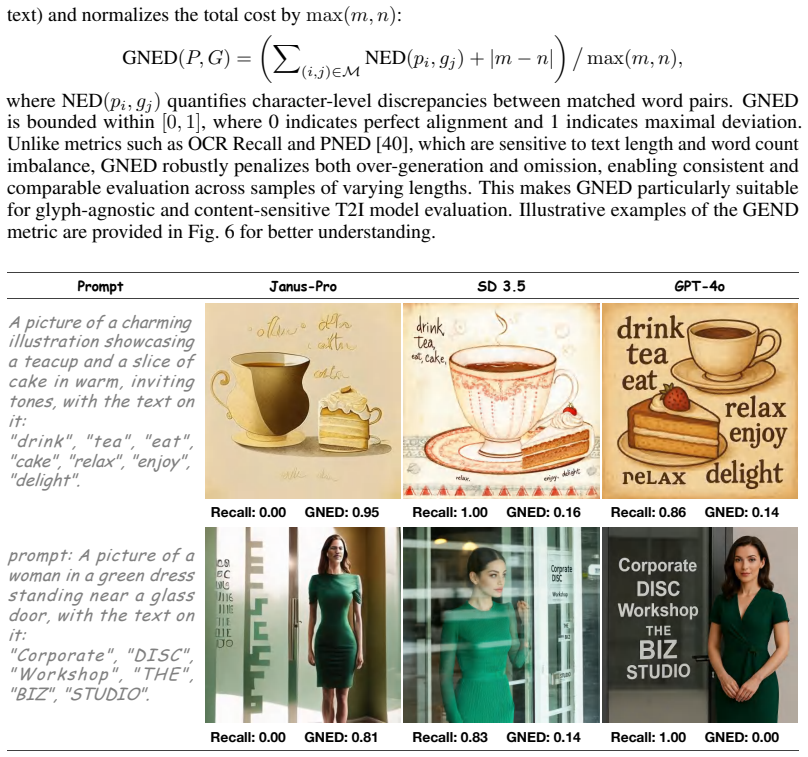
The load-bearing mechanism is the attribute-specific yes/no evaluation protocol. For each prompt, core concepts are extracted into concept pools, an LLM such as GPT-4o generates a yes/no question with a ground-truth answer for each concept, and the generated image is presented together with the question list to a VLM (GPT-4o or Qwen2.5-VL-72B); the model's score is the fraction of questions answered correctly, and the original prompt is never shown to the evaluator. The second mechanism is GNED (Global Normalized Edit Distance), computed as the minimal character-level normalized edit distance between target words and OCR-extracted words under optimal bipartite matching, normalized by the longer word list, with a penalty for unmatched words so that both omission and hallucinated text lower the score. Together the two mechanisms are what let the benchmark separate instruction comprehension from image quality and rank models in a way that tracks human preference.
What would settle it
Feed the evaluator a deliberately non-compliant image: generate or hand-pick an image that violates one or more of a prompt's yes/no questions, and count how often the VLM still answers 'yes'; if the evaluator cannot reliably reject clearly wrong images, the reported alignment with human preference cannot be trusted. Alternatively, re-run the user study with more than ten participants and far more than three prompts per dimension, and check whether the Spearman correlation with TIIF-Bench rankings stays near 1.00, since any large drop would falsify the benchmark's central claim. A third check is to regenerate all ground-truth answers with a different LLM than GPT-4o and observe whether the model rankings change materially.
Extended reading notes
Core claim
The central claim is that fine-grained instruction following in T2I generation is measurable by decomposition: every prompt's core concepts are turned into yes/no questions with known answers, and a VLM scores the generated image by the fraction of those questions it answers correctly. Because the scoring questions never include the original prompt, the design is meant to suppress the VLM hallucination that plagues caption-based judging, where the judge can answer from language rather than from the image. For text rendering, the paper introduces GNED, a metric bounded in $[0,1]$ that matches the prompt's target words to OCR-extracted words from the image via the Hungarian algorithm and penalizes both missing and extra words. On this protocol the paper reports near-perfect Spearman rank correlations with human ranking, finds that stronger instruction-followers are also more robust to prompt length, and observes that autoregressive models such as Janus-Pro match diffusion models in instruction following despite lower visual fidelity.
Load-bearing premise
The load-bearing assumption is that a self-consistent GPT-4o pipeline, which composes the prompts, writes the yes/no questions and expected answers, and then evaluates the images by answering those same questions, measures genuine instruction following; the 10-participant user study correlates the resulting rankings with human preference but does not independently verify the correctness of the question-answer ground truth.
Editorial extensions
If this is right
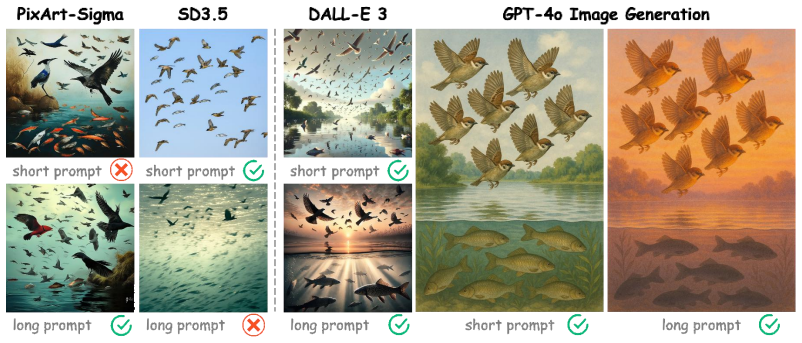
- Prompt length becomes a standard evaluation axis: short and long versions of the same instruction rank models differently, so models must be tested at both extremes.
- Spatial relations and logical reasoning, not simple attributes like color or texture, are the binding constraint for current T2I models, with GPT-4o the only model that holds up across these dimensions.
- Instruction-comprehension ability is positively correlated with generation quality, since top-ranked models are also the most robust to prompt-length variation.
- Autoregressive architectures, jointly trained on understanding and generation, reach instruction-following parity with diffusion models despite lower image fidelity, pointing to a promising direction for the next generation.
- The benchmark's own stated limits are that its prompts cover mainly common objects, are English-only, and ignore stylistic register, so its rankings say nothing about rare-object, multilingual, or register-sensitive instruction following.
Reading between the lines
- The benchmark's ground truth is generated and scored by the same model family: GPT-4o writes the prompts, writes the questions and expected answers, and judges the images, so TIIF-Bench may in part measure that model's own interpretation of 'following instructions'; sourcing expected answers from human annotation or from a different LLM would test whether the rankings hold.
- GNED is not specific to T2I evaluation: the same Hungarian-matched edit-distance scoring could apply wherever target text must appear in a generated artifact, such as logo design, document-image synthesis, or glyph rendering in video generation.
- If the reported correlation between instruction-following quality and prompt-length robustness is real, labs could screen models cheaply on long prompts alone, treating length robustness as a fast proxy for overall instruction comprehension.
- The headline rankings for closed-source models rest on a 10% testmini subset of the prompts, not the full 5,000, so small score gaps between commercial models should be read with that sample size in mind.
Editorial analysis
A structured set of objections, weighed in public.
Referee Report
Summary. The paper introduces TIIF-Bench, a text-to-image instruction-following benchmark containing 5,000 prompts organized into six compositional dimensions, with short and long variants of each prompt to test length robustness. Evaluation is performed by decomposing each prompt into attribute-specific yes/no questions generated by an LLM, then asking a VLM to answer those questions on the generated image; text rendering is scored with a proposed GNED edit-distance metric. The authors benchmark a wide set of open- and closed-source T2I models, compare TIIF-Bench rankings with CompBench++ and GenAI-Bench, and report a user study claiming high Spearman correlation between TIIF-Bench scores and human preferences across dimensions.
Significance. If the evaluation protocol is valid, TIIF-Bench would be a useful resource: the prompt set is substantially larger and more diverse than predecessor benchmarks, the short/long prompt design addresses a real evaluation gap, and the yes/no decomposition is a sensible way to obtain fine-grained signal from VLMs. The paper also ships unusually broad model coverage, a second VLM evaluator (Qwen2.5-VL-72B) as a stability check, and a concrete new metric for text rendering. The load-bearing weakness is that the questions, ground-truth answers, and the primary scorer all come from the same model family, so the benchmark measures GPT-4o's internal consistency more directly than it measures human-verifiable instruction following. The user study is too small and too coarse to validate per-prompt ground truth. These issues are fixable in a revision, and the benchmark infrastructure itself appears reusable.
major comments (3)
- [Section 3.2, Section 3.3, A1.1] There is a self-referential evaluation loop: GPT-4o composes the prompts (Section 3.2), expands them into long versions (A1.1), generates the yes/no questions and their ground-truth answers (Section 3.3), and then acts as the VLM evaluator that answers those questions. Any systematic bias in GPT-4o's question interpretation, such as a yes-bias or tolerance for a particular failure mode, is therefore shared by the answer set and the scorer. The Qwen2.5-VL-72B cross-check in Table 9 shows ranking stability across two judges, but both judges are scored against the same unvalidated answer set, so it does not break the loop. The central claim of the paper requires independent validation of the auto-generated ground-truth answers; without it, the scores may reflect GPT-4o's self-consistency rather than true instruction following.
- [Section 4.3, Table 7] The user study has 10 participants, samples only 3 prompts per dimension, and computes Spearman rho over 8 model-level ranks. With n=8, the reported rho values of 0.81-1.00 have very wide confidence intervals and are sensitive to a single swapped rank. More importantly, the study asks participants to rank whole images by quality, not to answer the per-attribute yes/no questions, so it cannot validate the correctness of the auto-generated ground-truth answers and cannot detect yes-bias or other evaluator errors. The paper should report confidence intervals or significance tests, increase the number of participants and prompts, and add per-question human labels on a sample of the benchmark.
- [Section 4.3, Table 7] The claim that TIIF-Bench results "exhibit a high degree of alignment with human preferences across all dimensions" is quantitatively underdetermined by the evidence presented. For dimensions such as Attribute-short (rho=0.81) and Style-short (rho=0.81), the correlation is not distinguishable from moderate or weak alignment given the tiny sample, and the user-study rankings are averaged over only three prompts. The authors should either provide a substantially larger human study or soften the headline claim to a preliminary indication of alignment.
minor comments (5)
- [Section 3.1, Figure 1] The text says "As shown in Fig. 1 (right)" for semantic redundancy, but the right panel of Figure 1 shows prompt length; the redundancy discussion refers to the left panel. Please correct the cross-reference.
- [Section 3.3, Figure 6] The figure caption refers to the "GEND metric" but the metric is named GNED elsewhere in the paper; please unify the spelling.
- [Table 7] The table header says "VLM Eval/PNED" even though the text states that GNED is used for text rendering. Please clarify the relationship between PNED and GNED in this table.
- [Section 4.1.5] "achieves" is misspelled as "achiees" in the discussion of Flux.1 Pro versus Flux.1 Dev.
- [Figure 8 caption] The caption says the evaluation set is from COMPBENCH++, but Section 4.3 describes the user study as measuring TIIF-Bench alignment. Please clarify which benchmark the illustrated set belongs to.
Circularity Check
GPT-4o writes the prompts, writes the yes/no questions, sets the ground-truth answers, and serves as the primary scorer, so TIIF-Bench scores primarily measure GPT-4o's self-consistency rather than an externally anchored instruction-following ground truth; the small user study does not break the loop.
-
self definitional
[Section 3.3 (Evaluation Method), Eq. (1); Appendix A3.1 (Tab. 9)]
"For each concept c_i, we employ an LLM (e.g., GPT-4o) to generate a corresponding yes/no question q_i, resulting in a set of evaluation questions Q={q_i} and the associated ground-truth answers A={â_i}. The generated image, along with the questions Q, is then input into a VLM (e.g., GPT-4o, Qwen2.5-VL-72B), which produces N predicted answers. The final evaluation score s for the generated image is computed as: s = 1/N Σ I[a_i = â_i]."
Here the same model (GPT-4o) creates the answer key â_i and, in the primary evaluation, supplies the predicted answers a_i. The benchmark score is therefore the agreement of GPT-4o-the-scorer with GPT-4o-the-question-writer; the 'ground-truth' label is not an independent specification of what the prompt requires. A T2I model is scored by whether GPT-4o's visual answer matches GPT-4o's textual expectation, so the measured quantity is GPT-4o's self-consistency about its own prompts. The Qwen2.5-VL-72B cross-check (Tab. 9) uses the same GPT-4o-authored answer key, so it only shows inter-VLM agreement against that key and cannot validate correctness.
full rationale
TIIF-Bench's prompt construction is not itself circular: the prompts, length variants, GNED metric, and comparisons against CompBench++/GenAI-Bench involve external benchmarks and are independently checkable. No load-bearing self-citation or imported uniqueness theorem appears; the authors' prior works are cited only as related model papers. The central circularity is in the evaluation protocol: GPT-4o generates the yes/no questions and the ground-truth answers (Sec. 3.3), and GPT-4o is the primary VLM that produces the predicted answers scored against that same key. Thus the reported per-model scores are agreement rates between two GPT-4o behaviors (question writer/answer setter and visual answerer), not between an externally specified correct answer and a model's output. The Qwen2.5-VL-72B cross-check (Appendix A3.1) uses the same GPT-4o-authored answer key and therefore only demonstrates inter-judge ranking consistency, not correctness of the key. The user study (Sec. 4.3) samples 3 prompts per dimension and 8 models per prompt; with n=8 ranks, Spearman ρ values from 0.81 to 1.00 have wide confidence intervals, and the study does not score per-question accuracy, so it cannot independently validate the generated ground truth. These facts make the headline claim of 'high degree of alignment with human preferences across all dimensions' underdetermined by the evidence and make the benchmark's core metric self-referential. The circularity is methodological and load-bearing: the benchmark's central scores reduce, by construction, to agreement with GPT-4o's own answer key.
Assumptions & free parameters
free parameters (1)
- semantic deduplication cosine threshold =
0.85
assumptions (3)
- domain assumption GPT-4o-generated yes/no questions and their ground-truth answers are correct and unbiased
- domain assumption VLM yes/no answers reliably reflect true image-instruction alignment
- domain assumption Human rankings in the user study reflect instruction-following ability
Cite this review
Pith. "Pith review of TIIF-Bench: How Does Your T2I Model Follow Your Instructions?." pith.science (2026). https://pith.science/paper/AHPI6N2T
@misc{pith2026250602161,
  author       = {Pith},
  title        = {Pith review of: TIIF-Bench: How Does Your T2I Model Follow Your Instructions?},
  year         = {2026},
  howpublished = {\url{https://pith.science/paper/AHPI6N2T}},
  note         = {Machine review of arXiv:2506.02161}
}
read the original abstract
The rapid advancements of Text-to-Image (T2I) models have ushered in a new phase of AI-generated content, marked by their growing ability to interpret and follow user instructions. However, existing T2I model evaluation benchmarks fall short in limited prompt diversity and complexity, as well as coarse evaluation metrics, making it difficult to evaluate the fine-grained alignment performance between textual instructions and generated images. In this paper, we present TIIF-Bench Text-to-Image Instruction Following Benchmark), aiming to systematically assess T2I models' ability in interpreting and following intricate textual instructions. TIIF-Bench comprises 5,000 prompts organized along multiple dimensions and categorized into three levels of difficulty and complexity. To rigorously evaluate robustness to prompt length, each prompt is provided in both short and long versions with identical core semantics. We further propose a novel Global Normalized Edit Distance (GNED) metric for text rendering and provide aspect-ratio-diverse reference images for each prompt to assess style control. In addition, we collect 100 high-quality designer-level prompts covering diverse scenarios for comprehensive evaluation. To enable scalable and fine-grained evaluation, we explore the best paradigm for leveraging the world knowledge encoded in large Vision-Language Models (VLMs) as automated binary evaluators. Through extensive ablations, we develop a fully reproducible evaluator that provides interpretable reasoning and reliable verification, enabling our benchmark to discern subtle variations in T2I model outputs. Through comprehensive benchmarking of mainstream T2I models on TIIF-Bench, we analyze the strengths and weaknesses of current T2I systems and reveal the limitations of existing evaluation benchmarks. Project Page: https://a113n-w3i.github.io/TIIF_Bench/.
Figures


Figures from the paper (9 more)




Forward citations
Cited by 4 Pith papers
-
DynEval: Holistic Evaluations of T2I Generative Models in the Wild
DynEval distills a 235B teacher VLM into 2B/4B evaluators via 250K synthetic instruction triplets, yielding higher human correlation than existing T2I metrics while enabling open-set dynamic QA and scene-graph quality checks.
-
Z-Image: An Efficient Image Generation Foundation Model with Single-Stream Diffusion Transformer
Z-Image is an efficient 6B-parameter foundation model for image generation that rivals larger commercial systems in photorealism and bilingual text rendering through a new single-stream diffusion transformer and strea...
-
Echo-4o: Harnessing the Power of GPT-4o Synthetic Images for Improved Image Generation
A curated GPT-4o synthetic image dataset improves open-source generation models on instruction-following, surreal scenes, and multi-reference synthesis, plus two new benchmarks to measure those skills.
-
Mage-Flow: An Efficient Native-Resolution Foundation Model for Image Generation and Editing
A compact 4B image generation/editing system with a fast one-step VAE, native-resolution packing, RL alignment, and 4-step distillation reports competitive benchmarks against 6B–80B open models.
Reference graph
Works this paper leans on
-
[1]
High-Resolution Image Synthesis With Latent Diffusion Models
Robin Rombach, Andreas Blattmann, Dominik Lorenz, Patrick Esser, and Björn Ommer. High-Resolution Image Synthesis With Latent Diffusion Models. InProceedings of the IEEE/CVF Conference on Computer Vision and Pattern Recognition, pages 10684–10695, 2022
work page 2022
-
[2]
Scaling Rectified Flow Transformers for High-Resolution Image Synthesis
Patrick Esser, Sumith Kulal, Andreas Blattmann, Rahim Entezari, Jonas Müller, Harry Saini, Yam Levi, Dominik Lorenz, Axel Sauer, Frederic Boesel, Dustin Podell, Tim Dockhorn, Zion English, and Robin Rombach. Scaling Rectified Flow Transformers for High-Resolution Image Synthesis. InForty-First International Conference on Machine Learning, June 2024
work page 2024
-
[3]
Junsong Chen, Chongjian Ge, Enze Xie, Yue Wu, Lewei Yao, Xiaozhe Ren, Zhongdao Wang, Ping Luo, Huchuan Lu, and Zhenguo Li. PixArt- Σ: Weak-to-Strong Training of Diffusion Transformer for 4K Text-to-Image Generation, March 2024
work page 2024
-
[4]
PIXART-δ: Fast and Controllable Image Generation with Latent Consistency Models, January 2024
Junsong Chen, Yue Wu, Simian Luo, Enze Xie, Sayak Paul, Ping Luo, Hang Zhao, and Zhenguo Li. PIXART-δ: Fast and Controllable Image Generation with Latent Consistency Models, January 2024
work page 2024
-
[5]
Junsong Chen, Jincheng Yu, Chongjian Ge, Lewei Yao, Enze Xie, Yue Wu, Zhongdao Wang, James Kwok, Ping Luo, Huchuan Lu, and Zhenguo Li. PixArt-$α$: Fast Training of Diffusion Transformer for Photorealistic Text-to-Image Synthesis, December 2023
work page 2023
-
[6]
Daiqing Li, Aleks Kamko, Ehsan Akhgari, Ali Sabet, Linmiao Xu, and Suhail Doshi. Playground v2.5: Three Insights towards Enhancing Aesthetic Quality in Text-to-Image Generation, February 2024
work page 2024
-
[7]
Bingchen Liu, Ehsan Akhgari, Alexander Visheratin, Aleks Kamko, Linmiao Xu, Shivam Shrirao, Chase Lambert, Joao Souza, Suhail Doshi, and Daiqing Li. Playground v3: Improving Text-to-Image Alignment with Deep-Fusion Large Language Models, October 2024
work page 2024
-
[8]
Flux.https://github.com/black-forest-labs/flux, 2024
Black Forest Labs. Flux.https://github.com/black-forest-labs/flux, 2024
2024
Show all 47 references
-
[9]
SANA-Sprint: One-Step Diffusion with Continuous-Time Consistency Distillation, March 2025
Junsong Chen, Shuchen Xue, Yuyang Zhao, Jincheng Yu, Sayak Paul, Junyu Chen, Han Cai, Enze Xie, and Song Han. SANA-Sprint: One-Step Diffusion with Continuous-Time Consistency Distillation, March 2025
2025
-
[10]
SANA 1.5: Efficient Scaling of Training-Time and Inference-Time Compute in Linear Diffusion Transformer, March 2025
Enze Xie, Junsong Chen, Yuyang Zhao, Jincheng Yu, Ligeng Zhu, Chengyue Wu, Yujun Lin, Zhekai Zhang, Muyang Li, Junyu Chen, Han Cai, Bingchen Liu, Daquan Zhou, and Song Han. SANA 1.5: Efficient Scaling of Training-Time and Inference-Time Compute in Linear Diffusion Transformer,...
2025
-
[11]
SANA: Efficient High-Resolution Image Synthesis with Linear Diffusion Transformers, October 2024
Enze Xie, Junsong Chen, Junyu Chen, Han Cai, Haotian Tang, Yujun Lin, Zhekai Zhang, Muyang Li, Ligeng Zhu, Yao Lu, and Song Han. SANA: Efficient High-Resolution Image Synthesis with Linear Diffusion Transformers, October 2024
2024
-
[12]
Improving Image Generation with Better Captions
James Betker, Gabriel Goh, Li Jing, Tim Brooks, Jianfeng Wang, Linjie Li, Long Ouyang, Juntang Zhuang, Joyce Lee, Yufei Guo, Wesam Manassra, Prafulla Dhariwal, Casey Chu, Yunxin Jiao, and Aditya Ramesh. Improving Image Generation with Better Captions
-
[13]
Imagen 3, December 2024
Imagen-Team-Google, Jason Baldridge, Jakob Bauer, Mukul Bhutani, and Others. Imagen 3, December 2024. 15
2024
-
[14]
Lumina-Next: Making Lumina-T2X Stronger and Faster with Next-DiT, June 2024
Le Zhuo, Ruoyi Du, Han Xiao, Yangguang Li, Dongyang Liu, Rongjie Huang, Wenze Liu, Lirui Zhao, Fu-Yun Wang, Zhanyu Ma, Xu Luo, Zehan Wang, Kaipeng Zhang, Xiangyang Zhu, Si Liu, Xiangyu Yue, Dingning Liu, Wanli Ouyang, Ziwei Liu, Yu Qiao, Hongsheng Li, and Peng Gao. Lumina-Next...
2024
-
[15]
Hunyuan-DiT: A Powerful Multi-Resolution Diffusion Transformer with Fine-Grained Chinese Understanding, May 2024
Zhimin Li, Jianwei Zhang, Qin Lin, Jiangfeng Xiong, Yanxin Long, Xinchi Deng, Yingfang Zhang, Xingchao Liu, Minbin Huang, Zedong Xiao, Dayou Chen, Jiajun He, Jiahao Li, Wenyue Li, Chen Zhang, Rongwei Quan, Jianxiang Lu, Jiabin Huang, Xiaoyan Yuan, Xiaoxiao Zheng, Yixuan Li, Ji...
2024
-
[16]
Autore- gressive Model Beats Diffusion: Llama for Scalable Image Generation, June 2024
Peize Sun, Yi Jiang, Shoufa Chen, Shilong Zhang, Bingyue Peng, Ping Luo, and Zehuan Yuan. Autore- gressive Model Beats Diffusion: Llama for Scalable Image Generation, June 2024
2024
-
[17]
Janus-Pro: Unified Multimodal Understanding and Generation with Data and Model Scaling
Xiaokang Chen, Zhiyu Wu, Xingchao Liu, Zizheng Pan, Wen Liu, Zhenda Xie, Xingkai Yu, and Chong Ruan. Janus-Pro: Unified Multimodal Understanding and Generation with Data and Model Scaling
-
[18]
Janus: Decoupling Visual Encoding for Unified Multimodal Understanding and Generation, October 2024
Chengyue Wu, Xiaokang Chen, Zhiyu Wu, Yiyang Ma, Xingchao Liu, Zizheng Pan, Wen Liu, Zhenda Xie, Xingkai Yu, Chong Ruan, and Ping Luo. Janus: Decoupling Visual Encoding for Unified Multimodal Understanding and Generation, October 2024
2024
-
[19]
Infinity: Scaling bitwise autoregressive modeling for high-resolution image synthesis, 2024
Jian Han, Jinlai Liu, Yi Jiang, Bin Yan, Yuqi Zhang, Zehuan Yuan, Bingyue Peng, and Xiaobing Liu. Infinity: Scaling bitwise autoregressive modeling for high-resolution image synthesis, 2024
2024
-
[20]
Visual autoregressive modeling: Scalable image generation via next-scale prediction, 2024
Keyu Tian, Yi Jiang, Zehuan Yuan, Bingyue Peng, and Liwei Wang. Visual autoregressive modeling: Scalable image generation via next-scale prediction, 2024
2024
-
[21]
Lumina-mgpt: Illuminate flexible photorealistic text-to-image generation with multimodal generative pretraining, 2025
Dongyang Liu, Shitian Zhao, Le Zhuo, Weifeng Lin, Yi Xin, Xinyue Li, Qi Qin, Yu Qiao, Hongsheng Li, and Peng Gao. Lumina-mgpt: Illuminate flexible photorealistic text-to-image generation with multimodal generative pretraining, 2025
2025
-
[22]
T2i-r1: Reinforcing image generation with collaborative semantic-level and token-level cot.arXiv preprint arXiv:2505.00703, 2025
Dongzhi Jiang, Ziyu Guo, Renrui Zhang, Zhuofan Zong, Hao Li, Le Zhuo, Shilin Yan, Pheng-Ann Heng, and Hongsheng Li. T2i-r1: Reinforcing image generation with collaborative semantic-level and token-level cot.arXiv preprint arXiv:2505.00703, 2025
2025 arXiv
-
[23]
Can we generate images with cot? let’s verify and reinforce image generation step by step.arXiv preprint arXiv:2501.13926, 2025
Ziyu Guo, Renrui Zhang, Chengzhuo Tong, Zhizheng Zhao, Peng Gao, Hongsheng Li, and Pheng-Ann Heng. Can we generate images with cot? let’s verify and reinforce image generation step by step.arXiv preprint arXiv:2501.13926, 2025
2025 arXiv
-
[24]
Delving into rl for image generation with cot: A study on dpo vs
Chengzhuo Tong, Ziyu Guo, Renrui Zhang, Wenyu Shan, Xinyu Wei, Zhenghao Xing, Hongsheng Li, and Pheng-Ann Heng. Delving into rl for image generation with cot: A study on dpo vs. grpo, 2025
2025
-
[25]
Mavis: Mathematical visual instruction tuning with an automatic data engine, 2024
Renrui Zhang, Xinyu Wei, Dongzhi Jiang, Ziyu Guo, Shicheng Li, Yichi Zhang, Chengzhuo Tong, Jiaming Liu, Aojun Zhou, Bin Wei, Shanghang Zhang, Peng Gao, Chunyuan Li, and Hongsheng Li. Mavis: Mathematical visual instruction tuning with an automatic data engine, 2024
2024
-
[26]
Gpt-4o system card.arXiv preprint arXiv:2410.21276, 2024
Aaron Hurst, Adam Lerer, Adam P Goucher, Adam Perelman, Aditya Ramesh, Aidan Clark, AJ Ostrow, Akila Welihinda, Alan Hayes, Alec Radford, et al. Gpt-4o system card.arXiv preprint arXiv:2410.21276, 2024
2024 arXiv
-
[27]
Imagen 3.arXiv preprint arXiv:2408.07009, 2024
Jason Baldridge, Jakob Bauer, Mukul Bhutani, Nicole Brichtova, Andrew Bunner, Lluis Castrejon, Kelvin Chan, Yichang Chen, Sander Dieleman, Yuqing Du, et al. Imagen 3.arXiv preprint arXiv:2408.07009, 2024
2024
-
[28]
Midjourney.https://www.midjourney.com/, 2025
Midjourney Team. Midjourney.https://www.midjourney.com/, 2025
2025
-
[29]
Evaluating text-to-visual generation with image-to-text generation, 2024
Zhiqiu Lin, Deepak Pathak, Baiqi Li, Jiayao Li, Xide Xia, Graham Neubig, Pengchuan Zhang, and Deva Ramanan. Evaluating text-to-visual generation with image-to-text generation, 2024
2024
-
[30]
Human preference score v2: A solid benchmark for evaluating human preferences of text-to-image synthesis, 2023
Xiaoshi Wu, Yiming Hao, Keqiang Sun, Yixiong Chen, Feng Zhu, Rui Zhao, and Hongsheng Li. Human preference score v2: A solid benchmark for evaluating human preferences of text-to-image synthesis, 2023
2023
-
[31]
Visionreward: Fine-grained multi-dimensional human preference learning for image and video generation, 2025
Jiazheng Xu, Yu Huang, Jiale Cheng, Yuanming Yang, Jiajun Xu, Yuan Wang, Wenbo Duan, Shen Yang, Qunlin Jin, Shurun Li, Jiayan Teng, Zhuoyi Yang, Wendi Zheng, Xiao Liu, Ming Ding, Xiaohan Zhang, Xiaotao Gu, Shiyu Huang, Minlie Huang, Jie Tang, and Yuxiao Dong. Visionreward: Fin...
2025
-
[32]
T2i-compbench++: An enhanced and comprehensive benchmark for compositional text-to-image generation, 2025
Kaiyi Huang, Chengqi Duan, Kaiyue Sun, Enze Xie, Zhenguo Li, and Xihui Liu. T2i-compbench++: An enhanced and comprehensive benchmark for compositional text-to-image generation, 2025
2025
-
[33]
Geneval: An object-focused framework for evaluating text-to-image alignment, 2023
Dhruba Ghosh, Hanna Hajishirzi, and Ludwig Schmidt. Geneval: An object-focused framework for evaluating text-to-image alignment, 2023
2023
-
[34]
Genai-bench: Evaluating and improving compositional text-to-visual generation, 2024
Baiqi Li, Zhiqiu Lin, Deepak Pathak, Jiayao Li, Yixin Fei, Kewen Wu, Tiffany Ling, Xide Xia, Pengchuan Zhang, Graham Neubig, and Deva Ramanan. Genai-bench: Evaluating and improving compositional text-to-visual generation, 2024. 16
2024
-
[35]
Improving image generation with better captions.Computer Science
James Betker, Gabriel Goh, Li Jing, Tim Brooks, Jianfeng Wang, Linjie Li, Long Ouyang, Juntang Zhuang, Joyce Lee, Yufei Guo, et al. Improving image generation with better captions.Computer Science. https://cdn. openai. com/papers/dall-e-3. pdf, 2(3):8, 2023
2023
-
[36]
LightGen: Efficient Image Generation through Knowledge Distillation and Direct Preference Optimization, March 2025
Xianfeng Wu, Yajing Bai, Haoze Zheng, Harold Haodong Chen, Yexin Liu, Zihao Wang, Xuran Ma, Wen-Jie Shu, Xianzu Wu, Harry Yang, and Ser-Nam Lim. LightGen: Efficient Image Generation through Knowledge Distillation and Direct Preference Optimization, March 2025
2025
-
[37]
Fluid: Scaling Autoregressive Text-to-image Generative Models with Continuous Tokens, October 2024
Lijie Fan, Tianhong Li, Siyang Qin, Yuanzhen Li, Chen Sun, Michael Rubinstein, Deqing Sun, Kaiming He, and Yonglong Tian. Fluid: Scaling Autoregressive Text-to-image Generative Models with Continuous Tokens, October 2024
2024
-
[38]
CLIPScore: A Reference-free Evaluation Metric for Image Captioning, March 2022
Jack Hessel, Ari Holtzman, Maxwell Forbes, Ronan Le Bras, and Yejin Choi. CLIPScore: A Reference-free Evaluation Metric for Image Captioning, March 2022
2022
-
[39]
Imagine-e: Image generation intelligence evaluation of state-of-the-art text-to-image models, 2025
Jiayi Lei, Renrui Zhang, Xiangfei Hu, Weifeng Lin, Zhen Li, Wenjian Sun, Ruoyi Du, Le Zhuo, Zhongyu Li, Xinyue Li, Shitian Zhao, Ziyu Guo, Yiting Lu, Peng Gao, and Hongsheng Li. Imagine-e: Image generation intelligence evaluation of state-of-the-art text-to-image models, 2025
2025
-
[40]
Lex-art: Rethinking text generation via scalable high-quality data synthesis, 2025
Shitian Zhao, Qilong Wu, Xinyue Li, Bo Zhang, Ming Li, Qi Qin, Dongyang Liu, Kaipeng Zhang, Hongsheng Li, Yu Qiao, Peng Gao, Bin Fu, and Zhen Li. Lex-art: Rethinking text generation via scalable high-quality data synthesis, 2025
2025
-
[41]
Show-o: One Single Transformer to Unify Multimodal Understanding and Generation, October 2024
Jinheng Xie, Weijia Mao, Zechen Bai, David Junhao Zhang, Weihao Wang, Kevin Qinghong Lin, Yuchao Gu, Zhijie Chen, Zhenheng Yang, and Mike Zheng Shou. Show-o: One Single Transformer to Unify Multimodal Understanding and Generation, October 2024. 17 Appendix A1 Meta Prompts A1.1...
2024
-
[42]
yes" or
Answer each question on a separate line, starting with "yes" or "no", followed by a brief reason
-
[43]
Maintain the exact order of the questions in your answers
-
[44]
Provide only one answer per question
-
[45]
Return only the answers—no additional commentary
-
[46]
Each answer must be on its own line
-
[47]
drink",
Ensure the number of answers matches the number of questions. A2 Additional Visualizations A2.1 Failure Cases of Strong Closed-source Models in the Relation Dimension Through extensive experiments on TIIF BENCH, we observe that most models exhibit strong instruction-following ...
1940
Reviewed August 7, 2026 · model on record in the stance chip above.
Discussion (0). Sign in to comment.