REVIEW 5 major objections 5 minor 1 cited by
In-context Clustering-based Entity Resolution with Large Language Models: A Design Space Exploration
T0 review · 5 major / 5 minor · reviewed 2026-08-07 · deepseek-v4-flash
Pith's one-line read This paper claims that entity resolution can be done by asking an LLM to cluster whole record sets in one prompt, beating pairwise comparison on accuracy while using up to 5x fewer API calls.
desk verdict The API-cost reduction is real, but the quality gains are carried by the embedding guardrail, not the LLM clustering alone; the abstract's cost-parity claim also doesn't match Table 4. read the letter →
The pith
A machine-rendered reading of the paper's core claim, the machinery that carries it, and where it could break.
The reading
What carries the argument
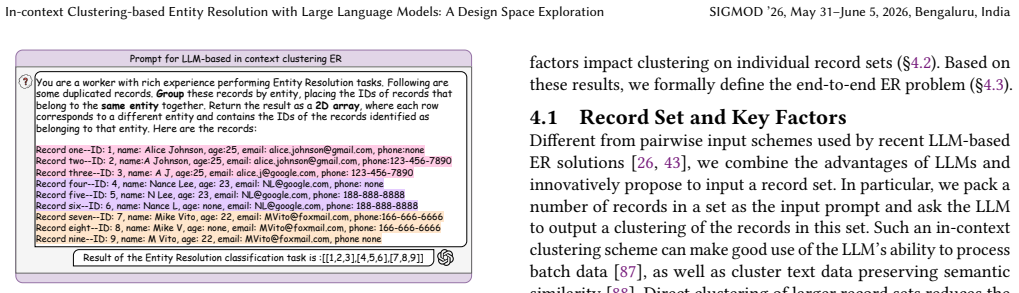
The load-bearing object is the in-context clustering prompt: up to nine records packed into one message with the instruction to return cluster IDs as a 2D array, so a single API call resolves every pairwise relationship in the set. Around it the paper builds three algorithms. Next Record Set Creation (NRS) picks which records to pack together, using k-means with the elbow method to estimate diversity and filling each set to meet the size-nine, four-entity, minimal-variation constraints. The Misclustering Detection Guardrail (MDG) checks the LLM's output against a similarity oracle: if a record's minimum similarity to its own cluster falls below its maximum similarity to any other cluster, the record is flagged as misclustered and the set is regenerated with similar records placed adjacently. Cluster Merge (CMR) treats each LLM-produced cluster as a new record and packs the most similar clusters from different sets into the next round, using a greedy heuristic because optimal merging is NP-hard by way of 3-dimensional matching.
What would settle it
Run LLM-CER on a dataset whose duplicates are lexically dissimilar but semantically identical, such as product records like 'aperture-priority camera body' and 'AV-mode camera' that refer to the same item, and compare accuracy with the MDG guardrail enabled versus disabled. Because the guardrail uses a sentence-embedding similarity oracle, records that the LLM clusters correctly but that share few tokens would be flagged as misclustered; if accuracy then falls below the no-MDG run, the reported gains come from the embedding oracle rather than from in-context clustering itself.
Extended reading notes
Core claim
On the paper's own terms, the discovery is that a pretrained LLM asked to partition a set of records directly, returning a 2D array of record IDs grouped by entity, produces entity-resolution decisions that are as accurate as or more accurate than combining many pairwise match decisions, while consuming far fewer API calls because one call settles all pairwise relationships among up to nine records. The authors characterize the conditions under which this holds: roughly nine records per set, four distinct entities per set, near-balanced cluster sizes with a coefficient of variation close to zero, and consecutive placement of records from the same entity. They then show that an end-to-end resolution system built on these findings, with a misclustering guardrail and hierarchical cluster merging, generalizes the state of the art, because a pairwise questioning scheme is exactly the special case of in-context clustering with set size two.
Load-bearing premise
The load-bearing premise is that a fixed sentence-embedding model reliably judges whether a record belongs with its assigned cluster; the guardrail's verdicts, not the LLM's clustering alone, drive most of the reported accuracy gains.
Editorial extensions
If this is right
- Pairwise questioning stops being the default atomic operation of LLM-based entity resolution: set-level clustering is cheaper per unit of information, and pairwise matching becomes simply the size-two special case of the same paradigm.
- API-call counts drop by 12-108x versus plain pairwise matching and by up to 5x versus a cost-optimized batched baseline, with equal or better clustering quality on the nine datasets.
- The guardrail, not the LLM alone, carries much of the accuracy: adding MDG raises the FP-measure by up to 75 percent at roughly 10 percent time overhead, making hallucination checking a necessary pipeline stage rather than an optional extra.
- The method scales: runtime grows near-linearly from 10K to 50K records, while a batched pairwise baseline fails to finish on 50K records within a 24-hour limit.
Reading between the lines
- My read: the optimal size-nine, four-entity configuration is likely a property of LLM context processing in general rather than of entity resolution, so the same recipe should transfer to other in-prompt grouping tasks such as survey coding or log clustering.
- The fragile joint is MDG's oracle: it is a fixed sentence-embedding model, and on data where duplicates are semantically identical but lexically unrelated, the guardrail could reject correct LLM clusters; swapping the embedding check for a second, cheaper LLM verification is a natural experiment.
- The cost accounting also understates the efficiency case in one direction: because pricing tracks tokens rather than calls, batching several record sets into one message, which the appendix shows cuts runtime 3-4x, extends the same argument to the next level of the hierarchy.
- A testable extension the paper leaves implicit: feeding the LLM's own cluster boundaries back into the embedding check, rather than raw records, could let MDG catch intra-cluster contaminations that the current per-record test misses.
Editorial analysis
A structured set of objections, weighed in public.
Referee Report
Summary. The paper proposes in-context clustering for LLM-based entity resolution: instead of pairwise record comparisons, it packs records into sets and asks an LLM to cluster each set directly. The authors explore a design space of set size, set diversity, set variation, and record ordering, and from this derive LLM-CER, an end-to-end pipeline combining a Next Record Set Creation algorithm, an embedding-based Misclustering Detection Guardrail (MDG), and a hierarchical Cluster Merge algorithm. Experiments on nine real-world datasets report improvements in ACC and FP-measure, reductions in API calls and tokens, and comparisons against pairwise and LLM-based baselines. The central claims are that in-context clustering is more API-efficient than pairwise questioning and that LLM-CER improves end-to-end ER quality while keeping monetary cost competitive.
Significance. If the empirical claims hold, the paper makes a useful contribution: it generalizes pairwise LLM-based ER to direct set-level clustering, provides a systematic design-space analysis with concrete parameter recommendations, and introduces a guardrail that improves clustering quality at small overhead. The paper also reports detailed operational metrics (API calls, tokens, cost, time) and includes a scalability study. However, the headline quality gains are largely attributable to the embedding-based MDG guardrail rather than to the LLM's in-context clustering per se, and the abstract's cost-comparability claim conflicts with the paper's own Table 4. Both issues need to be resolved before the significance of the contribution can be fully assessed.
major comments (5)
- [§5.2, Table 8] The central quality claim is not yet supported because the MDG guardrail, not in-context LLM clustering, drives the reported gains. In Table 8, removing MDG drops Cora ACC from 0.90 to 0.60, Alaska from 0.82 to 0.35, and AS from 0.70 to 0.52; the guardrail flags records using all-MiniLM-L6-v2 cosine similarity (Algorithm 2). Since the same embedding similarity is used in LSH blocking, an embedding-only clustering baseline (e.g., agglomerative clustering or thresholded connected components on the same block similarity graph, without any LLM call) must be reported for the same datasets. If that baseline matches LLM-CER, the paper's claim that in-context LLM clustering improves ER quality would collapse; if it does not, the numbers would clarify the contribution.
- [Abstract, §1, Table 4] The abstract's claim of 'comparable monetary cost to the most cost-effective baseline' is contradicted by Table 4. In every dataset, Booster's Cost is substantially lower than LLM-CER's: Alaska $0.02 vs $0.15, AS $0.01 vs $0.02, Song $0.02 vs $0.06, Music $0.02 vs $0.19, DG $0.02 vs $0.07, Cora $0.01 vs $0.03, Citeseer $0.01 vs $0.03, AG $0.01 vs $0.02, and Walmart-Amazon $0.01 vs $0.02. LLM-CER is 2–10 times more expensive than Booster, so the wording should be revised (e.g., 'within $0.20 of the cheapest baseline' or compare against BQ and CrowdER+LLM), and the paper should explain why the cost premium is acceptable given the quality gain.
- [§5.1] The unsupervised parameter-selection procedure is circular. Blocking thresholds b_t, b_s, and m_s are set by maximizing F1 on a validation set, and 'when ground truth is unavailable, we exploit LLM-based clustering results over a certain number of record subsets as ground truth.' Because the LLM-based clustering is the method being evaluated, pseudo-labels derived from it can bias threshold selection in its favor. Please either use an independent validation signal, report results with thresholds set without the LLM, or quantify how sensitive the end-to-end accuracy is to threshold choices.
- [§5.3, Algorithm 3] Cluster Merge relies on anti-transitivity within a record set: clusters from the same original record set are never packed together, because they are assumed to represent different entities. However, the LLM can split one true entity into two clusters in a record set, and the MDG criterion in Algorithm 2 only detects records whose inter-cluster similarity exceeds intra-cluster similarity; an internally coherent fragment of a split entity will pass the guardrail. Once two such fragments are separated, Algorithm 3 can never merge them, making split errors unrecoverable. The paper should report the split-error rate and either add a mechanism to re-examine clusters from the same record set or justify why splits are negligible after MDG.
- [§6.1, Tables 2–4] The paper states 'All experiments are repeated three times... we report the average values over three runs,' but Tables 2–4 report only point estimates. Given API nondeterminism and several close comparisons (e.g., AS FP-measure 0.63 vs Booster 0.62), standard deviations or confidence intervals are necessary to support the claim that LLM-CER 'consistently outperforms' baselines. Please add variance measures to every headline table.
minor comments (5)
- [§5.1 remark] The remark cites §6.4 for the blocking comparison, but the blocking ablation appears in Appendix A.3 (Table 14); the cross-reference should be corrected.
- [§5.2, Algorithm 2] Algorithm 4 invokes 'record sets regeneration' on line 5, but Algorithm 2 returns only a boolean and does not specify how the relocated record set is constructed; add pseudocode or a precise pointer to the textual description.
- [Throughout] The paper alternates between 'FP-measure' and 'FP' labels; standardize the notation consistently across the text, tables, and figures.
- [Figures 4, 5, 8] Several figure axis labels appear as unreadable glyph sequences (e.g., '/uni00000017/...' in the extracted text); please ensure the final PDF embeds all fonts and renders labels correctly.
- [§7 vs Appendix A.10] The conclusion lists batch clustering as future work, but Appendix A.10 already integrates batching into the framework and reports end-to-end results; reconcile the conclusion with the presented experiments.
Circularity Check
No significant circularity in the benchmark comparisons; one self-referential blocking-threshold fallback weakens the unsupervised claim.
-
self definitional
[Section 5.1 (Filtering and Blocking), threshold-setting paragraph; repeated for Canopy blocking thresholds]
"The similarity threshold b_t is set empirically by maximizing the F1-score of clustering on a validation dataset [28], iterating thresholds from 0.05 to 0.95 in 0.05 increments. When ground truth is unavailable, we exploit LLM-based clustering results over a certain number of record subsets as ground truth."
In the no-labels mode that supports the paper's claim of operating entirely without supervision, the blocking threshold b_t is fitted to maximize agreement with LLM-based clustering on record subsets—the same LLM that LLM-CER later uses for in-context clustering. The threshold determines which records are placed in the same block, so any duplicate pair whose similarity falls below the LLM-fitted threshold is never presented to the LLM again. The candidate set for the final ER output is therefore constructed from the LLM's own prior clustering judgments, making the output partly a restatement of the pseudo-labels rather than an independent discovery. This is a genuine self-referential loop in the unsupervised deployment setting.
full rationale
The paper's core contribution is empirical rather than derivational. The main claimed advantages—that in-context clustering reduces API calls and the Misclustering Detection Guardrail improves accuracy—are supported by ablations and comparisons against external baselines using real ground truth. The record-set design parameters (S_s=9, S_d=4, S_v about 0, sequential ordering) are selected by measuring LLM clustering accuracy against ground-truth labels in Section 4.2 and then reused in end-to-end evaluation; that is fitting-to-data on the same benchmark sets, a correctness risk, not a circular derivation. The MDG guardrail and Cluster Merge algorithm rely on an external embedding model (all-MiniLM-L6-v2) and are evaluated by their measured effect on ACC and FP-measure; this may shift credit from the LLM to embedding similarity, but it does not make the final result equal to its input by construction. There are no load-bearing self-citations: the related-work references are external, and no 'uniqueness' or correctness claim is imported from the authors' own prior theorems. The only circular-sounding passage is the Section 5.1 fallback that uses LLM clustering as pseudo-ground-truth for blocking thresholds when labels are absent; this creates a self-referential loop in the unsupervised setting, but the benchmark results use labeled validation data and are not produced by that loop. Overall circularity is minor.
Assumptions & free parameters
free parameters (5)
- Set size S_s =
9 (optimal; 6 or 7 for some datasets and LLMs)
- Set diversity S_d =
4 (optimal; 3 for some datasets and LLMs)
- Set variation target S_v =
about 0 (balanced sets)
- Blocking similarity threshold b_t =
not reported numerically
- Canopy blocking thresholds b_s and m_s =
not reported numerically
assumptions (5)
- domain assumption In-context LLM clustering outputs respect transitivity and anti-transitivity, so clusters within a set are distinct entities and records within a cluster are identical.
- domain assumption Cosine similarity between all-MiniLM-L6-v2 embeddings is a valid proxy for record equivalence in the MDG guardrail.
- ad hoc to paper Design-space-optimal parameters (S_s=9, S_d=4, S_v near 0, sequential order) transfer from Music 20K, Cora, and Alaska to all nine evaluation datasets and to the MDG-augmented pipeline.
- ad hoc to paper When ground truth is unavailable, LLM-clustering-derived labels are valid ground truth for setting blocking thresholds.
- domain assumption A cluster can be represented by one of its records or by an average embedding without loss of information for subsequent merging.
Cite this review
Pith. "Pith review of In-context Clustering-based Entity Resolution with Large Language Models: A Design Space Exploration." pith.science (2026). https://pith.science/paper/I6EXTQOL
@misc{pith2026250602509,
  author       = {Pith},
  title        = {Pith review of: In-context Clustering-based Entity Resolution with Large Language Models: A Design Space Exploration},
  year         = {2026},
  howpublished = {\url{https://pith.science/paper/I6EXTQOL}},
  note         = {Machine review of arXiv:2506.02509}
}
read the original abstract
Entity Resolution (ER) is a fundamental data quality improvement task that identifies and links records referring to the same real-world entity. Traditional ER approaches often rely on pairwise comparisons, which can be costly in terms of time and monetary resources, especially with large datasets. Recently, Large Language Models (LLMs) have shown promising results in ER tasks. However, existing methods typically focus on pairwise matching, missing the potential of LLMs to perform clustering directly in a more cost-effective and scalable manner. In this paper, we propose a novel in-context clustering approach for ER, where LLMs are used to cluster records directly, reducing both time complexity and monetary costs. We systematically investigate the design space for in-context clustering, analyzing the impact of factors such as set size, diversity, variation, and ordering of records on clustering performance. Based on these insights, we develop LLM-CER (LLM-powered Clustering-based ER), which achieves high-quality ER results while minimizing LLM API calls. Our approach addresses key challenges, including efficient cluster merging and LLM hallucination, providing a scalable and effective solution for ER. Extensive experiments on nine real-world datasets demonstrate that our method significantly improves result quality, achieving up to 150% higher accuracy, 10% increase in the F-measure, and reducing API calls by up to 5 times, while maintaining comparable monetary cost to the most cost-effective baseline.
Figures


Figures from the paper (10 more)


Forward citations
Cited by 1 Pith paper
-
Human Preference aligned Tabular Similarity
Downstream prediction metrics do not certify human-aligned tabular similarity rankings; a pairwise preference workflow and pilot show user-specific embedding quality gaps.
Reference graph
Works this paper leans on
-
[1]
API Pricing of Open-AI
2024. API Pricing of Open-AI. Retrieved December 16, 2024 from https: //openai.com/api/pricing/
2024
-
[2]
Faraz Ahmed and Muhammad Abulaish. 2012. An MCL-based approach for spam profile detection in online social networks. In 2012 IEEE 11th International Conference on Trust, Security and Privacy in Computing and Communications . 602–608
2012
-
[3]
Sihem Amer-Yahia, Angela Bonifati, Lei Chen, Guoliang Li, Kyuseok Shim, Jian- liang Xu, and Xiaochun Yang. 2023. From large language models to databases and back: A discussion on research and education. SIGMOD Rec. 52, 3 (2023), 49–56
2023
-
[4]
Omar Benjelloun, Hector Garcia-Molina, David Menestrina, Qi Su, Steven Eui- jong Whang, and Jennifer Widom. 2009. Swoosh: A generic approach to entity resolution. VLDB Journal 18, 1 (2009), 255–276
2009
-
[5]
Mikhail Bilenko and Raymond J. Mooney. 2003. Adaptive duplicate detection using learnable string similarity measures. In Proceedings of the Ninth ACM SIGKDD International Conference on Knowledge Discovery and Data Mining . 39– 48
2003
-
[6]
Christian Böhm and Hans-Peter Kriegel. 2001. A cost model and index archi- tecture for the similarity join. In Proceedings 17th International Conference on Data Engineering, Dimitrios Georgakopoulos and Alexander Buchmann (Eds.). 411–420
2001
-
[7]
A. Broder. 1997. On the resemblance and containment of documents. In Com- pression and Complexity of (SEQUENCES) . 21–29
1997
-
[8]
Tom B. Brown, Benjamin Mann, Nick Ryder, Melanie Subbiah, Jared Kaplan, Prafulla Dhariwal, Arvind Neelakantan, Pranav Shyam, Girish Sastry, Amanda Askell, Sandhini Agarwal, Ariel Herbert-Voss, Gretchen Krueger, Tom Henighan, Rewon Child, Aditya Ramesh, Daniel M. Ziegler, Jeffrey Wu, Clemens Winter, Christopher Hesse, Mark Chen, Eric Sigler, Mateusz Litwin...
2020
Show all 97 references
-
[9]
Chengliang Chai, Guoliang Li, Jian Li, Dong Deng, and Jianhua Feng. 2016. Cost-Effective Crowdsourced Entity Resolution: A Partial-Order Approach. In Proceedings of the 2016 International Conference on Management of Data . 969–984
2016
-
[10]
Zhaoqi Chen, Dmitri V Kalashnikov, and Sharad Mehrotra. 2005. Exploiting relationships for object consolidation. In Proceedings of the 2nd international workshop on Information quality in information systems . 47–58
2005
-
[11]
Zhaoqi Chen, Dmitri V Kalashnikov, and Sharad Mehrotra. 2007. Adaptive graphical approach to entity resolution. In ACM/IEEE-CS Joint Conference on Digital Libraries (JCDL) . 204–213
2007
-
[12]
Zhikai Chen, Haitao Mao, Hongzhi Wen, Haoyu Han, Wei Jin, Haiyang Zhang, Hui Liu, and Jiliang Tang. [n.d.]. Label-free node classification on graphs with large language models (llms). In The Twelfth International Conference on Learning Representations year=2024
2024
-
[13]
Peter Christen. 2012. A survey of indexing techniques for scalable record linkage and deduplication. IEEE Transactions on Knowledge and Data Engineering 24, 9 (2012), 1537–1555
2012
-
[14]
Vassilis Christophides, Vasilis Efthymiou, Themis Palpanas, George Papadakis, and Kostas Stefanidis. 2020. An overview of end-to-end entity resolution for big data. ACM Comput. Surv. 53, 6 (2020), 1–42
2020
-
[15]
Vassilis Christophides, Vasilis Efthymiou, Themis Palpanas, George Papadakis, and Kostas Stefanidis. 2021. An overview of end-to-end entity resolution for big data. ACM Comput. Surv. 53, 6 (2021), 127:1–127:42
2021
-
[16]
Pierluigi Crescenzi, Viggo Kann, Magnus Halldorsson, Marek Karpinski, and Gerhard Woeginger. 2000. Maximum 3-dimensional matching. A Compendium of NP Optimization Problems (2000)
2000
-
[17]
Valter Crescenzi, Andrea De Angelis, Donatella Firmani, Maurizio Mazzei, Paolo Merialdo, Federico Piai, and Divesh Srivastava. 2021. Alaska: A flexible benchmark for data integration tasks. arXiv Preprint arXiv:2101.11259 (2021)
2021 arXiv
-
[18]
Mengyao Cui. 2020. Introduction to the k-means clustering algorithm based on the elbow method. Accounting, Auditing and Finance 1, 1 (2020), 5–8
2020
-
[19]
C., AnHai Doan, Jeffrey F
Sanjib Das, Paul Suganthan G. C., AnHai Doan, Jeffrey F. Naughton, Ganesh Kr- ishnan, Rohit Deep, Esteban Arcaute, Vijay Raghavendra, and Youngchoon Park
-
[20]
Database Research Group of the Roma Tre University. 2020. SIGMOD 2020 programming contest official website. Retrieved September 22, 2024 from http://www.inf.uniroma3.it/db/sigmod2020contest
2020
-
[21]
Gianluca Demartini, Djellel Eddine Difallah, and Philippe Cudré-Mauroux. 2012. ZenCrowd: Leveraging probabilistic reasoning and crowdsourcing techniques for large-scale entity linking. In Proceedings of the 21st International Conference on World Wide Web. 469–478
2012
-
[22]
Jacob Devlin, Ming-Wei Chang, Kenton Lee, and Kristina Toutanova. 2019. BERT: Pre-training of deep bidirectional transformers for language understanding. Con- ference of the North American Chapter of the Association for Computational Lin- guistics: Human Language Technologies,...
2019
-
[23]
Joty, Mourad Ouzzani, and Nan Tang
Muhammad Ebraheem, Saravanan Thirumuruganathan, Shafiq R. Joty, Mourad Ouzzani, and Nan Tang. 2018. Distributed representations of tuples for entity resolution. In Proc. VLDB Endow., Vol. 11. 1454—-1467
2018
-
[24]
Elmagarmid, Panagiotis G
Ahmed K. Elmagarmid, Panagiotis G. Ipeirotis, and Vassilios S. Verykios. 2007. Duplicate record detection: A survey. IEEE Transactions on Knowledge and Data Engineering 19, 1 (2007), 1–16
2007
-
[25]
Maxim Enis and Mark Hopkins. 2024. From LLM to NMT: Advancing Low- Resource Machine Translation with Claude. InProceedings of the 41st International Conference on Machine Learning . 55204–55224
2024
-
[26]
Meihao Fan, Xiaoyue Han, Ju Fan, Chengliang Chai, Nan Tang, Guoliang Li, and Xiaoyong Du. 2024. Cost-effective in-context learning for entity resolution: A design space exploration. In 2024 IEEE 40th International Conference on Data Engineering (ICDE). 3696–3709
2024
-
[27]
Sainyam Galhotra, Donatella Firmani, Barna Saha, and Divesh Srivastava. 2021. Efficient and effective ER with progressive blocking. The VLDB Journal 30, 4 (2021), 537–557
2021
-
[28]
Papadakis George, Mandilaras George, Gagliardelli Luca, Simonini Giovanni, Thanos Emmanouil, Giannakopoulos George, Bergamaschi Sonia, Palpanas Themis, and Koubarakis Manolis. 2020. Three-dimensional entity resolution with JedAI. Information Systems 93 (2020), 101565
2020
-
[29]
Lise Getoor and Ashwin Machanavajjhala. 2012. Entity resolution: theory, prac- tice & open challenges. Proc. VLDB Endow. 5, 12 (2012), 2018—-2019
2012
-
[30]
Aristides Gionis, Piotr Indyk, Rajeev Motwani, et al. 1999. Similarity search in high dimensions via hashing. In Proceedings of the 25th International Conference on Very Large Data Bases , Vol. 99. 518–529
1999
-
[31]
Naughton, Narasimhan Rampalli, Jude Shavlik, and Xiaojin Zhu
Chaitanya Gokhale, Sanjib Das, AnHai Doan, Jeffrey F. Naughton, Narasimhan Rampalli, Jude Shavlik, and Xiaojin Zhu. 2014. Corleone: Hands-off crowdsourc- ing for entity matching. In Proceedings of the 2014 ACM SIGMOD International Conference on Management of Data . 601–612
2014
-
[32]
Anja Gruenheid, Donald Kossmann, and Besmira Nushi. 2013. When is A=B? Bull. EATCS 111 (2013)
2013
-
[33]
Guerreiro, Duarte M
Nuno M. Guerreiro, Duarte M. Alves, Jonas Waldendorf, Barry Haddow, Alexan- dra Birch, Pierre Colombo, and André F. T. Martins. 2023. Hallucinations in large multilingual translation models. Transactions of the Association for Computational Linguistics 11 (2023), 1500–1517
2023
-
[34]
Oktie Hassanzadeh, Fei Chiang, Hyun Chul Lee, and Renée J Miller. 2009. Frame- work for evaluating clustering algorithms in duplicate detection. In Proc. VLDB Endow., Vol. 2. 1282–1293
2009
-
[35]
Boyi Hou, Qun Chen, Jiquan Shen, Xin Liu, Ping Zhong, Yanyan Wang, Zhaoqiang Chen, and Zhanhuai Li. 2019. Gradual machine learning for entity resolution. In The World Wide Web Conference. 3526–3530
2019
-
[36]
Arvanitis Kasinikos Ioannis. 2024. Entity resolution with small-scale LLMs: A study on prompting strategies and hardware limitations
2024
-
[37]
Jeffery, Michael J
Shawn R. Jeffery, Michael J. Franklin, and Alon Y. Halevy. 2008. Pay-as-you-go user feedback for dataspace systems. In Proceedings of the 2008 ACM SIGMOD International Conference on Management of Data . 847–860
2008
-
[38]
Takeshi Kojima, Shixiang Shane Gu, Machel Reid, Yutaka Matsuo, and Yusuke Iwasawa. 2022. Large language models are zero-shot reasoners. Proceedings of the 36th International Conference on Neural Information Processing Systems 35 (2022), 22199–22213
2022
-
[39]
C., AnHai Doan, Adel Ardalan, Jeffrey R
Pradap Konda, Sanjib Das, Paul Suganthan G. C., AnHai Doan, Adel Ardalan, Jeffrey R. Ballard, Han Li, Fatemah Panahi, Haojun Zhang, Jeffrey F. Naughton, Shishir Prasad, Ganesh Krishnan, Rohit Deep, and Vijay Raghavendra. 2016. Magellan: Toward Building Entity Matching Manageme...
2016
-
[40]
Michael Levandowsky and David Winter. 1971. Distance between sets. Nature 234, 5323 (1971), 34–35
1971
-
[41]
Bing Li, Yukai Miao, Yaoshu Wang, Yifang Sun, and Wei Wang. 2021. Improv- ing the efficiency and effectiveness for BERT-based entity resolution. In AAAI Conference on Artificial Intelligence. 13226–13233
2021
-
[42]
Bing Li, Yukai Miao, Yaoshu Wang, Yifang Sun, and Wei Wang. 2021. Improv- ing the efficiency and effectiveness for bert-based entity resolution. In AAAI Conference on Artificial Intelligence, Vol. 35. 13226–13233
2021
-
[43]
Huahang Li, Shuangyin Li, Fei Hao, Chen Jason Zhang, Yuanfeng Song, and Lei Chen. 2024. BoostER: Leveraging large language models for enhancing entity resolution. In Companion Proceedings of the ACM Web Conference 2024 . 1043–1046
2024
-
[44]
Tianle Li, Ge Zhang, Quy Duc Do, Xiang Yue, and Wenhu Chen. 2024. Long- context llms struggle with long in-context learning. CoRR (2024)
2024
-
[45]
Yuliang Li, Jinfeng Li, Yoshihiko Suhara, AnHai Doan, and Wang-Chiew Tan
-
[46]
Yuliang Li, Jinfeng Li, Yoshi Suhara, AnHai Doan, and Wang-Chiew Tan. 2023. Effective entity matching with transformers. The VLDB Journal 32, 6 (2023), SIGMOD ’26, May 31–June 5, 2026, Bengaluru, India Jiajie Fu, Haitong Tang, Arijit Khan, Sharad Mehrotra, Xiangyu Ke, and Yunj...
2023
-
[47]
Xiao Liu, Fanjin Zhang, Zhenyu Hou, Li Mian, Zhaoyu Wang, Jing Zhang, and Jie Tang. 2021. Self-supervised learning: Generative or contrastive.IEEE Transactions on Knowledge and Data Engineering 35, 1 (2021), 857–876
2021
-
[48]
Yinhan Liu, Myle Ott, Naman Goyal, Jingfei Du, Mandar Joshi, Danqi Chen, Omer Levy, Mike Lewis, Luke Zettlemoyer, and Veselin Stoyanov. 2019. RoBERTa: A robustly optimized BERT pretraining approach. CoRR abs/1907.11692 (2019)
2019 arXiv
-
[49]
M., and Perego R
Alessio M., Faggioli G., Ferro N., Nardini F. M., and Perego R. 2024. Improv- ing RAG systems via sentence clustering and reordering. In CEUR WORKSHOP PROCEEDINGS, vol. 3784, pp. 34-43. Washington DC, USA, 07/07/2024 . CEUR-WS, 34–43
2024
-
[50]
Andrew McCallum, Kamal Nigam, and Lyle H Ungar. 2000. Efficient clustering of high-dimensional data sets with application to reference matching. InProceedings of the Sixth ACM SIGKDD International Conference on Knowledge Discovery and Data Mining. 169–178
2000
-
[51]
Venkata Vamsikrishna Meduri, Lucian Popa, Prithviraj Sen, and Mohamed Sarwat
-
[52]
Sidharth Mudgal, Han Li, Theodoros Rekatsinas, AnHai Doan, Youngchoon Park, Ganesh Krishnan, Rohit Deep, Esteban Arcaute, and Vijay Raghavendra. 2018. Deep Learning for Entity Matching: A Design Space Exploration. In Proceedings of the 2018 International Conference on Manageme...
2018
-
[53]
Navapat Nananukul, Khanin Sisaengsuwanchai, and Mayank Kejriwal. 2024. Cost- efficient prompt engineering for unsupervised entity resolution in the product matching domain. Discover Artificial Intelligence 4, 1 (2024), 56
2024
-
[54]
In ACM SIGMOD International Conference on Management of Data
A comprehensive benchmark framework for active learning methods in entity matching. In ACM SIGMOD International Conference on Management of Data. 1133–1147
-
[55]
Felix Naumann and Melanie Herschel. 2010. An introduction to duplicate detection. Morgan & Claypool Publishers
2010
-
[56]
Hao Nie, Xianpei Han, Ben He, Le Sun, Bo Chen, Wei Zhang, Suhui Wu, and Hao Kong. 2019. Deep sequence-to-sequence entity matching for heterogeneous entity resolution. In Proceedings of the 28th ACM International Conference on Information and Knowledge Management . 629–638
2019
-
[57]
Avanika Narayan, Ines Chami, Laurel Orr, Simran Arora, and Christopher Ré
-
[58]
George Papadakis, Ekaterini Ioannou, Emanouil Thanos, and Themis Palpanas
-
[60]
George Papadakis, Dimitrios Skoutas, Emmanouil Thanos, and Themis Palpanas
-
[61]
Konstantinos Nikoletos, George Papadakis, and Manolis Koubarakis. 2022. py- JedAI: a Lightsaber for Link Discovery. In ISWC (Posters/Demos/Industry)
2022
-
[62]
Ralph Peeters and Christian Bizer. 2021. Dual-objective fine-tuning of BERT for entity matching. Proc. VLDB Endow. 14, 10 (2021), 1913–1921
2021
-
[63]
Ralph Peeters and Christian Bizer. 2023. Using ChatGPT for entity matching. In New Trends in Database and Information Systems . 221–230
2023
-
[64]
Ralph Peeters, Aaron Steiner, and Christian Bizer. 2025. Entity matching us- ing large language models. In International Conference on Extending Database Technology (EDBT). 529–541
2025
-
[65]
ACM Comput
Blocking and filtering techniques for entity resolution: A survey. ACM Comput. Surv. 53, 2 (2020), 1–42
2020
-
[66]
Leigang Qu, Shengqiong Wu, Hao Fei, Liqiang Nie, and Tat-Seng Chua. 2023. Layoutllm-t2i: Eliciting layout guidance from llm for text-to-image generation. In Proceedings of the 31st ACM International Conference on Multimedia . 643–654
2023
-
[67]
ACM Comput
Blocking and filtering techniques for entity resolution: A survey. ACM Comput. Surv. 53, 2, Article 31 (2020), 42 pages
2020
-
[68]
George Papadakis, Jonathan Svirsky, Avigdor Gal, and Themis Palpanas. 2016. Comparative analysis of approximate blocking techniques for entity resolution. In Proc. VLDB Endow., Vol. 9. 684–695
2016
-
[69]
Alieh Saeedi, Eric Peukert, and Erhard Rahm. 2017. Comparative evaluation of distributed clustering schemes for multi-source entity resolution. In Advances in Databases and Information Systems (ADBIS) . 278–293
2017
-
[70]
Victor Sanh, Lysandre Debut, Julien Chaumond, and Thomas Wolf. 2019. Distil- BERT, a distilled version of BERT: smaller, faster, cheaper and lighter. InWorkshop on Energy Efficient Machine Learning and Cognitive Computing@NeurIPS
2019
-
[71]
Xiaofei Sun, Xiaoya Li, Jiwei Li, Fei Wu, Shangwei Guo, Tianwei Zhang, and Guoyin Wang. 2023. Text classification via large language models. In The 2023 Conference on Empirical Methods in Natural Language Processing
2023
-
[72]
Kun Qian, Lucian Popa, and Prithviraj Sen. 2017. Active learning for large-scale entity resolution. In Proceedings of the 2017 ACM on Conference on Information and Knowledge Management. 1379–1388
2017
-
[73]
Ioannidis, Changhe Yuan, and Chan- dan K
Sindhu Tipirneni, Ravinarayana Adkathimar, Nurendra Choudhary, Gaurush Hiranandani, Rana Ali Amjad, Vassilis N. Ioannidis, Changhe Yuan, and Chan- dan K. Reddy. 2024. Context-Aware Clustering using Large Language Models. arXiv:2405.00988 [cs.CL] https://arxiv.org/abs/2405.00988
2024 arXiv
-
[74]
Mehdi Akbarian Rastaghi, Ehsan Kamalloo, and Davood Rafiei. 2022. Probing the robustness of pre-trained language models for entity matching. In Proceedings of the 31st ACM International Conference on Information & Knowledge Management . 3786–3790
2022
-
[75]
Nils Reimers and Iryna Gurevych. 2019. Sentence-BERT: Sentence embeddings using Siamese BERT-Networks. InProceedings of the 2019 Conference on Empirical Methods in Natural Language Processing and the 9th International Joint Conference on Natural Language Processing (EMNLP-IJCN...
2019
-
[76]
Vijay Viswanathan, Kiril Gashteovski, Carolin Lawrence, Tongshuang Wu, and Graham Neubig. 2024. Large language models enable few-shot clustering. Trans- actions of the Association for Computational Linguisticss 12 (2024), 321–333
2024
-
[77]
Jiannan Wang, Tim Kraska, Michael J Franklin, and Jianhua Feng. 2012. Crowder: Crowdsourcing entity resolution. In Proc. VLDB Endow., Vol. 5. 1483—-1494
2012
-
[78]
Franklin, and Jianhua Feng
Jiannan Wang, Guoliang Li, Tim Kraska, Michael J. Franklin, and Jianhua Feng
-
[79]
Saravanan Thirumuruganathan, Han Li, Nan Tang, Mourad Ouzzani, Yash Govind, Derek Paulsen, Glenn Fung, and AnHai Doan. 2021. Deep learning for blocking in entity matching: A design space exploration. Proc. VLDB Endow. 14, 11 (2021), 2459–2472
2021
-
[80]
Tianshu Wang, Hongyu Lin, Xiaoyang Chen, Xianpei Han, Hao Wang, Zhenyu Zeng, and Le Sun. 2025. Match, compare, or select? An investigation of large language models for entity matching. In Proceedings of the 31st International Conference on Computational Linguistics . 96–109
2025
-
[81]
Vasilis Verroios and Hector Garcia-Molina. 2015. Entity resolution with crowd errors. In 2015 IEEE 31st International Conference on Data Engineering . 219–230
2015
-
[82]
Norases Vesdapunt, Kedar Bellare, and Nilesh N. Dalvi. 2014. Crowdsourcing algorithms for entity resolution. Proc. VLDB Endow. 7, 12 (2014), 1071–1082
2014
-
[83]
Jianlong Wu, Keyu Long, Fei Wang, Chen Qian, Cheng Li, Zhouchen Lin, and Hongbin Zha. 2019. Deep comprehensive correlation mining for image clustering. In 2019 IEEE/CVF International Conference on Computer Vision (ICCV). 8150–8159
2019
-
[84]
Chuan Xiao, Wei Wang, Xuemin Lin, Jeffrey Xu Yu, and Guoren Wang. 2011. Efficient similarity joins for near-duplicate detection. ACM Trans. Database Syst. 36, 3 (2011), 1–41
2011
-
[85]
Vijaya Krishna Yalavarthi, Xiangyu Ke, and Arijit Khan. 2017. Select your ques- tions wisely: For entity resolution with crowd errors. In Proceedings of the 2017 ACM on Conference on Information and Knowledge Management . 317–326
2017
-
[86]
Ka Yee Yeung and Walter L Ruzzo. 2001. Details of the adjusted rand index and clustering algorithms, supplement to the paper an empirical study on principal component analysis for clustering gene expression data. Bioinformatics 17, 9 (2001), 763–774
2001
-
[87]
Sibo Wang, Xiaokui Xiao, and Chun-Hee Lee. 2015. Crowd-based deduplication: An adaptive approach. In Proceedings of the 2015 ACM SIGMOD International Conference on Management of Data . 1263–1277
2015
-
[88]
Yuwei Zhang, Zihan Wang, and Jingbo Shang. 2023. ClusterLLM: Large Language Models as a Guide for Text Clustering. In Proceedings of the 2023 Conference on Empirical Methods in Natural Language Processing . 13903–13920
2023
-
[89]
Yu Wang, Xinjie Yao, Pengfei Zhu, Weihao Li, Meng Cao, and Qinghua Hu. 2024. Integrated heterogeneous graph attention network for incomplete multi-modal clustering. International Journal of Computer Vision 132, 9 (2024), 3847–3866
2024
-
[90]
Steven Euijong Whang, Peter Lofgren, and Hector Garcia-Molina. 2013. Question selection for crowd entity resolution. Proc. VLDB Endow. 6, 6 (2013), 349–360
2013
-
[95]
Haochen Zhang, Yuyang Dong, Chuan Xiao, and Masafumi Oyamada. 2023. Large language models as data preprocessors. Workshops at the International Conference on Very Large Data Bases
2023
-
[97]
Sequential
Zeyu Zhang, Paul Groth, Iacer Calixto, and Sebastian Schelter. 2024. Directions towards efficient and automated data wrangling with large language models. In 2024 IEEE 40th International Conference on Data Engineering Workshops (ICDEW) . 301–304. In-context Clustering-based En...
2024
-
[98]
Specif- ically, we incorporate multiple record sets within a single prompt, tasking the LLM with sequentially classifying them
into our framework to enhance end-to-end ER efficiency. Specif- ically, we incorporate multiple record sets within a single prompt, tasking the LLM with sequentially classifying them. We conduct two experiments: First, we investigate the impact of varying the number of record ...
2026
-
[2013]
InProceedings of the 2013 ACM SIGMOD International Conference on Management of Data
Leveraging transitive relations for crowdsourced joins. InProceedings of the 2013 ACM SIGMOD International Conference on Management of Data . 229–240
2013
-
[2017]
In Proceedings of the 2017 ACM International Conference on Management of Data
Falcon: Scaling up hands-off crowdsourced entity matching to build cloud services. In Proceedings of the 2017 ACM International Conference on Management of Data. 1431–1446
2017
-
[2020]
VLDB Endow
Deep entity matching with pre-trained language models.Proc. VLDB Endow. 14, 1 (2020), 50–60
2020
-
[2021]
Morgan & Claypool Publishers
The four generations of entity resolution . Morgan & Claypool Publishers
-
[2022]
Can foundation models wrangle your data?. In Proc. VLDB Endow., Vol. 16. 738—-746
Reviewed August 7, 2026 · model on record in the stance chip above.
Discussion (0). Sign in to comment.