REVIEW 3 major objections 4 minor 38 references
Fast Machine Learning for Quantum Control of Microwave Qudits on Edge Hardware
T0 review · 3 major / 4 minor · reviewed 2026-08-07 · deepseek-v4-flash
Pith's one-line read A neural network can predict SNAP-gate control pulses for a five-level microwave cavity qudit with mean trace infidelity near 10^-3, and a quantized version fits on an FPGA.
desk verdict Solid ML-surrogate engineering paper for SNAP gates on a simulated 5-level qudit, but the 'fast' in the title is never measured — expect latency gaps and some post-hoc model selection if you referee it. read the letter →
The pith
A machine-rendered reading of the paper's core claim, the machinery that carries it, and where it could break.
The reading
What carries the argument
The load-bearing object is the learned function $\alpha \mapsto (\theta_1,\ldots,\theta_{32})$, where the $\theta$ are quadratic B-spline coefficients for the in-phase and quadrature microwave drives that realize a SNAP gate, a diagonal phase gate acting on one selected level of a multilevel cavity. The training pipeline first regresses these coefficients from the target phase angle using a multilayer perceptron or a mixture-of-experts network, the latter with soft or hard switching to handle discontinuities in the optimal-pulse surface. A second stage fine-tunes the network by backpropagating through the differentiable trace-infidelity cost of the simulated gate, which improves mean infidelity by more than an order of magnitude over mean-squared-error training alone. Knowledge distillation then transfers the mixture-of-experts behavior into a single small MLP, and quantization-aware training plus high-level synthesis converts that MLP into register-transfer logic for an FPGA.
What would settle it
Measure the deployed quantized model's SNAP gate on a real cavity-transmon device: if the mean trace infidelity is substantially above $10^{-2}$ under realistic decoherence and pulse distortions, or even in an open-system simulation with $T_1$ and $T_2$ included, the central fidelity claim would not transfer.
Extended reading notes
Core claim
The central claim is that machine-learned models can replace the numerical optimizer in a control pipeline for microwave cavity qudits. Concretely, a neural network maps a requested SNAP phase angle to the 32 B-spline coefficients of a 290 ns control pulse, and the resulting gate has mean trace infidelity near $10^{-3}$ for a five-level qudit in closed-system simulation. A five-expert mixture-of-experts model reaches a mean infidelity near $7\times10^{-4}$ and a maximum near $1.6\times10^{-3}$. The authors further claim that a distilled single-MLP version, trained by knowledge distillation from the mixture-of-experts model and quantized to 5-bit weights, synthesizes to FPGA logic with roughly 87 percent lookup-table utilization at a mean infidelity near $2.3\times10^{-3}$, making low-latency inference plausible on edge hardware.
Load-bearing premise
The reported infidelities are evaluated in the same closed-system simulation used to create the training data, so the claim stands on that noiseless model faithfully representing the physical cavity-transmon system.
Editorial extensions
If this is right
- A five-expert mixture-of-experts model based on a roughly 4,300-parameter MLP achieves mean trace infidelity near $7\times10^{-4}$ for the five-level SNAP gate, with maximum infidelity near $1.6\times10^{-3}$.
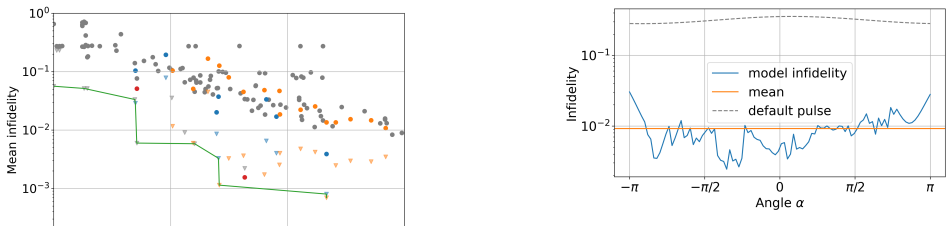
- Direct fine-tuning on the differentiable infidelity cost is what pushes performance below $10^{-3}$; MSE-only training leaves mean infidelity around $10^{-2}$ for the same model sizes.
- Knowledge distillation transfers the mixture-of-experts behavior into a single MLP, so the hardware-friendly model retains near-Pareto infidelity without the multi-expert overhead.
- Quantizing weights to five bits degrades mean infidelity only to about $2.3\times10^{-3}$ while reducing FPGA lookup-table usage to 87 percent, which fits the target programmable-logic device.
- Because the optimized control pulses last 290 ns instead of the roughly 2000 ns standard SNAP implementation, the ML-computed pulses reduce decoherence exposure and raise the achievable gate clock rate.
Reading between the lines
- Editorial: the same data-generation, distillation, and quantization pipeline should apply directly to SNAP gates on other levels and to qudits with more than five levels; the paper explicitly leaves this open, so the generality claim is an extrapolation, not a demonstrated result.
- Editorial: the discovery that distilled models produce a continuous pulse-parameter surface suggests the discontinuities in the raw optimized data are largely an artifact of the optimizer's initialization and branch choices, not a physical feature of the gate; enforcing continuity during data generation could remove the need for mixture-of-experts entirely.
- Editorial: the natural next benchmark is a lookup table mapping angles to pulse parameters on the same FPGA; the paper lists this as future work, but a comparative latency-and-fidelity study would show whether the ML route earns its complexity.
- Editorial: since the infidelity cost is differentiable, one could fine-tune the deployed model against measured hardware outcomes rather than the closed-system simulation, turning the pipeline into a closed-loop calibration tool; the paper hints at this but does not test it.
Editorial analysis
A structured set of objections, weighed in public.
Referee Report
Summary. The paper presents a machine-learning-based pipeline for predicting optimal control-pulse parameters for SNAP gates on a five-level microwave cavity qudit. Data are generated by L-BFGS-B optimization of B-spline pulse parameters against a closed-system Hamiltonian (Eq. (2)) with chi=5 MHz and xi=200 MHz. Several architectures are compared: MLPs, mixture-of-experts (MoE), hand-segmented multi-region (MR) models, and knowledge-distilled compact MLPs. The best MoE achieves mean trace infidelity around 6.9e-4 in simulation. A knowledge-distilled model is quantized with QKeras, synthesized via hls4ml to a ZCU102 FPGA, and the 5-bit version achieves mean infidelity ~2.3e-3 with 87% LUT utilization. The paper reports no measured latency, only resource utilization.
Significance. The paper provides a concrete, end-to-end design flow for embedding a quantum-control surrogate in programmable logic, and the resource-utilization numbers show that a quantized model can fit on an FPGA. The DSE with Pareto analysis and the use of differentiable infidelity fine-tuning are useful contributions. However, the main quantitative claim is an in-sample simulation metric: training, fine-tuning, and evaluation all use the same closed-system simulator and the same infidelity cost. The 'fast' claim is not backed by any latency measurement. If the authors supply post-synthesis latency and quantify robustness to simulation error, the work would be a meaningful step toward real-time qudit control.
major comments (3)
- [Sec. 2.4 and Table 4] The title and Sec. 1.1 motivate this work by the need for low-latency control, yet no latency, throughput, or achieved clock frequency is reported anywhere. Table 4 gives only LUT/FF utilization and infidelity; the target clock period of 3.225 ns is mentioned but the achieved timing is not. Without post-synthesis latency or a comparison to the classical optimizer's runtime (e.g., L-BFGS-B seconds per angle), the 'Fast Machine Learning' claim is unsupported. Please add latency estimates and a baseline comparison, or re-scope the title.
- [Sec. 2.1, 2.2.3, and 2.3.1] The reported gate trace infidelity is computed with the same closed-system Hamiltonian (Eq. (2)) used to generate the training data and the same differentiable infidelity cost used in fine-tuning. Thus the numbers in Table 2 and Fig. 13 measure how well the network reproduces the classical optimizer's solutions within the idealized model, not the fidelity achievable on physical hardware. The abstract presents 'gate trace infidelity near 10^{-3}' without this caveat. Please add a robustness study (e.g., Lindblad decoherence, pulse distortion, finite bandwidth) or explicitly state in the abstract and conclusion that these are simulation-level results.
- [Sec. 2.2.4 (Multi-Region)] For the MR models, the authors state that they 'evaluated the results of every intermediate fine-tuning step and manually composed a model with the best regressor found for each decision region.' It is not stated whether this selection used the validation set or the test set. If the test set was used for model selection, the MR infidelities reported in Table 2 are optimistically biased. Please clarify the selection procedure and, if necessary, use a nested validation split to report unbiased performance.
minor comments (4)
- [Table 4] The first row of Table 4 lists a quantization value '18'; this appears to be a typo for '8', which would match the text saying that weight quantization bits 7 and 8 exceed 100% LUT utilization. Please correct the table and the column header.
- [Sec. 2.3.1] The model selected for quantization is called 'random 3' but this name is never defined in the design space exploration of Sec. 2.2.4. Please describe which of the 100 random configurations corresponds to 'random 3' and its architecture.
- [Sec. 2.2.2] The statement that the universal approximation theorem 'holds for discontinuous functions as well, as long as the network is at least three layers deep' is too broad for the cited reference; please quote the precise theorem from [28].
- [Sec. 2.2.3] The fine-tuning procedure is described in terms of 'batches of each 16 angles per round' and 'iterations'; the relationship between a round and an iteration should be defined when first used (e.g., 'one round consists of N iterations').
Circularity Check
No significant circularity: the ML surrogate is a standard supervised fit evaluated on held-out angles; FPGA synthesis evidence is independent.
full rationale
The paper's derivation chain is a conventional supervised-surrogate pipeline. Classical optimal control (L-BFGS-B minimizing infidelity on the closed-system Hamiltonian H0 of Eq. (2) with B-spline pulse parameters) generates 10,000 labeled samples, and the neural network learns the map from phase angle α to optimal pulse parameters θ*. The reported mean trace infidelity near 10^-3 is computed with the same simulator used for label generation, but this reuse is not circular: at inference the network has not been given the optimal parameters, and the data are split into training, validation, and testing sets (80/10/10, Sec. 2.2.1), so the test infidelity is a generalization measure. The fine-tuning step in Sec. 2.2.3 minimizes the same differentiable infidelity cost used in data generation, which makes the reported infidelity partly an optimization objective rather than an independent prediction; however, it is an honest statement about surrogate approximation quality inside the simulator, not a fitted parameter renamed as a prediction. The FPGA resource-utilization results in Table 4 are independent evidence of synthesizability. The paper is also transparent about its external-validation gaps: Sec. 4 (Future Work) states that a real-time qudit control experiment “should be conducted” and that the ML model “should ideally be compared to the more common lookup table implementation.” These are limitations on the practical “fast control” claim, not circularity. No load-bearing argument reduces to a self-citation, an imported uniqueness theorem, or an ansatz smuggled in by citation. The derivation is self-contained, so the circularity score is 0.
Assumptions & free parameters
free parameters (6)
- Infidelity filtering threshold =
1e-4
- Smoothing window width =
50 samples
- Multi-Region decision boundaries =
[-0.490pi, -0.426pi, 0, 0.682pi]
- Number of MoE experts =
5
- Weight quantization bit width =
5 bits
- Fine-tuning rounds =
25-30
assumptions (5)
- domain assumption The dispersive Hamiltonian H0 = -chi a-dagger a b-dagger b - xi (b-dagger)^2 b^2, with chi=5 MHz and xi=200 MHz and qubit truncated to three levels, accurately models the real qudit-qubit system.
- domain assumption The L-BFGS-B optimizer returns pulse parameters that are globally near-optimal after filtering out infidelity above 1e-4.
- domain assumption The quadratic B-spline parameterization with 16 coefficients per quadrature can represent the optimal 290 ns pulses.
- standard math Trace infidelity computed from the simulation is the correct metric to minimize for gate quality.
- standard math The universal approximation theorem justifies that a sufficiently wide MLP can represent the target pulse-parameter function.
Cite this review
Pith. "Pith review of Fast Machine Learning for Quantum Control of Microwave Qudits on Edge Hardware." pith.science (2026). https://pith.science/paper/SZT3HRAG
@misc{pith2026250603323,
  author       = {Pith},
  title        = {Pith review of: Fast Machine Learning for Quantum Control of Microwave Qudits on Edge Hardware},
  year         = {2026},
  howpublished = {\url{https://pith.science/paper/SZT3HRAG}},
  note         = {Machine review of arXiv:2506.03323}
}
abstract
Quantum optimal control is a promising approach to improve the accuracy of quantum gates, but it relies on complex algorithms to determine the best control settings. CPU or GPU-based approaches often have delays that are too long to be applied in practice. It is paramount to have systems with extremely low delays to quickly and with high fidelity adjust quantum hardware settings, where fidelity is defined as overlap with a target quantum state. Here, we utilize machine learning (ML) models to determine control-pulse parameters for preparing Selective Number-dependent Arbitrary Phase (SNAP) gates in microwave cavity qudits, which are multi-level quantum systems that serve as elementary computation units for quantum computing. The methodology involves data generation using classical optimization techniques, ML model development, design space exploration, and quantization for hardware implementation. Our results demonstrate the efficacy of the proposed approach, with optimized models achieving low gate trace infidelity near $10^{-3}$ and efficient utilization of programmable logic resources.
Figures


Figures from the paper (12 more)






Reference graph
Works this paper leans on
-
[1]
INTRODUCTION Quantum Computing (QC) has undergone rapid develop- ment over the past four decades [1]. Harnessing the quan- tum mechanical properties of the natural world, specialized algorithms such as Shor’s Algorithm [2] and Grover’s Algo- rithm [3] theoretically offer asymptotic scaling advantages over all known relevant classical algorithms. Although ...
work page Pith review arXiv 2025
-
[2]
METHODOLOGY This section provides a more detailed explanation of the various steps of our design methodology shown in Fig. 1. In Sec. 2.1 we explain how we produced the dataset used to train the ML model for qudit-based quantum control. Next, Sec. 2.2 discusses the steps required to design and optimize a ML model for this task. In Sec. 2.3, we discuss the...
work page 2000
-
[3]
model selector and hand-defined regions as a clas- sifier, further labeled Multi-Region (MR). Owing to the hand-selected switching, we refer to this as “hard switching.” Note the contrast to soft switching where a weighted average is implicitly learned. The advantage of these architectures is that the network can explicitly model or learn the discontinuit...
-
[4]
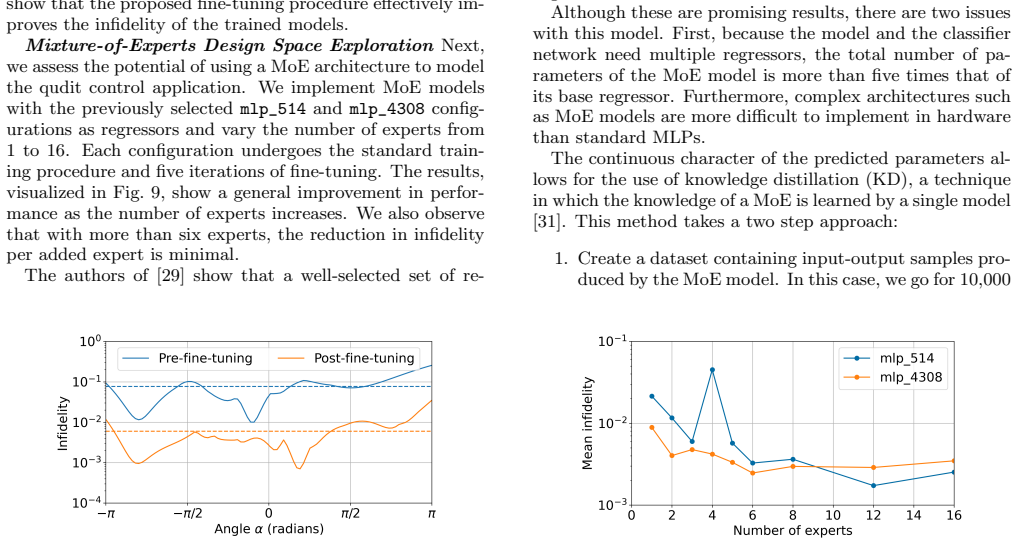
In this case, we go for 10,000 Figure 9: MoE expert count vs
Create a dataset containing input-output samples pro- duced by the MoE model. In this case, we go for 10,000 Figure 9: MoE expert count vs. model infidelity Figure 10: MoE Fine-tuning for mlp_4308 Figure 11: MoE Fine-tuning for mlp_514 linearly spaced input angles
-
[5]
Here we select all configurations from Table 1
Train a MLP model on this new dataset. Here we select all configurations from Table 1. After training, KD models with parameter counts exceed- ing 1000 surpass their fine-tuned counterparts in mean infi- delity performance, confirming the effectiveness of the KD technique. However, the results for models with lower pa- rameter counts do not achieve the sa...
-
[6]
CONCLUSION Quantum computing may offer super-polynomial asymp- totic scaling advantages for some important problems, but its practical realization hinges on addressing critical chal- lenges such the development of optimal quantum control sys- tems with sufficiently low latency and high fidelity. Here, we explored the fusion of machine learning and quantum...
-
[7]
Below, we offer some specific questions that may inform future research directions
FUTURE WORK While the contributions made here are concrete and promis- ing, optimal control for qudit devices in quantum comput- Figure 21: Trace Output for Layer 6 Figure 22: Trace Output for Layer 10 ers remains an open research problem. Below, we offer some specific questions that may inform future research directions. • The main issue holding back mod...
-
[8]
Quantum computing: A taxonomy, systematic review and future directions
Sukhpal Singh Gill, Adarsh Kumar, Harvinder Singh, Manmeet Singh, Kamalpreet Kaur, Muhammad Usman, and Rajkumar Buyya. Quantum computing: A taxonomy, systematic review and future directions. Software: Practice and Experience, 52(1):66–114, 2022
work page 2022
Show all 38 references
-
[9]
P.W. Shor. Algorithms for quantum computation: discrete logarithms and factoring. In Proceedings 35th Annual Symposium on Foundations of Computer Science , pages 124–134, 1994
1994
-
[10]
Lov K. Grover. A fast quantum mechanical algorithm for database search, 1996
1996
-
[11]
Whitney, Alexia Auffeves, and Hui Khoon Ng
Marco Fellous-Asiani, Jing Hao Chai, Robert S. Whitney, Alexia Auffeves, and Hui Khoon Ng. Limitations in quantum computing from resource constraints. PRX Quantum, 2(4), nov 2021
2021
-
[12]
Baris Ozguler and Joshua A
A. Baris Ozguler and Joshua A. Job. Dynamics of qudit gates and effects of spectator modes on optimal control pulses, 2022
2022
-
[13]
Sanders, and Sabre Kais
Yuchen Wang, Zixuan Hu, Barry C. Sanders, and Sabre Kais. Qudits and high-dimensional quantum computing. Frontiers in Physics, 8, 2020
2020
-
[14]
Sohaib Alam, Sergey Belomestnykh, Nicholas Bornman, Gustavo Cancelo, Yu-Chiu Chao, Mattia Checchin, Vinh San Dinh, Anna Grassellino, Erik J
M. Sohaib Alam, Sergey Belomestnykh, Nicholas Bornman, Gustavo Cancelo, Yu-Chiu Chao, Mattia Checchin, Vinh San Dinh, Anna Grassellino, Erik J. Gustafson, Roni Harnik, Corey Rae Harrington McRae, Ziwen Huang, Keshav Kapoor, Taeyoon Kim, James B. Kowalkowski, Matthew J. Kramer,...
2022
-
[15]
Tholen, Riccardo Borgani, David B
Marina Kudra, Mikael Kervinen, Ingrid Strandberg, Shahnawaz Ahmed, Marco Scigliuzzo, Amr Osman, Daniel Perez Lozano, Mats O. Tholen, Riccardo Borgani, David B. Haviland, Giulia Ferrini, Jonas Bylander, Anton Frisk Kockum, Fernando Quijandria, Per Delsing, and Simone Gasparinet...
2022
-
[16]
Barls Ozguler, Giuseppe Di Guglielmo, Nhan Tran, Gabriel N
David Xu, A. Barls Ozguler, Giuseppe Di Guglielmo, Nhan Tran, Gabriel N. Perdue, Luca Carloni, and Farah Fahim. Neural network accelerator for quantum control. In 2022 IEEE/ACM Third International Workshop on Quantum Computing Software (QCS) . IEEE, nov 2022
2022
-
[17]
Machine Learning for Arbitrary Single-Qubit Rotations on an Embedded Device
Madhav Narayan Bhat, Marco Russo, Luca P Carloni, Giuseppe Di Guglielmo, Farah Fahim, Andy CY Li, and Gabriel N Perdue. Machine Learning for Arbitrary Single-Qubit Rotations on an Embedded Device. arXiv preprint arXiv:2411.13037, 2024
2024
-
[18]
Anders Petersson, Fortino M
N. Anders Petersson, Fortino M. Garcia, Austin E. Copeland, Ylva L. Rydin, and Jonathan L. DuBois. Discrete adjoints for accurate numerical optimization with application to quantum control, 2020
2020
-
[20]
Anders Petersson, and Jonathan L
Stefanie G ¨unther, N. Anders Petersson, and Jonathan L. DuBois. Quantum optimal control for pure-state preparation using one initial state. A VS Quantum Science, 3(4):043801, December 2021
2021
-
[21]
Anders Petersson, and Jonathan L
Stefanie G ¨unther, N. Anders Petersson, and Jonathan L. Dubois. Quandary: An open-source c++ package for high-performance optimal control of open quantum systems, 2021
2021
-
[22]
Johansson, P.D
J.R. Johansson, P.D. Nation, and Franco Nori. Qutip: An open-source python framework for the dynamics of open quantum systems. Computer Physics Communications , 183(8):1760–1772, August 2012
2012
-
[23]
Rodr ´ ıguez-Borb´ on, Xian Wang, Adri´ an P
Jos´ e M. Rodr ´ ıguez-Borb´ on, Xian Wang, Adri´ an P. Di´ eguez, Khaled Z. Ibrahim, and Bryan M. Wong. V AN-DAMME: GPU-Accelerated and Symmetry-Assisted Quantum Optimal Control of Multi-Qubit Systems. Computer Physics Communications, 296:109403, 2024
2024
-
[24]
Performance Analysis and Modeling for Quantum Computing Simulation on Hybrid CPU–GPU Platforms
Armin Ahmadzadeh and Hamid Sarbazi-Azad. Performance Analysis and Modeling for Quantum Computing Simulation on Hybrid CPU–GPU Platforms. Quantum Information Processing, 2024. Accessed via https://link.springer.com/article/10.1007/s11128-024- 04580-x
2024 doi
-
[25]
Mart ´ ın Abadi, Ashish Agarwal, Paul Barham, Eugene Brevdo, Zhifeng Chen, Craig Citro, Greg S. Corrado, Andy Davis, Jeffrey Dean, Matthieu Devin, Sanjay Ghemawat, Ian Goodfellow, Andrew Harp, Geoffrey Irving, Michael Isard, Yangqing Jia, Rafal Jozefowicz, Lukasz Kaiser, Manju...
2015
-
[26]
Fast inference of deep neural networks in FPGAs for particle physics
Javier Duarte et al. Fast inference of deep neural networks in FPGAs for particle physics. JINST, 13(07):P07027, 2018
2018
-
[27]
Farah Fahim, Benjamin Hawks, Christian Herwig, James Hirschauer, Sergo Jindariani, Nhan Tran, Luca P. Carloni, Giuseppe Di Guglielmo, Philip Harris, Jeffrey Krupa, Dylan Rankin, Manuel Blanco Valentin, Josiah Hester, Yingyi Luo, John Mamish, Seda Orgrenci-Memik, Thea Aarrestad...
2021 arXiv
-
[28]
Siemens simplifies development of AI accelerators for advanced system-on-chip designs with Catapult AI NN, May 2024
Siemens Digital Industries Software. Siemens simplifies development of AI accelerators for advanced system-on-chip designs with Catapult AI NN, May 2024. Accessed: 2024-11-13
2024
-
[29]
Heeres, Brian Vlastakis, Eric Holland, Stefan Krastanov, Victor V
Reinier W. Heeres, Brian Vlastakis, Eric Holland, Stefan Krastanov, Victor V. Albert, Luigi Frunzio, Liang Jiang, and Robert J. Schoelkopf. Cavity state manipulation using photon-number selective phase gates. Physical Review Letters, 115(13), September 2015
2015
-
[30]
Albert, Chao Shen, Chang-Ling Zou, Reinier W
Stefan Krastanov, Victor V. Albert, Chao Shen, Chang-Ling Zou, Reinier W. Heeres, Brian Vlastakis, Robert J. Schoelkopf, and Liang Jiang. Universal control of an oscillator with dispersive coupling to a qubit. Phys. Rev. A, 92:040303, Oct 2015
2015
-
[31]
Anders Petersson and Fortino Garcia
N. Anders Petersson and Fortino Garcia. Optimal control of closed quantum systems via b-splines with carrier waves, 2022
2022
-
[32]
Oliphant, Matt Haberland, Tyler Reddy, David Cournapeau, Evgeni Burovski, Pearu Peterson, Warren Weckesser, Jonathan Bright, St´ efan J
Pauli Virtanen, Ralf Gommers, Travis E. Oliphant, Matt Haberland, Tyler Reddy, David Cournapeau, Evgeni Burovski, Pearu Peterson, Warren Weckesser, Jonathan Bright, St´ efan J. van der Walt, Matthew Brett, Joshua Wilson, K. Jarrod Millman, Nikolay Mayorov, Andrew R. J. Nelson,...
2020
-
[33]
JAX: composable transformations of Python+NumPy programs, 2018
James Bradbury, Roy Frostig, Peter Hawkins, Matthew James Johnson, Chris Leary, Dougal Maclaurin, George Necula, Adam Paszke, Jake VanderPlas, Skye Wanderman-Milne, and Qiao Zhang. JAX: composable transformations of Python+NumPy programs, 2018
2018
-
[34]
Multilayer feedforward networks are universal approximators
Kurt Hornik, Maxwell Stinchcombe, and Halbert White. Multilayer feedforward networks are universal approximators. Neural Networks, 2(5):359–366, 1989
1989
-
[35]
Ismailov
Vugar E. Ismailov. A three layer neural network can represent any multivariate function. Journal of Mathematical Analysis and Applications , 523(1):127096, 2023
2023
-
[36]
Discontinuity-sensitive optimal control learning by mixture of experts
Gao Tang and Kris Hauser. Discontinuity-sensitive optimal control learning by mixture of experts. In 2019 International Conference on Robotics and Automation (ICRA), pages 7892–7898, 2019
2019
-
[37]
An exponential learning rate schedule for deep learning
Zhiyuan Li and Sanjeev Arora. An exponential learning rate schedule for deep learning. arXiv preprint arXiv:1910.07454, 2019
1910 arXiv
-
[38]
Distilling the knowledge in a neural network, 2015
Geoffrey Hinton, Oriol Vinyals, and Jeff Dean. Distilling the knowledge in a neural network, 2015
2015
-
[39]
Sohaib Alam, Joshua Adam Job, Andy C
Doga Murat Kurkcuoglu, M. Sohaib Alam, Joshua Adam Job, Andy C. Y. Li, Alexandru Macridin, Gabriel N. Perdue, and Stephen Providence. Quantum simulation of ϕ4 theories in qudit systems, 2022
2022
Reviewed August 7, 2026 · model on record in the stance chip above.
Discussion (0). Continue with ORCID to comment.