REVIEW 4 major objections 6 minor 1 cited by
Online Adaptation of Terrain-Aware Dynamics for Planning in Unstructured Environments
T0 review · 4 major / 6 minor · reviewed 2026-08-07 · deepseek-v4-flash
Pith's one-line read This paper reports that a robot can adapt its dynamics model to a new, unseen terrain online by fitting learned neural-ODE basis functions with a least-squares calculation, and that this yields zero collisions where a fixed neural-ODE…
desk verdict A clean, honest extension of the authors' own function-encoder line to closed-loop MPPI planning, with the main claim scoped too broadly for the narrow friction-only validation. read the letter →
The pith
A machine-rendered reading of the paper's core claim, the machinery that carries it, and where it could break.
The reading
What carries the argument
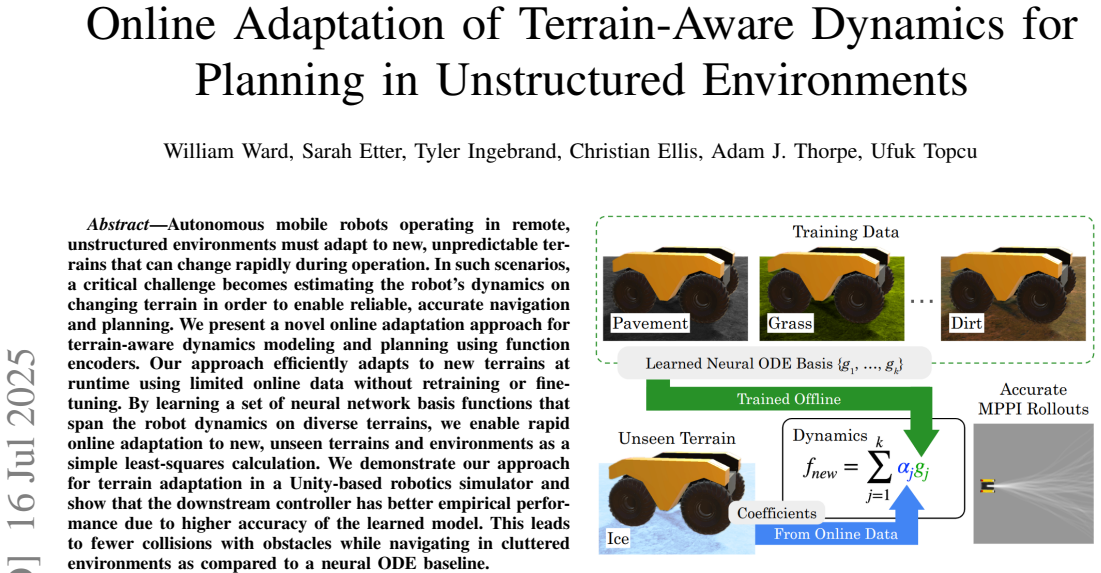
The central object is a function encoder with neural-ODE basis functions. Offline training learns k basis functions g1,...,gk whose linear span approximates the Hilbert space F of possible terrain dynamics. The basis functions output the state change Δx_t = x_{t+1} − x_t, and a full model for terrain w is f̂^w = Σ_{j=1}^k α_j^w g_j. The coefficients solve the normal equation α^w = $G^{{-1}}$ b, where G is a k×k Gram matrix of inner products between basis functions and b collects inner products ⟨F^w, G_j⟩, with inner products approximated by Monte Carlo from online data. Because k = 8, the inverse is negligible and does not need recomputation during inference, and each MPPI rollout becomes a cheap forward pass through the integrated basis, turning online adaptation into a closed-form least-squares calculation rather than retraining.
What would settle it
Measure the least-squares residual in the coefficient update on a terrain generated by a mechanism not used in training, such as deformable soil, vegetation, or a bumpy slope, and then run the same waypoint navigation. If the residual stays as small as on the held-out friction scenes and collisions remain at zero, the span assumption holds; if residuals grow and the controller collides, the central claim fails.
Extended reading notes
Core claim
The paper's central claim is that the space of terrain-dependent robot dynamics can be approximated by a learned basis, and that this reduces online adaptation to a linear algebra problem. Given datasets from several known terrains, the method trains k = 8 neural ordinary differential equation basis functions so that every training terrain's vector field is approximately in span{g1,...,gk}. At runtime, for an unseen terrain, it gathers roughly 100 transitions and solves a normal equation to obtain coefficients α^w; the adapted model f̂^w = Σ α_j^w g_j is then used inside MPPI to generate rollouts. Tests on out-of-distribution scenes show lower one-step and rollout error than a fixed neural ODE, and when deployed for waypoint navigation on an icy scene the controller using the adapted model avoided all obstacles over four trials while the neural-ODE controller collided 11 times. The result, stated on the paper's own terms, is that pretrained neural-ODE basis functions plus online least-squares coefficient inference give fast, data-efficient terrain adaptation and improve closed-loop planning without gradient updates.
Load-bearing premise
The true dynamics of every encountered terrain lie close to the linear span of the eight neural-ODE basis functions, an assumption tested only along one axis of variation, namely interpolation and extrapolation of two friction parameter sets in simulation.
Editorial extensions
If this is right
- Coefficient fitting needs only a small amount of runtime data: 5 transitions already give the function encoder lower prediction error than the fixed neural ODE, and roughly 100 transitions produce stable estimates.
- Because adaptation requires no gradient updates and k is small, the method is cheap enough to deploy inside a real-time MPPI loop, requiring only an 8×8 Gram matrix inversion and forward passes.
- On an unseen interpolated terrain and an extrapolated icy terrain, the function encoder accumulates less rollout error over time than the neural ODE, which overfits the training scenes.
- In closed-loop waypoint navigation on the icy scene, the adapted model produced zero collisions across four trials, compared with 11 collisions for the neural-ODE baseline.
Reading between the lines
- Inference: the span assumption implies the coefficient fit cannot invent dynamics outside the learned basis; for qualitatively new surfaces such as deformable soil, vegetation, or rough ground, the method would need basis functions trained on those effects, a limit the paper itself concedes.
- Inference: the least-squares formulation naturally extends to streaming or recursive least squares, which would let the model track a terrain that changes mid-mission; the paper mentions this possibility but does not implement it.
- Inference: coupling visual perception to the coefficient space would make adaptation anticipatory rather than reactive, letting the robot infer terrain dynamics before wheel contact, a direction stated in the future-work section.
Editorial analysis
A structured set of objections, weighed in public.
Referee Report
Summary. The paper proposes an online terrain-adaptation method for ground-vehicle dynamics using function encoders with neural-ODE basis functions. A set of k=8 basis functions is trained offline on data from several simulated terrains, and at runtime the terrain-dependent dynamics are represented as a linear combination of these bases with coefficients computed by a least-squares normal equation (Eq. 10). The adapted model is used inside MPPI rollouts. Experiments are conducted in the Unity-based Phoenix simulator with a Clearpath Warthog, where terrains are generated as convex combinations of two friction parameter vectors (normal and icy). The paper reports that the function encoder outperforms a fixed neural ODE baseline on held-out interpolation and extrapolation scenes in terms of prediction MSE, and in a closed-loop waypoint navigation task on an icy extrapolation scene the function encoder achieves zero collisions across four trials versus 11 collisions for the baseline. The central claim is that this enables rapid adaptation to new, unseen terrains without retraining or fine-tuning.
Significance. If the claims hold, the approach is a computationally inexpensive way to adapt a learned dynamics model to new terrains inside a sampling-based MPC framework, requiring only a small least-squares solve at runtime. The mathematical skeleton is clean and clearly presented, the Limitations section is honest, and the comparison against a neural ODE baseline is a reasonable first step. The main strengths are the closed-form coefficient update via Eq. (10), the demonstration that only a few online data points are needed, and the closed-loop deployment with MPPI. However, the significance is currently limited by the narrow terrain family tested: all scenes lie on a one-dimensional interpolation between two friction vectors, so the broader claims of adaptation to 'diverse terrains' and to 'new, unseen terrains and environments' are only supported for a one-parameter family of friction scalings. The closed-loop collision result is also reported without per-trial statistics. With either substantially broader terrain experiments or appropriately narrowed claims, this would be a useful application of function encoders to terrain-adaptive model predictive control.
major comments (4)
- [Section IV, terrain generation] All eight training terrains are generated as convex combinations theta*a + (1-theta)*b of two friction parameter vectors with a single scalar theta (Section IV, paragraph 2). Consequently, every scene in the paper, including the held-out interpolation and extrapolation scenes, lies on a one-dimensional manifold of tire-friction parameters. The abstract's claim that the basis functions 'span the robot dynamics on diverse terrains' is therefore not supported by this experiment design: the basis is only required to represent a one-parameter family of friction scalings. Since Eq. (10) can only select coefficients within the pretrained span, the reported gains do not measure the method's behavior when terrain dynamics are categorically different, such as deformable soil, vegetation, or uneven ground. The paper should either add experiments that vary independent terrain parameters or use different contact models, or it should substantially restrict the generalization claims to friction-parameter variation.
- [Section III.A, Eqs. (7)-(12)] The text states that function encoders 'learn a set of neural network basis functions {g1,...,gk} to span the Hilbert space F.' With finite k this is not literally possible for an infinite-dimensional space; what is actually constructed is a k-dimensional subspace \hat{F} = span{g1,...,gk}, and Eq. (10) is a least-squares projection onto this subspace. The paper provides no approximation guarantee or error bound for this projection, and the Limitations section concedes that out-of-span dynamics may cause failure. Because the central claim is that the method generalizes to unseen terrains, the paper should either provide evidence of basis capacity beyond the tested friction manifold or reformulate the claim as an approximation with an explicit residual error term.
- [Section IV.E, Figures 9-10] The closed-loop collision comparison is summarized only as 'Over four trials, the function encoder had no collisions, while the neural ODE had 11 total.' No per-trial breakdown, random seed handling, starting conditions, or variability is reported, and four trials is a small sample for a stochastic controller that samples 1,000 rollouts per iteration. Because the paper's headline claim is 'fewer collisions with obstacles,' this evidence should be presented with per-trial counts and, ideally, repeated-seed statistics. In addition, the deployment scene is an extrapolation along the same friction axis used during training rather than a categorically new terrain, so the closed-loop result should be interpreted and stated accordingly.
- [Section III.A-B, Eq. (10)] The implementation of the least-squares coefficient calculation is underspecified for reproduction. The inner product in Eq. (11) is defined over X×U, but in practice it is approximated from finite discrete transitions; the paper does not state the number of Monte Carlo samples used, how the Gram matrix is formed, whether any regularization is applied, or how the online data window n in Figure 5 relates to the 'approximately 100 data points' mentioned in Section III.A. These details matter because the runtime adaptation mechanism is exactly this least-squares step, and because the Limitations section notes that low-excitation inputs can make the regression ill-conditioned. Please provide the numerical recipe or a short pseudocode for the online coefficient update.
minor comments (6)
- [Section II] The text refers to a 'Savitsky-Galoy smoothing filter'; this should read 'Savitzky-Golay smoothing filter.'
- [Author footnote] The corresponding author's email address is given as 'adam.thorpe@autin.utexas.edu'; the domain appears to be misspelled and should likely be 'austin.utexas.edu.'
- [Section IV.C] The sentence saying that the training curve on the extrapolation dataset is 'indicative of overfitting for both algorithms' is not directly supported by the plotted MSE curves, which do not clearly separate training and validation error; please clarify the evidence for overfitting.
- [Section III.A, Eq. (10)] Eq. (10) writes the right-hand side as an inner product with the unknown ground-truth function F, but in practice this is replaced by an empirical Monte Carlo estimate from data; please introduce a notational distinction between the true inner product and its finite-sample approximation.
- [Section IV.D and Figure 5] Figure 5's caption says the function encoder 'only requires a small amount of online data,' but the x-axis and the exact definition of 'data points' (single transitions, windows, or seconds) should be stated in the caption or the main text for reproducibility.
- [Section I.A and Section III] The method is closely based on the function-encoder formulation from prior work [19] and [22]; the paper should more explicitly delineate what is inherited from these works and what is new, beyond the integration with MPPI and the terrain-adaptation evaluation.
Circularity Check
No circular derivation: online coefficient fitting is genuine few-shot adaptation, and the closed-loop comparison is externally evaluated against a fixed neural ODE baseline.
full rationale
The paper's derivation chain is not circular. Offline, the function-encoder basis functions are trained on trajectories from known terrains (Section IV.A). Online, the coefficients in Eq. (10) are fit by least squares to a small amount of observed transitions from the new terrain (Section III.A, 'Online Inference'), and this adapted model is then used to generate MPPI rollouts. The MSE and collision comparisons in Figures 5-10 evaluate out-of-sample predictions (coefficients fit on preceding transitions, error measured on subsequent transitions) and closed-loop performance against a fixed neural ODE, so the reported improvement is not the same quantity that was fit. The main caveats are not circularity: the Hilbert-space/span assumption in Section III.A is an explicit assumption, and Section V concedes that if terrain-induced dynamics fall outside the learned span the model may fail to generalize. The experiments only vary one scalar friction-interpolation family, so the 'diverse terrains' claim is under-supported, but that is a limitation of evidence scope, not a reduction of the result to its inputs. The paper does rely on the authors' prior function-encoder work [19,20,22] for the method and for basis-count guidance, but these self-citations are not load-bearing: the central closed-loop claim is tested against an external baseline and depends on the training and evaluation in this paper.
Assumptions & free parameters
free parameters (2)
- Number of basis functions k =
8
- Online data window n for coefficient estimation =
5 to about 100 transitions
assumptions (4)
- domain assumption The space of robot dynamics F is a Hilbert space, and the true terrain dynamics lie in the span of the k=8 learned basis functions.
- domain assumption Monte Carlo approximation of the inner product in Eq. (11) using a small number of online transitions gives an invertible and accurate Gram matrix.
- ad hoc to paper Terrain variation relevant to the system's dynamics is captured by the scalar convex-combination family theta*a + (1-theta)*b of friction parameters.
- standard math Least-squares projection in a Hilbert space via the normal equations provides the best linear approximation of observed dynamics in the basis span.
Cite this review
Pith. "Pith review of Online Adaptation of Terrain-Aware Dynamics for Planning in Unstructured Environments." pith.science (2026). https://pith.science/paper/K7F5H6XJ
@misc{pith2026250604484,
  author       = {Pith},
  title        = {Pith review of: Online Adaptation of Terrain-Aware Dynamics for Planning in Unstructured Environments},
  year         = {2026},
  howpublished = {\url{https://pith.science/paper/K7F5H6XJ}},
  note         = {Machine review of arXiv:2506.04484}
}
read the original abstract
Autonomous mobile robots operating in remote, unstructured environments must adapt to new, unpredictable terrains that can change rapidly during operation. In such scenarios, a critical challenge becomes estimating the robot's dynamics on changing terrain in order to enable reliable, accurate navigation and planning. We present a novel online adaptation approach for terrain-aware dynamics modeling and planning using function encoders. Our approach efficiently adapts to new terrains at runtime using limited online data without retraining or fine-tuning. By learning a set of neural network basis functions that span the robot dynamics on diverse terrains, we enable rapid online adaptation to new, unseen terrains and environments as a simple least-squares calculation. We demonstrate our approach for terrain adaptation in a Unity-based robotics simulator and show that the downstream controller has better empirical performance due to higher accuracy of the learned model. This leads to fewer collisions with obstacles while navigating in cluttered environments as compared to a neural ODE baseline.
Figures


Figures from the paper (6 more)


Forward citations
Cited by 1 Pith paper
-
VertiAKD: Adaptive Off-Road Kinodynamics on Vertically Challenging Terrain
VertiAKD combines terrain-conditioned function encoders, latent-space descriptor retrieval, and recursive least squares to transfer kinodynamic models across off-road vehicles, cutting long-horizon prediction error by...
Reference graph
Works this paper leans on
-
[1]
π0: A vision- language-action flow model for general robot control
Kevin Black, Noah Brown, Danny Driess, Adnan Es- mail, Michael Equi, Chelsea Finn, Niccolo Fusai, Lachy Groom, Karol Hausman, Brian Ichter, et al. π0: A vision- language-action flow model for general robot control. arXiv preprint arXiv:2410.24164 , 2024
-
[2]
Rt-1: Robotics transformer for real-world control at scale
Anthony Brohan, Noah Brown, Justice Carbajal, Yev- gen Chebotar, Joseph Dabis, Chelsea Finn, Keerthana Gopalakrishnan, Karol Hausman, Alex Herzog, Jasmine Hsu, et al. Rt-1: Robotics transformer for real-world control at scale. arXiv preprint arXiv:2212.06817, 2022
arXiv 2022
-
[3]
SE3-Pose-Nets: Structured Deep Dynamics Models for Visuomotor Planning and Control
Arunkumar Byravan, Felix Leeb, Franziska Meier, and Dieter Fox. Se3-pose-nets: Structured deep dynamics models for visuomotor planning and control. arXiv preprint arXiv:1710.00489, 2017
work page Pith review arXiv 2017
-
[4]
How does it feel? self-supervised costmap learning for off-road vehicle traversability
Mateo Guaman Castro, Samuel Triest, Wenshan Wang, Jason M Gregory, Felix Sanchez, John G Rogers, and Sebastian Scherer. How does it feel? self-supervised costmap learning for off-road vehicle traversability. In 2023 IEEE International Conference on Robotics and Automation (ICRA), pages 931–938. IEEE, 2023
work page 2023
-
[5]
Neural ordinary differential equations
Ricky TQ Chen, Yulia Rubanova, Jesse Bettencourt, and David K Duvenaud. Neural ordinary differential equations. Advances in neural information processing systems, 31, 2018
2018
-
[6]
Calvin Chanyoung Chung, Andrea Finazzi, Hyunki Seong, Daegyu Lee, Seungwook Lee, Bosung Kim, Gyuri Gang, and David Hyunchul Shim. Autonomous system for head-to-head race: Design, implementation and analysis; team kaist at the indy autonomous chal- lenge. Transactions on Field Robotics, pages 1–1, 2024. doi: 10.1109/TFR.2024.3497922
arXiv 2024
-
[7]
Online terrain estimation for autonomous vehicles on deformable terrains
James Dallas, Kshitij Jain, Zheng Dong, Leonid Sapronov, Michael P Cole, Paramsothy Jayakumar, and Tulga Ersal. Online terrain estimation for autonomous vehicles on deformable terrains. Journal of Terrame- chanics, 91:11–22, 2020
work page 2020
-
[8]
Terrain estimation for planetary exploration robots
Mauro Dimastrogiovanni, Florian Cordes, and Giulio Reina. Terrain estimation for planetary exploration robots. Applied Sciences, 10(17), 2020. ISSN 2076-3417. doi: 10.3390/app10176044. URL https://www.mdpi.com/ 2076-3417/10/17/6044
Show all 52 references
-
[9]
Autonomous drifting with 3 minutes of data via learned tire models
Franck Djeumou, Jonathan YM Goh, Ufuk Topcu, and Avinash Balachandran. Autonomous drifting with 3 minutes of data via learned tire models. In 2023 IEEE International Conference on Robotics and Automation (ICRA), pages 968–974. IEEE, 2023
2023
-
[10]
How to learn and generalize from three minutes of data: Physics- constrained and uncertainty-aware neural stochastic dif- ferential equations, 2023
Franck Djeumou, Cyrus Neary, and Ufuk Topcu. How to learn and generalize from three minutes of data: Physics- constrained and uncertainty-aware neural stochastic dif- ferential equations, 2023. URL https://arxiv.org/abs/ 2306.06335
2023 arXiv
-
[11]
One model to drift them all: Physics-informed conditional diffusion model for driving at the limits
Franck Djeumou, Thomas Jonathan Lew, Nan Ding, Michael Thompson, Makoto Suminaka, Marcus Greiff, and John Subosits. One model to drift them all: Physics-informed conditional diffusion model for driving at the limits. In 8th Annual Conference on Robot Learning, 2024. URL https:...
2024
-
[12]
Palm- e: An embodied multimodal language model
Danny Driess, Fei Xia, Mehdi SM Sajjadi, Corey Lynch, Aakanksha Chowdhery, Brian Ichter, Ayzaan Wahid, Jonathan Tompson, Quan Vuong, Tianhe Yu, et al. Palm- e: An embodied multimodal language model. arXiv preprint arXiv:2303.03378, 2023
2023 arXiv
-
[13]
Vehicle- terrain parameter estimation for small-scale unmanned tracked vehicles
Albert A Espinoza, Jorge L Torres-Filomeno, Karla M Monta˜nez-S´anchez, and ´Angel J Ortiz-And ´ujar. Vehicle- terrain parameter estimation for small-scale unmanned tracked vehicles. In 2019 IEEE International Symposium on Measurement and Control in Robotics (ISMCR), pages A3–...
2019
-
[14]
Model- agnostic meta-learning for fast adaptation of deep net- works
Chelsea Finn, Pieter Abbeel, and Sergey Levine. Model- agnostic meta-learning for fast adaptation of deep net- works. In International conference on machine learning , pages 1126–1135. PMLR, 2017
2017
-
[15]
RoadRun- ner—learning traversability estimation for autonomous off-road driving
Jonas Frey, Manthan Patel, Deegan Atha, Julian Nu- bert, David Fan, Ali Agha, Curtis Padgett, Patrick Spieler, Marco Hutter, and Shehryar Khattak. RoadRun- ner—learning traversability estimation for autonomous off-road driving. Transactions on Field Robotics, 1:192– 212, 2024....
2024
-
[16]
Learning nonlinear dynamic models of soft robots for model predictive control with neural networks
Morgan T Gillespie, Charles M Best, Eric C Townsend, David Wingate, and Marc D Killpack. Learning nonlinear dynamic models of soft robots for model predictive control with neural networks. In 2018 IEEE International Conference on Soft Robotics (RoboSoft) , pages 39–45. IEEE, 2018
2018
-
[17]
Gregory, Felix Sanchez, John G
Mateo Guaman Castro, Samuel Triest, Wenshan Wang, Jason M. Gregory, Felix Sanchez, John G. Rogers III, and Sebastian Scherer. How does it feel? self-supervised costmap learning for off-road vehicle traversability. In International Conference on Robotics and Automation . IEEE, 2023
2023
-
[18]
Model predictive control for aggressive driving over uneven terrain
Tyler Han, Alex Liu, Anqi Li, Alex Spitzer, Guanya Shi, and Byron Boots. Model predictive control for aggressive driving over uneven terrain. In Robotics: Science and Systems Conference, 2024
2024
-
[19]
Thorpe, and Ufuk Topcu
Tyler Ingebrand, Adam J. Thorpe, and Ufuk Topcu. Zero- shot transfer of neural ODEs. In Advances in Neural In- formation Processing Systems, volume 37, pages 67604– 67626. Curran Associates, Inc., 2024
2024
-
[20]
Zero- shot reinforcement learning via function encoders
Tyler Ingebrand, Amy Zhang, and Ufuk Topcu. Zero- shot reinforcement learning via function encoders. In International Conference on Machine Learning , volume 235 of Proceedings of Machine Learning Research , pages 21007–21019. PMLR, 21–27 Jul 2024. URL https://proceedings.mlr....
2024
-
[21]
Thorpe, Somdatta Goswami, Krishna Kumar, and Ufuk Topcu
Tyler Ingebrand, Adam J. Thorpe, Somdatta Goswami, Krishna Kumar, and Ufuk Topcu. Basis-to-basis operator learning using function encoders. Computer Methods in Applied Mechanics and Engineering , 435:117646,
-
[22]
Thorpe, and Ufuk Topcu
Tyler Ingebrand, Adam J. Thorpe, and Ufuk Topcu. Function encoders: A principled approach to transfer learning in hilbert spaces. ICML, 2025
2025
-
[23]
V-STRONG: visual self- supervised traversability learning for off-road navigation
Sanghun Jung, Joonho Lee, Xiangyun Meng, Byron Boots, and Alexander Lambert. V-STRONG: visual self- supervised traversability learning for off-road navigation. In IEEE International Conference on Robotics and Au- tomation, pages 1766–1773. IEEE, 2024
2024
-
[24]
RMA: rapid motor adaptation for legged robots
Ashish Kumar, Zipeng Fu, Deepak Pathak, and Jitendra Malik. RMA: rapid motor adaptation for legged robots. In Dylan A. Shell, Marc Toussaint, and M. Ani Hsieh, editors, Robotics: Science and Systems , 2021. doi: 10. 15607/RSS.2021.XVII.011
2021
-
[25]
Natural terrain classification using three-dimensional ladar data for ground robot mo- bility
Jean-Franc ¸ois Lalonde, Nicolas Vandapel, Daniel F Hu- ber, and Martial Hebert. Natural terrain classification using three-dimensional ladar data for ground robot mo- bility. Journal of field robotics , 23(10):839–861, 2006
2006
-
[26]
A multi-mode real- time terrain parameter estimation method for wheeled motion control of mobile robots
Yuankai Li, Liang Ding, Zhizhong Zheng, Qizhi Yang, Xingang Zhao, and Guangjun Liu. A multi-mode real- time terrain parameter estimation method for wheeled motion control of mobile robots. Mechanical Systems and Signal Processing , 104:758–775, 2018
2018
-
[27]
Learning on the job: Online lifelong and con- tinual learning
Bing Liu. Learning on the job: Online lifelong and con- tinual learning. In Proceedings of the AAAI conference on artificial intelligence, volume 34, pages 13544–13549, 2020
2020
-
[28]
A lifelong learning approach to mobile robot navigation
Bo Liu, Xuesu Xiao, and Peter Stone. A lifelong learning approach to mobile robot navigation. IEEE Robotics and Automation Letters, 6(2):1090–1096, 2021
2021
-
[29]
Real-time semantic mapping for autonomous off-road navigation
Daniel Maturana, Po-Wei Chou, Masashi Uenoyama, and Sebastian Scherer. Real-time semantic mapping for autonomous off-road navigation. In International Conference on Field and Service Robotics , pages 335 – 350, September 2017
2017
-
[30]
Efficient generation of accurate mobility maps using machine learning algorithms
Dave Mechergui and Paramsothy Jayakumar. Efficient generation of accurate mobility maps using machine learning algorithms. Journal of Terramechanics, 88:53– 63, 2020
2020
-
[31]
Terrainnet: Visual modeling of complex terrain for high-speed, off-road navigation
Xiangyun Meng, Nathan Hatch, Alexander Lambert, Anqi Li, Nolan Wagener, Matthew Schmittle, Joonho Lee, Wentao Yuan, Zoey Qiuyu Chen, Samuel Deng, Greg Okopal, Dieter Fox, Byron Boots, and Amirreza Shaban. Terrainnet: Visual modeling of complex terrain for high-speed, off-road ...
2023
-
[32]
NeBula: Team CoSTAR’s robotic autonomy solution that won phase ii of DARPA subterranean challenge
Benjamin Morrell, Rohan Thakker, `Angel Santa- maria Navarro, Amanda Bouman, Xiaoming Lei, Jef- frey Edlund, Torkom Pailevanian, Tiago Stegun Vaquero, Yun Lin Chang, Thomas Touma, et al. NeBula: Team CoSTAR’s robotic autonomy solution that won phase ii of DARPA subterranean ch...
2022
-
[33]
Deep-neural-network-based modelling of longitudinal-lateral dynamics to predict the vehicle states for autonomous driving
Xiaobo Nie, Chuan Min, Yongjun Pan, Ke Li, and Zhixiong Li. Deep-neural-network-based modelling of longitudinal-lateral dynamics to predict the vehicle states for autonomous driving. Sensors, 22(5):2013, 2022
2013
-
[34]
Terrain characterization and classification with a mobile robot
Lauro Ojeda, Johann Borenstein, Gary Witus, and Robert Karlsen. Terrain characterization and classification with a mobile robot. Journal of field robotics, 23(2):103–122, 2006
2006
-
[35]
Open x-embodiment: Robotic learning datasets and rt-x models
Abby O’Neill, Abdul Rehman, Abhinav Gupta, Abhiram Maddukuri, Abhishek Gupta, Abhishek Padalkar, Abra- ham Lee, Acorn Pooley, Agrim Gupta, Ajay Mandlekar, et al. Open x-embodiment: Robotic learning datasets and rt-x models. arXiv preprint arXiv:2310.08864 , 2023
-
[36]
Estimation of terramechanics pa- rameters of wheel-soil interaction model using particle filtering
Chandramouli Padmanabhan, Sayan Gupta, Annadurai Mylswamy, et al. Estimation of terramechanics pa- rameters of wheel-soil interaction model using particle filtering. Journal of Terramechanics, 79:79–95, 2018
2018
-
[37]
On- line estimation of vehicle motion and power model parameters for skid-steer robot energy use prediction
Jesse Pentzer, Sean Brennan, and Karl Reichard. On- line estimation of vehicle motion and power model parameters for skid-steer robot energy use prediction. In 2014 American Control Conference , pages 2786–2791, 2014
2014
-
[38]
Terrain estimation via vehicle vibration measurement and cubature kalman filtering
Giulio Reina, Antonio Leanza, and Arcangelo Messina. Terrain estimation via vehicle vibration measurement and cubature kalman filtering. Journal of Vibration and Control, 26(11-12):885–898, 2020
2020
-
[39]
Semantic terrain classification for off-road autonomous driving
Amirreza Shaban, Xiangyun Meng, JoonHo Lee, Byron Boots, and Dieter Fox. Semantic terrain classification for off-road autonomous driving. In Aleksandra Faust, David Hsu, and Gerhard Neumann, editors, Conference on Robot Learning , volume 164 of Proceedings of Ma- chine Learnin...
2022
-
[40]
Neural network vehicle models for high-performance automated driving
Nathan A Spielberg, Matthew Brown, Nitin R Kapania, John C Kegelman, and J Christian Gerdes. Neural network vehicle models for high-performance automated driving. Science robotics, 4(28):eaaw1975, 2019
2019
-
[41]
Open-world object manipulation using pre-trained vision-language models
Austin Stone, Ted Xiao, Yao Lu, Keerthana Gopalakrish- nan, Kuang-Huei Lee, Quan Vuong, Paul Wohlhart, Sean Kirmani, Brianna Zitkovich, Fei Xia, et al. Open-world object manipulation using pre-trained vision-language models. arXiv preprint arXiv:2303.00905 , 2023
2023 arXiv
-
[42]
Octo: An open-source generalist robot policy
Octo Model Team, Dibya Ghosh, Homer Walke, Karl Pertsch, Kevin Black, Oier Mees, Sudeep Dasari, Joey Hejna, Tobias Kreiman, Charles Xu, et al. Octo: An open-source generalist robot policy. arXiv preprint arXiv:2405.12213, 2024
2024 arXiv
-
[43]
Wheel collider friction
Unity Technologies. Wheel collider friction. https://docs.unity3d.com/6000.0/Documentation/Manual/ wheel-colliders-friction.html, 2025. Accessed 21 Apr. 2025
2025
-
[44]
Thorpe, Tyler Ingebrand, Somdatta Goswami, Krishna Kumar, and Ufuk Topcu
Adam J. Thorpe, Tyler Ingebrand, Somdatta Goswami, Krishna Kumar, and Ufuk Topcu. Basis-to-basis operator learning: A paradigm for scalable and interpretable oper- ator learning on hilbert spaces. In 2025 SIAM Conference on Computational Science and Engineering , 2025
2025
-
[45]
Offseg: A semantic segmentation framework for off-road driving
Kasi Viswanath, Kartikeya Singh, Peng Jiang, PB Sujit, and Srikanth Saripalli. Offseg: A semantic segmentation framework for off-road driving. In International Con- ference on Automation Science and Engineering , pages 354–359. IEEE, 2021
2021
-
[46]
A RUGD dataset for au- tonomous navigation and visual perception in unstruc- tured outdoor environments
Maggie Wigness, Sungmin Eum, John G Rogers, David Han, and Heesung Kwon. A RUGD dataset for au- tonomous navigation and visual perception in unstruc- tured outdoor environments. In International Conference on Intelligent Robots and Systems , pages 5000–5007. IEEE, 2019
2019
-
[47]
Aggressive driving with model predictive path integral control
Grady Williams, Paul Drews, Brian Goldfain, James M Rehg, and Evangelos A Theodorou. Aggressive driving with model predictive path integral control. In Inter- national Conference on Robotics and Automation , pages 1433–1440. IEEE, 2016
2016
-
[48]
Rehg, Byron Boots, and Evangelos A
Grady Williams, Nolan Wagener, Brian Goldfain, Paul Drews, James M. Rehg, Byron Boots, and Evangelos A. Theodorou. Information theoretic mpc for model-based reinforcement learning. In Proceedings of the IEEE International Conference on Robotics and Automation (ICRA), pages 171...
-
[49]
Hyperdy- namics: Meta-learning object and agent dynamics with hypernetworks
Zhou Xian, Shamit Lal, Hsiao-Yu Tung, Emmanouil An- tonios Platanios, and Katerina Fragkiadaki. Hyperdy- namics: Meta-learning object and agent dynamics with hypernetworks. In International Conference on Learning Representations. OpenReview.net, 2021
2021
-
[50]
Motion planning and control for mobile robot navigation using machine learning: a survey
Xuesu Xiao, Bo Liu, Garrett Warnell, and Peter Stone. Motion planning and control for mobile robot navigation using machine learning: a survey. Autonomous Robots , 46(5):569–597, 2022
2022
-
[2017]
doi: 10.1109/ICRA.2017.7989202
IEEE. doi: 10.1109/ICRA.2017.7989202
2017
-
[2025]
doi: https://doi.org/10.1016/j
ISSN 0045-7825. doi: https://doi.org/10.1016/j. cma.2024.117646. URL https://www.sciencedirect.com/ science/article/pii/S0045782524009009
2024
Reviewed August 7, 2026 · model on record in the stance chip above.
Discussion (0). Sign in to comment.