REVIEW 4 major objections 6 minor 59 references
Learning dissection trajectories from expert surgical videos via imitation learning with equivariant diffusion
T0 review · 4 major / 6 minor · reviewed 2026-08-07 · deepseek-v4-flash
Pith's one-line read iDPOE, an implicit diffusion policy with equivariant representations, predicts ESD dissection trajectories from expert videos more accurately and with better generalization than prior explicit and implicit methods.
desk verdict Solid empirical paper on a new surgical trajectory task, but the load-bearing conditional sampling equation (Eq. 4) is mathematically unjustified and needs correction or explicit heuristic status. read the letter →
The pith
A machine-rendered reading of the paper's core claim, the machinery that carries it, and where it could break.
The reading
What carries the argument
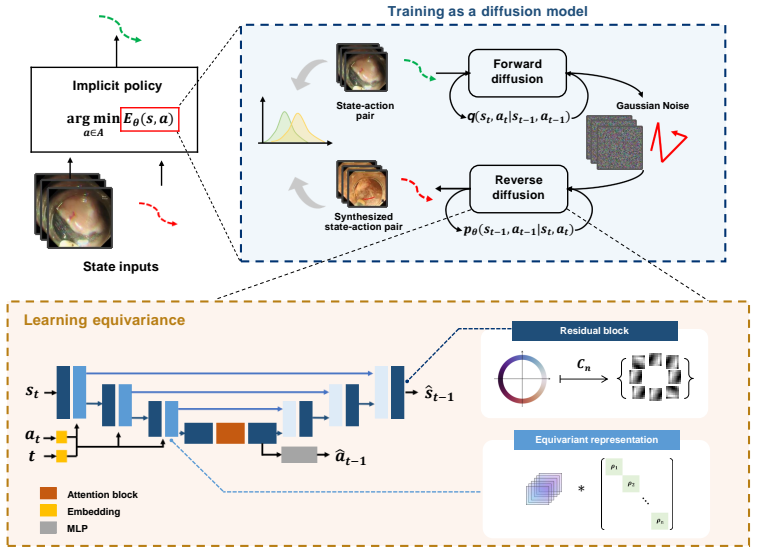
The central object is the implicit diffusion policy network, a U-Net with residual and attention blocks trained as an unconditional denoising diffusion model over the joint state–action pair $x = (s, a)$, where $s$ is the video-clip state and $a$ is the future dissection trajectory. The paper's key supporting identity is the conditional-sampling factorization in Eq. (4), $p_\theta(x_{t-1} \mid x_t, s^*) = p_\theta(x_{t-1} \mid x_t)\, q(s_t \mid s^*)$, which turns the learned unconditional denoiser into a predictor conditioned on an observed video clip $s^*$ by multiplying the denoising transition by a forward noising kernel from the observed state. Rotational equivariance is embedded by using $C_4$-equivariant convolutional layers in the network, so features transform predictably under discrete image rotations. The machinery's job is to let the same trained model generate synthetic trajectories unconditionally, then steer generation toward a specific video at inference time by diffusing the video state forward alongside the action denoising loop.
What would settle it
Train the same implicit diffusion policy but replace the forward-diffusion guidance with a properly trained conditional denoiser (for example, feeding the video frames as conditioning input or using classifier guidance), then re-run the in-context and out-of-context evaluations; if the product-kernel version in Eq. (4) does not at least match the properly conditioned variant, the reported advantage rests on an unvalidated sampling recipe rather than on the learned policy.
Extended reading notes
Core claim
On the paper's own terms, the central discovery is that an implicit policy represented by an unconditional diffusion model, trained to maximize the log-likelihood of the joint state–action distribution of expert demonstrations, predicts ESD dissection trajectories more accurately and with better generalization than explicit regression-based policies and prior implicit or diffusion-based trajectory predictors. The paper reports consistent improvements across all three metrics (ADE, FDE, FD) in both in-the-context and out-of-the-context evaluations, and its error standard deviations are lower as well. Two design choices carry the result: (1) representing the policy implicitly as a joint state–action density, which avoids averaging over the multiple plausible dissection paths that a deterministic behavior-cloning objective would collapse, and (2) conditioning the otherwise unconditional diffusion model at inference time through a forward-diffusion guided sampling loop that diffuses the observed video forward and denoises the action back. Rotational equivariance built into the U-Net backbone is what lets the learned policy transfer across rotated endoscopic scenes.
Load-bearing premise
The load-bearing premise is the conditional-sampling factorization in Eq. (4), which treats conditioning the denoising step on the observed video as a simple multiplication of the learned unconditional denoising transition by a forward noising kernel from the video to the noisy state, an identity the paper states without derivation.
Editorial extensions
If this is right
- If the reported gains are correct, iDPOE can serve as the basis for real-time dissection-trajectory guidance in ESD, running at roughly 23 FPS on a standard GPU.
- The implicit diffusion policy can generate synthetic expert dissection trajectories; the paper shows that mixing these synthetic trajectories with real ones improves behavior-cloning training, an affordable data-augmentation route for surgical skill models.
- Because the method generalizes to four unseen surgical cases in the out-of-the-context test set, it is a candidate for cross-patient and cross-scene deployment without per-case retraining.
- The equivariant representation is the paper's stated mechanism for improving generalization to geometric symmetries, and its ablation attributes a consistent margin to this component.
- If the method transfers to other endoscopic procedures, the same implicit-diffusion-with-forward-guidance recipe could become a general tool for procedure-agnostic trajectory prediction.
Reading between the lines
- A natural next step is to prove or empirically test the identity $p_\theta(x_{t-1} \mid x_t, s^*) = p_\theta(x_{t-1} \mid x_t)\, q(s_t \mid s^*)$, since the paper states it without derivation; if it fails, the guided-sampling recipe could be replaced by a properly derived conditional denoiser and the baseline comparison redone.
- The $C_4$ rotation group is a coarse discretization of the full planar rotation symmetry of dissection trajectories; extending to finer or continuous equivariance groups could yield further gains on highly varied endoscopic views.
- Because the implicit policy is trained as an unconditional generator, the same model can act as both predictor and data synthesizer; using its synthetic clips to pretrain downstream models such as phase recognition or tool tracking is a testable extension the paper does not explore.
- The out-of-the-context evaluation uses four unseen surgical cases; a leave-one-case-out cross-validation over all 40 collected videos would sharpen the generalization claim beyond what the paper reports.
Editorial analysis
A structured set of objections, weighed in public.
Referee Report
Summary. The paper proposes iDPOE, an implicit diffusion policy with equivariant representations for imitation learning, to predict Endoscopic Submucosal Dissection (ESD) dissection trajectories from expert endoscopic videos. It trains an unconditional DDPM-style model on joint state-action pairs and, at inference, uses a proposed "forward-diffusion guided" conditional sampler (Eq. 4) to inject the observed video. The method is evaluated on a private dataset of 1993 annotated clips from 40 ESD videos against BC, iBC, MID, LED, and SingularTrajectory, with ablations for implicit modeling, guidance, equivariance, synthetic data, and blurred conditions. The authors report consistent improvements in ADE/FDE/FD in both in-the-context and out-of-the-context settings and an inference speed of about 23 FPS.
Significance. If the results hold, this would be the first imitation-learning approach for dissection trajectory prediction and could be practically useful for surgical training and intraoperative guidance. The paper's strengths include a sizeable annotated clinical dataset, an evaluation on previously unseen surgical cases, ablations of the main components, and a computational-complexity analysis. However, the central conditional-sampling equation appears mathematically unsound, the empirical comparison lacks significance testing and baseline tuning details, and the out-of-the-context set is small; these issues place the main claim at risk and require a major revision.
major comments (4)
- [§3.4, Eq. (4)] The decomposition pθ(x_{t−1}|x_t,s*) = pθ(x_{t−1}|x_t) q(s_t|s*) is not a valid conditional reverse transition. For fixed x_t and s*, q(s_t|s*) is a scalar that does not depend on x_{t−1}; after normalization over x_{t−1}, the right-hand side is exactly pθ(x_{t−1}|x_t). Thus Eq. (4) does not introduce conditioning on s* in the probabilistic sense, and no derivation is given for the equality. The algorithm described in the text and Figure 3—denoising the action while the state channel is re-supplied as a forward-diffused version of s*—may be a useful heuristic, but it is not justified by Eq. (4). Since this sampler is the mechanism by which video observations are injected at inference, the reported gains over the baselines rest on an unsupported inference step. Please provide a correct derivation (e.g., using a likelihood p(s*|x_t) or an approximate guided-sampling formulation) or explicitly reframe the procedure as a heuristic and validate it against an alternative conditioning scheme.
- [§4.4, Table 1] The comparison reports only means and standard deviations with no number of independent runs, confidence intervals, or significance tests. For example, in the out-of-the-context set the FDE advantage of iDPOE over SingularTrajectory is 22.076±1.080 vs 22.996±2.367; with the reported standard deviations this difference is not self-evidently significant. In addition, no hyperparameter search or tuning budget is described for any baseline, so it is unclear whether the comparison is fair. Please add significance testing (or per-clip paired tests and effect sizes) and report the baseline tuning protocol.
- [§4.2] The out-of-the-context evaluation is based on only four previously unseen surgical cases (393 clips), and the in-the-context set is described as "consecutive frames selected from the same period in the training data," which suggests it may come from the same cases as training. The claim of generalization to "diverse surgical scenarios" needs a clearer case-level split and more unseen cases, or at least a discussion of the limits imposed by the four-case test set.
- [§3.1, Eq. (1)] The claimed equivalence max E[log πθ(a|s)] = max E[log pθ(s,a)] is not generally true: log πθ(a|s) = log pθ(s,a) − log pθ(s), and the state marginal pθ(s) also depends on θ. Unless pθ(s) is held fixed or the objective is explicitly defined as a surrogate, the diffusion training objective is not the behavior-cloning objective. The paper should clarify the exact objective being optimized and why maximizing the joint likelihood yields a valid policy.
minor comments (6)
- [§4.4] The text says "As shown in Table. 4.1" but should refer to Table 1; similar table-reference issues occur for Table 2 and Table 3.
- [§3.2, Eq. (2)] The norm notation in Eq. (2) is ambiguous: it is unclear whether the loss uses L2 norms or squared L2 norms, and the weighting parameter γ is not described in terms of a schedule or sensitivity analysis.
- [§3.5] The implementation section reports a fixed maximum of 200 epochs and a learning rate but does not state how the best checkpoint is selected or whether early stopping is used; please specify this for reproducibility.
- [§5.4] The synthetic-data augmentation experiment does not describe how the generated trajectories are filtered or validated for quality, and no significance testing is reported for the BC (synt) and BC (mix) comparisons.
- [§4.3] The Fréchet Distance metric is only described as measuring "geometrical similarity" between two temporal sequences; the precise discrete computation for length-6 polylines should be specified.
- [§1] The introduction states "To date, no data-driven solutions have been developed to predict dissection trajectories," which is inconsistent with the later disclosure that a preliminary version of this work appeared at MICCAI 2023 and with the cited trajectory-prediction works; the novelty claim should be qualified.
Circularity Check
No circularity found: the central claim is an independent empirical comparison against external baselines, and the only self-citation is a non-load-bearing lineage note.
full rationale
The paper's central claim is the empirical result in Table 1, where iDPOE is compared with external baselines (BC, iBC, MID, LED, SingularTrajectory) on an annotated ESD dataset using ADE/FDE/FD. No parameter is fitted to those target metrics, no benchmark is redefined in terms of the method's own output, and the comparison is self-contained against external methods. The training losses in Eqs. (1)-(2) follow standard diffusion-model practice and are cited to external work. The only self-citation is the statement in Section 1 that a preliminary version appeared in MICCAI 2023 [27]; it is a lineage note and is not used to justify any equation, exclude alternatives, or supply a uniqueness theorem. Section 3.4's Eq. (4) is asserted without derivation and, as written, is not a valid conditional reverse transition because q(st|s*) is constant in xt-1; however, that is a correctness/mathematical-validity risk, not a circular reduction, because the observed state s* genuinely enters the sampling loop as the source of the forward-diffused visual input. The synthetic-data augmentation experiment in Section 5.4 uses the model's own samples to train a BC baseline, but that is a separate downstream-utility analysis, not the headline prediction result. Therefore no circular step can be exhibited from the paper's equations or citations.
Assumptions & free parameters
free parameters (3)
- gamma (state-action noise weighting) =
not reported
- T diffusion steps =
not reported
- cyclic group C4 order =
4
assumptions (4)
- standard math DDPM ELBO reduces likelihood maximization to noise prediction (Ho et al., 2020)
- domain assumption Dissection trajectories and video states transform equivariantly under C4 rotations of the image plane
- ad hoc to paper Eq. (4) factorization ptheta(xt-1|xt,s*) = ptheta(xt-1|xt) q(st|s*)
- domain assumption Joint state-action density ptheta(s,a) learned unconditionally can be used to recover the optimal action after forward-diffusion guidance
Cite this review
Pith. "Pith review of Learning dissection trajectories from expert surgical videos via imitation learning with equivariant diffusion." pith.science (2026). https://pith.science/paper/GXHQTIBN
@misc{pith2026250604716,
  author       = {Pith},
  title        = {Pith review of: Learning dissection trajectories from expert surgical videos via imitation learning with equivariant diffusion},
  year         = {2026},
  howpublished = {\url{https://pith.science/paper/GXHQTIBN}},
  note         = {Machine review of arXiv:2506.04716}
}
read the original abstract
Endoscopic Submucosal Dissection (ESD) is a well-established technique for removing epithelial lesions. Predicting dissection trajectories in ESD videos offers significant potential for enhancing surgical skill training and simplifying the learning process, yet this area remains underexplored. While imitation learning has shown promise in acquiring skills from expert demonstrations, challenges persist in handling uncertain future movements, learning geometric symmetries, and generalizing to diverse surgical scenarios. To address these, we introduce a novel approach: Implicit Diffusion Policy with Equivariant Representations for Imitation Learning (iDPOE). Our method models expert behavior through a joint state action distribution, capturing the stochastic nature of dissection trajectories and enabling robust visual representation learning across various endoscopic views. By incorporating a diffusion model into policy learning, iDPOE ensures efficient training and sampling, leading to more accurate predictions and better generalization. Additionally, we enhance the model's ability to generalize to geometric symmetries by embedding equivariance into the learning process. To address state mismatches, we develop a forward-process guided action inference strategy for conditional sampling. Using an ESD video dataset of nearly 2000 clips, experimental results show that our approach surpasses state-of-the-art methods, both explicit and implicit, in trajectory prediction. To the best of our knowledge, this is the first application of imitation learning to surgical skill development for dissection trajectory prediction.
Figures


Figures from the paper (4 more)


Reference graph
Works this paper leans on
-
[1]
L. Maier-Hein, S. S. Vedula, S. Speidel, N. Navab, R. Kikinis, A. Park, M. Eisenmann, H. Feussner, G. Forestier, S. Giannarou, et al., Surgi- cal data science for next-generation interventions, Nature Biomedical Engineering 1 (9) (2017) 691–696
work page 2017
-
[2]
T. J. Loftus, P. J. Tighe, A. C. Filiberto, P. A. Efron, S. C. Braken- ridge, A. M. Mohr, P. Rashidi, G. R. Upchurch, A. Bihorac, Artificial intelligence and surgical decision-making, JAMA surgery 155 (2) (2020) 148–158
work page 2020
-
[3]
L. Maier-Hein, M. Eisenmann, D. Sarikaya, K. März, T. Collins, A. Mal- pani, J. Fallert, H. Feussner, S. Giannarou, P. Mascagni, et al., Surgical data science–from concepts toward clinical translation, Medical image analysis 76 (2022) 102306
work page 2022
-
[4]
C. R. Garrow, K.-F. Kowalewski, L. Li, M. Wagner, M. W. Schmidt, S.Engelhardt, D.A.Hashimoto, H.G.Kenngott, S.Bodenstedt, S.Spei- del, et al., Machine learning for surgical phase recognition: a systematic review, Annals of surgery 273 (4) (2021) 684–693
work page 2021
-
[5]
Y. Jin, Y. Long, X. Gao, D. Stoyanov, Q. Dou, P.-A. Heng, Trans-svnet: hybrid embedding aggregation transformer for surgical workflow analy- sis, International Journal of Computer Assisted Radiology and Surgery 17 (12) (2022) 2193–2202
work page 2022
- [6]
-
[7]
C. I. Nwoye, T. Yu, C. Gonzalez, B. Seeliger, P. Mascagni, D. Mut- ter, J. Marescaux, N. Padoy, Rendezvous: Attention mechanisms for the recognition of surgical action triplets in endoscopic videos, Medical Image Analysis 78 (2022) 102433
work page 2022
-
[8]
Z. Wang, Z. Yan, Y. Xing, H. Wang, Real-time trajectory prediction of laparoscopic instrument tip based on long short-term memory neural network in laparoscopic surgery training, The International Journal of Medical Robotics and Computer Assisted Surgery 18 (6) (2022) e2441
work page 2022
Show all 59 references
-
[9]
J. Guo, Y. Sun, S. Guo, A novel trajectory predicting method of catheter for the vascular interventional surgical robot, in: 2020 IEEE Interna- tional Conference on Mechatronics and Automation (ICMA), IEEE, 2020, pp. 1304–1309
2020
-
[10]
Y. Qin, S. Feyzabadi, M. Allan, J. W. Burdick, M. Azizian, davincinet: Joint prediction of motion and surgical state in robot-assisted surgery, in: 2020 IEEE/RSJ International Conference on Intelligent Robots and Systems (IROS), IEEE, 2020, pp. 2921–2928
2020
-
[11]
Zhang, Y
J. Zhang, Y. Nie, Y. Lyu, H. Li, J. Chang, X. Yang, J. J. Zhang, Sym- metric dilated convolution for surgical gesture recognition, in: Interna- tional Conference on Medical Image Computing and Computer-Assisted Intervention, Springer, 2020, pp. 409–418
2020
-
[12]
K. C. Lau, Y. Yam, P. W. Y. Chiu, An advanced endoscopic surgery robotic platform for removal of early-stage gastrointestinal cancer using endoscopic submucosal dissection (2021)
2021
-
[13]
E. Kim, K. Cho, K. Park, K. Lee, B. Jang, W. Chung, J. Hwang, Factors predictive of perforation during endoscopic submucosal dissection for the treatment of colorectal tumors, Endoscopy 43 (07) (2011) 573–578
2011
-
[14]
J. M. Laurence, P. D. Tran, A. J. Richardson, H. C. Pleass, V. W. Lam, Laparoscopic or open cholecystectomy in cirrhosis: a systematic review of outcomes and meta-analysis of randomized trials, Hpb 14 (3) (2012) 153–161
2012
-
[15]
J. Wang, Y. Jin, S. Cai, H. Xu, P.-A. Heng, J. Qin, L. Wang, Real- time landmark detection for precise endoscopic submucosal dissection 22 via shape-aware relation network, Medical Image Analysis 75 (2022) 102291
2022
-
[16]
Hussein, M
A. Hussein, M. M. Gaber, E. Elyan, C. Jayne, Imitation learning: A survey of learning methods, ACM Computing Surveys (CSUR) 50 (2) (2017) 1–35
2017
-
[17]
Kläser, T
K. Kläser, T. Varsavsky, P. Markiewicz, T. Vercauteren, A. Hammers, D. Atkinson, K. Thielemans, B. Hutton, M. J. Cardoso, S. Ourselin, Im- itation learning for improved 3d pet/mr attenuation correction, Medical image analysis 71 (2021) 102079
2021
-
[18]
Le Mero, D
L. Le Mero, D. Yi, M. Dianati, A. Mouzakitis, A survey on imitation learning techniques for end-to-end autonomous vehicles, IEEE Transac- tions on Intelligent Transportation Systems (2022)
2022
-
[19]
Codevilla, E
F. Codevilla, E. Santana, A. M. López, A. Gaidon, Exploring the limi- tations of behavior cloning for autonomous driving, in: Proceedings of the IEEE/CVF International Conference on Computer Vision, 2019, pp. 9329–9338
2019
-
[20]
Y. Li, J. Song, S. Ermon, Infogail: Interpretable imitation learning from visual demonstrations, Advances in Neural Information Processing Sys- tems 30 (2017)
2017
-
[21]
A. Ren, S. Veer, A. Majumdar, Generalization guarantees for imitation learning, in: Conference on Robot Learning, PMLR, 2021, pp. 1426– 1442
2021
-
[22]
L. Ke, S. Choudhury, M. Barnes, W. Sun, G. Lee, S. Srinivasa, Imita- tion learning as f-divergence minimization, in: Algorithmic Foundations of Robotics XIV: Proceedings of the Fourteenth Workshop on the Algo- rithmic Foundations of Robotics 14, Springer, 2021, pp. 313–329
2021
-
[23]
Florence, C
P. Florence, C. Lynch, A. Zeng, O. A. Ramirez, A. Wahid, L. Downs, A. Wong, J. Lee, I. Mordatch, J. Tompson, Implicit behavioral cloning, in: Conference on Robot Learning, PMLR, 2022, pp. 158–168
2022
-
[24]
Jarrett, I
D. Jarrett, I. Bica, M. van der Schaar, Strictly batch imitation learning by energy-based distribution matching, Advances in Neural Information Processing Systems 33 (2020) 7354–7365. 23
2020
-
[25]
Ganapathi, P
A. Ganapathi, P. Florence, J. Varley, K. Burns, K. Goldberg, A. Zeng, Implicit kinematic policies: Unifying joint and cartesian action spaces in end-to-end robot learning, in: 2022 International Conference on Robotics and Automation (ICRA), IEEE, 2022, pp. 2656–2662
2022
-
[26]
Y. Du, I. Mordatch, Implicit generation and modeling with energy based models, Advances in Neural Information Processing Systems 32 (2019)
2019
-
[27]
J. Li, Y. Jin, Y. Chen, H.-C. Yip, M. Scheppach, P. W.-Y. Chiu, Y. Yam, H. M.-L. Meng, Q. Dou, Imitation learning from expert video data for dissection trajectory prediction in endoscopic surgical procedure, in: In- ternational Conference on Medical Image Computing and Compute...
2023
-
[28]
Zhu, Q.-C
Y. Zhu, Q.-C. Wang, M.-D. Xu, Z. Zhang, J. Cheng, Y.-S. Zhong, Y.-Q. Zhang, W.-F. Chen, L.-Q. Yao, P.-H. Zhou, Q.-L. Li, Application of con- volutional neural network in the diagnosis of the invasion depth of gas- triccancerbasedonconventionalendoscopy, GastrointestinalEndosco...
2019 doi
-
[29]
J. Xia, T. Xia, J. Pan, F. Gao, S. Wang, Y.-Y. Qian, H. Wang, J. Zhao, X. Jiang, W.-B. Zou, et al., Use of artificial intelligence for detection of gastric lesions by magnetically controlled capsule endoscopy, Gastroin- testinal endoscopy 93 (1) (2021) 133–139
2021
-
[30]
H. Yang, C. Chen, Y. Chen, H. C. Yip, D. QI, Uncertainty estimation for safety-critical scene segmentation via fine-grained reward maximization, Advances in Neural Information Processing Systems 36 (2023) 36238– 36249
2023
-
[31]
N.Ghatwary, M.Zolgharni, X.Ye, Earlyesophagealadenocarcinomade- tection using deep learning methods, International journal of computer assisted radiology and surgery 14 (2019) 611–621
2019
-
[32]
Cao, H.-C
J. Cao, H.-C. Yip, Y. Chen, M. Scheppach, X. Luo, H. Yang, M. K. Cheng, Y. Long, Y. Jin, P. W.-Y. Chiu, et al., Intelligent surgical work- flow recognition for endoscopic submucosal dissection with real-time an- imal study, Nature Communications 14 (1) (2023) 6676. 24
2023
-
[33]
Toyer, R
S. Toyer, R. Shah, A. Critch, S. Russell, The magical benchmark for robust imitation, Advances in Neural Information Processing Systems 33 (2020) 18284–18295
2020
-
[34]
N. M. Shafiullah, Z. Cui, A. A. Altanzaya, L. Pinto, Behavior transform- ers: Cloningkmodes with one stone, Advances in neural information processing systems 35 (2022) 22955–22968
2022
-
[35]
A. Zeng, P. Florence, J. Tompson, S. Welker, J. Chien, M. Attarian, T. Armstrong, I. Krasin, D. Duong, V. Sindhwani, et al., Transporter networks: Rearranging the visual world for robotic manipulation, in: Conference on Robot Learning, PMLR, 2021, pp. 726–747
2021
-
[36]
Y. Du, S. Li, J. Tenenbaum, I. Mordatch, Improved contrastive diver- gence training of energy-based models, in: International Conference on Machine Learning, PMLR, 2021, pp. 2837–2848
2021
-
[37]
Mandlekar, D
A. Mandlekar, D. Xu, J. Wong, S. Nasiriany, C. Wang, R. Kulkarni, L. Fei-Fei, S. Savarese, Y. Zhu, R. Martín-Martín, What matters in learning from offline human demonstrations for robot manipulation, in: Conference on Robot Learning, PMLR, 2022, pp. 1678–1690
2022
-
[38]
Cohen, M
T. Cohen, M. Welling, Group equivariant convolutional networks, in: International conference on machine learning, PMLR, 2016, pp. 2990– 2999
2016
-
[39]
Finzi, S
M. Finzi, S. Stanton, P. Izmailov, A. G. Wilson, Generalizing convolu- tional neural networks for equivariance to lie groups on arbitrary contin- uous data, in: International Conference on Machine Learning, PMLR, 2020, pp. 3165–3176
2020
-
[40]
Fuchs, D
F. Fuchs, D. Worrall, V. Fischer, M. Welling, Se (3)-transformers: 3d roto-translation equivariant attention networks, Advances in neural in- formation processing systems 33 (2020) 1970–1981
2020
-
[41]
Dehmamy, R
N. Dehmamy, R. Walters, Y. Liu, D. Wang, R. Yu, Automatic symmetry discovery with lie algebra convolutional network, Advances in Neural Information Processing Systems 34 (2021) 2503–2515. 25
2021
-
[42]
van der Ouderaa, A
T. van der Ouderaa, A. Immer, M. van der Wilk, Learning layer-wise equivariances automatically using gradients, Advances in Neural Infor- mation Processing Systems 36 (2024)
2024
-
[43]
R. Wang, R. Walters, R. Yu, Approximately equivariant networks for imperfectly symmetric dynamics, in: International Conference on Ma- chine Learning, PMLR, 2022, pp. 23078–23091
2022
-
[44]
M. Xu, L. Yu, Y. Song, C. Shi, S. Ermon, J. Tang, Geodiff: A geometric diffusion model for molecular conformation generation, in: International Conference on Learning Representations, 2022
2022
-
[45]
Z. Wang, J. J. Hunt, M. Zhou, Diffusion policies as an expressive policy class for offline reinforcement learning, in: The Eleventh International Conference on Learning Representations, 2023
2023
-
[46]
A. Ajay, Y. Du, A. Gupta, J. B. Tenenbaum, T. S. Jaakkola, P. Agrawal, Is conditional generative modeling all you need for decision making?, in: The Eleventh International Conference on Learning Representations, 2023
2023
-
[47]
Janner, Y
M. Janner, Y. Du, J. Tenenbaum, S. Levine, Planning with diffusion for flexible behavior synthesis, in: International Conference on Machine Learning, PMLR, 2022, pp. 9902–9915
2022
-
[48]
Z. Xian, N. Gkanatsios, T. Gervet, T.-W. Ke, K. Fragkiadaki, Chained- diffuser: Unifying trajectory diffusion and keypose prediction for robotic manipulation, in: 7th Annual Conference on Robot Learning, 2023
2023
-
[49]
J. Ho, A. Jain, P. Abbeel, Denoising diffusion probabilistic models, Ad- vances in Neural Information Processing Systems 33 (2020) 6840–6851
2020
-
[50]
Weiler, G
M. Weiler, G. Cesa, General E(2)-Equivariant Steerable CNNs, in: Con- ference on Neural Information Processing Systems (NeurIPS), 2019
2019
-
[51]
G. Cesa, L. Lang, M. Weiler, A program to build E(N)-equivariant steer- able CNNs, in: International Conference on Learning Representations (ICLR), 2022
2022
-
[52]
T. S. Cohen, M. Geiger, M. Weiler, A general theory of equivariant cnns on homogeneous spaces, Advances in neural information processing systems 32 (2019). 26
2019
-
[53]
R. Wang, R. Walters, R. Yu, Incorporating symmetry into deep dynam- ics models for improved generalization, in: International Conference on Learning Representations, 2021
2021
-
[54]
Ronneberger, P
O. Ronneberger, P. Fischer, T. Brox, U-net: Convolutional networks for biomedical image segmentation, in: Medical image computing and computer-assisted intervention–MICCAI 2015: 18th international con- ference, Munich, Germany, October 5-9, 2015, proceedings, part III 18, Spri...
2015
-
[55]
Mohamed, K
A. Mohamed, K. Qian, M. Elhoseiny, C. Claudel, Social-stgcnn: A social spatio-temporal graph convolutional neural network for human trajec- tory prediction, in: Proceedings of the IEEE/CVF conference on com- puter vision and pattern recognition, 2020, pp. 14424–14432
2020
-
[56]
J. Sun, Q. Jiang, C. Lu, Recursive social behavior graph for trajectory prediction, in: Proceedings of the IEEE/CVF conference on computer vision and pattern recognition, 2020, pp. 660–669
2020
-
[57]
T. Gu, G. Chen, J. Li, C. Lin, Y. Rao, J. Zhou, J. Lu, Stochastic tra- jectory prediction via motion indeterminacy diffusion, in: Proceedings of the IEEE/CVF Conference on Computer Vision and Pattern Recog- nition, 2022, pp. 17113–17122
2022
-
[58]
W. Mao, C. Xu, Q. Zhu, S. Chen, Y. Wang, Leapfrog diffusion model for stochastic trajectory prediction, in: Proceedings of the IEEE/CVF Conference on Computer Vision and Pattern Recognition, 2023, pp. 5517–5526
2023
-
[59]
Bae, Y.-J
I. Bae, Y.-J. Park, H.-G. Jeon, Singulartrajectory: Universal trajectory predictor using diffusion model, in: Proceedings of the IEEE/CVF Con- ference on Computer Vision and Pattern Recognition, 2024. 27
2024
Reviewed August 7, 2026 · model on record in the stance chip above.
Discussion (0). Sign in to comment.