REVIEW 4 major objections 5 minor 1 cited by
Towards End-to-End Earthquake Monitoring Using a Multitask Deep Learning Model
T0 review · 4 major / 5 minor · reviewed 2026-08-07 · deepseek-v4-flash
Pith's one-line read PhaseNet+ simultaneously picks phases, reads polarities, and estimates origin times from raw waveforms.
desk verdict Useful incremental multitask model with a genuinely new combination, but the origin-time association claim is under-specified and not independently validated. read the letter →
The pith
A machine-rendered reading of the paper's core claim, the machinery that carries it, and where it could break.
The reading
What carries the argument
The central object is the multitask U-Net architecture of PhaseNet+: a shared encoder feeding three branches, namely a phase arrival-time segmentation branch that labels P, S, and noise; a polarity branch that outputs a per-sample score in $[-1,1]$ on the vertical component; and an event-detection branch that both segments the midpoint of P and S arrival times and regresses the origin time. The load-bearing identity is the station-level origin-time proxy: the midpoint of P and S arrival times approximates the origin time up to a distance-dependent offset, and the regression branch learns that correction, so phase association reduces to grouping picks with similar predicted origin times. This shared-encoder design lets the three tasks reinforce one another, and the origin-time branch is what makes a single forward pass sufficient to provide association constraints.
What would settle it
Apply PhaseNet+ to a sequence with a high-precision reference catalog that includes near-simultaneous earthquakes, and check whether predicted origin times separate events whose true origin times differ by less than about 2 s; if a substantial fraction of associations merge or split at that threshold, the origin-time short-cut fails. A companion check is to measure origin-time prediction error as a function of epicentral distance beyond about 100 km, since the paper already reports growing errors for travel times exceeding 15 s, and to test whether association accuracy degrades exactly in that regime.
Extended reading notes
Core claim
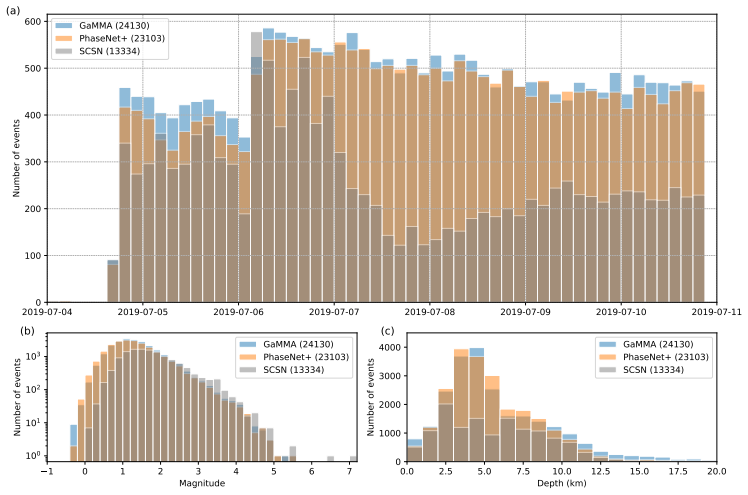
PhaseNet+ performs phase arrival-time picking, first-motion polarity determination, and origin-time prediction for phase association in a single forward pass, built on a shared U-Net encoder with three output branches. The phase arrival and polarity branches share hidden layers; polarity is scored in $[-1,1]$ at every sample of the vertical component, and the arrival-time branch determines where on the waveform the polarity score is read. Event detection is framed as a segmentation task that locates the midpoint of P and S arrival times, and the origin time is predicted by regression, so that phase association becomes the grouping of picks with similar predicted origin times. Trained on the California Earthquake Event Dataset, the model matches PhaseNet in pick timing, matches or beats the CNN Ross baseline in polarity classification, and keeps origin-time errors mostly within 2 s. In the 2019 Ridgecrest application, the workflow produced 23,103 events (73-81% more than the SCSN catalog), less spatial scatter than the GaMMA-based reference association, and up to 7,815 focal mechanism solutions from combined polarity and S/P amplitude ratio data.
Load-bearing premise
The load-bearing premise is that a station-level origin-time estimate, learned from the average of P and S arrival times with errors mostly within 2 s, is accurate enough to separate distinct earthquakes even in dense aftershock sequences where events can occur nearly simultaneously.
Editorial extensions
If this is right
- A single scan of continuous waveforms can yield picks, polarities, and origin times, so earthquake catalogs can be built without running separate phase-picking, polarity-picking, and association models.
- Because polarity is extracted directly from the phase-arrival branch, the model reclassifies roughly 50-60% of manual 'unknown' polarities as up or down, increasing the yield of usable first-motion readings for focal mechanism inversions.
- On the 2019 Ridgecrest sequence the end-to-end workflow produced 73-81% more events than the SCSN catalog and focal mechanism counts up to about four times SCSN's, with faulting style and stress directions consistent across catalogs.
- The multitask template is not specific to PhaseNet: any sequence-to-sequence phase picker, such as EQTransformer or PhaseNO, can be extended the same way.
- The workflow separates perception (picking, polarity, association constraints) from physics-based inversion (location, focal mechanism), so deep learning handles pattern recognition while geophysical inversion preserves physical constraints.
Reading between the lines
- If the origin-time proxy degrades with distance, as the paper's own error growth beyond 15 s travel time suggests, the association shortcut may need a distance-aware correction or a hybrid approach when networks include far stations.
- The multitask design could be extended to multi-station input, so that origin-time consistency across stations is learned jointly rather than combined afterwards; the paper notes this as a possibility but does not implement it.
- Applying PhaseNet+ to induced or volcanic sequences, where event rates and waveform similarity differ from California, would test whether the polarity-reclassification gain and origin-time association margins transfer beyond the training region.
- The reported four-fold increase in focal mechanisms implies that even small events, which routine catalogs leave without mechanisms, may carry usable polarity information; this could change how completeness of mechanism catalogs is measured.
Editorial analysis
A structured set of objections, weighed in public.
Referee Report
Summary. The manuscript presents PhaseNet+, a multitask extension of the PhaseNet phase-picking architecture that jointly outputs P/S arrival-time picks, first-motion polarities, and a per-station origin-time estimate intended to support phase association. The authors train PhaseNet+ on the Northern California portion of the CEED dataset and evaluate it on 2023 data from Northern and Southern California, comparing phase picking with PhaseNet, polarity picking with the CNN Ross model, and origin-time accuracy against manually reviewed labels. They then apply the model to one week of the 2019 Ridgecrest sequence, producing an event catalog via origin-time-based association and a focal-mechanism catalog using SKHASH. The reported results show phase-picking parity with PhaseNet, polarity accuracy comparable or superior to the CNN Ross baseline, origin-time errors mostly within 2 s, a PhaseNet+ catalog with 73–81% more events than SCSN and less spatial scatter than a GaMMA catalog built from the same picks, and up to 7,815 focal mechanism solutions. The central claim is that origin-time prediction enables a simplified end-to-end association workflow that rivals dedicated phase association methods.
Significance. If the central claim is upheld, PhaseNet+ would be a practically valuable contribution: a single model that simultaneously provides phase picks, polarities, and origin-time constraints could streamline earthquake monitoring pipelines and make focal-mechanism catalogs much more complete. The authors provide code and promise SeisBench integration, and the training/evaluation on a large, publicly available dataset is a strength. The phase-picking comparison against PhaseNet is a clean same-training-set test, and the Ridgecrest application demonstrates a realistic use case. However, the novelty rests on the origin-time association concept, and that concept is underspecified and under-validated in the manuscript as written. Because the association step is not described as an algorithm and is only tested on preselected single-event waveforms, the event-catalog comparisons in Section 3.2 are not yet sufficient to establish that PhaseNet+ rivals state-of-the-art association methods.
major comments (4)
- [§2.1, phase association paragraph] The manuscript says phase association 'simplifies to identifying picks with shared onset times,' but no concrete algorithm is given. There is no description of how per-station origin-time predictions are turned into associated events: no clustering method, no threshold on origin-time agreement, no procedure for handling multiple events at one station, and no treatment of false or missing origin-time predictions. This is the core novelty of the paper, and without this specification the PhaseNet+ catalog in §3.2 cannot be reproduced and the comparison with GaMMA is not interpretable. The authors should provide a precise association procedure, including any hyperparameters, or clearly state that the association is performed by an external algorithm whose inputs include the origin-time predictions.
- [§3.2 and Figure 9] The claim that the end-to-end approach 'rival[s] state-of-the-art methods' is supported only by internal comparisons: the PhaseNet+ catalog is compared with SCSN and with a GaMMA catalog built from the same PhaseNet+ picks, but there is no independent ground-truth association reference. The 73–81% increase in event count over SCSN and the reduced spatial scatter relative to GaMMA could be influenced by association artifacts, such as splitting one earthquake into multiple events or merging distinct events with similar origin times. The acknowledged limitation in §4 that origin-time association 'becomes less effective when multiple earthquakes occur nearly simultaneously' is directly relevant to the dense aftershock setting of the Ridgecrest application. A validation against a high-quality reference catalog for the same period, e.g., Shelly (2020), or against at least a set of manually reviewed associations, is needed before the 'rival state-of-the-art' conclusion can be accepted.
- [§3.1.2 and Figure 5] The polarity comparison with 'CNN Ross' is not apples-to-apples. The CNN Ross model is described as pre-trained on Southern California data prior to 2018, whereas PhaseNet+ was trained on the Northern California CEED training set (with a different task formulation and architecture). On the Southern California 2023 test set, the comparison is between a model trained on Northern California and a model trained on older Southern California data; on the Northern California 2023 test set, CNN Ross is evaluated out-of-region. The conclusion that PhaseNet+ achieves 'comparable or superior performance' is plausible, but the asymmetry in training data makes the quantitative comparison difficult to interpret. The authors should either retrain CNN Ross on the same Northern California training data, or at least clearly qualify the comparison as a benchmark against a published, frozen baseline rather than a matched model comparison.
- [§3.1.3 and §4] The origin-time accuracy evaluation in Figure 7 is performed on isolated, pre-selected test waveforms, not on continuous data with overlapping or near-simultaneous events. The stated purpose of origin-time prediction is phase association in continuous data, yet no experiment measures how well the origin-time predictions separate distinct events in a continuous stream. The §4 statement that the approach 'becomes less effective when multiple earthquakes occur nearly simultaneously, e.g., in dense aftershock sequences' is in tension with the §3.2 claim that the method 'works as effectively for dense aftershocks as dedicated phase association algorithms.' The authors should add a continuous-data evaluation, even a small annotated segment, that tests association performance against known event times, or explicitly narrow the claim about dense aftershock performance.
minor comments (5)
- [§3.2, paragraph on catalogs] The SCSN earthquake catalog is attributed to Yang et al. (2012), but Yang et al. (2012) is the Southern California focal mechanism catalog; the routine SCSN event catalog is more commonly attributed to the Southern California Seismic Network/SCEDC (e.g., Hutton et al., 2010). Please clarify the source of the SCSN event catalog used in Figure 9.
- [Open research statement] The code is hosted in the EQNet repository, but the paper announces PhaseNet+ as an extension; please provide a specific tag, branch, or model checkpoint identifier so that the exact PhaseNet+ version trained and evaluated here can be retrieved reproducibly.
- [Figure 8 caption] The caption says 'green ticks indicating predicted earthquake origin times' but the histogram in panel (b) is not explicitly linked to the per-station green ticks; a sentence clarifying how the histogram is built from the per-station predictions would improve readability.
- [§3.2, focal mechanism section] The inversion with SKHASH uses 'SP amplitude ratio data,' but the manuscript does not describe how the S/P amplitude ratios are measured from the PhaseNet+ outputs or whether they come from a separate routine. A brief description or reference for this measurement step would make the focal-mechanism workflow more complete.
- [Throughout] There are a few minor grammatical issues, such as 'detecting the average of P and S arrival-times as a segmentation task' in §2.1, where 'detecting' should be 'predicting' or 'estimating' for clarity.
Circularity Check
No significant circularity: the perception tasks are validated on held-out external labels, and the Ridgecrest application is an empirical demonstration rather than a derivation from its own fit.
full rationale
No circularity found. PhaseNet+ is trained on the CEED dataset with manually labeled phase picks, polarities, and origin times, and the task-level evaluations are performed on held-out 2023 Northern and Southern California data against external manual labels, so the per-task performance claims do not reduce to the training labels. The Ridgecrest application is an empirical case study: model outputs are processed by ADLoc and SKHASH and compared with SCSN, a GaMMA catalog built from the same picks, and the Cheng et al. (2023) catalog. The GaMMA reference and PhaseNet+ sharing the same PhaseNet+ picks means the comparison isolates the association mechanism, but this is a validation-design limitation, not a circular derivation. The origin-time association step is not fully specified (no clustering algorithm, threshold, or handling of overlapping events is given), which is a reproducibility concern, not a self-referential reduction. The paper's own Section 4 explicitly acknowledges that origin-time association 'becomes less effective when multiple earthquakes occur nearly simultaneously, e.g., in dense aftershock sequences,' further showing that the limitation is disclosed rather than hidden. Citations to the authors' prior PhaseNet, CEED, GaMMA, EQNet, and ADLoc work are normal method-building and baseline references; they are independent published tools and do not import the present paper's results as premises. No equation, fitted parameter, or learned target is renamed as a prediction in a way that forces the central claims.
Assumptions & free parameters
free parameters (2)
- Polarity score thresholds =
+/-0.33
- Polarity loss weight =
0.2
assumptions (3)
- domain assumption A station-level origin time can be approximated by the average of P and S arrival times.
- domain assumption Manual phase picks and polarity labels in the CEED and NCEDC/SCEDC datasets are accurate enough to serve as ground truth.
- domain assumption A shared U-Net-style encoder can learn representations useful for all three tasks simultaneously.
Cite this review
Pith. "Pith review of Towards End-to-End Earthquake Monitoring Using a Multitask Deep Learning Model." pith.science (2026). https://pith.science/paper/UKDXFZYM
@misc{pith2026250606939,
  author       = {Pith},
  title        = {Pith review of: Towards End-to-End Earthquake Monitoring Using a Multitask Deep Learning Model},
  year         = {2026},
  howpublished = {\url{https://pith.science/paper/UKDXFZYM}},
  note         = {Machine review of arXiv:2506.06939}
}
read the original abstract
Seismic waveforms contain rich information about earthquake processes, making effective data analysis crucial for earthquake monitoring, source characterization, and seismic hazard assessment. With rapid developments in deep learning, the state-of-the-art approach in artificial intelligence, many neural network models have been developed to enhance earthquake monitoring tasks, such as earthquake detection, phase picking, and phase association. However, most current efforts focus on developing separate models for each specific task, leaving the potential of an end-to-end framework relatively unexplored. To address this gap, we extend an existing phase picking model, PhaseNet, to create a multitask framework. This extended model, PhaseNet+, simultaneously performs phase arrival-time picking, first-motion polarity determination, and phase association. The outputs from these perception-based models can then be processed by specialized physics-based algorithms to accurately determine earthquake location and focal mechanism. The multitask approach is not limited to the PhaseNet model and can be applied to other state-of-the-art phase picking models, ultimately improving seismic monitoring through a more unified and efficient approach.
Figures


Figures from the paper (9 more)




Forward citations
Cited by 1 Pith paper
-
VORA: Rapid Association of Earthquake Phases from Local to Global
VORA associates earthquake phases via unsupervised spatio-temporal clustering of origin times on a Voronoi station graph, delivering fastest runtime and local-to-global scalability without training.
Reference graph
Works this paper leans on
-
[1]
allen1978automatic APACrefauthors Allen, R V. APACrefauthors \ 1978 . Automatic Earthquake Recognition and Timing from Single Traces Automatic earthquake recognition and timing from single traces . Bulletin of the seismological society of America 68 5
work page 1978
-
[2]
amodei2016deep APACrefauthors Amodei, D. , Ananthanarayanan, S. , Anubhai, R. , Bai, J. , Battenberg, E. , Case, C. others APACrefauthors \ 2016 . Deep speech 2: End-to-end speech recognition in english and mandarin Deep speech 2: End-to-end speech recognition in english and mandarin . International conference on machine learning International conference ...
work page 2016
-
[3]
chai2020using APACrefauthors Chai, C. , Maceira, M. , Santos-Villalobos, H J. , Venkatakrishnan, S V. , Schoenball, M. , Zhu, W. Team, E C. APACrefauthors \ 2020 . Using a deep neural network and transfer learning to bridge scales for seismic phase picking Using a deep neural network and transfer learning to bridge scales for seismic phase picking . Geoph...
work page 2020
-
[4]
chen2024f5tts APACrefauthors Chen, Y. , Niu, Z. , Ma, Z. , Deng, K. , Wang, C. , Zhao, J. Chen, X. APACrefauthors \ 2024 10 . F5- TTS : A Fairytaler That Fakes Fluent and Faithful Speech with Flow Matching F5- TTS : A fairytaler that fakes fluent and faithful speech with flow matching \ ( \ arXiv:2410.06885). arXiv
arXiv 2024
-
[5]
cheng2020variations APACrefauthors Cheng, Y. \ Ben-Zion, Y. APACrefauthors \ 2020 . Variations of earthquake properties before, during, and after the 2019 M7. 1 Ridgecrest, CA, earthquake Variations of earthquake properties before, during, and after the 2019 m7. 1 ridgecrest, ca, earthquake . Geophysical Research Letters 47 18 e2020GL089650
work page 2020
-
[6]
cheng2023refineda APACrefauthors Cheng, Y. , Hauksson, E. \ Ben-Zion , Y. APACrefauthors \ 2023 . Refined Earthquake Focal Mechanism Catalog for Southern California Derived With Deep Learning Algorithms Refined Earthquake Focal Mechanism Catalog for Southern California Derived With Deep Learning Algorithms . Journal of Geophysical Research: Solid Earth 128 2
work page 2023
-
[7]
guo2018dynamic APACrefauthors Guo, M. , Haque, A. , Huang, D A. , Yeung, S. \ Fei-Fei, L. APACrefauthors \ 2018 . Dynamic task prioritization for multitask learning Dynamic task prioritization for multitask learning . Proceedings of the European conference on computer vision (ECCV) Proceedings of the european conference on computer vision (eccv) \ ( \ 270--287)
work page 2018
- [8]
Show all 72 references
-
[9]
\ Shearer, P M
hardebeck2002new APACrefauthors Hardebeck, J L. \ Shearer, P M. APACrefauthors \ 2002 . A new method for determining first-motion focal mechanisms A new method for determining first-motion focal mechanisms . Bulletin of the Seismological Society of America 92 6 2264--2276
2002
-
[10]
\ Shearer, P M
hardebeck2003using APACrefauthors Hardebeck, J L. \ Shearer, P M. APACrefauthors \ 2003 . Using S/P amplitude ratios to constrain the focal mechanisms of small earthquakes Using s/p amplitude ratios to constrain the focal mechanisms of small earthquakes . Bulletin of the Seism...
2003
-
[11]
, Woessner, J
hutton2010earthquake APACrefauthors Hutton, K. , Woessner, J. \ Hauksson, E. APACrefauthors \ 2010 . Earthquake monitoring in southern California for seventy-seven years (1932--2008) Earthquake monitoring in southern california for seventy-seven years (1932--2008) . Bulletin o...
2010
-
[12]
, Zhang, P
jiang2022detailed APACrefauthors Jiang, C. , Zhang, P. , White, M C. , Pickle, R. \ Miller, M S. APACrefauthors \ 2022 . A detailed earthquake catalog for Banda Arc--Australian plate collision zone using machine-learning phase picker and an automated workflow A detailed earthq...
2022
-
[13]
, Ellsworth, W
kissling1994initial APACrefauthors Kissling, E. , Ellsworth, W. , Eberhart-Phillips, D. \ Kradolfer, U. APACrefauthors \ 1994 . Initial reference models in local earthquake tomography Initial reference models in local earthquake tomography . Journal of Geophysical Research: So...
1994
-
[14]
APACrefauthors \ 2002
klein2002user APACrefauthors Klein, F W. APACrefauthors \ 2002 . User's guide to HYPOINVERSE-2000, a Fortran program to solve for earthquake locations and magnitudes User's guide to hypoinverse-2000, a fortran program to solve for earthquake locations and magnitudes \ . US Geo...
2002
-
[15]
, Thomas, A
lin2023detection APACrefauthors Lin, J T. , Thomas, A. , Bachelot, L. , Toomey, D. , Searcy, J. \ Melgar, D. APACrefauthors \ 2023 . Detection of Hidden Low-Frequency Earthquakes in Southern Vancouver Island with Deep Learning Detection of hidden low-frequency earthquakes in s...
2023
-
[16]
liu2023complexity APACrefauthors Liu, M. , Li, L. , Zhang, M. , Lei, X. , Nedimovi \'c , M R. , Plourde, A P. Li, H. APACrefauthors \ 2023 . Complexity of initiation and evolution of the 2013 Yunlong earthquake swarm Complexity of initiation and evolution of the 2013 yunlong e...
2023
-
[17]
, Zhang, M
liu2020rapid APACrefauthors Liu, M. , Zhang, M. , Zhu, W. , Ellsworth, W L. \ Li, H. APACrefauthors \ 2020 . Rapid Characterization of the July 2019 Ridgecrest , California , Earthquake Sequence from Raw Seismic Data Using Machine-Learning Phase Picker Rapid characterization o...
2020
-
[18]
, Johns, E
liu2019end APACrefauthors Liu, S. , Johns, E. \ Davison, A J. APACrefauthors \ 2019 . End-to-end multi-task learning with attention End-to-end multi-task learning with attention . Proceedings of the IEEE/CVF conference on computer vision and pattern recognition Proceedings of ...
2019
-
[19]
, Virieux, J
lomax2000probabilistic APACrefauthors Lomax, A. , Virieux, J. , Volant, P. \ Berge-Thierry, C. APACrefauthors \ 2000 . Probabilistic earthquake location in 3D and layered models: Introduction of a Metropolis-Gibbs method and comparison with linear locations Probabilistic earth...
2000 doi
-
[20]
\ Hutter, F
loshchilov2017decoupled APACrefauthors Loshchilov, I. \ Hutter, F. APACrefauthors \ 2017 . Decoupled weight decay regularization Decoupled weight decay regularization . arXiv preprint arXiv:1711.05101
2017 arXiv
-
[21]
\ Beroza, G C
mcbrearty2023earthquake APACrefauthors McBrearty, I W. \ Beroza, G C. APACrefauthors \ 2023 . Earthquake phase association with graph neural networks Earthquake phase association with graph neural networks . Bulletin of the Seismological Society of America 113 2 524--547
2023
-
[22]
, Delorey, A A
mcbrearty2019pairwise APACrefauthors McBrearty, I W. , Delorey, A A. \ Johnson, P A. APACrefauthors \ 2019 . Pairwise association of seismic arrivals with convolutional neural networks Pairwise association of seismic arrivals with convolutional neural networks . Seismological ...
2019
-
[23]
, Ellsworth, W L
mousavi2020earthquake APACrefauthors Mousavi, S M. , Ellsworth, W L. , Zhu, W. , Chuang, L Y. \ Beroza, G C. APACrefauthors \ 2020 . Earthquake Transformer---an Attentive Deep-Learning Model for Simultaneous Earthquake Detection and Phase Picking Earthquake transformer---an at...
2020
-
[24]
APACrefauthors \ 2024
munchmeyer2024pyocto APACrefauthors M \"u nchmeyer, J. APACrefauthors \ 2024 . PyOcto: A high-throughput seismic phase associator Pyocto: A high-throughput seismic phase associator . Seismica 3 1
2024
-
[25]
, Giffard-Roisin, S
munchmeyer2024deep APACrefauthors M \"u nchmeyer, J. , Giffard-Roisin, S. , Malfante, M. , Frank, W B. , Poli, P. , Marsan, D. \ Socquet, A. APACrefauthors \ 2024 . Deep learning detects uncataloged low-frequency earthquakes across regions Deep learning detects uncataloged low...
2024
-
[26]
, Woollam, J
munchmeyer2022which APACrefauthors M \"u nchmeyer, J. , Woollam, J. , Rietbrock, A. , Tilmann, F. , Lange, D. , Bornstein, T. Soto, H. APACrefauthors \ 2022 . Which Picker Fits My Data ? A Quantitative Evaluation of Deep Learning Based Seismic Pickers Which Picker Fits My Data...
2022
-
[27]
APACrefauthors \ 2014
ncedc2014northern APACrefauthors NCEDC. APACrefauthors \ 2014 . Northern California Earthquake Data Center . Northern California Earthquake Data Center . APACrefDOI doi:10.7932/NCEDC APACrefDOI
2014 doi
-
[28]
, Chuang, L Y
neves2024complex APACrefauthors Neves, M. , Chuang, L Y. , Li, W. , Peng, Z. , Figueiredo, P M. \ Ni, S. APACrefauthors \ 2024 . Complex rupture dynamics of the extremely shallow August 2020 M5. 1 Sparta, North Carolina earthquake Complex rupture dynamics of the extremely shal...
2024
-
[29]
, Beroza, G C
park2022basement APACrefauthors Park, Y. , Beroza, G C. \ Ellsworth, W L. APACrefauthors \ 2022 . Basement Fault Activation before Larger Earthquakes in Oklahoma and Kansas Basement fault activation before larger earthquakes in Oklahoma and Kansas . The Seismic Record 2 3
2022
-
[30]
, Mousavi, S M
park2020machine APACrefauthors Park, Y. , Mousavi, S M. , Zhu, W. , Ellsworth, W L. \ Beroza, G C. APACrefauthors \ 2020 . Machine-Learning-Based Analysis of the Guy-Greenbrier , Arkansas Earthquakes: A Tale of Two Sequences Machine-learning-based analysis of the Guy-Greenbrie...
2020
-
[31]
peng2025microseismic APACrefauthors Peng, L. , Li, L. \ Zeng, X. APACrefauthors \ 2025 . A Microseismic Phase Picking and Polarity Determination Model Based on the Earthquake Transformer A microseismic phase picking and polarity determination model based on the earthquake tran...
2025
-
[32]
, Saurel, J M
retailleau2022automatic APACrefauthors Retailleau, L. , Saurel, J M. , Laporte, M. , Lavayssi \`e re, A. , Ferrazzini, V. , Zhu, W. others APACrefauthors \ 2022 . Automatic Detection for a Comprehensive View of Mayotte Seismicity Automatic detection for a comprehensive view of...
2022
-
[33]
, Fischer, P
ronneberger2015unet APACrefauthors Ronneberger, O. , Fischer, P. \ Brox, T. APACrefauthors \ 2015 . U- Net : Convolutional Networks for Biomedical Image Segmentation U- Net : Convolutional Networks for Biomedical Image Segmentation . N. Navab, J. Hornegger, W M. Wells \ A F. F...
2015
-
[34]
, Idini, B
ross2019hierarchical APACrefauthors Ross, Z E. , Idini, B. , Jia, Z. , Stephenson, O L. , Zhong, M. , Wang, X. others APACrefauthors \ 2019 . Hierarchical interlocked orthogonal faulting in the 2019 Ridgecrest earthquake sequence Hierarchical interlocked orthogonal faulting in...
2019
-
[35]
, Meier, M A
ross2018p APACrefauthors Ross, Z E. , Meier, M A. \ Hauksson, E. APACrefauthors \ 2018 . P Wave Arrival Picking and First-Motion Polarity Determination with Deep Learning P wave arrival picking and first-motion polarity determination with deep learning . Journal of Geophysical...
2018
-
[36]
, Meier, M A
ross2018generalized APACrefauthors Ross, Z E. , Meier, M A. , Hauksson, E. \ Heaton, T H. APACrefauthors \ 2018 . Generalized Seismic Phase Detection with Deep Learning Generalized seismic phase detection with deep learning . Bulletin of the Seismological Society of America 108 5A
2018
-
[37]
, Trugman, D T
ross2019searching APACrefauthors Ross, Z E. , Trugman, D T. , Hauksson, E. \ Shearer, P M. APACrefauthors \ 2019 . Searching for hidden earthquakes in Southern California Searching for hidden earthquakes in southern california . Science 364 6442 767--771
2019
-
[38]
, Yue, Y
ross2019phaselink APACrefauthors Ross, Z E. , Yue, Y. , Meier, M A. , Hauksson, E. \ Heaton, T H. APACrefauthors \ 2019 . PhaseLink: A deep learning approach to seismic phase association Phaselink: A deep learning approach to seismic phase association . Journal of Geophysical ...
2019
-
[39]
APACrefauthors \ 2013
scedc2013southern APACrefauthors SCEDC. APACrefauthors \ 2013 . Southern California Earthquake Center. Caltech. Dataset. Southern California Earthquake Center. Caltech. Dataset. APACrefDOI doi:10.7909/C3WD3xH1 APACrefDOI
2013 doi
-
[40]
APACrefauthors \ 2019
shearer2019introduction APACrefauthors Shearer, P M. APACrefauthors \ 2019 . Introduction to seismology Introduction to seismology . Cambridge university press
2019
-
[41]
, Prieto, G A
shearer2006comprehensive APACrefauthors Shearer, P M. , Prieto, G A. \ Hauksson, E. APACrefauthors \ 2006 . Comprehensive analysis of earthquake source spectra in southern California Comprehensive analysis of earthquake source spectra in southern california . Journal of Geophy...
2006
-
[42]
APACrefauthors \ 2020
shelly2020high APACrefauthors Shelly, D R. APACrefauthors \ 2020 . A High-Resolution Seismic Catalog for the Initial 2019 Ridgecrest Earthquake Sequence: Foreshocks , Aftershocks, and Faulting Complexity A high-resolution seismic catalog for the initial 2019 Ridgecrest earthqu...
2020
-
[43]
, Meier, M A
shi2024labquakes APACrefauthors Shi, P. , Meier, M A. , Villiger, L. , Tuinstra, K. , Selvadurai, P A. , Lanza, F. others APACrefauthors \ 2024 . From labquakes to megathrusts: Scaling deep learning based pickers over 15 orders of magnitude From labquakes to megathrusts: Scali...
2024
-
[44]
si2024all APACrefauthors Si, X. , Wu, X. , Li, Z. , Wang, S. \ Zhu, J. APACrefauthors \ 2024 . An all-in-one seismic phase picking, location, and association network for multi-task multi-station earthquake monitoring An all-in-one seismic phase picking, location, and associati...
2024
-
[45]
, Hardebeck, J L
skoumal2024skhash APACrefauthors Skoumal, R J. , Hardebeck, J L. \ Shearer, P M. APACrefauthors \ 2024 04 . SKHASH : A Python Package for Computing Earthquake Focal Mechanisms SKHASH : A Python Package for Computing Earthquake Focal Mechanisms . Seismological Research Letters
2024
-
[46]
, Ross, Z E
sun2023phase APACrefauthors Sun, H. , Ross, Z E. , Zhu, W. \ Azizzadenesheli, K. APACrefauthors \ 2023 . Phase Neural Operator for Multi-Station Picking of Seismic Arrivals Phase Neural Operator for Multi-Station Picking of Seismic Arrivals . Geophysical Research Letters 50 24...
2023
-
[47]
, Waldhauser, F
tan2021machine APACrefauthors Tan, Y J. , Waldhauser, F. , Ellsworth, W L. , Zhang, M. , Zhu, W. , Michele, M. Segou, M. APACrefauthors \ 2021 . Machine-Learning-Based High-Resolution Earthquake Catalog Reveals How Complex Fault Structures Were Activated during the 2016--2017 ...
2021
-
[48]
, Inbal, A
thomas2021identification APACrefauthors Thomas, A M. , Inbal, A. , Searcy, J. , Shelly, D R. \ B \"u rgmann, R. APACrefauthors \ 2021 . Identification of low-frequency earthquakes on the San Andreas Fault with deep learning Identification of low-frequency earthquakes on the sa...
2021
-
[49]
\ Shearer, P M
trugman2017growclust APACrefauthors Trugman, D T. \ Shearer, P M. APACrefauthors \ 2017 . GrowClust: A hierarchical clustering algorithm for relative earthquake relocation, with application to the Spanish Springs and Sheldon, Nevada, earthquake sequences Growclust: A hierarchi...
2017
-
[50]
APACrefauthors \ 2001
waldhauser2001hypodd APACrefauthors Waldhauser, F. APACrefauthors \ 2001 . HypoDD-A program to compute double-difference hypocenter locations Hypodd-a program to compute double-difference hypocenter locations \
2001
-
[51]
\ Ellsworth, W L
waldhauser2000double APACrefauthors Waldhauser, F. \ Ellsworth, W L. APACrefauthors \ 2000 . A Double-Difference Earthquake Location Algorithm: Method and Application to the Northern Hayward Fault, California A double-difference earthquake location algorithm: Method and applic...
2000
-
[52]
, Schmandt, B
wang2020injection APACrefauthors Wang, R. , Schmandt, B. , Zhang, M. , Glasgow, M. , Kiser, E. , Rysanek, S. \ Stairs, R. APACrefauthors \ 2020 . Injection-induced earthquakes on complex fault zones of the Raton Basin illuminated by machine-learning phase picker and dense noda...
2020
-
[53]
, Liu, F
wang2025seismollm APACrefauthors Wang, X. , Liu, F. , Su, R. , Wang, Z. , Bai, L. \ Ouyang, W. APACrefauthors \ 2025 . SeisMoLLM: Advancing Seismic Monitoring via Cross-modal Transfer with Pre-trained Large Language Model Seismollm: Advancing seismic monitoring via cross-modal...
2025 arXiv
-
[54]
\ Zhan, Z
wang2020seismotectonics APACrefauthors Wang, X. \ Zhan, Z. APACrefauthors \ 2020 . Seismotectonics and fault geometries of the 2019 Ridgecrest sequence: Insight from aftershock moment tensor catalog using 3-D Green's functions Seismotectonics and fault geometries of the 2019 r...
2020
-
[55]
, Zhu, W
wilding2023magmatic APACrefauthors Wilding, J D. , Zhu, W. , Ross, Z E. \ Jackson, J M. APACrefauthors \ 2023 . The Magmatic Web beneath Hawai `i The magmatic web beneath Hawai `i . Science 379 6631
2023
-
[56]
, M \"u nchmeyer, J
woollam2022seisbench APACrefauthors Woollam, J. , M \"u nchmeyer, J. , Tilmann, F. , Rietbrock, A. , Lange, D. , Bornstein, T. others APACrefauthors \ 2022 . SeisBench—A toolbox for machine learning in seismology Seisbench—a toolbox for machine learning in seismology . Seismol...
2022
-
[57]
, Rietbrock, A
woollam2020hex APACrefauthors Woollam, J. , Rietbrock, A. , Leitloff, J. \ Hinz, S. APACrefauthors \ 2020 . Hex: Hyperbolic event extractor, a seismic phase associator for highly active seismic regions Hex: Hyperbolic event extractor, a seismic phase associator for highly acti...
2020
-
[58]
, Wei, S S
xi2024deep APACrefauthors Xi, Z. , Wei, S S. , Zhu, W. , Beroza, G C. , Jie, Y. \ Saloor, N. APACrefauthors \ 2024 . Deep Learning for Deep Earthquakes: Insights from OBS Observations of the Tonga Subduction Zone Deep learning for deep earthquakes: Insights from obs observatio...
2024
-
[59]
, Hauksson, E
yang2012computing APACrefauthors Yang, W. , Hauksson, E. \ Shearer, P M. APACrefauthors \ 2012 . Computing a Large Refined Catalog of Focal Mechanisms for Southern California (1981--2010): Temporal Stability of the Style of Faulting Computing a large refined catalog of focal m...
2012
-
[60]
zhang2023simultaneous APACrefauthors Zhang, J. , Li, Z. \ Zhang, J. APACrefauthors \ 2023 . Simultaneous Seismic Phase Picking and Polarity Determination with an Attention-Based Neural Network Simultaneous seismic phase picking and polarity determination with an attention-base...
2023
-
[61]
, Ellsworth, W L
zhang2019rapid APACrefauthors Zhang, M. , Ellsworth, W L. \ Beroza, G C. APACrefauthors \ 2019 . Rapid earthquake association and location Rapid earthquake association and location . Seismological Research Letters 90 6 2276--2284
2019
-
[62]
, Liu, M
zhang2022loc APACrefauthors Zhang, M. , Liu, M. , Feng, T. , Wang, R. \ Zhu, W. APACrefauthors \ 2022 03 . LOC - FLOW : An End -to- End Machine Learning - Based High - Precision Earthquake Location Workflow LOC - FLOW : An End -to- End Machine Learning - Based High - Precision...
2022
-
[63]
, Xiao, Z
zhao2023ditingmotion APACrefauthors Zhao, M. , Xiao, Z. , Zhang, M. , Yang, Y. , Tang, L. \ Chen, S. APACrefauthors \ 2023 . DiTingMotion: A deep-learning first-motion-polarity classifier and its application to focal mechanism inversion Ditingmotion: A deep-learning first-moti...
2023
-
[64]
\ Tan, Y J
zhong2024deep APACrefauthors Zhong, Y. \ Tan, Y J. APACrefauthors \ 2024 . Deep-learning-based phase picking for volcano-tectonic and long-period earthquakes Deep-learning-based phase picking for volcano-tectonic and long-period earthquakes . Geophysical Research Letters 51 12...
2024
-
[65]
\ Beroza, G C
zhu2019phasenet APACrefauthors Zhu, W. \ Beroza, G C. APACrefauthors \ 2019 . PhaseNet : A Deep-Neural-Network-Based Seismic Arrival-Time Picking Method PhaseNet : A deep-neural-network-based seismic arrival-time picking method . Geophysical Journal International 216 1
2019
-
[66]
, Biondi, E
zhu2023seismic APACrefauthors Zhu, W. , Biondi, E. , Li, J. , Yin, J. , Ross, Z E. \ Zhan, Z. APACrefauthors \ 2023 . Seismic arrival-time picking on distributed acoustic sensing data using semi-supervised learning Seismic arrival-time picking on distributed acoustic sensing d...
2023
-
[67]
, Hou, A B
zhu2023quakeflow APACrefauthors Zhu, W. , Hou, A B. , Yang, R. , Datta, A. , Mousavi, S M. , Ellsworth, W L. \ Beroza, G C. APACrefauthors \ 2023 . QuakeFlow: a scalable machine-learning-based earthquake monitoring workflow with cloud computing Quakeflow: a scalable machine-le...
2023
-
[68]
, McBrearty, I W
zhu2022earthquake APACrefauthors Zhu, W. , McBrearty, I W. , Mousavi, S M. , Ellsworth, W L. \ Beroza, G C. APACrefauthors \ 2022 . Earthquake phase association using a Bayesian Gaussian mixture model Earthquake phase association using a bayesian gaussian mixture model . Journ...
2022
-
[69]
, Rong, B
zhu2025robust APACrefauthors Zhu, W. , Rong, B. , Jie, Y. \ Wei, S. APACrefauthors \ 2025 . Robust Earthquake Location using Random Sample Consensus (RANSAC) Robust earthquake location using random sample consensus (ransac) . arXiv preprint
2025
-
[70]
, Tai, K S
zhu2022end APACrefauthors Zhu, W. , Tai, K S. , Mousavi, S M. , Bailis, P. \ Beroza, G C. APACrefauthors \ 2022 . An end-to-end earthquake detection method for joint phase picking and association using deep learning An end-to-end earthquake detection method for joint phase pic...
2022
-
[71]
, Wang, H
zhu2025california APACrefauthors Zhu, W. , Wang, H. , Rong, B. , Allen, R M. , Husker, A. , Marty, J. Beroza, G. APACrefauthors \ 2025 . California Earthquake Dataset for Machine Learning and Cloud Computing California earthquake dataset for machine learning and cloud computin...
2025
-
[72]
\ Goldberg, A B
zhu2022introduction APACrefauthors Zhu, X. \ Goldberg, A B. APACrefauthors \ 2022 . Introduction to semi-supervised learning Introduction to semi-supervised learning . Springer Nature
2022
Reviewed August 7, 2026 · model on record in the stance chip above.
Discussion (0). Continue with ORCID to comment.