REVIEW 4 major objections 5 minor 3 cited by
Not so dark, not so dense: an alternative explanation for the lensing subhalo in SDSSJ0946+1006
T0 review · 4 major / 5 minor · reviewed 2026-08-07 · deepseek-v4-flash
Pith's one-line read This paper argues that the perturbing subhalo in SDSSJ0946+1006 is a luminous satellite galaxy, and that neglecting its light caused previous analyses to overestimate the dark-matter concentration by an order of magnitude.
desk verdict A careful re-analysis that makes a real point about subhalo light biasing concentration inferences, but the headline conclusion rests on only part of the data. read the letter →
The pith
A machine-rendered reading of the paper's core claim, the machinery that carries it, and where it could break.
The reading
What carries the argument
The machinery is joint modelling of the subhalo's mass and light: a spherical NFW profile for the mass is paired with a co-centred elliptical Sersic profile for the light, embedded in a staged lens-modelling pipeline that fits the main galaxy with multi-Gaussian light profiles, a pixelized Voronoi source reconstruction, and an elliptical power-law macro mass model. The key identity is that the light component absorbs signal that would otherwise be attributed to a compact mass clump, breaking the degeneracy between a high-concentration dark halo and a normal halo plus faint galaxy. A mock test is the supporting mechanism that shows the mass-only model misattributes the light as excess concentration.
What would settle it
Refit the system including the second lensed source in the luminous-subhalo model; if the low concentration (log10 c ≈ 1.7) does not survive, the CDM-consistency conclusion is falsified. A cleaner test is to model the F160W or F336W HST image: if the perturber is truly dark, the same high-concentration mass solution must be inferred at each wavelength, whereas a luminous satellite should show wavelength-dependent emission consistent with an old dwarf galaxy.
Extended reading notes
Core claim
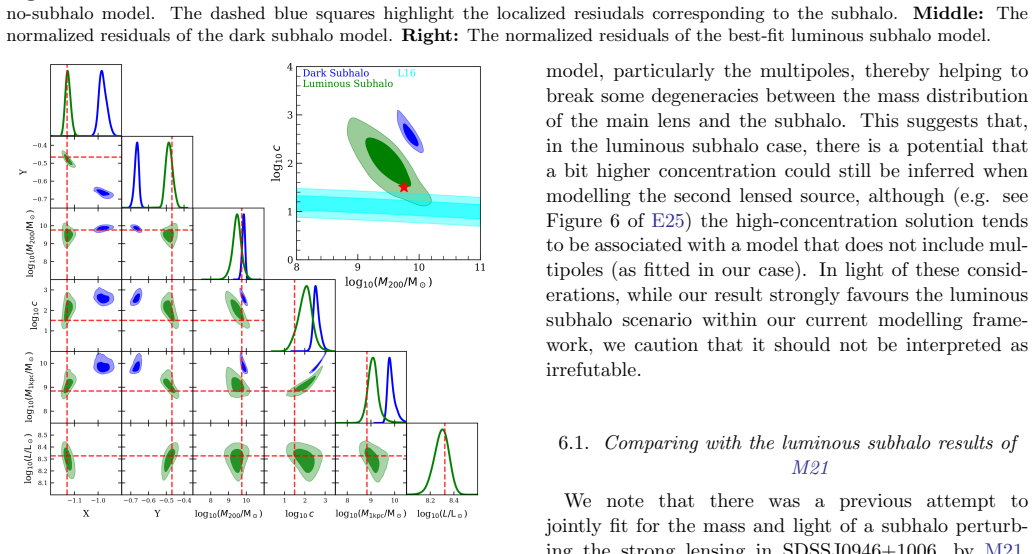
The paper's central claim is that the perturbing subhalo in SDSSJ0946+1006 hosts a faint galaxy, and that once this light is modelled the inferred mass distribution becomes fully consistent with CDM predictions. Including an elliptical Sersic profile for the perturber, co-centred with its NFW mass, lowers the median concentration by about an order of magnitude, to log10 c = 1.7 (+1.2, −0.9), and reduces the 1 kpc enclosed mass from log10 M1kpc ≈ 9.7 to 8.9 (+1.1, −0.8). The best-fit luminous model has log10(m200/M⊙) = 9.5 (+0.7, −1.1) and log10(L/L⊙) = 8.4 (+0.1, −0.2), matching simulated dwarf satellites of similar halo mass. The luminous subhalo model is preferred over the dark subhalo model by a log-Bayes factor of 16, formally >5σ, and mock tests show that neglecting subhalo light reproduces the artificially compact inference.
Load-bearing premise
The paper's case rests on a single-filter fit to only the inner lensed arc, and adding the second lensed source in the same system may shift the inferred concentration back to high values.
Editorial extensions
If this is right
- The super-concentrated subhalo previously reported in SDSSJ0946+1006 ceases to be evidence against CDM; the system is consistent with a ~10^9.5 Msun halo hosting a ~10^8.4 Lsun dwarf galaxy.
- Dark-subhalo fits can still be used to locate perturbations in large lens surveys, but follow-up modelling with subhalo light is required to recover unbiased mass profiles.
- The inferred satellite luminosity matches the mass-luminosity relation of dwarf satellites in hydrodynamical simulations, supporting the CDM picture of galaxy formation at low halo masses.
- The absence of a strong F336W counterpart is expected for an old red dwarf, explaining the earlier null detection of light at the perturber position.
- Joint mass-light subhalo modelling should become a standard check in strong-lens analyses to avoid spurious high-concentration inferences.
Reading between the lines
- A similar bias may affect other reported dark-subhalo detections where the perturber overlaps the lensed arc; re-fitting with a light component could reveal that some are luminous satellites.
- The mass-light degeneracy described here suggests that concentration constraints from mass-only fits should be treated as upper limits when the perturber is projected on bright lensed emission.
- A systematic mock study varying subhalo mass, luminosity, position relative to the arc, and image depth could quantify when the bias becomes severe and when it is safe to fit dark subhaloes.
- If the multi-band follow-up is carried out, it should distinguish a red dwarf (bright in F160W, faint in F336W) from a truly dark subhalo with a single mass solution across bands.
Editorial analysis
A structured set of objections, weighed in public.
Referee Report
Summary. The paper reanalyzes the HST F814W image of the strong lens system SDSSJ0946+1006 with the open-source PyAutoLens pipeline. Three subhalo models are compared: no subhalo, a dark NFW subhalo, and an NFW subhalo with an additional Sersic light component, all embedded in an EPL-plus-shear macro model with a pixelized source reconstruction. The dark-only fit reproduces the previously reported ultra-compact solution (log10 c = 2.5+0.7-0.5) with high significance. When a Sersic profile is added at the subhalo position, the inferred concentration drops to log10 c = 1.7+1.2-0.9 and the projected mass within 1 kpc decreases, bringing the halo into agreement with the CDM mass-concentration relation. The luminous model is preferred over the dark model by Delta ln E = 16, quoted as '>5 sigma'. A single mock test with a luminous input shows that a dark-only fit would overestimate the concentration. The paper concludes that the perturber is likely a low-luminosity dwarf satellite rather than a super-concentrated dark clump.
Significance. If correct, this result eliminates the strongest reported tension of SDSSJ0946+1006 with CDM and removes the need to invoke SIDM core collapse or other exotic physics for this object. The analysis is careful and reproducible: the modelling pipeline is described phase by phase, priors are tabulated, posteriors are shown, and the code is open source. The mock test usefully demonstrates the bias direction when perturber light is neglected. However, the central claim rests on the F814W band alone, with the second lensed source masked and no cross-band confirmation, and on a single mock configuration that only tests a luminous input. These limitations directly affect the interpretation of the reported evidence ratio. The result is potentially important and publishable, but the strength of the current wording exceeds what is supported by the tests presented.
major comments (4)
- [Sec. 2; Sec. 6; Table 2] The headline result and the CDM-consistent concentration are derived from a single band (F814W) and a single lensed source (z=0.609), with the second source masked. The authors themselves note in Sec. 6 that previous analyses including the second source (M25, E25) infer higher dark-subhalo concentrations and that a 'bit higher concentration could still be inferred' for the luminous model. Because the central claim is that the inferred concentration is consistent with CDM, this unmodeled information is load-bearing. The paper should either include the second source in the fit or provide a quantitative sensitivity test showing how the luminous-model concentration and the evidence ratio change when it is added; otherwise the conclusions should be explicitly limited to the first-source F814W analysis.
- [Sec. 5; Table 3; Fig. 4] The mock validation only injects a luminous subhalo and demonstrates that a dark-only fit then overestimates concentration. It does not test the converse and more dangerous scenario: a truly dark, super-concentrated input that is re-fit by the flexible luminous model with a lower concentration and a higher evidence. Since the Sersic component is placed on the lensed arc and adds five free parameters, it could in principle absorb residual structure produced by a compact mass clump. An injection test using a high-concentration dark input, together with the resulting posterior and the distribution of Delta ln E between the luminous and dark models, is needed to support the claim that the >5 sigma preference is not an artifact of model flexibility.
- [Sec. 4.3; Table 2; footnote 3] The conversion of Delta ln E = 16 into a '>5 sigma' preference is not justified in the text. No formula, calibration, or null-distribution test is given, and the Bayes factor for five extra parameters is sensitive to the prior ranges in Table A1 and to the Occam penalty. The reported fit statistics (best-fit chi-square lower by 23, regularization term only 1 unit larger) make the evidence gain especially sensitive to small changes in the modeling choices. Please state the exact significance conversion used, or replace the Gaussian-language claim by the Bayes factor itself with an associated calibration from mocks.
- [Sec. 3.4; Sec. 4.3] The macro-lens model is a single EPL without multipoles. The paper justifies this using previous work on the dark-subhalo solution, but the relevant question is whether the new Sersic component can absorb multipole-like residuals of the main lens. Multipole amplitudes in this system are only tightly constrained when the second source is included, which is not done here. A test including multipoles in the subhalo phase, or a comparison of the luminous-model evidence with and without multipoles, would address this degeneracy.
minor comments (5)
- [Table A1] Table A1 lists the Sersic x-centre prior as U(-1.63,0.63), while the NFW x-centre prior is U(-1.63,-0.63) and the text says the mass and light components share the same centre; this appears to be a typo and should be corrected.
- [Sec. 4.3] Section 4.3 contains the typo 'lunminous' in 'best-fit lunminous subhalo model'.
- [Fig. A1 caption] The caption of Fig. A1 says 'the unif of I_e' instead of 'the unit of I_e'.
- [References] The reference list contains two identical entries for Speagle (2020); one should be removed.
- [Sec. 5] Section 5 states that the true input concentration is log10 c = 1.5, which is consistent with Table 3, but the mock posterior figure shows only the dark-fit and luminous-fit contours; adding a legend in the zoom-in panel to distinguish the contours would improve clarity.
Circularity Check
No significant circularity; the central evidence is a self-contained model comparison, with only a closed-loop mock validation as a caveat.
full rationale
The paper's central claim rests on a Bayesian model comparison among no-subhalo, dark-subhalo, and luminous-subhalo models fitted to the same F814W image with the same macro model, source model, and priors (Sec. 3.6, Table A1). The reported values log10 c = 1.7^{+1.2}_{-0.9}, log10 L = 8.4^{+0.1}_{-0.2}, and delta ln E = 16 (Sec. 4.3, Table 2) are outputs of likelihood evaluation and nested sampling, not identities or re-labelled inputs. The CDM consistency comparison uses an external mass-concentration relation (L16), and the TNG50 luminosity comparison uses an external simulation; neither is an input to the fit. The mock test in Sec. 5 is the only place where inputs are taken from the fitted result: the input subhalo is 'inspired by the best-fit parameters from the luminous subhalo model fit to the real observations' (Table 3). This makes the mock a closed-loop consistency check rather than independent evidence, but the paper explicitly frames it as a validation of methodology ('To validate our approach') and does not use the mock recovery as the derivation of the real-data conclusion. The pipeline and software citations (PyAutoLens, SLaM, H24) are open-source and externally used tools, and no load-bearing uniqueness theorem, ansatz, or self-citation chain is invoked to force the luminous-subhalo choice. The authors further caution that the second lensed source is not modelled and that a somewhat higher concentration could be inferred if it were, showing the conclusion is not built into the framework by construction. No specific equation or fitted parameter is renamed as a prediction, so no circular step can be exhibited.
Assumptions & free parameters
free parameters (7)
- NFW subhalo mass m200 =
log10(m200/Msun) ~ 9.5 (95% CI -1.1, +0.7)
- NFW concentration c =
log10 c ~ 1.7 (95% CI -0.9, +1.2)
- Sersic effective radius r_e =
posterior shown in Fig. A1 (mock input ~0.16 arcsec)
- Sersic index n =
posterior shown in Fig. A1 (mock input ~0.83)
- Sersic intensity I_e =
posterior shown in Fig. A1 (mock input ~0.05 e-/pix)
- Sersic axis ratio q and position angle phi =
posterior shown in Fig. A1 (mock input q~0.61, phi~131 deg)
- Subhalo centre (x,y) =
posterior shown in Fig. A1 (mock input near -1.13, -0.45 arcsec)
assumptions (6)
- domain assumption The subhalo mass distribution is described by an NFW profile (Eq. 4).
- domain assumption The subhalo light distribution is described by an elliptical Sersic profile (Eq. 5).
- domain assumption The perturber lies at the lens redshift z=0.222.
- domain assumption Subhalo mass and light share the same center.
- ad hoc to paper The analysis of the inner lensed arc in F814W alone is sufficient; the second source and other bands are not modeled.
- ad hoc to paper The single mock configuration is representative of the real system.
Cite this review
Pith. "Pith review of Not so dark, not so dense: an alternative explanation for the lensing subhalo in SDSSJ0946+1006." pith.science (2026). https://pith.science/paper/SU4BOZPL
@misc{pith2026250607978,
  author       = {Pith},
  title        = {Pith review of: Not so dark, not so dense: an alternative explanation for the lensing subhalo in SDSSJ0946+1006},
  year         = {2026},
  howpublished = {\url{https://pith.science/paper/SU4BOZPL}},
  note         = {Machine review of arXiv:2506.07978}
}
read the original abstract
Previous studies of the strong lens system SDSSJ0946+1006 have reported a dark matter subhalo with an unusually high central density, potentially challenging the standard cold dark matter (CDM) paradigm. However, these analyses assumed the subhalo to be completely dark, neglecting the possibility that it may host a faint galaxy. In this work, we revisit the lensing analysis of SDSSJ0946+1006, explicitly modelling the subhalo as a luminous satellite. Incorporating light from the perturber broadens the range of allowed subhalo properties, revealing solutions with significantly lower central densities that are consistent with CDM expectations. The inferred luminosity of the satellite also aligns with predictions from hydrodynamical simulations. While high-concentration subhaloes remain allowed, they are no longer statistically preferred. The luminous subhalo model yields a better fit to the data, while also offering a more plausible explanation that is in line with theoretical expectations. We validate our methodology using mock data, demonstrating that neglecting subhalo light can lead to inferred mass distributions that are artificially compact.
Figures


Figures from the paper (2 more)

Forward citations
Cited by 3 Pith papers
-
JWST lensed quasar dark matter survey IV: Stringent warm dark matter constraints from the joint reconstruction of extended lensed arcs and quasar flux ratios
Adding extended lensed arcs to quasar flux ratios in 28 JWST lenses tightens the dark-matter free-streaming limit to m_hm < 10^7.4 M⊙ (galacticus prior) and gives the most precise lensing measurement of subhalo abundance.
-
Strong-lensing Perturber Signatures in Self-interacting Dark Matter Simulations
Core-collapsed self-interacting dark matter halos in the Concerto simulations reach high enough central densities to match the perturbing masses inferred in J0946, B1938, SDP.81, and SPT2147-50.
-
Disentangling the dark and stellar mass through precise lens modelling of the JWST observation of lensed quasar WFI2033--4723
Composite time-delay lens modelling of JWST WFI2033–4723 yields intermediate stellar IMF normalisation and a steep gNFW inner slope γ_in≃1.3 that is robust to the choice of external cosmology.
Reference graph
Works this paper leans on
-
[1]
, " * write output.state after.block = add.period write newline
ENTRY address archivePrefix author booktitle chapter doi edition editor eprint howpublished institution journal key month number organization pages publisher school series title misctitle type volume year version url label extra.label sort.label short.list INTEGERS output.state before.all mid.sentence after.sentence after.block FUNCTION init.state.consts ...
-
[2]
write newline
" write newline "" before.all 'output.state := FUNCTION format.url url empty "" new.block "" url * "" * if FUNCTION format.eprint eprint empty "" archivePrefix empty "" archivePrefix "arXiv" = new.block " " eprint * " " * new.block " " eprint * " " * if if if FUNCTION format.doi doi empty "" " " doi * " " * if FUNCTION format.pid doi empty eprint empty ur...
-
[3]
U9l̊x 2]eV\ Yx^9Μ7˷:4˱O+*m) f[tC4ʢ +3[C^W' P uW^IaÆ ڰaC (E jڒoťa :*gWp T̊t?gYҶұؘ v jlln^g(\,: ž6 @ gw 4G TrK a]uUvT_ )ǹc K А &&&544 j
thebibliography [1] 20pt to REFERENCES 6pt =0pt \@twocolumntrue 12pt -12pt 10pt plus 3pt =0pt =0pt =1pt plus 1pt =0pt =0pt -12pt =13pt plus 1pt =20pt =13pt plus 1pt \@M =10000 =-1.0em =0pt =0pt 0pt =0pt =1.0em @enumiv\@empty 10000 10000 `\.\@m \@noitemerr \@latex@warning Empty `thebibliography' environment \@ifnextchar \@reference \@latexerr Missing key o...
2017
-
[4]
C., Nightingale , J., He , Q., et al
Amorisco , N. C., Nightingale , J., He , Q., et al. 2022, title Halo concentration strengthens dark matter constraints in galaxy-galaxy strong lensing analyses , , 510, 2464, 10.1093/mnras/stab3527
-
[5]
Amvrosiadis , A., Nightingale , J. W., He , Q., et al. 2024, title Lopsidedness in Early-Type Galaxies: the role of the m=1 multipole in Isophote Fitting and Strong Lens Modelling , arXiv e-prints, arXiv:2407.12983, 10.48550/arXiv.2407.12983
-
[6]
Astropy Collaboration , Robitaille , T. P., Tollerud , E. J., et al. 2013, title Astropy: A community Python package for astronomy , A&A, 558, A33, 10.1051/0004-6361/201322068
-
[7]
Balberg , S., Shapiro , S. L., & Inagaki , S. 2002, title Self-Interacting Dark Matter Halos and the Gravothermal Catastrophe , , 568, 475, 10.1086/339038
doi:10.1086/339038 2002
-
[8]
Ballard , D. J., Enzi , W. J. R., Collett , T. E., Turner , H. C., & Smith , R. J. 2024, title Gravitational imaging through a triple source plane lens: revisiting the CDM-defying dark subhalo in SDSSJ0946+1006 , , 528, 7564, 10.1093/mnras/stae514
Show all 90 references
-
[9]
A., Marshall , P., & Oguri , M
Baltz , E. A., Marshall , P., & Oguri , M. 2009, title Analytic models of plausible gravitational lens potentials , , 2009, 015, 10.1088/1475-7516/2009/01/015
2009 doi
-
[10]
2020, title The detailed structure and the onset of galaxy formation in low-mass gaseous dark matter haloes , , 498, 4887, 10.1093/mnras/staa2698
Benitez-Llambay , A., & Frenk , C. 2020, title The detailed structure and the onset of galaxy formation in low-mass gaseous dark matter haloes , , 498, 4887, 10.1093/mnras/staa2698
2020 doi
-
[11]
R., Faber , S
Blumenthal , G. R., Faber , S. M., Flores , R., & Primack , J. R. 1986, title Contraction of Dark Matter Galactic Halos Due to Baryonic Infall , , 301, 27, 10.1086/163867
1986 doi
-
[12]
S., Burles , S., Koopmans , L
Bolton , A. S., Burles , S., Koopmans , L. V. E., Treu , T., & Moustakas , L. A. 2006, title The Sloan Lens ACS Survey. I. A Large Spectroscopically Selected Sample of Massive Early-Type Lens Galaxies , , 638, 703, 10.1086/498884
2006 doi
-
[13]
Bro, R., & De Jong, S. 1997, title A fast non-negativity-constrained least squares algorithm, Journal of Chemometrics, 11, 393, https://doi.org/10.1002/(SICI)1099-128X(199709/10)11:5<393::AID-CEM483>3.0.CO;2-L
1997 doi
-
[14]
2021, title Systematic errors induced by the elliptical power-law model in galaxy-galaxy strong lens modeling, Research in Astronomy and Astrophysics
Cao, X., Li, R., Nightingale, J., et al. 2021, title Systematic errors induced by the elliptical power-law model in galaxy-galaxy strong lens modeling, Research in Astronomy and Astrophysics. http://iopscience.iop.org/article/10.1088/1674-4527/ac3f2b
2021 doi
-
[15]
W., et al
Cao , X., Li , R., Nightingale , J. W., et al. 2025, title Probing Dark Matter Substructures with Free-Form Modelling: A Case Study of the `Jackpot' Strong Lens , arXiv e-prints, arXiv:2504.19177, 10.48550/arXiv.2504.19177
2025 doi
-
[16]
2002, title Efficient multi-Gaussian expansion of galaxies , , 333, 400, 10.1046/j.1365-8711.2002.05412.x
Cappellari , M. 2002, title Efficient multi-Gaussian expansion of galaxies , , 333, 400, 10.1046/j.1365-8711.2002.05412.x
2002
-
[18]
E., & Smith , R
Collett , T. E., & Smith , R. J. 2020, title A triple rollover: a third multiply imaged source at z 6 behind the Jackpot gravitational lens , , 497, 1654, 10.1093/mnras/staa1804
2020 doi
-
[19]
G., Aguilar , J., et al
DESI Collaboration , Adame , A. G., Aguilar , J., et al. 2024, title The Early Data Release of the Dark Energy Spectroscopic Instrument , , 168, 58, 10.3847/1538-3881/ad3217
2024 doi
- [20]
-
[21]
2017, title The impact of baryonic physics on the subhalo mass function and implications for gravitational lensing , , 469, 1997, 10.1093/mnras/stx966
Despali , G., & Vegetti , S. 2017, title The impact of baryonic physics on the subhalo mass function and implications for gravitational lensing , , 469, 1997, 10.1093/mnras/stx966
2017 doi
-
[22]
Despali , G., Vegetti , S., White , S. D. M., Giocoli , C., & van den Bosch , F. C. 2018, title Modelling the line-of-sight contribution in substructure lensing , , 475, 5424, 10.1093/mnras/sty159
2018 doi
-
[23]
Despali , G., Vegetti , S., White , S. D. M., et al. 2022, title Detecting low-mass haloes with strong gravitational lensing I: the effect of data quality and lensing configuration , , 510, 2480, 10.1093/mnras/stab3537
2022 doi
-
[24]
2018, title COLOSSUS: A Python Toolkit for Cosmology, Large-scale Structure, and Dark Matter Halos , The Astrophysical Journal Supplement Series, 239, 35, 10.3847/1538-4365/aaee8c
Diemer, B. 2018, title COLOSSUS: A Python Toolkit for Cosmology, Large-scale Structure, and Dark Matter Halos , The Astrophysical Journal Supplement Series, 239, 35, 10.3847/1538-4365/aaee8c
2018 doi
-
[25]
J., Weinberg , D
Eisenstein , D. J., Weinberg , D. H., Agol , E., et al. 2011, title SDSS-III: Massive Spectroscopic Surveys of the Distant Universe, the Milky Way, and Extra-Solar Planetary Systems , , 142, 72, 10.1088/0004-6256/142/3/72
2011 doi
-
[26]
Enzi , W. J. R., Krawczyk , C. M., Ballard , D. J., & Collett , T. E. 2025, title The overconcentrated dark halo in the strong lens SDSS J0946 + 1006 is a subhalo: evidence for self-interacting dark matter? , , 540, 247, 10.1093/mnras/staf697
2025 doi
-
[27]
W., Massey , R., et al
Etherington , A., Nightingale , J. W., Massey , R., et al. 2022, title Automated galaxy-galaxy strong lens modelling: No lens left behind , , 10.1093/mnras/stac2639
2022 doi
-
[28]
2016, title corner.py: Scatterplot matrices in Python, The J
Foreman-Mackey, D. 2016, title corner.py: Scatterplot matrices in Python, The J. Open Source Softw., 1, 24, 10.21105/joss.00024
2016 doi
-
[29]
S., & White , S
Frenk , C. S., & White , S. D. M. 2012, title Dark matter and cosmic structure , Annalen der Physik, 524, 507, 10.1002/andp.201200212
2012 doi
-
[30]
D., et al
Gavazzi , R., Treu , T., Rhodes , J. D., et al. 2007, title The Sloan Lens ACS Survey. IV. The Mass Density Profile of Early-Type Galaxies out to 100 Effective Radii , , 667, 176, 10.1086/519237
2007 doi
-
[31]
Gilman , D., Birrer , S., Nierenberg , A., et al. 2020, title Warm dark matter chills out: constraints on the halo mass function and the free-streaming length of dark matter with eight quadruple-image strong gravitational lenses , , 491, 6077, 10.1093/mnras/stz3480
2020 doi
-
[32]
2019, title Probing dark matter structure down to 10 ^ 7 solar masses: flux ratio statistics in gravitational lenses with line-of-sight haloes , , 487, 5721, 10.1093/mnras/stz1593
Gilman , D., Birrer , S., Treu , T., Nierenberg , A., & Benson , A. 2019, title Probing dark matter structure down to 10 ^ 7 solar masses: flux ratio statistics in gravitational lenses with line-of-sight haloes , , 487, 5721, 10.1093/mnras/stz1593
2019 doi
-
[33]
Y., Kravtsov , A
Gnedin , O. Y., Kravtsov , A. V., Klypin , A. A., & Nagai , D. 2004, title Response of Dark Matter Halos to Condensation of Baryons: Cosmological Simulations and Improved Adiabatic Contraction Model , , 616, 16, 10.1086/424914
2004 doi
-
[34]
W., & Driver , S
Graham , A. W., & Driver , S. P. 2005, title A Concise Reference to (Projected) S \'e rsic R ^ 1/n Quantities, Including Concentration, Profile Slopes, Petrosian Indices, and Kron Magnitudes , , 22, 118, 10.1071/AS05001
2005 doi
-
[35]
2022 a , title A forward-modelling method to infer the dark matter particle mass from strong gravitational lenses , , 511, 3046, 10.1093/mnras/stac191
He , Q., Robertson , A., Nightingale , J., et al. 2022 a , title A forward-modelling method to infer the dark matter particle mass from strong gravitational lenses , , 511, 3046, 10.1093/mnras/stac191
2022 doi
-
[36]
S., et al
He , Q., Li , R., Frenk , C. S., et al. 2022 b , title Galaxy-galaxy strong lens perturbations: line-of-sight haloes versus lens subhaloes , , 512, 5862, 10.1093/mnras/stac759
2022 doi
-
[37]
2023, title Testing strong lensing subhalo detection with a cosmological simulation , , 518, 220, 10.1093/mnras/stac2779
He , Q., Nightingale , J., Robertson , A., et al. 2023, title Testing strong lensing subhalo detection with a cosmological simulation , , 518, 220, 10.1093/mnras/stac2779
2023 doi
-
[38]
W., Amvrosiadis , A., et al
He , Q., Nightingale , J. W., Amvrosiadis , A., et al. 2024, title Unveiling lens light complexity with a novel multi-Gaussian expansion approach for strong gravitational lensing , , 532, 2441, 10.1093/mnras/stae1577
2024 doi
-
[39]
D., Dalal , N., Marrone , D
Hezaveh , Y. D., Dalal , N., Marrone , D. P., et al. 2016, title Detection of Lensing Substructure Using ALMA Observations of the Dusty Galaxy SDP.81 , , 823, 37, 10.3847/0004-637X/823/1/37
2016 doi
-
[40]
1891, title Ueber die stetige Abbildung einer Linie auf ein Flächenstück, Mathematische Annalen, 38, 459
Hilbert, D. 1891, title Ueber die stetige Abbildung einer Linie auf ein Flächenstück, Mathematische Annalen, 38, 459. http://eudml.org/doc/157555
-
[41]
Hunter, J. D. 2007, title Matplotlib: A 2D graphics environment, Comput Sci Eng, 9, 90, 10.1109/MCSE.2007.55
2007 doi
-
[42]
1983, title A simple model for the distribution of light in spherical galaxies
Jaffe , W. 1983, title A simple model for the distribution of light in spherical galaxies. , , 202, 995, 10.1093/mnras/202.4.995
1983 doi
-
[43]
Kim , S., Rey , S.-C., Lisker , T., & Sohn , S. T. 2010, title Color-Magnitude Relations of Early-type Dwarf Galaxies in the Virgo Cluster: An Ultraviolet Perspective , , 721, L72, 10.1088/2041-8205/721/1/L72
2010 doi
-
[44]
Koopmans , L. V. E. 2005, title Gravitational imaging of cold dark matter substructures , , 363, 1136, 10.1111/j.1365-2966.2005.09523.x
2005
-
[45]
2023, title joshspeagle/dynesty: v2.1.3, , v2.1.3 Zenodo, 10.5281/zenodo.8408702
Koposov, S., Speagle, J., Barbary, K., et al. 2023, title joshspeagle/dynesty: v2.1.3, , v2.1.3 Zenodo, 10.5281/zenodo.8408702
2023 doi
-
[46]
1993, in Astronomical Society of the Pacific Conference Series, Vol
Krist , J. 1993, in Astronomical Society of the Pacific Conference Series, Vol. 52, Astronomical Data Analysis Software and Systems II, ed. R. J. Hanisch , R. J. V. Brissenden , & J. Barnes , 536
1993
-
[47]
K., Pitrou, A., & Seibert, S
Lam, S. K., Pitrou, A., & Seibert, S. 2015, title Numba: a LLVM-based Python JIT compiler , Proceedings of the Second Workshop on the LLVM Compiler Infrastructure in HPC - LLVM '15, 1, 10.1145/2833157.2833162
2015
-
[48]
Lange , J. U. 2023, title NAUTILUS: boosting Bayesian importance nested sampling with deep learning , , 525, 3181, 10.1093/mnras/stad2441
2023 doi
-
[49]
C., Amvrosiadis , A., Nightingale , J
Lange , S. C., Amvrosiadis , A., Nightingale , J. W., et al. 2025, title Galaxy mass modelling from multiwavelength JWST strong lens analysis: dark matter substructure, angular mass complexity, or both? , , 539, 704, 10.1093/mnras/staf491
2025 doi
-
[50]
S., Cole , S., et al
Li , R., Frenk , C. S., Cole , S., et al. 2016, title Constraints on the identity of the dark matter from strong gravitational lenses , , 460, 363, 10.1093/mnras/stw939
2016 doi
-
[51]
S., Cole , S., Wang , Q., & Gao , L
Li , R., Frenk , C. S., Cole , S., Wang , Q., & Gao , L. 2017, title Projection effects in the strong lensing study of subhaloes , , 468, 1426, 10.1093/mnras/stx554
2017 doi
-
[52]
2025, title The ``Little Dark Dot'': Evidence for Self-Interacting Dark Matter in the Strong Lens SDSSJ0946+1006? , arXiv e-prints, arXiv:2504.11800, 10.48550/arXiv.2504.11800
Li , S., Li , R., Wang , K., et al. 2025, title The ``Little Dark Dot'': Evidence for Self-Interacting Dark Matter in the Strong Lens SDSSJ0946+1006? , arXiv e-prints, arXiv:2504.11800, 10.48550/arXiv.2504.11800
2025 doi
-
[53]
D., Bose , S., Angulo , R
Ludlow , A. D., Bose , S., Angulo , R. E., et al. 2016, title The mass-concentration-redshift relation of cold and warm dark matter haloes , , 460, 1214, 10.1093/mnras/stw1046
2016 doi
-
[54]
2021, title Auto-identification of unphysical source reconstructions in strong gravitational lens modelling , , 503, 2229, 10.1093/mnras/stab387
Maresca , J., Dye , S., & Li , N. 2021, title Auto-identification of unphysical source reconstructions in strong gravitational lens modelling , , 503, 2229, 10.1093/mnras/stab387
2021 doi
-
[55]
2021, title An unexpected high concentration for the dark substructure in the gravitational lens SDSSJ0946+1006 , , 507, 1662, 10.1093/mnras/stab2247
Minor , Q., Gad-Nasr , S., Kaplinghat , M., & Vegetti , S. 2021, title An unexpected high concentration for the dark substructure in the gravitational lens SDSSJ0946+1006 , , 507, 1662, 10.1093/mnras/stab2247
2021 doi
-
[56]
Minor , Q. E. 2025, title High Significance Detection of the Dark Substructure in Gravitational Lens SDSS J0946+1006 by Image Pixel Supersampling , , 981, 2, 10.3847/1538-4357/adb1b6
2025 doi
-
[57]
A., Kochanek , C
Mu \ n oz , J. A., Kochanek , C. S., & Keeton , C. R. 2001, title Cusped Mass Models of Gravitational Lenses , , 558, 657, 10.1086/322314
2001 doi
-
[58]
O., Yang , D., & Yu , H.-B
Nadler , E. O., Yang , D., & Yu , H.-B. 2023, title A Self-interacting Dark Matter Solution to the Extreme Diversity of Low-mass Halo Properties , , 958, L39, 10.3847/2041-8213/ad0e09
2023 doi
-
[59]
F., Frenk , C
Navarro , J. F., Frenk , C. S., & White , S. D. M. 1996, title The Structure of Cold Dark Matter Halos , , 462, 563, 10.1086/177173
1996 doi
-
[60]
2021, title PyAutoFit: A Classy Probabilistic Programming Language for Model Composition and Fitting , The Journal of Open Source Software, 6, 2550, 10.21105/joss.02550
Nightingale , J., Hayes , R., & Griffiths , M. 2021, title PyAutoFit: A Classy Probabilistic Programming Language for Model Composition and Fitting , The Journal of Open Source Software, 6, 2550, 10.21105/joss.02550
2021 doi
- [61]
-
[62]
W., & Dye , S
Nightingale , J. W., & Dye , S. 2015, title Adaptive semi-linear inversion of strong gravitational lens imaging , , 452, 2940, 10.1093/mnras/stv1455
2015 doi
-
[63]
W., Dye , S., & Massey , R
Nightingale , J. W., Dye , S., & Massey , R. J. 2018, title AutoLens: automated modeling of a strong lens's light, mass, and source , , 478, 4738, 10.1093/mnras/sty1264
2018 doi
-
[64]
W., Massey , R
Nightingale , J. W., Massey , R. J., Harvey , D. R., et al. 2019, title Galaxy structure with strong gravitational lensing: decomposing the internal mass distribution of massive elliptical galaxies , , 489, 2049, 10.1093/mnras/stz2220
2019 doi
-
[65]
W., Amvrosiadis, A., Hayes, R
Nightingale, J. W., Amvrosiadis, A., Hayes, R. G., et al. 2023, title PyAutoGalaxy: Open-Source Multiwavelength Galaxy Structure & Morphology, J. Open Source Softw., 8, 4475, 10.21105/joss.04475
2023 doi
-
[66]
W., He , Q., Cao , X., et al
Nightingale , J. W., He , Q., Cao , X., et al. 2024, title Scanning for dark matter subhaloes in Hubble Space Telescope imaging of 54 strong lenses , , 527, 10480, 10.1093/mnras/stad3694
2024 doi
-
[67]
M., & Vegetti , S
O'Riordan , C. M., & Vegetti , S. 2024, title Angular complexity in strong lens substructure detection , , 528, 1757, 10.1093/mnras/stae153
2024 doi
-
[68]
2011, title Scikit-learn: Machine Learning in P ython, Journal of Machine Learning Research, 12, 2825
Pedregosa, F., Varoquaux, G., Gramfort, A., et al. 2011, title Scikit-learn: Machine Learning in P ython, Journal of Machine Learning Research, 12, 2825
2011
-
[69]
2018, title Simulating galaxy formation with the IllustrisTNG model , , 473, 4077, 10.1093/mnras/stx2656
Pillepich , A., Springel , V., Nelson , D., et al. 2018, title Simulating galaxy formation with the IllustrisTNG model , , 473, 4077, 10.1093/mnras/stx2656
2018 doi
-
[70]
Planck Collaboration , Ade , P. A. R., Aghanim , N., et al. 2016, title Planck 2015 results. XIII. Cosmological parameters , , 594, A13, 10.1051/0004-6361/201525830
2016 doi
-
[71]
M., Vegetti , S., McKean , J
Powell , D. M., Vegetti , S., McKean , J. P., et al. 2022, title A lensed radio jet at milliarcsecond resolution I: Bayesian comparison of parametric lens models , , 516, 1808, 10.1093/mnras/stac2350
2022 doi
-
[72]
M., Sip o cz , B
Price-Whelan , A. M., Sip o cz , B. M., G \"u nther , H. M., et al. 2018, title The Astropy Project: Building an Open-science Project and Status of the v2.0 Core Package , AJ, 156, 123, 10.3847/1538-3881/aabc4f
2018 doi
-
[73]
1981, Interpreting Multivariate Data, ed
Sibson, R. 1981, Interpreting Multivariate Data, ed. V. Barnett (New York: John Wiley and Sons)
1981
-
[75]
Speagle, J. S. 2020, title dynesty: a dynamic nested sampling package for estimating Bayesian posteriors and evidences , MNRAS, 493, 3132, 10.1093/mnras/staa278
2020 doi
-
[76]
Springel , V., White , S. D. M., Tormen , G., & Kauffmann , G. 2001, title Populating a cluster of galaxies - I. Results at [formmu2]z=0 , , 328, 726, 10.1046/j.1365-8711.2001.04912.x
2001
-
[77]
R., Powell , D
Stacey , H. R., Powell , D. M., Vegetti , S., et al. 2024, title Complex angular structure of three elliptical galaxies from high-resolution ALMA observations of strong gravitational lenses , , 688, A110, 10.1051/0004-6361/202449710
2024 doi
-
[78]
M., et al
Tajalli , M., Vegetti , S., O'Riordan , C. M., et al. 2025, title SHARP -- IX. The dense, low-mass perturbers in B1938+666 and J0946+1006: implications for cold and self-interacting dark matter , arXiv e-prints, arXiv:2505.07944, 10.48550/arXiv.2505.07944
2025 doi
-
[79]
Tessore , N., & Metcalf , R. B. 2015, title The elliptical power law profile lens , , 580, A79, 10.1051/0004-6361/201526773
2015 doi
-
[80]
2008, title Bayes in the sky: Bayesian inference and model selection in cosmology , Contemporary Physics, 49, 71, 10.1080/00107510802066753
Trotta , R. 2008, title Bayes in the sky: Bayesian inference and model selection in cosmology , Contemporary Physics, 49, 71, 10.1080/00107510802066753
2008 doi
-
[81]
C., & Varoquaux , G
van der Walt , S., Colbert , S. C., & Varoquaux , G. 2011, title The NumPy Array2D: A Structure for Efficient Numerical Computation, Comput Sci Eng, 13, 22, 10.1109/MCSE.2011.37
2011 doi
-
[82]
L., Nunez-Iglesias, J., et al
Van der Walt, S., Sch \"o nberger, J. L., Nunez-Iglesias, J., et al. 2014, title scikit-image: image processing in Python, PeerJ, 2, e453
2014
-
[83]
Van Rossum, G., & Drake, F. L. 2009, Python 3 Reference Manual (Scotts Valley, CA: CreateSpace)
2009
-
[84]
R., & Enzi , W
Vegetti , S., Despali , G., Lovell , M. R., & Enzi , W. 2018, title Constraining sterile neutrino cosmologies with strong gravitational lensing observations at redshift z 0.2 , , 481, 3661, 10.1093/mnras/sty2393
2018 doi
-
[85]
Vegetti , S., & Koopmans , L. V. E. 2009 a , title Statistics of mass substructure from strong gravitational lensing: quantifying the mass fraction and mass function , , 400, 1583, 10.1111/j.1365-2966.2009.15559.x
2009
-
[86]
Vegetti , S., & Koopmans , L. V. E. 2009 b , title Bayesian strong gravitational-lens modelling on adaptive grids: objective detection of mass substructure in Galaxies , , 392, 945, 10.1111/j.1365-2966.2008.14005.x
2009
-
[87]
Vegetti , S., Koopmans , L. V. E., Auger , M. W., Treu , T., & Bolton , A. S. 2014, title Inference of the cold dark matter substructure mass function at z = 0.2 using strong gravitational lenses , , 442, 2017, 10.1093/mnras/stu943
2014 doi
-
[88]
Vegetti , S., Koopmans , L. V. E., Bolton , A., Treu , T., & Gavazzi , R. 2010, title Detection of a dark substructure through gravitational imaging , , 408, 1969, 10.1111/j.1365-2966.2010.16865.x
2010
-
[89]
J., McKean , J
Vegetti , S., Lagattuta , D. J., McKean , J. P., et al. 2012, title Gravitational detection of a low-mass dark satellite galaxy at cosmological distance , , 481, 341, 10.1038/nature10669
2012 doi
-
[90]
S., et al
Wang , J., Bose , S., Frenk , C. S., et al. 2020, title Universal structure of dark matter haloes over a mass range of 20 orders of magnitude , , 585, 39, 10.1038/s41586-020-2642-9
2020 doi
-
[91]
Wang , K., Cao , X., Li , R., et al. 2025, title Measuring the Stellar-to-Halo Mass Relation at 10^ 10 Solar masses, using space-based imaging of galaxy-galaxy strong lenses , arXiv e-prints, arXiv:2501.16139, 10.48550/arXiv.2501.16139
2025 doi
-
[92]
S., et al
Zheng , H., Bose , S., Frenk , C. S., et al. 2024, title The abundance of dark matter haloes down to Earth mass , , 528, 7300, 10.1093/mnras/stae289
2024 doi
Reviewed August 7, 2026 · model on record in the stance chip above.
Discussion (0). Continue with ORCID to comment.