REVIEW 2 major objections 5 minor 2 cited by
Correlated Noise Mechanisms for Differentially Private Learning
T0 review · 2 major / 5 minor · reviewed 2026-08-07 · deepseek-v4-flash
Pith's one-line read This monograph establishes that correlated noise mechanisms for differentially private learning can reduce the worst-case prefix-sum estimation error from Θ(√n) to Θ(ln n), and that structured families like the Buffered Linear Toeplitz…
desk verdict A faithful, well-structured tutorial that consolidates the DP correlated-noise literature; the main risk is the unproved external reduction behind every privacy claim, but that is a citation, not an error. read the letter →
The pith
A machine-rendered reading of the paper's core claim, the machinery that carries it, and where it could break.
The reading
What carries the argument
The central object is the matrix factorization A = BC of the workload matrix A (the prefix-sum matrix Apre or a momentum-weighted variant), with B the decoder and C the strategy matrix; the inverse $C^{{-1}}$ maps i.i.d. seed noise to correlated noise and is called the noise-correlating matrix. The privacy analysis hinges on two facts: the adaptive-to-non-adaptive Gaussian mechanism reduction, which lets the privacy of adaptive DP-SGD be bounded by that of a non-adaptive procedure, and the sensitivity identity sens(C) = 2||C||_col under replace-one adjacency (or ||C||_col under zero-out adjacency), which shows privacy depends only on the maximum column norm of C. Utility is measured by the normalized max loss ||B||_row ||C||_col, which generalizes to the product of an error term and a sensitivity term. For Toeplitz factorizations, the generating-function correspondence reduces the problem to approximating the function 1/√(1-x), explaining why rational approximations (BLT) outperform polynomial approximations (banded Toeplitz) and why the optimal Toeplitz mechanism matches the dense optimum up to an additive constant.
What would settle it
Take n = 3 and a specific lower-triangular C, enumerate all pairs of unit-norm gradient sequences that differ in exactly one row, and compute the supremum of ||C(G-G')||_F; if this exceeds 2||C||_col under replace-one adjacency, Lemma 1.12 is false. Alternatively, on the CIFAR-10 setup of Figure 3.2, run unamplified correlated-noise DP-SGD and amplified independent-noise DP-SGD at a fixed ε = 3: if correlated noise does not match or beat the independent-noise accuracy, the empirical dominance claim would be contradicted.
Extended reading notes
Core claim
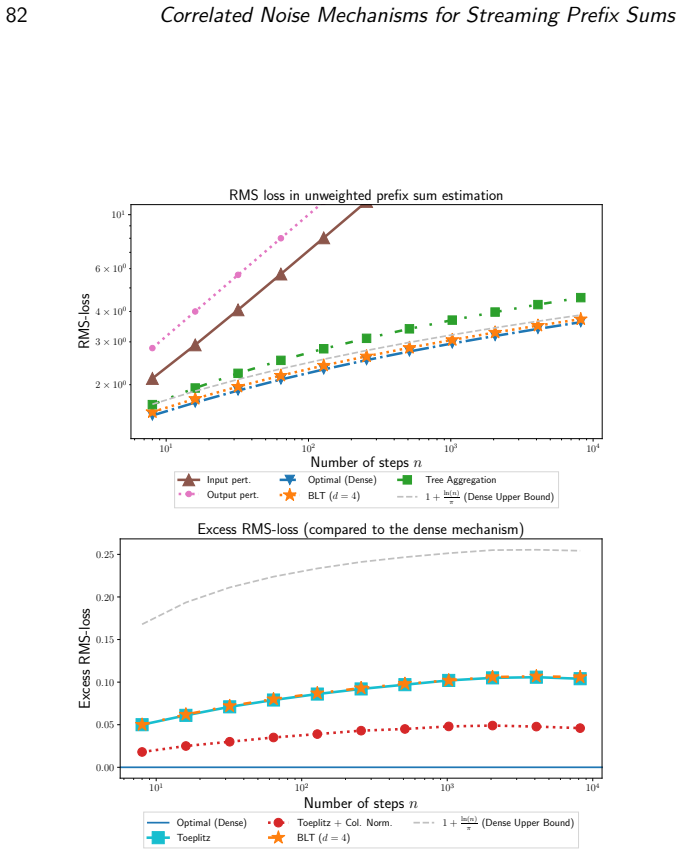
The paper's central claim is that any correlated noise mechanism for private learning can be analyzed as a factorization A = BC of the workload matrix, where the privacy guarantee depends only on the strategy matrix C through its sensitivity sens(C) and the utility depends on the decoder B. For the canonical prefix-sum workload, the optimal factorization achieves a normalized max loss of ln(n)/π plus a small constant, while independent noise (input perturbation) and output perturbation both incur Θ(√n). The monograph proves that this near-optimal rate is attainable by structured factorizations: the max-loss-optimal Toeplitz factorization B = C = $A^{{1/2}}$ is within an additive constant of the unconstrained optimum, and the Buffered Linear Toeplitz (BLT) mechanism, which approximates the optimal Toeplitz coefficients by a sum of exponentials, matches this bound with O(md) time and space for d = O(ln² n). In multiple-participation settings, correlated noise maintains strict privacy without sampling assumptions and, when amplification is available, correlated noise with amplification uniformly outperforms independent noise both with and without amplification.
Load-bearing premise
The privacy guarantee for every mechanism rests on the cited, unproved reduction of adaptive Gaussian mechanisms to non-adaptive ones (Theorem 1.11) together with the sensitivity formulas sens(C) = 2||C||_col (replace-one) and sens(C) = ||C||_col (zero-out); if either fails, the stated 1/σ-GDP bounds for correlated DP-SGD do not follow.
Editorial extensions
If this is right
- If the claimed bounds are correct, correlated noise mechanisms improve the worst-case prefix-sum error in private learning from Θ(√n) to Θ(ln n), a super-polynomial gap that grows with the number of training steps n.
- Correlated noise DP-SGD provides strict differential privacy without requiring Poisson sampling or shuffling, making it applicable in federated learning and streaming settings where privacy amplification is infeasible or unverifiable.
- The BLT mechanism achieves near-optimal utility with O(md) per-step time and space for a small constant d, so the theoretical gains are realizable in large-scale model training with billions of parameters.
- When privacy amplification by sampling can be applied, correlated noise with amplification dominates independent noise with amplification at every privacy budget, as shown empirically in the CIFAR-10 comparison.
- The factorization viewpoint transfers to other optimizers, such as SGD with momentum and weight decay, whose iterates can be expressed as weighted prefix sums, extending the same privacy-utility tradeoffs.
Reading between the lines
- A testable extension is to apply the generating-function recipe to workload matrices beyond prefix sums, such as the momentum workload Amom, and check whether the optimal Toeplitz symbol admits a rational approximation with the same exp(-√d) error, which would give the first near-optimal correlated noise mechanisms for momentum-based optimizers.
- The paper's analysis suggests that the relative advantage of correlated noise over independent noise grows logarithmically in n relative to √n, implying that very long training runs (large n) benefit most from correlated noise; this is an implicit quantitative prediction that could be tested by measuring prefix-sum error as n scales.
- Resolving Conjecture 4.7, which the paper leaves open, would provide a closed-form expression for the optimal BLT parameters, likely turning the empirically successful BLT heuristic into an exact, parameter-free mechanism; the paper's own Section 5.6 flags this as an open problem.
- The sensitivity reduction to ||C||_col suggests that any structured C whose columns have nearly equal norms (or can be column-normalized) automatically achieves near-optimal privacy, so column normalization could be applied to other structured mechanisms (e.g., tree aggregation) to improve their tradeoffs beyond the stated bounds.
Editorial analysis
A structured set of objections, weighed in public.
Referee Report
Summary. This monograph is a pedagogical tutorial on correlated noise mechanisms for differentially private learning. It recasts DP-SGD as a weighted prefix-sum estimation problem, develops the matrix-factorization (correlated noise) framework, analyzes streaming mechanisms (dense, Toeplitz, banded Toeplitz, BLT, tree aggregation), extends the framework to multiple-participation settings, and closes with implementation guidance, numerical recommendations, and open problems. The central claim is that carefully correlated noise can improve privacy-utility trade-offs over independent noise, with quantitative illustrations such as the Θ(ln n) vs. Θ(√n) max-loss gap for unweighted prefix sums. The manuscript states and proves many of its supporting lemmas, and attributes the few external results, most notably the adaptive-to-non-adaptive Gaussian mechanism reduction (Theorem 1.11), to the literature.
Significance. If the claims are correct, this tutorial fills a real need: it consolidates a fragmented literature on matrix/factorization mechanisms, provides a common notation, and offers concrete practical guidance (including numerical tables and a discussion of open-source software). The mathematical derivations—such as the sensitivity identities of Lemmas 1.12 and 1.19, the GDP bounds in Lemma 1.13 and Theorem 1.14, and the max-loss formula in Theorem 2.2—are clean, correctly stated, and largely self-contained. The paper is explicit about assumptions, gives reproducible numerical comparisons, and honestly marks advanced sections. It will be a useful entry point for graduate students and practitioners, and the open-problems chapter is a constructive research roadmap. The tutorial's value is primarily expository rather than original, but it is a genuine contribution to the accessibility of this area.
major comments (2)
- [Section 3.3.1 / Definition 3.6] There is a scale-factor inconsistency between Eq. (3.8) and Definition 3.6 that directly affects the sensitivity calibration used in Lemma 3.8 and Theorem 3.9. Eq. (3.8) and Algorithm 3.1 define each gradient as a batch average, g_t = (1/B) Σ_{i∈I_t} ∇ℓ(θ_t, x_i), so that under zero-out adjacency a single changed example perturbs a row by at most 1/B in ℓ2 norm. Definition 3.6, however, writes g_t = Σ_{i∈I_t} ∇ℓ(θ_t, x_i) (a sum), which has row norm bounded by B rather than 1. Lemma 3.8 then assumes rows are 'clipped to norm 1', which is consistent with the average interpretation but not with the sum definition. This ambiguity propagates into the definition of sens(C) and the noise variance ν = σ·sens(C): if Definition 3.6 is taken literally, the stated 1/σ-GDP bound of Theorem 3.9 would be conservative by a factor of B, while the utility analysis would be off by the same factor. The authors should correct Definition 3.6 to use 1/B Σ_{i∈I_t} (or equivalently clarify that the sensitivity is defined on the averaged sequence) and explicitly state which normalization sens(C) refers to.
- [Section 1.3.1 (Theorem 1.11)] The privacy guarantees of every correlated-noise mechanism in the monograph—notably Theorems 1.14 and 3.9—rest on Theorem 1.11, the adaptive-to-non-adaptive reduction for Gaussian mechanisms. The theorem is stated precisely, and it is attributed to Denisov et al. (2022), but no proof sketch or verification of its conditions for the DP-SGD setting is provided in the text. Given that this is the single most load-bearing technical step and the manuscript aims to be a pedagogical tutorial, I recommend adding a proof sketch (or at least a detailed explanation of why the uniform sensitivity condition applies to clipped, nonlinear trajectories with unbounded state spaces) so that readers can audit the key step. I do not see a misstatement of the theorem, and the condition is plausibly satisfied for the mechanisms considered, but the current presentation leaves the central privacy claim as an external black box.
minor comments (5)
- [Eq. (1.6)] The definition of the prefix-sum workload matrix states Apre[t,τ] = 1 if t ≤ τ, but the displayed 4×4 example and all subsequent usage require the condition t ≥ τ. Please correct this typo.
- [Theorem 1.11 (notation)] The Frobenius norm is defined as ∥M∥_F = √(Σ_{i,j} M[i,j]), which is missing the square on M[i,j]. It should read √(Σ_{i,j} M[i,j]^2).
- [Lemma 1.12 (proof)] In the proof, the maximization is written as 'max_{t∈[t]}', which should be 'max_{t∈[n]}'.
- [Section 1.5] The phrase 'we will use this a canonical example' should be 'we will use this as a canonical example'.
- [Section 2.11 (Table 2.2)] The 'Streaming H2' column in Table 2.2 is all NaN for every n; either the entries were not computed or the variant is undefined in this setting. Please report the values or remove/annotate the column to avoid confusion.
Circularity Check
No significant circularity: the monograph's derivations are self-contained, with the single load-bearing external Theorem 1.11 cited but not proved in-text.
full rationale
This is a tutorial and synthesis, not an empirical paper with fitted parameters, so the main circularity patterns do not arise. The core privacy theorems (Lemma 1.13, Theorem 1.14, Lemma 3.8, Theorem 3.9) are derived in-text from the Gaussian mechanism (Lemma 1.6), the sensitivity computations (Lemmas 1.12 and 1.19), and Theorem 1.11. The sensitivity lemmas are proved directly in the text. The utility claims—such as the max-loss bounds Θ(ln n) vs Θ(√n)—are mathematical consequences of the factorization framework and the chosen loss metric, not fitted re-statements of empirical outcomes; the empirical figures are explicitly illustrative or reproduced from prior work. The one step that is both load-bearing and not proved in the monograph is Theorem 1.11, the adaptive-vs-non-adaptive Gaussian mechanism reduction, which is cited to Denisov et al. 2022, a work with overlapping authors. This is a real dependence: every GDP guarantee for DP-SGD with correlated noise funnels through that theorem. However, citing it is not circular in the sense targeted here. The monograph does not define the privacy guarantee to be equivalent to Theorem 1.11, nor does it fit any parameter to a prediction that is then reported as a discovery. Theorem 1.11 is an external mathematical result with stated conditions, and the tutorial's contribution is the synthesis and presentation of mechanisms that use it. The absence of a proof is a completeness or correctness-risk concern about verification, not evidence of circularity. Under the hard rules, I cannot identify a specific equation or fitted value that reduces to its own input by construction, so the honest finding is no circularity.
Assumptions & free parameters
assumptions (3)
- standard math Gaussian mechanism yields 1/sigma-GDP and post-processing preserves DP.
- domain assumption Adaptive Gaussian mechanism has same privacy as non-adaptive (Theorem 1.11).
- domain assumption Clipped gradients with replace-one or zero-out adjacency define sensitivity.
Cite this review
Pith. "Pith review of Correlated Noise Mechanisms for Differentially Private Learning." pith.science (2026). https://pith.science/paper/FST2K7CT
@misc{pith2026250608201,
  author       = {Pith},
  title        = {Pith review of: Correlated Noise Mechanisms for Differentially Private Learning},
  year         = {2026},
  howpublished = {\url{https://pith.science/paper/FST2K7CT}},
  note         = {Machine review of arXiv:2506.08201}
}
read the original abstract
This monograph explores the design and analysis of correlated noise mechanisms for differential privacy (DP), focusing on their application to private training of AI and machine learning models via the core primitive of estimation of weighted prefix sums. While typical DP mechanisms inject independent noise into each step of a stochastic gradient (SGD) learning algorithm in order to protect the privacy of the training data, a growing body of recent research demonstrates that introducing (anti-)correlations in the noise can significantly improve privacy-utility trade-offs by carefully canceling out some of the noise added on earlier steps in subsequent steps. Such correlated noise mechanisms, known variously as matrix mechanisms, factorization mechanisms, and DP-Follow-the-Regularized-Leader (DP-FTRL) when applied to learning algorithms, have also been influential in practice, with industrial deployment at a global scale.
Figures


Figures from the paper (29 more)




Forward citations
Cited by 2 Pith papers
-
Improved Error Bounds for Pure Differentially Private Continual Counting via Matrix Factorization
Recursive matrix factorization from optimized low-dimensional bases yields pure-DP continual counting with MaxSE ≤ 0.0778 log^{3}_{2} n/ε^{2} and MeanSE ≤ 0.0710 log^{3}_{2} n/ε^{2}, plus Ω(log^{3} n) lower bounds for...
-
Correlating Cross-Iteration Noise for DP-SGD using Model Curvature
Using Hessian eigenvalues from public data to design correlated noise for DP-SGD improves accuracy by 1–4% over current DP-MF methods.
Reference graph
Works this paper leans on
-
[1]
Deep Learning with Differen- tial Privacy
Martin Abadi, Andy Chu, Ian Goodfellow, H Brendan McMahan, Ilya Mironov, Kunal Talwar, and Li Zhang. Deep Learning with Differen- tial Privacy. InProceedings of the 2016 ACM SIGSAC conference on computer and communications security, pages 308–318,
work page 2016
-
[6]
How Private are DP-SGD Implementations?
Lynn Chua, Badih Ghazi, Pritish Kamath, Ravi Kumar, Pasin Manu- rangsi, Amer Sinha, and Chiyuan Zhang. How private are dp-sgd implementations?arXiv preprint arXiv:2403.17673, 2024a. Lynn Chua, Badih Ghazi, Pritish Kamath, Ravi Kumar, Pasin Manu- rangsi, Amer Sinha, and Chiyuan Zhang. Scalable dp-sgd: Shuffling vs. poisson subsampling.Advances in Neural In...
-
[8]
ISSN 1369-7412. doi: 10.1111/rssb .12454. URLhttps://doi.org/10.1111/rssb.12454. John C Duchi, Alekh Agarwal, and Martin J Wainwright. Dual averag- ing for distributed optimization: Convergence analysis and network scaling.IEEE Transactions on Automatic control, 57(3):592–606,
-
[9]
Concentrated differential privacy
200References Cynthia Dwork and Guy N Rothblum. Concentrated differential privacy. arXiv preprint arXiv:1603.01887,
-
[12]
Private Convex Optimization via Exponential Mechanism
Sivakanth Gopi, Yin Tat Lee, and Daogao Liu. Private convex optimiza- tion via exponential mechanism.arXiv preprint arXiv:2203.00263,
-
[16]
Nikita P Kalinin, Ryan McKenna, Jalaj Upadhyay, and Christoph H Lampert. Back to square roots: An optimal bound on the matrix factorization error for multi-epoch differentially private sgd.arXiv preprint arXiv:2505.12128,
-
[21]
URLhttps://arxiv.org/ab s/1408.1376. Ryan McKenna. Scaling up the Banded Matrix Factorization Mechanism for Differentially Private ML.arXiv preprint arXiv:2405.15913,
-
[22]
Ryan McKenna, Gerome Miklau, Michael Hay, and Ashwin Machanava- jjhala. Hdmm: Optimizing error of high-dimensional statistical queries under differential privacy.arXiv preprint arXiv:2106.12118,
Show all 29 references
-
[24]
Understanding hierar- chical methods for differentially private histograms.Proceedings of the VLDB Endowment, 6(14):1954–1965,
Wahbeh Qardaji, Weining Yang, and Ninghui Li. Understanding hierar- chical methods for differentially private histograms.Proceedings of the VLDB Endowment, 6(14):1954–1965,
1954
-
[28]
Convex op- timization for linear query processing under approximate differential privacy
Ganzhao Yuan, Yin Yang, Zhenjie Zhang, and Zhifeng Hao. Convex op- timization for linear query processing under approximate differential privacy. InProceedings of the 22nd ACM SIGKDD International Con- ference on Knowledge Discovery and Data Mining, pages 2005–2014,
2005
-
[29]
Differentially private online-to-batch for smooth losses
Qinzi Zhang, Hoang Tran, and Ashok Cutkosky. Differentially private online-to-batch for smooth losses. InNeurIPS, 2022a. Xinwei Zhang, Xiangyi Chen, Mingyi Hong, Zhiwei Steven Wu, and Jin- feng Yi. Understanding Clipping for Federated Learning: Convergence and Client-Level Dif...
1997
-
[1961]
Private empirical risk minimization: Efficient algorithms and tight error bounds
Raef Bassily, Adam Smith, and Abhradeep Thakurta. Private empirical risk minimization: Efficient algorithms and tight error bounds. InProc. of the 2014 IEEE 55th Annual Symp. on Foundations of Computer Science (FOCS), pages 464–473, 2014a. Raef Bassily, Adam Smith, and Abhrade...
2014
-
[1964]
URL https://doi.org/10.1307/mmj/1028999029
doi: 10.1307/mmj/1028999029. URL https://doi.org/10.1307/mmj/1028999029. Aleksandar Nikolov, Kunal Talwar, and Li Zhang. The Geometry of Differential Privacy: the Sparse and Approximate Cases.SIAM Journal on Computing, 45(2):575–616,
-
[1971]
Efficient use of differentially private binary trees
James Honaker. Efficient use of differentially private binary trees. Theory and Practice of Differential Privacy (TPDP 2015), London, UK, 2:26–27,
2015
-
[1993]
Factorization Norms and Hereditary Discrepancy.International Mathematics Re- search Notices, 2020(3):751–780,
Jiří Matoušek, Aleksandar Nikolov, and Kunal Talwar. Factorization Norms and Hereditary Discrepancy.International Mathematics Re- search Notices, 2020(3):751–780,
2020
-
[2003]
Census Bureau Sets Key Parameters to Protect Privacy in 2020 Census Results.https://www.census.gov/newsr oom/press-releases/2021/2020-census-key-parameters.html ,
US Census Bureau. Census Bureau Sets Key Parameters to Protect Privacy in 2020 Census Results.https://www.census.gov/newsr oom/press-releases/2021/2020-census-key-parameters.html ,
2020
-
[2008]
Chao Li, Michael Hay, Gerome Miklau, and Yue Wang
URL https://web.archive.org/web/20230109145533/https: //www2.mta.ac.il/~adish/Pubs/Papers/DPTDiscrepancy.pdf. Chao Li, Michael Hay, Gerome Miklau, and Yue Wang. A data-and workload-aware algorithm for range queries under differential privacy. arXiv preprint arXiv:1410.0265,
-
[2010]
Improved Differentially Private Continual Observation Using Group Algebra
Monika Henzinger and Jalaj Upadhyay. Improved Differentially Private Continual Observation Using Group Algebra. InProceedings of the 2025 Annual ACM-SIAM Symposium on Discrete Algorithms (SODA). SIAM,
2025
-
[2012]
References203 Anastasia Koloskova, Hadrien Hendrikx, and Sebastian U. Stich. Re- visiting Gradient Clipping: Stochastic bias and tight convergence guarantees. InICML, volume 202, pages 17343–17363, 2023a. Anastasiia Koloskova, Ryan McKenna, Zachary Charles, John Rush, and H.Br...
2023
-
[2013]
Differentially private continual release of graph statistics
Shuang Song, Susan Little, Sanjay Mehta, Staal Vinterbo, and Kamalika Chaudhuri. Differentially private continual release of graph statistics. arXiv preprint arXiv:1809.02575,
-
[2015]
Optimality of matrix mechanism onℓp p-metric.arXiv preprint arXiv:2406.02140,
Jingcheng Liu, Jalaj Upadhyay, and Zongrui Zou. Optimality of matrix mechanism onℓp p-metric.arXiv preprint arXiv:2406.02140,
-
[2016]
Our data, ourselves: Privacy via distributed noise generation
Cynthia Dwork, Krishnaram Kenthapadi, Frank McSherry, Ilya Mironov, and Moni Naor. Our data, ourselves: Privacy via distributed noise generation. In Serge Vaudenay, editor,Advances in Cryptology - EU- ROCRYPT 2006, pages 486–503, Berlin, Heidelberg,
2006
-
[2019]
Stability of stochastic gradient descent on nonsmooth convex losses
Raef Bassily, Vitaly Feldman, Cristóbal Guzmán, and Kunal Talwar. Stability of stochastic gradient descent on nonsmooth convex losses. arXiv preprint arXiv:2006.06914,
2006 arXiv
-
[2020]
Differentially private algorithms for graphs under continual observation.arXiv preprint arXiv:2106.14756,
Hendrik Fichtenberger, Monika Henzinger, and Lara Ost. Differentially private algorithms for graphs under continual observation.arXiv preprint arXiv:2106.14756,
-
[2021]
Accessed: 2025-03-21. Salil P. Vadhan. The Complexity of Differential Privacy. InTuto- rials on the Foundations of Cryptography, pages 347–450. Springer International Publishing,
2025
-
[2022]
Differen- tially private data cubes: optimizing noise sources and consistency
Bolin Ding, Marianne Winslett, Jiawei Han, and Zhenhui Li. Differen- tially private data cubes: optimizing noise sources and consistency. InProceedings of the 2011 ACM SIGMOD International Conference on Management of data, pages 217–228,
2011
-
[2023]
To shuffle or not to shuffle: Auditing dp-sgd with shuffling.arXiv preprint arXiv:2411.10614,
Meenatchi Sundaram Muthu Selva Annamalai, Borja Balle, Emiliano De Cristofaro, and Jamie Hayes. To shuffle or not to shuffle: Auditing dp-sgd with shuffling.arXiv preprint arXiv:2411.10614,
-
[2024]
Optimal rates for dp-sco with a single epoch and large batches.arXiv preprint arXiv:2406.02716,
Christopher A Choquette-Choo, Arun Ganesh, and Abhradeep Thakurta. Optimal rates for dp-sco with a single epoch and large batches.arXiv preprint arXiv:2406.02716,
-
[2025]
Almost Tight Error Bounds on Differentially Private Continual Counting
Monika Henzinger, Jalaj Upadhyay, and Sarvagya Upadhyay. Almost Tight Error Bounds on Differentially Private Continual Counting. In Proceedings of the 2023 Annual ACM-SIAM Symposium on Discrete Algorithms (SODA), pages 5003–5039. SIAM,
2023
Reviewed August 7, 2026 · model on record in the stance chip above.
Discussion (0). Continue with ORCID to comment.