REVIEW 4 major objections 6 minor 1 cited by
Transforming Expert Knowledge into Scalable Ontology via Large Language Models
T0 review · 4 major / 6 minor · reviewed 2026-08-07 · deepseek-v4-flash
Pith's one-line read An LLM pipeline, calibrated by experts and shown hundreds of examples, can map domain concepts at F1 0.97—well above the 0.68 human benchmark.
desk verdict A solid empirical pipeline undermined by a stacked-deck human baseline: the 0.97 vs 0.68 headline is not interpretable as surpassing human ability. read the letter →
The pith
A machine-rendered reading of the paper's core claim, the machinery that carries it, and where it could break.
The reading
What carries the argument
The load-bearing mechanism is a calibration-to-prompt pipeline. Expert calibration sessions convert subjective judgments into a frequency-based five-point scale in which only Always Necessary counts as Required, producing 973 ground-truth labels and 314 documented rationales. A Bayesian prompt optimizer then expands a one-line instruction into a structured prompt of roughly forty sentences, and a demonstration pool of up to 300 examples—each pairing two concept descriptions with an LLM-generated rationale and the calibrated label—teaches the model the decision pattern. The critical object is the rationale: the LLM's chain-of-thought-style reasoning, with its component-level assessment and counterfactual reasoning, is what the paper credits for outperforming human rationales and for letting experts validate disagreements in about a minute per case.
What would settle it
Let the four original annotators relabel the same held-out test set after reading the same instructions, rationales, and demonstrations the LLM was given; if their F1 reaches or exceeds 0.97, the claimed human-model gap collapses. Alternatively, run the LLM on the full 973 samples with no calibration-derived examples in its prompt; if its F1 drops to the human level, the gain is calibration memorization rather than generalizable reasoning.
Extended reading notes
Core claim
The paper's central claim is that the concept-essentiality mapping—a stand-in for the harder general problem of taxonomy alignment—can be effectively automated by an LLM given calibration-derived instructions, LLM-generated rationales, and hundreds of demonstrations. The best tested configuration scores 0.97 F1 on a held-out split, far above the 0.68 F1 of the initial human annotations, and every tested model surpasses that human benchmark once demonstrations reach fifty. The paper further claims that LLM-generated rationales consistently outperform human-authored explanations, and that experts confirmed the LLM was superior in all 16 examined disagreement cases, implying the model is not merely matching the human ground truth but correcting it.
Load-bearing premise
The headline gap rests on treating the experts' post-calibration labels as the ground truth, even though the humans were scored without the calibration instructions, rationales, and demonstrations that the LLM received.
Editorial extensions
If this is right
- At fifty demonstrations, every model tested exceeds the human benchmark of 0.68, so even smaller and cheaper models can automate this mapping task.
- The best configuration—a frontier model in extended-thinking mode with 200 demonstrations—reaches 0.97 F1, near-ceiling performance on the task.
- LLM-generated rationales outperform human-generated ones in nearly every configuration, which suggests that the quality of guiding explanations matters more than the labels alone.
- Because expert re-review found the LLM correct in all 16 disagreements, LLM output can serve as an audit mechanism that finds errors in human-annotated training data.
- A high-confidence/flag-for-review split turns the framework into a scalable human-in-the-loop workflow for organizations maintaining large ontologies.
Reading between the lines
- Beyond the paper, dynamic example selection by semantic similarity is the natural next test: if a dozen well-chosen demonstrations match 200 random ones, the practical token cost of this approach collapses.
- Beyond the paper, the same calibration-plus-many-shot recipe should transfer to other binary semantic-relation tasks, such as subsumption versus equivalence, where LLM rationales double as audit trails.
- Beyond the paper, because smaller models gained most from added demonstrations, deployments could pick the cheapest model that meets a target F1 by tuning only the demonstration count.
Editorial analysis
A structured set of objections, weighed in public.
Referee Report
Summary. The paper proposes a framework that combines large language models (LLMs) with expert calibration, prompt optimization, and human-in-the-loop validation to automate taxonomy alignment. The method is evaluated on a binary concept-essentiality classification task over 973 concept pairs, where four annotators first labeled the data, then calibration sessions resolved disagreements and produced a ground truth. The authors report that Claude 3.7 Sonnet in thinking mode with 200 many-shot demonstrations achieves an F1 score of 0.97, compared with a human benchmark of 0.68, and they claim that experts confirmed the LLM was superior in all 16 examined disagreement cases. Appendices provide the optimized prompts, examples of human and LLM rationales, and detailed performance tables across models and demonstration counts.
Significance. If the evaluation were sound, the framework would be a practically valuable contribution to scaling taxonomy alignment while retaining expert oversight. The paper documents a real annotation-calibration pipeline and systematically explores prompt optimization, rationales, and many-shot prompting; the appendices are useful for replication. However, the central comparative claim — that the LLM substantially exceeds the human benchmark — is not currently interpretable because the human and LLM evaluations are not matched, and the human-in-the-loop validation is circular. The contribution is therefore best viewed as an application of existing prompt-optimization and in-context-learning techniques to a domain-specific task, rather than a demonstrated superiority of LLMs over human experts.
major comments (4)
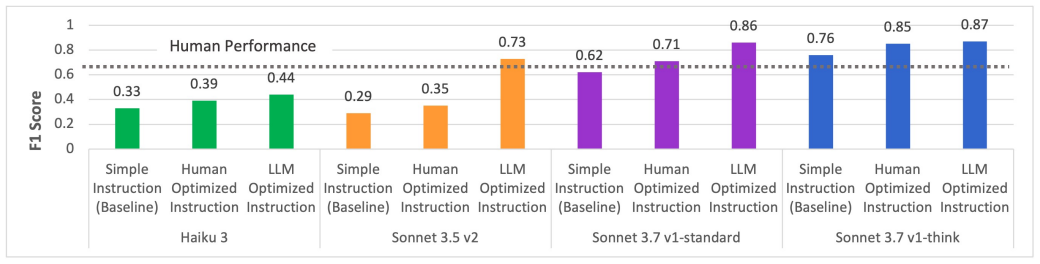
- [III-A3, IV-A, Figure 4] The headline claim that the LLM substantially exceeds the human benchmark (Abstract and Section VII) rests on a non-comparable evaluation. The human F1 of 0.68 in Table I is computed by comparing initial independent annotations against the calibrated ground truth on the full dataset of 973 samples, before the annotators received any calibration guidance; Section III-A3 explicitly states that these metrics represent the initial human benchmark on the entire collection. In contrast, the LLM is evaluated on a held-out test split after receiving calibration-derived instructions (Section III-B1), human rationales (Section III-B3), MIPRO-optimized instructions, and up to 300 many-shot demonstrations drawn from the training/development pool that include ground-truth labels (Section III-B5). The LLM is thus effectively conditioned on the reasoning that produced the labels it is scored against, while the humans were not given that guidance when their 0.68 score was recorded. To support the superiority claim, the authors would need to run a matched study in which human annotators receive the same calibration instructions, rationales, and demonstrations and are scored on the same held-out split.
- [V-D] The claimed expert confirmation that the LLM is superior in all 16 disagreement cases is circular and does not provide independent evidence. The reviewers are the same annotators from the original calibration sessions (Section III-A2) whose aggregated labels constitute the ground truth; asking them to adjudicate LLM corrections of their own labels is not an impartial assessment. Furthermore, if the 16 reversals (9 false negatives and 7 false positives in human annotations) are correct, then the ground-truth labels used to compute both the human F1 of 0.68 and the LLM F1 of 0.97 are themselves unstable, so both scores are moving targets. The paper should either re-adjudicate disagreements with a new expert panel under a pre-specified protocol, or it should drop the claim that experts independently confirmed LLM superiority.
- [IV-B1e, Figure 4, Appendix D] The reported 0.97 F1 is a single point on a demonstration-count scan (Sonnet 3.7-think with 200 demonstrations, Figure 4), with no error bars, no repeated trials, and no explicit test-set size or confidence interval. The dataset is partitioned into train/dev/test sets (Section III-B2 says 963 samples are partitioned equally, which would imply roughly 321 test samples), but the exact test-set size and class distribution for the reported results are not stated. Given the class imbalance (34% Required, 66% Not Required; Section III-A3), the differences between configurations (e.g., 0.95 vs 0.97) may be within sampling variability. Reporting repeated runs, variance, and exact test-set size is necessary to support the quantitative claims.
- [III-B4, V-B, Appendix D Tables V-VIII] The claim that LLM-generated rationales consistently outperform human-authored explanations (Section V-B and Conclusion) is not supported by the data as presented. The comparison is confounded: human rationales were collected during calibration and were not optimized, whereas LLM rationales were generated and selected by MIPRO using validation performance (Section III-B4). The appendix tables show at least one exception (Haiku 3, 3-shot: human F1 0.49 vs LLM F1 0.33, Table V) and several near-ties, so consistently is an overstatement. A fair comparison would hold optimization effort constant (e.g., optimize human rationales too, or use unoptimized LLM rationales).
minor comments (6)
- [II-B] The word multifacted should be multifaceted.
- [References] Reference [1] has a bracket typo and several citations have inconsistent spacing (e.g., '[ 3]', '[ 7]', '[ 13]'); please correct the formatting.
- [VI-B] The in-text citations Han and Johnson (2024) and Lee and Chen (2025) do not match the reference list entries [42] and [43]; please correct the author attributions.
- [III-A1, III-B2] The dataset size is inconsistent: Section III-A1 says 973 concept pairs, while Section III-B2 says 963 annotated samples partitioned equally; please clarify how the 10 samples were dropped and report the actual test-set size.
- [V-D] The text refers to Table 5 for the confusion matrix, but the figure is labeled Fig. 5; please fix the cross-reference.
- [Appendix A] The human-optimized instruction in Table II uses a Likert scale but does not explicitly state which ratings map to Required versus Not Required; please clarify the threshold in the prompt.
Circularity Check
The headline 'LLM F1 0.97 exceeds human F1 0.68' compares a calibration-conditioned model against an uncalibrated human baseline, uses calibration rationales in prompts without a stated split restriction, and validates LLM corrections by having the original annotators re-review after reading LLM rationales.
-
self definitional
[Section V-D, Human-in-the-Loop Validation and Operationalization Strategy]
"Human annotators from the original calibration sessions reviewed these 16 cases alongside the LLM's detailed reasoning. This review process revealed that in all examined cases, the LLM classifications were superior—all 9 cases were confirmed to be false negatives and all 7 cases were false positives in the human annotations."
The ground truth is defined by the original calibration sessions, and the same annotators are then asked to arbitrate disagreements after reading the LLM's rationales. Their reversal of their own post-calibrated labels is presented as evidence that the LLM found human oversights, but no independent gold standard is used; the evaluators are the same people who produced the labels under evaluation, and their judgment is elicited after exposure to the output being validated. The conclusion that the LLM was superior in all 16 cases is therefore an artifact of the review procedure, not an independent measurement.
-
fitted input called prediction
[Section III-B3, Human-Generated Rationales (Few-shot Prompting)]
"During the calibration sessions described in Section III-A2, annotators resolved disagreements and documented 314 rationales that captured the reasoning behind each labeling decision (see Appendix B for an example of human-generated rationales). These rationales were integrated into the prompts alongside the optimized instructions from the previous section."
The same calibration sessions that define the ground-truth labels also produce the rationales placed into evaluation prompts. The paper states a training/development/test split only for later model experiments and never restricts these 314 rationales to the training split; since the test split is a subset of the same 973-pair calibration set, a test-pair rationale may appear in the prompt as a demonstration. The model is then scored on reproducing labels whose reasoning it has been handed, so the reported few-shot F1 is not an independent held-out prediction.
1 more flagged steps
-
fitted input called prediction
[Section III-A3, Annotation Results; Section IV-B1e, Many-Shot Demonstrations]
"Comparing initial independent annotations against the calibrated ground truth across the full dataset of 973 samples yielded metrics of 0.69 for precision, recall, and accuracy, with a 0.68 F1-score (Table I), highlighting both the challenges in the annotation process and the importance of calibration. Unlike later model-based experiments that use data partitioning, these metrics represent the initial human benchmark on the entire collection. ... Figure 4 demonstrates that at 50 demonstrations, all models, including Haiku 3 (the smallest model tested), exceeded the human benchmark."
The human benchmark is defined as agreement between pre-calibration annotations and the calibrated consensus, while the LLM is evaluated after being given instructions, rationales, and demonstrations derived from those same calibration sessions. The headline gap of 0.97 versus 0.68 therefore compares 'agreement with calibrated consensus when the calibration is provided to the model' against 'agreement with calibrated consensus when humans were not given that calibration.' The claimed substantial superiority over humans is not established by this comparison.
full rationale
The central many-shot F1 result is not circular by construction: the 0.97 figure for Sonnet 3.7-think at 200 demonstrations uses a demonstration pool explicitly drawn from training and development data and is scored on a held-out test split, so it retains partial independent content. The self-citations in the paper ([40], [41]) appear only in future-work suggestions and are not load-bearing. However, three parts of the argument are contaminated. First, the calibration sessions that define ground truth also produce the instructions and 314 rationales that are placed into the evaluation prompts, with no stated split restriction, so few-shot test evaluations may include the reasoning and label for the very items being predicted. Second, the headline 'substantially exceeding the human benchmark' compares pre-calibration human agreement with a calibration-conditioned model, which is not an apples-to-apples human-vs-model comparison. Third, the Section V-D validation that the LLM was superior in all 16 disagreement cases is self-referential: the original annotators, after reading LLM rationales, reverse their own calibrated labels, and those reversals are then used as evidence of LLM superiority rather than as an independent measurement. These are genuine circularities in the supporting claims, though they do not make the held-out many-shot F1 itself a tautology; hence a score of 5.
Assumptions & free parameters
free parameters (5)
- Likert threshold for Required =
Always only
- Demonstration count for many-shot =
200 (best for Sonnet 3.7-think)
- Reasoning token budget =
10,000
- MIPRO mini-batch size =
25
- MIPRO full-validation interval =
10 mini-batch trials
assumptions (4)
- domain assumption Calibrated ground truth is the correct target
- domain assumption The private 973-pair dataset represents taxonomy alignment at scale
- domain assumption LLM rationales faithfully capture the reasoning behind classifications
- domain assumption Expert adjudication of LLM disagreements is independent
invented entities (1)
-
myskos:isRequiredFor and myskos:isNotRequiredFor
Cite this review
Pith. "Pith review of Transforming Expert Knowledge into Scalable Ontology via Large Language Models." pith.science (2026). https://pith.science/paper/FKI3D3PD
@misc{pith2026250608422,
  author       = {Pith},
  title        = {Pith review of: Transforming Expert Knowledge into Scalable Ontology via Large Language Models},
  year         = {2026},
  howpublished = {\url{https://pith.science/paper/FKI3D3PD}},
  note         = {Machine review of arXiv:2506.08422}
}
read the original abstract
Having a unified, coherent taxonomy is essential for effective knowledge representation in domain-specific applications as diverse terminologies need to be mapped to underlying concepts. Traditional manual approaches to taxonomy alignment rely on expert review of concept pairs, but this becomes prohibitively expensive and time-consuming at scale, while subjective interpretations often lead to expert disagreements. Existing automated methods for taxonomy alignment have shown promise but face limitations in handling nuanced semantic relationships and maintaining consistency across different domains. These approaches often struggle with context-dependent concept mappings and lack transparent reasoning processes. We propose a novel framework that combines large language models (LLMs) with expert calibration and iterative prompt optimization to automate taxonomy alignment. Our method integrates expert-labeled examples, multi-stage prompt engineering, and human validation to guide LLMs in generating both taxonomy linkages and supporting rationales. In evaluating our framework on a domain-specific mapping task of concept essentiality, we achieved an F1-score of 0.97, substantially exceeding the human benchmark of 0.68. These results demonstrate the effectiveness of our approach in scaling taxonomy alignment while maintaining high-quality mappings and preserving expert oversight for ambiguous cases.
Figures


Figures from the paper (2 more)


Forward citations
Cited by 1 Pith paper
-
Three Million Years Opposite State Data Retention in Partially Switched Wurtzite Ferroelectrics
Partially switching wurtzite ferroelectric capacitors is projected to improve opposite-state retention by 5–7 orders of magnitude, reaching ~3 million years at 150°C.
Reference graph
Works this paper leans on
-
[1]
Ontology-based knowledge management tools for knowledge sharing in organization—a review,
M. A. Osman, S. A. M. Noah, and S. Saad, “Ontology-based knowledge management tools for knowledge sharing in organization—a review,” IEEE access, vol. 10, pp. 43 267–43 283, 2022
work page 2022
-
[2]
Healthcare Knowledge Graph Construction: State-of-the-art, open issues, and opportunities
B. Abu-Salih, M. Al-Qurishi, M. Alweshah, M. Al-Smadi, R. Alfayez, and H. Saadeh, “Healthcare knowledge graph construction: State-of-the- art, open issues, and opportunities,”arXiv preprint arXiv:2207.03771, 2022
work page Pith review arXiv 2022
-
[3]
The behaviour change technique ontology: transforming the behaviour change technique taxonomy v1,
M. M. Marques, A. J. Wright, E. Corker, M. Johnston, R. West, J. Hastings, L. Zhang, and S. Michie, “The behaviour change technique ontology: transforming the behaviour change technique taxonomy v1,” Wellcome open research, vol. 8, p. 308, 2024
work page 2024
-
[4]
Taxonomy development methods sciences–a systematic review,
T. Syyrilä, S. Koskiniemi, E. Manias, and M. Härkänen, “Taxonomy development methods sciences–a systematic review,”International Journal of Medical Informatics, p. 105438, 2024
work page 2024
-
[5]
Subsumption prediction for e-commerce taxonomies,
J. Shi, J. Chen, H. Dong, I. Khan, L. Liang, Q. Zhou, Z. Wu, and I. Horrocks, “Subsumption prediction for e-commerce taxonomies,” pp. 244–261, 2023
work page 2023
-
[6]
M. A. AlAfnan, “Taxonomy of educational objectives: Teaching, learning, and assessing in the information and artificial intelligence era,”Journal of Curriculum and Teaching, vol. 13, no. 4, pp. 173–191, 2024
work page 2024
-
[7]
J. Euzenat, M.-E. Ro¸ soiu, and C. Trojahn,Ontology matching benchmarks: generation, stability, and discriminability. Elsevier, 2013, vol. 21
work page 2013
-
[8]
The prompt suite: interactive tools for ontology merging and mapping,
N. F. Noy and M. A. Musen, “The prompt suite: interactive tools for ontology merging and mapping,”International journal of human- computer studies, vol. 59, no. 6, pp. 983–1024, 2003
2003
Show all 55 references
-
[9]
Deep learning for knowledge representation: Automating semantic analysis and ontology construction,
F. Mustafa and F. Dine, “Deep learning for knowledge representation: Automating semantic analysis and ontology construction,” 2025
2025
-
[10]
Learning to match ontologies on the semantic web,
A. Doan, J. Madhavan, R. Dhamankar, P. Domingos, and A. Halevy, “Learning to match ontologies on the semantic web,”The VLDB journal, vol. 12, pp. 303–319, 2003
2003
-
[11]
Dis- tributed representations of words and phrases and their compositionality,
T. Mikolov, I. Sutskever, K. Chen, G. S. Corrado, and J. Dean, “Dis- tributed representations of words and phrases and their compositionality,” Advances in neural information processing systems, vol. 26, 2013
2013
-
[12]
Glove: Global vectors for word representation,
J. Pennington, R. Socher, and C. D. Manning, “Glove: Global vectors for word representation,” pp. 1532–1543, 2014
2014
-
[13]
A comprehensive survey of graph neural networks for knowledge graphs,
Z. Ye, Y . J. Kumar, G. O. Sing, F. Song, and J. Wang, “A comprehensive survey of graph neural networks for knowledge graphs,”IEEE Access, vol. 10, pp. 75 729–75 741, 2022
2022
-
[14]
Interpretable deep learning: Interpretation, interpretability, trustworthiness, and beyond,
X. Li, H. Xiong, X. Li, X. Wu, X. Zhang, J. Liu, J. Bian, and D. Dou, “Interpretable deep learning: Interpretation, interpretability, trustworthiness, and beyond,”Knowledge and Information Systems, vol. 64, no. 12, pp. 3197–3234, 2022
2022
-
[15]
Ontologies in the era of large language models–a perspec- tive,
F. Neuhaus, “Ontologies in the era of large language models–a perspec- tive,”Applied ontology, vol. 18, no. 4, pp. 399–407, 2023
2023
-
[16]
Language models are few-shot learners,
T. Brown, B. Mann, N. Ryder, M. Subbiah, J. D. Kaplan, P. Dhariwal, A. Neelakantan, P. Shyam, G. Sastry, A. Askellet al., “Language models are few-shot learners,” vol. 33, 2020, pp. 1877–1901
2020
-
[17]
Llms4ol: Large language models for ontology learning,
H. Babaei Giglou, J. D’Souza, and S. Auer, “Llms4ol: Large language models for ontology learning,” pp. 408–427, 2023
2023
-
[18]
Ontogenix: Leveraging large language models for enhanced ontology engineering from datasets,
M. Val-Calvo, M. E. Aranguren, J. Mulero-Hernández, G. Almagro- Hernández, P. Deshmukh, J. A. Bernabé-Díaz, P. Espinoza-Arias, J. L. Sánchez-Fernández, J. Mueller, and J. T. Fernández-Breis, “Ontogenix: Leveraging large language models for enhanced ontology engineering from da...
2025
-
[19]
Explain yourself! leveraging language models for commonsense reasoning,
N. F. Rajani, B. McCann, C. Xiong, and R. Socher, “Explain yourself! leveraging language models for commonsense reasoning,” 2019
2019
-
[20]
Chain-of-thought prompting elicits reasoning in large language models,
J. Wei, X. Wang, D. Schuurmans, M. Bosma, F. Xia, E. Chi, Q. V . Le, D. Zhouet al., “Chain-of-thought prompting elicits reasoning in large language models,”Advances in neural information processing systems, vol. 35, pp. 24 824–24 837, 2022
2022
-
[21]
Selection-inference: Exploit- ing large language models for interpretable logical reasoning,
A. Creswell, M. Shanahan, and I. Higgins, “Selection-inference: Exploit- ing large language models for interpretable logical reasoning,”arXiv preprint arXiv:2205.09712, 2022
2022 arXiv
-
[22]
Large language models are zero-shot reasoners,
T. Kojima, S. S. Gu, M. Reid, Y . Matsuo, and Y . Iwasawa, “Large language models are zero-shot reasoners,” vol. 35, 2022, pp. 22 199– 22 213
2022
-
[23]
Auto- prompt: Eliciting knowledge from language models with automatically generated prompts,
T. Shin, Y . Razeghi, R. L. Logan IV , E. Wallace, and S. Singh, “Auto- prompt: Eliciting knowledge from language models with automatically generated prompts,”arXiv preprint arXiv:2010.15980, 2020
2010 arXiv
-
[24]
Large language models are human-level prompt engineers,
Y . Zhou, A. I. Muresanu, Z. Han, K. Paster, S. Pitis, H. Chan, and J. Ba, “Large language models are human-level prompt engineers,” 2022
2022
-
[25]
Large language models as optimizers,
C. Yang, X. Wang, Y . Lu, H. Liu, Q. V . Le, D. Zhou, and X. Chen, “Large language models as optimizers,”arXiv preprint arXiv:2309.03409, 2023
2023 arXiv
-
[26]
Connecting large language models with evo-lutionary algorithms yields powerful prompt optimizers
Q. Guo12, R. Wang, J. Guo, B. Li23, K. Song, X. Tan, G. Liu, J. Bian, and Y . Yang, “Connecting large language models with evo-lutionary algorithms yields powerful prompt optimizers.”
-
[27]
Optimizing instructions and demonstrations for multi- stage language model programs,
K. Opsahl-Ong, M. J. Ryan, J. Purtell, D. Broman, C. Potts, M. Zaharia, and O. Khattab, “Optimizing instructions and demonstrations for multi- stage language model programs,”arXiv preprint arXiv:2406.11695, 2024
2024 arXiv
-
[28]
Improving consistency in large language models through chain of guidance,
H. Raj, V . Gupta, D. Rosati, and S. Majumdar, “Improving consistency in large language models through chain of guidance,”arXiv preprint arXiv:2502.15924, 2025
2025 arXiv
-
[29]
In-context learning unlocked for diffusion models,
Z. Wang, Y . Jiang, Y . Lu, P. He, W. Chen, Z. Wang, M. Zhouet al., “In-context learning unlocked for diffusion models,”Advances in Neural Information Processing Systems, vol. 36, pp. 8542–8562, 2023
2023
-
[30]
Machine learning in automated text categorization,
F. Sebastiani, “Machine learning in automated text categorization,” pp. 1–47, 2002
2002
-
[31]
Baselines and bigrams: Simple, good sentiment and topic classification,
S. I. Wang and C. D. Manning, “Baselines and bigrams: Simple, good sentiment and topic classification,” inProceedings of the 50th Annual Meeting of the Association for Computational Linguistics (Volume 2: Short Papers), 2012, pp. 90–94
2012
-
[32]
Chatgpt and finetuned bert: A comparative study for developing intelligent design support systems,
Y . Qiu and Y . Jin, “Chatgpt and finetuned bert: A comparative study for developing intelligent design support systems,”Intelligent systems with applications, vol. 21, p. 200308, 2024
2024
-
[33]
Paradigm shift presented by large language models (llm) in deep learning,
N. Chacko and V . Chacko, “Paradigm shift presented by large language models (llm) in deep learning,”Advances in Emerging Computing Technologies, vol. 40, 2023
2023
-
[34]
Challenging big- bench tasks and whether chain-of-thought can solve them,
M. Suzgun, N. Scales, N. Schärli, S. Gehrmann, Y . Tay, H. W. Chung, A. Chowdhery, Q. V . Le, E. H. Chi, D. Zhouet al., “Challenging big- bench tasks and whether chain-of-thought can solve them,”arXiv preprint arXiv:2210.09261, 2022
-
[35]
Self-consistency improves chain of thought reasoning in language models,
X. Wang, J. Wei, D. Schuurmans, Q. Le, E. Chi, S. Narang, A. Chowdhery, and D. Zhou, “Self-consistency improves chain of thought reasoning in language models,”arXiv preprint arXiv:2203.11171, 2022
2022 arXiv
-
[36]
Language models of code are few-shot commonsense learners,
A. Madaan, S. Zhou, U. Alon, Y . Yang, and G. Neubig, “Language models of code are few-shot commonsense learners,” 2022
2022
-
[37]
Future of jobs report 2023,
A. Di Battista, S. Grayling, E. Hasselaar, T. Leopold, R. Li, M. Rayner, and S. Zahidi, “Future of jobs report 2023,” inWorld Economic Forum, Geneva, Switzerland. https://www. weforum. org/reports/the-future-of- jobs-report-2023, 2023
2023
-
[38]
Skos simple knowledge organization system reference,
A. Miles and S. Bechhofer, “Skos simple knowledge organization system reference,” 2009
2009
-
[39]
Judging llm-as-a-judge with mt-bench and chatbot arena,
L. Zheng, W.-L. Chiang, Y . Sheng, S. Zhuang, Z. Wu, Y . Zhuang, Z. Lin, Z. Li, D. Li, E. Xinget al., “Judging llm-as-a-judge with mt-bench and chatbot arena,” vol. 36, 2023, pp. 46 595–46 623
2023
-
[40]
Potential and perils of large language models as judges of unstructured textual data,
R. Bedemariam, N. Perez, S. Bhaduri, S. Kapoor, A. Gil, E. Conjar, I. Itoku, D. Theil, A. Chadha, and N. Nayyar, “Potential and perils of large language models as judges of unstructured textual data,”arXiv preprint arXiv:2501.08167, 2025
2025 arXiv
-
[41]
Reconciling methodological paradigms: Employing large language models as novice qualitative research assistants in talent management research,
S. Bhaduri, S. Kapoor, A. Gil, A. Mittal, and R. Mulkar, “Reconciling methodological paradigms: Employing large language models as novice qualitative research assistants in talent management research,”arXiv preprint arXiv:2408.11043, 2024
2024 arXiv
-
[42]
Token-budget- aware llm reasoning,
T. Han, Z. Wang, C. Fang, S. Zhao, S. Ma, and Z. Chen, “Token-budget- aware llm reasoning,”arXiv preprint arXiv:2412.18547, 2024
2024 arXiv
-
[43]
How well do llms compress their own chain-of-thought? a token complexity approach,
A. Lee, E. Che, and T. Peng, “How well do llms compress their own chain-of-thought? a token complexity approach,”arXiv preprint arXiv:2503.01141, 2025. APPENDIXA HUMAN ANDLLM OPTIMIZEDINSTRUCTIONS A comparison of three instruction approaches shows progression from a simple bas...
2025 arXiv
-
[44]
Provide your reasoning in the rationale section, ensuring your assessment strictly aligns with the conceptual definitions provided
Analyze the Relationship: Evaluate whether Concept A is essential to the definition or realization of Concept B. Provide your reasoning in the rationale section, ensuring your assessment strictly aligns with the conceptual definitions provided
-
[45]
- Usually Necessary: Very important, with rare exceptions
Rate Necessity: Using the rationale, rate the competency’s necessity for performing the responsibility according to the Likert scale below: - Always Necessary: Essential and required in all circumstances. - Usually Necessary: Very important, with rare exceptions. - Often Neces...
-
[46]
Out- put only ‘Required‘ or ‘Not Required‘
Determine Requirement: Based on your rationale and Likert scale analysis, identify whether the competency is Required or Not Required for fulfilling the responsibility. Out- put only ‘Required‘ or ‘Not Required‘. You are an experienced ontological domain expert specializing in...
-
[47]
First, carefully analyze: - Concept A and its definition - Concept B and its definition - How they fundamentally relate to each other
-
[48]
Provide detailed step-by-step reasoning that: - Breaks down the key components of Concept B - Examines how Concept A relates to these components - Considers if Concept B can be defined or realized without Concept A - Evaluates the impact of removing Concept A from the relationship
-
[49]
Rate the essentiality of Concept A to Concept B using this Likert scale: - Always Necessary: Essential and required in all circumstances - Usually Necessary: Very important with rare exceptions - Often Necessary: Frequently helpful but not critical - Sometimes Necessary: Occas...
-
[50]
Required
Make a final determination: - Required: Concept B CANNOT be defined or realized without Concept A under ANY circumstances - Not Required: Concept A is helpful but not absolutely essential to Concept B Important: Focus on whether Concept B can exist or be meaningfully defined a...
-
[51]
Let me analyze this case step by step: - Break down the key components of mentorship: - Knowledge transfer - Skill development - Performance feedback - Career guidance - Relationship building
-
[52]
Analyze the verbal communication requirements: - Explaining complex concepts clearly - Articulating expectations and goals - Delivering constructive feedback - Asking effective questions - Active listening and responding
-
[53]
Evaluate the connection: - Cannot transfer knowledge without clear verbal explanations - Feedback delivery requires nuanced verbal communication - Building mentor-mentee trust depends on verbal rapport - Guidance becomes ineffective without articulate expression - Misunderstan...
-
[54]
Consider if mentorship could succeed without verbal communication: - Written communication alone lacks immediate clarification - Non-verbal cues insufficient for complex knowledge transfer - Time-sensitive feedback requires verbal exchange - Relationship development hindered b...
-
[55]
For Claude 3.7 Sonnet specifically, our analysis included both standard inference operation and enhanced thinking mode with 10,000 reasoning tokens
Failure in verbal communication would result in: - Incomplete knowledge transfer - Misinterpreted feedback - Diminished mentee engagement - Ineffective skill development - Damaged mentor-mentee relationship Answer: Required APPENDIXC PERFORMANCECOMPARISON OFDIFFERENTINSTRUCTIO...
Reviewed August 7, 2026 · model on record in the stance chip above.
Discussion (0). Sign in to comment.