REVIEW 2 major objections 4 minor 42 references
Modern approach to muonic x-ray spectroscopy demonstrated through the measurement of stable Cl radii
T0 review · 2 major / 4 minor · reviewed 2026-08-07 · deepseek-v4-flash
Pith's one-line read Modern muonic x-ray spectroscopy, with a Barrett-radius recipe and an energy-density-functional shape correction, determines the chlorine charge radii to 0.07% precision and replaces the electron-scattering values with results seven times…
desk verdict Careful first muonic radii for Cl with a useful new V2 method; the V2 uncertainty transfer is the main thing to probe in review. read the letter →
The pith
A machine-rendered reading of the paper's core claim, the machinery that carries it, and where it could break.
The reading
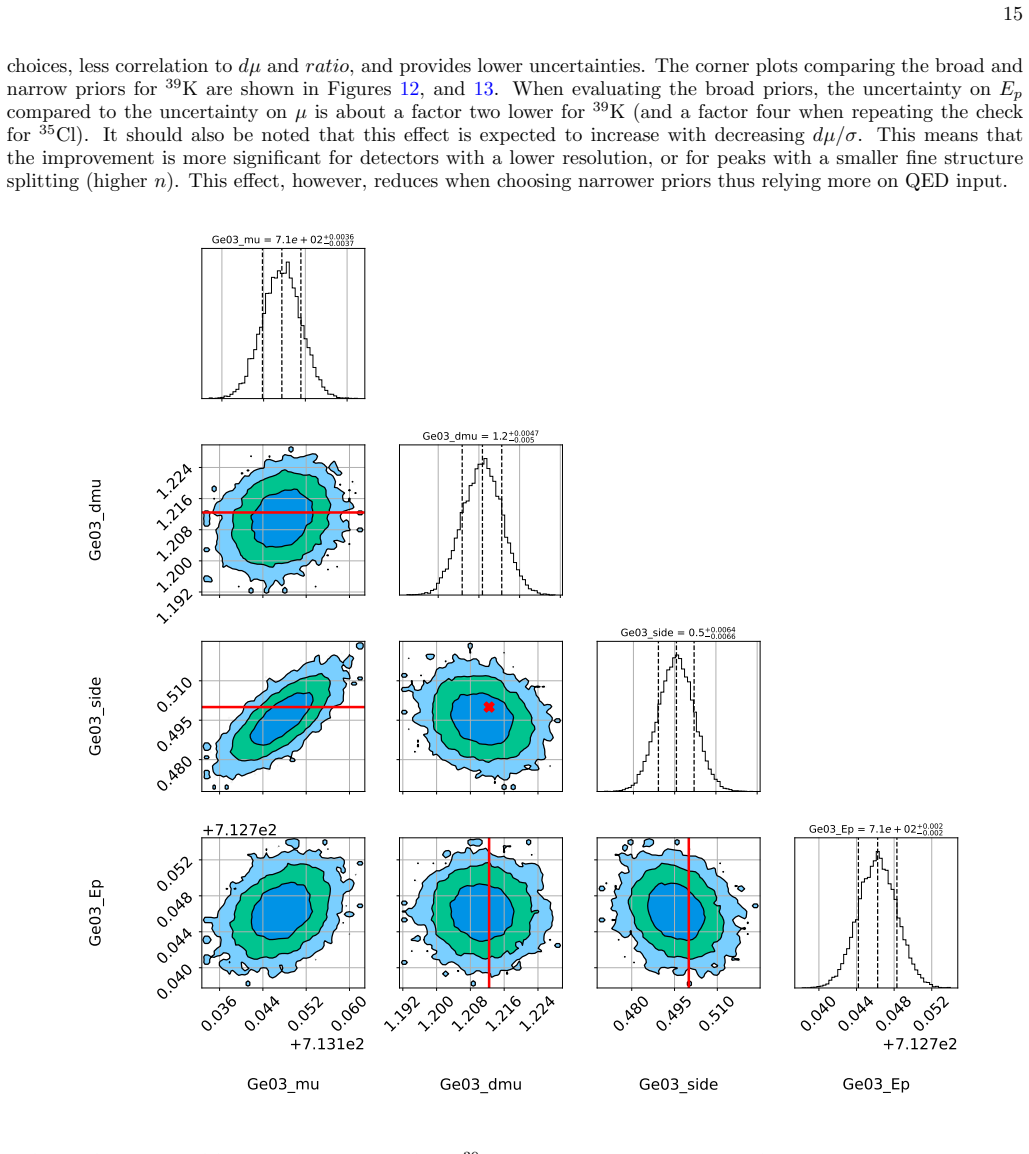
What carries the argument
The load-bearing objects are the Barrett moment $\langle r^k e^{-\alpha r}\rangle$ with its equivalent radius $R_{k\alpha}$, and the shape-correction ratio $V_2 = R_{k\alpha}/R_{\mathrm{RMS}}$ that turns a model-independent muonic radius into an RMS charge radius. The Barrett recipe, which fits the parameters $k$ and $\alpha$ to the difference in the muon's initial- and final-state potentials, suppresses the dependence on the assumed charge distribution. The paper's new move is to compute $V_2$ from the monopole charge distributions of the BSkG4 energy density functional — a Skyrme-Hartree-Fock-Bogoliubov model fitted to observables across the nuclear chart — instead of from electron scattering, benchmarking the model against high-$q_{\max}$ scattering on nine neighboring nuclei ($^{31}$P, $^{32,34,36}$S, $^{39}$K, $^{40,48}$Ca), whose average $0.05\%$ deviation is adopted as the $V_2$ uncertainty for chlorine. A second supporting mechanism is the handling of correlated uncertainties: nuclear polarization is split into nuclear and nucleon parts with an implied $88.2\%$ inter-isotope correlation, and the $V_2$ factors are assumed $97.0\%$ correlated between isotopes, which is what makes the differential radius an order of magnitude more precise than the absolute radii.
What would settle it
Measure the charge radii of 35Cl and 37Cl again with a technique whose shape correction does not depend on BSkG4 — for example a high-momentum-transfer elastic electron scattering experiment on both isotopes, or a muonic measurement of a different isotope pair where high-$q_{\max}$ scattering independently fixes $V_2$. If the true chlorine $V_2$ error sits near the $0.071\%$ offset BSkG4 shows against the available low-$q_{\max}$ chlorine data rather than the assumed $0.05\%$, the absolute radii would shift by 2–3 attometers, a large fraction of the quoted 23-attometer uncertainty, and the differential claim could be tested directly by measuring the $97.0\%$ inter-isotope $V_2$ correlation through a third isotope pair.
Extended reading notes
Core claim
The paper's central claim is that a fully modernized muonic x-ray analysis — digitally acquired and precisely calibrated $np1s$ transition energies, QED corrections that include effects older work omitted (notably hadronic vacuum polarization and a relativistic finite-size self-energy), nuclear-polarization uncertainties benchmarked against microscopic calculations, and a Barrett-moment recipe that removes charge-distribution model dependence — yields charge radii accurate at the $0.07\%$ level. The final conversion from the model-independent Barrett radius $R_{k\alpha}$ to the RMS radius uses the shape-correction ratio $V_2 = R_{k\alpha}/R_{\mathrm{RMS}}$ computed from BSkG4 energy-density-functional charge distributions instead of electron scattering. Applied to the two stable chlorine isotopes this gives $R(^{35}\mathrm{Cl}) = 3.3334(23)$ fm and $R(^{37}\mathrm{Cl}) = 3.3444(23)$ fm, disagreeing with the 1980 electron-scattering values of $3.388(17)$ fm by $3.2\sigma$ and $2.3\sigma$, and a differential mean square radius $\delta\langle r^2\rangle^{37,35} = +0.0771(66)\,\mathrm{fm}^2$. The paper argues the discrepancy signals underestimated systematics in the old electron-scattering analysis, and that the new radii, used as mirror-pair inputs, bring the mirror-shift fit's reduced $\chi^2$ from $2.15$ to $1.01$, supporting that fit's use for predicting radii of exotic isotopes.
Load-bearing premise
The load-bearing premise is that the BSkG4 energy density functional predicts the shape of the chlorine charge distribution, through the $V_2$ correction, as reliably as it does for nine neighboring nuclei that have high-quality electron scattering, so a $0.05\%$ uncertainty drawn from that comparison is transferred to chlorine even though the only available chlorine scattering data is low-$q_{\max}$ and was not used to set the uncertainty.
Editorial extensions
If this is right
- If the paper is right, muonic x-ray spectroscopy plus an energy-density-functional shape correction is accurate at the $0.07\%$ level for absolute radii in this mass region, and the 1980 electron-scattering chlorine values should be replaced by these numbers.
- The differential radius $\delta\langle r^2\rangle^{37,35} = +0.0771(66)\,\mathrm{fm}^2$ is now precise enough to calibrate the isotope-shift factor for laser spectroscopy of radioactive chlorine isotopes, including $^{34}$Cl in superallowed beta-decay studies.
- The EDF-based $V_2$ method removes the historical requirement of high-quality electron scattering, so the same pipeline can be applied to odd-mass and heavier nuclei, and to radioactive species where scattering is impossible.
- The new chlorine radii, combined with the mirror partners $^{35}$Ar and $^{37}$Ca, lower the mirror-shift fit's reduced $\chi^2$ from $2.15$ to $1.01$, strengthening the empirical case that the mirror fit predicts radii of exotic mirror pairs.
- The self-consistency check between measured $np1s$ energy differences and QED predictions certifies the energy scale, so the improved radii can serve as anchors for the charge-radius compilation in the $Z \approx 17$–$20$ region.
Reading between the lines
- My inference: if the BSkG4 $V_2$ transfer holds for further mid-mass isotopes, the same pipeline could revive muonic x-ray spectroscopy as the standard absolute-radius anchor for exotic-beam laser spectroscopy chains, where no electron scattering will ever exist.
- My inference: the $2.3$–$3.2\sigma$ disagreement with the 1980 scattering data raises the possibility that other compilation radii based on that era's low-$q_{\max}$ scattering carry similar unaccounted systematics; comparing differential radii from modern muonic measurements on several such isotope pairs would reveal the pattern.
- My inference: the $97.0\%$ inter-isotope $V_2$ correlation is a testable prediction — a muonic measurement of a neighboring isotope pair (for example a sulfur pair) where high-$q_{\max}$ scattering exists would check whether differences of $V_2$ really cancel to that degree.
- My inference: the mirror-shift consistency could be turned into a cross-check tool — for any future muonic radius pair, disagreement with the mirror trend would flag either the fit or the EDF shape correction, helping isolate where the method fails.
Editorial analysis
A structured set of objections, weighed in public.
Referee Report
Summary. The paper presents a muonic x-ray spectroscopy measurement of the stable chlorine isotopes 35Cl and 37Cl performed at the PSI πE1 beamline, and uses the extracted np1s transition energies (n = 2, 3, 4) to determine absolute nuclear charge radii and the differential mean square radius. The experimental analysis is state-of-the-art: per-detector hypermet line-shape fitting, bootstrap calibration with a detector-averaging bias check, a time-cut systematics correction, and a self-consistency check on radius-insensitive np1s energy differences. On the theory side, the paper combines MDFGME QED calculations, nuclear polarization with a new uncertainty treatment, Barrett-moment extraction, and a novel V2 shape correction obtained from BSkG4 energy-density-functional charge distributions. The central results are R(35Cl) = 3.3334(23) fm, R(37Cl) = 3.3444(23) fm, and δ⟨r²⟩^{37,35} = +0.0771(66) fm², which the authors compare with electron scattering literature and use to update a mirror shift fit. The paper claims a factor-of-seven improvement in absolute radius uncertainty and more than an order-of-magnitude improvement in the differential mean square radius.
Significance. If the extracted radii and uncertainties hold, this is an important result: it provides long-needed absolute charge radii for chlorine, benchmark values for laser spectroscopy of the Cl chain, and input for Vud, mirror-shift, and nuclear structure studies. The experimental work is careful and unusually transparent: the energy extraction includes a per-detector calibration with bootstrap uncertainty, a detector-averaging bias investigation, a high-statistics check on the time-cut induced shift, and a self-consistency comparison of np1s differences with QED. The paper also ships processed data on Zenodo, which supports reproducibility. The two load-bearing assumptions that need scrutiny are the transfer of the V2 uncertainty from neighboring nuclei to Cl and the assumed 97.0% inter-isotope V2 correlation; these are falsifiable calibration issues rather than internal inconsistencies, and they can be addressed by additional analysis within the scope of the manuscript.
major comments (2)
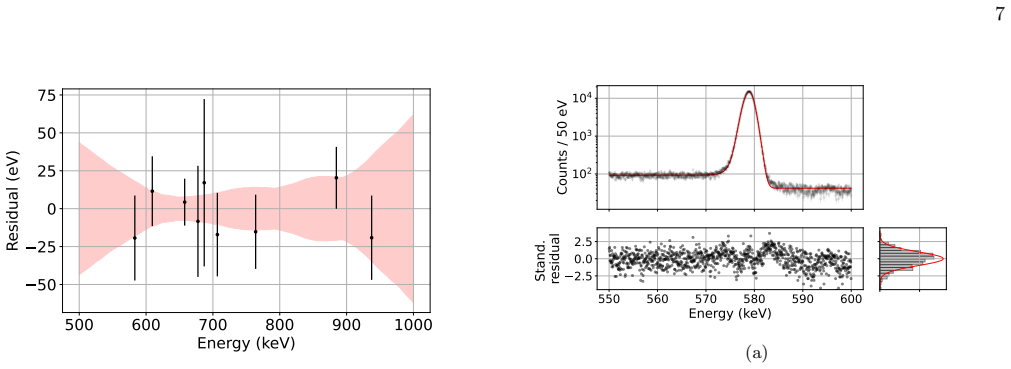
- [§IV E, Table X, Fig. 21] The 0.05% uncertainty assigned to the BSkG4 V2 correction for 35Cl and 37Cl is the average deviation of BSkG4 from high-qmax electron scattering on nine neighboring nuclei (31P, 32,34,36S, 39K, 40,48Ca), none of which is chlorine. The only direct Cl comparison, the low-qmax data of Ref. [49], gives V2 deviations of 0.071% (35Cl) and 0.059% (37Cl) from BSkG4, both outside the 0.05% band. The authors state in Fig. 21 that these points are 'in agreement', but agreement within the 0.15% uncertainty of the low-qmax measurement does not validate the much smaller EDF uncertainty. Since σV2 = 1.69 am is the dominant contribution to the absolute radius error budget (Table XIII) and the V2 term contributes 3.2 × 10⁻³ fm² to δ⟨r²⟩, a Cl-specific validation or a conservative V2 uncertainty based on the available low-qmax data is needed before the quoted error bars can be accepted.
- [§IV F, Eq. (12)–(13), Table XIII] The differential radius δ⟨r²⟩ = 0.0771(66) fm² relies on an assumed 97.0% correlation between the BSkG4 V2 factors of 35Cl and 37Cl. This correlation is inferred from neighboring nuclei and from the spread among BSkG2–BSkG4, with a stated minimal value of about 95%, but no Cl-specific check is available; ground-state configuration differences in odd-A nuclei could plausibly change the inter-isotope correlation. Because the V2 contribution to the δ⟨r²⟩ uncertainty is only 3.2 × 10⁻³ fm² at 97.0% correlation, the claimed 'more than one order of magnitude' improvement is sensitive to this number. Please provide a sensitivity analysis of δ⟨r²⟩ and its uncertainty for correlation values in a plausible range, or additional evidence that the neighboring-nucleus correlation applies to the Cl pair.
minor comments (4)
- [Abstract and Table XIV] The abstract quotes R(35Cl) = 3.3335(23) fm and R(37Cl) = 3.3445(23) fm, while Table XIV lists 3.3334(23) fm and 3.3444(23) fm; the rounding should be harmonized.
- [§IV A and Supplementary §II C] The main text states that the estimated QED uncertainty for the 1s state is about 3 eV, while the supplementary material says that adding the identified missing contributions in quadrature gives about 4 eV after rounding; please clarify which value is used in the error budget and make the statements consistent.
- [Fig. 21] The figure legend says the Cl values are 'in agreement' with BSkG4, but the two Cl points lie outside the blue band representing the average deviation; please state explicitly what the band represents and quote the 35Cl and 37Cl deviations in the text or caption.
- [Table III and Supplementary Table IX] The entry '06.6' for the 3p1s statistical-plus-calibration uncertainty of 35Cl has a leading zero, and the 4p1s total uncertainty for 35Cl is rounded to 12.5 eV in the main text but 12.6 eV in the supplementary material; these formatting and rounding inconsistencies should be corrected.
Circularity Check
No circularity found: extraction chain is self-contained; V2 benchmark caveat is an accuracy concern, not circularity.
full rationale
The radius extraction chain is not circular. The measured muonic np1s transition energies are calibrated against independent gamma-ray lines (Table II), the QED and nuclear polarization corrections are computed with established codes and published data (MDFGME; Refs. 79-82), and the Barrett parameters k and alpha are obtained by fitting the muonic potential difference rather than the measured energies. The Barrett radii are converted to RMS radii using the V2 shape correction from BSkG4, an externally published energy-density functional, whose V2 predictions are benchmarked against high-qmax electron scattering on nine neighboring nuclei (Table X, Fig. 21); the BSkG4 V2 values are not fitted to the Cl muonic data. The extracted radii disagree with the 1980 electron-scattering values by 3.2 sigma and 2.3 sigma, confirming that the measurement carries independent information and is not forced by its inputs. Although several theoretical tools involve co-authors (BSkG models and nuclear polarization methods), they are independently published and benchmarked against external data, so the self-citation is not load-bearing in a circularity sense. The main caveat is that the 0.05% V2 uncertainty is transferred from a neighboring-nucleus benchmark while the direct low-qmax Cl comparison shows deviations slightly outside that band, and the assumed 97.0% inter-isotope V2 correlation is an assumption; these are falsifiable calibration concerns, not circular steps.
Assumptions & free parameters
free parameters (6)
- Barrett parameters k and alpha =
k = 2.0937(4), alpha = 0.0559(2) fm^-1 (35Cl); k = 2.0940(4), alpha = 0.0558(2) fm^-1 (37Cl)
- NP correlated fraction fCorr =
90.4% (35Cl), 97.6% (37Cl), cross-isotope 88.2%
- V2 inter-isotope correlation =
97.0%
- V2 (BSkG4) relative uncertainty =
0.05%
- NP relative uncertainty =
23%
- QED 1s uncertainty estimate =
3 eV (about 4 eV after quadrature)
assumptions (7)
- domain assumption A two-parameter Fermi charge distribution with fixed t = 2.3 fm adequately describes the nuclear charge for the QED and Barrett calculations.
- domain assumption Nuclear polarization uncertainties for the odd-mass Cl isotopes can be quantified via the 40Ca Skyrme-benchmark spread (23%).
- domain assumption BSkG4 predicts V2 for 35,37Cl with the 0.05% accuracy observed on the nine-nucleus benchmark set.
- ad hoc to paper Inter-isotope correlations: V2 correlation 97.0%, NP correlation 88.2%.
- domain assumption Uncalculated higher-order QED effects are bounded by 3-4 eV on the 1s state.
- domain assumption The high-qmax electron scattering datasets in the benchmark set provide reliable V2 references.
- domain assumption Electron screening can be modeled with fully populated 1s and 2s electron orbitals during the muonic cascade.
Cite this review
Pith. "Pith review of Modern approach to muonic x-ray spectroscopy demonstrated through the measurement of stable Cl radii." pith.science (2026). https://pith.science/paper/DHRNHE4P
@misc{pith2026250608804,
  author       = {Pith},
  title        = {Pith review of: Modern approach to muonic x-ray spectroscopy demonstrated through the measurement of stable Cl radii},
  year         = {2026},
  howpublished = {\url{https://pith.science/paper/DHRNHE4P}},
  note         = {Machine review of arXiv:2506.08804}
}
abstract
Recent advances in muonic x-ray experiments have reinvigorated efforts in measurements of absolute nuclear charge radii. Here, a modern approach is presented, and demonstrated through determination of the charge radii of the two stable chlorine nuclides $^{35}$Cl and $^{37}$Cl. Knowledge of these radii has implications for fundamental studies in nuclear and atomic physics. For this purpose, a state-of-the-art experiment was performed at the $\pi$E1 beamline in the Paul Scherrer Institute (Switzerland), using a large-scale HPGe detector array in order to extract precise energies of the muonic $^{35}$Cl and $^{37}$Cl $np1s$ transitions. The nuclear charge radius extraction relies on modern calculations for QED effects and nuclear polarization with rigorous uncertainty quantification, including effects that were not accounted for in older studies. Additionally, we established a new method for applying the nuclear shape correction directly from energy density functionals, which are amenable to isotopes for which no high-quality electron scattering experiments are available. The resulting charge radii are $3.3335(23) fm$ for $^{35}$Cl and $3.3445(23) fm$ for $^{37}$Cl, thus improving the uncertainty of the available electron scattering values by a factor of seven. The correlation of several observables was evaluated between the different isotopes in order to produce a more precise value of the differential mean square charge radius $\delta \langle r^2 \rangle^{37, 35}=+0.0771(66) fm^{2}$. In this case, improvement of the uncertainty by more than one order of magnitude was achieved compared to the literature value. This precision is sufficient to use this differential as input for isotope shift factor determination.
Figures


Figures from the paper (37 more)






Reference graph
Works this paper leans on
-
[1]
Coupled hypermet fitting The individual peaks are fitted with a hypermet function (Eq. ( 3)). f (E) = Nsig [fG ·g(E) +fT ·t(E) +s(E)] +b(E), (3) where fT = 1 −fG, g(E) = 1√ 2Ãà exp ( − 1 2 [E −µ à ]2) , t(E) = 1 2´ exp ( E −µ ´ + Ã2 2´2 ) erfc ( E −µ√ 2à + Ã√ 2´ ) , s(E) = A 2 erfc ( E −µ√ 2à ) , b(E) = Linear Chebychev with integral NBg =Ndata −Nsig. While...
-
[2]
Bootstrap fitting As a next step, a calibration fit was performed. If we proceed with stan dard least-squares fitting methods, it is assumed that the estimated centroid uncertainties are accurate. Whe n the calibration is statistics limited, this is a valid assumption. In many cases, however, the limiting aspect of th e calibration is an underlying non-linea...
-
[3]
The cuts applied for this dataset are:
Rejection logic In order to clean up the prompt spectra, several rejections can be made . The cuts applied for this dataset are:
-
[4]
Muon pile-up protection cut
-
[5]
Multiplicity cut The muon beam at PSI is approximately uniformly distributed in time (∼ 20 ns between proton pulses, O(1 ms) average time between subsequent muons). When muons arrive close to one another, a germanium event may be 11 100− 80− 60− 40− 20− 0 20 40 Time difference (ns) 0 20 40 60 80 100 120 140 160 180 200 310× Counts FIG. 10: Time difference ...
-
[6]
Coincidence time cut Once the calibration is performed, a time cut was made which contains on ly few non-coincident events. A large fraction of the background at the np1s peaks for these data is prompt with respect to the muon. For the 35Cl measurement, the primary background originates from Compton scattering of higher np1s peaks, while for the 37Cl meas...
-
[7]
The choice of priors In this section, the fitting of the np1s peaks will be explained. Here, we need to use an approach which is simi lar to that applied for the bias investigation in Section I G. Since the background does not vary significantly over energy in these spectra, the linear component of the background is omitted. Due t o the fine structure splitt...
-
[8]
This is because the model cannot identify the exact position of the individual peaks
Extraction of energies During the fitting process, it was observed that µ has a significant correlation with dµ and ratio. This is because the model cannot identify the exact position of the individual peaks. This issue can be overcome by introducing the center-of-gravity energy Ep using Ep = µ +ratio × (µ −dµ) 1 +ratio . (8) This quantity is a more direct ...
Show all 42 references
-
[9]
This is displayed in Figure 14 for a BEGe 3820 type HPGe detector
Effect of time cut The energy versus time spectrum shows a slight shift in centroid energy based on the time difference with the incoming muon. This is displayed in Figure 14 for a BEGe 3820 type HPGe detector. As will later be shown, this particular detector (Ge09) suffers the m...
2001
-
[10]
The 2 p1s, 3p1s, and 4p1s are visible without significant overlap for both Cl isotopes
Fit results With these methods established, the muonic x-ray peaks of intere st were fitted. The 2 p1s, 3p1s, and 4p1s are visible without significant overlap for both Cl isotopes. For 37Cl, more care has to be taken, as the 7f3d peaks from silver (AgCl) are less than 10 keV bel...
-
[11]
However, si nce this splitting is completely unresolved, the effects should in first order cancel out
Effect of hyperfine splitting While the muonic x-ray peaks were fitted with doublets, justified by the fine structure (FS), they in principle contain more peaks due to the hyperfine structure (HFS). However, si nce this splitting is completely unresolved, the effects should in first o...
2000
-
[12]
Consequently, the center- of-gravity energies may suffer a systematic shift
Effect of impurities The enriched targets used during these measurements did not have 100% isotopic purity. Consequently, the center- of-gravity energies may suffer a systematic shift. As a result, the isotope shift measured before are actually effective isotope shifts IS ′, whic...
-
[13]
the hydrodynamical Jensen-Steinwedel model for L = 1, and 3) the Tassie-Goldhaber-Teller model for L g 2. The models were chosen based on the comparison with the microscopic Skyrm e calculations [ 26] for 40Ca, from which one can also expect that the corrections obtained for 3...
-
[14]
M.-M. B´ e, V. Chist´ e, C. Dulieu, X. Mougeot, E. Browne, V. C hechev, N. Kuzmenko, F. Kondev, A. Luca, M. Galan, A. Nichols, A. Arinc, and X. Huang, Table of radionuclides (Vol. 5 - A = 22 to 244) , Table of Radionuclides, Vol. 5 (Bureau International des Poids et Mesures, 2010)
2010
-
[15]
Campbell and J
J. Campbell and J. Maxwell, A cautionary note on the use of t he hypermet tailing function in x-ray spectrometry with Si (Li) detectors, Nuclear Instruments and Methods in Physics Research Section B 129, 297 (1997)
1997
-
[16]
G. F. Knoll, Radiation detection and measurement (John & Wiley Sons Inc, 2010)
2010
-
[17]
Pachucki, V
K. Pachucki, V. Patk´ oˇ s, and V. A. Yerokhin, Second-order hyperfine correction to H, D, and 3He energy levels, Physical Review A 110, 062806 (2024) . 36
2024
-
[18]
Indelicato, Mcdfgme: Multiconfiguration Dirac-Fock and General Matrix Elemen ts Program (2024v2) (2024)
P. Indelicato, Mcdfgme: Multiconfiguration Dirac-Fock and General Matrix Elemen ts Program (2024v2) (2024)
2024
-
[19]
E. A. Uehling, Polarization effects in the positron theory, Physical Review 48, 55 (1935)
1935
-
[20]
Klarsfeld, Analytical expressions for the evaluation of v acuum-polarization potentials in muonic atoms, Physics Letters B 66, 86 (1977)
S. Klarsfeld, Analytical expressions for the evaluation of v acuum-polarization potentials in muonic atoms, Physics Letters B 66, 86 (1977)
1977
-
[21]
Indelicato, Nonperturbative evaluation of some QED con tributions to the muonic hydrogen n= 2 Lamb shift and hyperfine structure, Physical Review A 87, 022501 (2013)
P. Indelicato, Nonperturbative evaluation of some QED con tributions to the muonic hydrogen n= 2 Lamb shift and hyperfine structure, Physical Review A 87, 022501 (2013)
2013
-
[22]
E. H. Wichmann and N. M. Kroll, Vacuum polarization in a stron g Coulomb field, Physical Review 101, 843 (1956)
1956
-
[23]
Huang, Calculation of the vacuum-polarization po tential, Physical Review A 14, 1311 (1976)
K.-N. Huang, Calculation of the vacuum-polarization po tential, Physical Review A 14, 1311 (1976)
1976
-
[24]
L. W. Fullerton and G. Rinker Jr., Accurate and efficient meth ods for the evaluation of vacuum-polarization potentials of order Zα and Zα 2, Physical Review A 13, 1283 (1976)
1976
-
[25]
Breidenbach, E
S. Breidenbach, E. Dizer, H. Cakir, and Z. Harman, Hadronic vac uum polarization correction to atomic energy levels, Physical Review A 106, 042805 (2022)
2022
-
[26]
S. G. Karshenboim, E. Y. Korzinin, V. A. Shelyuto, and V. G. Ivanov, α (Zα )5m finite-nuclear-size contribution to the energy levels in light muonic atoms, Physical Review A 98, 062512 (2018)
2018
-
[27]
V. A. Yerokhin and N. S. Oreshkina, QED calculations of the nuclear recoil effect in muonic atoms, Physical Review A 108, 052824 (2023)
2023
-
[28]
Pachucki, Radiative recoil correction to the Lamb shift, Physical Review A 52, 1079 (1995)
K. Pachucki, Radiative recoil correction to the Lamb shift, Physical Review A 52, 1079 (1995)
1995
-
[29]
U. D. Jentschura, Proton radius, Darwin-Foldy term and radiativ e corrections, The European Physical Journal D 61, 7 (2011)
2011
-
[30]
Pachucki, Nuclear structure corrections in muonic deute rium, Physical Review Letters 106, 193007 (2011)
K. Pachucki, Nuclear structure corrections in muonic deute rium, Physical Review Letters 106, 193007 (2011)
2011
-
[31]
Indelicato, QED tests with highly charged ions, Journal of Physics B 52, 232001 (2019)
P. Indelicato, QED tests with highly charged ions, Journal of Physics B 52, 232001 (2019)
2019
-
[32]
I. A. Valuev, G. Col` o, X. Roca-Maza, C. H. Keitel, and N. S. Oreshkina, Evidence against nuclear polarization as source of fine-structure anomalies in muonic atoms, Physical Review Letters 128, 203001 (2022)
2022
-
[33]
I. A. Valuev and N. S. Oreshkina, Full leading-order nucle ar polarization in highly charged ions, Physical Review A 109, 042811 (2024)
2024
-
[34]
A. Haga, Y. Horikawa, and H. Toki, Reanalysis of muonic 90Zr and 208Pb atoms, Physical Review C 75, 044315 (2007)
2007
-
[35]
Gorchtein, A hitchhiker’s guide to nuclear polarizatio n in muonic atoms, arXiv:2501.15274 (2025)
M. Gorchtein, A hitchhiker’s guide to nuclear polarizatio n in muonic atoms, arXiv:2501.15274 (2025)
2025
-
[36]
J. Chen, J. Cameron, and B. Singh, Nuclear data sheets for A = 35, Nuclear Data Sheets 112, 2715 (2011)
2011
-
[37]
J. Chen, J. Cameron, B. Singh, and N. Nica, Nuclear data sh eets for A= 37, Nuclear Data Sheets 113, 0090 (2012)
2012
-
[38]
Rinker and J
G. Rinker and J. Speth, Nuclear polarization in muonic at oms, Nuclear Physics A 306, 397 (1978)
1978
-
[39]
G. Colo, L. Cao, N. Van Giai, and L. Capelli, Self-consist ent RPA calculations with Skyrme-type interactions: The skyrme rpa program, Computer Physics Communications 184, 142 (2013)
2013
-
[40]
Angeli and K
I. Angeli and K. P. Marinova, Table of experimental nuclea r ground state charge radii: An update, Atomic Data and Nuclear Data Tables 99, 69 (2013)
2013
-
[41]
Angeli, Table of nuclear root mean square charge radii, IN DC(HUN)-033, IAEA Nuclear Data Section, Vienna https://inis.iaea.org/records/d154x-etn35 (1999)
I. Angeli, Table of nuclear root mean square charge radii, IN DC(HUN)-033, IAEA Nuclear Data Section, Vienna https://inis.iaea.org/records/d154x-etn35 (1999)
1999
-
[42]
De Vries, C
H. De Vries, C. De Jager, and C. De Vries, Nuclear charge-density -distribution parameters from elastic electron scattering, Atomic Data and Nuclear Data Tables 36, 495 (1987)
1987
Reviewed August 7, 2026 · model on record in the stance chip above.
Discussion (0). Continue with ORCID to comment.