REVIEW 3 major objections 4 minor 1 cited by
Bar-driven dispersal of Galactic substructure
T0 review · 3 major / 4 minor · reviewed 2026-08-07 · deepseek-v4-flash
Pith's one-line read The Milky Way's bar disperses low-energy substructure in integrals-of-motion space, so searches should use the Jacobi integral plus chemistry.
desk verdict The bar-dispersal claim holds up across three models, and the H_J plus chemistry proposal is the practical takeaway; the diffusion toy model is the weakest link, but the simulations carry the argument. read the letter →
The pith
A machine-rendered reading of the paper's core claim, the machinery that carries it, and where it could break.
The reading
What carries the argument
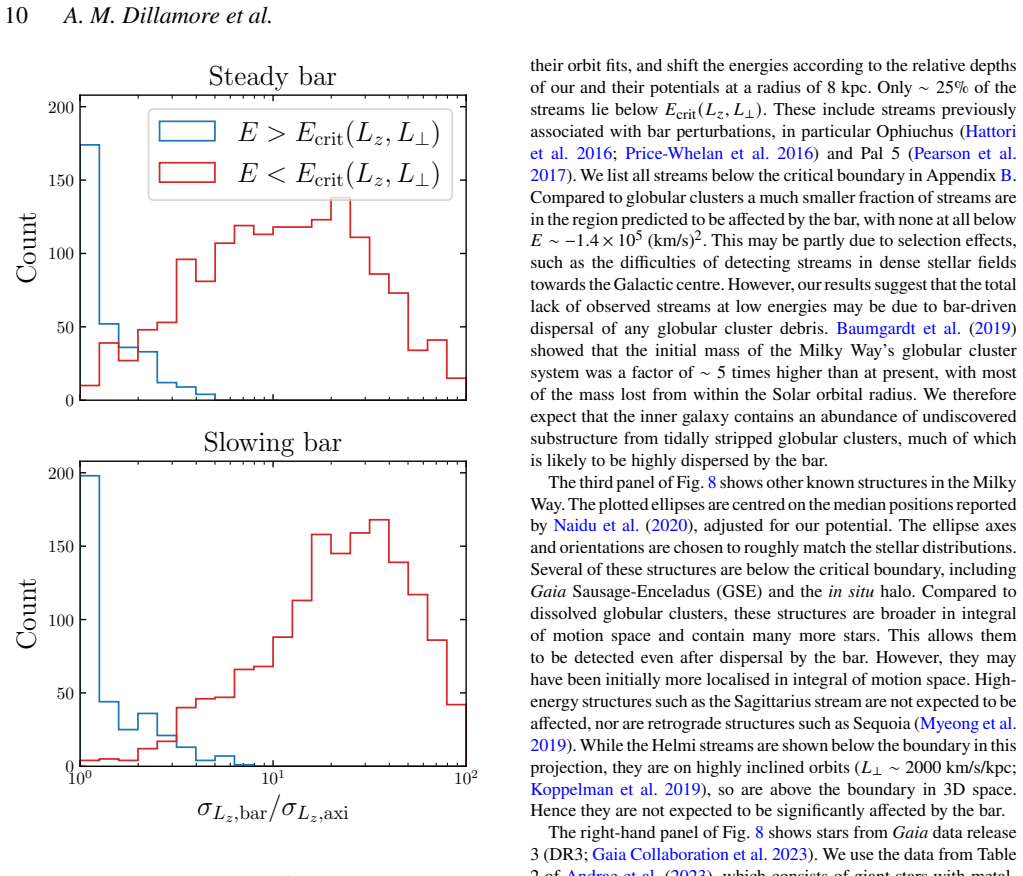
The load-bearing object is the Jacobi integral $H_\mathrm{J}=E-\Omega_\mathrm{b}L_z$, defined in the frame corotating with the bar. In a barred potential it replaces energy and angular momentum individually as the conserved quantity, and even when the bar decelerates the relation $dE/dL_z=\Omega_\mathrm{b}(t)$ (equation 7) locks each particle's energy change to its angular-momentum change at every instant. The paper models bar encounters as a random-walk diffusion in $L_z$ (equations 8--9), whose Green's-function solution is a Gaussian in $(L_z,E)$ with a narrow, elongated covariance; the long axis has slope approximately $\langle\Omega_\mathrm{b}\rangle_D$, the diffusion-weighted average pattern speed over the substructure's lifetime (equations 21--31). The second piece of machinery is the fitted critical surface $E_\mathrm{crit}(L_z,L_\perp)$ (equation 50), a downward-curving paraboloid in the three-dimensional integral-of-motion space that marks where bar-induced spreading exceeds a factor of $e\approx2.7$.
What would settle it
Identify an ancient, chemically tagged dissolved globular cluster in the inner halo (with $E<E_\mathrm{crit}$) and measure the distribution of its member stars in $(L_z,E)$. If the stars are not elongated along a line whose slope lies between the present and time-averaged bar pattern speed, or if they remain compact after several gigayears, the diffusion picture and its slope prediction would be ruled out. A population-level version: measure the slope distribution across many chemically tagged low-energy substructures; it should cluster between the current $\Omega_\mathrm{b}$ and the time-averaged $\Omega_\mathrm{b}$, peaking where the paper's weighted average sits.
Extended reading notes
Core claim
The central claim is that a rotating bar turns the traditional integrals of motion ($L_z$, $L_\perp$, $E$, and the actions) into non-conserved quantities for substructure on low-energy prograde orbits, so dissolved globular clusters and accreted debris cannot remain tightly clustered in the usual integral-of-motion spaces. In the $(L_z,E)$ plane the dispersal proceeds along lines of slope $dE/dL_z=\Omega_\mathrm{b}(t)$: with a steadily rotating bar this is exact conservation of the Jacobi integral $H_\mathrm{J}=E-\Omega_\mathrm{b}L_z$, and with a slowing bar the present-day slope equals a diffusion-weighted time average of the pattern speed, equation (30). The paper quantifies a critical surface $E_\mathrm{crit}(L_z,L_\perp)$ such that structures below it have their angular-momentum spread amplified by more than a factor of $e\approx2.7$ (often 10--100), and it finds that roughly three-quarters of Milky Way globular clusters and a quarter of known stellar streams fall below it. All three models agree that the debris remains substantially more concentrated in the space of metallicity and $H_\mathrm{J}$, so the paper proposes using $H_\mathrm{J}$ plus chemistry when searching for inner-halo substructure, and using the measured slopes of bar-dispersed debris to constrain the bar's past pattern-speed evolution.
Load-bearing premise
The diffusion model assumes that each encounter with the bar gives an independent, unbiased random kick, ignoring resonant trapping and coherent transport; the paper's own test-particle simulations show a population of stars trapped at the corotation resonance ($L_z\sim1000$ kpc km/s, $E\sim-1.4\times10^5$ (km/s)$^2$) that could shift the angular momenta coherently and change the predicted spreading direction.
Editorial extensions
If this is right
- Traditional clustering searches in $(L_z,L_\perp,E)$ will miss most ancient inner-halo substructure, because the bar smears it into overlapping diffuse clouds; abundant 'bar-dispersed' debris is predicted to exist.
- The observed lack of low-energy stellar streams is naturally explained as bar-driven dispersal of globular-cluster debris, rather than requiring that such streams never existed.
- The slope of bar-dispersed substructure in $(L_z,E)$ is a fossil of the bar's pattern-speed history; comparing measured slopes with the present-day $\Omega_\mathrm{b}$ gives a direct test of whether the Milky Way's bar has been decelerating.
- Searching in the combined space of $H_\mathrm{J}$ and metallicity keeps dissolved globular clusters identifiable even where they have been heavily dispersed, and remains useful for clusters dissolved up to a few gigayears ago.
- The fitted surface $E_\mathrm{crit}(L_z,L_\perp)$ provides a rule of thumb for any realistic Milky Way potential to decide when the bar can be ignored and when it must be included.
Reading between the lines
- Extending the paper's logic, the same slope-memory argument should apply to any rotating non-axisymmetric perturbation, so the method could in principle measure the pattern speed of transient spiral structure, though the paper only tests bars.
- A population-level prediction that follows is that chemically tagged low-energy halo stars should show many small elongated clumps in $(L_z,E)$ oriented at a common angle; measuring the scatter in these orientations across clumps would quantify how much the pattern speed changed during the dispersal.
- Because most in-situ globular clusters lie below $E_\mathrm{crit}$, their debris is preferentially dispersed, so the diffuse high-[N/O] stars in the inner halo may be the surviving bar-smeared remnants of multiple clusters rather than a single progenitor — a scenario the paper's picture supports but does not explicitly claim.
- If the bar has indeed been slowing, the predicted slopes should systematically exceed the current $\Omega_\mathrm{b}$; a first test could be made with existing data by measuring the elongation of known low-energy structures whose orbital fits are reliable.
Editorial analysis
A structured set of objections, weighed in public.
Referee Report
Summary. This paper quantifies the dispersal of Galactic substructure in integrals-of-motion (IoM) space by a rotating bar, using three complementary approaches: an analytical diffusion model in (L_z,E), test-particle simulations with steady and slowing bars, and the Auriga 18 cosmological zoom-in simulation. The central claim is that low-energy, prograde, eccentric substructure is dispersed by a factor of roughly 10--100 in angular-momentum/energy spread, so that traditional IoM clustering becomes ineffective in the inner halo, while clustering in the Jacobi integral H_J = E - Omega_b L_z together with chemical abundances remains effective. A paraboloid survival criterion E_crit(L_z,L_perp) is fitted to the test-particle simulations, and the paper applies this criterion to observed globular clusters, stellar streams, and halo stars, concluding that a large fraction of known substructure is affected by the bar. The paper also proposes that the gradient dE/dL_z of dispersed substructure encodes the past evolution of the bar's pattern speed.
Significance. If correct, the paper's conclusions have substantial impact on Galactic archaeology: they directly challenge the common practice of searching for ancient substructure using (L_z,L_perp,E) clustering in the inner halo, and they offer a concrete alternative (H_J plus chemistry). The paper is strong in using three independent model families that agree qualitatively, in deriving an exact differential relation dE/dL_z = Omega_b(t) (Eq. 7), and in making falsifiable predictions about the slope of dispersed debris and the relative compactness in H_J space. The code is made publicly available, and the Auriga-based mock-cluster test is a valuable external check. The main significance is conditional on the robustness of the dispersal amplitude and the survival criterion, which currently rest on the diffusion approximation and on a fit with no quoted uncertainties.
major comments (3)
- The diffusion model assumes that bar encounters are random, unbiased, and uncorrelated impulses, and Section 2.2 explicitly restricts this to substructure away from resonances. However, the test-particle simulation with a slowing bar in Section 3.1 produces a prominent corotation-resonance-trapped population (the excess near L_z ~ 1000 kpc km/s and E ~ -1.4e5 (km/s)^2), whose orbits receive coherent, biased angular-momentum kicks. Because the headline dispersal factor of 10--100 and the fitted survival boundary E_crit (Eq. 50) are calibrated on simulations that include this trapped population without separating it from diffusive trajectories, the universal 'cannot remain tightly clustered' claim and the survival criterion are not yet cleanly separated from resonant transport. I ask the authors to quantify the fraction of trapped particles, to recompute the dispersion ratio excluding them or with a resonance-aware treatment, and to state explicitly how the conclusions depend on that separation.
- The survival criterion is an empirical paraboloid fit with no quoted parameter uncertainties, no sensitivity analysis, and an arbitrary threshold e = 2.7. The fit uses a Gaussian weight with sigma = 0.1 in log dispersion and no cross-validation against an independent simulation or a different bar model. This criterion is load-bearing for the observational statements that about 3/4 of globular clusters and 1/4 of known streams lie below E_crit, and for the recommendation to use H_J in that region. I request that the authors report the covariance of the fitted parameters, show how the classification changes as e is varied over a reasonable range, and test the fitted boundary against the Auriga simulation or a barred potential with different strength/pattern speed.
- The cosmological simulation shows that the oldest mock clusters have low-energy gradients steeper than any value of Omega_b in the simulation, and the paper attributes this to mass growth and violent relaxation. Since the proposed pattern-speed-history diagnostic targets bar-dispersed substructure, and since the most interesting ancient globular-cluster debris is old, this complication directly limits the central predictive claim in the abstract that bar-dispersed substructure should allow the past evolution of Omega_b to be constrained. The current text acknowledges the effect but does not quantify it; I ask the authors to provide a quantitative decomposition of the gradient excess in Au-18 (e.g., bar-driven versus potential-growth-driven contributions) or to restrict the pattern-speed claim to age-selected populations where the bar dominates.
minor comments (4)
- The text says the points in Fig. 2 are coloured by circularity eta and the caption mentions red/blue, but the colour scale is not defined in the caption; please state explicitly which colour corresponds to prograde versus retrograde orbits.
- The paraboloid form has units that mix kpc and km/s; it would be clearer to define all variables with explicit units in the equation caption, as done in Eq. (50).
- The mock clusters are constructed by selecting the 50 particles nearest to a progenitor in IoM space; this procedure is reasonable, but the choice of 50 particles and the dependence on the unit conversion factor Omega_0 should be justified or tested, since it directly sets the initial compactness of the mock clusters.
- The table lists streams below the critical boundary, but for a few entries the quoted |E - E_crit| values are very small compared to likely energy uncertainties in orbit fits; a brief caveat about this would be helpful.
Circularity Check
No significant circularity: model predictions are tested against independent test-particle and cosmological simulations; fitted quantities are presented as empirical calibrations.
full rationale
The paper's central claims are not circular. The diffusion model (Section 2.2, Eq. 9) is introduced as an explicit toy model whose Appendix A derivation assumes unbiased random kicks with Delta E = Omega_b(t) Delta L_z, an assumption the paper states is only valid away from resonances. The resulting slope prediction (Eq. 30) follows mathematically from that ansatz plus the exact identity dE/dL_z = Omega_b(t) (Eq. 7), but it is then confronted with two independent simulations: a test-particle setup with a Hunter et al. (2024)/Sormani et al. (2022) barred potential (Section 3) and the cosmological Au-18 simulation (Section 4), neither of which is fitted to the diffusion model's outputs. The predicted factor ~10-100 increase in L_z/E spread is measured rather than imposed, and the Auriga results are external to the analytic model. The E_crit paraboloid (Eq. 50) is admittedly 'fit to the simulation data' (Section 3.3), so its later use to classify observed globular clusters and streams is a calibration, not a hidden prediction. The only near-circular element is that in a steadily rotating bar the dispersal direction dE/dL_z = Omega_b follows exactly from Jacobi-integral conservation, so agreement of the diffusion model with the steady-bar simulation is partly built in; however, the paper does not rely on the steady-bar slope as independent confirmation, and the slowing-bar gradient and dispersal amplitudes are nontrivial predictions verified against independent simulations. Self-citations (Dillamore et al. 2024a,b, 2025) supply potential parameters and prior context, but the trapping phenomenon cited from Dillamore et al. (2024b) is also reproduced in the present test-particle simulations, so the argument does not reduce to a self-citation chain.
Assumptions & free parameters
free parameters (7)
- Bar strength A =
0.02
- Bar shape parameter b =
0.28
- Isochrone potential parameters M and a =
M=2.35e11 Msun, a=3 kpc
- Initial pattern speed and deceleration (Omega_b0, eta, t_f) =
80 km/s/kpc, 0.003, 5.4 Gyr
- Cluster mass M_c and velocity dispersion sigma =
1e5 Msun, 1 km/s
- Criterion fit coefficients (a, b, c, d) in E_crit =
a=4.8e4 (km/s)^2, b=0.018, c=505 km/s, d=0.005
- Threshold e for 'significantly affected' =
e=2.7
assumptions (6)
- domain assumption Bar interactions are random, uncorrelated, unbiased impulses (no resonant trapping)
- domain assumption Impulse approximation replaces the true orbit with the unperturbed axisymmetric orbit when computing Delta E
- domain assumption The phase angles (Omega, omega) are uniformly distributed for phase-mixed substructure
- ad hoc to paper The survival boundary has the form of a paraboloid in (L_z, E, L_perp)
- ad hoc to paper Bar length scales with corotation radius as S(t)=Omega_b(t_f)/Omega_b(t)
- domain assumption Mock clusters in Auriga are represented by the 50 stars closest in IoM space to a random old star
Cite this review
Pith. "Pith review of Bar-driven dispersal of Galactic substructure." pith.science (2026). https://pith.science/paper/I3ZX2JES
@misc{pith2026250609117,
  author       = {Pith},
  title        = {Pith review of: Bar-driven dispersal of Galactic substructure},
  year         = {2026},
  howpublished = {\url{https://pith.science/paper/I3ZX2JES}},
  note         = {Machine review of arXiv:2506.09117}
}
abstract
Galactic archaeologists often assume that integrals of motion (IoMs) such as $L_z$ and $E$ are conserved, so substructure remains frozen in IoM space over many Gyr. However, this is not true in the Milky Way due in part to its rotating bar. In this study we quantify the effects of the bar on the dynamics of substructure. We employ three different theoretical models: an analytical toy model; a set of test particle simulations with steady and slowing bars; and a cosmological zoom-in simulation of a Milky Way-like galaxy. Each model predicts that the bar increases the angular momentum and energy spread of low-energy substructures by a factor of $\sim10-100$, so they cannot remain tightly clustered. We derive a criterion for determining when this effect is important. The most affected orbits are low energy ($E\lesssim E_\odot$, $r_\mathrm{apo}<40$ kpc), prograde, eccentric, or low inclination. This includes $\sim3/4$ of Galactic globular clusters and $\sim1/4$ of known stellar streams. We predict the presence of abundant bar-dispersed substructure. The structures remain much more tightly clustered in the space of metallicity and Jacobi integral $H_\mathrm{J}=E-\Omega_\mathrm{b}L_z$. We therefore propose using $H_\mathrm{J}$ and chemistry instead of traditional IoMs when searching for inner halo substructure. In $(L_z,E)$ space the dispersal of the structures is along a principal direction with gradient $\mathrm{d}E/\mathrm{d}L_z$ equal to the bar's pattern speed $\Omega_\mathrm{b}$. Bar-dispersed substructure should therefore allow the past evolution of $\Omega_\mathrm{b}$ to be constrained.
Figures


Figures from the paper (9 more)




Forward citations
Cited by 1 Pith paper
-
The chemodynamical memory of a major merger in a NIHAO-UHD Milky Way analogue -- I. A golden thread through time and space
In a Milky Way analogue simulation, accreted stars from the last major merger retain a measurable memory of their birth radius: core-born stars are more bound and metal-rich, outer-born stars less bound and metal-poor...
Reference graph
Works this paper leans on
-
[1]
write newline
" write newline "" before.all 'output.state := FUNCTION fin.entry write newline FUNCTION new.block output.state before.all = 'skip after.block 'output.state := if FUNCTION new.sentence output.state after.block = 'skip output.state before.all = 'skip after.sentence 'output.state := if if FUNCTION not #0 #1 if FUNCTION and 'skip pop #0 if FUNCTION or pop #1...
-
[2]
Andrae R., Rix H.-W., Chandra V., 2023, @doi [ ] 10.3847/1538-4365/acd53e , https://ui.adsabs.harvard.edu/abs/2023ApJS..267....8A 267, 8
-
[3]
Baumgardt H., Hilker M., 2018, @doi [ ] 10.1093/mnras/sty1057 , https://ui.adsabs.harvard.edu/abs/2018MNRAS.478.1520B 478, 1520
-
[4]
Baumgardt H., Hilker M., Sollima A., Bellini A., 2019, @doi [ ] 10.1093/mnras/sty2997 , https://ui.adsabs.harvard.edu/abs/2019MNRAS.482.5138B 482, 5138
-
[5]
Belokurov V., Kravtsov A., 2022, @doi [ ] 10.1093/mnras/stac1267 , https://ui.adsabs.harvard.edu/abs/2022MNRAS.514..689B 514, 689
-
[6]
Belokurov V., Kravtsov A., 2023, @doi [ ] 10.1093/mnras/stad2241 , https://ui.adsabs.harvard.edu/abs/2023MNRAS.525.4456B 525, 4456
-
[7]
Belokurov V., Kravtsov A., 2024, @doi [ ] 10.1093/mnras/stad3920 , https://ui.adsabs.harvard.edu/abs/2024MNRAS.528.3198B 528, 3198
-
[8]
Belokurov V., Erkal D., Evans N. W., Koposov S. E., Deason A. J., 2018, @doi [ ] 10.1093/mnras/sty982 , https://ui.adsabs.harvard.edu/abs/2018MNRAS.478..611B 478, 611
Show all 94 references
-
[9]
Binney J., 2020, @doi [ ] 10.1093/mnras/staa1103 , https://ui.adsabs.harvard.edu/abs/2020MNRAS.495..895B 495, 895
2020 doi
-
[10]
Binney J., Tremaine S., 2008, Galactic Dynamics: Second Edition
2008
-
[11]
E., Stark A
Binney J., Gerhard O. E., Stark A. A., Bally J., Uchida K. I., 1991, @doi [ ] 10.1093/mnras/252.2.210 , https://ui.adsabs.harvard.edu/abs/1991MNRAS.252..210B 252, 210
1991 doi
-
[12]
Bland-Hawthorn J., Gerhard O., 2016, @doi [ ] 10.1146/annurev-astro-081915-023441 , https://ui.adsabs.harvard.edu/abs/2016ARA&A..54..529B 54, 529
2016 doi
-
[13]
N., 1991, @doi [ ] 10.1086/170535 , https://ui.adsabs.harvard.edu/abs/1991ApJ...379..631B 379, 631
Blitz L., Spergel D. N., 1991, @doi [ ] 10.1086/170535 , https://ui.adsabs.harvard.edu/abs/1991ApJ...379..631B 379, 631
1991 doi
-
[14]
M., 2025, @doi [ ] 10.1016/j.newar.2024.101713 , https://ui.adsabs.harvard.edu/abs/2025NewAR.10001713B 100, 101713
Bonaca A., Price-Whelan A. M., 2025, @doi [ ] 10.1016/j.newar.2024.101713 , https://ui.adsabs.harvard.edu/abs/2025NewAR.10001713B 100, 101713
2025
-
[15]
W., Hunt J
Bovy J., Leung H. W., Hunt J. A. S., Mackereth J. T., Garc \' a-Hern \'a ndez D. A., Roman-Lopes A., 2019, @doi [ ] 10.1093/mnras/stz2891 , https://ui.adsabs.harvard.edu/abs/2019MNRAS.490.4740B 490, 4740
2019 doi
-
[16]
W., 2015, @doi [ ] 10.1093/mnras/stv285 , https://ui.adsabs.harvard.edu/abs/2015MNRAS.449.1391B 449, 1391
Bowden A., Belokurov V., Evans N. W., 2015, @doi [ ] 10.1093/mnras/stv285 , https://ui.adsabs.harvard.edu/abs/2015MNRAS.449.1391B 449, 1391
2015 doi
-
[17]
M., Cautun M., Deason A
Callingham T. M., Cautun M., Deason A. J., Frenk C. S., Grand R. J. J., Marinacci F., 2022, @doi [ ] 10.1093/mnras/stac1145 , https://ui.adsabs.harvard.edu/abs/2022MNRAS.513.4107C 513, 4107
2022 doi
-
[18]
Chiba R., Sch \"o nrich R., 2021, @doi [ ] 10.1093/mnras/stab1094 , https://ui.adsabs.harvard.edu/abs/2021MNRAS.505.2412C 505, 2412
2021 doi
-
[19]
Chiba R., Friske J. K. S., Sch \"o nrich R., 2021, @doi [ ] 10.1093/mnras/staa3585 , https://ui.adsabs.harvard.edu/abs/2021MNRAS.500.4710C 500, 4710
2021 doi
-
[20]
P., Gerhard O., 2022, @doi [ ] 10.1093/mnras/stac603 , https://ui.adsabs.harvard.edu/abs/2022MNRAS.512.2171C 512, 2171
Clarke J. P., Gerhard O., 2022, @doi [ ] 10.1093/mnras/stac603 , https://ui.adsabs.harvard.edu/abs/2022MNRAS.512.2171C 512, 2171
2022 doi
-
[21]
Dehnen W., 2000, @doi [ ] 10.1086/301226 , https://ui.adsabs.harvard.edu/abs/2000AJ....119..800D 119, 800
2000 doi
-
[22]
Dehnen W., Semczuk M., Sch \"o nrich R., 2023, @doi [ ] 10.1093/mnras/stac3184 , https://ui.adsabs.harvard.edu/abs/2023MNRAS.518.2712D 518, 2712
2023 doi
-
[23]
M., Belokurov V., Font A
Dillamore A. M., Belokurov V., Font A. S., McCarthy I. G., 2022a, @doi [ ] 10.1093/mnras/stac1038 , https://ui.adsabs.harvard.edu/abs/2022MNRAS.513.1867D 513, 1867
-
[24]
M., Belokurov V., Evans N
Dillamore A. M., Belokurov V., Evans N. W., Price-Whelan A. M., 2022b, @doi [ ] 10.1093/mnras/stac2311 , https://ui.adsabs.harvard.edu/abs/2022MNRAS.516.1685D 516, 1685
-
[25]
M., Belokurov V., Evans N
Dillamore A. M., Belokurov V., Evans N. W., Davies E. Y., 2023, @doi [ ] 10.1093/mnras/stad2136 , https://ui.adsabs.harvard.edu/abs/2023MNRAS.524.3596D 524, 3596
2023 doi
-
[26]
M., Belokurov V., Evans N
Dillamore A. M., Belokurov V., Evans N. W., 2024a, @doi [ ] 10.1093/mnras/stae1789 , https://ui.adsabs.harvard.edu/abs/2024MNRAS.532.4389D 532, 4389
-
[27]
M., Monty S., Belokurov V., Evans N
Dillamore A. M., Monty S., Belokurov V., Evans N. W., 2024b, @doi [ ] 10.3847/2041-8213/ad60c8 , https://ui.adsabs.harvard.edu/abs/2024ApJ...971L...4D 971, L4
- [28]
-
[29]
M., Helmi A., Matsuno T., Ruiz-Lara T., Balbinot E., L \"o vdal S., 2023, @doi [ ] 10.1051/0004-6361/202244546 , https://ui.adsabs.harvard.edu/abs/2023A&A...670L...2D 670, L2
Dodd E., Callingham T. M., Helmi A., Matsuno T., Ruiz-Lara T., Balbinot E., L \"o vdal S., 2023, @doi [ ] 10.1051/0004-6361/202244546 , https://ui.adsabs.harvard.edu/abs/2023A&A...670L...2D 670, L2
2023 doi
-
[30]
Einstein A., 1905, @doi [Annalen der Physik] 10.1002/andp.19053220806 , https://ui.adsabs.harvard.edu/abs/1905AnP...322..549E 322, 549
1905 doi
-
[31]
A., Huang S., Weinberg M
Fardal M. A., Huang S., Weinberg M. D., 2015, @doi [ ] 10.1093/mnras/stv1198 , https://ui.adsabs.harvard.edu/abs/2015MNRAS.452..301F 452, 301
2015 doi
-
[32]
Fattahi A., et al., 2019, @doi [ ] 10.1093/mnras/stz159 , https://ui.adsabs.harvard.edu/abs/2019MNRAS.484.4471F 484, 4471
2019 doi
-
[33]
Fragkoudi F., et al., 2020, @doi [ ] 10.1093/mnras/staa1104 , https://ui.adsabs.harvard.edu/abs/2020MNRAS.494.5936F 494, 5936
2020 doi
-
[34]
Gaia Collaboration et al., 2023, @doi [ ] 10.1051/0004-6361/202243940 , https://ui.adsabs.harvard.edu/abs/2023A&A...674A...1G 674, A1
2023 doi
-
[35]
Gibbons S. L. J., Belokurov V., Evans N. W., 2014, @doi [ ] 10.1093/mnras/stu1986 , https://ui.adsabs.harvard.edu/abs/2014MNRAS.445.3788G 445, 3788
2014 doi
-
[36]
Grand R. J. J., et al., 2017, @doi [ ] 10.1093/mnras/stx071 , https://ui.adsabs.harvard.edu/abs/2017MNRAS.467..179G 467, 179
2017 doi
-
[37]
Halle A., Di Matteo P., Haywood M., Combes F., 2015, @doi [ ] 10.1051/0004-6361/201525612 , https://ui.adsabs.harvard.edu/abs/2015A&A...578A..58H 578, A58
2015 doi
-
[38]
A., Arzamasskiy L., Duarte V
Hamilton C., Tolman E. A., Arzamasskiy L., Duarte V. N., 2023, @doi [ ] 10.3847/1538-4357/acd69b , https://ui.adsabs.harvard.edu/abs/2023ApJ...954...12H 954, 12
2023 doi
-
[39]
E., 1996, @doi [ ] 10.1086/118116 , https://ui.adsabs.harvard.edu/abs/1996AJ....112.1487H 112, 1487
Harris W. E., 1996, @doi [ ] 10.1086/118116 , https://ui.adsabs.harvard.edu/abs/1996AJ....112.1487H 112, 1487
1996 doi
- [40]
-
[41]
L., 2016, @doi [ ] 10.1093/mnras/stw1006 , https://ui.adsabs.harvard.edu/abs/2016MNRAS.460..497H 460, 497
Hattori K., Erkal D., Sanders J. L., 2016, @doi [ ] 10.1093/mnras/stw1006 , https://ui.adsabs.harvard.edu/abs/2016MNRAS.460..497H 460, 497
2016 doi
-
[42]
Helmi A., White S. D. M., 1999, @doi [ ] 10.1046/j.1365-8711.1999.02616.x , https://ui.adsabs.harvard.edu/abs/1999MNRAS.307..495H 307, 495
1999
-
[43]
T., 2000, @doi [ ] 10.1046/j.1365-8711.2000.03895.x , https://ui.adsabs.harvard.edu/abs/2000MNRAS.319..657H 319, 657
Helmi A., de Zeeuw P. T., 2000, @doi [ ] 10.1046/j.1365-8711.2000.03895.x , https://ui.adsabs.harvard.edu/abs/2000MNRAS.319..657H 319, 657
2000
-
[44]
Helmi A., White S. D. M., de Zeeuw P. T., Zhao H., 1999, @doi [ ] 10.1038/46980 , https://ui.adsabs.harvard.edu/abs/1999Natur.402...53H 402, 53
1999 doi
-
[45]
H., Massari D., Veljanoski J., Brown A
Helmi A., Babusiaux C., Koppelman H. H., Massari D., Veljanoski J., Brown A. G. A., 2018, @doi [ ] 10.1038/s41586-018-0625-x , https://ui.adsabs.harvard.edu/abs/2018Natur.563...85H 563, 85
2018 doi
-
[46]
Horta D., et al., 2021, @doi [ ] 10.1093/mnras/staa3598 , https://ui.adsabs.harvard.edu/abs/2021MNRAS.500.5462H 500, 5462
2021 doi
-
[47]
H., et al., 2024, @doi [ ] 10.1051/0004-6361/202450000 , https://ui.adsabs.harvard.edu/abs/2024A&A...692A.216H 692, A216
Hunter G. H., et al., 2024, @doi [ ] 10.1051/0004-6361/202450000 , https://ui.adsabs.harvard.edu/abs/2024A&A...692A.216H 692, A216
2024 doi
-
[48]
G., Belokurov V., Cranmer M., Monty S., Zhang H., Ardern-Arentsen A., 2025, @doi [ ] 10.1093/mnras/stae2689 , https://ui.adsabs.harvard.edu/abs/2025MNRAS.536.2507K 536, 2507
Kane S. G., Belokurov V., Cranmer M., Monty S., Zhang H., Ardern-Arentsen A., 2025, @doi [ ] 10.1093/mnras/stae2689 , https://ui.adsabs.harvard.edu/abs/2025MNRAS.536.2507K 536, 2507
2025 doi
-
[49]
Kim B., et al., 2025, @doi [ ] 10.1093/mnras/staf705 , https://ui.adsabs.harvard.edu/abs/2025MNRAS.tmp..685K
2025 doi
-
[50]
H., Helmi A., Massari D., Roelenga S., Bastian U., 2019, @doi [ ] 10.1051/0004-6361/201834769 , https://ui.adsabs.harvard.edu/abs/2019A&A...625A...5K 625, A5
Koppelman H. H., Helmi A., Massari D., Roelenga S., Bastian U., 2019, @doi [ ] 10.1051/0004-6361/201834769 , https://ui.adsabs.harvard.edu/abs/2019A&A...625A...5K 625, A5
2019 doi
-
[51]
Kruijssen J. M. D., et al., 2020, @doi [ ] 10.1093/mnras/staa2452 , https://ui.adsabs.harvard.edu/abs/2020MNRAS.498.2472K 498, 2472
2020 doi
-
[52]
O., Saracino S., Dreizler S., 2025, @doi [ ] 10.1051/0004-6361/202452420 , https://ui.adsabs.harvard.edu/abs/2025A&A...694A.248L 694, A248
Latour M., Kamann S., Martocchia S., Husser T. O., Saracino S., Dreizler S., 2025, @doi [ ] 10.1051/0004-6361/202452420 , https://ui.adsabs.harvard.edu/abs/2025A&A...694A.248L 694, A248
2025 doi
-
[53]
W., Bovy J., Mackereth J
Leung H. W., Bovy J., Mackereth J. T., Hunt J. A. S., Lane R. R., Wilson J. C., 2023, @doi [ ] 10.1093/mnras/stac3529 , https://ui.adsabs.harvard.edu/abs/2023MNRAS.519..948L 519, 948
2023 doi
-
[54]
Liu H., Du C., Ye D., Zhang J., Deng M., 2024, @doi [ ] 10.3847/1538-4357/ad8352 , https://ui.adsabs.harvard.edu/abs/2024ApJ...976..161L 976, 161
2024 doi
-
[55]
S., Ruiz-Lara T., Koppelman H
L \"o vdal S. S., Ruiz-Lara T., Koppelman H. H., Matsuno T., Dodd E., Helmi A., 2022, @doi [ ] 10.1051/0004-6361/202243060 , https://ui.adsabs.harvard.edu/abs/2022A&A...665A..57L 665, A57
2022 doi
-
[56]
Lynden-Bell D., 1967, @doi [ ] 10.1093/mnras/136.1.101 , https://ui.adsabs.harvard.edu/abs/1967MNRAS.136..101L 136, 101
1967 doi
-
[57]
L., Grebel E
Martell S. L., Grebel E. K., 2010, @doi [ ] 10.1051/0004-6361/201014135 , https://ui.adsabs.harvard.edu/abs/2010A&A...519A..14M 519, A14
2010 doi
-
[58]
H., Helmi A., 2019, @doi [ ] 10.1051/0004-6361/201936135 , https://ui.adsabs.harvard.edu/abs/2019A&A...630L...4M 630, L4
Massari D., Koppelman H. H., Helmi A., 2019, @doi [ ] 10.1051/0004-6361/201936135 , https://ui.adsabs.harvard.edu/abs/2019A&A...630L...4M 630, L4
2019 doi
-
[59]
Mateu C., 2023, @doi [ ] 10.1093/mnras/stad321 , https://ui.adsabs.harvard.edu/abs/2023MNRAS.520.5225M 520, 5225
2023 doi
-
[60]
McInnes L., Healy J., Astels S., 2017, @doi [The Journal of Open Source Software] 10.21105/joss.00205 , https://ui.adsabs.harvard.edu/abs/2017JOSS....2..205M 2, 205
2017 doi
-
[61]
Merrow A., Grand R. J. J., Fragkoudi F., Martig M., 2024, @doi [ ] 10.1093/mnras/stae1250 , https://ui.adsabs.harvard.edu/abs/2024MNRAS.531.1520M 531, 1520
2024 doi
-
[62]
Mowla L., et al., 2024, @doi [ ] 10.1038/s41586-024-08293-0 , https://ui.adsabs.harvard.edu/abs/2024Natur.636..332M 636, 332
2024 doi
-
[63]
C., Evans N
Myeong G. C., Evans N. W., Belokurov V., Sanders J. L., Koposov S. E., 2018a, @doi [ ] 10.3847/2041-8213/aab613 , https://ui.adsabs.harvard.edu/abs/2018ApJ...856L..26M 856, L26
-
[64]
C., Evans N
Myeong G. C., Evans N. W., Belokurov V., Sanders J. L., Koposov S. E., 2018b, @doi [ ] 10.3847/2041-8213/aad7f7 , https://ui.adsabs.harvard.edu/abs/2018ApJ...863L..28M 863, L28
-
[65]
C., Vasiliev E., Iorio G., Evans N
Myeong G. C., Vasiliev E., Iorio G., Evans N. W., Belokurov V., 2019, @doi [ ] 10.1093/mnras/stz1770 , https://ui.adsabs.harvard.edu/abs/2019MNRAS.488.1235M 488, 1235
2019 doi
-
[66]
P., Conroy C., Bonaca A., Johnson B
Naidu R. P., Conroy C., Bonaca A., Johnson B. D., Ting Y.-S., Caldwell N., Zaritsky D., Cargile P. A., 2020, @doi [ ] 10.3847/1538-4357/abaef4 , https://ui.adsabs.harvard.edu/abs/2020ApJ...901...48N 901, 48
2020 doi
-
[67]
Ou X., Necib L., Frebel A., 2023, @doi [ ] 10.1093/mnras/stad706 , https://ui.adsabs.harvard.edu/abs/2023MNRAS.521.2623O 521, 2623
2023 doi
-
[68]
M., Johnston K
Pearson S., Price-Whelan A. M., Johnston K. V., 2017, @doi [Nature Astronomy] 10.1038/s41550-017-0220-3 , https://ui.adsabs.harvard.edu/abs/2017NatAs...1..633P 1, 633
2017 doi
-
[69]
Planck Collaboration et al., 2014, @doi [ ] 10.1051/0004-6361/201321591 , https://ui.adsabs.harvard.edu/abs/2014A&A...571A..16P 571, A16
2014 doi
-
[70]
Portail M., Gerhard O., Wegg C., Ness M., 2017, @doi [ ] 10.1093/mnras/stw2819 , https://ui.adsabs.harvard.edu/abs/2017MNRAS.465.1621P 465, 1621
2017 doi
-
[71]
Posti L., Binney J., Nipoti C., Ciotti L., 2015, @doi [ ] 10.1093/mnras/stu2608 , https://ui.adsabs.harvard.edu/abs/2015MNRAS.447.3060P 447, 3060
2015 doi
-
[72]
M., Sesar B., Johnston K
Price-Whelan A. M., Sesar B., Johnston K. V., Rix H.-W., 2016, @doi [ ] 10.3847/0004-637X/824/2/104 , https://ui.adsabs.harvard.edu/abs/2016ApJ...824..104P 824, 104
2016 doi
-
[73]
Qin Y.-J., Shen J., 2021, @doi [ ] 10.3847/2041-8213/abfdb2 , https://ui.adsabs.harvard.edu/abs/2021ApJ...913L..22Q 913, L22
2021 doi
-
[74]
Rix H.-W., et al., 2022, @doi [ ] 10.3847/1538-4357/ac9e01 , https://ui.adsabs.harvard.edu/abs/2022ApJ...941...45R 941, 45
2022 doi
-
[75]
L., Smith L., Evans N
Sanders J. L., Smith L., Evans N. W., 2019, @doi [ ] 10.1093/mnras/stz1827 , https://ui.adsabs.harvard.edu/abs/2019MNRAS.488.4552S 488, 4552
2019 doi
-
[76]
L., Kawata D., Matsunaga N., Sormani M
Sanders J. L., Kawata D., Matsunaga N., Sormani M. C., Smith L. C., Minniti D., Gerhard O., 2024, @doi [ ] 10.1093/mnras/stae711 , https://ui.adsabs.harvard.edu/abs/2024MNRAS.530.2972S 530, 2972
2024 doi
-
[77]
P., et al., 2017, @doi [ ] 10.1093/mnras/stw2162 , https://ui.adsabs.harvard.edu/abs/2017MNRAS.465..501S 465, 501
Schiavon R. P., et al., 2017, @doi [ ] 10.1093/mnras/stw2162 , https://ui.adsabs.harvard.edu/abs/2017MNRAS.465..501S 465, 501
2017 doi
-
[78]
A., Binney J
Sellwood J. A., Binney J. J., 2002, @doi [ ] 10.1046/j.1365-8711.2002.05806.x , https://ui.adsabs.harvard.edu/abs/2002MNRAS.336..785S 336, 785
2002
-
[79]
C., Gerhard O., Portail M., Vasiliev E., Clarke J., 2022, @doi [ ] 10.1093/mnrasl/slac046 , https://ui.adsabs.harvard.edu/abs/2022MNRAS.514L...1S 514, L1
Sormani M. C., Gerhard O., Portail M., Vasiliev E., Clarke J., 2022, @doi [ ] 10.1093/mnrasl/slac046 , https://ui.adsabs.harvard.edu/abs/2022MNRAS.514L...1S 514, L1
2022 doi
-
[80]
Springel V., 2010, @doi [ ] 10.1111/j.1365-2966.2009.15715.x , https://ui.adsabs.harvard.edu/abs/2010MNRAS.401..791S 401, 791
2010
-
[81]
Z., Mateo M., Udalski A., Szymanski M., Kaluzny J., Kubiak M., 1994, @doi [ ] 10.1086/187416 , https://ui.adsabs.harvard.edu/abs/1994ApJ...429L..73S 429, L73
Stanek K. Z., Mateo M., Udalski A., Szymanski M., Kaluzny J., Kubiak M., 1994, @doi [ ] 10.1086/187416 , https://ui.adsabs.harvard.edu/abs/1994ApJ...429L..73S 429, L73
1994 doi
-
[82]
A., Brogaard K., Leaman R., Casagrande L., 2013, @doi [ ] 10.1088/0004-637X/775/2/134 , https://ui.adsabs.harvard.edu/abs/2013ApJ...775..134V 775, 134
VandenBerg D. A., Brogaard K., Leaman R., Casagrande L., 2013, @doi [ ] 10.1088/0004-637X/775/2/134 , https://ui.adsabs.harvard.edu/abs/2013ApJ...775..134V 775, 134
2013 doi
-
[83]
O., 1979, @doi [ ] 10.1086/157268 , https://ui.adsabs.harvard.edu/abs/1979ApJ...232...91V 232, 91
Vandervoort P. O., 1979, @doi [ ] 10.1086/157268 , https://ui.adsabs.harvard.edu/abs/1979ApJ...232...91V 232, 91
1979 doi
-
[84]
Vasiliev E., 2019, @doi [ ] 10.1093/mnras/sty2672 , https://ui.adsabs.harvard.edu/abs/2019MNRAS.482.1525V 482, 1525
2019 doi
-
[85]
Vasiliev E., Baumgardt H., 2021, @doi [ ] 10.1093/mnras/stab1475 , https://ui.adsabs.harvard.edu/abs/2021MNRAS.505.5978V 505, 5978
2021 doi
-
[86]
Wang J., Hammer F., Yang Y., 2022, @doi [ ] 10.1093/mnras/stab3258 , https://ui.adsabs.harvard.edu/abs/2022MNRAS.510.2242W 510, 2242
2022 doi
-
[87]
L., et al., 1994, @doi [ ] 10.1086/187315 , https://ui.adsabs.harvard.edu/abs/1994ApJ...425L..81W 425, L81
Weiland J. L., et al., 1994, @doi [ ] 10.1086/187315 , https://ui.adsabs.harvard.edu/abs/1994ApJ...425L..81W 425, L81
1994 doi
-
[88]
White S. D. M., Rees M. J., 1978, @doi [ ] 10.1093/mnras/183.3.341 , https://ui.adsabs.harvard.edu/abs/1978MNRAS.183..341W 183, 341
1978 doi
-
[89]
30, Variable Stars and Galaxies, in honor of M
Whitelock P., 1992, in Warner B., ed., Astronomical Society of the Pacific Conference Series Vol. 30, Variable Stars and Galaxies, in honor of M. W. Feast on his retirement. p. 11
1992
- [90]
- [91]
-
[92]
W., Kane S
Zhang H., Belokurov V., Evans N. W., Kane S. G., Sanders J. L., 2024, @doi [ ] 10.1093/mnras/stae2023 , https://ui.adsabs.harvard.edu/abs/2024MNRAS.533.3395Z 533, 3395
2024 doi
- [93]
-
[94]
J., ed., Proc
de Vaucouleurs G., 1964, in Kerr F. J., ed., Proc. IAU Symp. Vol. 20, The Galaxy and the Magellanic Clouds. p. 195
1964
Reviewed August 7, 2026 · model on record in the stance chip above.
Discussion (0). Continue with ORCID to comment.