REVIEW 1 major objections 7 minor 1 cited by
Speed-dependent Threshold for Electron Injection into Diffusive Shock Acceleration
T0 review · 1 major / 7 minor · reviewed 2026-08-07 · deepseek-v4-flash
Pith's one-line read This paper argues that electrons start participating in diffusive shock acceleration once their speed exceeds the shock speed, not once their momentum exceeds a high threshold, and that a minimal model built on this speed threshold…
desk verdict The speed-threshold claim is real and directly supported by trajectory statistics; the calibrated minimal model is a consistency check, not an independent confirmation. read the letter →
The pith
A machine-rendered reading of the paper's core claim, the machinery that carries it, and where it could break.
The reading
What carries the argument
The load-bearing mechanism is magnetic mirroring of electrons at the shock ramp, treated in the de Hoffmann–Teller frame where the motional electric field vanishes. The reflection condition (Eq. 4) fixes the minimum speed $u_{\min}$ an incoming electron needs to mirror; the paper couples this to the assumption that the upstream electron distribution is preheated to $M_{s,e}\lesssim3$, giving a reflection fraction near 10%. The energy gain per cycle is described by Eq. (1), $G \simeq \frac{2}{3}\frac{V}{u}\left[1+\sqrt{1+(V/u)^2}+\frac{3}{2}\frac{V}{u}\right]$, and the probability of remaining in the accelerator is $P_{\rm rem}\simeq1-\frac{4}{R-1}\frac{v_{\rm pt}}{u}$, with the product of these two factors producing the power-law tail.
What would settle it
Run a quasi-parallel shock simulation with identical parameters but with upstream electrons prevented from preheating (held at $M_{s,e}\gg3$): the speed criterion predicts almost no nonthermal electron tail above $m_e v_{\rm sh}$. Alternatively, measure $\langle\Delta p/p\rangle$ for electrons with speeds between $v_{\rm sh}$ and $2v_{\rm sh}$; the claim is that it already follows Eq. (1), whereas a momentum threshold would place the onset near the proton injection momentum.
Extended reading notes
Core claim
The central claim is that the electron injection threshold for DSA in quasi-parallel collisionless shocks is set by speed, not momentum. Electrons are first preheated in the shock foot, magnetically reflected off the shock ramp if they are fast enough, and then, once their speed $u$ exceeds the shock speed $v_{\rm sh}$, they can outrun the shock and undergo repeated recrossing cycles that give the standard DSA momentum gain. The paper demonstrates this by measuring $\langle \Delta p/p \rangle$ as a function of particle momentum for about $2\times10^5$ cycles and finding agreement with Eq. (1) for every electron with $u>v_{\rm sh}$, in both $M_A=20$ and $M_A=5$ shocks. It then shows that a Monte Carlo model using this speed threshold produces electron spectra that agree with the simulations, and that the same model yields an electron-to-proton ratio $K_{ep}\sim10^{-3}$.
Load-bearing premise
The result depends on upstream electrons being preheated to an effective electron sonic Mach number $M_{s,e}\lesssim3$ in the shock foot, so that a significant fraction (about 10%) can be magnetically reflected and isotropized back toward the shock; if that preheating is weaker, almost no electrons meet the speed criterion and the injection fraction collapses.
Editorial extensions
If this is right
- The nonthermal electron tail in shock-powered sources begins at momenta of order $m_e v_{\rm sh}$, far below the proton injection momentum, so electrons require much less pre-acceleration to enter DSA.
- The small electron-to-proton ratio at relativistic energies, $K_{ep}\sim10^{-3}$, follows from the lower electron injection momentum and the larger number of lossy cycles, without a separate suppression mechanism.
- In high Mach number shocks, proton-driven turbulence provides the preheating that makes electron injection possible; in low Mach number shocks, weak upstream turbulence slows acceleration and keeps $p_{\max,e}$ low.
- The acceleration rate and maximum electron momentum are controlled by the self-generated diffusion coefficient, with $p_{\max,e}\simeq9\,m_i v_{\rm pt}$ for $M_A=20$ and $\simeq0.9\,m_i v_{\rm pt}$ for $M_A=5$.
Reading between the lines
- Beyond the paper: a speed threshold implies that injection efficiency at fixed momentum depends on pitch angle and local field inclination; binning injected electrons by pitch angle at $u\simeq v_{\rm sh}$ in simulations would test this directly.
- Beyond the paper: the model predicts a low-momentum break in the electron spectrum near $m_e v_{\rm sh}$; broadband radio-to-X-ray observations of supernova remnants could search for this break to distinguish speed- from momentum-based injection.
- Beyond the paper: the preheating requirement ($M_{s,e}\lesssim3$) implies a sharp dependence of electron injection on shock Mach number and obliquity, which could be checked with electron-to-proton ratios measured at heliospheric bow shocks.
Editorial analysis
A structured set of objections, weighed in public.
Referee Report
Summary. The Letter argues that electrons are injected into diffusive shock acceleration when their speed, not their momentum, exceeds the shock speed. The authors present fully kinetic PIC simulations of quasi-parallel shocks at M_A = 20 and M_A = 5, track individual electron trajectories, and measure the mean fractional momentum gain per upstream-downstream-upstream crossing. They report that the measured <Δp/p> matches the DSA prediction once the electron speed exceeds v_sh, and they construct a minimal Monte Carlo model with prescribed preheating, magnetic reflection, and DSA cycles that reproduces the nonthermal electron spectra from the PIC runs. The paper further uses the model to estimate the electron-to-proton ratio K_ep and connects it to the lower-momentum onset of the electron tail.
Significance. If the speed-threshold result is correct, it replaces the momentum-based injection paradigm for electrons with a criterion u > v_sh, implying the nonthermal electron tail starts near m_e v_sh rather than near the proton injection momentum. The trajectory-based measurement of <Δp/p> is a valuable and relatively direct piece of evidence, and the paper is commendably explicit about the required preheating step and about the possibility that weak self-generated turbulence suppresses injection. The minimal model is a useful compact synthesis with falsifiable implications for K_ep and for the maximum electron momentum. The main weaknesses are the qualitative nature of the central Fig. 2 comparison, the assumed rather than derived electron preheating to M_s,e ≈ 2.5, and the anecdotal treatment of the low-M_A case.
major comments (1)
- [§II.C and Fig. 3] The extension to low-Mach shocks is based on a single representative electron trajectory. To support the claim that the speed threshold applies "regardless of the shock Mach number," the same aggregate Δp/p analysis as in Fig. 2 should be presented for the M_A = 5 run, including the number of tracks and the same statistical treatment. As written, the low-M_A conclusion is anecdotal.
minor comments (7)
- [§II] The simulations are described only by references to a prior survey; please state explicitly whether these are 1D3V or 2D runs and give the numerical resolution and domain size used here.
- [Eq. (4) and §III] The expression "secθ_Bn p" contains a stray "p"; the intended expression is secθ_Bn. Also ensure that the symbol θ_Bn is defined before Eq. (4).
- [§II.A] The statement "p∼m_e v_pt < 10^{-2} m_i v_pt" is dimensionally awkward; use a dimensionless momentum p/(m_i v_pt) to avoid the appearance of a strict inequality where equality holds for m_R = 100.
- [Fig. 2 caption] Identify which white curve corresponds to V = v_pt and which to V = v_sh, and add error bars or shaded regions to the cyan curve.
- [Fig. 4] Add a legend or caption text distinguishing the circles from the squares and the M_A = 20 from M_A = 5 cases.
- [§III] The phrase "which prevents particles from transmitting through the shock" should be "which prevent particles from transmitting through the shock," since the subject is plural.
- [Abstract and Introduction] The text has a missing space in "andγ-ray" in the first paragraph of the Introduction.
Circularity Check
No significant circularity: the speed-threshold claim is supported by direct PIC measurements of the momentum gain against an independently derived analytic DSA formula, not by a fitted parameter or self-citation.
full rationale
The central speed-threshold criterion (Section II.B) is tested by comparing the measured fractional momentum gain <Delta p/p> from roughly 2e5 electron tracks with Eq. (1), an analytic DSA expression derived in Appendix A from Lorentz kinematics and isotropic pitch-angle averaging. Neither Eq. (1) nor the boundary u > v_sh is calibrated to the electron spectra: the analytic curves use only the independently known upstream/downstream speed contrast V = v_pt or V = v_sh, and the measurement is the cyan curve in Fig. 2. The threshold is therefore not equivalent to the input by construction. The minimal model in Section III is explicitly a model: it adopts a preheated electron sonic Mach number M_s,e = 2.5, justified by the authors' earlier kinetic work [46,49] and by the prescribed-shock reflection tests of Appendix C, and then checks that the resulting synthetic spectra resemble the PIC spectra (Fig. 4). This makes Fig. 4 a consistency check rather than an independent prediction, and the paper itself flags the sensitivity to preheating in the Conclusions ('weak self-generated [turbulence] may hinder preheating and prevent NT electrons from returning to the shock'). But this is an assumption/limited-applicability caveat, not a circular derivation: the model's input is not statistically fitted to the predicted spectra, and the main speed criterion is established separately from the direct trajectory and <Delta p/p> analysis. No load-bearing step reduces, by the paper's own equations or self-citations, to its own inputs.
Assumptions & free parameters
free parameters (3)
- Effective upstream electron sonic Mach number M_s,e =
2.5
- Electron DSA injection efficiency η_inj =
~0.05
- Shock-crossing detection window Δx_crit =
M_A d_i / 4
assumptions (5)
- standard math DSA cycle gain formula (Eq. 1) governs the average momentum gain per shock crossing.
- domain assumption Electron reflection off the ramp is described by magnetic mirroring in the de Hoffmann-Teller frame (Eqs. C1-C2).
- domain assumption Reflected electrons rapidly isotropize in self-generated upstream turbulence.
- domain assumption Strong quasi-parallel shocks preheat upstream electrons to M_s,e ≲ 3.
- domain assumption PIC runs with m_R=100 and quasi-1D geometry capture the essential injection physics, with m_R=1836 checks covering diffusion only.
Cite this review
Pith. "Pith review of Speed-dependent Threshold for Electron Injection into Diffusive Shock Acceleration." pith.science (2026). https://pith.science/paper/AQEHOAGQ
@misc{pith2026250609134,
  author       = {Pith},
  title        = {Pith review of: Speed-dependent Threshold for Electron Injection into Diffusive Shock Acceleration},
  year         = {2026},
  howpublished = {\url{https://pith.science/paper/AQEHOAGQ}},
  note         = {Machine review of arXiv:2506.09134}
}
read the original abstract
Finding the injection threshold for diffusive shock acceleration (DSA) of electrons in collisionless shocks has been a longstanding unsolved problem. Using first-principles kinetic simulations, we identify the conditions for electron injection into DSA and quantify the evolution of the nonthermal tail in self-generated electromagnetic turbulence. By analyzing electron trajectories and their momentum gain during shock-recrossing cycles, we demonstrate that electrons start participating in DSA when their speed is large enough to overrun the shock. We develop a minimal model showing that speed-dependent injection reproduces nonthermal electron spectra observed in kinetic simulations. Our findings establish a new criterion for electron DSA, which has broad implications for the nonthermal emission of shock-powered space/astrophysical systems.
Figures


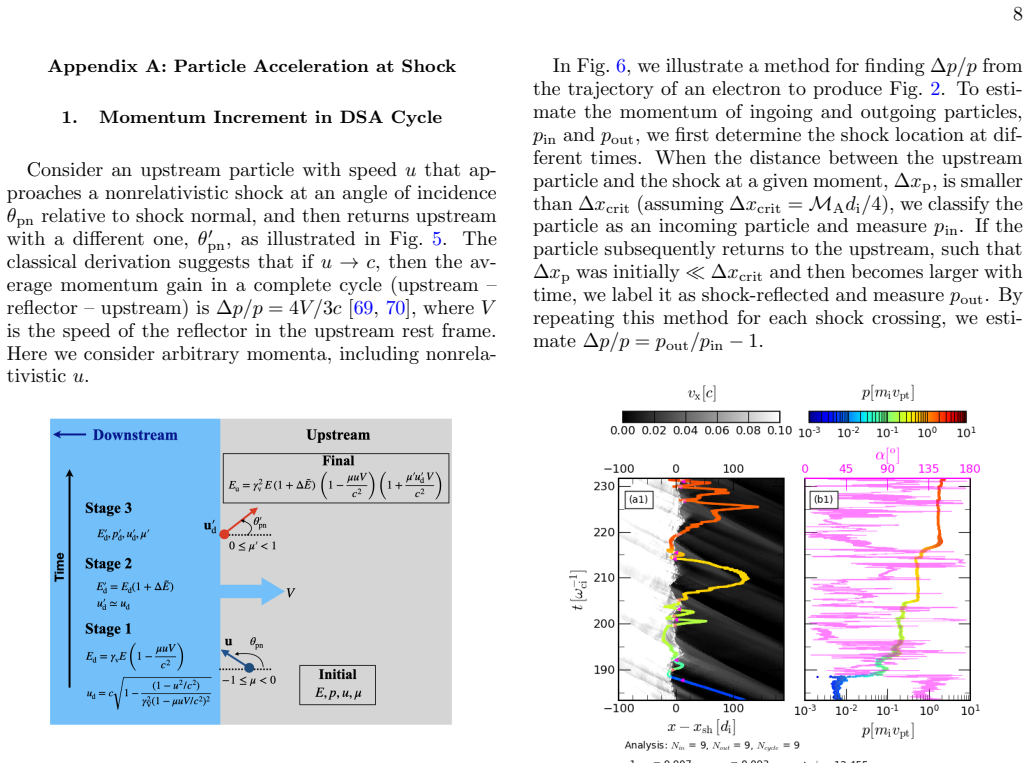
Figures from the paper (6 more)


Forward citations
Cited by 1 Pith paper
-
Deep Learning Analysis of Ions Accelerated at Shocks
A convolutional neural network can predict with >90% accuracy whether an ion at a collisionless shock is injected into acceleration, using only the local magnetic field time series from its first few gyrations.
Reference graph
Works this paper leans on
-
[1]
Cosmic-ray Acceleration and Propagation
D. Caprioli, Cosmic-ray acceleration and propagation, in 34th International Cosmic Ray Conference (ICRC2015), International Cosmic Ray Conference, Vol. 34, edited by A. S. Borisov, V. G. Denisova, Z. M. Guseva, E. A. Kanevskaya, M. G. Kogan, A. E. Morozov, V. S. Puchkov, S. E. Pyatovsky, G. P. Shoziyoev, M. D. Smirnova, A. V. Vargasov, V. I. Galkin, S. I....
work page Pith review arXiv 2015
-
[2]
A. Marcowith, A. Bret, A. Bykov, M. E. Dieckman, L. O’C Drury, B. Lemb` ege, M. Lemoine, G. Mor- lino, G. Murphy, G. Pelletier, I. Plotnikov, B. Reville, M. Riquelme, L. Sironi, and A. Stockem Novo, The microphysics of collisionless shock waves, Reports on Progress in Physics79, 046901 (2016), arXiv:1604.00318 [astro-ph.HE]
arXiv 2016
-
[3]
Electron acceleration at supernova remnants
A. Bohdan, Electron acceleration in supernova remnants, Plasma Physics and Controlled Fusion65, 014002 (2023), arXiv:2211.13992 [astro-ph.HE]
work page Pith review arXiv 2023
-
[4]
G. F. Krymskii, A regular mechanism for the accelera- tion of charged particles on the front of a shock wave, Akademiia Nauk SSSR Doklady234, 1306 (1977)
work page 1977
-
[5]
W. I. Axford, E. Leer, and G. Skadron, Acceler- ation of Cosmic Rays at Shock Fronts (Abstract), in Acceleration of Cosmic Rays at Shock Fronts, Inter- national Cosmic Ray Conference, Vol. 2 (1977) pp. 273– +
work page 1977
-
[6]
R. D. Blandford and J. P. Ostriker, Particle acceleration by astrophysical shocks, ApJL221, L29 (1978)
work page 1978
-
[7]
A. R. Bell, The acceleration of cosmic rays in shock fronts. I, MNRAS182, 147 (1978)
work page 1978
-
[8]
R. J. van Weeren, H. J. A. R¨ ottgering, M. Br¨ uggen, and M. Hoeft, Particle Acceleration on Megaparsec Scales in a Merging Galaxy Cluster, Science330, 347 (2010), arXiv:1010.4306 [astro-ph.CO]
arXiv 2010
Show all 75 references
-
[9]
M. Su, T. R. Slatyer, and D. P. Finkbeiner, Giant Gamma-ray Bubbles from Fermi-LAT: Active Galactic Nucleus Activity or Bipolar Galactic Wind?, Astrophys. J.724, 1044 (2010), arXiv:1005.5480 [astro-ph.HE]
2010 arXiv
-
[10]
Morlino and D
G. Morlino and D. Caprioli, Strong evidence for hadron acceleration in Tycho’s supernova remnant, A&A538, A81 (2012), arXiv:arXiv:1105.6342 [astro-ph.HE]. 6
2012 arXiv
-
[11]
Acero et al., First detection of VHEγ-rays from SN 1006 by HESS, A&A516, A62+ (2010), arXiv:1004.2124 [astro-ph.HE]
F. Acero et al., First detection of VHEγ-rays from SN 1006 by HESS, A&A516, A62+ (2010), arXiv:1004.2124 [astro-ph.HE]
2010 arXiv
-
[12]
Masters, A
A. Masters, A. H. Sulaiman, N. Sergis, L. Stawarz, M. Fu- jimoto, A. J. Coates, and M. K. Dougherty, Suprather- mal electrons at saturn’s bow shock, The Astrophysical Journal826, 48 (2016)
2016
-
[13]
T. Z. Liu, V. Angelopoulos, and S. Lu, Relativistic elec- trons generated at Earth’s quasi-parallel bow shock, Sci- ence Advances5, eaaw1368 (2019)
2019
-
[14]
I. C. Jebaraj, O. Agapitov, V. Krasnoselskikh, L. Vuori- nen, M. Gedalin, K.-E. Choi, E. Palmerio, N. Wijsen, N. Dresing, C. Cohen, A. Kouloumvakos, M. Balikhin, R. Vainio, E. Kilpua, A. Afanasiev, J. Verniero, J. G. Mitchell, D. Trotta, M. Hill, N. Raouafi, and S. D. Bale, Ac...
2024 arXiv
-
[15]
Giuffrida, M
R. Giuffrida, M. Miceli, D. Caprioli, A. Decourchelle, J. Vink, S. Orlando, F. Bocchino, E. Greco, and G. Peres, The supernova remnant SN 1006 as a Galac- tic particle accelerator, Nat. Comm.13, 5098 (2022), arXiv:2208.14491 [astro-ph.HE]
2022 arXiv
-
[16]
Blasi, S
P. Blasi, S. Gabici, and G. Vannoni, On the role of injec- tion in kinetic approaches to non-linear particle acceler- ation at non-relativistic shock waves, MNRAS361, 907 (2005), astro-ph/0505351
2005 arXiv
-
[17]
M. A. Malkov and L. O’C. Drury, Nonlinear theory of diffusive acceleration of particles by shock waves, Rep. Prog. Phys.64, 429 (2001)
2001
-
[18]
H. Kang, T. W. Jones, and U. D. J. Gieseler, Numer- ical Studies of Cosmic-Ray Injection and Acceleration, Astrophys. J.579, 337 (2002), arXiv:astro-ph/0207410 [astro-ph]
2002 arXiv
-
[19]
R. A. Treumann, Fundamentals of collisionless shocks for astrophysical application, 1. Non-relativistic shocks, AApR17, 409 (2009)
2009
-
[20]
Caprioli, A
D. Caprioli, A. Pop, and A. Spitkovsky, Simulations and Theory of Ion Injection at Non-relativistic Collision- less Shocks, The Astrophysical Journal Letters798, 28 (2015), arXiv:1409.8291 [astro-ph.HE]
2015 arXiv
-
[21]
Caprioli and A
D. Caprioli and A. Spitkovsky, Simulations of Ion Ac- celeration at Non-relativistic Shocks: I. Acceleration Ef- ficiency, Astrophys. J.783, 91 (2014), arXiv:1310.2943 [astro-ph.HE]
2014 arXiv
-
[22]
J. Park, D. Caprioli, and A. Spitkovsky, Simultaneous Acceleration of Protons and Electrons at Nonrelativistic Quasiparallel Collisionless Shocks, Physical Review Let- ters114, 085003 (2015), arXiv:1412.0672 [astro-ph.HE]
2015 arXiv
-
[23]
Kumar and B
N. Kumar and B. Reville, Nonthermal Particle Ac- celeration at Highly Oblique Nonrelativistic Shocks, The Astrophysical Journal Letters921, L14 (2021), arXiv:2110.09939 [physics.plasm-ph]
2021 arXiv
-
[24]
Amano, Y
T. Amano, Y. Matsumoto, A. Bohdan, O. Kobzar, S. Matsukiyo, M. Oka, J. Niemiec, M. Pohl, and M. Hoshino, Nonthermal electron acceleration at colli- sionless quasi-perpendicular shocks, Reviews of Modern Plasma Physics6, 29 (2022), arXiv:2209.03521 [astro- ph.HE]
2022 arXiv
-
[25]
Ball and D
L. Ball and D. B. Melrose, Shock drift acceleration of electrons, PASA18, 361 (2001)
2001
-
[26]
Hoshino and N
M. Hoshino and N. Shimada, Nonthermal Electrons at High Mach Number Shocks: Electron Shock Surfing Ac- celeration, Astrophys. J.572, 880 (2002), arXiv:astro- ph/0203073 [astro-ph]
2002
-
[27]
Amano and M
T. Amano and M. Hoshino, Electron Injection at High Mach Number Quasi-perpendicular Shocks: Surfing and Drift Acceleration, Astrophys. J.661, 190 (2007), arXiv:astro-ph/0612204
2007 arXiv
-
[28]
M. A. Riquelme and A. Spitkovsky, Electron Injection by Whistler Waves in Non-relativistic Shocks, Astrophys. J. 733, 63 (2011), arXiv:1009.3319 [astro-ph.HE]
2011 arXiv
-
[29]
Matsumoto, T
Y. Matsumoto, T. Amano, and M. Hoshino, Elec- tron Accelerations at High Mach Number Shocks: Two-dimensional Particle-in-cell Simulations in Various Parameter Regimes, Astrophys. J.755, 109 (2012), arXiv:1204.6312 [astro-ph.HE]
2012 arXiv
-
[30]
X. Guo, L. Sironi, and R. Narayan, Non-thermal elec- tron acceleration in low mach number collisionless shocks. i. particle energy spectra and acceleration mechanism, Astrophys. J.794, 153 (2014), arXiv:1406.5190 [astro- ph.HE]
2014 arXiv
-
[31]
T. N. Kato, Particle Acceleration and Wave Excita- tion in Quasi-parallel High-Mach-number Collisionless Shocks: Particle-in-cell Simulation, Astrophys. J.802, 115 (2015), arXiv:1407.1971 [astro-ph.HE]
2015 arXiv
-
[32]
Crumley, D
P. Crumley, D. Caprioli, S. Markoff, and A. Spitkovsky, Kinetic simulations of mildly relativistic shocks: Particle acceleration in high mach number shocks, MNRAS485, 5105 (2019), arXiv:1809.10809 [astro-ph.HE]
2019 arXiv
-
[33]
Bohdan, J
A. Bohdan, J. Niemiec, M. Pohl, Y. Matsumoto, T. Amano, and M. Hoshino, Kinetic Simulations of Non- relativistic Perpendicular Shocks of Young Supernova Remnants. I. Electron Shock-surfing Acceleration, Astro- phys. J.878, 5 (2019), arXiv:1904.13153 [astro-ph.HE]
2019 arXiv
-
[34]
R. Xu, A. Spitkovsky, and D. Caprioli, Electron Ac- celeration in One-dimensional Nonrelativistic Quasi- perpendicular Collisionless Shocks, The Astrophysical Journal Letters897, L41 (2020), arXiv:1908.07890 [astro-ph.HE]
2020 arXiv
-
[35]
Arbutina and V
B. Arbutina and V. Zekovi´ c, Non-linear diffusive shock acceleration: A recipe for injection of electrons, As- troparticle Physics127, 102546 (2021), arXiv:2012.15117 [astro-ph.HE]
2021 arXiv
-
[36]
Shalaby, R
M. Shalaby, R. Lemmerz, T. Thomas, and C. Pfrom- mer, The Mechanism of Efficient Electron Acceleration at Parallel Nonrelativistic Shocks, Astrophys. J.932, 86 (2022), arXiv:2202.05288 [astro-ph.HE]
2022 arXiv
-
[37]
P. J. Morris, A. Bohdan, M. S. Weidl, and M. Pohl, Preacceleration in the Electron Foreshock. I. Elec- tron Acoustic Waves, Astrophys. J.931, 129 (2022), arXiv:2204.11569 [physics.plasm-ph]
2022 arXiv
-
[38]
Zekovi´ c, A
V. Zekovi´ c, A. Spitkovsky, and Z. Hemler, SLAMS- Propelled Electron Acceleration at High-Mach Number Astrophysical Shocks, arXiv e-prints , arXiv:2408.02084 (2024), arXiv:2408.02084 [astro-ph.HE]
2024 arXiv
-
[39]
Caprioli, ”Espresso” Acceleration of Ultra-high- energy Cosmic Rays, The Astrophysical Journal Letters 811, L38 (2015), arXiv:1505.06739 [astro-ph.HE]
D. Caprioli, ”Espresso” Acceleration of Ultra-high- energy Cosmic Rays, The Astrophysical Journal Letters 811, L38 (2015), arXiv:1505.06739 [astro-ph.HE]
2015 arXiv
-
[40]
Brunetti and T
G. Brunetti and T. W. Jones, Cosmic rays in galaxy clusters and their nonthermal emission, International Journal of Modern Physics D23, 1430007-98 (2014), arXiv:1401.7519
2014 arXiv
-
[41]
Diesing, B
R. Diesing, B. D. Metzger, E. Aydi, L. Chomiuk, I. Vurm, S. Gupta, and D. Caprioli, Evidence for multiple shocks from the gamma-ray emission of rs ophiuchi, Astrophys. J.947, 70 (2023). 7
2023
-
[42]
Adriani, G
O. Adriani, G. C. Barbarino, G. A. Bazilevskaya, R. Bellotti, M. Boezio, E. A. Bogomolov, L. Bonechi, M. Bongi, V. Bonvicini, S. Borisov, S. Bottai, A. Bruno, F. Cafagna, D. Campana, R. Carbone, P. Carlson, M. Casolino, G. Castellini, L. Consiglio, M. P. De Pas- cale, C. De Sa...
2011
-
[43]
Aguilar et al
M. Aguilar et al. [AMS Collaboration], Towards under- standing the origin of cosmic-ray electrons, Phys. Rev. Lett.122, 101101 (2019)
2019
-
[44]
Bunemann, Computer space plasma physics:simulation techniques and software (Terra Scientific Publishing Company, 1993) pp
O. Bunemann, Computer space plasma physics:simulation techniques and software (Terra Scientific Publishing Company, 1993) pp. 67–87
1993
-
[45]
A. Spitkovsky, Simulations of relativistic collisionless shocks: shock structure and particle acceleration, in Astrophysical Sources of High Energy Particles and Radiation, American Institute of Physics Conference Series, Vol. 801, edited by T. Bulik, B. Rudak, and G. Madejski...
2005 arXiv
-
[46]
Gupta, D
S. Gupta, D. Caprioli, and A. Spitkovsky, Electron Acceleration at Quasi-parallel Nonrelativistic Shocks: A 1D Kinetic Survey, Astrophys. J.976, 10 (2024), arXiv:2408.16071 [astro-ph.HE]
2024 arXiv
-
[47]
Caprioli and A
D. Caprioli and A. Spitkovsky, Simulations of Ion Acceleration at Non-relativistic Shocks: II. Magnetic Field Amplification, Astrophys. J.794, 46 (2014), arXiv:1401.7679 [astro-ph.HE]
2014 arXiv
-
[48]
Muschietti and B
L. Muschietti and B. Lemb` ege, Two-stream instabilities from the lower-hybrid frequency to the electron cyclotron frequency: application to the front of quasi-perpendicular shocks, Annales Geophysicae35, 1093 (2017)
2017
-
[49]
Gupta, D
S. Gupta, D. Caprioli, and A. Spitkovsky, Return Cur- rents in Collisionless Shocks, Astrophys. J.968, 17 (2024), arXiv:2312.13365 [astro-ph.HE]
2024 arXiv
-
[50]
Lichko, D
E. Lichko, D. Caprioli, B. Schroer, and S. Gupta, Un- derstanding Streaming Instabilities in the Limit of High Cosmic-Ray Current Density, Astrophys. J.980, 240 (2025), arXiv:2411.05704 [astro-ph.HE]
2025 arXiv
-
[51]
Caprioli, C
D. Caprioli, C. C. Haggerty, and P. Blasi, Kinetic Simu- lations of Cosmic-Ray-modified Shocks. II. Particle Spec- tra, Astrophys. J.905, 2 (2020), arXiv:2009.00007 [astro- ph.HE]
2020 arXiv
-
[52]
L. O. Drury, REVIEW ARTICLE: An introduction to the theory of diffusive shock acceleration of energetic par- ticles in tenuous plasmas, Reports on Progress in Physics 46, 973 (1983)
1983
-
[53]
Blasi, E
P. Blasi, E. Amato, and D. Caprioli, The maximum mo- mentum of particles accelerated at cosmic ray modified shocks, MNRAS375, 1471 (2007)
2007
-
[54]
Caprioli and A
D. Caprioli and A. Spitkovsky, Simulations of Ion Ac- celeration at Non-relativistic Shocks. III. Particle Dif- fusion, Astrophys. J.794, 47 (2014), arXiv:1407.2261 [astro-ph.HE]
2014 arXiv
-
[55]
S. J. Schwartz, M. F. Thomsen, and J. T. Gosling, Ions upstream of the earth’s bow shock - A theoretical com- parison of alternative source populations, Journal of Geo- physical Research88, 2039 (1983)
1983
-
[56]
Krauss-Varban and C
D. Krauss-Varban and C. S. Wu, Fast Fermi and gradi- ent drift acceleration of electrons at nearly perpendicular collisionless shocks, Journal of Geophysical Research94, 15367 (1989)
1989
-
[57]
G. Mann, H. Aurass, and A. Warmuth, Electron accel- eration by the reconnection outflow shock during solar flares, A&A454, 969 (2006)
2006
-
[58]
Bohdan, M
A. Bohdan, M. S. Weidl, P. J. Morris, and M. Pohl, The electron foreshock at high-Mach-number non-relativistic oblique shocks, Physics of Plasmas29, 052301 (2022), arXiv:2204.05652 [physics.plasm-ph]
2022 arXiv
-
[59]
J. C. Raymond, P. Ghavamian, A. Bohdan, D. Ryu, J. Niemiec, L. Sironi, A. Tran, E. Amato, M. Hoshino, M. Pohl, T. Amano, and F. Fiuza, Electron-Ion Temper- ature Ratio in Astrophysical Shocks, Astrophys. J.949, 50 (2023), arXiv:2303.08849 [astro-ph.GA]
2023 arXiv
-
[60]
Vanthieghem, V
A. Vanthieghem, V. Tsiolis, A. Spitkovsky, Y. Todo, K. Sekiguchi, and F. Fiuza, Electron Heating in High Mach Number Collisionless Shocks, Phys. Rev. Lett.132, 265201 (2024), arXiv:2405.09618 [astro-ph.HE]
2024 arXiv
-
[61]
Morlino, E
G. Morlino, E. Amato, P. Blasi, and D. Caprioli, Spatial structure of X-ray filaments in SN 1006, MNRAS405, L21 (2010), arXiv:0912.2972 [astro-ph.HE]
2010 arXiv
-
[62]
Merten, J
L. Merten, J. Becker Tjus, B. Eichmann, and R.-J. Dettmar, On the non-thermal electron-to-proton ratio at cosmic ray acceleration sites, Astroparticle Physics90, 75 (2017), arXiv:1702.07523 [astro-ph.HE]
2017 arXiv
-
[63]
Battiston, High precision cosmic ray physics with ams- 02 on the international space station, La Rivista del Nuovo Cimento43, 319 (2020)
R. Battiston, High precision cosmic ray physics with ams- 02 on the international space station, La Rivista del Nuovo Cimento43, 319 (2020)
2020
-
[64]
Raptis, A
S. Raptis, A. Lalti, M. Lindberg, D. L. Turner, D. Capri- oli, and J. L. Burch, Revealing an unexpectedly low electron injection threshold via reinforced shock ac- celeration, Nature Communications16, 488 (2025), arXiv:2502.10643 [astro-ph.HE]
2025 arXiv
-
[65]
Fulat, A
K. Fulat, A. Bohdan, G. Torralba Paz, and M. Pohl, Kinetic Simulations of Nonrelativistic High-mach- number Perpendicular Shocks Propagating in a Tur- bulent Medium, Astrophys. J.959, 119 (2023), arXiv:2310.14388 [physics.plasm-ph]
2023 arXiv
-
[66]
J. G. Kirk, P. Duffy, and Y. A. Gallant, Stochastic parti- cle acceleration at shocks in the presence of braided mag- netic fields., A&A314, 1010 (1996), astro-ph/9604056
1996 arXiv
-
[67]
A. R. Bell, K. M. Schure, and B. Reville, Cosmic ray ac- celeration at oblique shocks, MNRAS418, 1208 (2011), arXiv:1108.0582 [astro-ph.HE]
2011 arXiv
-
[68]
C. C. Haggerty and D. Caprioli, Kinetic Simulations of Cosmic-Ray-modified Shocks. I. Hydrodynamics, Astro- phys. J.905, 1 (2020), arXiv:2008.12308 [astro-ph.HE]
2020 arXiv
-
[69]
M. S. Longair, High Energy Astrophysics (2011)
2011
-
[70]
Caprioli, Particle Acceleration at Shocks: An In- troduction, arXiv e-prints , arXiv:2307.00284 (2023), arXiv:2307.00284 [astro-ph.HE]
D. Caprioli, Particle Acceleration at Shocks: An In- troduction, arXiv e-prints , arXiv:2307.00284 (2023), arXiv:2307.00284 [astro-ph.HE]
2023 arXiv
-
[71]
de Hoffmann and E
F. de Hoffmann and E. Teller, Magneto-Hydrodynamic Shocks, Physical Review80, 692 (1950). 8 Appendix A: Particle Acceleration at Shock
1950
-
[72]
Momentum Increment in DSA Cycle Consider an upstream particle with speeduthat ap- proaches a nonrelativistic shock at an angle of incidence θpn relative to shock normal, and then returns upstream with a different one,θ ′ pn, as illustrated in Fig. 5. The classical derivation s...
-
[73]
HereV d ≡ −(vsh −v pt) =−v pt/(R −1) is the downstream bulk speed relative to the shock
Escape F raction In our minimal model, the probability of particles remaining for acceleration is taken asP rem = 1− Fadv,x/Fin,x, where the flux of particles entering the shock from upstream (F x,in) and then leaving the shock (Fx,out) are Fin,x =n c Z 0 −1 P(µ)dµ s 1− 1−u 2/...
-
[74]
Method Here we outline a method, similar to [54], for estimat- ingD e(p) across the shock to quantifyp max,e (§II D). We take a snapshot of the magnetic field from our PIC sim- ulations and evolve test electrons using the Boris pusher, with a second-order shape function to est...
-
[75]
This is done using the method described in Appendix B 1
Evolution of Maximum Momentum To quantify the momentum evolution of NT electrons in theM A = 20 andM A = 5 shocks, as discussed in §II D, we compute the electron diffusion coefficient across the shock. This is done using the method described in Appendix B 1. Since the NT spect...
Reviewed August 7, 2026 · model on record in the stance chip above.
Discussion (0). Sign in to comment.