REVIEW 3 major objections 4 minor 52 references
Cross-Frame Representation Alignment for Fine-Tuning Video Diffusion Models
T0 review · 3 major / 4 minor · reviewed 2026-08-07 · deepseek-v4-flash
Pith's one-line read The paper claims that adding a cross-frame representation alignment loss to LoRA fine-tuning of video diffusion models improves both visual fidelity and cross-frame semantic coherence over vanilla fine-tuning and per-frame REPA.
desk verdict A cheap and useful fine-tuning trick, but the paper's causal story is undercut by a missing matched-regularization control. read the letter →
The pith
A machine-rendered reading of the paper's core claim, the machinery that carries it, and where it could break.
The reading
What carries the argument
The load-bearing mechanism is a distillation regularizer applied to a diffusion-transformer encoder layer located by linear probing: a small MLP $h_\phi$ projects the noisy hidden state $h^f_t$ into the feature space of DINOv2, and the loss pulls that projection toward the current frame's clean feature and, with weight $e^{-|k-f|/\tau}$, toward features of frames at distances $\pm d$ ($d=1$, $\tau=1$). The exponential decay ensures nearby frames dominate, so the target is the local direction of the video's feature trajectory rather than a global average. This turns the fine-tuning objective into $L = L_{\text{score}} + \lambda L_{\text{align}}$ with $\lambda=0.5$ for CogVideoX and $\lambda=1$ for Hunyuan.
What would settle it
Train the same video diffusion model under CREPA with adjacency $d=0$, $d=1$, and $d=3$ while holding all else fixed. If $d=3$ does not increase CKNNA similarity to adjacent frames over $d=1$, or if subject consistency on VBench decreases with larger $d$, then the exponential neighbor weighting is not tracking a semantic manifold. A second direct test: replace the adjacent-frame term with a single temporally averaged DINOv2 feature; if that matches or exceeds CREPA, the benefit is smoothing rather than semantic alignment.
Extended reading notes
Core claim
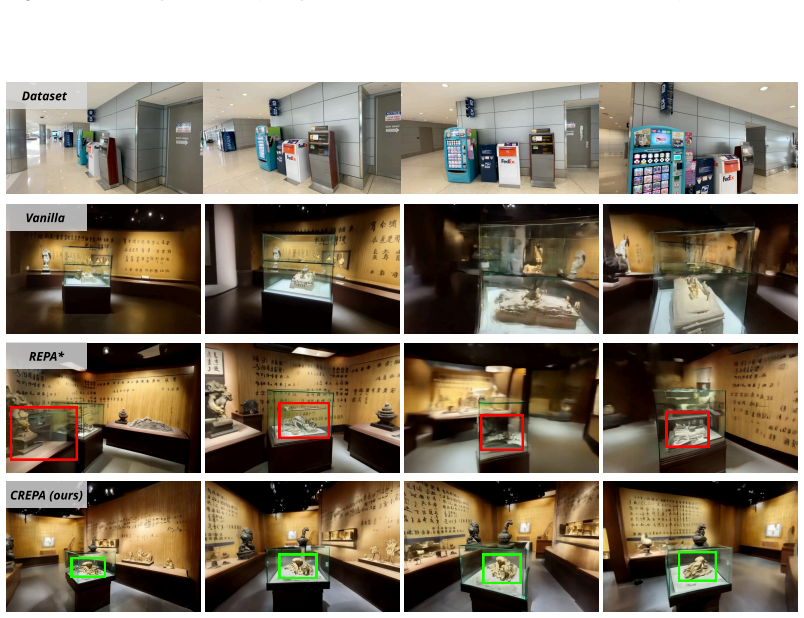
The central discovery is that per-frame representation alignment (REPA*) under-constrains video diffusion fine-tuning: a noisy hidden state can match its own frame's clean feature while sitting at an arbitrary distance from adjacent frames' features, and this freedom produces temporally inconsistent generations. CREPA resolves the under-constraint by maximizing $\text{sim}(\bar{y}_f, h_\phi(h^f_t)) + \sum_{k\in\{f\pm d\}} e^{-|k-f|/\tau}\, \text{sim}(\bar{y}_k, h_\phi(h^f_t))$ for each frame $f$, with $\bar{y}_k = E(x^k_0)$ extracted by a pretrained DINOv2 encoder from clean neighboring frames. In the authors' experiments this raises CKNNA similarity to adjacent frames while maintaining current-frame alignment, and translates into better subject/background consistency and lower FVD (281.2 vs 291.4 for REPA* and 305.5 for vanilla on their DL3DV setup) on CogVideoX-5B and Hunyuan Video.
Load-bearing premise
The load-bearing premise is that the DINOv2 features of nearby clean frames form a temporally coherent manifold, so pulling a noisy frame's hidden state toward them improves semantic tracking; if those features are not coherent across adjacent frames, the extra term would just average frames together and smooth away distinct content.
Editorial extensions
If this is right
- Applied to any DiT-based video diffusion model, CREPA needs only the chosen encoder layer and a small MLP, so it adds no inference-time cost and works with existing LoRA pipelines.
- With 3,000 iterations (9-13 hours on one A100) it enables attribute-specific fine-tuning within a user-level budget, which the paper demonstrates on cartoon style, physical interactions, and static 3D scenes.
- Because it improves frame-to-frame semantic coherence, downstream tasks that consume generated video—camera-pose estimation and 3D reconstruction with COLMAP and 3DGS—also improve, as shown by PSNR/SSIM/LPIPS on novel view synthesis.
- The regularization is attribute-agnostic: the same $d=1$, $\tau=1$ setting works across seven datasets, suggesting it can be bundled into fine-tuning toolkits as a default.
Reading between the lines
- If the DINOv2 feature trajectory is the right temporal manifold, CREPA should also help during pre-training of video foundation models, not just fine-tuning; the authors note this as future work.
- The exponential weighting suggests a clean experiment the paper does not run: as $\tau \to 0$ the objective becomes local frame matching, and as $\tau \to \infty$ it becomes a uniform temporal average; performance should peak at intermediate $\tau$ if the manifold story holds, and would reveal whether the gains are from smoothing or semantic tracking.
- Since layer search is done once per model and shared, CREPA can be composed with other fine-tuning regularizers, such as long-context tuning or attention modifications, as an orthogonal consistency term.
Editorial analysis
A structured set of objections, weighed in public.
Referee Report
Summary. The paper proposes Cross-frame Representation Alignment (CREPA), a regularization objective for fine-tuning video diffusion models (VDMs) with parameter-efficient methods such as LoRA. Starting from REPA*, a direct adaptation of the image-domain REPA objective that aligns each frame's hidden state with its own DINOv2 feature, the authors add terms that align the hidden state of a frame with the pretrained features of adjacent frames, weighted by an exponential decay in temporal distance. The loss is combined with the standard score-matching objective. The method is evaluated on CogVideoX-5B and Hunyuan Video over seven datasets (cartoon style, physical interactions, 3D scenes, movie scenes) using VBench, FVD/IS, novel view synthesis, and a user study, with comparisons against vanilla fine-tuning and REPA*. The paper reports consistent improvements, especially on semantic-consistency metrics.
Significance. If the central claim holds, CREPA is a simple and practical regularizer that improves both visual fidelity and cross-frame semantic coherence in VDM fine-tuning, with a single-GPU training budget and no architectural changes. The paper's strengths include a clearly specified objective (Eq. 6), experiments across two large models and multiple datasets, and the inclusion of both automatic metrics and human evaluation. The proposed method is easy to implement on top of existing REPA-style losses, which could make it immediately useful. However, the paper's mechanistic claim—that the cross-frame terms specifically, rather than simply a stronger overall alignment signal, are responsible for the gains—is not yet supported by the evidence. The main empirical results lack error bars and significance tests, and the diagnostic in Fig. 2 measures exactly the quantity the loss maximizes, so it cannot independently validate the mechanism. These issues make the contribution promising but not yet fully established.
major comments (3)
- [Sec. 4.2, Eq. (6) and Sec. 5.1 (implementation details)] The cross-frame terms are not compared against a matched-strength REPA* baseline. With d=1 and tau=1, the total weight on the two neighbor terms is 2e^{-1} ≈ 0.736 times the current-frame term, so the overall alignment weight is about 1.736 times that of Eq. (4). Since the effective temporal adjacency after 4× latent compression is only a few frames, adjacent-frame DINOv2 features may be near-duplicates of the current-frame feature; if so, CREPA reduces to REPA* with a larger lambda. The paper does not report the similarity between y_f and y_k for k=f±d on its training data, nor does it include a REPA* run with lambda scaled by 1.736 (or a normalized version of L_align). Without this control, the improvements in Tables 1–3 and Fig. 25 do not establish that cross-frame information, rather than stronger alignment regularization, drives the gains. This is load-bearing for the paper's central claim.
- [Sec. 4.2, Fig. 2, and Appendix B] The empirical observation in Fig. 2 measures CKNNA between hidden states and pretrained features of current and adjacent frames, which is precisely the quantity the CREPA loss (Eq. 6) maximizes. An increase in this metric is expected by construction and therefore cannot serve as independent evidence that the method improves temporal semantic structure. The paper should provide a diagnostic that is not directly optimized, such as the redundancy of adjacent-frame features (e.g., cosine similarity between y_f and y_{f±d}), or an ablation in which the neighbor terms are replaced by current-frame features with a total weight matched to CREPA.
- [Sec. 5.2, Tables 1–3, and Appendix E] All quantitative claims are reported without error bars, confidence intervals, or significance tests. Many VBench differences are small (e.g., 0.5145 vs 0.5207 for Aesthetic Quality on Hunyuan Video, Table 1), and the FVD/IS evaluation is limited to a single dataset (DL3DV) with one I2V model. The user study uses 20 samples per criterion with no reported inter-annotator agreement or statistical test. Since the paper's central claim is empirical, the absence of variance estimates makes it difficult to assess whether the observed improvements are reliable beyond the specific checkpoint and seed used.
minor comments (4)
- [Sec. 5.2, Quantitative Results] The text says 'as shown in Table 4' but the VBench results for the main comparison are in Table 1; Table 4 in the appendix reports layer-search ablations. The reference should be corrected.
- [Fig. 1 caption] There is a typo: 'beter' should be 'better'.
- [Appendix E] The descriptions of Text–Video Alignment and Visual Quality are duplicated; criterion (1) says it reflects frame-level clarity and artifacts, which is the same wording as criterion (2). This should be clarified.
- [Sec. A] The linear probing dataset is constructed from all fine-tuning datasets used in the paper, which may leak information about the target datasets into the layer-selection procedure. The authors should clarify whether the linear probes are trained on held-out videos or only on the training splits, and whether this selection affects the reported results.
Circularity Check
Fig. 2 measures exactly what Eq. (6) maximizes, so that mechanistic evidence is circular; the headline benchmarks are external and keep the paper's central claim largely independent.
-
self definitional
[Sec. 4.2, Eq. (6) and Fig. 2]
"To do so, we define a simple yet novel regularization objective for alignment: Lalign(ϕ) := −E[ Σ_f sim(ȳ_f, h_ϕ(h^f_t)) + Σ_{k∈K} e^{−|k−f|/τ} sim(ȳ_k, h_ϕ(h^f_t)) ], where K={f−d, f+d} ... We first quantify the degree of cross-frame representation alignment ... CREPA yields higher similarity between the current hidden states and adjacent pretrained features, as shown in Fig. 2-(a),(b)."
The CKNNA diagnostic in Fig. 2 measures essentially the quantity that the CREPA loss in Eq. (6) directly maximizes: the similarity between current-frame hidden states h^f_t and adjacent-frame DINOv2 features ȳ_{f±d}. Since the loss contains those adjacent-frame terms with positive weights e^{−|k−f|/τ}, a CREPA-trained model must exhibit higher such similarity than a REPA*-trained model, so observing this increase is expected by construction. The passage therefore cannot independently validate the hypothesis that cross-frame regularization improves semantic consistency. This circularity is confined to the mechanistic motivation; the paper's headline results on VBench, FVD/IS, NVS, and the user study use external metrics and provide independent support for the central claim.
full rationale
The paper's central claim — that CREPA improves visual fidelity and cross-frame semantic coherence when fine-tuning VDMs — is supported by external benchmarks (VBench, FVD/IS, novel-view synthesis, and a user study) that are not part of the training objective. These evaluations are self-contained against the method's inputs, and they are not defined in terms of the CREPA loss. The one clear circular element is Fig. 2: the paper presents a CKNNA-based diagnostic showing that CREPA increases alignment to adjacent-frame DINOv2 features. But that is precisely the quantity Eq. (6) maximizes, so the result is a direct consequence of the loss rather than an independent confirmation of the mechanism. No other pattern of circularity is present. REPA* is a straightforward re-implementation of an existing external method and is used as a baseline, not as a self-citation carrying the paper's argument. The use of DINOv2-g as the pretrained encoder follows REPA but is an external, openly available model; no uniqueness theorem or author-generated theorem is invoked to force the design. The choice of hidden layer is made by linear probing plus VBench evaluation, which is an external criterion. A possible experimental weakness — that with d=1 and τ=1 the cross-frame terms approximately re-weight the REPA loss when adjacent DINOv2 features are near-duplicates — is a missing control or model-selection concern, not a definitional reduction that the paper itself asserts. Because the central claim survives on independent external benchmarks, and only the supporting diagnostic is circular, an overall score of 3 reflects a low-to-moderate circularity burden.
Assumptions & free parameters
free parameters (5)
- λ (alignment weight) =
0.5 for CogVideoX-5B, 1 for Hunyuan Video
- d (adjacency window) =
1
- τ (temperature) =
1
- hidden layer index =
8th layer for CogVideoX, 10th layer for Hunyuan
- LoRA rank/alpha/learning rate =
not reported
assumptions (4)
- domain assumption DiT blocks form a denoising autoencoder with an encoder and decoder split
- domain assumption DINOv2 features of clean frames are semantically meaningful and temporally coherent enough to serve as distillation targets
- ad hoc to paper Aligning hidden states to adjacent-frame features improves semantic consistency without collapsing representations to a trivial constant
- domain assumption The selected encoder layer's hidden states capture the semantic content needed for alignment
Cite this review
Pith. "Pith review of Cross-Frame Representation Alignment for Fine-Tuning Video Diffusion Models." pith.science (2026). https://pith.science/paper/6SBCXXEL
@misc{pith2026250609229,
  author       = {Pith},
  title        = {Pith review of: Cross-Frame Representation Alignment for Fine-Tuning Video Diffusion Models},
  year         = {2026},
  howpublished = {\url{https://pith.science/paper/6SBCXXEL}},
  note         = {Machine review of arXiv:2506.09229}
}
read the original abstract
Fine-tuning Video Diffusion Models (VDMs) at the user level to generate videos that reflect specific attributes of training data presents notable challenges, yet remains underexplored despite its practical importance. Meanwhile, recent work such as Representation Alignment (REPA) has shown promise in improving the convergence and quality of DiT-based image diffusion models by aligning, or assimilating, its internal hidden states with external pretrained visual features, suggesting its potential for VDM fine-tuning. In this work, we first propose a straightforward adaptation of REPA for VDMs and empirically show that, while effective for convergence, it is suboptimal in preserving semantic consistency across frames. To address this limitation, we introduce Cross-frame Representation Alignment (CREPA), a novel regularization technique that aligns hidden states of a frame with external features from neighboring frames. Empirical evaluations on large-scale VDMs, including CogVideoX-5B and Hunyuan Video, demonstrate that CREPA improves both visual fidelity and cross-frame semantic coherence when fine-tuned with parameter-efficient methods such as LoRA. We further validate CREPA across diverse datasets with varying attributes, confirming its broad applicability.
Figures


Figures from the paper (26 more)




Reference graph
Works this paper leans on
-
[1]
N. Agarwal, A. Ali, M. Bala, Y . Balaji, E. Barker, T. Cai, P. Chattopadhyay, Y . Chen, Y . Cui, Y . Ding, et al. Cosmos world foundation model platform for physical ai.arXiv preprint arXiv:2501.03575, 2025
arXiv 2025
- [2]
-
[3]
X. Bi, J. Lu, B. Liu, X. Cun, Y . Zhang, W. Li, and B. Xiao. Customttt: Motion and appearance customized video generation via test-time training. InProceedings of the AAAI Conference on Artificial Intelligence, volume 39, pages 1871–1879, 2025
work page 2025
-
[4]
Scenes dataset.https://huggingface.co/datasets/bigdata-pw/scenes, 2025
bigdata pw. Scenes dataset.https://huggingface.co/datasets/bigdata-pw/scenes, 2025
work page 2025
-
[5]
A. Blattmann, T. Dockhorn, S. Kulal, D. Mendelevitch, M. Kilian, D. Lorenz, Y . Levi, Z. English, V . V oleti, A. Letts, et al. Stable video diffusion: Scaling latent video diffusion models to large datasets.arXiv preprint arXiv:2311.15127, 2023
arXiv 2023
-
[6]
Blattmann, R
A. Blattmann, R. Rombach, H. Ling, T. Dockhorn, S. W. Kim, S. Fidler, and K. Kreis. Align your latents: High-resolution video synthesis with latent diffusion models. InProceedings of the IEEE/CVF conference on computer vision and pattern recognition, pages 22563–22575, 2023
2023
-
[7]
Brown, B
T. Brown, B. Mann, N. Ryder, M. Subbiah, J. D. Kaplan, P. Dhariwal, A. Neelakantan, P. Shyam, G. Sastry, A. Askell, et al. Language models are few-shot learners.Advances in neural information processing systems, 33:1877–1901, 2020
1901
-
[8]
F. Chen, S. Zhao, C. Xu, and L. Lan. Jointtuner: Appearance-motion adaptive joint training for customized video generation.arXiv preprint arXiv:2503.23951, 2025
arXiv 2025
Show all 52 references
-
[9]
J. Deng, W. Dong, R. Socher, L.-J. Li, K. Li, and L. Fei-Fei. Imagenet: A large-scale hierarchical image database. In2009 IEEE conference on computer vision and pattern recognition, pages 248–255. Ieee, 2009
2009
-
[10]
Cakeify smol dataset
Finetrainers. Cakeify smol dataset. https://huggingface.co/datasets/finetrainers/ cakeify-smol, 2024
2024
-
[11]
Crush smol dataset
Finetrainers. Crush smol dataset. https://huggingface.co/datasets/finetrainers/ crush-smol, 2024
2024
-
[12]
Squish pika dataset
Finetrainers. Squish pika dataset. https://huggingface.co/datasets/finetrainers/ squish-pika, 2024
2024
-
[13]
Y . Guo, C. Yang, Z. Yang, Z. Ma, Z. Lin, Z. Yang, D. Lin, and L. Jiang. Long context tuning for video generation.arXiv preprint arXiv:2503.10589, 2025
2025 arXiv
-
[14]
Gururangan, A
S. Gururangan, A. Marasovi´c, S. Swayamdipta, K. Lo, I. Beltagy, D. Downey, and N. A. Smith. Don’t stop pretraining: Adapt language models to domains and tasks.arXiv preprint arXiv:2004.10964, 2020
2004 arXiv
-
[15]
H. He, Y . Xu, Y . Guo, G. Wetzstein, B. Dai, H. Li, and C. Yang. Cameractrl: Enabling camera control for video diffusion models. InThe Thirteenth International Conference on Learning Representations
-
[16]
J. Ho, A. Jain, and P. Abbeel. Denoising diffusion probabilistic models.Advances in neural information processing systems, 33:6840–6851, 2020
2020
-
[17]
W. Hong, W. Wang, M. Ding, W. Yu, Q. Lv, Y . Wang, Y . Cheng, S. Huang, J. Ji, Z. Xue, et al. Cogvlm2: Visual language models for image and video understanding.arXiv preprint arXiv:2408.16500, 2024
2024 arXiv
-
[18]
E. J. Hu, Y . Shen, P. Wallis, Z. Allen-Zhu, Y . Li, S. Wang, L. Wang, W. Chen, et al. Lora: Low-rank adaptation of large language models.ICLR, 1(2):3, 2022
2022
-
[19]
X. Hu, X. Xu, and Y . Shi. How to efficiently adapt large segmentation model (sam) to medical images. arXiv preprint arXiv:2306.13731, 2023
2023 arXiv
-
[20]
Huang, Y
Z. Huang, Y . He, J. Yu, F. Zhang, C. Si, Y . Jiang, Y . Zhang, T. Wu, Q. Jin, N. Chanpaisit, et al. Vbench: Comprehensive benchmark suite for video generative models. InProceedings of the IEEE/CVF Conference on Computer Vision and Pattern Recognition, pages 21807–21818, 2024
2024
-
[21]
M. Huh, B. Cheung, T. Wang, and P. Isola. The platonic representation hypothesis.CoRR, 2024. 10
2024
-
[22]
Kerbl, G
B. Kerbl, G. Kopanas, T. Leimkühler, and G. Drettakis. 3d gaussian splatting for real-time radiance field rendering.ACM Trans. Graph., 42(4):139–1, 2023
2023
-
[23]
W. Kong, Q. Tian, Z. Zhang, R. Min, Z. Dai, J. Zhou, J. Xiong, X. Li, B. Wu, J. Zhang, et al. Hunyuanvideo: A systematic framework for large video generative models.arXiv preprint arXiv:2412.03603, 2024
2024 arXiv
-
[24]
Kornblith, M
S. Kornblith, M. Norouzi, H. Lee, and G. Hinton. Similarity of neural network representations revisited. In International conference on machine learning, pages 3519–3529. PMLR, 2019
2019
-
[25]
Liang, J
H. Liang, J. Cao, V . Goel, G. Qian, S. Korolev, D. Terzopoulos, K. N. Plataniotis, S. Tulyakov, and J. Ren. Wonderland: Navigating 3d scenes from a single image.arXiv preprint arXiv:2412.12091, 2024
2024 arXiv
-
[26]
L. Ling, Y . Sheng, Z. Tu, W. Zhao, C. Xin, K. Wan, L. Yu, Q. Guo, Z. Yu, Y . Lu, et al. Dl3dv-10k: A large-scale scene dataset for deep learning-based 3d vision. InProceedings of the IEEE/CVF Conference on Computer Vision and Pattern Recognition, pages 22160–22169, 2024
2024
-
[27]
H. Liu, C. Li, Y . Li, and Y . J. Lee. Improved baselines with visual instruction tuning. InProceedings of the IEEE/CVF Conference on Computer Vision and Pattern Recognition, pages 26296–26306, 2024
2024
-
[28]
H. Liu, C. Li, Q. Wu, and Y . J. Lee. Visual instruction tuning.Advances in neural information processing systems, 36:34892–34916, 2023
2023
-
[29]
Y . Liu, X. Cun, X. Liu, X. Wang, Y . Zhang, H. Chen, Y . Liu, T. Zeng, R. Chan, and Y . Shan. Evalcrafter: Benchmarking and evaluating large video generation models. InProceedings of the IEEE/CVF Conference on Computer Vision and Pattern Recognition, pages 22139–22149, 2024
2024
-
[30]
Z. Lu, H. Yang, D. Xu, B. Li, B. Ivanovic, M. Pavone, and Y . Wang. Lora3d: Low-rank self-calibration of 3d geometric foundation models.arXiv preprint arXiv:2412.07746, 2024
2024 arXiv
-
[31]
N. Ma, M. Goldstein, M. S. Albergo, N. M. Boffi, E. Vanden-Eijnden, and S. Xie. Sit: Exploring flow and diffusion-based generative models with scalable interpolant transformers. InEuropean Conference on Computer Vision, pages 23–40. Springer, 2024
2024
-
[32]
Mahendran and A
A. Mahendran and A. Vedaldi. Understanding deep image representations by inverting them. InProceedings of the IEEE conference on computer vision and pattern recognition, pages 5188–5196, 2015
2015
-
[33]
Oquab, T
M. Oquab, T. Darcet, T. Moutakanni, H. V . V o, M. Szafraniec, V . Khalidov, P. Fernandez, D. HAZIZA, F. Massa, A. El-Nouby, et al. Dinov2: Learning robust visual features without supervision.Transactions on Machine Learning Research
-
[34]
Peebles and S
W. Peebles and S. Xie. Scalable diffusion models with transformers. InProceedings of the IEEE/CVF international conference on computer vision, pages 4195–4205, 2023
2023
-
[35]
L. I. Rudin, S. Osher, and E. Fatemi. Nonlinear total variation based noise removal algorithms.Physica D: nonlinear phenomena, 60(1-4):259–268, 1992
1992
-
[36]
N. Ruiz, Y . Li, V . Jampani, Y . Pritch, M. Rubinstein, and K. Aberman. Dreambooth: Fine tuning text-to- image diffusion models for subject-driven generation. InProceedings of the IEEE/CVF conference on computer vision and pattern recognition, pages 22500–22510, 2023
2023
-
[37]
J. L. Schönberger and J.-M. Frahm. Structure-from-motion revisited. InConference on Computer Vision and Pattern Recognition (CVPR), 2016
2016
-
[38]
V . Shah, N. Ruiz, F. Cole, E. Lu, S. Lazebnik, Y . Li, and V . Jampani. Ziplora: Any subject in any style by effectively merging loras. InEuropean Conference on Computer Vision, pages 422–438. Springer, 2024
2024
-
[39]
Sohl-Dickstein, E
J. Sohl-Dickstein, E. Weiss, N. Maheswaranathan, and S. Ganguli. Deep unsupervised learning using nonequilibrium thermodynamics. InInternational conference on machine learning, pages 2256–2265. PMLR, 2015
2015
-
[40]
J. Song, C. Meng, and S. Ermon. Denoising diffusion implicit models.arXiv preprint arXiv:2010.02502, 2020
2010 arXiv
-
[41]
Y . Song, J. Sohl-Dickstein, D. P. Kingma, A. Kumar, S. Ermon, and B. Poole. Score-based generative modeling through stochastic differential equations.arXiv preprint arXiv:2011.13456, 2020
2011 arXiv
-
[42]
A. Wang, B. Ai, B. Wen, C. Mao, C.-W. Xie, D. Chen, F. Yu, H. Zhao, J. Yang, J. Zeng, et al. Wan: Open and advanced large-scale video generative models.arXiv preprint arXiv:2503.20314, 2025. 11
2025 arXiv
-
[43]
S. Wang, V . Leroy, Y . Cabon, B. Chidlovskii, and J. Revaud. Dust3r: Geometric 3d vision made easy. In Proceedings of the IEEE/CVF Conference on Computer Vision and Pattern Recognition, pages 20697– 20709, 2024
2024
-
[44]
Z. Wang, L. Zhao, and W. Xing. Stylediffusion: Controllable disentangled style transfer via diffusion models. InProceedings of the IEEE/CVF International Conference on Computer Vision, pages 7677–7689, 2023
2023
-
[45]
Disney video generation dataset
Wild-Heart. Disney video generation dataset. https://huggingface.co/datasets/Wild-Heart/ Disney-VideoGeneration-Dataset, 2024
2024
-
[46]
Tom and jerry video generation dataset
Wild-Heart. Tom and jerry video generation dataset. https://huggingface.co/datasets/ Wild-Heart/Tom-and-Jerry-VideoGeneration-Dataset, 2024
2024
-
[47]
Xiang, H
W. Xiang, H. Yang, D. Huang, and Y . Wang. Denoising diffusion autoencoders are unified self-supervised learners. InProceedings of the IEEE/CVF International Conference on Computer Vision, pages 15802– 15812, 2023
2023
-
[48]
Z. Yang, J. Teng, W. Zheng, M. Ding, S. Huang, J. Xu, Y . Yang, W. Hong, X. Zhang, G. Feng, et al. Cogvideox: Text-to-video diffusion models with an expert transformer.CoRR, 2024
2024
-
[49]
R. A. Yeh, C.-Y . Chen, and A. G. Schwing. Total variation optimization layers for computer vision. In Proceedings of the IEEE/CVF Conference on Computer Vision and Pattern Recognition (CVPR), pages 12345–12354, 2022
2022
-
[50]
S. Yu, S. Kwak, H. Jang, J. Jeong, J. Huang, J. Shin, and S. Xie. Representation alignment for generation: Training diffusion transformers is easier than you think.arXiv preprint arXiv:2410.06940, 2024
2024 arXiv
-
[51]
Y . Yue, A. Das, F. Engelmann, S. Tang, and J. E. Lenssen. Improving 2d feature representations by 3d-aware fine-tuning. InEuropean Conference on Computer Vision, pages 57–74. Springer, 2024
2024
-
[52]
Zheng, X
Z. Zheng, X. Peng, T. Yang, C. Shen, S. Li, H. Liu, Y . Zhou, T. Li, and Y . You. Open-sora: Democratizing efficient video production for all.arXiv preprint arXiv:2412.20404, 2024. 12 Appendix A Locating layers for hidden-state retrieval Linear probing for locating denoising e...
2024 arXiv
Reviewed August 7, 2026 · model on record in the stance chip above.
Discussion (0). Sign in to comment.