REVIEW 2 major objections 6 minor 1 cited by
Augmented links, shadow links, and the TV volume conjecture: a geometric perspective
T0 review · 2 major / 6 minor · reviewed 2026-08-07 · deepseek-v4-flash
Pith's one-line read This paper proves that every octahedral fully augmented link complement is isometric to a fundamental shadow link complement, and uses this identification to verify the Turaev–Viro volume conjecture for the flat case.
desk verdict Solid incremental paper: the new isometry proof and explicit coloured Jones formula are useful, and the TV volume conjecture proof is a known result whose new route mostly works once a fixable typo in Eq. (4.17) is corrected. read the letter →
The pith
A machine-rendered reading of the paper's core claim, the machinery that carries it, and where it could break.
The reading
What carries the argument
The central object is the nerve of the circle packing associated to a fully augmented link's ideal polyhedral decomposition: a triangulation of $S^2$ whose subdivision pattern detects whether the polyhedra are unions of regular ideal octahedra. The matching quantum machinery is recoupling theory with Jones–Wenzl idempotents, in which triangle pops rewrite the dual graph into a tetrahedral network, each pop contributing one quantum $6j$-symbol, and the final tetrahedron is evaluated through the relation between quantum $6j$-symbols and tetrahedral coefficients. The bridge from link-invariant growth to volume is the identity from the paper's Theorem 4.1, which expresses $TV_r(S^3\setminus L,q)$ as a sum over colourings of $|J_{L,\mathbf{i}}(A)|^2$.
What would settle it
Compute the sign of $S_z^{j_1,j_2}$ in equation (4.17) for a small admissible case such as $r=7$ (so $n_r=2$) with pairs like $(j_1,j_2)=(2,4)$ or $(4,2)$, using the corrected denominator $n_r+(j_1+j_2)/2-z$ in place of the printed $n_r-j_1/2-j_2/2-z$; if the sign depends on $j_1,j_2$ rather than only on $r$, Lemma 4.15 is false. Alternatively, evaluate $|TV_r(S^3\setminus L,e^{2\pi i/r})|$ numerically for a small flat octahedral fully augmented link with $c=3$ crossing circles and check whether the limit equals $4v_8$.
Extended reading notes
Core claim
The central claim is Theorem 2.12: for an octahedral fully augmented link $L$ with $c$ crossing circles, the complement $S^3\setminus L$ is isometric to $\#_c(S^1\times S^2)\setminus \widetilde{L}$ for some fundamental shadow link $\widetilde{L}$. The proof starts from the ideal polyhedral decomposition of the fully augmented link complement, reads off the nerve of the associated circle packing, and shows that central subdivisions of the complete graph on four vertices correspond exactly to graph moves on a $D_3$-labelled 4-valent gluing graph; the Borromean family supplies the base case, and each added regular ideal octahedron corresponds to one graph move. On the quantum side, the paper computes the coloured Jones polynomial by recoupling theory and obtains a formula in which the $c-1$ regular ideal octahedra of the decomposition correspond to $c-1$ quantum $6j$-symbols. Combining this with the identity expressing Turaev–Viro invariants as sums of squared coloured Jones polynomials, the paper proves that for odd $r$, $\lim_{r\to\infty} \frac{2\pi}{r}\log |TV_r(S^3\setminus L, e^{2\pi i/r})| = 2(c-1)v_8 = \operatorname{Vol}(S^3\setminus L)$ whenever $L$ has no half-twists.
Load-bearing premise
The whole lower bound rests on Lemma 4.15, which asserts that the sign of the quantum $6j$-symbol $\begin{Bmatrix} n_r & n_r & j_1\\ n_r & n_r & j_2\end{Bmatrix}$ depends only on $r\bmod 4$; the proof of that lemma uses equation (4.17), whose denominator appears misprinted, and if the sign uniformity fails then Corollary 4.20 and the lower bound of Lemma 4.25 collapse.
Editorial extensions
If this is right
- Every octahedral fully augmented link with $c$ crossing circles has hyperbolic volume exactly $2(c-1)v_8$, realized by the shadow-link model.
- The Turaev–Viro volume conjecture holds for every flat octahedral fully augmented link, not only for the previously known examples and families.
- The coloured Jones polynomial of such a link is a sum over $c$ summation variables of products of $c$ factors $\Delta_j\lambda_{j,a}$, optional half-twist factors, and $c-1$ quantum $6j$-symbols, giving a diagrammatic bookkeeping of the octahedral decomposition.
- For flat octahedral fully augmented links, the coloured Jones polynomial evaluated at $t=e^{4\pi i/(2m+1)}$ grows with rate $2(c-1)v_8$, answering a question raised in the literature for these links.
Reading between the lines
- If the sign uniformity asserted in Lemma 4.15 survives a corrected computation, the only stated obstacle to links with half-twists is cancellation of complex half-twist factors; analytic lower-bound techniques of the type the authors cite may close that gap.
- The one-octahedron-per-$6j$-symbol structure suggests that the volume conjecture here is additive: the growth rate decomposes octahedron by octahedron, with each regular ideal octahedron contributing exactly $v_8$ to the logarithmic growth of the invariant.
- Because Theorem 2.12 gives isometries rather than homeomorphisms, cusp shapes and Dehn-filling limits of octahedral fully augmented links are readable from the shadow-link side, potentially extending volume-conjecture results to fillings.
Editorial analysis
A structured set of objections, weighed in public.
Referee Report
Summary. This paper has three main threads. First, it gives a new, geometric proof (Theorem 2.12) that for an octahedral fully augmented link L in S^3 with c crossing circles, the complement S^3 - L is isometric to the complement of a fundamental shadow link in #^c(S^1 x S^2). The proof uses the circle-packing description of fully augmented links, translates central subdivision of the nerve into a graph move on the associated 4-valent gluing graph (Lemmas 2.15 and 2.18), and connects the result to the change-of-pair operation of Wong and Yang (Proposition 2.20). Second, the paper derives a formula for the coloured Jones polynomial of octahedral fully augmented links using Kauffman-bracket recoupling theory (Proposition 3.16): the evaluation is a sum over c merging colours of products of Delta-lambda factors, optional half-twist factors, and exactly c-1 quantum 6j-symbols, with all trihedron coefficients cancelling. Third, using the Detcherry-Kalfagianni-Yang formula relating Turaev-Viro invariants to sums of squared coloured Jones polynomials (Theorem 4.1), the paper proves the TV volume conjecture for flat octahedral fully augmented links (Theorem 4.26) and a related asymptotic for the coloured Jones polynomial (Theorem 4.28).
Significance. The correspondence of Theorem 2.12 is proved as an isometry rather than a homeomorphism, which is genuinely useful: it identifies a diagrammatic bridge between the two octahedral families, and the graph-move induction gives an explicit mechanism that the authors reuse for the skein-theoretic computation. The coloured Jones formula of Proposition 3.16 is a clean structural result (one quantum 6j-symbol per octahedron, with all trihedron factors cancelling), and the sign-uniformity method of Lemma 4.15/Corollary 4.20 is an original approach to the lower bound in the TV volume conjecture; Theorem 4.28 answers a question of Detcherry-Kalfagianni-Yang for this family in the even-colouring case. The paper is exemplary in attribution: it states plainly that Theorem 4.26 follows from [2,38] and that the half-twist case remains open (Remark 4.29). The new proofs are only partially delivered, however: the sign computation in Lemma 4.15 rests on a misprinted formula (Eq. (4.17)) that is undefined as written, and the gluing argument in Lemma 2.18 is diagrammatic rather than isometry-level.
major comments (2)
- [§4, Eq. (4.17), Lemma 4.15] Equation (4.17) is not a valid specialization of Definition 4.8, so the proof of Lemma 4.15 does not establish the sign uniformity on which the lower bound in Lemma 4.25 rests. For the 6-tuple (n_r,n_r,j_1,n_r,n_r,j_2), Definition 4.8 gives T_1 = T_4 = n_r + j_1/2, T_2 = T_3 = n_r + j_2/2, Q_1 = 2n_r, and Q_2 = Q_3 = n_r + (j_1+j_2)/2, so the factors [Q_2-z]![Q_3-z]! in (4.11) equal ([n_r+(j_1+j_2)/2-z]!)^2. The displayed (4.17) instead has ([n_r-j_1/2-j_2/2-z]!)^2. For any z in the summation range with j_1 or j_2 nonzero, the argument n_r-j_1/2-j_2/2-z is negative, and the quantum factorial is not defined for negative arguments, so the displayed S^{j_1,j_2}_z is meaningless. Since the sign computation for S^{j_1,j_2}_z feeds directly into Lemma 4.15, then into Corollary 4.20 (sign of N independent of the j_k), and then into the single-summand truncation in Lemma 4.25, the new proof of Theorem 4.26 (and Theorem 4.28) is incomplete as printed. The factor is squared in (4.17), so replacing it by ([n_r+(j_1+j_2)/2-z]!)^2 likely preserves the subsequent parity argument; but as published the computation does not go through and must be corrected and rechecked.
- [§2.3, Lemma 2.18] The proof of Lemma 2.18, which is the induction step for Theorem 2.12, is carried out by inspection of Figures 9 and 10 rather than by an explicit comparison of gluing isometries, and several load-bearing assertions are not justified in the text. (i) The claim that the second ideal vertex created by a central subdivision (the red vertex in Figure 10) must correspond to a crossing circle is made by reference to the figure. (ii) The claim that the gluing of the new octahedron O_1 is forced, namely that the final shaded face of O_1 must be glued to S', uses the unproved assertion that every shaded face is glued to a distinct shaded face. (iii) The assignment of gluing data on the two free edges and the loop of the new gluing graph is asserted to match Definition 2.17, but no argument is given that the edge adjacent to S is glued by the identity and that the loop label is the reflection across the edge joining the two triangular faces. (iv) The case v_2 = v_3, where the deleted edge e is a loop, is noted parenthetically but the graph move is not worked out for a loop. Since the statement of Theorem 2.12 is already known from [38], this is a rigor gap in the paper's new geometric proof rather than an error in a theorem; the authors should supply an isometry-level argument or state explicitly which parts of the correspondence are obtained by comparison with [38].
minor comments (6)
- [§3.2, Definitions 3.1 and 3.16] Please fix the following typos: 'Kaufman multi-bracket' should be 'Kauffman multi-bracket' (Definition 3.1); 'there arec−1 quantum 6j-symbols' is missing a space (proof of Proposition 3.16); 'th even integers' should be 'the even integers' (Theorem 4.28); and 'triangluations' should be 'triangulations' (introduction, first paragraph).
- [§3.1, Definition 3.1] The notation J_{L,iii+111}(A) and '(iii+111)th coloured Jones polynomial' is confusing because the bold multi-index does not survive typesetting; please introduce the multi-index \mathbf{i} and write (\mathbf{i}+\mathbf{1})-coloured explicitly.
- [§4, Lemma 4.25] Lemma 4.25 states 'for odd r', but for r = 3 the colour n_r equals 0, which is outside the range 1 ≤ i_k ≤ m of the summation in Theorem 4.1; the proof should explicitly restrict to r ≥ 5 (or to all sufficiently large odd r), which is harmless for the limit.
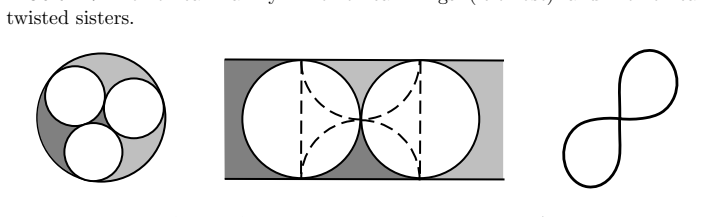
- [§2.3, Lemma 2.15] In Lemma 2.15, the sentence 'Two of the Borromean twisted sisters have homeomorphic complements' is asserted without proof or citation; please add a reference or a sketch of the isotopy.
- [§3.2, Proposition 3.16] The trihedron-cancellation bookkeeping in the proof of Proposition 3.16 is intricate and difficult to verify from the text; a systematic tracking of when each 3-vertex is created and removed (for example, a table indexed by the triangle pops) would make the argument checkable. This point is not load-bearing for the asymptotic results, since trihedron factors contribute only O(log r/r).
- [§2.3, proof of Theorem 2.12] The assertion in the proof of Theorem 2.12 that gluing the c−1 building blocks 'gives a genus c handlebody' is made without argument; a one-line Euler-characteristic computation would clarify the count.
Circularity Check
No significant circularity: the derivation chain is self-contained against external published bounds; self-citations are independent, parameter-free results.
full rationale
The paper's central geometric claim, Theorem 2.12, is not derived from its own conclusion. The characterization that an octahedral fully augmented link has nerve given by central subdivisions of the complete graph on four vertices is imported from Proposition 2.14, cited as Proposition 3.8 of the author's earlier work [29]. That is a published, parameter-free theorem with its own proof; using it as an input does not make the later construction circular. The induction in the proof of Theorem 2.12 builds the fundamental shadow link by explicit gluing of octahedra and checks isometry, rather than assuming the target consequence. The Turaev–Viro upper bound in Proposition 4.24 uses the external growth bound of [2, Theorem 1.2], and the lower bound in Lemma 4.25 uses the external lower bound of [16, Lemma 3.6] for the all-colour quantum 6j-symbol. Neither bound is fitted to the paper's links, and no target volume is inserted as an input. The sign-independence step in Corollary 4.20 is used to justify keeping a single term in the sum; even if the displayed formula (4.17) contains a denominator typo that may undermine the proof as published, that is a correctness gap, not a circularity, because the argument does not assume the desired limit. The paper explicitly credits [2, 38] for the original volume-conjecture result and presents its contribution as an independent geometric and skein-theoretic route. There is no self-definitional, fitted-prediction, or self-citation chain that forces the conclusions.
Assumptions & free parameters
assumptions (6)
- domain assumption Proposition 2.14 ([29, Prop 3.8]): a fully augmented link's polyhedral decomposition is obtained by gluing regular ideal octahedra iff its nerve is obtained by central subdivision of K4.
- domain assumption Theorem 4.1 ([9, Thm 1.1]): TV_r(S3 \ L, q) = 2^{n-1}(eta'_r)^2 sum |J_{L,iii}(A)|^2.
- domain assumption Theorem 4.21 ([2, Thm 1.2]): growth of any admissible quantum 6j-symbol is bounded above by v8 + O(log r/r).
- domain assumption Theorem 4.22 ([16, Lem 3.6]): the specific 6j-symbol with all entries (r-2 +/- 1)/2 has growth exactly v8.
- domain assumption Proposition 2.11 ([6]): complement of a fundamental shadow link has a complete hyperbolic metric of volume 2 c v8.
- standard math The quantum 6j-symbol formula (Definition 4.8) with the standard Racah-Wigner sum and the convention for sqrt of negative numbers.
Cite this review
Pith. "Pith review of Augmented links, shadow links, and the TV volume conjecture: a geometric perspective." pith.science (2026). https://pith.science/paper/32O2SNCJ
@misc{pith2026250609296,
  author       = {Pith},
  title        = {Pith review of: Augmented links, shadow links, and the TV volume conjecture: a geometric perspective},
  year         = {2026},
  howpublished = {\url{https://pith.science/paper/32O2SNCJ}},
  note         = {Machine review of arXiv:2506.09296}
}
abstract
For hyperbolic 3-manifolds, the growth rate of their Turaev-Viro invariants, evaluated at a certain root of unity, is conjectured to give the hyperbolic volume of the manifold. This has been verified for a handful of examples and several infinite families of link complements, including fundamental shadow links. Fundamental shadow links lie in connected sums of copies of $S^1\times S^2$, and their complements are built of regular ideal octahedra. Another well-known family of links with complements built of regular ideal octahedra are the octahedral fully augmented links in the 3-sphere. The complements of these links are now known to be homeomorphic to complements of fundamental shadow links, using topological techniques. In this paper, we give a new, geometric proof that complements of octahedral fully augmented links are isometric to complements of fundamental shadow links. We then use skein theoretic techniques to determine formulae for coloured Jones polynomials of these links. In the case of no half-twists, this gives a new, more geometric verification of the Turaev-Viro volume conjecture for these links.
Figures


Figures from the paper (14 more)




Forward citations
Cited by 1 Pith paper
-
Expansion joints in hyperbolic manifolds
Cone-deforming an ideal arc through 'expansion joints' interpolates between stacked Borromean ring complements and lantern manifolds, and yields cone deformations of highly twisted 2-bridge unknotting tunnels.
Reference graph
Works this paper leans on
-
[38]
Ka Ho Wong and Tian Yang, Relative Reshetikhin-Turaev invariants, hyperbolic cone metrics and discrete Fourier transforms I , Comm. Math. Phys. 400 (2023), no. 2, 1019–1070. School of Mathematics, Monash University, Clayton, VIC 3800, Australia Email address : dionne.ibarra@monash.edu School of Mathematics, Monash University, Clayton, VIC 3800, Australia ...
work page 2023
-
[1]
Colin C. Adams, Augmented alternating link complements are hyperbolic , Low-dimensional topology and Kleinian groups (Coventry/Durham, 1984), London Math. Soc. Lecture Note Ser., vol. 112, Cambridge Univ. Press, Cambridge, 1986, pp. 115–130
work page 1984
-
[2]
Giulio Belletti, Renaud Detcherry, Efstratia Kalfagianni, and Tian Yang, Growth of quantum 6j-symbols and applications to the volume conjecture , J. Differential Geom. 120 (2022), no. 2, 199–229
work page 2022
-
[3]
Christian Blanchet, Nathan Habegger, Gregor Masbaum, and Pierre Vogel, Topological quantum field theories derived from the Kauffman bracket , Topology 34 (1995), no. 4, 883–927
work page 1995
-
[4]
Qingtao Chen and Tian Yang, Volume conjectures for the Reshetikhin-Turaev and the Turaev-Viro invariants , Quantum Topol. 9 (2018), no. 3, 419–460
work page 2018
-
[5]
Francesco Costantino, 6 j-symbols, hyperbolic structures and the volume conjecture , Geom. Topol. 11 (2007), 1831–1854
work page 2007
-
[6]
Francesco Costantino and Dylan Thurston, 3-manifolds efficiently bound 4-manifolds , J. Topol. 1 (2008), no. 3, 703–745
work page 2008
-
[7]
Knot Theory Ramifications 28 (2019), no
Renaud Detcherry, Growth of Turaev-Viro invariants and cabling , J. Knot Theory Ramifications 28 (2019), no. 14, 1950041, 8
work page 2019
Show all 38 references
-
[8]
Renaud Detcherry and Efstratia Kalfagianni, Gromov norm and Turaev-Viro invariants of 3-manifolds , Ann. Sci. ´Ec. Norm. Sup´ er. (4)53 (2020), no. 6, 1363–1391
2020
-
[9]
9 (2018), no
Renaud Detcherry, Efstratia Kalfagianni, and Tian Yang, Turaev-Viro invariants, colored Jones polynomials, and volume , Quantum Topol. 9 (2018), no. 4, 775–813
2018
-
[10]
Vaughan F. R. Jones, A polynomial invariant for knots via von Neumann algebras , Bull. Amer. Math. Soc. (N.S.) 12 (1985), no. 1, 103–111
1985
-
[11]
Kashaev, The hyperbolic volume of knots from the quantum dilogarithm , Lett
Rinat M. Kashaev, The hyperbolic volume of knots from the quantum dilogarithm , Lett. Math. Phys. 39 (1997), no. 3, 269–275
1997
-
[12]
Kauffman, Knots, spin networks and 3-manifold invariants , Knots 90 (Osaka, 1990), de Gruyter, Berlin, 1992, pp
Louis H. Kauffman, Knots, spin networks and 3-manifold invariants , Knots 90 (Osaka, 1990), de Gruyter, Berlin, 1992, pp. 271–287
1990
-
[13]
Kauffman and S´ ostenes L
Louis H. Kauffman and S´ ostenes L. Lins, Temperley-Lieb recoupling theory and invariants of 3-manifolds, Annals of Mathematics Studies, vol. 134, Princeton University Press, Princeton, NJ, 1994
1994
-
[14]
Kirillov and Nicolai Yu
Anatol N. Kirillov and Nicolai Yu. Reshetikhin, Representations of the algebra Uq(sl(2)), q-orthogonal poly- nomials and invariants of links , Infinite-dimensional Lie algebras and groups (Luminy-Marseille, 1988), Adv. Ser. Math. Phys., vol. 7, World Sci. Publ., Teaneck, NJ, 1...
1988
-
[15]
Sanjay Kumar, Fundamental shadow links realized as links in S3, Algebr. Geom. Topol. 21 (2021), no. 6, 3153–3198
2021
-
[16]
Melby, Asymptotic additivity of the Turaev-Viro invariants for a family of 3-manifolds, J
Sanjay Kumar and Joseph M. Melby, Asymptotic additivity of the Turaev-Viro invariants for a family of 3-manifolds, J. Lond. Math. Soc. (2) 106 (2022), no. 4, 3043–3068
2022
-
[17]
, Turaev-Viro invariants and cabling operations, Internat. J. Math.34 (2023), no. 11, Paper No. 2350065, 22
2023
-
[18]
London Math
Marc Lackenby, The volume of hyperbolic alternating link complements, Proc. London Math. Soc. (3) 88 (2004), no. 1, 204–224, With an appendix by Ian Agol and Dylan Thurston
2004
-
[19]
W. B. R. Lickorish, Three-manifolds and the Temperley-Lieb algebra , Math. Ann. 290 (1991), no. 4, 657–670
1991
-
[20]
William B. R. Lickorish, The skein method for three-manifold invariants , J. Knot Theory Ramifications 2 (1993), no. 2, 171–194
1993
-
[21]
175, Springer-Verlag, New York, 1997
, An introduction to knot theory , Graduate Texts in Mathematics, vol. 175, Springer-Verlag, New York, 1997
1997
-
[22]
Masbaum and P
G. Masbaum and P. Vogel, 3 -valent graphs and the Kauffman bracket , Pacific J. Math. 164 (1994), no. 2, 361–381
1994
-
[23]
G. D. Mostow, Strong rigidity of locally symmetric spaces , Annals of Mathematics Studies, vol. No. 78, Prince- ton University Press, Princeton, NJ; University of Tokyo Press, Tokyo, 1973
1973
-
[24]
186 (2001), no
Hitoshi Murakami and Jun Murakami, The colored Jones polynomials and the simplicial volume of a knot , Acta Math. 186 (2001), no. 1, 85–104
2001
-
[25]
7 (2016), no
Tomotada Ohtsuki, On the asymptotic expansion of the Kashaev invariant of the 52 knot, Quantum Topol. 7 (2016), no. 4, 669–735
2016
-
[26]
, On the asymptotic expansion of the quantum SU(2) invariant at q = exp(4 π√−1/N) for closed hyperbolic 3-manifolds obtained by integral surgery along the figure-eight knot, Algebr. Geom. Topol. 18 (2018), no. 7, 4187–4274
2018
-
[27]
Gopal Prasad, Strong rigidity of Q-rank 1 lattices, Invent. Math. 21 (1973), 255–286
1973
-
[28]
Purcell, Cusp shapes under cone deformation , J
Jessica S. Purcell, Cusp shapes under cone deformation , J. Differential Geom. 80 (2008), no. 3, 453–500
2008
-
[29]
Math., vol
, An introduction to fully augmented links, Interactions between hyperbolic geometry, quantum topology and number theory, Contemp. Math., vol. 541, Amer. Math. Soc., Providence, RI, 2011, pp. 205–220
2011
-
[30]
209, American Mathematical Society, Providence, RI, [2020] ©2020
, Hyperbolic knot theory , Graduate Studies in Mathematics, vol. 209, American Mathematical Society, Providence, RI, [2020] ©2020
2020
-
[31]
N. Yu. Reshetikhin and V. G. Turaev, Ribbon graphs and their invariants derived from quantum groups, Comm. Math. Phys. 127 (1990), no. 1, 1–26
1990
-
[32]
Turaev, Shadow links and face models of statistical mechanics , J
Vladimir G. Turaev, Shadow links and face models of statistical mechanics , J. Differential Geom. 36 (1992), no. 1, 35–74. AUGMENTED LINKS, SHADOW LINKS, AND THE TV VOLUME CONJECTURE 23
1992
-
[33]
Turaev and Oleg Y
Vladimir G. Turaev and Oleg Y. Viro, State sum invariants of 3-manifolds and quantum 6j-symbols, Topology 31 (1992), no. 4, 865–902
1992
-
[34]
Roland van der Veen, Proof of the volume conjecture for Whitehead chains , Acta Math. Vietnam. 33 (2008), no. 3, 421–431
2008
-
[35]
, The volume conjecture for augmented knotted trivalent graphs , Algebr. Geom. Topol. 9 (2009), no. 2, 691–722
2009
-
[36]
Wong and Tian Yang, On the volume conjecture for hyperbolic dehn-filled 3-manifolds along the figure- eight knot , arXiv:2003.10053 Geometric Topology (2022)
Ka H. Wong and Tian Yang, On the volume conjecture for hyperbolic dehn-filled 3-manifolds along the figure- eight knot , arXiv:2003.10053 Geometric Topology (2022)
2022 arXiv
-
[37]
Ka Ho Wong, Asymptotics of some quantum invariants of the Whitehead chains , arXiv: 1912.10638, 2019
1912 arXiv
Reviewed August 7, 2026 · model on record in the stance chip above.
Discussion (0). Continue with ORCID to comment.