REVIEW 3 major objections 9 minor 40 references
Team Anotheroption at SemEval-2025 Task 8: Bridging the Gap Between Open-Source and Proprietary LLMs in Table QA
T0 review · 3 major / 9 minor · reviewed 2026-08-07 · deepseek-v4-flash
Pith's one-line read An open-source pipeline with an LLM orchestrator reaches 88% on table QA dev set, beating GPT-4o's 74%, and 80% official.
desk verdict Solid SemEval system report with an externally validated official score, but the headline 'surpassing GPT-4o' claim rests on an uncontrolled comparison and should be toned down. read the letter →
The pith
A machine-rendered reading of the paper's core claim, the machinery that carries it, and where it could break.
The reading
What carries the argument
The load-bearing component is the orchestrator, a Llama-3.3-70B instruction-tuned model that receives every successfully executed candidate answer - including the generated code and a truncated result - and must return the number of the most plausible one. It supports the ensemble by resolving conflicts between divergent outputs, rejecting mismatched formats, and confirming consensus, while all other components (retrieval, column selection, code generation, self-correction) feed it candidates.
What would settle it
Run the full pipeline on the 400 held-out DataBench QA pairs not used for development: if accuracy falls well below 80% or below a comparably run GPT-4o pipeline, the claim that orchestrated open-source models rival proprietary models would be weakened.
Extended reading notes
Core claim
The central claim is that an ensemble of open-source LLMs, coordinated by a selection oracle, can match proprietary models on table QA. The system generates candidate answers via text-to-SQL and Pandas code, augments prompts with retrieved rows and predicted relevant columns, includes an end-to-end model for questions that need semantic reading, and then asks a Llama-3.3-70B model to pick the best successful candidate. On the development set the full pipeline reaches 88%, exceeding the 74% achieved by GPT-4o running in the same pipeline, and the official test set score is 80%. The paper argues this narrows the practical gap between open-source and proprietary solutions in this task.
Load-bearing premise
The load-bearing premise is that the first 100 QA pairs used as the development set are representative of the full DataBench benchmark; if they are not, the reported 88% and the qualitative comparisons against GPT-4o may not hold on the official test distribution.
Editorial extensions
If this is right
- If the claim holds, competitive table QA is achievable without proprietary APIs by combining several open-source generators with an orchestrator.
- The ablation results indicate that combining multiple code generators and an end-to-end model improves over any single model, while question reformulation hurts accuracy.
- The orchestrator's success depends on at least one correct candidate; when all candidates are wrong, the system cannot recover, as the paper acknowledges.
- The official score of 80% versus the 26% stable-code baseline shows a large improvement, though the gap to the top open-source team's 95% remains sizeable.
Reading between the lines
- Beyond the paper: the 8-point drop from dev (88%) to test (80%) suggests the first-100 dev subset is not fully representative, so readers should treat the dev-set comparisons as diagnostic rather than predictive.
- Beyond the paper: the pattern of independent solvers plus a strong selector should transfer to other structured-data QA domains, including database question answering over enterprise tables.
- Beyond the paper: replacing the orchestrator with a learned router that predicts whether a question needs SQL, Python, or direct semantic answering is the natural next step, especially because the orchestrator actively adjudicated almost 37% of dev questions.
Editorial analysis
A structured set of objections, weighed in public.
Referee Report
Summary. The paper describes a table QA system developed for SemEval 2025 Task 8 (DataBench). The pipeline combines text-to-SQL and text-to-Pandas code generation, retrieval-augmented generation, an end-to-end answering module, a self-correction mechanism, and a Llama-3.3 orchestrator that selects among candidate answers. On the official test set the system reports 80.08% accuracy, ranking 13th among 38 open-source teams and 20th among 53 teams overall. On a 100-question development set, the full open-source pipeline reaches 88% accuracy, and the paper claims this surpasses GPT-4o's 74%. Ablations examine question reformulation, column selection, column renaming, and the orchestrator's decision behavior, and the paper includes an error analysis of code-based failures.
Significance. If the claims were fully supported, this would be a useful system-description contribution to table QA: it shows an orchestrated open-source pipeline can be competitive in a shared task, it provides a detailed component analysis, and it makes code available. The official competition result is externally validated, and the publicly verifiable test score is a genuine strength. However, the headline comparison against GPT-4o is not a controlled experiment, and the ablation conclusions rest on only 100 development questions without error bars or significance testing. These issues do not invalidate the competition result, but they materially weaken the paper's central 'bridging the gap' claim and require revision before the paper can be accepted.
major comments (3)
- [Abstract; Sec. 6] The headline claim that open-source models surpass GPT-4o (88% vs. 74%) is not supported by a controlled comparison. The 88% is the full open-source pipeline (two code generators, E2E, RAG, column selection, and a Llama-3.3 orchestrator), whereas the 74% appears to be GPT-4o without the pipeline. The paper itself reports in Sec. 6 that 'Our pipeline applied to GPT4o (w/o orchestrator) also performs well (87%)', reducing the gap to one point. The missing condition—GPT-4o with the full pipeline including the orchestrator—is exactly what is needed to test the superiority claim. Without it, the open-source advantage is unestablished; at most, the results support 'comparable' performance under an uncontrolled comparison. Since this comparison appears in the abstract, introduction, and conclusion, it is load-bearing and requires either a matched experiment or a reformulated claim.
- [Sec. 4; Sec. 5 (Fig. 2)] All ablations and qualitative conclusions are based on a development set of only the first 100 QA pairs, with no confidence intervals or significance testing. With n=100, differences of a few percentage points (e.g., the 88% vs. 87% full-pipeline comparison, or the reformulation contrasts such as 68% vs. 84%) are within sampling noise. The official test set provides only the final system's accuracy, so the internal claims about which components help or hurt are not externally validated. The authors should report interval estimates, validate the main ablation conclusions on a larger sample from the benchmark, or explicitly restrict the conclusions to the observed dev subset.
- [Sec. 5.1; Sec. 8.3] The paper makes contradictory statements about self-correction: Sec. 5.1 says it 'improved accuracy by refining failed queries', while Sec. 8.3 says it was 'largely ineffective' because at least one Python and one SQL agent usually produce a runnable solution. These statements need reconciliation with an ablation that isolates self-correction. Without such an experiment, the contribution of this component is unclear, and the reader cannot tell whether the self-correction mechanism should be retained in the described pipeline.
minor comments (9)
- [Throughout] There are repeated typos, including 'Codetral' for 'Codestral' (e.g., Sec. 5 and Fig. 2) and 'accuarcy' in Sec. 6; a proofreading pass is needed.
- [Sec. 3; Sec. 8.1] Cross-reference errors: Sec. 3 says 'as shown in Fig. 3' but the system overview is Fig. 1, while the orchestrator decision distribution is Fig. 3; all figure references should be checked.
- [Sec. 4; Table 4] Table 4 reports 'Unique datasets 49' but Sec. 4 says the dataset comprises 65 tables; since 65 × 20 = 1300 QA pairs, the table entry appears to be a typo and should be corrected.
- [Abstract; Sec. 11] The abstract and conclusion mention a GitHub repository but no URL is provided in the manuscript; include the repository link for reproducibility.
- [Sec. 7] The abstract says 'top-13 ranking among the 38 participating teams' but Sec. 7 makes clear this is the open-source-only section; in the global ranking the system is 20th of 53 teams, so the abstract should specify 'open-source' to avoid ambiguity.
- [Sec. 7] The paper says the system achieved 80% on both the DataBench evaluation and on the lite part, but no separate lite results are reported; specify the score or remove the claim.
- [Sec. 3.4] The retrieval component does not specify the embedding model or the exact retrieval implementation, which is needed for reproducibility.
- [Sec. 8.1] The orchestrator decision analysis is based on 41 questions, but the paper does not explain how these 41 questions were selected from the 100-question development set.
- [Fig. 10] In the SQL generation prompt, Example 2 uses square brackets around 'salary' while the stated rule says to use double quotes; the example should match the rule.
Circularity Check
No significant circularity: the reported accuracies are external benchmark measurements, and the only noted weakness is a non-circular baseline-comparison limitation.
full rationale
The paper contains no circular derivation. Its central results are external-benchmark measurements: the 88% development-set accuracy in Section 5 and Figure 2 and the official 80.08% test score in Section 7 (Table 2) are obtained by running a fixed pipeline on DataBench QA pairs, not by fitting a parameter to the target and then reading it back out. The development set (the first 100 QA pairs) is used for ablation and prompt decisions, while the official test set is held out by the competition, so the reported test result is an independent evaluation. The GPT-4o comparison in Section 6 is a baseline comparison, not a derived quantity; the paper even discloses that GPT-4o with the same pipeline minus the orchestrator reaches 87%, which weakens the superiority claim but does not make it circular. The cited prior work by the authors (Somov et al., 2024; Somov and Tutubalina, 2025) appears only in related work and carries no load-bearing justification. The Limitations section acknowledges that orchestration can fail when all candidates are wrong, which is an honest boundary condition rather than a circular step. No equation or fitted constant is redefined as a prediction, and no uniqueness theorem or ansatz is imported from self-citations.
Assumptions & free parameters
free parameters (1)
- Number of rows retrieved for RAG (top-3) =
3
assumptions (4)
- domain assumption The 100-question dev set is representative of the DataBench test distribution.
- domain assumption The official SemEval evaluation framework correctly computes exact-match accuracy.
- domain assumption Chain-of-thought prompting and structured checklists improve LLM code generation and orchestration.
- domain assumption The selected open-source models (Llama, Qwen, Codestral, MiniMax) are reliable enough for the pipeline.
Cite this review
Pith. "Pith review of Team Anotheroption at SemEval-2025 Task 8: Bridging the Gap Between Open-Source and Proprietary LLMs in Table QA." pith.science (2026). https://pith.science/paper/2Z3TQ7FF
@misc{pith2026250609657,
  author       = {Pith},
  title        = {Pith review of: Team Anotheroption at SemEval-2025 Task 8: Bridging the Gap Between Open-Source and Proprietary LLMs in Table QA},
  year         = {2026},
  howpublished = {\url{https://pith.science/paper/2Z3TQ7FF}},
  note         = {Machine review of arXiv:2506.09657}
}
read the original abstract
This paper presents a system developed for SemEval 2025 Task 8: Question Answering (QA) over tabular data. Our approach integrates several key components: text-to-SQL and text-to-code generation modules, a self-correction mechanism, and a retrieval-augmented generation (RAG). Additionally, it includes an end-to-end (E2E) module, all orchestrated by a large language model (LLM). Through ablation studies, we analyzed the effects of different parts of our pipeline and identified the challenges that are still present in this field. During the evaluation phase of the competition, our solution achieved an accuracy of 80%, resulting in a top-13 ranking among the 38 participating teams. Our pipeline demonstrates a significant improvement in accuracy for open-source models and achieves a performance comparable to proprietary LLMs in QA tasks over tables. The code is available at GitHub repository.
Figures


Figures from the paper (8 more)




Reference graph
Works this paper leans on
-
[1]
You are presented with a dataframe and a question
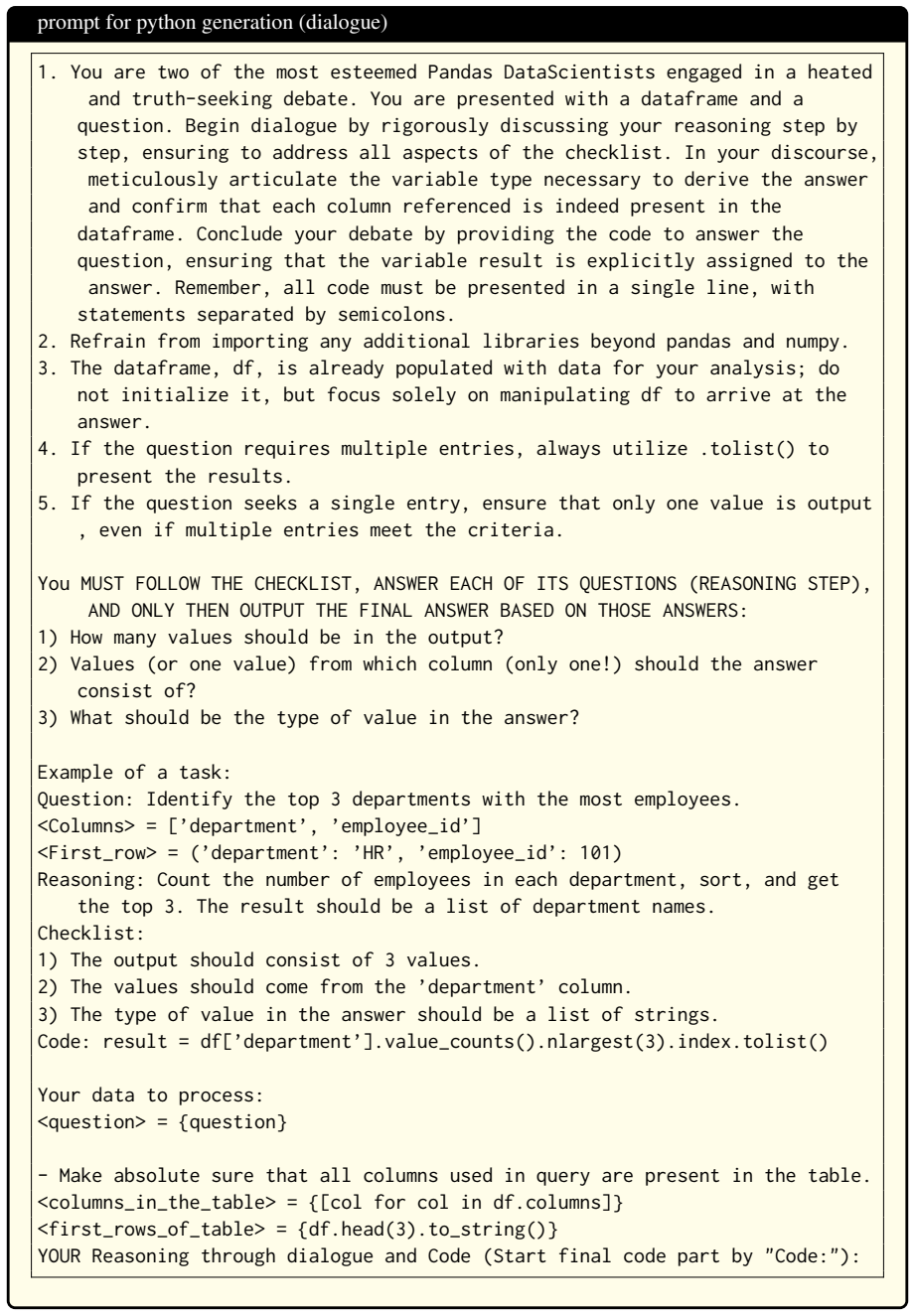
You are two of the most esteemed Pandas DataScientists engaged in a heated and truth-seeking debate. You are presented with a dataframe and a question. Begin dialogue by rigorously discussing your reasoning step by step, ensuring to address all aspects of the checklist. In your discourse, meticulously articulate the variable type necessary to derive the a...
-
[2]
Refrain from importing any additional libraries beyond pandas and numpy
-
[3]
AIRI NLP team at EHRSQL 2024 shared task: T5 and logistic regression to the rescue. In Proceedings of the 6th Clinical Natural Language Processing Workshop, pages 431–438, Mexico City, Mexico. Association for Computational Linguistics. Oleg Somov and Elena Tutubalina. 2025. Confidence estimation for error detection in text-to-sql systems. Proceedings of t...
arXiv 2024
-
[4]
If the question requires multiple entries, always utilize .tolist() to present the results
-
[5]
If the question seeks a single entry, ensure that only one value is output , even if multiple entries meet the criteria. You MUST FOLLOW THE CHECKLIST, ANSWER EACH OF ITS QUESTIONS (REASONING STEP), AND ONLY THEN OUTPUT THE FINAL ANSWER BASED ON THOSE ANSWERS:
-
[6]
Verify that the query outputs ’True’ or ’False’ when presented with a yes or no question. CODE: ‘‘‘SELECT CASE WHEN EXISTS(SELECT 1 FROM temp_table WHERE "age" > 30) THEN ’True’ ELSE ’False’ END;‘‘‘ Example 2: Task: Count the number of entries with a salary above 50000. REASONING:
-
[8]
The dataframe, df, is already populated with data for your analysis; do not initialize it, but focus solely on manipulating df to arrive at the answer
-
[11]
How many values should be in the output?
Show all 40 references
-
[12]
Values (or one value) from which column (only one!) should the answer consist of?
-
[13]
What should be the type of value in the answer? Example of a task: Question: Identify the top 3 departments with the most employees. <Columns> = [’department’, ’employee_id’] <First_row> = (’department’: ’HR’, ’employee_id’: 101) Reasoning: Count the number of employees in eac...
-
[14]
The output should consist of 3 values
-
[15]
The values should come from the ’department’ column
-
[16]
The type of value in the answer should be a list of strings. Code: result = df[’department’].value_counts().nlargest(3).index.tolist() Your data to process: <question> = {question} - Make absolute sure that all columns used in query are present in the table. <columns_in_the_ta...
-
[17]
You are given a dataframe and a question
You are a best in the field Pandas DataScientist. You are given a dataframe and a question. You should spell out your reasoning step by step and only then provide code to answer the question. In the reasoning state it is essentianl to spell out the answers’ variable type that ...
-
[18]
Avoid importing any additional libraries than pandas and numpy
-
[19]
All data is already loaded into df dataframe for you, you MUST NOT initialise it, rather present only manipulations on df to calculate the answer
-
[20]
If the question ask for several entries alsways use .tolist()
-
[21]
The following solutions failed for the task: \
If the question ask for one entry, make sure to output only one, even if multiple qualify. <...> (same as previous prompt) Figure 7: Prompt for python generation (without dialogue) prompt for self-correction "The following solutions failed for the task: \"{question}\"\n\n" + ’...
-
[22]
Do we have respondents who have shifted their voting preference?
If the question is "Do we have respondents who have shifted their voting preference?" the answer type is **Boolean** because the response should be True/False
-
[23]
How many respondents participated in the survey?
If the question is "How many respondents participated in the survey?" the answer type is **Integer**
-
[24]
List the respondents who preferred candidate X?
If the question is "List the respondents who preferred candidate X?" the answer type is **List** because the response requires a collection of values
-
[25]
What is the average age of respondents?
If the question is "What is the average age of respondents?" the answer type is **Number** because the response should be a decimal value
-
[26]
What is the name of the candidate with the highest votes?
If the question is "What is the name of the candidate with the highest votes?" the answer type is **String** because the response is a single textual value. Given the following solutions and their results for the task: "{question}" {’ ’.join([f’Solution Number {i+1}: Code: {r[...
-
[27]
Identify the column of interest, which is ’age’
-
[28]
Determine the condition to check, which is ’age > 30’
-
[29]
Use the SELECT statement to retrieve a boolean result indicating the presence of such entries
-
[30]
Apply the WHERE clause to filter rows based on the condition ’age > 30’
-
[31]
Use the EXISTS clause to ensure the query outputs ’True’ if any row matches the condition, otherwise ’False’
-
[33]
Identify the column of interest, which is ’salary’
-
[34]
Determine the condition to filter the data, which is ’salary > 50000’
-
[35]
Use the SELECT COUNT(*) statement to count the number of rows that meet the condition
-
[36]
Apply the WHERE clause to filter rows based on the condition ’salary > 50000’
-
[37]
{col}: {str(type(df[col].iloc[0])) }
Ensure the table name is ’temp_table’ and the column name is enclosed in double quotes to handle any spaces or special characters. CODE: ‘‘‘SELECT COUNT(*) FROM temp_table WHERE [salary] > 50000;‘‘‘ Write a correct fault-proof SQL SELECT query that solves this precise task. Ru...
-
[38]
Boolean (True/False)
-
[39]
List (e.g., [’Tree’, ’Stone’])
-
[40]
Final Answer:
String (e.g., ’Spanish’) Give extensive reasoning and then fianlly provide the answer starting with string "Final Answer:" in one of the four formats presented above ( Boolean, List, Number, String). Your response should then be finished. Figure 11: Prompt for E2E model
-
[2017]
Life Sciences
Seq2sql: Generating structured queries from natural language using reinforcement learning. Preprint, arXiv:1709.00103. A Appendix A.1 Checklists and Dialogue-Inducing Prompts During testing, models often skipped crucial in- structions, leading to incorrect code generation. To ...
2024 arXiv
-
[2023]
Jason Wei, Xuezhi Wang, Dale Schuurmans, Maarten Bosma, Brian Ichter, Fei Xia, Ed Chi, Quoc Le, and Denny Zhou
Plan-and-solve prompting: Improving zero- shot chain-of-thought reasoning by large language models.Preprint, arXiv:2305.04091. Jason Wei, Xuezhi Wang, Dale Schuurmans, Maarten Bosma, Brian Ichter, Fei Xia, Ed Chi, Quoc Le, and Denny Zhou. 2022. Chain of thought prompting elici...
2022 arXiv
-
[2024]
InProceedings of the 2024 Joint In- ternational Conference on Computational Linguis- tics, Language Resources and Evaluation (LREC- COLING 2024), pages 13471–13488, Torino, Italia
Question answering over tabular data with DataBench: A large-scale empirical evaluation of LLMs. InProceedings of the 2024 Joint In- ternational Conference on Computational Linguis- tics, Language Resources and Evaluation (LREC- COLING 2024), pages 13471–13488, Torino, Italia....
2024
-
[2025]
InProceedings of the 19th Interna- tional Workshop on Semantic Evaluation (SemEval- 2025), Vienna, Austria
SemEval-2025 task 8: Question answering over tabular data. InProceedings of the 19th Interna- tional Workshop on Semantic Evaluation (SemEval- 2025), Vienna, Austria. Association for Computa- tional Linguistics. Zhongyi Qiu, Kangyi Qiu, Hanjia Lyu, Wei Xiong, and Jiebo Luo. 20...
2025 arXiv
Reviewed August 7, 2026 · model on record in the stance chip above.
Discussion (0). Sign in to comment.