REVIEW 2 major objections 4 minor 176 references
Spontaneous emission and Purcell effect: some aspects
T0 review · 2 major / 4 minor · reviewed 2026-08-07 · deepseek-v4-flash
Pith's one-line read This review chapter sets out to establish that spontaneous emission is not a fixed atomic property: the surrounding electromagnetic environment changes the decay rate, and engineered media can suppress it, enhance it by orders of…
desk verdict A competent review chapter with no new science; Eq. (7.19) is dimensionally wrong and the percolation enhancement rests on a shaky local effective-medium premise. read the letter →
The pith
A machine-rendered reading of the paper's core claim, the machinery that carries it, and where it could break.
The reading
What carries the argument
Two equivalent expressions carry the argument. The first is the golden rule of time-dependent perturbation theory, Eq. (7.5): $\Gamma(\mathbf{r}) = \frac{\pi\omega_0}{\epsilon_0\hbar}\sum_{\zeta} |\mathbf{d}\cdot\mathbf{A}_\zeta(\mathbf{r})|^2 \delta(\omega_\zeta-\omega_0)$, where the $\mathbf{A}_\zeta$ are orthonormal solutions of the Helmholtz equation satisfying the boundary conditions; this makes the environment dependence visible through the modes. The second is the dyadic Green's function identity, Eq. (7.14): $\Gamma(\mathbf{r})/\Gamma^{(0)} = \frac{6\pi c}{\omega_0}\,\mathrm{Im}\{\mathbf{n}\cdot\mathbf{G}(\mathbf{r},\mathbf{r};\omega_0)\cdot\mathbf{n}\}$, which turns the problem into the imaginary part of the scattered field at the emitter's position, with planar interfaces described by Fresnel reflection coefficients. For composite and phase-change media, effective-medium averaging supplies the local dielectric constant that enters those coefficients, and the quasi-static limit produces the near-field scaling $\Gamma_\perp/\Gamma^{(0)} \simeq 2\Gamma_\parallel/\Gamma^{(0)} \simeq \frac{3}{4 z^3}\,\frac{\mathrm{Im}[\varepsilon_e]}{|\varepsilon_e+1|^2}$.
What would settle it
Measure the decay rate of a cesium emitter held about 100 nm above a gold-in-dielectric composite while sweeping the metal filling fraction through the percolation value 1/3; the chapter predicts a five-to-six-order-of-magnitude enhancement peaking at that fraction, so observing a smaller, shifted, or suppressed peak would show the local effective-medium description is inadequate.
Extended reading notes
Core claim
Stated explicitly in Section 7.3.1, the central claim is that 'the SE rate of a quantum emitter is not an intrinsic property, but rather depends on the surrounding atomic environment.' The chapter demonstrates this first with exact mode-sum expressions for an atom near one or two perfectly conducting plates, where the decay rate oscillates with distance and a parallel dipole is completely suppressed when the plate separation is below half the transition wavelength. It then extends the claim to engineered media: a plasmonic shell can cancel the Purcell effect so the emitter decays at its free-space rate regardless of distance; a metal–dielectric composite at the percolation threshold enhances the near-field decay rate by five to six orders of magnitude; a VO2 film gives the decay rate a thermal hysteresis across its metal–insulator transition; and uniaxial strain in phosphorene can enhance the electric Purcell effect by up to 1300% or nearly suppress it while shifting the dominant decay channel among propagating, total-internal-reflection, and lossy-surface-wave modes.
Load-bearing premise
The load-bearing premise is that a metal–dielectric mixture near its percolation threshold, and a VO2 film during its phase transition, can be treated as homogeneous materials with a single local dielectric constant determined by effective-medium averaging; if that premise fails at nanoscale emitter–surface distances, the predicted enhancements, peaks, and hysteresis in the decay rate would change.
Editorial extensions
If this is right
- Between two parallel conducting plates separated by less than half the transition wavelength, an emitter whose dipole is parallel to the plates stops emitting entirely, while a perpendicular dipole keeps decaying; the chapter notes this was observed with Rydberg atoms.
- A plasmonic shell around a dielectric sphere can make the sphere invisible to the emitter in the dipole approximation, so the decay rate returns to its free-space value at every emitter–sphere distance.
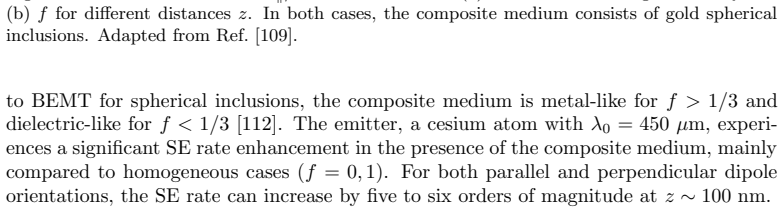
- Near a metal–dielectric composite at the percolation threshold, the decay rate of a cesium atom at about 100 nm is enhanced by five to six orders of magnitude, with the maximum at the metal filling fraction $f_c = 1/3$.
- Across the VO2 metal–insulator transition, the decay rate follows the material's thermal hysteresis, with peaks up to about $10^3$ times the free-space value for emitters with $\lambda_0 \lesssim 10\,\mu$m.
- Uniaxial strain in phosphorene can increase the electric Purcell effect by 1300% or nearly suppress it, and it changes which decay channel—propagating, total internal reflection, or lossy surface wave—dominates.
Reading between the lines
- Because the same Green's function identity also governs resonance energy transfer, radiative heat transfer, and two-photon emission, the percolation, phase-change, and strain controls described here plausibly transfer to those phenomena; the chapter only names that wider family in its closing remarks.
- The percolation prediction rests on a local effective permittivity, so an emitter placed well below 100 nm from the composite, or extremely close to the critical filling fraction, would be a natural place to look for nonlocal corrections that move or broaden the predicted peak.
- The strain-based switching in phosphorene offers a mechanical, hysteresis-free route to on-demand control of single-photon emission that avoids the Zeeman shifts of magneto-optical schemes mentioned in the chapter.
- The cloaking result suggests that a single emitter's decay rate can serve as a quantum-local probe of invisibility, complementing far-field scattering-cross-section measurements in the dipole regime.
Editorial analysis
A structured set of objections, weighed in public.
Referee Report
Summary. This chapter provides a pedagogical review of spontaneous emission (SE) and the Purcell effect, ranging from a historical survey of QED vacuum effects to a derivation of the SE rate via Fermi's golden rule and mode expansion for free space, a single perfectly conducting plate, and two parallel plates. It then presents several advanced scenarios: plasmonic cloaking, composite media near the percolation threshold, VO2 phase transitions, and strained phosphorene. The central claim is that the SE rate of a quantum emitter is not an intrinsic atomic property but depends on the surrounding electromagnetic environment, supported by textbook derivations and the cited experiments of Drexhage and Hulet.
Significance. As a review chapter, the manuscript succeeds in presenting a coherent and readable overview, and the standard derivations of the free-space and plate results are correct and consistent with the literature. Its strengths include the transparent citation of the original peer-reviewed papers for the advanced sections, the explicit connection to landmark experiments, and the clear historical narrative. The advanced sections report potentially large effects (orders-of-magnitude enhancement, suppression, and switching of SE), which would be significant for quantum technology if they hold up experimentally. However, the quantitative claims in the percolation section (Section 7.4.2) rely on an effective-medium assumption that the chapter itself undercuts near the critical point, and one of the analytic expressions in that section contains a dimensional error.
major comments (2)
- [7.4.2, Eq. (7.19)] Equation (7.19) is dimensionally inconsistent: the right-hand side, (3/4) z^{-3} Im[\epsilon_e]/|\epsilon_e+1|^2, has units of inverse cubic length, whereas the left-hand side \Gamma_\perp/\Gamma(0) is dimensionless. The quasi-static limit of Eqs. (7.16) and (7.17) must contain a factor k_0^{-3}, i.e., an expression of the form (3/4)(k_0 z)^{-3} Im[\epsilon_e]/|\epsilon_e+1|^2. As written, the equation cannot be correct, and since it is presented as the analytic explanation for the five-to-six-orders-of-magnitude enhancement at the percolation threshold, it needs to be fixed and the surrounding discussion adjusted accordingly.
- [7.4.2] The quantitative predictions at z ~ 100 nm near the percolation threshold use a local Bruggeman effective permittivity in the Fresnel coefficients of Eq. (7.18). This is in tension with the chapter's own statements that near percolation the field fluctuations become scale-invariant and highly localized, because homogenization is only valid at scales much larger than the inhomogeneities. The authors should either provide evidence (e.g., from nonlocal or full-wave calculations) that the local effective-medium description remains accurate at these distances and filling fractions, or explicitly state this limitation and qualify the claimed enhancement.
minor comments (4)
- [7.3.2, Eq. (7.2)] Equation (7.2) for the free-space SE rate is dimensionally inconsistent in SI units; the standard result is \Gamma(0) = |d|^2 \omega_0^3 / (3 \pi \epsilon_0 \hbar c^3). Please specify the unit system (e.g., Gaussian with c = 1) or insert the missing factors so that the equation is consistent with the SI expressions used elsewhere in the chapter.
- [References [51]] Reference [51] gives an incorrect title for Lifshitz's 1956 paper; the actual title is "The theory of molecular attractive forces between solids" (Sov. Phys. JETP 2, 73 (1956)). The current title appears to be from a much later, unrelated paper.
- [Eqs. (7.16)-(7.17) and (7.20)-(7.25)] The square roots are typeset as 'q' in Eqs. (7.16) and (7.17), and the integrals in Eqs. (7.20)-(7.25) appear as 'Z d2k\|' instead of \int d^2k_\parallel; these typographical issues should be corrected.
- [7.4.2] The statement that the SE rate 'scales as 1/Im[\epsilon_e]' for a metallic medium is imprecise: the dimensionless combination is Im[\epsilon_e]/|\epsilon_e+1|^2, which for a good metal behaves as Im[\epsilon_e]/|\epsilon_e|^2, not as 1/Im[\epsilon_e]. Please rephrase for accuracy.
Circularity Check
No significant circularity: the environment-dependence of spontaneous emission is derived from boundary-condition-dependent modes and benchmarked against independent experiments; advanced sections are transparent reviews of prior peer-reviewed work.
full rationale
The chapter's central claim is not circular. Equation (7.5), Γ(r) = (πω0/ε0ℏ) Σ|d·Aζ(r)|²δ(ωζ−ω0), is presented as a Fermi-golden-rule consequence in which the field modes Aζ(r) are constrained by boundary conditions; the conclusion that the SE rate depends on the surrounding environment follows from the equations rather than being assumed. The canonical plate and cavity results (Eqs. 7.9–7.12) are checked against the Drexhage and Hulet experiments independently. Sections 7.4.1–7.4.4 summarize the authors' own prior peer-reviewed papers (Refs. 101, 109, 114, 126) transparently, and those underlying results are externally falsifiable parameter-free calculations (BEMT, Fresnel coefficients, optical conductivity), not fits to the SE data being 'predicted'. The substantive weaknesses are physical-correctness concerns, not circularity: Eq. (7.19) is dimensionally inconsistent because a factor of k0³ is missing, and Section 7.4.2 itself notes the highly localized, subwavelength-confined resonant plasmon fluctuations near percolation, which undercut the local-homogenization premise at nanoscale emitter–surface separations. These issues affect confidence in quantitative enhancement claims but do not make the derivation equivalent to its inputs.
Assumptions & free parameters
assumptions (5)
- standard math Fermi's golden rule and the Markovian approximation govern the decay dynamics of the two-level emitter.
- domain assumption The emitter is treated as a two-level system with a nonvanishing electric dipole transition; spontaneous emission proceeds via one-photon electric dipole transitions.
- standard math Electromagnetic modes form a complete orthonormal set satisfying the Helmholtz equation and the boundary conditions imposed by surrounding bodies.
- domain assumption Composite media are described by a local, scalar effective permittivity derived from Bruggeman effective medium theory.
- domain assumption Boundaries such as perfectly conducting plates impose E_parallel = 0.
Cite this review
Pith. "Pith review of Spontaneous emission and Purcell effect: some aspects." pith.science (2026). https://pith.science/paper/SXO6VCHT
@misc{pith2026250610210,
  author       = {Pith},
  title        = {Pith review of: Spontaneous emission and Purcell effect: some aspects},
  year         = {2026},
  howpublished = {\url{https://pith.science/paper/SXO6VCHT}},
  note         = {Machine review of arXiv:2506.10210}
}
read the original abstract
This chapter, part of the Proceedings of the III International Workshop on Quantum Nonstationary Systems (eds. Alexandre Dodonov and Lucas Chibebe Celeri), held in Brasilia in August 2024, offers a comprehensive overview of spontaneous emission (SE) and the Purcell effect within the broader context of quantum electrodynamics (QED) and vacuum fluctuations. It begins with a historical and theoretical review, tracing the development of classical and quantum electromagnetic theories. The chapter then examines how the SE rate of a quantum emitter is fundamentally influenced by its electromagnetic environment, the so-called Purcell effect, through canonical examples, such as emitters near perfectly conducting plates and inside cavities, as well as more advanced scenarios. Special attention is given to modern strategies for tailoring SE using engineered environments, including plasmonic cloaks, composite media near percolation thresholds, metal-insulator phase transitions, and strain-induced modulation in phosphorene. Analytical techniques, such as mode summation and Green's function formalism, are employed to describe how surrounding materials and boundary conditions affect local field modes and the local density of states. The findings underscore both the theoretical depth and experimental relevance of SE modulation, paving the way for innovations in nano-optics, quantum technologies, and advanced material design.
Figures


Figures from the paper (14 more)




Reference graph
Works this paper leans on
-
[1]
J. C. Maxwell, A Treatise on Electricity and Magnetism (Clarendon press, Oxford, 1873)
-
[2]
− Γν(ϵy = 0)]/Γν(ϵy = 0), where ν = {x, y, z} and Γ ν(ϵy ̸= 0) [Γ ν(ϵy = 0)] stands for the SE rate near strained (relaxed) phosphorene. In Fig. 7.10, we exhibit the percentage variation in SE rates for both values of λ0. Figures 7.10(a) and (b) show these variations as functions of d, while Figs. 7.10(c) and (d) are calculations as functions of ϵy. In Fi...
2022
-
[3]
E. T. Whittaker, A History of the Theories of Aether and Electricity (Oxford City Press, Oxford, 1951)
1951
-
[4]
Einstein
A. Einstein. On the electrodynamics of moving bodies. Ann. Phys. 17, 891 (1905)
1905
-
[5]
H. A. Bethe. The electromagnetic shift of energy levels. Phys. Rev. 72, 241 (1947)
1947
-
[6]
P. A. M. Dirac. The quantum theory of emission and absorption of radiation. Proc. R. Soc. Lond. A 114, 243 (1927)
1927
-
[7]
P. W. Milonni, The Quantum Vacuum: An Introduction to Quantum Electrodynam- ics (Academic press, 1994)
1994
-
[8]
W. E. Lamb Jr. and R. C. Retherford. Fine structure of the hydrogen atom by a microwave method. Phys. Rev. 72, 241 (1947)
1947
Show all 176 references
-
[9]
Beringer et al
J. Beringer et al. Review of particle physics. Phys. Rev. D, 86, 010001 (2012)
2012
-
[10]
Schwinger
J. Schwinger. On quantum-electrodynamics and the magnetic moment of the electron. Phys. Rev. 73, 416 (1948)
1948
-
[11]
H. M. Foley and P. Kusch. On the intrinsic moment of the electron. Phys. Rev. 73, 412 (1948)
1948
-
[12]
Kusch and H
P. Kusch and H. M. Foley. Precision measurement of the ratio of the atomic ‘g values’ in the 2P 3 2 and 2P 1 2 states of gallium. Phys. Rev. 72, 1256 (1947)
1947
-
[13]
S. M. C. Atara. An introduction to some QED vacuum effects. Master thesis, Uni- versidade Federal do Rio de Janeiro (2022)
2022
-
[14]
Barn´ othy
J. Barn´ othy. On the Intrinsic Moment of the Electron. Phys. Rev. 74, 250 (1948)
1948
-
[15]
F. J. Dyson. The radiation theories of Tomonaga, Schwinger, and Feynman. Phys. Rev. 75, 486 (1949)
1949
-
[16]
S. S. Schweber, QED and the Men who Made it: Dyson, Feynman, Schwinger and Tomonaga (Princeton University Press, Princeton, 1994)
1994
-
[17]
H. Euler. ¨Uber die streuung von Licht an Licht nach der diracschen theorie. Ann. Phys. (Leipzig) 26, 398 (1936)
1936
-
[18]
Euler and B
H. Euler and B. Kockel. ¨Uber die streuung von Licht an Licht nach der diracschen theorie. Naturwiss. 23, 246 (1935)
1935
-
[19]
Dittrich and M
W. Dittrich and M. Reuter, Effective Lagrangians in quantum electrodynamics (Springer Berlin Heidelberg, 1985)
1985
-
[20]
Heisenberg and H
W. Heisenberg and H. Euler. Folgerungen aus der Diracschen Theorie des Positrons. Z. Phys. 98, 714 (1936)
1936
-
[21]
Jarlskog, et al
G. Jarlskog, et al. Measurement of Delbruck scattering and observation of photon splitting at high energies. Phys. Rev. D 8, 3813 (1973)
1973
-
[22]
Meitner and H
L. Meitner and H. K¨ osters. ¨Uber die Streuung kurzwelliger γ-Strahlen. Z. Phys. 84, 137 (1933) (with a comment of M. Delbr¨ uck)
1933
-
[23]
Rullhusen et al
P. Rullhusen et al. Test of vacuum polarization by precise investigation of Delbruck scattering. Phys. Rev. C 23, 1375 (1981)
1981
-
[24]
Muckenheim and M
W. Muckenheim and M. Schumacher. Delbruck and Rayleigh scattering by uranium investigated at photon energies between 0.1 and 1.5 MeV. J. Phys. G 6, 1237 (1980)
1980
-
[25]
Evidence for light-by-light scattering in heavy-ion collisions 22 P
ATLAS Collaboration. Evidence for light-by-light scattering in heavy-ion collisions 22 P. P. Abrantes, D. Szilard, and C. Farina with the ATLAS detector at the LHC. Nat. Phys. 13, 852 (2017)
2017
-
[26]
Dittrich
W. Dittrich. The Heisenberg Euler Lagrangian as an example of an effective field theory. Int. J. Mod. Phys. A 29, 1430052 (2014)
2014
-
[27]
E. A. Uehling. Polarization effects in the positron theory. Phys. Rev. 48, 55 (1935)
1935
-
[28]
J. Furtado. Sobre a a¸ c˜ ao de Euler-Heisenberg e o espalhamento da luz pela luz. Rev. Bras. Ens. Fis. 41, e20180253 (2019)
2019
-
[29]
Peskin and D
M. Peskin and D. Schroeder, Introduction to quantum field theory (CRC Press, 2018)
2018
-
[30]
Greiner and J
W. Greiner and J. Reinhart, Quantum Electrodynamics (Springer Verlag, 2010)
2010
-
[31]
Medeiros, F
M. Medeiros, F. E. Barone and F. A. Barone. Effects of the fermionic vacuum polar- ization in QED. Eur. Phys. J. C 78, 1 (2018)
2018
-
[32]
A. E. Frolov and D. M. Wardlaw. Analytical formula for the Uehling potential. Eur. Phys. J. B 85, 348 (2012)
2012
-
[33]
Weisskopf
V. Weisskopf. ¨Uber die Elektrodynamik des Vakuums auf Grund der Quantentheorie des Elektrons. Dan. Mat. Fys. Medd. 24, 3 (1936)
1936
-
[34]
F. Sauter. ¨Uber das Verhalten eines Elektrons im homogenen elektrischen Feld nach der relativistischen Theorie Diracs. Z. Phys. 69, 742 (1931)
1931
-
[35]
Greiner, B
W. Greiner, B. M¨ uller and J. Rafelski, Quantum Electrodynamics of Strong Fields (Springer Berlin Heidelberg, 1985)
1985
-
[36]
Schwinger
J. Schwinger. On gauge invariance and vacuum polarization. Phys. Rev. 82, 664 (1951)
1951
-
[37]
G. V. Dunne, Heisenberg-Euler effective Lagrangians: Basics and extensions, in From Fields to Strings: Circumnavigating Theoretical Physics. Ian Kogan Memorial Col- lection (3 volume set). edited by M. Shifman, A. Vainshtein, and J. Wheater (World Scientific Pub. Co, 2005), pp...
2005
-
[38]
F. C. Salgado el al. Towards pair production in the non-perturbative regime. New J. Phys. 23, 105002 (2021)
2021
-
[39]
H. B. G. Casimir. On the attraction between two perfectly conducting plates. Proc. K. Ned. Akad. Wet. 51, 793 (1948)
1948
-
[40]
Holstein
B. Holstein. Strong field pair production. Am. J. Phys. 67, 499 (1999)
1999
-
[41]
F. London. Zur Theorie und Systematik der Molekularkr¨ afte. Z. Phys.63, 245 (1930)
1930
-
[42]
Eisenschitz and F
R. Eisenschitz and F. London. ¨Uber das Verhaltnis der van der Waalsschen Krafte zu den homopolaren Bindungskraften. Z. Phys. 60, 491 (1930)
1930
-
[43]
H. B. G. Casimir and D. Polder. Influence of retardation in the London-van der Waals force. Nature 158, 787 (1946)
1946
-
[44]
E. J. W. Verwey and J. Th. G. Overbeek, Theory of the Stability of Lyophobic Colloids (Dover Publications, 1999)
1999
-
[45]
J. A. Wheeler. The scattering of alpha-particles in helium. Phys. Rev. 59, 16 (1941)
1941
-
[46]
H. B. G. Casimir and D. Polder. The influence of retardation on the London-van der Waals forces. Phys. Rev. 73, 360 (1948)
1948
-
[47]
M. J. Sparnaay. Measurements of attractive forces between flat plates. Physica 24, 751 (1958)
1958
-
[48]
H. B. G. Casimir. Sur les forces Van der Waals-London. J. Chim. Phys. 46, 407 (1946)
1946
-
[49]
Mohideen and A
U. Mohideen and A. Roy. Precision measurement of the Casimir force from 0 .1 to 0.9 µm. Phys. Rev. Lett. 81, 4549 (1998)
1998
-
[50]
Lamoreaux
S. Lamoreaux. Demonstration of the Casimir force in the 0 .6 to 6 µm range. Phys. Rev. Lett. 78, 5 (1997)
1997
-
[51]
E. M. Lifshitz. Probing atom-surface interactions by diffraction of Bose-Einstein condensates. Sov. Phys. JETP 2, 73 (1956)
1956
-
[52]
Bimonte et al
G. Bimonte et al. Measurement of the Casimir force between 0 .2 and 8 µm: experi- Spontaneous emission and Purcell effect: some aspects 23 mental procedures and comparison with theory. Universe 7, 93 (2021)
2021
-
[53]
Reuter and W
M. Reuter and W. Dittrich. Regularization schemes for the Casimir effect. Eur. J. Phys. 6, 33 (1985)
1985
-
[54]
I. E. Dzyaloshinskii, E. M. Lifshitz and L. P. Pitaevskii. The general theory of van der Waals forces. Adv. Phys. 10, 165 (1961)
1961
-
[55]
P. W. Milonni and M.-L. Shih. Casimir forces. Contemp. Phys. 33, 313 (1992)
1992
-
[56]
Elizalde and A
E. Elizalde and A. Romeo. Essentials of the Casimir effect and its computation. Am. J. Phys. 59, 711 (1991)
1991
-
[57]
K. A. Milton, The Casimir Effect: Physical Manifestation of Zero-Point Energy (World Scientific, 2001)
2001
-
[58]
C. Farina. The Casimir effect: some aspects. Braz. J. Phys. 36, 1137 (2006)
2006
-
[59]
S. Y. Buhmann, Dispersion forces (Springer, 2013)
2013
-
[60]
Bordag, G
M. Bordag, G. I. Klimchitskaya, U. Mohideen and V. M. Mostepanenko, Advances in the Casimir Effect (Oxford University Press, 2009)
2009
-
[61]
Schwinger
J. Schwinger. Casimir light: a glimpse. PNAS 90, 958 (1993)
1993
-
[62]
Yablonovitch
E. Yablonovitch. Accelerating reference frame for electromagnetic waves in a rapidly growing plasma: Unruh-Davies-Fulling-DeWitt radiation and the nonadiabatic Casimir effect. Phys. Rev. Lett. 62, 1742 (1989)
1989
-
[63]
D. M. Tibaduiza. On the quantum harmonic oscillator with variable frequency and the dynamical Casimir effect with time-dependent Robin boundary condition. Ph.D. thesis, Universidade Federal do Rio de Janeiro (2019)
2019
-
[64]
D. M. Tibaduiza, L. Pires, D. Szilard, C. A. D. Zarro, C. Farina and A. L. C. Rego. A time-dependent harmonic oscillator with two frequency jumps: an exact algebraic solution. Braz. J. Phys. 50, 634 (2020)
2020
-
[65]
S. A. Fulling and P. C. W. Davies. Radiation from a moving mirror in two dimensional space-time: conformal anomaly. Proc. R. Soc. Lond. A 348, 393 (1976)
1976
-
[66]
G. T. Moore. Quantum theory of the electromagnetic field in a variable-length one- dimensional cavity. J. Math. Phys. 11, 2679 (1970)
1970
-
[67]
P. A. Maia Neto. Vacuum radiation pressure on moving mirrors. J. Phys. A 27, 2167 (1994)
1994
-
[68]
L. H. Ford and A. Vilenkin. Quantum radiation by moving mirrors. Phys. Rev. D 25, 2569 (1982)
1982
-
[69]
D. F. Mundarain and P. A. Maia Neto. Quantum radiation in a plane cavity with moving mirrors. Phys. Rev. A 57, 1379 (1998)
1998
-
[70]
P. A. Maia Neto and L. A. S. Machado. Quantum radiation generated by a moving mirror in free space. Phys. Rev. A 54, 3420 (1996)
1996
-
[71]
Mintz, C
B. Mintz, C. Farina, P. A. Maia Neto and R. B. Rodrigues. Casimir forces for moving boundaries with Robin conditions. J. Phys. A 39, 6559 (2006)
2006
-
[72]
Mintz, C
B. Mintz, C. Farina, P. A. Maia Neto and R. B. Rodrigues. Particle creation by a moving boundary with a Robin boundary condition. J. Phys. A 39, 11325 (2006)
2006
-
[73]
H. O. Silva and C. Farina. Simple model for the dynamical Casimir effect for a static mirror with time-dependent properties. Phys. Rev. D 84, 045003 (2011)
2011
-
[74]
C. M. Wilson et al. Observation of the dynamical Casimir effect in a superconducting circuit. Nature 479, 376 (2011)
2011
-
[75]
R. M. Souza, F. Impens and P. A. M. Neto. Microscopic dynamical Casimir effect. Phys. Rev. A 97, 032514 (2017)
2017
-
[76]
J. R. Johansson, G. Johansson, C. M. Wilson and F. Nori. Dynamical Casimir effect 24 P. P. Abrantes, D. Szilard, and C. Farina in a superconducting coplanar waveguide. Phys. Rev. Lett. 103, 147003 (2009)
2009
-
[77]
C. D. Fosco, F. C. Lombardo and F. D. Mazzitelli. Motion-induced radiation due to an atom in the presence of a graphene plane. Universe 7, 158 (2021)
2021
-
[78]
M. B. Far ´ ıas, C. D. Fosco, F. C. Lombardo and F. D. Mazzitelli. Motion induced radiation and quantum friction for a moving atom. Phys. Rev. D100, 036013 (2019)
2019
-
[79]
J. D. L. Silva, A. N. Braga, A. L. C. Rego and D. T. Alves. Motion induced by asymmetric excitation of the quantum vacuum. Phys. Rev. D 102, 125019 (2020)
2020
-
[80]
J. D. L. Silva, A. N. Braga and D. T. Alves. Dynamical Casimir effect with δ − δ′ mirrors. Phys. Rev. D 94, 105009 (2016)
2016
-
[81]
D. A. R. Dalvit and W. J. M. Kort-Kamp. Shaping dynamical Casimir photons. Universe 7, 189 (2021)
2021
-
[82]
A. L. C. Rego, A. N. Braga, J. D. L. Silva and D. T. Alves. Dynamical Casimir effect enhanced by decreasing the mirror reflectivity. Phys. Rev. D 105, 025013 (2022)
2022
-
[83]
V. Dodonov. Fifty years of the dynamical Casimir effect. Physics 2, 67 (2020)
2020
-
[84]
Dalvit, P
D. Dalvit, P. W. Milonni, D. Roberts and F. S. S. Rosa, Casimir physics (Springer, 2011)
2011
-
[85]
G. N. Lewis. The conservation of photons. Nature 118, 874 (1926)
1926
-
[86]
Einstein
A. Einstein. Zur Quantentheorie der Strahlung. Phys. Z. 18, 121 (1917). English translation: The Quantum Theory of Radiation, in D. T. Haar, The Old Quantum Theory (Pergamon Press, 1967)
1917
-
[87]
M. Planck. On an improvement of Wien’s equation for the spectrum. Verh. Deut. Phys. Ges. 2, 202 (1900)
1900
-
[88]
Kleppner
D. Kleppner. Rereading Einstein on radiation. Phys. Today 58, 30 (2005)
2005
-
[89]
Y. Muniz. Quantum light-matter interactions in low-dimensional materials. Ph.D. thesis, Universidade Federal do Rio de Janeiro (2021)
2021
-
[90]
E. M. Purcell. Spontaneous emission probabilities at radio frequencies. Phys. Rev. 69, 681 (1946)
1946
-
[91]
Goppert-Mayer
M. Goppert-Mayer. ¨Uber Elementarakte mit zwei Quantenspr¨ ungen. Ann. Phys.401, 273 (1931)
1931
-
[92]
D. Szilard. Spontaneous emission in the presence of phase transitions. Ph.D. thesis, Universidade Federal do Rio de Janeiro (2017)
2017
-
[93]
K. H. Drexhage. Beeinflussung der Fluoreszenz eins Europiumchelates durch einen Spiegel. Ber. Bunsenges. Phys. Chem. 70, 1179 (1966)
1966
-
[94]
Weisskopf and E
V. Weisskopf and E. Wigner. Berechnung der nat¨ urlichen Linienbreite auf Grund der Diracschen Lichttheorie. Z. Phys. 63, 54 (1930)
1930
-
[95]
R. J. Hulet, E. S. Hilfer and D. Kleppner. Inhibited spontaneous emission by a Rydberg atom. Phys. Rev. Lett. 55, 2137 (1985)
1985
-
[96]
K. H. Drexhage, H. Kuhn and F. P. Sh¨ afer. Variation of the fluorescence decay time of a molecule in front of a mirror. Ber. Bunsenges. Phys. Chem. 72, 329 (1968)
1968
-
[97]
J. D. Joannopoulos, S. G. Johnson, J. N. Winn and R. D. Meade, Photonic Crystals: Molding the Flow of Light (Princeton University Press, 2008)
2008
-
[98]
J. D. Joannopoulos, P. R. Villeneuve and S. Fan. Photonic crystals: putting a new twist on light. Nature 386, 143 (1997)
1997
-
[99]
Al` u and N
A. Al` u and N. Engheta. Polarizabilities and effective parameters for collections of spherical nanoparticles formed by pairs of concentric double-negative, single- negative, and/or double-positive metamaterial layers. J. Appl. Phys. 97, 094310 (2005)
2005
-
[100]
Yablonovitch
E. Yablonovitch. Inhibited spontaneous emission in solid-state physics and electron- ics. Phys. Rev. Lett. 58, 2059 (1987). Spontaneous emission and Purcell effect: some aspects 25
1987
-
[101]
(see also Ref. [102]). By calculating the scattered field modes for this cloaking device, they used Eq. (7.5), concluding that the suppression of the Purcell effect occurs exactly under the same invisibility condition described above for classical radiation. Spontaneous emissi...
-
[102]
Al` u and N
A. Al` u and N. Engheta. Achieving transparency with plasmonic and metamaterial coatings. Phys. Rev. E 72, 016623 (2005)
2005
-
[103]
W. J. M. Kort-Kamp et al. Spontaneous emission in the presence of a spherical plasmonic metamaterial. Phys. Rev. A 87, 023837 (2013)
2013
-
[104]
W. J. M. Kort-Kamp. Novel approaches to tailor and tune light-matter interactions at the nanoscale. Ph.D. thesis, Universidade Federal do Rio de Janeiro (2015)
2015
-
[105]
C. F. Bohren and D. R. Huffman, Absorption and Scattering of Light by Small Particles (John Wiley & Sons, 1983)
1983
-
[106]
W. C. Chew, Waves and fields in inhomogeneous media (IEEE Press, 1995)
1995
-
[107]
H. E. Stanley. Scaling, universality, and renormalization: Three pillars of modern critical phenomena. Rev. Mod. Phys. 71, S358 (1999)
1999
-
[108]
Zheng et al
C. Zheng et al. Enabling active nanotechnologies by phase transition: from elec- tronics, photonics to thermotics. Chem. Rev. 122, 15450 (2022)
2022
-
[109]
Huang and K
J. Huang and K. Yu. Enhanced nonlinear optical responses of materials: Composite effects. Phys. Rep. 431, 87 (2006)
2006
-
[110]
T. C. Choy, Effective Medium Theory: Principles and Applications (Oxford Uni- versity Press, 1999)
1999
-
[111]
Szilard et al
D. Szilard et al. Purcell effect at the percolation transition. Phys. Rev. B 94, 134204 (2016)
2016
-
[112]
Novotny and B
L. Novotny and B. Hecht, Principles of Nano-Optics (Cambridge University Press, 2006)
2006
-
[113]
W. J. M. Kort-Kamp, F. S. S. Rosa, F. A. Pinheiro and C. Farina. Active magneto- optical control of spontaneous emission in graphene. Phys. Rev. B 92, 205415 (2015)
2015
-
[114]
Sahimi, Applications of Percolation Theory (CRC Press, 1993)
M. Sahimi, Applications of Percolation Theory (CRC Press, 1993)
1993
-
[115]
A. K. Sarychev and V. M. Shalaev. Electromagnetic field fluctuations and optical nonlinearities in metal-dielectric composites. Phys. Rep. 335, 275 (2000)
2000
-
[116]
Szilard et al
D. Szilard et al. Hysteresis in the spontaneous emission induced by VO 2 phase change. JOSA B 36, C46 (2019)
2019
-
[117]
F. J. Morin. Oxides which show a metal-to-insulator transition at the Neel temper- ature. Phys. Rev. Lett. 3, 34 (1959)
1959
-
[118]
H. W. Verleur, A. S. Barker and C. N. Berglund. Optical properties of VO2 between 0.25 and 5 eV. Phys. Rev. 172, 788 (1968)
1968
-
[119]
Yang and S
Z. Yang and S. Ramanathan. Breakthroughs in photonics 2014: phase change ma- terials for photonics. IEEE Photonics J. 7, 0700305 (2015)
2015
-
[120]
Pergament, G
A. Pergament, G. Stefanovich and A. Velichko. Oxide electronics and vanadium dioxide perspective: a review. J. Sel. Top. Nano Electron. Comput. 1, 24 (2013)
2013
-
[121]
W. J. M. Kort-Kamp, S. Kramadhati, A. K. Azad, M. T. Reiten and D. A. R. Dalvit. Passive radiative ‘thermostat’ enabled by phase change photonic nanostructures. ACS Photonics 5, 4554 (2018)
2018
-
[122]
Jin et al
L. Jin et al. VO 2-based switchable thermal emitters using magnetic polaritons. J. Quant. Spectrosc. Radiat. Transfer 317, 108937 (2024)
2024
-
[123]
Peterseim, M
T. Peterseim, M. Dressel, M. Dietrich and A. Polity. Optical properties of VO2 films at the phase transition: Influence of substrate and electronic correlations. J. Appl. 26 P. P. Abrantes, D. Szilard, and C. Farina Phys. 120, 075102 (2016)
2016
-
[124]
Cueff et al
S. Cueff et al. Dynamic control of light emission faster than the lifetime limit using VO2 phase-change. Nat. Commun. 6, 8636 (2015)
2015
-
[125]
Cueff et al
S. Cueff et al. VO 2 nanophotonics. APL Photonics 5, 110901 (2020)
2020
-
[126]
Cunningham, H
S. Cunningham, H. Calin and A. L. Bradley. Plasmonic nanodiscs on vanadium dioxide thin films for tunable luminescence enhancement. Opt. Express 29, 22288 (2021)
2021
-
[127]
Liu et al
Y. Liu et al. Temperature-modulated superradiance near phase transition material. Opt. Mater. 137, 113568 (2023)
2023
-
[128]
P. P. Abrantes, W. J. M. Kort-Kamp, F. S. S. Rosa, C. Farina, F. A. Pinheiro and T. P. Cysne. Controlling electric and magnetic Purcell effects in phosphorene via strain engineering. Phys. Rev. B 108, 155427 (2023)
2023
-
[129]
E. T. Sisakht, F. Fazileh, M. H. Zare, M. Zarenia and F. M. Peeters. Strain-induced topological phase transition in phosphorene and in phosphorene nanoribbons. Phys. Rev. B 94, 085417 (2016)
2016
-
[130]
Midtvedt, C
D. Midtvedt, C. H. Lewenkopf and A. Croy. Strain-displacement relations for strain engineering in single-layer 2D materials. 2D Mater. 3, 011005 (2016)
2016
-
[131]
Midtvedt, C
D. Midtvedt, C. H. Lewenkopf and A. Croy. Multi-scale approach for strain- engineering of phosphorene. J. Phys.: Condens. Matter 29, 185702 (2017)
2017
-
[132]
Wei and X
Q. Wei and X. Peng. Superior mechanical flexibility of phosphorene and few-layer black phosphorus. Appl. Phys. Lett. 104, 251915 (2014)
2014
-
[133]
X. Peng, Q. Wei and A. Copple. Strain-engineered direct-indirect band gap transi- tion and its mechanism in two-dimensional phosphorene. Phys. Rev. B 90, 085402 (2014)
2014
-
[134]
Huang et al
S. Huang et al. Strain-tunable van der Waals interactions in few-layer black phos- phorus. Nat. Commun. 10, 2447 (2019)
2019
-
[135]
Quereda et al
J. Quereda et al. Strong modulation of optical properties in black phosphorus through strain-engineered rippling. Nano Lett. 16, 2931 (2016)
2016
-
[136]
Nemilentsau, T
A. Nemilentsau, T. Low and G. Hanson. Anisotropic 2D materials for tunable hy- perbolic plasmonics. Phys. Rev. Lett. 116, 066804 (2016)
2016
-
[137]
S. Das, M. Demarteau and A. Roelofs. Ambipolar phosphorene field effect transistor. ACS Nano 8, 11730 (2014)
2014
-
[138]
H. Lu, G. M. Carroll, N. R. Neale and M. C. Beard. Infrared quantum dots: progress, challenges, and opportunities. ACS Nano 13, 939 (2019)
2019
-
[139]
Muniz, F
Y. Muniz, F. S. S. da Rosa, C. Farina, D. Szilard and W. J. M. Kort-Kamp. Quan- tum two-photon emission in a photonic cavity. Phys. Rev. A 100, 023818 (2019)
2019
-
[140]
Hayat, P
A. Hayat, P. Ginzburg and M. Orenstein. Observation of two-photon emission from semiconductors. Nat. Photonics 2, 238 (2008)
2008
-
[141]
Nevet et al
A. Nevet et al. Plasmonic nanoantennas for broad-band enhancement of two-photon emission from semiconductors. Nano Lett. 10, 1848 (2010)
2010
-
[142]
A. N. Poddubny, P. Ginzburg, P. A. Belov, A. V. Zayats and Y. S. Kivshar. Tai- loring and enhancing spontaneous two-photon emission using resonant plasmonic nanostructures. Phys. Rev. A 86, 033826 (2012)
2012
-
[143]
Rivera, G
N. Rivera, G. Rosolen, J. D. Joannopoulos, I. Kaminer and M. Soljaˇ ci´ c. Making two- photon processes dominate one-photon processes using mid-IR phonon polaritons. Proc. Natl. Acad. Sci. 114, 13607 (2017)
2017
-
[144]
Muniz, A
Y. Muniz, A. Manjavacas, C. Farina, D. A. R. Dalvit and W. J. M. Kort-Kamp. Spontaneous emission and Purcell effect: some aspects 27 Two-photon spontaneous emission in atomically thin plasmonic nanostructures. Phys. Rev. Lett. 125, 033601 (2020)
2020
-
[145]
Muniz, P
Y. Muniz, P. P. Abrantes, L. Martin-Moreno, F. A. Pinheiro, C. Farina and W. J. M. Kort-Kamp. Entangled two-plasmon generation in carbon nanotubes and graphene- coated wires. Phys. Rev. B 105, 165412 (2022)
2022
-
[146]
Weitzel, Y
L. Weitzel, Y. Muniz, C. Farina and C. A. D. Zarro. Two-photon spontaneous emission of an atom in a cosmic string background. Phys. Rev. D106, 045020 (2022)
2022
-
[147]
Whisler, G
C. Whisler, G. Holdman, D. D. Yavuz and V. W. Brar. Enhancing two-photon spontaneous emission in rare earths using graphene and graphene nanoribbons. Phys. Rev. B 107, 195420 (2023)
2023
-
[148]
Cysne, W
T. Cysne, W. J. M. Kort-Kamp, D. Oliver, F. A. Pinheiro, F. S. S. Rosa and C. Fa- rina. Tuning the Casimir-Polder interaction via magneto-optical effects in graphene. Phys. Rev. A 90, 052511 (2014)
2014
-
[149]
Jiang and F
Q.-D. Jiang and F. Wilczek. Chiral Casimir forces: Repulsive, enhanced, tunable. Phys. Rev. B 99, 125403 (2019)
2019
-
[150]
Fuchs, R
S. Fuchs, R. Bennett, R. V. Krems and S. Y. Buhmann. Nonadditivity of optical and Casimir-Polder potentials. Phys. Rev. Lett. 121, 083603 (2018)
2018
-
[151]
T. Haug, S. Y. Buhmann and R. Bennett. Casimir-Polder potential in the presence of a Fock state. Phys. Rev. A 99, 012508 (2019)
2019
-
[152]
Silvestre, T
M. Silvestre, T. P. Cysne, D. Szilard, F. A. Pinheiro and C. Farina. Tuning quantum reflection in graphene with an external magnetic field. Phys. Rev. A 100, 033605 (2019)
2019
-
[153]
Fiscelli, L
G. Fiscelli, L. Rizzuto and R. Passante. Dispersion interaction between two hydro- gen atoms in a static electric field. Phys. Rev. Lett. 124, 013604 (2020)
2020
-
[154]
P. P. Abrantes, T. P. Cysne, D. Szilard, F. S. S. Rosa, F. A. Pinheiro and C. Farina. Probing topological phase transitions via quantum reflection in the graphene family materials. Phys. Rev. B 104, 075409 (2021)
2021
-
[155]
P. P. Abrantes, V. Pessanha, R. M. Souza and C. Farina. Controlling the atom- sphere interaction with an external electric field. Phys. Rev. A 104, 022820 (2021)
2021
-
[156]
P. P. Abrantes. Different strategies to harness quantum electrodynamics phenomena at low energies. Ph.D. thesis, Universidade Federal do Rio de Janeiro (2021)
2021
-
[157]
B.-S. Lu. The Casimir effect in topological matter. Universe 7, 237 (2021)
2021
-
[158]
Laliotis, B.-S
A. Laliotis, B.-S. Lu, M. Ducloy and D. Wilkowski. Atom-surface physics: A review. A VS Quantum Sci.3, 043501 (2021)
2021
-
[159]
Rodriguez-Lopez, W
P. Rodriguez-Lopez, W. J. M. Kort-Kamp, D. A. R. Dalvit and L. M. Woods. Casimir force phase transitions in the graphene family. Nat. Commun. 8, 14699 (2017)
2017
-
[160]
Muniz, C
Y. Muniz, C. Farina and W. J. M. Kort-Kamp. Casimir forces in the flatland: Interplay between photoinduced phase transitions and quantum Hall physics. Phys. Rev. Res. 3, 023061 (2021)
2021
-
[161]
Kilianski and R
R. Kilianski and R. Bennett. Designer quantum reflection from a micropore. Phys. Rev. A 109, 032812 (2024)
2024
-
[162]
R. M. Ab. Ekeroth, P. B. Abdallah, J. C. Cuevas and A. Garc ´ ıa-Mart ´ ın. Anisotropic thermal magnetoresistance for an active control of radiative heat transfer. ACS Pho- tonics 5, 705 (2018)
2018
-
[163]
Ghanekar, M
A. Ghanekar, M. Ricci, Y. Tian, O. Gregory and Y. Zheng. Strain-induced modu- lation of near-field radiative transfer. Appl. Phys. Lett. 112, 241104 (2018). 28 P. P. Abrantes, D. Szilard, and C. Farina
2018
-
[164]
H. Wu, Y. Huang, L. Cui and K. Zhu. Active magneto-optical control of near-field radiative heat transfer between graphene sheets. Phys. Rev. Appl.11, 054020 (2019)
2019
-
[165]
L. Ge, K. Gong, Y. Cang, Y. Luo, X. Shi and Y. Wu. Magnetically tunable multi- band near-field radiative heat transfer between two graphene sheets. Phys. Rev. B 100, 035414 (2019)
2019
-
[166]
Pascale, M
M. Pascale, M. Giteau and G. T. Papadakis. Perspective on near-field radiative heat transfer. Appl. Phys. Lett. 122, 100501 (2023)
2023
-
[167]
Tang et al
L. Tang et al. Corner- and edge-mode enhancement of near-field radiative heat transfer. Nature 629, 67 (2024)
2024
-
[168]
Rinc´ on-Garc ´ ıa, D
L. Rinc´ on-Garc ´ ıa, D. Thompson, R. Mittapally, N. Agra ¨ ıt, E. Meyhofer and P. Reddy. Enhancement and Saturation of Near-Field Radiative Heat Transfer in Nanogaps between Metallic Surfaces. Phys. Rev. Lett. 129, 145901 (2022)
2022
-
[169]
Mittapally, J
R. Mittapally, J. W. Lim, E. Meyhofer, P. Reddy and B. Song. Quantifying the effect of nanofilms on near-field radiative heat transfer. ACS Photonics, 10, 2474 (2023)
2023
-
[170]
Salihoglu, J
H. Salihoglu, J. Shi, Z. Li, Z. Wang, X. Luo, I. V. Bondarev, S.-A. Biehs and S. Shen. Nonlocal near-field radiative heat transfer by transdimensional plasmonics. Phys. Rev. Lett. 131, 086901 (2023)
2023
-
[171]
P. P. Abrantes, D. Szilard, F. S. S. Rosa and C. Farina. Resonance energy transfer at percolation transition. Mod. Phys. Lett. A 35, 2040022 (2020)
2020
-
[172]
P. P. Abrantes, G. Bastos, D. Szilard, C. Farina and F. S. S. Rosa. Tuning resonance energy transfer with magneto-optical properties of graphene. Phys. Rev. B 103, 174421 (2021)
2021
-
[173]
Lee and L.-Y
M.-W. Lee and L.-Y. Hsu. Polariton-assisted resonance energy transfer beyond res- onant dipole-dipole interaction: A transition-current-density approach. Phys. Rev. A 107, 053709 (2023)
2023
-
[174]
H. Liu, C. Li, J. Li, Y. Cheng, J. Zhao, J. Chen and M. Sun. Plasmon-enhanced fluorescence resonance energy transfer in different nanostructures and nanomaterials. Appl. Mater. Today 30, 101731 (2023)
2023
-
[175]
S. H. Nayem, B. Sikder and S. Z. Uddin. Anisotropic energy transfer near multi-layer black phosphorus. 2D Mater. 10, 045022 (2023)
2023
-
[176]
Oliveira-Cony, P
J. Oliveira-Cony, P. P. Abrantes, C. Farina and T. P. Cysne. Anisotropic resonance energy transfer with strained phosphorene. https://arxiv.org/abs/2502.07121 (2025)
2025 arXiv
Reviewed August 7, 2026 · model on record in the stance chip above.
Discussion (0). Continue with ORCID to comment.