REVIEW 4 major objections 5 minor 20 references
Hierarchical Group-wise Ranking Framework for Recommendation Models
T0 review · 4 major / 5 minor · reviewed 2026-08-07 · deepseek-v4-flash
Pith's one-line read This paper proposes replacing in-batch negatives in CTR/CVR ranking with listwise losses computed inside hierarchical clusters of similar users, built from residual-vector-quantized user codes, and reports consistent gains in calibration…
desk verdict A plausible training-side alternative to hard negative mining, but the paper never measures whether similar-user groups actually produce harder negatives; worth refereeing with a request for a random-group ablation. read the letter →
The pith
A machine-rendered reading of the paper's core claim, the machinery that carries it, and where it could break.
The reading
What carries the argument
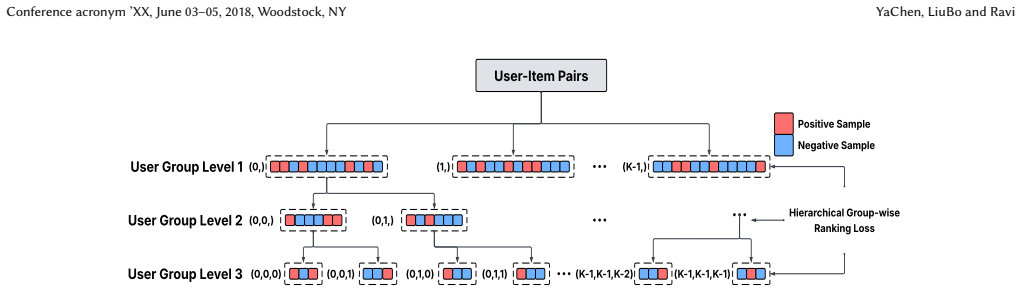
The load-bearing object is the hierarchical user code produced by L-stage residual vector quantization: each stage quantizes the residual of the previous stage against a codebook, and the sequence of code indices forms a trie. A shared prefix of length l places a user in a nested group at level l; the paper applies the Regression-Compatible Listwise Cross Entropy (ListCE) loss inside each group, replacing softmax normalization with sigmoid normalization so ranking and calibration losses agree. The ranking loss at each level is weighted by a learnable uncertainty parameter, and a straight-through estimator lets gradients flow through the non-differentiable code selection, with stop_gradient on item embeddings preventing conflicting auxiliary updates.
What would settle it
Train the same architecture but replace user-code groups with randomly assigned user groups of identical sizes at each level. If GroupCE's gains over in-batch ListCE persist under random grouping, the benefit is not similarity-based hard negatives. Alternatively, compute the expected squared gradient norm of negatives from same-prefix groups versus uniform negatives; if in-group negatives are not larger on average, the p* approximation fails.
Extended reading notes
Core claim
The central claim is that hierarchical group-wise listwise training, driven by residual vector quantization of user embeddings, approximates the variance-optimal negative sampling distribution p* proportional to squared gradient norm, and thereby improves both ranking and calibration. Users are assigned discrete code paths; at each depth, user-item pairs sharing a code prefix form one group, and a sigmoid-normalized listwise cross-entropy (ListCE) loss is applied within each group. Because users with similar codes are presumed to share content exposure and preferences, negatives drawn from their groups are claimed to be more informative than in-batch negatives. The paper reports that the full objective, combining primary logloss, an auxiliary logloss on the quantized embedding via straight-through estimator, and the hierarchical ranking loss with uncertainty-based level weighting, yields the best LogLoss, AUC, and GAUC on both datasets, and also helps cold-start users the most.
Load-bearing premise
The method assumes that users with similar quantized codes produce negative items that are genuinely harder and more informative for a given user, so that group-wise listwise loss is a faithful proxy for sampling negatives in proportion to squared gradient norms; the paper asserts this bridge without deriving or measuring it.
Editorial extensions
If this is right
- GroupCE is reported to improve LogLoss, AUC, and GAUC over in-batch listwise baselines and JRC on both datasets, so the hierarchical grouping adds ranking signal beyond a plain listwise loss.
- In the cold-start split, GroupCE shows the largest GAUC gain, indicating cluster-level priors can compensate for sparse individual user history.
- Removing either the hierarchical ranking loss or the quantized auxiliary loss hurts performance, so both jointly contribute to the reported result.
- No real-time context logging or nearest-neighbor retrieval is needed at serving time, so the method can be dropped into standard production pipelines with only RVQ added to training.
Reading between the lines
- A direct test of the paper's core premise would measure the squared gradient norms of negatives sampled from same-prefix user groups against uniformly sampled negatives; the theory predicts the former are larger.
- If the hard-negative story is right, the same trie grouping can be applied to item codes or to pre-rankers, where distinguishing similar items matters most.
- Part of the gain may come simply from enlarging the negative set per user through group normalization; ablating with random user groups of equal size would separate that effect from similarity.
- Because the method needs no serving-time changes, it can be combined with ANN-based hard-negative mining, suggesting gains may stack.
Editorial analysis
A structured set of objections, weighed in public.
Referee Report
Summary. The paper proposes a hierarchical group-wise ranking framework for CTR/CVR models. User embeddings are discretized with residual vector quantization into hierarchical codes, and listwise cross-entropy losses are applied within user groups defined by shared code prefixes at multiple depths. The motivating argument is that the variance-optimal negative sampling distribution is proportional to the squared gradient norm, and that sampling negatives from code-similar users approximates this distribution by surfacing progressively harder negatives. Experiments on KuaiRand and Taobao report consistent improvements in LogLoss, AUC, and GAUC over several baselines, including ListCE and JRC, and additional experiments address cold-start performance and loss-component ablations. The central claim is that this framework improves ranking and calibration without real-time context collection or retrieval infrastructure.
Significance. If validated, the framework would offer an inexpensive alternative to gradient-based or ANN-based hard-negative mining, with a clean formulation that combines calibration and hierarchical listwise ranking. The paper is honest about relying on public datasets and held-out evaluation, and the core RVQ-plus-listwise design is easy to reproduce from the described configuration. However, the claimed mechanism linking user-code similarity to gradient-optimal negative sampling is neither derived nor experimentally demonstrated, and the reported performance gains are small and lack uncertainty quantification. The approach is likely of interest to practitioners, but the evidence presented does not yet establish that the hierarchical semantic grouping, rather than the mere addition of a second listwise loss, is responsible for the observed gains.
major comments (4)
- [Section 4, Eq. (4), and Section 5] The theoretical result that the variance-optimal negative sampling distribution is proportional to the squared gradient norm is not connected to the proposed grouping mechanism. The paper asserts in Section 5 that negatives drawn from similar users are more informative and that deeper prefix matches yield harder negatives, but no experiment measures whether negatives from code-similar users actually have larger gradient norms, nor whether group depth increases negative hardness. A direct test would be to compare the distribution of gradient norms for negatives sampled from random groups versus code-prefix groups; without such a test, the central 'hard negative via hierarchy' claim rests on an unvalidated proxy.
- [Table 3 and Section 6.4.1] The ablation 'w/o Hierarchical Loss' removes the entire hierarchical ranking loss, so it cannot separate the contribution of semantically meaningful user grouping from the mere addition of a multi-group listwise loss or from the quantized auxiliary loss. A random-grouping control with the same group sizes, depths, and loss weights is needed. If random grouping performs as well as GroupCE, the 'similar users -> harder negatives' mechanism is not supported, and the framework reduces to adding another listwise loss plus quantization regularization.
- [Tables 1 and 2] The reported improvements are small and no measure of variance or statistical significance is provided. For example, KuaiRand GAUC improves from 0.6932 (ListCE) to 0.6953 (GroupCE) in Table 1, and cold-start GAUC improves from 0.6732 to 0.6786 in Table 2. Without multiple seeds, standard deviations, or significance tests, it is unclear whether these differences are reliable. The claim that the framework 'consistently enhances' ranking performance is stronger than the evidence supports.
- [Section 5.2, Eq. (8), and Section 4] The theoretical development in Section 4 concerns importance sampling with a sampling distribution p- and unbiased gradient scaling by 1/(N p-), but the proposed loss in Eq. (8) simply averages the ListCE over all user-item pairs in a group and does not implement importance sampling or any sampling distribution. The connection between Eq. (4) and Eq. (8) is therefore only motivational, not operational. The paper should either derive an approximation showing that grouping implements a form of implicit importance sampling, or explicitly reframe Section 4 as intuition and temper the corresponding claims.
minor comments (5)
- [Section 5, first paragraph] There is a typo: 'negatives samples' should be 'negative samples.'
- [Figure 4 and Section 6.4.2] The heatmap does not include numeric values or a colorbar, making it hard to assess the magnitude of differences across codebook size and quantization depth. The final chosen hyperparameters (codebook size K, depth L, auxiliary loss weight lambda, and uncertainty parameters sigma_l) should be reported explicitly.
- [Section 6.3] The cold-start stratification defines cold as at most 20 impressions and warm as 20-50 impressions, but users with more than 50 impressions are not described. Clarify whether they are excluded from the analysis or assigned to a third group.
- [Section 2.1 and Section 6.2] The related work discusses both JRC [13] and SBCR [18], but only JRC appears in the experiments. If SBCR cannot be evaluated on these public datasets, state this explicitly or remove it from the comparison narrative.
- [Section 4.2, Eq. (3)] The variance operator V_P-(g) is used without definition. Define it as the covariance or variance of the importance-weighted gradient under the sampling distribution P-.
Circularity Check
No circularity: the gradient-sampling theory is external and the empirical claims are tested on held-out data; the similar-user bridge is an unverified assumption, not a circular reduction.
full rationale
The paper's derivation chain is not circular. Section 4.2's optimal sampling result (Eq. 4) is imported from external variance-reduction work [4,5] and is not re-derived from the paper's own outputs. The proposed method does not fit any parameter to the target metrics; the RVQ codebooks and uncertainty weights are learned from training data, and all reported LogLoss/AUC/GAUC numbers are on held-out test splits (Section 6.1.1). The claim that similar-user groups approximate the gradient-optimal distribution is an untested assumption, not a definitional equivalence: no equation identifies group depth with squared gradient norm, and no fitted constant is renamed as a prediction. The ablation in Table 3 removes the entire hierarchical loss, so it does not isolate the grouping mechanism, but that is an experimental-validity concern, not circularity. There are no load-bearing self-citations: references [2,4,5,6] are external, and the framework is benchmarked against external baselines on KuaiRand and Taobao. The central claims are therefore self-contained and independently testable, yielding a circularity score of 0.
Assumptions & free parameters
free parameters (5)
- codebook_size_K =
grid searched over 4-32; best not reported
- quantization_depth_L =
grid searched over 1-4; best not reported
- auxiliary_loss_weight_lambda =
not reported
- level_uncertainty_sigma_l =
learned during training
- EMA_decay_and_code_replacement_threshold =
not reported
assumptions (5)
- standard math Optimal negative sampling is proportional to squared gradient norm (Eq 4)
- standard math Sigmoid-based ListCE has global minima aligned with binary classification labels
- ad hoc to paper Users with similar profiles and behaviors yield more informative negative comparisons
- domain assumption RVQ codebook distance defines meaningful user similarity
- domain assumption Group-wise normalization of labels across users is a valid training signal
invented entities (2)
-
Hierarchical user codes (trie-structured user groups)
-
Quantized user embedding e_q with straight-through estimator
Cite this review
Pith. "Pith review of Hierarchical Group-wise Ranking Framework for Recommendation Models." pith.science (2026). https://pith.science/paper/RXPX2MSC
@misc{pith2026250612756,
  author       = {Pith},
  title        = {Pith review of: Hierarchical Group-wise Ranking Framework for Recommendation Models},
  year         = {2026},
  howpublished = {\url{https://pith.science/paper/RXPX2MSC}},
  note         = {Machine review of arXiv:2506.12756}
}
read the original abstract
In modern recommender systems, CTR/CVR models are increasingly trained with ranking objectives to improve item ranking quality. While this shift aligns training more closely with serving goals, most existing methods rely on in-batch negative sampling, which predominantly surfaces easy negatives. This limits the model's ability to capture fine-grained user preferences and weakens overall ranking performance. To address this, we propose a Hierarchical Group-wise Ranking Framework with two key components. First, we apply residual vector quantization to user embeddings to generate hierarchical user codes that partition users into hierarchical, trie-structured clusters. Second, we apply listwise ranking losses to user-item pairs at each level of the hierarchy, where shallow levels group loosely similar users and deeper levels group highly similar users, reinforcing learning-to-rank signals through progressively harder negatives. Since users with similar preferences and content exposure tend to yield more informative negatives, applying ranking losses within these hierarchical user groups serves as an effective approximation of hard negative mining. Our approach improves ranking performance without requiring complex real-time context collection or retrieval infrastructure. Extensive experiments demonstrate that the proposed framework consistently enhances both model calibration and ranking accuracy, offering a scalable and practical solution for industrial recommender systems.
Figures


Figures from the paper (1 more)

Reference graph
Works this paper leans on
-
[1]
Martín Abadi, Paul Barham, Jianmin Chen, Zhifeng Chen, Andy Davis, Jeffrey Dean, Matthieu Devin, Sanjay Ghemawat, Geoffrey Irving, Michael Isard, et al
-
[2]
Aijun Bai, Rolf Jagerman, Zhen Qin, Le Yan, Pratyush Kar, Bing-Rong Lin, Xuan- hui Wang, Michael Bendersky, and Marc Najork. 2023. Regression compatible listwise objectives for calibrated ranking with binary relevance. In Proceedings of the 32nd ACM International Conference on Information and Knowledge Manage- ment. 4502–4508
work page 2023
-
[3]
Xingyan Bin, Jianfei Cui, Wujie Yan, Zhichen Zhao, Xintian Han, Chongyang Yan, Feng Zhang, Xun Zhou, Qi Wu, and Zuotao Liu. 2025. Real-time Indexing for Large-scale Recommendation by Streaming Vector Quantization Retriever. arXiv preprint arXiv:2501.08695 (2025)
arXiv 2025
-
[4]
Tyler B Johnson and Carlos Guestrin. 2018. Training deep models faster with robust, approximate importance sampling. Advances in Neural Information Pro- cessing Systems 31 (2018)
work page 2018
-
[5]
Angelos Katharopoulos and François Fleuret. 2018. Not all samples are created equal: Deep learning with importance sampling. In International conference on machine learning. PMLR, 2525–2534
work page 2018
-
[6]
Alex Kendall, Yarin Gal, and Roberto Cipolla. 2018. Multi-task learning using uncertainty to weigh losses for scene geometry and semantics. In Proceedings of the IEEE conference on computer vision and pattern recognition . 7482–7491
work page 2018
-
[7]
Doyup Lee, Chiheon Kim, Saehoon Kim, Minsu Cho, and Wook-Shin Han. 2022. Autoregressive image generation using residual quantization. InProceedings of the IEEE/CVF Conference on Computer Vision and Pattern Recognition . 11523–11532
2022
-
[8]
Cheng Li, Yue Lu, Qiaozhu Mei, Dong Wang, and Sandeep Pandey. 2015. Click- through prediction for advertising in twitter timeline. In Proceedings of the 21th ACM SIGKDD International Conference on Knowledge Discovery and Data Mining . 1959–1968
work page 2015
Show all 20 references
-
[9]
Zhutian Lin, Junwei Pan, Shangyu Zhang, Ximei Wang, Xi Xiao, Shudong Huang, Lei Xiao, and Jie Jiang. 2024. Understanding the Ranking Loss for Recommen- dation with Sparse User Feedback. In Proceedings of the 30th ACM SIGKDD Conference on Knowledge Discovery and Data Mining . 5409–5418
2024
-
[10]
Qijiong Liu, Xiaoyu Dong, Jiaren Xiao, Nuo Chen, Hengchang Hu, Jieming Zhu, Chenxu Zhu, Tetsuya Sakai, and Xiao-Ming Wu. 2024. Vector quantization for recommender systems: a review and outlook. arXiv preprint arXiv:2405.03110 (2024)
2024 arXiv
-
[11]
Ilya Loshchilov and Frank Hutter. 2017. Decoupled weight decay regularization. arXiv preprint arXiv:1711.05101 (2017)
2017 arXiv
-
[12]
Shashank Rajput, Nikhil Mehta, Anima Singh, Raghunandan Hulikal Keshavan, Trung Vu, Lukasz Heldt, Lichan Hong, Yi Tay, Vinh Tran, Jonah Samost, et al
-
[13]
Xiang-Rong Sheng, Jingyue Gao, Yueyao Cheng, Siran Yang, Shuguang Han, Hongbo Deng, Yuning Jiang, Jian Xu, and Bo Zheng. 2023. Joint optimization of ranking and calibration with contextualized hybrid model. In Proceedings of the 29th ACM SIGKDD Conference on Knowledge Discover...
2023
-
[14]
Aaron Van Den Oord, Oriol Vinyals, et al. 2017. Neural discrete representation learning. Advances in neural information processing systems 30 (2017)
2017
-
[15]
Lee Xiong, Chenyan Xiong, Ye Li, Kwok-Fung Tang, Jialin Liu, Paul Bennett, Junaid Ahmed, and Arnold Overwijk. 2020. Approximate nearest neighbor nega- tive contrastive learning for dense text retrieval. arXiv preprint arXiv:2007.00808 (2020)
2020 arXiv
-
[16]
Le Yan, Zhen Qin, Xuanhui Wang, Michael Bendersky, and Marc Najork. 2022. Scale calibration of deep ranking models. In Proceedings of the 28th ACM SIGKDD Conference on Knowledge Discovery and Data Mining . 4300–4309
2022
-
[17]
Neil Zeghidour, Alejandro Luebs, Ahmed Omran, Jan Skoglund, and Marco Tagliasacchi. 2021. Soundstream: An end-to-end neural audio codec. IEEE/ACM Transactions on Audio, Speech, and Language Processing 30 (2021), 495–507
2021
-
[18]
Shunyu Zhang, Hu Liu, Wentian Bao, Enyun Yu, and Yang Song. 2024. A Self- boosted Framework for Calibrated Ranking. In Proceedings of the 30th ACM SIGKDD Conference on Knowledge Discovery and Data Mining . 6226–6235
2024
-
[2016]
In 12th USENIX symposium on operating systems design and implementation (OSDI 16)
{TensorFlow}: a system for {Large-Scale} machine learning. In 12th USENIX symposium on operating systems design and implementation (OSDI 16) . 265–283
-
[2023]
Advances in Neural Information Processing Systems 36 (2023), 10299–10315
Recommender systems with generative retrieval. Advances in Neural Information Processing Systems 36 (2023), 10299–10315
2023
Reviewed August 7, 2026 · model on record in the stance chip above.
Discussion (0). Continue with ORCID to comment.