REVIEW 3 major objections 5 minor 33 references
AttentionDrag: Exploiting Latent Correlation Knowledge in Pre-trained Diffusion Models for Image Editing
T0 review · 3 major / 5 minor · reviewed 2026-08-07 · deepseek-v4-flash
Pith's one-line read AttentionDrag performs one-step, training-free drag editing by reusing the self-attention maps a pre-trained diffusion model already computes during DDIM inversion.
desk verdict A genuine one-step drag editing recipe built on self-attention maps from DDIM inversion, but Eq. 13's interpolation is misdescribed and the SOTA claim in the text is contradicted by Table 1. read the letter →
The pith
A machine-rendered reading of the paper's core claim, the machinery that carries it, and where it could break.
The reading
What carries the argument
The load-bearing object is the self-attention map of the U-Net (the denoising network of the latent diffusion model) at the user-specified handle point, averaged over the DDIM inversion steps. Formally, for handle point $(x_0, y_0)$ and any other position $(x_i, y_j)$, the score $A_t[x_0, y_0, x_i, y_j]$ is the softmax-normalized dot product of the query vector at the handle with the key vector at that position, and the aggregated map $\mathrm{AttentionMap}[x_i, y_j]$ is its mean over a set of inversion time steps. This single map carries the whole method: it weights the movement vector at each position (Eq. 6), it is thresholded into the binary editing mask (Eq. 12), and it provides the interpolation weights that fill the blank regions left after the latent values are moved (Eq. 13). The actual edit is one latent remapping $z'[x_i+\Delta x_i, y_j+\Delta y_j] = z[x_i, y_j]$ restricted to the mask, followed by one DDIM sampling step to obtain the output image.
What would settle it
Take an image where the method works, record the attention map from the original DDIM inversion, then run the edit and record the attention map at the same handle point on the edited latent after one sampling step; if the two maps disagree enough that the movement vector no longer points toward the target region, the single-update assumption behind the method is falsified for that case.
Extended reading notes
Core claim
The central claim is that the latent correlation knowledge embedded in the self-attention mechanism of a pre-trained diffusion model's U-Net can be reused as a complete drag-editing controller. During DDIM inversion of the input image, the attention map at the handle point (the softmax-normalized query–key dot products between the handle and all other positions) is aggregated over time steps and then drives every stage of the edit: Eq. 6 scales each position's movement vector by its attention score, Eq. 12 thresholds the same map into an automatic binary mask, and Eq. 13 uses the same map as interpolation weights to fill the holes left by moving latent values. The edited latent is produced by one application of the movement rule $z'[x_i+\Delta x_i, y_j+\Delta y_j] = z[x_i, y_j]$ inside the mask, followed by a single DDIM sampling step. Because no loss, gradient, or optimization loop is involved, the method is training-free and one-step. The paper argues that this attention-driven procedure outperforms the one-step geometry-based approach FastDrag on drag precision while matching its speed, and that it remains competitive with iterative latent-optimization methods.
Load-bearing premise
The load-bearing premise is that the self-attention map measured at the handle point on the original noisy latents still describes the correct semantic correspondences after those latents are moved and after one DDIM sampling step; the paper relies on this transfer without proving or statistically testing it.
Editorial extensions
If this is right
- Drag-based edits become a single latent remapping plus one sampling step, which puts interactive editing within reach of real-time tools.
- No per-image fine-tuning, LoRA preparation, or user-supplied mask is needed, because the attention map supplies both the movement field and the editable region.
- The same attention-weighted interpolation makes the pipeline applicable to inpainting when only a mask is given, extending the method beyond point dragging.
- Because the edit is driven by semantic correlation rather than geometry, the paper argues it preserves scene coherence better than one-step geometric transforms such as FastDrag.
- On the reported DragBench evaluation, per-point editing time drops to about 5.5 seconds, comparable to the fastest one-step baseline while improving drag precision.
Reading between the lines
- Editorial inference: the same recipe should transfer to other attention-equipped diffusion backbones, such as video or higher-resolution models, since the attention maps are computed during inversion in any such model; the paper only demonstrates the latent-diffusion setting.
- Editorial inference: the mask threshold $\tau$ is a free parameter tuned on DragBench; a per-image adaptive rule based on attention-map statistics would be a natural, testable improvement.
- Editorial inference: if the attention map is a reliable semantic-correspondence prior, it could also serve as a predictor of edit difficulty, since a diffuse or multi-peaked attention map at the handle point signals ambiguous correspondence and should flag likely failures.
- Editorial inference: combining this attention-based movement with text-prompt editing could yield simultaneous semantic and geometric edits at one-step cost, because the attention maps are already available during inversion.
Editorial analysis
A structured set of objections, weighed in public.
Referee Report
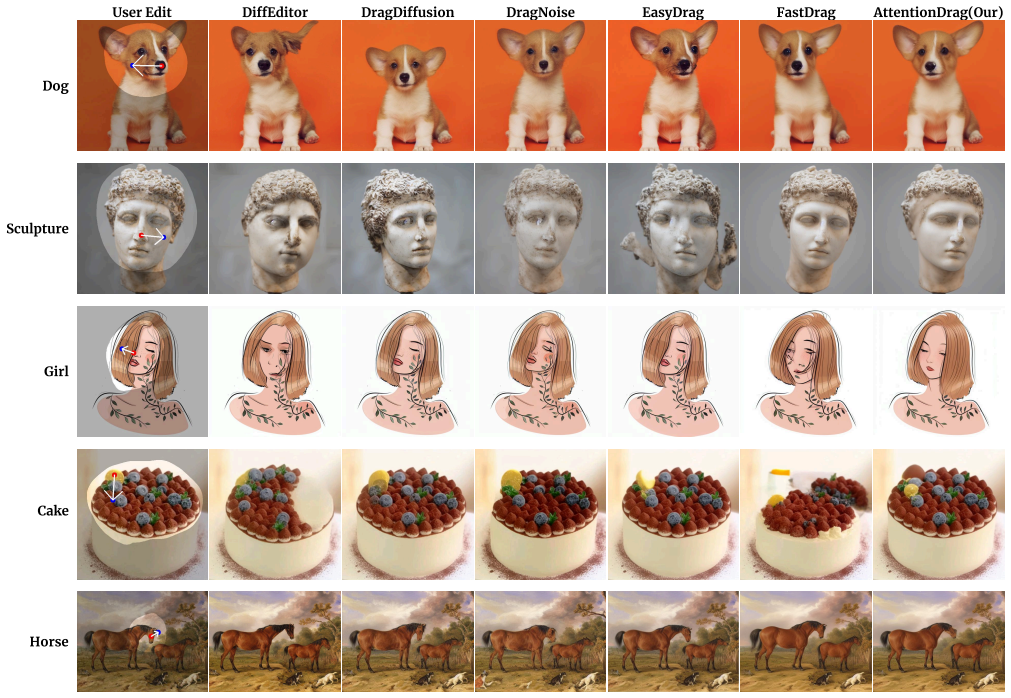
Summary. The paper proposes AttentionDrag, a one-step, training-free point-based image editing method built on Stable Diffusion. The core idea is to reuse self-attention maps from the U-Net during DDIM inversion: an attention map anchored at the user's handle point is used to (i) compute movement vectors for latent positions, (ii) generate an editing mask automatically, and (iii) fill blank regions left by the move via attention-weighted interpolation. The authors report qualitative comparisons and DragBench-based quantitative results, claiming state-of-the-art performance with much lower editing time than iterative methods.
Significance. If the central claims hold, the method would be a practically useful simplification: it removes iterative latent optimization and gives users a mask-free, one-step drag interface. The paper releases code, which is a concrete asset for verification, and the idea of reusing pre-trained self-attention correlations for editing is worth exploring. However, the current manuscript does not yet establish the core mechanism rigorously: the interpolation step as written is not semantically grounded, the attention-transfer assumption is not validated, and the headline quantitative comparison is weakened by tuning the mask threshold on the same benchmark used for the final scores. The claimed state-of-the-art status is also contradicted by the paper's own Table 1.
major comments (3)
- [Sec. 3.4, Eq. (13)] The interpolation formula as written does not use the blank cell's own semantic relationships. By Eq. (10), AttentionMap[x_n, y_m] = A_t[x0, y0, x_n, y_m], i.e., the attention of the handle point to the source cell, not the attention of the blank cell (x_i, y_j) to the source cell. Therefore Eq. (13) applies the same source-weighting vector to every blank cell, and the interpolated value differs between blank cells only because z' differs, not because each blank region 'has' a semantic relationship to its surroundings. This contradicts the text in Sec. 3.4, and the ablation in Table 2 credits SBI for fidelity. Either the code implements a different interpolation that the paper should derive, or the claimed semantic-based interpolation mechanism is misdescribed. The paper should also state whether the sum is normalized and how blank positions in z' are treated.
- [Sec. 4.3 and Sec. 4.4, Table 1 and Fig. 8] The evaluation is partly circular and the reported SOTA claim is not supported. The threshold tau is tuned by running the method on DragBench and optimizing MD and 1-LPIPS (Fig. 8, Sec. 4.4), and the same DragBench results are then reported in Table 1 as the headline comparison. This makes the reported advantage a fitted result rather than an independent validation; the authors should report held-out performance or describe the selection procedure separately. In addition, the sentence in Sec. 4.3 that AttentionDrag 'reaches state-of-the-art (SOTA) performance in both LPIPS and MD' is contradicted by Table 1: GoodDrag has lower MD (22.96 vs. 29.66), and DragDiffusion and DiffEditor have higher 1-LPIPS (0.89 vs. 0.87). The text should be corrected to match the table.
- [Sec. 3.2, Eqs. (6), (9), and Sec. 3.4, Eq. (13)] The load-bearing premise that attention maps measured during DDIM inversion remain valid for the edited latent is not validated. After the latent values are moved according to Eq. (9) and after one DDIM sampling step, the self-attention correlations of the original noisy latent are used without re-querying or updating them. The paper provides only a few qualitative examples and does not test whether, e.g., the handle-point attention map still corresponds to the semantic region after the move. A simple quantitative check would be to compare the proposed one-step procedure with a variant that re-computes attention maps from the edited latent, or to report success rates and error bars over DragBench rather than aggregate MD/LPIPS alone.
minor comments (5)
- [Sec. 4.1] The sentence 'the latent diffusion optimization is performed at the 5th step' is ambiguous; it should specify whether this is the DDIM step index used for editing, and the effect of this choice should either be ablated or justified, since it is a free parameter not covered by Fig. 8.
- [Table 1] The time columns are formatted inconsistently: the preparation and editing times are not clearly separated for each method, and the preparation time for the proposed method is not reported in the same way as for the LORA-based baselines.
- [Sec. 4.4, Fig. 8] The text says Image Fidelity improves with tau and 'reaching its peak at 2.1, reflecting worse semantic preservation'; since 1-LPIPS is higher-is-better, a higher value should not be described as reflecting worse preservation. The sentence should be reworded.
- [Sec. 4.2] The note about the EasyDrag horse image — 'the image of the edited horse comes from the result after removing the blue dot from the image in the paper' — is not a reproducible evaluation procedure and should be replaced by a proper rerun or removed.
- [Sec. 4.1 and References] The paper cites [Manukyan et al., 2023] for Stable Diffusion 1.5; the appropriate attribution is the original Stable Diffusion / Latent Diffusion Model work, e.g. Rombach et al., 2022.
Circularity Check
Headline benchmark numbers are partly fitted via τ selection on DragBench, and the SBI interpolation as written reduces blank-region semantics to the handle-point attention map.
-
fitted input called prediction
[Section 4.4 (The value of τ) and Section 4.3, Table 1]
"We set τ to be tan = 1.8,1.9,2.0,2.1 and run our approach on DragBench dataset to get the editing results. The outcomes are as- sessed with IF and MD, and are shown in Fig. 8. As τ increases from 1.8 to 2.0, the Mean Distance decreases and then increases slightly at τ=2.1, indicating an optimal balance at τ=2.0."
The threshold τ is explicitly tuned to optimize MD and 1-LPIPS on the DragBench dataset. Table 1 then reports exactly the DragBench MD and 1-LPIPS values arising from this tuned choice as the headline comparison ('Ours 29.66 0.87'). Thus the reported quantitative advantage is not an independent prediction of the method on the benchmark; it is partly a fitted result, because the parameter was selected using the same benchmark metrics that are later presented as evidence.
-
self definitional
[Section 3.4, Eqs. 4, 10, and 13]
"For each blank region (x_i,y_j), its attention score with respect to other region (x_n,y_m) is AttentionMap[x_n,y_m] ... \hat z[x_i,y_j] = Σ_{x_n,y_m} AttentionMap[x_n,y_m] · z'[x_n,y_m]."
Eq. 4 defines AttentionMap[x_i,y_j] as A_t[x0,y0,x_i,y_j], i.e. the handle point's attention. Eq. 13 then uses AttentionMap[x_n,y_m] as the weight for every blank cell, so the interpolation weight is independent of the blank destination (x_i,y_j). The paper's claim that SBI uses 'semantic relationships between the blank regions and their surroundings' therefore reduces by construction to a handle-centered weighting: the blank cell's own query is never used, and every blank cell receives the same weighted aggregate of z'. The mechanism as written is not a per-blank semantic interpolation.
full rationale
The core pipeline is mostly a constructive design rather than a fitted prediction: movement vectors (Eq. 6), masks (Eq. 12), and latent updates (Eq. 9) use the attention map as a hand-defined control signal, and no self-citation chain is load-bearing. However, two issues raise the circularity burden. First, the mask threshold τ is selected by optimizing MD and 1-LPIPS on DragBench (Section 4.4), and the same DragBench metrics are then reported as the headline results in Table 1, making the reported advantage partly a fitted outcome. Second, Semantic-based Interpolation as written in Eq. 13 uses AttentionMap[x_n,y_m], which by Eq. 4 is the handle point's attention, not the blank region's own attention; the claimed per-blank semantic reconstruction is therefore definitionally tied to the handle point, and every blank cell gets the same handle-weighted aggregate. This is a definitional gap in a core component rather than a hidden statistical fit, so the overall score is moderate rather than maximal. The released code could resolve whether an undocumented per-blank query is used, but the paper text as presented does not support the claimed mechanism.
Assumptions & free parameters
free parameters (3)
- tau (mask threshold) =
2.0
- Number of inversion and sampling steps N =
10
- Editing step index =
5th step
assumptions (4)
- domain assumption Self-attention scores computed during DDIM inversion encode semantic relationships between image regions.
- domain assumption Moving latent values by attention-weighted displacement in z_T produces a valid edit after one DDIM sampling step.
- domain assumption Latent-space Euclidean displacement corresponds to pixel-space drag direction.
- domain assumption LCM-distilled weights preserve the attention semantics needed for editing.
Cite this review
Pith. "Pith review of AttentionDrag: Exploiting Latent Correlation Knowledge in Pre-trained Diffusion Models for Image Editing." pith.science (2026). https://pith.science/paper/ZOFF3KP3
@misc{pith2026250613301,
  author       = {Pith},
  title        = {Pith review of: AttentionDrag: Exploiting Latent Correlation Knowledge in Pre-trained Diffusion Models for Image Editing},
  year         = {2026},
  howpublished = {\url{https://pith.science/paper/ZOFF3KP3}},
  note         = {Machine review of arXiv:2506.13301}
}
read the original abstract
Traditional point-based image editing methods rely on iterative latent optimization or geometric transformations, which are either inefficient in their processing or fail to capture the semantic relationships within the image. These methods often overlook the powerful yet underutilized image editing capabilities inherent in pre-trained diffusion models. In this work, we propose a novel one-step point-based image editing method, named AttentionDrag, which leverages the inherent latent knowledge and feature correlations within pre-trained diffusion models for image editing tasks. This framework enables semantic consistency and high-quality manipulation without the need for extensive re-optimization or retraining. Specifically, we reutilize the latent correlations knowledge learned by the self-attention mechanism in the U-Net module during the DDIM inversion process to automatically identify and adjust relevant image regions, ensuring semantic validity and consistency. Additionally, AttentionDrag adaptively generates masks to guide the editing process, enabling precise and context-aware modifications with friendly interaction. Our results demonstrate a performance that surpasses most state-of-the-art methods with significantly faster speeds, showing a more efficient and semantically coherent solution for point-based image editing tasks.
Figures


Figures from the paper (5 more)


Reference graph
Works this paper leans on
-
[1]
Instructpix2pix: Learning to follow im- age editing instructions
[Brookset al., 2023 ] Tim Brooks, Aleksander Holynski, and Alexei A Efros. Instructpix2pix: Learning to follow im- age editing instructions. InProceedings of the IEEE/CVF Conference on Computer Vision and Pattern Recognition, pages 18392–18402,
work page 2023
-
[3]
[Chenet al., 2024 ] Shi Chen, Lefei Zhang, and Liangpei Zhang. Cross-scope spatial-spectral information aggrega- tion for hyperspectral image super-resolution.IEEE Trans. Image Process., 33:5878–5891,
work page 2024
-
[6]
DragText: Rethinking Text Embedding in Point-based Image Editing
[Choiet al., 2024 ] Gayoon Choi, Taejin Jeong, Sujung Hong, Jaehoon Joo, and Seong Jae Hwang. Dragtext: Rethinking text embedding in point-based image editing. arXiv preprint arXiv:2407.17843,
work page Pith review arXiv 2024
-
[7]
StableDrag: Stable Dragging for Point-based Image Editing
[Cuiet al., 2024 ] Yutao Cui, Xiaotong Zhao, Guozhen Zhang, Shengming Cao, Kai Ma, and Limin Wang. Stable- drag: Stable dragging for point-based image editing.arXiv preprint arXiv:2403.04437,
work page Pith review arXiv 2024
-
[8]
[Dhariwal and Nichol, 2021] Prafulla Dhariwal and Alexan- der Nichol. Diffusion models beat gans on image synthe- sis.Advances in Neural Information Processing Systems, 34:8780–8794,
work page 2021
-
[10]
Instruct- diffusion: A generalist modeling interface for vision tasks
[Genget al., 2024 ] Zigang Geng, Binxin Yang, Tiankai Hang, Chen Li, Shuyang Gu, Ting Zhang, Jianmin Bao, Zheng Zhang, Houqiang Li, Han Hu, et al. Instruct- diffusion: A generalist modeling interface for vision tasks. InProceedings of the IEEE/CVF Conference on Computer Vision and Pattern Recognition, pages 12709– 12720,
work page 2024
-
[11]
Prompt-to-prompt image editing with cross attention con- trol.arXiv preprint arXiv:2208.01626,
[Hertzet al., 2022 ] Amir Hertz, Ron Mokady, Jay Tenen- baum, Kfir Aberman, Yael Pritch, and Daniel Cohen-Or. Prompt-to-prompt image editing with cross attention con- trol.arXiv preprint arXiv:2208.01626,
arXiv 2022
-
[13]
[Hoet al., 2020 ] Jonathan Ho, Ajay Jain, and Pieter Abbeel. Denoising diffusion probabilistic models.Advances in Neural Information Processing Systems, 33:6840–6851,
work page 2020
Show all 33 references
-
[15]
Direct inversion: Boosting diffusion-based editing with 3 lines of code.arXiv preprint arXiv:2310.01506,
[Juet al., 2023 ] Xuan Ju, Ailing Zeng, Yuxuan Bian, Shaoteng Liu, and Qiang Xu. Direct inversion: Boosting diffusion-based editing with 3 lines of code.arXiv preprint arXiv:2310.01506,
2023 arXiv
-
[16]
Imagic: Text-based real image editing with diffusion models
[Kawaret al., 2023 ] Bahjat Kawar, Shiran Zada, Oran Lang, Omer Tov, Huiwen Chang, Tali Dekel, Inbar Mosseri, and Michal Irani. Imagic: Text-based real image editing with diffusion models. InProceedings of the IEEE/CVF Conference on Computer Vision and Pattern Recognition, pag...
2023
-
[17]
Diffusionclip: Text-guided diffusion mod- els for robust image manipulation
[Kimet al., 2022 ] Gwanghyun Kim, Taesung Kwon, and Jong Chul Ye. Diffusionclip: Text-guided diffusion mod- els for robust image manipulation. InProceedings of the IEEE/CVF Conference on Computer Vision and Pattern Recognition, pages 2426–2435,
2022
-
[18]
Freedrag: Point tracking is not you need for interactive point-based image editing.arXiv preprint arXiv:2307.04684,
[Linget al., 2023 ] Pengyang Ling, Lin Chen, Pan Zhang, Huaian Chen, and Yi Jin. Freedrag: Point tracking is not you need for interactive point-based image editing.arXiv preprint arXiv:2307.04684,
2023 arXiv
-
[19]
Hd-painter: high- resolution and prompt-faithful text-guided image inpainting with diffusion models.arXiv preprint arXiv:2312.14091,
[Manukyanet al., 2023 ] Hayk Manukyan, Andranik Sargsyan, Barsegh Atanyan, Zhangyang Wang, Shant Navasardyan, and Humphrey Shi. Hd-painter: high- resolution and prompt-faithful text-guided image inpainting with diffusion models.arXiv preprint arXiv:2312.14091,
2023 arXiv
-
[20]
Null-text inver- sion for editing real images using guided diffusion models
[Mokadyet al., 2023 ] Ron Mokady, Amir Hertz, Kfir Aber- man, Yael Pritch, and Daniel Cohen-Or. Null-text inver- sion for editing real images using guided diffusion models. InProceedings of the IEEE/CVF Conference on Computer Vision and Pattern Recognition, pages 6038–6047,
2023
-
[21]
Dragondiffusion: En- abling drag-style manipulation on diffusion models.arXiv preprint arXiv:2307.02421,
[Mouet al., 2023 ] Chong Mou, Xintao Wang, Jiechong Song, Ying Shan, and Jian Zhang. Dragondiffusion: En- abling drag-style manipulation on diffusion models.arXiv preprint arXiv:2307.02421,
2023 arXiv
-
[22]
Diffeditor: Boosting accuracy and flexibility on diffusion-based image editing
[Mouet al., 2024 ] Chong Mou, Xintao Wang, Jiechong Song, Ying Shan, and Jian Zhang. Diffeditor: Boosting accuracy and flexibility on diffusion-based image editing. InProceedings of the IEEE/CVF Conference on Computer Vision and Pattern Recognition, pages 8488–8497,
2024
-
[23]
Drag your gan: Interactive point-based manip- ulation on the generative image manifold
[Panet al., 2023 ] Xingang Pan, Ayush Tewari, Thomas Leimk¨uhler, Lingjie Liu, Abhimitra Meka, and Christian Theobalt. Drag your gan: Interactive point-based manip- ulation on the generative image manifold. InACM SIG- GRAPH 2023 Conference Proceedings, pages 1–11,
2023
-
[24]
High-resolution image synthesis with latent diffusion models
[Rombachet al., 2022 ] Robin Rombach, Andreas Blattmann, Dominik Lorenz, Patrick Esser, and Bj ¨orn Ommer. High-resolution image synthesis with latent diffusion models. InProceedings of the IEEE/CVF conference on computer vision and pattern recognition, pages 10684–10695,
2022
-
[25]
U-net: Convolutional net- works for biomedical image segmentation.CoRR, abs/1505.04597,
[Ronnebergeret al., 2015 ] Olaf Ronneberger, Philipp Fis- cher, and Thomas Brox. U-net: Convolutional net- works for biomedical image segmentation.CoRR, abs/1505.04597,
2015 arXiv
-
[27]
Denoising diffusion implicit models.arXiv preprint arXiv:2010.02502,
[Songet al., 2020 ] Jiaming Song, Chenlin Meng, and Ste- fano Ermon. Denoising diffusion implicit models.arXiv preprint arXiv:2010.02502,
2020 arXiv
-
[28]
Plug-and-play diffusion fea- tures for text-driven image-to-image translation
[Tumanyanet al., 2023 ] Narek Tumanyan, Michal Geyer, Shai Bagon, and Tali Dekel. Plug-and-play diffusion fea- tures for text-driven image-to-image translation. InPro- ceedings of the IEEE/CVF Conference on Computer Vision and Pattern Recognition, pages 1921–1930,
2023
-
[29]
Inversion-free image editing with natural language.arXiv preprint arXiv:2312.04965,
[Xuet al., 2023 ] Sihan Xu, Yidong Huang, Jiayi Pan, Ziqiao Ma, and Joyce Chai. Inversion-free image editing with natural language.arXiv preprint arXiv:2312.04965,
2023 arXiv
-
[30]
Inst- inpaint: Instructing to remove objects with diffusion mod- els.arXiv preprint arXiv:2304.03246,
[Yildirimet al., 2023 ] Ahmet Burak Yildirim, Vedat Baday, Erkut Erdem, Aykut Erdem, and Aysegul Dundar. Inst- inpaint: Instructing to remove objects with diffusion mod- els.arXiv preprint arXiv:2304.03246,
2023 arXiv
-
[31]
The unreasonable effectiveness of deep features as a perceptual metric
[Zhanget al., 2018 ] Richard Zhang, Phillip Isola, Alexei A Efros, Eli Shechtman, and Oliver Wang. The unreasonable effectiveness of deep features as a perceptual metric. In Proceedings of the IEEE Conference on Computer Vision and Pattern Recognition, pages 586–595,
2018
-
[33]
Fastdrag: Manipulate anything in one step.arXiv preprint arXiv:2405.15769, 2024
[Zhaoet al., 2024 ] Xuanjia Zhao, Jian Guan, Congyi Fan, Dongli Xu, Youtian Lin, Haiwei Pan, and Pengming Feng. Fastdrag: Manipulate anything in one step.arXiv preprint arXiv:2405.15769, 2024
2024 arXiv
-
[2015]
Dragdiffusion: Harnessing diffusion mod- els for interactive point-based image editing
[Shiet al., 2024 ] Yujun Shi, Chuhui Xue, Jun Hao Liew, Ji- achun Pan, Hanshu Yan, Wenqing Zhang, Vincent YF Tan, and Song Bai. Dragdiffusion: Harnessing diffusion mod- els for interactive point-based image editing. InProceed- ings of the IEEE/CVF Conference on Computer Vision...
2024
-
[2018]
Gooddrag: Towards good practices for drag editing with diffusion models.arXiv preprint arXiv:2404.07206,
[Zhanget al., 2024 ] Zewei Zhang, Huan Liu, Jun Chen, and Xiangyu Xu. Gooddrag: Towards good practices for drag editing with diffusion models.arXiv preprint arXiv:2404.07206,
2024 arXiv
-
[2020]
Easydrag: Effi- cient point-based manipulation on diffusion models
[Houet al., 2024 ] Xingzhong Hou, Boxiao Liu, Yi Zhang, Jihao Liu, Yu Liu, and Haihang You. Easydrag: Effi- cient point-based manipulation on diffusion models. In Proceedings of the IEEE/CVF Conference on Computer Vision and Pattern Recognition, pages 8404–8413,
2024
-
[2021]
Diffusion self- guidance for controllable image generation.Advances in Neural Information Processing Systems, 36:16222–16239,
[Epsteinet al., 2023 ] Dave Epstein, Allan Jabri, Ben Poole, Alexei Efros, and Aleksander Holynski. Diffusion self- guidance for controllable image generation.Advances in Neural Information Processing Systems, 36:16222–16239,
2023
-
[2022]
Classifier-free diffusion guidance.arXiv preprint arXiv:2207.12598,
[Ho and Salimans, 2022] Jonathan Ho and Tim Salimans. Classifier-free diffusion guidance.arXiv preprint arXiv:2207.12598,
2022 arXiv
-
[2023]
Mas- actrl: Tuning-free mutual self-attention control for consis- tent image synthesis and editing
[Caoet al., 2023 ] Mingdeng Cao, Xintao Wang, Zhongang Qi, Ying Shan, Xiaohu Qie, and Yinqiang Zheng. Mas- actrl: Tuning-free mutual self-attention control for consis- tent image synthesis and editing. InProceedings of the IEEE/CVF International Conference on Computer Vision, ...
2023
-
[2024]
Cyclic cross-modality interaction for hyperspec- tral and multispectral image fusion.IEEE Transactions on Circuits and Systems for Video Technology, 35(1):741– 753,
[Chenet al., 2025 ] Shi Chen, Lefei Zhang, and Liangpei Zhang. Cyclic cross-modality interaction for hyperspec- tral and multispectral image fusion.IEEE Transactions on Circuits and Systems for Video Technology, 35(1):741– 753,
2025
-
[2025]
Noise map guidance: Inversion with spatial context for real image editing.arXiv preprint arXiv:2402.04625,
[Choet al., 2024 ] Hansam Cho, Jonghyun Lee, Seoung Bum Kim, Tae-Hyun Oh, and Yonghyun Jeong. Noise map guidance: Inversion with spatial context for real image editing.arXiv preprint arXiv:2402.04625,
2024 arXiv
Reviewed August 7, 2026 · model on record in the stance chip above.
Discussion (0). Sign in to comment.