REVIEW 3 major objections 6 minor 1 cited by
Multiview Geometric Regularization of Gaussian Splatting for Accurate Radiance Fields
T0 review · 3 major / 6 minor · reviewed 2026-08-15 · deepseek-v4-flash
Pith's one-line read Gaussian Splatting surfaces become markedly more accurate when MVS depth priors guide both initialization and a multiview median-depth loss.
desk verdict A well-ablated, honest methods paper that shows real geometry gains from MVS-guided regularization of Gaussian Splatting, with the main caveat that the MVS-bias failure mode is untested. read the letter →
The pith
A machine-rendered reading of the paper's core claim, the machinery that carries it, and where it could break.
The reading
What carries the argument
The load-bearing component is the multiview median-depth relative loss $L_{\mathrm{rel}} = \lvert 1 - D_{\mathrm{mvs}}/D_r \rvert \cdot U \cdot \mathbb{1}(\lvert D_r - D_{\mathrm{mvs}}\rvert < s D_r)$, where $D_r$ is the rendered median depth (the largest depth with accumulated transmittance above 0.5), $U$ is the accumulated opacity along the ray, and $s$ is a threshold annealed from 0.15 to 0.05. This loss converts MVS depths into a soft attractor that is active only when the current Gaussian-splatting depth and the MVS depth roughly agree, and its pull is scaled by rendering certainty. It is evaluated across triplets of adjacent views, together with multiview extensions of RGB, normal-consistency, and depth-distortion losses. The companion mechanism is MVS-guided initialization: voxel-filtered MVS points seed the Gaussians, and an initial phase that freezes positions while pruning low-opacity Gaussians removes outliers before the main optimization.
What would settle it
A concrete test: take a scene with a ground-truth mesh, perturb all MVS depths by a constant fraction smaller than the annealing threshold (say 4 percent) and rerun the pipeline; if the output surface shifts by roughly that amount, the method is letting systematically biased priors through the gate.
Extended reading notes
Core claim
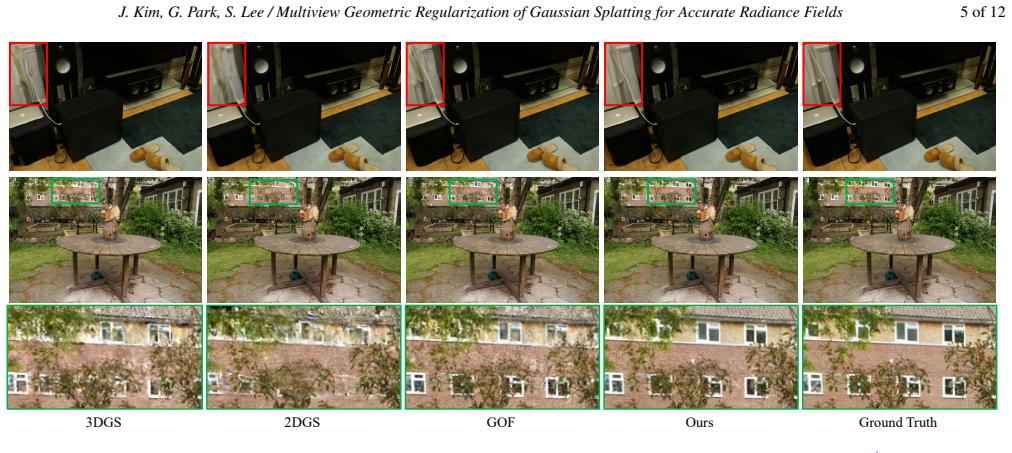
The paper's central claim is that MVS-derived depth and Gaussian Splatting's optimized points are complementary, and that an optimization scheme can harvest both. MVS patch matching with epipolar constraints is reliable in well-textured regions but noisy near boundaries; Gaussian Splatting handles boundaries but can drift under view-dependent appearance. The authors exploit this by initializing Gaussians from filtered MVS point clouds, then adding a multiview relative depth loss whose reference is the rendered median depth, with accumulated opacity as uncertainty. The loss rejects MVS depths that deviate beyond an annealed threshold and pulls the Gaussians toward the remaining depths. Ablations show that neither initialization nor the depth loss alone is enough: the full combination is what removes noise and keeps surfaces smooth.
Load-bearing premise
The method assumes that MVS depth estimates, after heuristic geometric filtering, are accurate enough in textured regions to serve as a valid geometric prior, and that the threshold rule $|D_r - D_{\mathrm{mvs}}| < s D_r$ reliably separates good MVS depths from bad ones.
Editorial extensions
If this is right
- On DTU, the mean Chamfer distance drops from 0.74 for GOF to 0.63, and on Tanks and Temples the mean F1 score rises from 0.46 to 0.52.
- On Mip-NeRF360, novel-view synthesis stays close to the strongest appearance-only methods, with LPIPS 0.197 on outdoor and 0.172 on indoor scenes.
- The additional cost is roughly 4 minutes of MVS depth estimation on DTU and 35 minutes on Tanks and Temples, plus longer optimization from denser Gaussian sets.
- The method remains an explicit splatting pipeline, so it keeps the fast, differentiable rendering of GOF while improving geometric fidelity.
Reading between the lines
- A direct extension would be to replace the hard indicator threshold with a robust weighting, which could recover scenes where MVS depths are systematically biased by less than the threshold.
- The same median-depth-plus-confidence recipe may transfer to other explicit primitives, such as surfels or 2D disks, that already have ray-splat intersection logic.
- Because the method depends on MVS patch matching, its gains plausibly shrink on textureless or heavily specular scenes; that is a testable boundary rather than a contradiction.
- One could isolate the value of epipolar consistency by feeding monocular depth through the identical loss and initialization; if the gains persist, the essential ingredient is the prior, not the multiview matching.
Signed reviews
Editorial analysis
A structured set of objections, weighed in public.
Referee Report
Summary. The paper proposes a multiview geometric regularization strategy for Gaussian Splatting, building on Gaussian Opacity Fields (GOF). The method has three main components: an MVS-guided initialization that produces a dense, geometrically informed starting point; a median-depth-based multiview relative depth loss with a rendering-uncertainty weight that aligns Gaussian positions with MVS depth estimates; and multiview extensions of RGB photometric, normal-consistency, and depth-distortion losses. Experiments on DTU, Tanks and Temples, and Mip-NeRF360 report improved surface reconstruction over GOF (DTU mean Chamfer distance 0.63 vs 0.74 mm; TnT mean F1 0.52 vs 0.46) with roughly maintained or slightly improved novel-view synthesis metrics. The paper includes component-wise ablations on one Mip-NeRF360 scene and aggregate ablations on DTU/TnT.
Significance. If the reported results hold, the paper makes a useful contribution to explicit Gaussian-splatting surface reconstruction by demonstrating that MVS depth priors can be combined with splatting optimization to improve geometry without sacrificing rendering quality. The paper's strengths are its clear component-wise ablation study (Figures 4 and 5), the consistent per-scene improvement over GOF on both DTU and TnT, and the breadth of comparisons against implicit and explicit baselines. The proposed relative depth loss with median-depth rendering and accumulated-alpha uncertainty is simple and plausible. However, the central claim depends on an assumption, stated in Section 7, that MVS depths are more accurate than the unregularized Gaussian geometry; the paper does not experimentally stress this assumption, and the rejection rule in Eq. (3) has a feedback-coupling property that is not analyzed. These concerns are addressable with additional experiments.
major comments (3)
- [Section 5.1, Eq. (3)] The rejection gate in Eq. (3) uses the rendered median depth D_r as the reference for accepting or rejecting MVS depths, but D_r is the very quantity being optimized by this loss. This creates a feedback coupling: if the early optimization drifts (for instance, due to appearance-geometry ambiguity in specular or view-dependent regions), the gate preferentially retains MVS depths consistent with the biased D_r and discards corrective depths, so a systematic MVS bias can be locked in rather than corrected. The Limitations section (Section 7) acknowledges that MVS may be unreliable, but it does not address this coupling. Because the central geometry claim relies on the retained MVS depths being more accurate than the current Gaussian geometry, please add an experiment that directly tests this assumption, for example by injecting a known systematic bias into the MVS depths on a synthetic scene with ground truth and measuring whether the filter recovers or amplifies the bias.
- [Section 6.3, Tables 1 and 2] The main geometry comparisons report single-run numbers without error bars, significance tests, or multiple seeds. The per-scene improvements over GOF are often small (e.g., DTU scan24: 0.43 vs 0.50 mm; TnT Ignatius: 0.67 vs 0.68 F1), so without variance information it is difficult to determine whether the mean improvement from 0.74 to 0.63 mm (DTU) and from 0.46 to 0.52 F1 (TnT) is robust to optimization noise. Please report variance across at least three seeds for the primary comparison with GOF, or justify why single runs are representative.
- [Section 5.1 and Figures 4/5] The paper claims that the uncertainty term U = Σ_i ω_i is a key component of the relative depth loss, but no ablation isolates its contribution. Figures 4 and 5 vary multiple components simultaneously (for example, (e) vs (f) adds both MVS-guided initialization and multiview normal/depth-distortion losses together with the uncertainty-weighted depth loss), so the reader cannot tell whether U improves results over an unweighted relative depth loss. Please add an ablation with U removed or set to 1, and report its effect on both DTU and TnT metrics.
minor comments (6)
- [Section 1, Abstract] The introduction and abstract claim that the method outperforms state-of-the-art models in both novel-view synthesis and surface reconstruction, but Table 3 shows that 3DGS-MCMC achieves higher PSNR, SSIM, and lower LPIPS on Mip-NeRF360, and the paper later states it is second-best overall. Please rephrase the NVS claim to match the reported results.
- [Section 5.1, Eq. (3)] The threshold parameter s is used in Eq. (3) but is only defined later in Section 6.1; please define it near the equation or refer forward explicitly.
- [Section 2.1 referenced [LHH25]] Reference [LHH25] is cited for using monocular depth priors to handle weakly textured regions, but the reference title 'Multi-plane Gaussian Splatting for compact scenes rendering' does not appear to match that description; please verify the citation.
- [Tables 1 and 2] The training-time notation '58.1m + α' and '75.1m + α' with α defined as approximately 4m (DTU) and 35m (TnT) is confusing because α has different meanings in the two tables; consider reporting a single total time or a clearer breakdown.
- [Section 2.1 heading] The heading 'Neural Radience Field' contains a typo; it should read 'Neural Radiance Field'.
- [Figure 4 caption] The caption uses 'multview normal and depth distortion losses' in the description of configuration (f); this should be 'multiview'.
Circularity Check
No significant circularity: the MVS depth prior is an external input and the geometry claims are validated against ground-truth scans.
full rationale
The paper's central claim is that adding MVS-derived depth supervision to Gaussian Opacity Fields improves reconstructed geometry. The proposed relative depth loss (Eq. 3) compares an externally computed MVS depth D_mvs with the rendered median depth D_r; D_mvs is produced by an independent PatchMatch MVS algorithm (Schönberger et al.) and is not defined in terms of the Gaussian parameters or the loss. The MVS-guided initialization also uses the same external depth points, but double use of an external prior is not circular. The thresholding indicator in Eq. 3 uses the current rendered depth only to reject outlier MVS values, which is a standard robust-estimation gate, not a derivation of the output from itself. The limitations section explicitly states the dependency: 'our multiview geometric regularization strategy relies on the fundamental assumption that Multi-View Stereo (MVS) depth estimates are generally more accurate than the initial or unregularized Gaussian Splatting geometry, especially in well-textured regions.' That is an acknowledged external-supervision assumption, not a hidden circular reduction. Evaluation metrics (DTU Chamfer distance, TnT F1) are computed against independent ground-truth scans, and the comparison baselines (3DGS, 2DGS, GOF) are cited works by other groups, with no load-bearing self-citation chain. No fitted parameter is renamed as a prediction, and no uniqueness theorem or ansatz is imported from the authors' prior work. The skeptical concern about feedback in the MVS-depth gate is a limitation of the prior's reliability, not a circularity of the derivation.
Assumptions & free parameters
free parameters (8)
- lambda_rel =
1
- lambda_d =
100
- lambda_n =
0.05
- N_prun =
2000 iterations
- K' (target point count) =
6M points
- l (initial voxel size) =
0.005 m
- s (threshold tolerance) =
0.15, annealed to 0.1 at 7000 iterations and 0.05 at 20000 iterations
- tau (opacity pruning threshold) =
not specified
assumptions (5)
- domain assumption MVS depths after heuristic filtering are reliable in textured regions.
- domain assumption Median depth Dr = max{ti | Ti > 0.5} approximates the surface location along a ray.
- domain assumption GOF's ray-Gaussian rendering model and its baseline regularization losses are correct and effective.
- domain assumption During the center-freeze pruning phase, opacity decay identifies noisy Gaussians.
- ad hoc to paper Rendering uncertainty U = accumulated alpha is a meaningful confidence measure.
Cite this review
Pith. "Pith review of Multiview Geometric Regularization of Gaussian Splatting for Accurate Radiance Fields." pith.science (2026). https://pith.science/paper/F5CNO3UW
@misc{pith2026250613508,
  author       = {Pith},
  title        = {Pith review of: Multiview Geometric Regularization of Gaussian Splatting for Accurate Radiance Fields},
  year         = {2026},
  howpublished = {\url{https://pith.science/paper/F5CNO3UW}},
  note         = {Machine review of arXiv:2506.13508}
}
read the original abstract
Recent methods, such as 2D Gaussian Splatting and Gaussian Opacity Fields, have aimed to address the geometric inaccuracies of 3D Gaussian Splatting while retaining its superior rendering quality. However, these approaches still struggle to reconstruct smooth and reliable geometry, particularly in scenes with significant color variation across viewpoints, due to their per-point appearance modeling and single-view optimization constraints. In this paper, we propose an effective multiview geometric regularization strategy that integrates multiview stereo (MVS) depth, RGB, and normal constraints into Gaussian Splatting initialization and optimization. Our key insight is the complementary relationship between MVS-derived depth points and Gaussian Splatting-optimized positions: MVS robustly estimates geometry in regions of high color variation through local patch-based matching and epipolar constraints, whereas Gaussian Splatting provides more reliable and less noisy depth estimates near object boundaries and regions with lower color variation. To leverage this insight, we introduce a median depth-based multiview relative depth loss with uncertainty estimation, effectively integrating MVS depth information into Gaussian Splatting optimization. We also propose an MVS-guided Gaussian Splatting initialization to avoid Gaussians falling into suboptimal positions. Extensive experiments validate that our approach successfully combines these strengths, enhancing both geometric accuracy and rendering quality across diverse indoor and outdoor scenes.
Figures


Figures from the paper (4 more)


Forward citations
Cited by 1 Pith paper
-
Reconstructing 4D Spatial Intelligence: A Survey
A review that classifies 4D scene reconstruction methods into five progressive levels: low-level cues, scene components, dynamic scenes, interactions, and physics.
Reference graph
Works this paper leans on
-
[1]
write newline
" write newline "" before.all 'output.state := FUNCTION fin.entry add.period write newline FUNCTION new.block output.state before.all = 'skip after.block 'output.state := if FUNCTION new.sentence output.state after.block = 'skip output.state before.all = 'skip after.sentence 'output.state := if if FUNCTION not #0 #1 if FUNCTION and 'skip pop #0 if FUNCTIO...
-
[2]
write newline
" write newline "" before.all 'output.state := FUNCTION fin.entry.original add.period write newline FUNCTION new.block output.state before.all = 'skip after.block 'output.state := if FUNCTION new.sentence output.state after.block = 'skip output.state before.all = 'skip after.sentence 'output.state := if if FUNCTION not #0 #1 if FUNCTION and 'skip pop #0 i...
-
[3]
T., Mildenhall B., Verbin D., Srinivasan P
Barron J. T., Mildenhall B., Verbin D., Srinivasan P. P., Hedman P. : Mip-nerf 360: Unbounded anti-aliased neural radiance fields. In Proceedings of the IEEE/CVF conference on computer vision and pattern recognition (2022), pp. 5470--5479
work page 2022
-
[4]
Chen Z., Funkhouser T., Hedman P., Tagliasacchi A. : Mobilenerf: Exploiting the polygon rasterization pipeline for efficient neural field rendering on mobile architectures. In Proceedings of the IEEE/CVF Conference on Computer Vision and Pattern Recognition (2023), pp. 16569--16578
work page 2023
-
[5]
: A volumetric method for building complex models from range images
Curless B., Levoy M. : A volumetric method for building complex models from range images. In Proceedings of the 23rd annual conference on Computer graphics and interactive techniques (1996), pp. 303--312
work page 1996
-
[6]
L., Tagliasacchi A., Sitzmann V
Charatan D., Li S. L., Tagliasacchi A., Sitzmann V. : pixelsplat: 3d gaussian splats from image pairs for scalable generalizable 3d reconstruction. In Proceedings of the IEEE/CVF conference on computer vision and pattern recognition (2024), pp. 19457--19467
work page 2024
-
[7]
: Mvsplat: Efficient 3d gaussian splatting from sparse multi-view images
Chen Y., Xu H., Zheng C., Zhuang B., Pollefeys M., Geiger A., Cham T.-J., Cai J. : Mvsplat: Efficient 3d gaussian splatting from sparse multi-view images. In European Conference on Computer Vision (2024), Springer, pp. 370--386
work page 2024
-
[8]
: Multiview stereo via noise suppression patchmatch
Chen J., Zhu A., Yu Y., Ma J. : Multiview stereo via noise suppression patchmatch. IEEE Transactions on Instrumentation and Measurement 73 (2024), 1--13
work page 2024
Show all 54 references
-
[9]
: High-quality surface reconstruction using gaussian surfels
Dai P., Xu J., Xie W., Liu X., Wang H., Xu W. : High-quality surface reconstruction using gaussian surfels. In ACM SIGGRAPH 2024 Conference Papers (2024), pp. 1--11
2024
-
[10]
J., Wimmer M
Erler P., Guerrero P., Ohrhallinger S., Mitra N. J., Wimmer M. : Points2surf learning implicit surfaces from point clouds. In European Conference on Computer Vision (2020), Springer, pp. 108--124
2020
-
[11]
: Lightgaussian: Unbounded 3d gaussian compression with 15x reduction and 200+ fps
Fan Z., Wang K., Wen K., Zhu Z., Xu D., Wang Z., et al. : Lightgaussian: Unbounded 3d gaussian compression with 15x reduction and 200+ fps. Advances in neural information processing systems 37 (2024), 140138--140158
2024
-
[12]
S., Tao W
Fu Q., Xu Q., Ong Y. S., Tao W. : Geo-neus: Geometry-consistent neural implicit surfaces learning for multi-view reconstruction. Advances in Neural Information Processing Systems 35 (2022), 3403--3416
2022
-
[13]
: Sugar: Surface-aligned gaussian splatting for efficient 3d mesh reconstruction and high-quality mesh rendering
Gu \'e don A., Lepetit V. : Sugar: Surface-aligned gaussian splatting for efficient 3d mesh reconstruction and high-quality mesh rendering. In Proceedings of the IEEE/CVF Conference on Computer Vision and Pattern Recognition (2024), pp. 5354--5363
2024
-
[14]
Goesele M., Snavely N., Curless B., Hoppe H., Seitz S. M. : Multi-view stereo for community photo collections. In 2007 IEEE 11th international conference on computer vision (2007), IEEE, pp. 1--8
2007
-
[15]
: Deep blending for free-viewpoint image-based rendering
Hedman P., Philip J., Price T., Frahm J.-M., Drettakis G., Brostow G. : Deep blending for free-viewpoint image-based rendering. ACM Transactions on Graphics (ToG) 37, 6 (2018), 1--15
2018
-
[16]
P., Mildenhall B., Barron J
Hedman P., Srinivasan P. P., Mildenhall B., Barron J. T., Debevec P. : Baking neural radiance fields for real-time view synthesis. In Proceedings of the IEEE/CVF international conference on computer vision (2021), pp. 5875--5884
2021
-
[17]
: 2d gaussian splatting for geometrically accurate radiance fields
Huang B., Yu Z., Chen A., Geiger A., Gao S. : 2d gaussian splatting for geometrically accurate radiance fields. In ACM SIGGRAPH 2024 conference papers (2024), pp. 1--11
2024
-
[18]
: Large scale multi-view stereopsis evaluation
Jensen R., Dahl A., Vogiatzis G., Tola E., Aan s H. : Large scale multi-view stereopsis evaluation. In 2014 IEEE Conference on Computer Vision and Pattern Recognition (2014), IEEE, pp. 406--413
2014
-
[19]
: Screened poisson surface reconstruction
Kazhdan M., Hoppe H. : Screened poisson surface reconstruction. ACM Transactions on Graphics (ToG) 32, 3 (2013), 1--13
2013
-
[20]
: 3d gaussian splatting for real-time radiance field rendering
Kerbl B., Kopanas G., Leimk \"u hler T., Drettakis G. : 3d gaussian splatting for real-time radiance field rendering. ACM Trans. Graph. 42, 4 (2023), 139--1
2023
-
[21]
: Neural point catacaustics for novel-view synthesis of reflections
Kopanas G., Leimk \"u hler T., Rainer G., Jambon C., Drettakis G. : Neural point catacaustics for novel-view synthesis of reflections. ACM Transactions on Graphics (TOG) 41, 6 (2022), 1--15
2022
-
[22]
: Point-based neural rendering with per-view optimization
Kopanas G., Philip J., Leimk \"u hler T., Drettakis G. : Point-based neural rendering with per-view optimization. In Computer Graphics Forum (2021), vol. 40, Wiley Online Library, pp. 29--43
2021
-
[23]
: Tanks and temples: Benchmarking large-scale scene reconstruction
Knapitsch A., Park J., Zhou Q.-Y., Koltun V. : Tanks and temples: Benchmarking large-scale scene reconstruction. ACM Transactions on Graphics (ToG) 36, 4 (2017), 1--13
2017
-
[24]
Kheradmand S., Rebain D., Sharma G., Sun W., Tseng Y.-C., Isack H., Kar A., Tagliasacchi A., Yi K. M. : 3d gaussian splatting as markov chain monte carlo. Advances in Neural Information Processing Systems 37 (2024), 80965--80986
2024
-
[25]
E., Cline H
Lorensen W. E., Cline H. E. : Marching cubes: A high resolution 3d surface construction algorithm. In Seminal graphics: pioneering efforts that shaped the field. 1998, pp. 347--353
1998
-
[26]
: Mpgs: Multi-plane gaussian splatting for compact scenes rendering
Li D., Huang S.-S., Huang H. : Mpgs: Multi-plane gaussian splatting for compact scenes rendering. IEEE Transactions on Visualization and Computer Graphics (2025)
2025
-
[27]
H., Unberath M., Liu M.-Y., Lin C.-H
Li Z., M \"u ller T., Evans A., Taylor R. H., Unberath M., Liu M.-Y., Lin C.-H. : Neuralangelo: High-fidelity neural surface reconstruction. In Proceedings of the IEEE/CVF Conference on Computer Vision and Pattern Recognition (2023), pp. 8456--8465
2023
-
[28]
: Scaffold-gs: Structured 3d gaussians for view-adaptive rendering
Lu T., Yu M., Xu L., Xiangli Y., Wang L., Lin D., Dai B. : Scaffold-gs: Structured 3d gaussians for view-adaptive rendering. In Proceedings of the IEEE/CVF Conference on Computer Vision and Pattern Recognition (2024), pp. 20654--20664
2024
-
[29]
: Instant neural graphics primitives with a multiresolution hash encoding
M \"u ller T., Evans A., Schied C., Keller A. : Instant neural graphics primitives with a multiresolution hash encoding. ACM transactions on graphics (TOG) 41, 4 (2022), 1--15
2022
-
[30]
: Neural-pull: Learning signed distance functions from point clouds by learning to pull space onto surfaces
Ma B., Han Z., Liu Y.-S., Zwicker M. : Neural-pull: Learning signed distance functions from point clouds by learning to pull space onto surfaces. arXiv preprint arXiv:2011.13495 (2020)
2020 arXiv
-
[31]
: Surface reconstruction from point clouds by learning predictive context priors
Ma B., Liu Y.-S., Zwicker M., Han Z. : Surface reconstruction from point clouds by learning predictive context priors. In Proceedings of the IEEE/CVF conference on computer vision and pattern recognition (2022), pp. 6326--6337
2022
-
[32]
P., Tancik M., Barron J
Mildenhall B., Srinivasan P. P., Tancik M., Barron J. T., Ramamoorthi R., Ng R. : Nerf: Representing scenes as neural radiance fields for view synthesis. Communications of the ACM 65, 1 (2021), 99--106
2021
-
[33]
: Compressed 3d gaussian splatting for accelerated novel view synthesis
Niedermayr S., Stumpfegger J., Westermann R. : Compressed 3d gaussian splatting for accelerated novel view synthesis. In Proceedings of the IEEE/CVF Conference on Computer Vision and Pattern Recognition (2024), pp. 10349--10358
2024
-
[34]
: Unisurf: Unifying neural implicit surfaces and radiance fields for multi-view reconstruction
Oechsle M., Peng S., Geiger A. : Unisurf: Unifying neural implicit surfaces and radiance fields for multi-view reconstruction. In Proceedings of the IEEE/CVF international conference on computer vision (2021), pp. 5589--5599
2021
-
[35]
: Binary opacity grids: Capturing fine geometric detail for mesh-based view synthesis
Reiser C., Garbin S., Srinivasan P., Verbin D., Szeliski R., Mildenhall B., Barron J., Hedman P., Geiger A. : Binary opacity grids: Capturing fine geometric detail for mesh-based view synthesis. ACM Transactions on Graphics (TOG) 43, 4 (2024), 1--14
2024
-
[36]
: Free view synthesis
Riegler G., Koltun V. : Free view synthesis. In Computer Vision--ECCV 2020: 16th European Conference, Glasgow, UK, August 23--28, 2020, Proceedings, Part XIX 16 (2020), Springer, pp. 623--640
2020
-
[37]
: Stable view synthesis
Riegler G., Koltun V. : Stable view synthesis. In Proceedings of the IEEE/CVF Conference on Computer Vision and Pattern Recognition (2021), pp. 12216--12225
2021
-
[38]
: Merf: Memory-efficient radiance fields for real-time view synthesis in unbounded scenes
Reiser C., Szeliski R., Verbin D., Srinivasan P., Mildenhall B., Geiger A., Barron J., Hedman P. : Merf: Memory-efficient radiance fields for real-time view synthesis in unbounded scenes. ACM Transactions on Graphics (TOG) 42, 4 (2023), 1--12
2023
-
[39]
M., Curless B., Diebel J., Scharstein D., Szeliski R
Seitz S. M., Curless B., Diebel J., Scharstein D., Szeliski R. : A comparison and evaluation of multi-view stereo reconstruction algorithms. In 2006 IEEE computer society conference on computer vision and pattern recognition (CVPR'06) (2006), vol. 1, IEEE, pp. 519--528
2006
-
[40]
L., Frahm J.-M
Schonberger J. L., Frahm J.-M. : Structure-from-motion revisited. In Proceedings of the IEEE conference on computer vision and pattern recognition (2016), pp. 4104--4113
2016
-
[41]
: Solidgs: Consolidating gaussian surfel splatting for sparse-view surface reconstruction
Shen Z., Liu Y., Chen Z., Li Z., Wang J., Liang Y., Yu Z., Zhang J., Xu Y., Schaefer S., et al. : Solidgs: Consolidating gaussian surfel splatting for sparse-view surface reconstruction. arXiv preprint arXiv:2412.15400 (2024)
2024 arXiv
-
[42]
M., Szeliski R
Snavely N., Seitz S. M., Szeliski R. : Photo tourism: exploring photo collections in 3d. In ACM siggraph 2006 papers. 2006, pp. 835--846
2006
-
[43]
L., Zheng E., Pollefeys M., Frahm J.-M
Sch\" o nberger J. L., Zheng E., Pollefeys M., Frahm J.-M. : Pixelwise view selection for unstructured multi-view stereo. In European Conference on Computer Vision (ECCV) (2016)
2016
-
[44]
: Neus2: Fast learning of neural implicit surfaces for multi-view reconstruction
Wang Y., Han Q., Habermann M., Daniilidis K., Theobalt C., Liu L. : Neus2: Fast learning of neural implicit surfaces for multi-view reconstruction. In Proceedings of the IEEE/CVF International Conference on Computer Vision (2023), pp. 3295--3306
2023
-
[45]
: Neus: Learning neural implicit surfaces by volume rendering for multi-view reconstruction
Wang P., Liu L., Liu Y., Theobalt C., Komura T., Wang W. : Neus: Learning neural implicit surfaces by volume rendering for multi-view reconstruction. arXiv preprint arXiv:2106.10689 (2021)
2021 arXiv
-
[46]
: Sparse2dgs: Geometry-prioritized gaussian splatting for surface reconstruction from sparse views
Wu J., Li R., Zhu Y., Guo R., Sun J., Zhang Y. : Sparse2dgs: Geometry-prioritized gaussian splatting for surface reconstruction from sparse views. arXiv preprint arXiv:2504.20378 (2025)
2025 arXiv
-
[47]
: Learning 3d geometry and feature consistent gaussian splatting for object removal
Wang Y., Wu Q., Zhang G., Xu D. : Learning 3d geometry and feature consistent gaussian splatting for object removal. In European Conference on Computer Vision (2024), Springer, pp. 1--17
2024
-
[48]
: Texture-gs: Disentangling the geometry and texture for 3d gaussian splatting editing
Xu T.-X., Hu W., Lai Y.-K., Shan Y., Zhang S.-H. : Texture-gs: Disentangling the geometry and texture for 3d gaussian splatting editing. In European Conference on Computer Vision (2024), Springer, pp. 37--53
2024
-
[49]
: Mip-splatting: Alias-free 3d gaussian splatting
Yu Z., Chen A., Huang B., Sattler T., Geiger A. : Mip-splatting: Alias-free 3d gaussian splatting. In Proceedings of the IEEE/CVF conference on computer vision and pattern recognition (2024), pp. 19447--19456
2024
-
[50]
: Volume rendering of neural implicit surfaces
Yariv L., Gu J., Kasten Y., Lipman Y. : Volume rendering of neural implicit surfaces. Advances in Neural Information Processing Systems 34 (2021), 4805--4815
2021
-
[51]
P., Szeliski R., Barron J
Yariv L., Hedman P., Reiser C., Verbin D., Srinivasan P. P., Szeliski R., Barron J. T., Mildenhall B. : Bakedsdf: Meshing neural sdfs for real-time view synthesis. In ACM SIGGRAPH 2023 Conference Proceedings (2023), pp. 1--9
2023
-
[52]
: Gsdf: 3dgs meets sdf for improved neural rendering and reconstruction
Yu M., Lu T., Xu L., Jiang L., Xiangli Y., Dai B. : Gsdf: 3dgs meets sdf for improved neural rendering and reconstruction. Advances in Neural Information Processing Systems 37 (2024), 129507--129530
2024
-
[53]
: Gaussian opacity fields: Efficient adaptive surface reconstruction in unbounded scenes
Yu Z., Sattler T., Geiger A. : Gaussian opacity fields: Efficient adaptive surface reconstruction in unbounded scenes. ACM Transactions on Graphics (TOG) 43, 6 (2024), 1--13
2024
-
[54]
: Open3D : A modern library for 3D data processing
Zhou Q.-Y., Park J., Koltun V. : Open3D : A modern library for 3D data processing. arXiv:1801.09847 (2018)
2018 arXiv
Reviewed August 15, 2026 · model on record in the stance chip above.
Discussion (0). Continue with ORCID to comment.