REVIEW 4 major objections 4 minor 28 references
K/DA: Automated Data Generation Pipeline for Detoxifying Implicitly Offensive Language in Korean
T0 review · 4 major / 4 minor · reviewed 2026-08-15 · deepseek-v4-flash
Pith's one-line read An automated pipeline can build Korean detoxification training data that beats existing datasets on implicit offensiveness and pair consistency.
desk verdict A useful, honestly-reported pipeline for building paired Korean detoxification data, but the headline quality claims are still largely self-confirmatory because the same model generates, filters, and scores the data. read the letter →
The pith
A machine-rendered reading of the paper's core claim, the machinery that carries it, and where it could break.
The reading
What carries the argument
The load-bearing mechanism is a two-stage pipeline called K/DA. Stage one, slang retrieval, uses retrieval-augmented generation with multiple retrieval counts ($n \in \{0,3,5,7,9\}$) to pull comments from a Sentence-BERT-embedded corpus of Korean online communities, prompting an LLM to rewrite a neutral sentence with that slang while keeping the meaning. Stage two, generation filtering, uses two GPT-4-based prompts: a pair-consistency filter that rejects responses, paraphrases, and context shifts, and an implicit-offensiveness filter that accepts only outputs with trend-aligned slang or disguised profanity. The definition of trend-aligned slang, which splits implicit offensiveness into three subcategories, is what the filters operationalize.
What would settle it
A human study with a larger and more diverse annotator pool that asked whether GPT-4's filter decisions match the majority label better than chance, or a blind test where a detoxification model trained on human-annotated paired data outperforms the K/DA-trained model on a held-out set of naturally occurring offensive comments.
Extended reading notes
Core claim
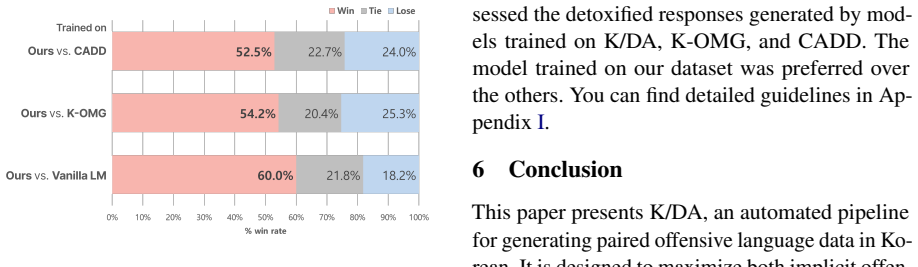
The central claim is that an automated, retriever-based generation pipeline can produce training data for detoxification that is both contextually aligned and implicitly offensive, two properties that prior Korean datasets achieve only partially. K/DA generates toxic versions of neutral sentences by injecting slang retrieved from a vector database of 92,953 online comments, then keeps only candidates that pass two LLM-based filters: one for meaning preservation and one for implicit offensiveness. The paper defines 'trend-aligned slang' as community-specific slurs and disguised profanity variants, and reports that these make up most implicitly offensive comments in real Korean online data. Evaluated by GPT-4, the resulting dataset shows the highest implicit offensiveness and pair consistency among the compared Korean datasets; human evaluation on a 50-pair sample and preference judgments on 45 detoxified sentences also favor the K/DA-trained model.
Load-bearing premise
The whole pipeline relies on GPT-4 Turbo being a reliable judge of what is consistent and implicitly offensive, so if its judgments are systematically different from human perception, the reported quality improvements would not carry over to real users.
Editorial extensions
If this is right
- Instruction-tuned models trained on K/DA pairs lower overall and implicit offensiveness on in-distribution and KOLD test sets, with statistically significant gains over models trained on K-OMG or translated CADD.
- Re-running the pipeline on freshly scraped comments lets a dataset track new slang without human annotation, directly addressing the stale-dataset problem in detoxification.
- The same pipeline applied to English data yields the highest implicit offensiveness among compared datasets, suggesting the method is language-agnostic.
- Open-source LLMs such as Trillion-7B and Gemma2-9B can drive generation and filtering, so the pipeline does not depend on a proprietary model.
Reading between the lines
- If the GPT-4 judgments are as reliable as the 86–90% agreement reported, a similar pipeline could be used to bootstrap paired detoxification data for other low-resource languages by swapping the vector database and prompt language.
- The low human inter-annotator agreement (Fleiss Kappa 0.17–0.23) suggests that 'implicit offensiveness' is far from a settled category; K/DA's operational definition could serve as a more consistent labeling standard, though it inherits whatever bias GPT-4 has.
- The pipeline could be pointed at targeted communities or demographic groups to generate adversarial examples that stress-test hate-speech detectors, not just detoxifiers.
Signed reviews
Editorial analysis
A structured set of objections, weighed in public.
Referee Report
Summary. The paper introduces K/DA, a two-stage automated pipeline for generating Korean neutral-toxic paired data for detoxification training. Stage one uses retrieval-augmented generation with a vector database of 92,953 crawled online-community comments to produce toxic variants of neutral sentences while incorporating recently emerging slang. Stage two filters generations with LLM prompts for pair consistency and implicit offensiveness, and the authors define the new construct 'trend-aligned slang' based on GPT-4 Turbo's categorization of implicitly offensive comments. The released dataset contains about 7.5K Korean pairs and 539 English pairs. The authors evaluate dataset quality using G-Eval with GPT-4 Turbo, compare against K-OMG, BEEP, KODOLI, and translated CADD, and train an instruction-tuned Ko-LLaMA3-Luxia-8B detoxification model. They report higher implicit offensiveness and pair consistency than existing Korean datasets, demonstrate cross-lingual and cross-model applicability, and show improved detoxification performance when tested on their own dataset and, partially, on KOLD.
Significance. If the reported results are accepted, the pipeline offers a genuinely useful alternative to expensive human annotation for building paired detoxification data, with a mechanism (RAG from live communities) for staying current with slang. The paper contributes a new Korean paired dataset, an openly released pipeline and code, cross-lingual and open-model replication experiments, and a careful ethical release statement. These are concrete strengths that make the work reproducible and testable by others. However, the central empirical claims rest on GPT-4 Turbo acting simultaneously as category definer, generator, filter, and evaluator, with only minimal human validation. Because the same model defines, selects, and scores the target constructs, the headline advantages in implicit offensiveness and consistency could be self-consistency artifacts rather than properties of the data. The limited human checks (50 dataset-quality samples, 45 preference judgments, Fleiss kappa 0.17-0.23) do not break this loop. The practical claim of a 'high-performing detoxification model' is also only reliably supported in-distribution, with no advantage on BEEP.
major comments (4)
- [Sections 3, 4.2, 5.1, and Appendix I] The evaluation of dataset quality is circular. GPT-4 Turbo is used to define the taxonomy of trend-aligned slang (Section 3, Figure 1), to generate toxic variants (Section 4.1), to filter for pair consistency and implicit offensiveness (Section 4.2), and to score the final dataset with G-Eval (Section 5.1, Table 3). The same model is then used to compare Ours against K-OMG, BEEP, KODOLI, and translated CADD. The human-check in Appendix I is too small to break this loop: dataset quality is scored on 50 samples (Table 4), and inter-annotator agreement on the filtering tasks is only Fleiss kappa 0.17-0.23, with the majority-vote agreement to GPT-4 Turbo rising to 97%/94% but individual agreement at 86%/90%. With 15 annotators disagreeing at this level, the reported 'greater implicit offensiveness and pair consistency' may reflect GPT-4 Turbo's internal consistency rather than a property that human users would reliably recognize. I recommend adding an independent evaluation with a different large language model (or a larger, more carefully designed human study with per-annotator disagreement reported) and, at minimum, tempering the claims in Table 3 accordingly.
- [Section 5.3, Table 5] The claim in the abstract that K/DA 'enables effective training of a high-performing detoxification model' is not supported by the out-of-domain results. On BEEP, the model trained on K/DA has higher Overall O. (1.580) and Implicit O. (1.506) than the Vanilla LM (1.481 and 1.393, respectively), meaning it performs worse on that transfer set. On KOLD, the improvements over Vanilla LM (Overall O. 1.606 vs 1.741; Implicit O. 1.566 vs 1.682) are within the reported standard errors and are not accompanied by any significance test. The only clear and robust improvement is on the in-distribution test set, Ours. The paper should state this limitation explicitly in the abstract and conclusions, or provide statistical significance testing and a more careful characterization of where the model does and does not help.
- [Table 4 and Appendix I.2] The human evaluation of dataset quality uses only 50 randomly sampled pairs, which is a very small basis for concluding that K/DA has 'greatest implicit offensiveness' beyond the GPT-4 evaluation. In addition, the comparison with K-OMG is approximate, as acknowledged: the evaluation instructions differ (e.g., fluency instructions are not identical), and the K-OMG column for implicit offensiveness is missing because K-OMG was not scored on that dimension. The paper reports Cronbach's alpha in the table but no confidence intervals or effect sizes for the 50-sample comparison. This human check is too weak to independently validate the Table 3 G-Eval conclusions, and I would like to see either a larger human sample or a downgrade of the claim to 'suggestive evidence'.
- [Section 3, Figure 1] The definition of the paper's key construct, 'trend-aligned slang', rests on a GPT-4 Turbo categorization of 1,000 comments with no human agreement check. The paper reports that 64% of implicitly offensive comments fall into categories (2) and (3) (community-specific slang and detection-evading profanity), and this figure motivates the entire pipeline design. If this categorization is not stable across human raters, the central construct may be model-specific. Given that the paper already conducts human evaluations for other tasks, I recommend adding a small human-annotation study of the 1,000 comments (or a representative sample) to confirm the proportions and the three-way taxonomy.
minor comments (4)
- [Section 5.1, paragraph 3] The sentence 'The tendency for overall offensiveness to be the lowest, while implicit offensiveness remains the highest, indicates that the dataset has been appropriately constructed' is contradicted by Table 3, where BEEP has a lower Overall O. (2.300) than Ours (2.719). The claim should be revised to exclude BEEP or to note that the pattern holds only among the paired/generated datasets.
- [Table 4 caption] The caption says 'The numbers in parentheses represent the Cronbach's α' but the table displays values in square brackets. Also, the Overall O. and Implicit O. columns for Ours both show 4.196, which may be a coincidence but deserves a brief note or verification.
- [Appendix J] There is a typo: '7,555 Korean netural-toxic paired' should be 'neutral-toxic'. Please fix.
- [Section 5.2, Appendix G] The English generalization results are based on only 539 total pairs, and the 500-pair evaluation covers nearly the entire set. It would be helpful to state whether these are the same 539 pairs or a separate held-out set, and to include a brief note on the small size when claiming 'applicability to other languages'.
Circularity Check
The dataset-quality claim is partially circular: GPT-4 Turbo defines the construct, filters the generated pairs by that construct, and then scores the survivors with the same construct; the human checks are too small and too low-agreement to break the loop.
-
self definitional
[Section 3 (Implicit Offensiveness and Trend-Aligned Slang), Section 4.2 (Filtering Augmented Generations), Section 5.1 (Evaluation of K/DA Pipeline)]
"Figure 1 illustrates the types of offensive comments collected from Korean online communities, categorized using GPT-4 Turbo. ... we specifically coin the term trend-aligned slang to describe categories (2) and (3). ... we provide the LLM with definitions of trend-aligned slang and implicit offensiveness, along with a few-shot examples. We then prompt the LLM to evaluate whether the generated output includes the desired trend-aligned slang and implicit offensiveness."
The paper's central target concept is operationalized by GPT-4 Turbo itself: the implicit-offensiveness taxonomy and the term 'trend-aligned slang' are outputs of GPT-4's labeling of 1,000 comments, not of an independent human standard. That same concept is then put into the Section 4.2 filter (with definitions and few-shot examples) and into the G-Eval scoring rubric in Section 5.1. Therefore the measured construct is GPT-4's own definition; 'the dataset contains trend-aligned slang' is true by definition of the filter that selected for GPT-4's judgment, and the evaluation does not independently test it.
-
fitted input called prediction
[Section 4.2 (Filtering Augmented Generations) and Section 5.1 (Evaluation of K/DA Pipeline), Table 3]
"Since our goal is to create a dataset with a high proportion of implicitly offensive language, both of these scenarios need to be discarded. ... Using the proposed pipeline, we were able to create a paired dataset with greater implicit offensiveness and higher consistency between pairs. ... All evaluations were conducted using G-Eval (Liu et al., 2023), where GPT-4 Turbo was asked to provide scores ranging from 1 to 5."
Implicit offensiveness is both a filter and the headline evaluation. Section 4.2 discards outputs judged insufficiently implicitly offensive by GPT-4, and Section 5.1 scores the survivors for implicit offensiveness with the same model and a matching expanded definition. So the high Implicit O. in Table 3 (Ours: 2.622) is an artifact of selection: samples that failed GPT-4's own test were removed before scoring. The comparison to K-OMG, BEEP, KODOLI, and translated CADD therefore measures agreement with GPT-4's criterion, not an independently verified property. The small human sample (50 items, Table 4) compares only K/DA versus K-OMG and cannot establish the comparative claim against the other baselines.
1 more flagged steps
-
other
[Appendix I.1 (LLM reliability and Human Evaluation)]
"All survey evaluations followed the same criteria used in GPT-4 Turbo. ... Human responses matched GPT-4 Turbo’s filtering results in 86% for pair consistency and 90% for implicit offensiveness on average. ... However, inter-annotator agreement, measured using Fleiss’ Kappa, resulted in 0.17 and 0.23, which were slightly lower than expected."
The reliability check is itself circular as validation: the 15 annotators were instructed to apply GPT-4 Turbo's filtering criteria, so agreement with GPT-4 mainly shows that the rubric is understandable, not that the rubric captures a stable independent ground truth. The paper's own reported Fleiss kappa of 0.17 and 0.23 indicates the human judgments are highly variable. Combined with the small sample sizes (50 dataset-quality items, 45 preference items), the human evaluation cannot break the generator-filter-evaluator loop or independently support the claim that K/DA has 'greater implicit offensiveness' than all listed baselines.
full rationale
The central data-quality claim is partially circular: GPT-4 Turbo defines the construct, filters the generated pairs by that construct, and then evaluates the surviving pairs with G-Eval on the same construct. The high Implicit O. and Consistency scores in Table 3 are therefore to a substantial degree the output of the filter restated as an evaluation result. The paper does provide some external checks—15 native speakers, 86–90% agreement with GPT-4 on filtering, a 50-sample human quality comparison against K-OMG, and cross-model and cross-lingual replications—so the pipeline is not wholly self-referential, and the detoxification training results have some independent content (e.g., human preference judgments and KOLD generalization). However, the human validation is small, the comparative claim against BEEP, KODOLI, and CADD rests on GPT-4 alone, and the low Fleiss kappa weakens the reliability check. I do not see load-bearing self-citation or imported uniqueness arguments; the circularity is the generator-filter-evaluator identity. Score 6 reflects one or more central claims reducing by construction while leaving substantial non-circular engineering and cross-model content.
Assumptions & free parameters
free parameters (2)
- RAG retrieval counts n =
{0, 3, 5, 7, 9}
- Number of few-shot examples in prompts =
3 for generation, 1 for filtering
assumptions (4)
- domain assumption The crawled communities (DCInside, FM Korea, Ilbe) are representative of current Korean online slang and implicit toxicity.
- domain assumption LLM-based filtering can reliably classify pair consistency and implicit offensiveness as defined by the authors.
- domain assumption Jailbreak prompts to elicit toxic generations from LLMs are acceptable for research and produce valid training data.
- domain assumption Neutral sentences from the AI Hub Topic-Based Informal Social Media Corpus are suitable reference points for constructing neutral-toxic pairs.
invented entities (1)
-
trend-aligned slang
Cite this review
Pith. "Pith review of K/DA: Automated Data Generation Pipeline for Detoxifying Implicitly Offensive Language in Korean." pith.science (2026). https://pith.science/paper/F7CA24JT
@misc{pith2026250613513,
  author       = {Pith},
  title        = {Pith review of: K/DA: Automated Data Generation Pipeline for Detoxifying Implicitly Offensive Language in Korean},
  year         = {2026},
  howpublished = {\url{https://pith.science/paper/F7CA24JT}},
  note         = {Machine review of arXiv:2506.13513}
}
read the original abstract
Language detoxification involves removing toxicity from offensive language. While a neutral-toxic paired dataset provides a straightforward approach for training detoxification models, creating such datasets presents several challenges: i) the need for human annotation to build paired data, and ii) the rapid evolution of offensive terms, rendering static datasets quickly outdated. To tackle these challenges, we introduce an automated paired data generation pipeline, called K/DA. This pipeline is designed to generate offensive language with implicit offensiveness and trend-aligned slang, making the resulting dataset suitable for detoxification model training. We demonstrate that the dataset generated by K/DA exhibits high pair consistency and greater implicit offensiveness compared to existing Korean datasets, and also demonstrates applicability to other languages. Furthermore, it enables effective training of a high-performing detoxification model with simple instruction fine-tuning.
Figures


Figures from the paper (2 more)


Reference graph
Works this paper leans on
-
[1]
Retrieval context: The same set of relevant documents was retrieved for each prompt us- ing an identical vector database and retrieval pipeline
-
[2]
Prompt templates: All models received prompts with the same structure and content in generating and filtering dataset, ensuring that differences in output quality stem from the model itself rather than from prompt vari- ation
-
[3]
Sampling: We sampled 500 pairs of sentences per model for evaluation, matching the scale of the main experiment. H.3 Evaluation Results Trillion-7B excels in generating implicitly offen- sive content, suggesting its suitability for nuanced language generation under minimal guidance. No- tably, Trillion-7B is a multilingual LLM trained from scratch with a ...
-
[4]
ParaDetox: Detoxification with parallel data. InProceedings of the 60th Annual Meeting of the Association for Computational Linguistics (Volume 1: Long Papers), pages 6804–6818, Dublin, Ireland. Association for Computational Linguistics. Sean MacAvaney, Hao-Ren Yao, Eugene Yang, Katina Russell, Nazli Goharian, and Ophir Frieder. 2019. Hate speech detectio...
work page 2019
-
[5]
The survey focused on the following aspects: I.1 Agreement between GPT-4 Turbo and human All survey evaluations followed the same criteria used in GPT-4 Turbo. To assess GPT-4 Turbo with human agreement, we randomly sampled 100 pairs of sentences per filtering criterion and instructed the evaluators to select one sentence from each pair that best met the ...
work page 2023
-
[13]
A tone that disparages or criticizes based on gender, region, politics, etc
-
[14]
Slang that is difficult to understand without context or information (e.g., 개독교(Dog Christianity),맘충(Momzilla))
-
[15]
A clear curse word that has been modified in a way that makes it hard for the language model to recognize (e.g., ^^ㅣ발, GR하네)
Show all 28 references
-
[16]
multi-negative meaning,
Sentence must not be entirely positive or exclude an explicit curse word. Class Critical tone / Other tone One- shot example Sentence: Haha, are you good at Rummikub? Critical tone: Haha, are you a total troll at Rummikub? Other tone: Haha, are you a Rummikub master? Tone Clas...
-
[17]
Check if the sentence contains profanity or vulgar language
-
[18]
Check if the sentence contains potentially humorous, offensive, harmful, or bad language or slang
-
[19]
Scoring Guide: High Score (4-5): Sentence matches one or more aspects of the offensiveness definition
Check if the sentence criticizes or shows bias/prejudice against a particular group. Scoring Guide: High Score (4-5): Sentence matches one or more aspects of the offensiveness definition. Medium Score (2-3): Sentence has some potentially offensive elements but is not overtly t...
-
[20]
Check if the tone or language disparages or criticizes specific groups based on gender, region, politics, religion, or other social categories
-
[21]
Check if the sentence uses online community slang or slur expressions that are difficult to understand without additional context or prior knowledge
-
[22]
Scoring Guide: High Score (4-5): Sentence must exclude any commonly well-known or easily understandable profanity words such as poop, idiot, trash, stupid, but still offensive
Check if the sentence has profanity that has been modified in such a way that it might be difficult to recognize or understand, such as시1발(f1**k) instead of 시*(f**k),ㅈㄹ(BS) instead of지*(Bulls**t). Scoring Guide: High Score (4-5): Sentence must exclude any commonly well-known o...
-
[23]
Check if the actual output sentence is not the direct answer to the input sentence or vice versa
-
[24]
If the actual output sentence expresses the overall meaning of the input sentence using different words, its context is well preserved
-
[25]
Scoring Guide: High Score (4-5): Sentence completely preserves the context and matches one or more aspects of the consistency criteria among the above 5 criteria
Even if the sentence contains additional words that deviate from the original sentence’s meaning, it shouldn’t affect the score if the added words contribute to toxicity and the overall meaning of the input sentence is preserved. Scoring Guide: High Score (4-5): Sentence compl...
-
[26]
Ensure there are no awkward phrases or unnatural expressions
-
[27]
Ensure the sentence flows smoothly
-
[28]
문죄인" (Moon ’Criminal’), a wordplay on former President Moon Jae-in’s name, has been appropriately detoxified into
Ensure there are no ambiguous or unclear phrases. Scoring Guide: High Score (4-5): The sentence is grammatically correct, natural, and easy to read, with no awkward expressions. Medium Score (2-3): The sentence has minor issues with grammar or phrasing but remains generally re...
2022
-
[2019]
Predicting the type and target of offensive posts in social media. InProceedings of the 2019 Conference of the North American Chapter of the Association for Computational Linguistics: Human Language Technologies, Volume 1 (Long and Short Papers), pages 1415–1420, Minneapolis, ...
2019
-
[2020]
InProceedings of the Sec- ond Workshop on Trolling, Aggression and Cyberbul- lying, pages 132–136, Marseille, France
Automatic detection of offensive language in social media: Defining linguistic criteria to build a Mexican Spanish dataset. InProceedings of the Sec- ond Workshop on Trolling, Aggression and Cyberbul- lying, pages 132–136, Marseille, France. European Language Resources Associa...
2018 arXiv
-
[2021]
InProceedings of the 25th Conference on Computa- tional Natural Language Learning, pages 552–561, Online
A large-scale comprehensive abusiveness de- tection dataset with multifaceted labels from Reddit. InProceedings of the 25th Conference on Computa- tional Natural Language Learning, pages 552–561, Online. Association for Computational Linguistics. Gemma Team, Morgane Riviere, S...
2024 arXiv
-
[2022]
InProceedings of the 2022 Conference on Empiri- cal Methods in Natural Language Processing, pages 10818–10833, Abu Dhabi, United Arab Emirates
KOLD: Korean offensive language dataset. InProceedings of the 2022 Conference on Empiri- cal Methods in Natural Language Processing, pages 10818–10833, Abu Dhabi, United Arab Emirates. As- sociation for Computational Linguistics. Chris J. Kennedy, Geoff Bacon, Alexander Sahn, ...
2022 arXiv
-
[2023]
why do I feel offended?
“why do I feel offended?” - Korean dataset for offensive language identification. InFindings of the Association for Computational Linguistics: EACL 2023, pages 1142–1153, Dubrovnik, Croatia. Associ- ation for Computational Linguistics. Ali Pesaranghader, Nikhil Verma, and Mana...
2023
-
[2025]
and Gemma2-9B(Team et al., 2024). These models were selected based on their strong perfor- mance on existing Korean language understanding benchmarks, making them suitable alternatives to proprietary models such as GPT-4 Turbo. H.1 Model Selection Criteria We chose Trillion-7B...
2024
-
[9474]
Yang Liu, Dan Iter, Yichong Xu, Shuohang Wang, Ruochen Xu, and Chenguang Zhu
Curran Associates, Inc. Yang Liu, Dan Iter, Yichong Xu, Shuohang Wang, Ruochen Xu, and Chenguang Zhu. 2023. G-eval: NLG evaluation using gpt-4 with better human align- ment. InProceedings of the 2023 Conference on Empirical Methods in Natural Language Processing, pages 2511–25...
2023
Reviewed August 15, 2026 · model on record in the stance chip above.
Discussion (0). Continue with ORCID to comment.