REVIEW 4 major objections 6 minor 1 cited by
Leader360V: The Large-scale, Real-world 360 Video Dataset for Multi-task Learning in Diverse Environment
T0 review · 4 major / 6 minor · reviewed 2026-08-07 · deepseek-v4-flash
Pith's one-line read Leader360V claims to be the first 10K+ labeled real-world 360-degree video dataset for segmentation and tracking.
desk verdict An important 360 video dataset in the making, but the current eval split leaks source videos between train and test, and the source counts are inconsistent; the headline performance claim isn't yet supported. read the letter →
The pith
A machine-rendered reading of the paper's core claim, the machinery that carries it, and where it could break.
The reading
What carries the argument
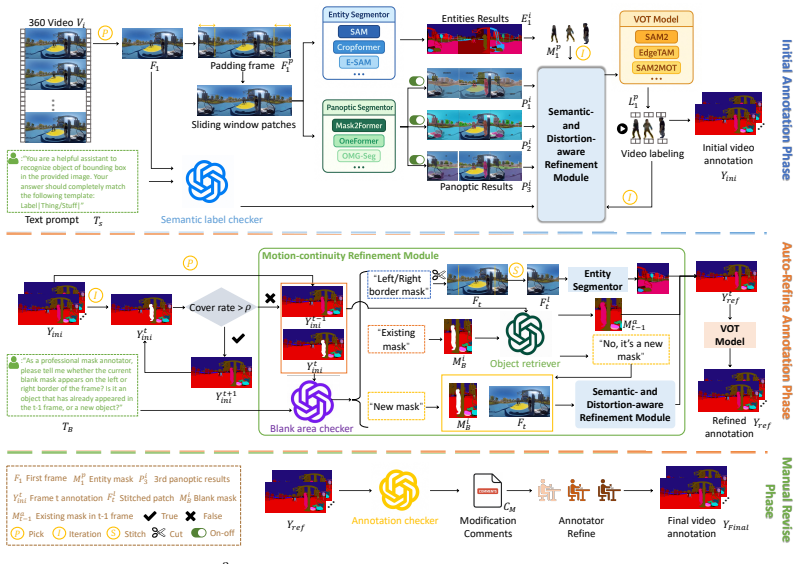
The central object is the A3360V annotation pipeline, whose load-bearing component is the Semantic- and Distortion-aware Refinement (SDR) module. SDR merges patch-wise mask proposals from multiple 2D segmentors, uses an LLM-based semantic label checker to unify labels, and feeds the resulting masks as prompts into SAM2, with a mask-prompt shifting step that selects the most consistent distortion-aware mask. The pipeline then propagates annotations through frames, using a coverage-rate threshold to trigger a Motion-Continuity Refinement module that resolves ERP border discontinuities, missing masks, and new objects before a final LLM-guided human revision pass.
What would settle it
Train a segmentation or tracking model on the Leader360V training clips and evaluate it on a holdout of videos whose source videos never appear in training; if the J&F or Sdual gains shrink to the level of the untrained baselines, the dataset's claimed value as a generalization resource would be refuted.
Extended reading notes
Core claim
On its own terms, the paper establishes Leader360V as the first 10K+ labeled real-world 360 video dataset for instance segmentation and tracking, spanning 198 object types across indoor, urban, natural, and dynamic outdoor scenes. It further claims that its three-phase A3360V annotation pipeline—initial annotation with a Semantic- and Distortion-aware Refinement module, auto-refinement with a Motion-Continuity Refinement module, and LLM-assisted manual revision—produces high-quality annotations at a fraction of manual cost. Experiments on segmentation and tracking benchmarks report that models fine-tuned on Leader360V gain, for example, +36.3 J&F for PSCFormer and +12.6 Sdual for SimTrack over their untrained counterparts.
Load-bearing premise
The reported performance gains rest on the assumption that the validation and test clips, 66% of which are cut from the training set's own source videos, actually test generalization rather than memory of the same scenes.
Editorial extensions
If this is right
- Fine-tuning on Leader360V becomes a practical recipe for adapting 2D video segmentation models to 360 input, closing part of the domain gap from distortion and border discontinuity.
- The dataset provides a unified mask-and-box annotation resource that can support training of 360-specific instance segmentation and multi-object tracking models end to end.
- The A3360V pipeline offers a reusable template for scaling annotation of other 360 video collections without prohibitive human effort.
- Performance comparisons on Leader360V can serve as a new benchmark for panoramic VOS and VOT, complementing the smaller 360VOTS and PanoVOS sets.
Reading between the lines
- If the leakage concern is real, the headline gains may overstate the benefit; a video-disjoint evaluation could still rank the dataset fairly but with smaller numbers.
- The pipeline's reliance on SAM2 and GPT-4o means its quality ceiling may track improvements in those foundation models, so the dataset could become richer automatically as base models improve.
- Because the taxonomy merges rare classes from COCO, ADE20K, and Cityscapes, models trained on Leader360V may inherit coarse-grained labels that limit fine-grained recognition; this trade-off is worth testing explicitly.
- The 360-degree nature of the data makes it a natural testbed for evaluating whether models learn true spherical consistency rather than merely ERP-specific artifacts.
Editorial analysis
A structured set of objections, weighed in public.
Referee Report
Summary. The paper introduces Leader360V, presented as the first large-scale (10K+) real-world 360 video dataset with instance segmentation and tracking annotations covering 198 object categories, built from a combination of existing 360 video datasets, online collections, and self-captured footage. To reduce annotation cost, the authors propose A3360V, a three-phase automatic annotation pipeline that combines pre-trained 2D segmentors, SAM2, and LLM-based checkers to produce and refine masks. Experiments on a 500-video sample and domain-transfer settings report substantial improvements on 360 VOS and VOT benchmarks after fine-tuning on Leader360V. The paper also includes user studies and ablations to support the pipeline's effectiveness.
Significance. If the dataset and pipeline claims are substantiated, Leader360V would be a valuable community resource, addressing the scarcity of large-scale annotated 360 video for segmentation and tracking, and the A3360V pipeline could lower annotation costs. The paper's strengths include a modular pipeline design, a broad 198-category taxonomy, explicit failure-case discussion in Appendix C.7, and a user study with multiple skill levels. However, the current evaluation protocol introduces potential video-level leakage between training and test clips, and internal dataset statistics are inconsistent, so the headline performance gains and dataset composition claims are not yet established.
major comments (4)
- [Sec. 4.1 (Evaluation Subset)] The split protocol states that 66% of validation and test clips are clipped from the original train set videos, meaning the same source recordings appear in both training and evaluation. This creates a video-level leakage that can inflate the reported fine-tuning gains (e.g., +36.3 J&F for PSCFormer in Table 4, +12.6 Sdual for SimTrack in Table 5) by allowing models to memorize scene-specific backgrounds and object instances. The paper does not report source-video IDs or a video-disjoint split, so the central claim that Leader360V significantly enhances model performance is not currently supported.
- [Table 10 and Sec. B.1] Appendix B.1 states that the 360VOTS dataset comprises 120 high-resolution video sequences, yet Table 10 reports selecting 232 videos from 360VOTS at an 80% selection rate. This is arithmetically impossible and indicates a factual error in the dataset composition statistics. The related row labeled 'Self-Collected 360VOTS' is also ambiguous. The authors should correct these entries and provide a source-by-source reconciliation that sums to the claimed 10,180 videos.
- [Sec. 4.3 / Table 8] The ablation study evaluates Phase I and Phase II outputs against 'the final annotations' as ground truth, but those final annotations are themselves the output of the same pipeline after human revision in Phase III. This is a self-consistency check rather than an external validation of annotation quality. The claim that A3360V produces high-quality annotations would be strengthened by a comparison with a fully manual annotation set or by reporting inter-annotator agreement between Phase III outputs and independent human annotations.
- [General (Dataset Release)] No dataset release artifacts or project page are provided in the paper. For a dataset contribution of this type, a download link, benchmark server, and code/data documentation are essential for the stated claims to be verifiable and usable by the community. The authors should clearly state data availability and provide these artifacts.
minor comments (6)
- [Abstract] In the abstract, 'appications' should be 'applications', and the phrase 'the first large-scale (10K+), labeled real-world 360 video datasets' mixes singular and plural; it should be 'dataset'.
- [Table 1] Table 1 uses the citation [10] for '360VOT', but the tracking benchmark 360VOT is correctly cited as [13] in the introduction; the table also seems to conflate 360VOT and 360VOTS.
- [Tables 4 and 5] The heading of Table 4 and Table 5 says 'Qualitative comparison', but the content is quantitative; the heading should say 'Quantitative comparison'.
- [Sec. 4.1] The evaluation subset description is ambiguous: it is unclear whether the 500-video sample includes the 250 training videos plus 125 val plus 125 test, and the relationship between 'clips' and 'videos' should be clarified; the paper should report the exact overlap in source video IDs between the training and test splits.
- [Table 10] In Table 10, the 'Source*' column includes a row 'Self-Collected 360VOTS' which appears to be a typographical error; this row should likely be 'Self-Collected' only, and the table's 'Task' and 'Pct' fields for open-source and self-collected rows are vague.
- [Tables 6 and 7] Tables 6 and 7 have a confusing header structure for the 'Training Dataset' columns; please clarify what 'Self-Collected' means in those tables (likely the Leader360V fine-tuning data) and ensure the column labels are self-explanatory.
Circularity Check
Leader360V's central model-improvement claim rests on an evaluation split where 66% of test clips come from the same source videos as training clips, so the reported gains are not an independent test of generalization.
-
fitted input called prediction
[Section 4.1, Evaluation Subset]
"For the validation set and test set, 66% of the clips are clipped from the original train set videos as val and test sets, and the rest are used as the train set. The remaining clips in the validation and test sets were selected from new and unseen scenarios."
The test set is constructed so that 66% of its clips are temporally clipped from the same source videos that supply training clips. A model fine-tuned on clips from a source video can then be evaluated on other clips from that same source video, succeeding by memorizing scene-specific content, static backgrounds, lighting, and even the same object instances rather than by learning generalizable 360-degree video representations.
full rationale
This paper constructs a dataset and an annotation pipeline, so there is no mathematical derivation chain whose prediction equals its input by definition. The strongest circularity concern is empirical rather than algebraic: the evaluation protocol in Section 4.1 creates train and test sets that share source videos, with 66% of test and validation clips clipped from the original train-set videos. Consequently, the fine-tuning gains that constitute the central claim that Leader360V significantly enhances model performance can be inflated by video-level leakage, making the test result a partial self-consistency check on overlapping content rather than an external generalization test. The pipeline ablations in Table 8 use final manual-refined annotations as ground truth, which is a self-consistency check with human correction providing some independence, but it is not a fitted-input-as-prediction step. The self-citations, GoodSAM [4] and E-SAM [31], are not load-bearing: GoodSAM is evaluated and performs poorly, while E-SAM is only listed as an optional entity segmentor and is not used in the main implementation. Therefore, the main circularity is the overlapping evaluation split, which warrants a score of 6 under the rubric of predictions reducing by construction.
Assumptions & free parameters
free parameters (2)
- IoU threshold tau =
not reported
- Coverage rate rho =
not reported
assumptions (5)
- domain assumption Pre-trained 2D entity and panoptic segmentors produce mask proposals reliable enough to serve as the initial annotation pool.
- domain assumption The LLM semantic label checker (GPT-4o) resolves label conflicts and blank regions correctly.
- domain assumption SAM2 video propagation maintains mask identity across frames for most objects.
- domain assumption Final manual-revised annotations are accurate enough to serve as ground truth for evaluating pipeline phases and model benchmarks.
- domain assumption The 500-video sampled subset is representative of the full Leader360V distribution.
Cite this review
Pith. "Pith review of Leader360V: The Large-scale, Real-world 360 Video Dataset for Multi-task Learning in Diverse Environment." pith.science (2026). https://pith.science/paper/XMQFKBZB
@misc{pith2026250614271,
  author       = {Pith},
  title        = {Pith review of: Leader360V: The Large-scale, Real-world 360 Video Dataset for Multi-task Learning in Diverse Environment},
  year         = {2026},
  howpublished = {\url{https://pith.science/paper/XMQFKBZB}},
  note         = {Machine review of arXiv:2506.14271}
}
read the original abstract
360 video captures the complete surrounding scenes with the ultra-large field of view of 360X180. This makes 360 scene understanding tasks, eg, segmentation and tracking, crucial for appications, such as autonomous driving, robotics. With the recent emergence of foundation models, the community is, however, impeded by the lack of large-scale, labelled real-world datasets. This is caused by the inherent spherical properties, eg, severe distortion in polar regions, and content discontinuities, rendering the annotation costly yet complex. This paper introduces Leader360V, the first large-scale, labeled real-world 360 video datasets for instance segmentation and tracking. Our datasets enjoy high scene diversity, ranging from indoor and urban settings to natural and dynamic outdoor scenes. To automate annotation, we design an automatic labeling pipeline, which subtly coordinates pre-trained 2D segmentors and large language models to facilitate the labeling. The pipeline operates in three novel stages. Specifically, in the Initial Annotation Phase, we introduce a Semantic- and Distortion-aware Refinement module, which combines object mask proposals from multiple 2D segmentors with LLM-verified semantic labels. These are then converted into mask prompts to guide SAM2 in generating distortion-aware masks for subsequent frames. In the Auto-Refine Annotation Phase, missing or incomplete regions are corrected either by applying the SDR again or resolving the discontinuities near the horizontal borders. The Manual Revision Phase finally incorporates LLMs and human annotators to further refine and validate the annotations. Extensive user studies and evaluations demonstrate the effectiveness of our labeling pipeline. Meanwhile, experiments confirm that Leader360V significantly enhances model performance for 360 video segmentation and tracking, paving the way for more scalable 360 scene understanding.
Figures


Figures from the paper (12 more)


Forward citations
Cited by 1 Pith paper
-
A Multi-Layer System for Ultra-High-Resolution Static 360-Degree Telepresence
Combining an 8K 360-degree camera with a 4K PTZ camera, the system builds a 24K static panorama, overlays live foreground motion, and streams a 4K region of interest, improving perceived detail in VR telepresence.
Reference graph
Works this paper leans on
-
[1]
Panacea: Panoramic and controllable video generation for autonomous driving
Yuqing Wen, Yucheng Zhao, Yingfei Liu, Fan Jia, Yanhui Wang, Chong Luo, Chi Zhang, Tiancai Wang, Xiaoyan Sun, and Xiangyu Zhang. Panacea: Panoramic and controllable video generation for autonomous driving. InProceedings of the IEEE/CVF Conference on Computer Vision and Pattern Recognition, pages 6902–6912, 2024
2024
-
[2]
Xinyu Zhang, Zhiwei Li, Yan Gong, Dafeng Jin, Jun Li, Li Wang, Yanzhang Zhu, and Huaping Liu. Openmpd: An open multimodal perception dataset for autonomous driving.IEEE Transactions on Vehicular Technology, 71(3):2437–2447, 2022
work page 2022
-
[3]
Andra Petrovai and Sergiu Nedevschi. Semantic cameras for 360-degree environment perception in automated urban driving.IEEE Transactions on Intelligent Transportation Systems, 23(10):17271–17283, 2022
work page 2022
-
[4]
Weiming Zhang, Yexin Liu, Xu Zheng, and Lin Wang. Goodsam: Bridging domain and capacity gaps via segment anything model for distortion-aware panoramic semantic segmentation.arXiv preprint arXiv:2403.16370, 2024
arXiv 2024
-
[5]
Panovos: Bridging non-panoramic and panoramic views with transformer for video segmentation
Shilin Yan, Xiaohao Xu, Lingyi Hong, Wenchao Chen, Wenqiang Zhang, and Wei Zhang. Panovos: Bridging non-panoramic and panoramic views with transformer for video segmentation. InEuropean Conference on Computer Vision, 2023
work page 2023
-
[6]
Jingxin Zhang, Eike Langbehn, Dennis Krupke, Nicholas Katzakis, and Frank Steinicke. Detection thresholds for rotation and translation gains in 360 video-based telepresence systems.IEEE transactions on visualization and computer graphics, 24(4):1671–1680, 2018
work page 2018
-
[7]
360vo: Visual odometry using a single 360 camera
Huajian Huang and Sai-Kit Yeung. 360vo: Visual odometry using a single 360 camera. In2022 International Conference on Robotics and Automation (ICRA), pages 5594–5600. IEEE, 2022
work page 2022
-
[8]
360+ x: A panoptic multi-modal scene understanding dataset
Hao Chen, Yuqi Hou, Chenyuan Qu, Irene Testini, Xiaohan Hong, and Jianbo Jiao. 360+ x: A panoptic multi-modal scene understanding dataset. InProceedings of the IEEE/CVF Conference on Computer Vision and Pattern Recognition, pages 19373–19382, 2024
work page 2024
Show all 57 references
-
[9]
Omniscribe: Authoring immersive audio descriptions for 360 videos
Ruei-Che Chang, Chao-Hsien Ting, Chia-Sheng Hung, Wan-Chen Lee, Liang-Jin Chen, Yu-Tzu Chao, Bing-Yu Chen, and Anhong Guo. Omniscribe: Authoring immersive audio descriptions for 360 videos. In Proceedings of the 35th Annual ACM Symposium on User Interface Software and Technolo...
2022
-
[10]
360vots: Visual object tracking and segmentation in omnidirectional videos.ArXiv, abs/2404.13953, 2024
Yinzhe Xu, Huajian Huang, Yingshu Chen, and Sai-Kit Yeung. 360vots: Visual object tracking and segmentation in omnidirectional videos.ArXiv, abs/2404.13953, 2024
2024 arXiv
-
[11]
Omnidirectional multi-object tracking.ArXiv, abs/2503.04565, 2025
Kai Luo, Haowen Shi, Sheng Wu, Fei Teng, Mengfei Duan, Chang Huang, Yuhang Wang, Kaiwei Wang, and Kailun Yang. Omnidirectional multi-object tracking.ArXiv, abs/2503.04565, 2025
2025 arXiv
-
[12]
Ryali, Tengyu Ma, Haitham Khedr, Roman Rädle, Chloé Rolland, Laura Gustafson, Eric Mintun, Junting Pan, Kalyan Vasudev Alwala, Nicolas Carion, Chao-Yuan Wu, Ross B
Nikhila Ravi, Valentin Gabeur, Yuan-Ting Hu, Ronghang Hu, Chaitanya K. Ryali, Tengyu Ma, Haitham Khedr, Roman Rädle, Chloé Rolland, Laura Gustafson, Eric Mintun, Junting Pan, Kalyan Vasudev Alwala, Nicolas Carion, Chao-Yuan Wu, Ross B. Girshick, Piotr Doll’ar, and Christoph Fe...
2024 arXiv
-
[13]
360vot: A new benchmark dataset for omnidirectional visual object tracking.2023 IEEE/CVF International Conference on Computer Vision (ICCV), pages 20509–20519, 2023
Huajian Huang, Yin Xu, Yingshu Chen, and Sai-Kit Yeung. 360vot: A new benchmark dataset for omnidirectional visual object tracking.2023 IEEE/CVF International Conference on Computer Vision (ICCV), pages 20509–20519, 2023
2023
-
[15]
High quality entity segmentation
Lu Qi, Jason Kuen, Tiancheng Shen, Jiuxiang Gu, Weidong Guo, Jiaya Jia, Zhe Lin, and Ming-Hsuan Yang. High quality entity segmentation. InICCV, 2023
2023
-
[16]
Oneformer: One transformer to rule universal image segmentation
Jitesh Jain, Jiachen Li, Mang Tik Chiu, Ali Hassani, Nikita Orlov, and Humphrey Shi. Oneformer: One transformer to rule universal image segmentation. InProceedings of the IEEE/CVF conference on computer vision and pattern recognition, pages 2989–2998, 2023
2023
-
[17]
Roberto Martín-Martín, Mihir Patel, Hamid Rezatofighi, Abhijeet Shenoi, JunYoung Gwak, Eric Frankel, Amir Sadeghian, and Silvio Savarese. Jrdb: A dataset and benchmark of egocentric robot visual perception of humans in built environments.IEEE Transactions on Pattern Analysis a...
2021
-
[18]
Waymo open dataset: Panoramic video panoptic segmentation
Jieru Mei, Alex Zihao Zhu, Xinchen Yan, Han Yan, Siyuan Qiao, Yukun Zhu, Liang-Chieh Chen, Henrik Kretzschmar, and Dragomir Anguelov. Waymo open dataset: Panoramic video panoptic segmentation. ArXiv, abs/2206.07704, 2022
2022 arXiv
-
[19]
Fine-grained perception in panoramic scenes: A novel task, dataset, and method for object importance ranking
Jia Song, Chenglizhao Chen, Xu Yu, and Shanchen Pang. Fine-grained perception in panoramic scenes: A novel task, dataset, and method for object importance ranking. InAAAI Conference on Artificial Intelligence, 2025
2025
-
[20]
Lvos: A benchmark for long-term video object segmentation.2023 IEEE/CVF International Conference on Computer Vision (ICCV), pages 13434–13446, 2022
Li Hong, Wen-Chao Chen, Zhongying Liu, Wei Zhang, Pinxue Guo, Zhaoyu Chen, and Wenqiang Zhang. Lvos: A benchmark for long-term video object segmentation.2023 IEEE/CVF International Conference on Computer Vision (ICCV), pages 13434–13446, 2022
2023
-
[21]
Large-scale video panoptic segmentation in the wild: A benchmark.2022 IEEE/CVF Conference on Computer Vision and Pattern Recognition (CVPR), pages 21001–21011, 2022
Jiaxu Miao, Xiaohan Wang, Yu Wu, Wei Li, Xu Zhang, Yunchao Wei, and Yi Yang. Large-scale video panoptic segmentation in the wild: A benchmark.2022 IEEE/CVF Conference on Computer Vision and Pattern Recognition (CVPR), pages 21001–21011, 2022
2022
-
[22]
Openannotate2: Multi-modal auto-annotating for autonomous driving.IEEE Transactions on Intelligent Vehicles, 2024
Yijie Zhou, Likun Cai, Xianhui Cheng, Qiming Zhang, Xiangyang Xue, Wenchao Ding, and Jian Pu. Openannotate2: Multi-modal auto-annotating for autonomous driving.IEEE Transactions on Intelligent Vehicles, 2024
2024
-
[23]
Algpt: Multi-agent cooperative framework for open-vocabulary multi-modal auto-annotating in autonomous driving.IEEE Transactions on Intelligent Vehicles, 2024
Yijie Zhou, Xianhui Cheng, Qiming Zhang, Lei Wang, Wenchao Ding, Xiangyang Xue, Chunbo Luo, and Jian Pu. Algpt: Multi-agent cooperative framework for open-vocabulary multi-modal auto-annotating in autonomous driving.IEEE Transactions on Intelligent Vehicles, 2024
2024
-
[24]
Mevis: A large-scale benchmark for video segmentation with motion expressions.2023 IEEE/CVF International Conference on Computer Vision (ICCV), pages 2694–2703, 2023
Henghui Ding, Chang Liu, Shuting He, Xudong Jiang, and Chen Change Loy. Mevis: A large-scale benchmark for video segmentation with motion expressions.2023 IEEE/CVF International Conference on Computer Vision (ICCV), pages 2694–2703, 2023
2023
-
[25]
Trackingnet: A large-scale dataset and benchmark for object tracking in the wild.ArXiv, abs/1803.10794, 2018
Matthias Müller, Adel Bibi, Silvio Giancola, Salman Al-Subaihi, and Bernard Ghanem. Trackingnet: A large-scale dataset and benchmark for object tracking in the wild.ArXiv, abs/1803.10794, 2018
2018 arXiv
-
[26]
Lasot: A high-quality benchmark for large-scale single object tracking.2019 IEEE/CVF Conference on Computer Vision and Pattern Recognition (CVPR), pages 5369–5378, 2018
Heng Fan, Liting Lin, Fan Yang, Peng Chu, Ge Deng, Sijia Yu, Hexin Bai, Yong Xu, Chunyuan Liao, and Haibin Ling. Lasot: A high-quality benchmark for large-scale single object tracking.2019 IEEE/CVF Conference on Computer Vision and Pattern Recognition (CVPR), pages 5369–5378, 2018
2019
-
[27]
Tao: A large-scale benchmark for tracking any object.ArXiv, abs/2005.10356, 2020
Achal Dave, Tarasha Khurana, Pavel Tokmakov, Cordelia Schmid, and Deva Ramanan. Tao: A large-scale benchmark for tracking any object.ArXiv, abs/2005.10356, 2020
2005 arXiv
-
[28]
360dvd: Controllable panorama video generation with 360-degree video diffusion model
Qian Wang, Weiqi Li, Chong Mou, Xinhua Cheng, and Jian Zhang. 360dvd: Controllable panorama video generation with 360-degree video diffusion model. InProceedings of the IEEE/CVF Conference on Computer Vision and Pattern Recognition, pages 6913–6923, 2024
2024
-
[29]
Imagine360: Immersive 360 video generation from perspective anchor.arXiv preprint arXiv:2412.03552, 2024
Jing Tan, Shuai Yang, Tong Wu, Jingwen He, Yuwei Guo, Ziwei Liu, and Dahua Lin. Imagine360: Immersive 360 video generation from perspective anchor.arXiv preprint arXiv:2412.03552, 2024
2024 arXiv
-
[30]
Segment anything
Alexander Kirillov, Eric Mintun, Nikhila Ravi, Hanzi Mao, Chloe Rolland, Laura Gustafson, Tete Xiao, Spencer Whitehead, Alexander C Berg, Wan-Yen Lo, et al. Segment anything. InProceedings of the IEEE/CVF international conference on computer vision, pages 4015–4026, 2023
2023
-
[31]
E-sam: Training-free segment every entity model.arXiv preprint arXiv:2503.12094, 2025
Weiming Zhang, Dingwen Xiao, Lei Chen, and Lin Wang. E-sam: Training-free segment every entity model.arXiv preprint arXiv:2503.12094, 2025
2025 arXiv
-
[32]
Schwing, Alexander Kirillov, and Rohit Girdhar
Bowen Cheng, Ishan Misra, Alexander G. Schwing, Alexander Kirillov, and Rohit Girdhar. Masked- attention mask transformer for universal image segmentation. 2022
2022
-
[33]
Schwing, and Alexander Kirillov
Bowen Cheng, Alexander G. Schwing, and Alexander Kirillov. Per-pixel classification is not all you need for semantic segmentation. 2021
2021
-
[34]
Omg-seg: Is one model good enough for all segmentation? InProceedings of the IEEE/CVF conference on computer vision and pattern recognition, pages 27948–27959, 2024
Xiangtai Li, Haobo Yuan, Wei Li, Henghui Ding, Size Wu, Wenwei Zhang, Yining Li, Kai Chen, and Chen Change Loy. Omg-seg: Is one model good enough for all segmentation? InProceedings of the IEEE/CVF conference on computer vision and pattern recognition, pages 27948–27959, 2024
2024
-
[35]
Microsoft coco: Common objects in context
Tsung-Yi Lin, Michael Maire, Serge Belongie, James Hays, Pietro Perona, Deva Ramanan, Piotr Dollár, and C Lawrence Zitnick. Microsoft coco: Common objects in context. InComputer vision–ECCV 2014: 13th European conference, zurich, Switzerland, September 6-12, 2014, proceedings,...
2014
-
[36]
Semantic understanding of scenes through the ade20k dataset.International Journal of Computer Vision, 127(3):302–321, 2019
Bolei Zhou, Hang Zhao, Xavier Puig, Tete Xiao, Sanja Fidler, Adela Barriuso, and Antonio Torralba. Semantic understanding of scenes through the ade20k dataset.International Journal of Computer Vision, 127(3):302–321, 2019. 13
2019
-
[37]
The cityscapes dataset for semantic urban scene understanding
Marius Cordts, Mohamed Omran, Sebastian Ramos, Timo Rehfeld, Markus Enzweiler, Rodrigo Benenson, Uwe Franke, Stefan Roth, and Bernt Schiele. The cityscapes dataset for semantic urban scene understanding. InProc. of the IEEE Conference on Computer Vision and Pattern Recognition...
2016
-
[38]
Edgetam: On-device track anything model.arXiv preprint arXiv:2501.07256, 2025
Chong Zhou, Chenchen Zhu, Yunyang Xiong, Saksham Suri, Fanyi Xiao, Lemeng Wu, Raghuraman Krishnamoorthi, Bo Dai, Chen Change Loy, Vikas Chandra, and Bilge Soran. Edgetam: On-device track anything model.arXiv preprint arXiv:2501.07256, 2025
2025 arXiv
-
[39]
Sam2mot: A novel paradigm of multi-object tracking by segmentation.arXiv preprint arXiv:2504.04519, 2025
Junjie Jiang, Zelin Wang, Manqi Zhao, Yin Li, and DongSheng Jiang. Sam2mot: A novel paradigm of multi-object tracking by segmentation.arXiv preprint arXiv:2504.04519, 2025
2025
-
[40]
Gpt-4 technical report.arXiv preprint arXiv:2303.08774, 2023
Josh Achiam, Steven Adler, Sandhini Agarwal, Lama Ahmad, Ilge Akkaya, Florencia Leoni Aleman, Diogo Almeida, Janko Altenschmidt, Sam Altman, Shyamal Anadkat, et al. Gpt-4 technical report.arXiv preprint arXiv:2303.08774, 2023
2023 arXiv
-
[41]
Personalize segment anything model with one shot.arXiv preprint arXiv:2305.03048, 2023
Renrui Zhang, Zhengkai Jiang, Ziyu Guo, Shilin Yan, Junting Pan, Xianzheng Ma, Hao Dong, Peng Gao, and Hongsheng Li. Personalize segment anything model with one shot.arXiv preprint arXiv:2305.03048, 2023
2023 arXiv
-
[42]
Segment anything meets point tracking.arXiv:2307.01197, 2023
Frano Raji ˇc, Lei Ke, Yu-Wing Tai, Chi-Keung Tang, Martin Danelljan, and Fisher Yu. Segment anything meets point tracking.arXiv:2307.01197, 2023
2023 arXiv
-
[43]
A benchmark dataset and evaluation methodology for video object segmentation
Federico Perazzi, Jordi Pont-Tuset, Brian McWilliams, Luc Van Gool, Markus Gross, and Alexander Sorkine-Hornung. A benchmark dataset and evaluation methodology for video object segmentation. In Proceedings of the IEEE conference on computer vision and pattern recognition, page...
2016
-
[44]
Xmem: Long-term video object segmentation with an atkinson- shiffrin memory model
Ho Kei Cheng and Alexander G Schwing. Xmem: Long-term video object segmentation with an atkinson- shiffrin memory model. InEuropean Conference on Computer Vision, pages 640–658. Springer, 2022
2022
-
[45]
Associating objects with transformers for video object segmentation.Advances in Neural Information Processing Systems, 34:2491–2502, 2021
Zongxin Yang, Yunchao Wei, and Yi Yang. Associating objects with transformers for video object segmentation.Advances in Neural Information Processing Systems, 34:2491–2502, 2021
2021
-
[46]
Siamx: An efficient long-term tracker using cross-level feature correlation and adaptive tracking scheme
Huajian Huang and Sai-Kit Yeung. Siamx: An efficient long-term tracker using cross-level feature correlation and adaptive tracking scheme. In2022 International Conference on Robotics and Automation (ICRA), pages 1237–1243, 2022
2022
-
[47]
Aiatrack: Attention in attention for transformer visual tracking
Shenyuan Gao, Chunluan Zhou, Chao Ma, Xinggang Wang, and Junsong Yuan. Aiatrack: Attention in attention for transformer visual tracking. InEuropean conference on computer vision, pages 146–164. Springer, 2022
2022
-
[48]
Procontext: Exploring progressive context transformer for tracking
Jin-Peng Lan, Zhi-Qi Cheng, Jun-Yan He, Chenyang Li, Bin Luo, Xu Bao, Wangmeng Xiang, Yifeng Geng, and Xuansong Xie. Procontext: Exploring progressive context transformer for tracking. InICASSP 2023-2023 IEEE International Conference on Acoustics, Speech and Signal Processing ...
2023
-
[49]
Backbone is all your need: A simplified architecture for visual object tracking.arXiv preprint arXiv:2203.05328, 2022
Boyu Chen, Peixia Li, Lei Bai, Lei Qiao, Qiuhong Shen, Bo Li, Weihao Gan, Wei Wu, and Wanli Ouyang. Backbone is all your need: A simplified architecture for visual object tracking.arXiv preprint arXiv:2203.05328, 2022
2022 arXiv
-
[50]
Siamx: An efficient long-term tracker using cross-level feature correlation and adaptive tracking scheme
Huajian Huang and Sai-Kit Yeung. Siamx: An efficient long-term tracker using cross-level feature correlation and adaptive tracking scheme. InInternational Conference on Robotics and Automation (ICRA). IEEE, 2022
2022
-
[51]
Youtube-vos: A large-scale video object segmentation benchmark.arXiv preprint arXiv:1809.03327, 2018
Ning Xu, Linjie Yang, Yuchen Fan, Dingcheng Yue, Yuchen Liang, Jianchao Yang, and Thomas Huang. Youtube-vos: A large-scale video object segmentation benchmark.arXiv preprint arXiv:1809.03327, 2018
2018 arXiv
-
[52]
Rethinking space-time networks with improved memory coverage for efficient video object segmentation
Ho Kei Cheng, Yu-Wing Tai, and Chi-Keung Tang. Rethinking space-time networks with improved memory coverage for efficient video object segmentation. InNeurIPS, 2021
2021
-
[53]
Recurrent dynamic embedding for video object segmentation
Mingxing Li, Li Hu, Zhiwei Xiong, Bang Zhang, Pan Pan, and Dong Liu. Recurrent dynamic embedding for video object segmentation. InProceedings of the IEEE/CVF Conference on Computer Vision and Pattern Recognition, pages 1332–1341, 2022
2022
-
[54]
Xmem++: Production-level video segmentation from few annotated frames
Maksym Bekuzarov, Ariana Bermudez, Joon-Young Lee, and Hao Li. Xmem++: Production-level video segmentation from few annotated frames. InProceedings of the IEEE/CVF International Conference on Computer Vision, pages 635–644, 2023
2023
-
[55]
Trackingnet: A large-scale dataset and benchmark for object tracking in the wild
Matthias Muller, Adel Bibi, Silvio Giancola, Salman Alsubaihi, and Bernard Ghanem. Trackingnet: A large-scale dataset and benchmark for object tracking in the wild. InProceedings of the European Conference on Computer Vision (ECCV), pages 300–317, 2018. 14
2018
-
[56]
Pct”: percentage of selected data.“Sel
Yutao Cui, Cheng Jiang, Limin Wang, and Gangshan Wu. Mixformer: End-to-end tracking with iterative mixed attention. InProceedings of the IEEE/CVF conference on computer vision and pattern recognition, pages 13608–13618, 2022. 15 A User Study /uni0000003a/uni000001b5/uni0000017...
2022
-
[57]
an uneven and unreasonable distribution of labels
and 360VOTS [10] exclude labels for categories other than animals and vehicles, resulting in 18 Road Road Beach Wilderness AlleySkateboard ParkGrassland Grassland Snowfield Grassland WildernessStreet Park Station Street Basketball Court Overpass Crossroad Road Zoo RoadUnderwat...
-
[58]
penguin" or
Various capturing strategies were employed, including tripod-mounted stationary recording, handheld shooting with a selfie stick for walk-through scenes, and vehicle-mounted setups to simulate autonomous driving scenarios. In addition, we captured multiple views of the same sc...
Reviewed August 7, 2026 · model on record in the stance chip above.
Discussion (0). Continue with ORCID to comment.