REVIEW 3 major objections 5 minor 30 references
Investigating Lagrangian Neural Networks for Infinite Horizon Planning in Quadrupedal Locomotion
T0 review · 3 major / 5 minor · reviewed 2026-08-06 · deepseek-v4-flash
Pith's one-line read Lagrangian neural networks for quadruped dynamics beat generic neural networks in sample efficiency and prediction accuracy.
desk verdict A useful LNN-variant ablation on a quadruped, but the headline numbers and the diagonalization speed-up claim are not backed by the evidence; worth a round of revision, not a rejection. read the letter →
The pith
A machine-rendered reading of the paper's core claim, the machinery that carries it, and where it could break.
The reading
What carries the argument
The load-bearing object is the learned positive-definite mass matrix $M(q)=Y(q)Y(q)^T+\epsilon I$, where $Y(q)$ is a learnable lower-triangular matrix and $\epsilon I$ guarantees positive definiteness. Instead of learning the next state directly, the network builds a Lagrangian $L(q,\dot{q})=\dot{q}^T M_\theta(q)\dot{q}-V_\theta(q)$, and forward dynamics is obtained by inverting the Hessian in the acceleration equation. The paper's efficiency claim is carried by diagonalizing $M(q)=P(q)^T\Lambda(q)P(q)$ and rewriting the acceleration solve as $\ddot{q}=P(q)\Lambda(q)^{-1}P(q)^T(-C(q,\dot{q})\dot{q}-G(q)+Bu+F_{\text{ext}})$, so that the inverse reduces to a diagonal operation. Additional machinery includes inverse-dynamics training, which learns torques from accelerations and switches to forward inference at deployment, and a reduced-order center-of-mass state that shrinks the mass matrix.
What would settle it
Run the learned forward-dynamics model on the real 18x18 mass matrix in the paper's setup and time the diagonalized acceleration equation against direct inversion or Cholesky factorization; if inversion is not slower, the diagonalization speed-up and real-time control claim fails.
Extended reading notes
Core claim
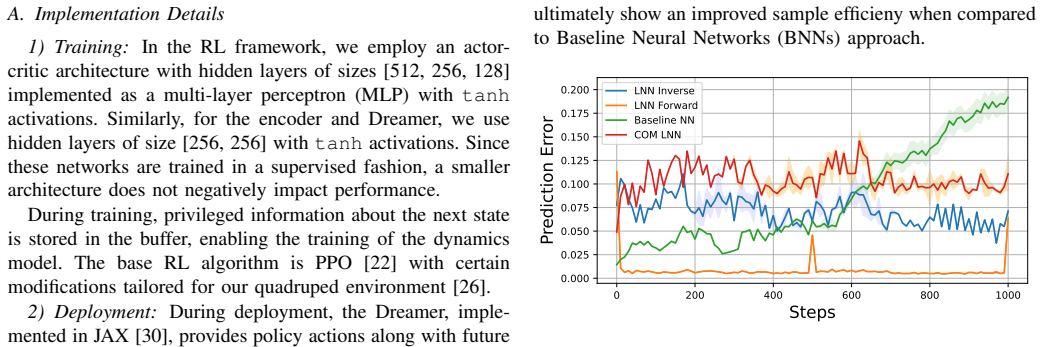
The central discovery is that a Lagrangian Neural Network that learns the mass-inertia matrix $M(q)=Y(q)Y(q)^T+\epsilon I$, rather than directly regressing future states, captures quadruped dynamics more efficiently and accurately than an MLP baseline within the paper's dreaming and planning loop. Across the four studied variants, the structured models show faster loss reduction per iteration, better forward prediction accuracy, and a 10x sample-efficiency improvement; the forward LNN attains the lowest prediction error, with inverse-dynamics-trained LNN close behind, and the diagonalized mass-matrix version provides the computational path to real-time receding horizon control while preserving physical interpretability.
Load-bearing premise
The real-time speed claim assumes that eigendecomposing the learned mass matrix at inference is cheaper than directly inverting or factorizing it, an assumption the paper states but does not measure.
Editorial extensions
If this is right
- An LNN-based dynamics model can replace the structure-agnostic MLP inside the planning loop and produce lower prediction error over long horizons.
- The diagonalized mass-matrix formulation makes forward-dynamics inference cheap enough to run inside a receding horizon controller on a quadruped.
- Training an LNN with inverse dynamics is a viable shortcut: it avoids some numerical issues of matrix inversion while keeping prediction accuracy close to the forward-LNN model.
- The torso-center-of-mass reduced LNN trades accuracy for speed and still behaves competitively with the baseline MLP.
- The observed 10x sample-efficiency improvement means less simulator data is needed to learn a usable quadruped dynamics model.
Reading between the lines
- The real-time speed claim actually depends on an unmeasured comparison: eigendecomposing the learned mass matrix at inference must be cheaper than inverting or factorizing it, and a wall-clock benchmark on the 18x18 matrix would decide this.
- Because inverse-dynamics training avoids the acceleration solve during learning, an obvious extension is to have the policy output accelerations or torques directly, which would remove the actuator-network conversion the authors flag as a bottleneck.
- Numerical eigendecomposition is not exact; a closed-loop test comparing the diagonalized acceleration equation against direct inversion would reveal whether eigenvector error degrades long-horizon predictions.
- The CoM-reduced LNN's error being close to the generic baseline suggests a hybrid planner could use the cheap CoM model for most of the horizon and the full-order LNN only at safety-critical steps.
Editorial analysis
A structured set of objections, weighed in public.
Referee Report
Summary. The paper presents an empirical study of four Lagrangian Neural Network (LNN) variants--full-order forward dynamics, diagonalized mass-matrix forward dynamics, inverse-dynamics training with forward-dynamics inference, and a reduced-order center-of-mass model--as learned dynamics models inside the PIP-Loco infinite-horizon planning framework for a simulated Unitree Go1 quadruped. The central claims are that physics-structured LNN dynamics are more sample-efficient (10x) and more accurate (up to 2-10x) than a structure-agnostic MLP baseline, and that diagonalizing the learned mass matrix reduces computational complexity, enabling real-time receding horizon control. The experiments reported are dynamics-loss curves, prediction-error curves, and controller inference-frequency box plots; no closed-loop planning results or wall-clock comparisons are provided.
Significance. If properly supported, the empirical comparison of LNN variants against an MLP baseline for quadruped dynamics would be a useful ablation, confirming that physics-inspired parameterizations can improve sample efficiency and prediction accuracy in a high-dimensional legged system. The paper also clearly identifies four distinct modeling choices that practitioners could adopt. However, the computational-efficiency claim is central to the abstract and is currently unsupported; the paper also does not evaluate the learned dynamics inside the actual planning loop or report closed-loop task performance. The contribution is therefore promising but not yet established at the level claimed.
major comments (3)
- [III.A, Eqs. (10)-(14)] The claimed computational speed-up from diagonalizing the mass matrix is not established and is likely incorrect as stated. Because M(q) = Y(q)Y(q)^T + epsilon*I is a learned matrix-valued function, the matrices P(q) and Lambda(q) must be obtained by a full symmetric eigendecomposition at every inference step, which is an O(n^3) operation with a larger constant than directly solving Eq. (8) via Cholesky factorization or a general linear solve. The statement that Lambda being diagonal makes its inverse cheap is mathematically true but does not reduce the dominant cost of computing the eigendecomposition. The paper provides no wall-clock comparison between Eq. (14) and direct inversion, and Figure 5 reports controller frequency, not the per-step cost of the dynamics prediction. Furthermore, Figure 4 omits the 'LNN Diagonalised' model entirely, so there is no evidence that the diagonalized variant preserves the prediction accuracy of the forward LNN. Since the abstract's 'real-time receding horizon control' claim rests on this computational argument, the authors must either provide a proper timing benchmark or remove the claim.
- [IV, Figures 3-4] The headline quantitative claims--10x sample efficiency, up to 2-10x prediction accuracy, and an average 85% reduction in prediction error--are not supported by any numerical data in the text. Figure 3 plots normalized loss on a logarithmic scale, but 'sample efficiency' is never defined operationally, no threshold crossing is reported, and no iteration counts are given. Figure 4 shows prediction-error curves without axis values, final errors, or per-model numbers, and the 'up to 85%' figure is not tied to a specific method or time step. Because these numbers appear in the abstract as experimental results, they should be backed by a table or explicit statistics, preferably with multiple seeds and error bars.
- [IV, Deployment Scheme] The paper does not evaluate the proposed dynamics models inside the infinite-horizon planning loop described by Eqs. (17)-(18). The experiments measure only dynamics prediction error and controller frequency, not closed-loop task performance such as tracking error, reward, or success rate in the PIP-Loco framework. The abstract's claims about 'infinite horizon planning' and 'real-time receding horizon control' therefore go beyond the evidence presented. A closed-loop comparison of LNN-based and BNN-based planning, or a clear repositioning of the paper as a dynamics-model-only study, is needed.
minor comments (5)
- [Abstract] The abstract states '10x' and '2-10x' without the qualifier 'up to,' which is inconsistent with the later 'up to 85%' phrasing; these claims should be precisely quantified or qualified.
- [IV, Inference Speed Analysis] The text says that physics-inspired approaches 'tend to have lower inference frequencies,' which appears in tension with the abstract's claim of a higher control frequency than previous LNN methods; please clarify which specific prior method is being compared and report the numerical frequencies.
- [Figure 5] The y-axis label 'Frequency' lacks units; please specify Hz or control-loop iterations per second, and describe what the 'candle plots' represent.
- [III.A, Eq. (15)] The inverse-dynamics training objective is trained with Eq. (15) but deployed with forward dynamics Eq. (8); the paper should comment on whether this train/inference mismatch affects stability, since the inverse-trained model never directly minimizes forward-dynamics prediction error.
- [IV, Results] There are several typographical and clarity issues: 'sample efficieny' should be 'sample efficiency,' the term 'candle plots' should be clarified, and Figure 3's normalization procedure should be defined in the caption or text.
Circularity Check
No significant circularity: the LNN-vs-BNN gains rest on independent baselines, and the diagonalization concern is an unsupported efficiency claim rather than a circular reduction.
full rationale
The paper's central quantitative claims—10x sample efficiency and up to 85% (2-10x) prediction-error improvement—are empirical comparisons between LNN variants and a structure-agnostic MLP (BNN) trained and evaluated on the same data. These numbers are not constructed from the LNN definition, and the BNN is an independent baseline, so the main comparison is not circular. Equations (6)-(8) are standard LNN constructions from prior external work [11], not self-referential definitions. The diagonalization step (Eqs. 10-14) is a mathematically valid spectral decomposition: Eq. 14 is algebraically equivalent to Eq. 8, and the paper's assertion that it 'reduces computational complexity and enables faster inference' is unsupported because eigendecomposing the learned mass matrix M(q) at inference is not obviously cheaper than direct inversion. That is a correctness/evidence gap, not a circularity. The only in-group citations—PIP-Loco [19], barrier reward [24], and MDR-MPC [16]—frame the deployment architecture and reward shaping, but the comparative LNN results stand independently of whether those cited works are correct; no load-bearing claim reduces to a self-citation. Overall, the derivation chain is not circular; the score reflects minor self-citation and an unverified speed-up premise, not a constructed equivalence.
Assumptions & free parameters
free parameters (3)
- Positive-definiteness regularizer epsilon in mass matrix (Eq 6)
- Learned network weights (LNN, state estimator, Dreamer, force estimator)
- Hidden layer sizes for actor-critic and encoder/Dreamer =
[512,256,128] and [256,256]
assumptions (6)
- standard math Euler-Lagrange equations govern the learned dynamics (Eq 8, Eq 12)
- domain assumption The learned mass matrix is positive definite via M = YY^T + epsilon*I (Eq 6)
- domain assumption Isaac Gym simulator provides ground-truth states for supervised training
- domain assumption A state estimator E_theta can recover the full 18-dimensional state q from partial observations (Eq 5)
- domain assumption The actuator network [23] converts commanded joint angles to torques accurately
- standard math Eigen-decomposition of a symmetric matrix yields P and Lambda and is a valid way to compute M^{-1} (Eq 10-11)
invented entities (1)
-
Learned external force estimator F_theta
Cite this review
Pith. "Pith review of Investigating Lagrangian Neural Networks for Infinite Horizon Planning in Quadrupedal Locomotion." pith.science (2026). https://pith.science/paper/KCUMCG4Q
@misc{pith2026250616079,
  author       = {Pith},
  title        = {Pith review of: Investigating Lagrangian Neural Networks for Infinite Horizon Planning in Quadrupedal Locomotion},
  year         = {2026},
  howpublished = {\url{https://pith.science/paper/KCUMCG4Q}},
  note         = {Machine review of arXiv:2506.16079}
}
read the original abstract
Lagrangian Neural Networks (LNNs) present a principled and interpretable framework for learning the system dynamics by utilizing inductive biases. While traditional dynamics models struggle with compounding errors over long horizons, LNNs intrinsically preserve the physical laws governing any system, enabling accurate and stable predictions essential for sustainable locomotion. This work evaluates LNNs for infinite horizon planning in quadrupedal robots through four dynamics models: (1) full-order forward dynamics (FD) training and inference, (2) diagonalized representation of Mass Matrix in full order FD, (3) full-order inverse dynamics (ID) training with FD inference, (4) reduced-order modeling via torso centre-of-mass (CoM) dynamics. Experiments demonstrate that LNNs bring improvements in sample efficiency (10x) and superior prediction accuracy (up to 2-10x) compared to baseline methods. Notably, the diagonalization approach of LNNs reduces computational complexity while retaining some interpretability, enabling real-time receding horizon control. These findings highlight the advantages of LNNs in capturing the underlying structure of system dynamics in quadrupeds, leading to improved performance and efficiency in locomotion planning and control. Additionally, our approach achieves a higher control frequency than previous LNN methods, demonstrating its potential for real-world deployment on quadrupeds.
Figures


Figures from the paper (2 more)


Reference graph
Works this paper leans on
- [1]
-
[2]
Neural ordinary differential equations,
R. T. Chen, Y . Rubanova, J. Bettencourt, and D. K. Duvenaud, “Neural ordinary differential equations,” Advances in neural information pro- cessing systems, vol. 31, 2018
2018
-
[3]
M. Raissi, P. Perdikaris, and G. E. Karniadakis, “Physics informed deep learning (part i): Data-driven solutions of nonlinear partial differential equations,” arXiv preprint arXiv:1711.10561 , 2017
arXiv 2017
-
[4]
M. Raissi, P. Perdikaris, and G. E. Karniadakis, “Physics informed deep learning (part ii): Data-driven discovery of nonlinear partial differential equations,” arXiv preprint arXiv:1711.10566 , 2017
arXiv 2017
-
[5]
Physics-informed neural networks: A deep learning framework for solving forward and inverse problems involving nonlinear partial differential equations,
M. Raissi, P. Perdikaris, and G. E. Karniadakis, “Physics-informed neural networks: A deep learning framework for solving forward and inverse problems involving nonlinear partial differential equations,” Journal of Computational Physics , vol. 378, pp. 686–707, 2019
2019
-
[6]
F. Djeumou, C. Neary, E. Goubault, S. Putot, and U. Topcu, “Neural net- works with physics-informed architectures and constraints for dynamical systems modeling,” 2022
work page 2022
-
[7]
M. Cranmer, S. Greydanus, S. Hoyer, P. Battaglia, D. Spergel, and S. Ho, “Lagrangian neural networks,” arXiv preprint arXiv:2003.04630 , 2020
arXiv 2003
-
[8]
Simplifying hamiltonian and lagrangian neural networks via explicit constraints,
M. Finzi, K. A. Wang, and A. G. Wilson, “Simplifying hamiltonian and lagrangian neural networks via explicit constraints,” Advances in neural information processing systems , vol. 33, pp. 13880–13889, 2020
work page 2020
Show all 30 references
-
[9]
Deconstructing the inductive biases of hamiltonian neural networks,
N. Gruver, M. Finzi, S. Stanton, and A. G. Wilson, “Deconstructing the inductive biases of hamiltonian neural networks,” 2022
2022
-
[10]
Simplifying hamiltonian and lagrangian neural networks via explicit constraints,
M. Finzi, K. A. Wang, and A. G. Wilson, “Simplifying hamiltonian and lagrangian neural networks via explicit constraints,” 2020
2020
-
[11]
Deep lagrangian networks: Using physics as model prior for deep learning,
M. Lutter, C. Ritter, and J. Peters, “Deep lagrangian networks: Using physics as model prior for deep learning,” in International Conference on Learning Representations , 2019
2019
-
[12]
Plan online, learn offline: Efficient learning and exploration via model- based control,
K. Lowrey, A. Rajeswaran, S. Kakade, E. Todorov, and I. Mordatch, “Plan online, learn offline: Efficient learning and exploration via model- based control,” arXiv preprint arXiv:1811.01848 , 2018
2018 arXiv
-
[13]
Learning off-policy with online planning,
H. Sikchi, W. Zhou, and D. Held, “Learning off-policy with online planning,” in Conference on Robot Learning , pp. 1622–1633, PMLR, 2022
2022
-
[14]
Making better decision by directly planning in continuous control,
J. Zhu, Y . Wang, L. Wu, T. Qin, W. gang Zhou, T.-Y . Liu, and H. Li, “Making better decision by directly planning in continuous control,” in International Conference on Learning Representations , 2023
2023
-
[15]
Model predictive actor-critic: Accelerating robot skill ac- quisition with deep reinforcement learning,
A. S. Morgan, D. Nandha, G. Chalvatzaki, C. D’Eramo, A. M. Dollar, and J. Peters, “Model predictive actor-critic: Accelerating robot skill ac- quisition with deep reinforcement learning,” in 2021 IEEE International Conference on Robotics and Automation (ICRA) , pp. 6672–6678, ...
2021
-
[16]
Dynamic mirror descent based model predictive control for accelerating robot learning,
U. A. Mishra, S. R. Samineni, P. Goel, C. Kunjeti, H. Lodha, A. Singh, A. Sagi, S. Bhatnagar, and S. Kolathaya, “Dynamic mirror descent based model predictive control for accelerating robot learning,” in 2022 International Conference on Robotics and Automation (ICRA) , pp. 163...
2022
-
[17]
Temporal difference learning for model predictive control,
N. Hansen, X. Wang, and H. Su, “Temporal difference learning for model predictive control,” arXiv preprint arXiv:2203.04955 , 2022
2022 arXiv
-
[18]
Td-mpc2: Scalable, robust world models for continuous control,
N. Hansen, H. Su, and X. Wang, “Td-mpc2: Scalable, robust world models for continuous control,” arXiv preprint arXiv:2310.16828, 2023
2023 arXiv
-
[19]
Pip-loco: A proprioceptive infinite horizon planning framework for quadrupedal robot locomotion,
A. Shirwatkar, N. Saxena, K. Chandra, and S. Kolathaya, “Pip-loco: A proprioceptive infinite horizon planning framework for quadrupedal robot locomotion,” 2024
2024
-
[20]
Model predictive path integral control using covariance variable importance sampling,
G. Williams, A. Aldrich, and E. Theodorou, “Model predictive path integral control using covariance variable importance sampling,” 2015
2015
-
[21]
Asymmetric actor critic for image-based robot learning,
L. Pinto, M. Andrychowicz, P. Welinder, W. Zaremba, and P. Abbeel, “Asymmetric actor critic for image-based robot learning,” arXiv preprint arXiv:1710.06542, 2017
2017 arXiv
-
[22]
Prox- imal policy optimization algorithms,
J. Schulman, F. Wolski, P. Dhariwal, A. Radford, and O. Klimov, “Prox- imal policy optimization algorithms,” arXiv preprint arXiv:1707.06347, 2017
2017 arXiv
-
[23]
Learning agile and dynamic motor skills for legged robots,
J. Hwangbo, J. Lee, A. Dosovitskiy, D. Bellicoso, V . Tsounis, V . Koltun, and M. Hutter, “Learning agile and dynamic motor skills for legged robots,” Science Robotics, vol. 4, no. 26, p. eaau5872, 2019
2019
-
[24]
Barrier functions inspired reward shaping for reinforcement learning,
Nilaksh, A. Ranjan, S. Agrawal, A. Jain, P. Jagtap, and S. Kolathaya, “Barrier functions inspired reward shaping for reinforcement learning,” in 2024 IEEE International Conference on Robotics and Automation (ICRA), pp. 10807–10813, 2024
2024
-
[25]
Dreamwaq: Learning robust quadrupedal locomotion with implicit terrain imagination via deep reinforcement learning,
I. M. A. Nahrendra, B. Yu, and H. Myung, “Dreamwaq: Learning robust quadrupedal locomotion with implicit terrain imagination via deep reinforcement learning,” in 2023 IEEE International Conference on Robotics and Automation (ICRA) , pp. 5078–5084, IEEE, 2023
2023
-
[26]
Hybrid internal model: Learning agile legged locomotion with simulated robot response,
J. Long, Z. Wang, Q. Li, L. Cao, J. Gao, and J. Pang, “Hybrid internal model: Learning agile legged locomotion with simulated robot response,” in The Twelfth International Conference on Learning Repre- sentations, 2024
2024
-
[27]
Isaac gym: High performance gpu-based physics simulation for robot learning,
V . Makoviychuk, L. Wawrzyniak, Y . Guo, M. Lu, K. Storey, M. Macklin, D. Hoeller, N. Rudin, A. Allshire, A. Handa, and G. State, “Isaac gym: High performance gpu-based physics simulation for robot learning,” 2021
2021
-
[28]
Learning to walk in minutes using massively parallel deep reinforcement learning,
N. Rudin, D. Hoeller, P. Reist, and M. Hutter, “Learning to walk in minutes using massively parallel deep reinforcement learning,” in Conference on Robot Learning , pp. 91–100, PMLR, 2022
2022
-
[29]
Automatic differentiation in pytorch,
A. Paszke, S. Gross, S. Chintala, G. Chanan, E. Yang, Z. DeVito, Z. Lin, A. Desmaison, L. Antiga, and A. Lerer, “Automatic differentiation in pytorch,” 2017
2017
-
[30]
JAX: composable transformations of Python+NumPy pro- grams,
J. Bradbury, R. Frostig, P. Hawkins, M. J. Johnson, C. Leary, D. Maclau- rin, G. Necula, A. Paszke, J. VanderPlas, S. Wanderman-Milne, and Q. Zhang, “JAX: composable transformations of Python+NumPy pro- grams,” 2018
2018
Reviewed August 6, 2026 · model on record in the stance chip above.
Discussion (0). Sign in to comment.