REVIEW 3 major objections 5 minor 52 references
Bias hardened estimators of patchy screening profiles
T0 review · 3 major / 5 minor · reviewed 2026-08-15 · deepseek-v4-flash
Pith's one-line read Lensing bias in stacked patchy-screening profiles can be nulled or accurately modeled, making robust gas-profile measurements possible.
desk verdict The hardening formalism is the real contribution and it holds up; the ACT×unWISE upper bound is the soft part because it leans on an unvalidated high-L Cκg model. read the letter →
The pith
A machine-rendered reading of the paper's core claim, the machinery that carries it, and where it could break.
The reading
What carries the argument
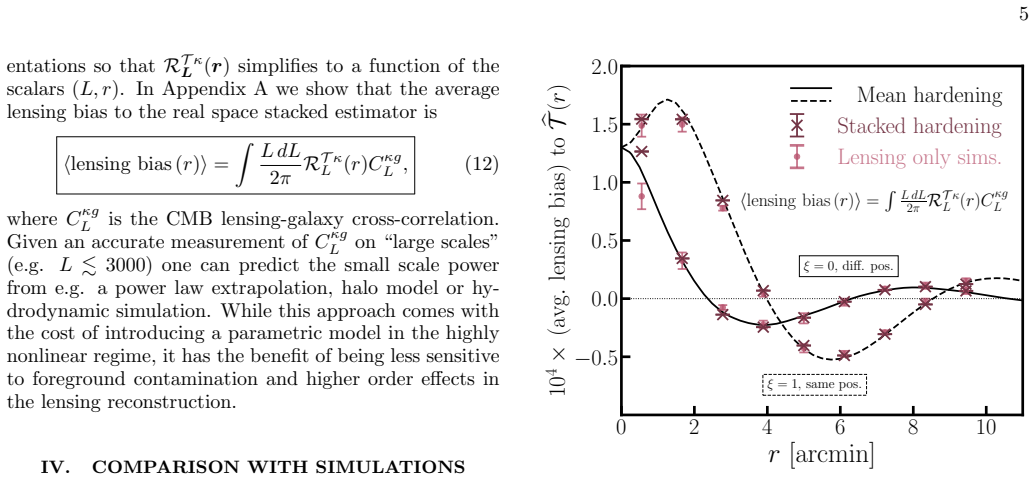
The load-bearing object is the pair of linear response functions of the CMB temperature covariance: $f^\tau_{\ell,L-\ell}=-(C^{TT}_\ell+C^{TT}_{|L-\ell|})$ for patchy screening and $f^\kappa_{\ell,L-\ell}=2\frac{L}{L^2}\cdot[\ell C^{TT}_\ell+(L-\ell)C^{TT}_{|L-\ell|}]$ for lensing. These kernels specify how a fixed optical-depth or convergence mode creates off-diagonal covariance, so the estimator design problem is to choose weights $F_{\ell,L-\ell}$ that respond to $\tau$ and are blind to $\kappa$. The paper transfers that logic to the real-space stacked estimator through a stacked response $R^{T\kappa}_L(r)$, which turns a convergence estimate into a radial lensing bias, and to mean hardening through the integral $\langle\mathrm{lensing\ bias}\rangle(r)=\int\frac{L\,dL}{2\pi}R^{T\kappa}_L(r)C^{\kappa g}_L$. The response formalism also shows that the signed-and-thresholded estimator has the same leading-order lensing response as the standard stacked estimator, so hardening applies unchanged to that variant.
What would settle it
Run the hardened stacked estimator on simulated lensed CMB maps that contain a known injected screening signal and also on maps with no screening; if the screening-free hardened profile deviates from zero beyond the noise, or if the residual matches the quadratic lensing response function, then linear-order hardening is insufficient.
Extended reading notes
Core claim
The central claim is that the lensing contamination of stacked patchy-screening estimators can be nulled or accurately modeled. Lensing changes the CMB covariance through a known linear response kernel $f^\kappa_{\ell,L-\ell}$, and by choosing quadratic weights that are normalized to the screening response $f^\tau_{\ell,L-\ell}$ but orthogonal to $f^\kappa$, the paper constructs a lens-hardened estimator whose stacked profile is unbiased. For the real-space long-short split estimator, the same logic runs through an effective response $R^{T\kappa}_L(r)$ that converts any unbiased convergence estimate into a predicted radial lensing bias, and in the mean-hardening variant the convergence map is replaced by the lensing-galaxy cross-spectrum $C^{\kappa g}_L$. The paper validates both approaches against lensed CMB simulations with mock LRG-like galaxies, finding that both track the lensing-only simulated profile. Applying mean hardening to the published unWISE stacked measurement yields a screened profile consistent with zero, with an upper bound $\tau_0<1.1\times10^{-4}$ at 68% confidence.
Load-bearing premise
The load-bearing premise is that the leading-order (linear) lensing effect is the dominant contamination, with higher-order lensing and extragalactic foregrounds small enough to ignore; for the unWISE upper bound, one must also trust the predicted galaxy-lensing correlation on small angular scales where it has not been directly measured.
Editorial extensions
If this is right
- Stacked patchy-screening profiles can be measured without the lensing bias for any galaxy tracer, using either field-level or stacked hardening.
- Mean hardening lets surveys with only large-scale lensing maps predict and subtract the dominant small-scale lensing bias from a stacked profile.
- The signed-and-thresholded estimator used in earlier work has the same leading-order lensing response, so its measurements can be interpreted and corrected with the same formalism.
- The published unfiltered ACT times unWISE profile is consistent with lensing bias alone; after subtraction, the screening signal is bounded by $\tau_0<1.1\times10^{-4}$ at 68% confidence.
- Lower-mass galaxy samples, having weaker clustering, will show a larger relative lensing bias, so bias hardening becomes more necessary for future surveys.
Reading between the lines
- Editorial inference: because the linear-response argument is independent of the weighting function, the same hardening logic should transfer to other quadratic stacked estimators, such as kinematic Sunyaev-Zel'dovich or cluster-lensing profiles, provided the relevant response kernels are re-derived.
- Editorial inference: the recommendation to evaluate the long and short maps at identical positions shrinks the lensing response on scales $L\gtrsim3000$, so this choice may reduce the need for hardening even before any subtraction is applied.
- Editorial inference: a direct small-scale measurement of the galaxy-CMB-lensing correlation would replace the extrapolated cross-spectrum in mean hardening and make the unWISE upper bound model-independent.
- Editorial inference: future high-resolution lensing maps could turn mean hardening into stacked or field-level hardening on the same data, which would test the parametric extrapolation by comparing the two debiased profiles.
Signed reviews
Editorial analysis
A structured set of objections, weighed in public.
Referee Report
Summary. This paper addresses the problem of CMB lensing contamination in stacked estimators of patchy screening (the 'blurring' Sunyaev-Zel'dovich effect). The authors derive the linear response of a general class of stacked estimators to lensing and present three mitigation strategies: field-level bias hardening via a constrained minimum-variance quadratic estimator; stacked hardening, in which an external convergence estimate is filtered by the stacked estimator's lensing response and subtracted; and mean hardening, in which the average lensing bias is computed from a model for the lensing-galaxy cross-spectrum Ckg_L. The field-level and stacked methods are validated against lensed CMB simulations built from AbacusSummit, showing that both reproduce the simulated lensing bias profile. The mean-hardening method is then applied to ACT DR6 temperature maps stacked on unWISE galaxies; the predicted lensing bias dominates the raw profile, and after subtraction the authors obtain no detection of patchy screening, quoting a 68% upper bound of tau0 < 1.1e-4 for a Gaussian electron profile with 2 arcmin FWHM.
Significance. If the results hold, the paper provides a practical route to unbiased stacked screening measurements for any large-scale structure tracer, removing what would otherwise be a dominant systematic. The analytic derivations in Sec. III and Appendices A-C are careful and self-contained, and the hardening methods themselves introduce no free parameters. The simulation comparison in Sec. IV, although partly delegated to the companion paper, provides a non-trivial validation of the subtraction prescription against lensed maps with no screening signal. The ACT x unWISE application is a useful demonstration that the expected lensing bias indeed dominates the raw stacked profile, and the resulting upper bound is consistent with expectations from recent kSZ measurements. The main weakness is that the unWISE bound rests on a small-scale model of Ckg_L that is not currently validated against data.
major comments (3)
- [§V, Eq. (12), Fig. 4] The ACT x unWISE no-detection conclusion and the tau0 < 1.1e-4 bound in §V rest on the mean-hardening estimate of Eq. (12), which uses Ckg_L obtained from the Kaiser-Limber approximation, a linear bias model, and the Aemulus nu matter power spectrum. As shown in Fig. 2, the lensing response RTkappa_L(r) for the xi=0 configuration used for unWISE is non-negligible up to L ~ 8000, while §III C notes that ACT DR6 lensing is reliable only to L ~ 3000. The paper does not compare this model with a measured unWISE x lensing cross-spectrum, and it does not propagate any uncertainty from the L > 3000 extrapolation. If the true Ckg_L differs from the model by tens of percent on these scales, the residual lensing bias could mimic or hide a screening signal at the level of the quoted bound. The authors should quantify this sensitivity, for example by varying the linear bias, magnification bias, and nonlinear matter power within plausible ranges and recomputing the profile and upper bound, or by validating Ckg_L against an external cross-correlation measurement.
- [§IV, Fig. 3, companion paper [13]] The central simulation validation of stacked and mean hardening is presented in Fig. 3, but the measurement of the lensed-CMB stacked profile (the 'lensing only sims.' curve) is delegated to the companion paper [13], cited as arXiv:2411.XXXX with no further details. The description in §IV specifies the filters and beam, but the construction of the lensed CMB maps, the galaxy catalog, the bandpower window used for binning, and the 0.5 arcmin smoothing applied in stacked hardening are not described here. Since the agreement between the predicted and simulated lensing biases is the empirical basis for the central claim, the authors should either include these details in the present paper or provide the actual arXiv number of the companion paper so that the validation can be audited.
- [Appendix A, Eq. (A13), §VI] Higher-order lensing contributions and extragalactic foregrounds are acknowledged as unquantified (Eq. A13 and §VI). For the stacked and mean-hardening validation this is a reasonable leading-order treatment, but for the ACT x unWISE upper bound the same statement applies: the bound assumes that the quadratic-order lensing term and foreground contamination are subdominant relative to the quoted 68% limit. The authors should state, even approximately, the expected size of these terms for the unWISE analysis (for example, the post-Born or foreground bias to the stacked profile compared with the tau0 < 1.1e-4 bound), or explicitly rescope the claim to be conditional on these terms being negligible.
minor comments (5)
- [References, [13]] Reference [13] is cited as arXiv:2411.XXXX throughout; the final arXiv number should be inserted before publication.
- [§V, text near Eq. (5)] The sentence 'the long map Tl appearing the numerator of Eq. (5)' should read 'appearing in the numerator'.
- [Fig. 3] The units of the y-axis label '10^4 x (avg. lensing bias) to T-hat(r)' are not defined; please state that the profile T-hat is dimensionless and that the vertical axis is the lensing bias scaled by 10^4.
- [Appendix B, Fig. 5] In Appendix B, the contour deformation for the Fourier transform of the signed and thresholded weight is described verbally and illustrated in Fig. 5; a one-line statement of the convergence condition (e.g., the sign of Im(T) required for omega > 0) would improve readability.
- [§IV, mean-hardening implementation] The practical details of the mean-hardening implementation, specifically how the bandpower window is applied to the smooth prediction in Eq. (12) before comparing with the binned profile, are mentioned only in the figure caption; a brief description in the text would make the comparison reproducible.
Circularity Check
No circularity: the hardening derivation is self-contained; the ACT×unWISE lensing-bias estimate is an externally calibrated cross-check, not a fitted prediction.
full rationale
The formal derivation is self-contained: Eq. (2) defines the patchy-screening response, Eq. (6) the lensing response, Eq. (8) follows from constrained minimization, and Eqs. (11)-(12) are linear-response integrals derived in Appendix A. The simulation test in Fig. 3 compares the predicted bias to a direct lensing-only stack; using the simulated convergence map and the simulated Ckg is a controlled test of the response formula, not a fit of that formula to the target profile. The ACT×unWISE application (Sec. V) models Ckg from Kaiser-Limber, linear bias, and Aemulus with parameters taken from [37,43,45]; these are external measurements, and no parameter is fit to the ACT×unWISE screening profile. The 'no detection' statement is therefore a consistency check, not a tautology. Limitations exist: the Sec. IV baseline is delegated to same-author companion [13] cited only as arXiv:2411.XXXX, so Fig. 3 is not independently auditable from this manuscript, and the L>3000 Ckg extrapolation is unvalidated; these affect confidence, not circularity. No step reduces by construction to its own input.
Assumptions & free parameters
free parameters (4)
- tau0 (Gaussian electron-profile peak) =
< 1.1e-4 at 68% CL (upper limit)
- Gaussian profile FWHM =
2 arcmin (fixed)
- Long-short filter transition scales =
2000, 2150, 2350, 2500 (Eq. 13)
- Beam FWHM for unWISE =
1.6 arcmin
assumptions (7)
- domain assumption Flat-sky approximation used throughout (Sec. I notation).
- domain assumption Thomson optical depth tau is small, so T = e^-tau T0 approximately T0 - tau T0 (Eq. 1).
- standard math Primary CMB is Gaussian; lensed CMB is Gaussian for fixed lensing realization, so Wick's theorem applies (Appendix A).
- domain assumption Long and short filters are disjoint, Wl Ws = 0, so the full-sky mean field vanishes.
- domain assumption The convergence estimate used in stacked hardening is an unbiased estimate of kappa with negligible response to tau (Rkappa tau -> 0 in Eq. 8).
- domain assumption Mean hardening assumes the Kaiser-Limber approximation, a linear bias model, and the Aemulus nu non-linear matter power spectrum describe Ckg on small scales.
- standard math The signed-thresholded weight function W[T] has a Fourier transform, computed by contour deformation in Appendix B.
Cite this review
Pith. "Pith review of Bias hardened estimators of patchy screening profiles." pith.science (2026). https://pith.science/paper/USWJNR7D
@misc{pith2026250617217,
  author       = {Pith},
  title        = {Pith review of: Bias hardened estimators of patchy screening profiles},
  year         = {2026},
  howpublished = {\url{https://pith.science/paper/USWJNR7D}},
  note         = {Machine review of arXiv:2506.17217}
}
read the original abstract
Detecting anisotropic screening of the cosmic microwave background (CMB) holds the promise of revealing the distribution of gas in the Universe, characterizing the complex processes of galaxy formation and feedback, and studying the epoch of reionization. Estimators for inhomogeneous screening, including some recently proposed small-scale (stacked) estimators, are quadratic or higher order in the CMB temperature or polarization fields and are therefore subject to contamination from CMB lensing. We review the origin of this lensing bias and show that, when stacking on unWISE galaxies, the expected lensing bias dominates the signal if left unmitigated. Hardening techniques that null the lensing bias have been proposed for standard quadratic estimators, whereas only approximate methods have been proposed for stacked estimators. We review these techniques and apply the former to stacked estimators, presenting several strategies (including the optimal strategy) to null lensing contamination when stacking on any large-scale structure (LSS) tracer.
Figures


Figures from the paper (2 more)


Reference graph
Works this paper leans on
-
[13]
B. Hadzhiyska, N. Sailer, and S. Ferraro, Mapping the gas density with the kinematic Sunyaev-Zel’dovich and patchy screening effects: a self-consistent comparison , arXiv:2411.XXXX
-
[1]
R. A. Sunyaev and I. B. Zeldovich, Intergalactic Gas in Clusters of Galaxies, the Microwave Background, and Cosmology, Astrophys. Space Phys. Res. 1 (Jan., 1981) 1
work page 1981
- [2]
- [3]
-
[4]
ACT, DESI Collaboration, B. Hadzhiyska et al., Evidence for large baryonic feedback at low and intermediate redshifts from kinematic Sunyaev-Zel’dovich observations with ACT and DESI photometric galaxies, arXiv:2407.07152
-
[5]
C. Dvorkin and K. M. Smith, Reconstructing Patchy Reionization from the Cosmic Microwave Background , Phys. Rev. D 79 (2009) 043003, [ arXiv:0812.1566]
arXiv 2009
-
[6]
M. Su, A. P. S. Yadav, M. McQuinn, et al., An Improved Forecast of Patchy Reionization Reconstruction with CMB, arXiv e-prints (June, 2011) arXiv:1106.4313, [arXiv:1106.4313]
arXiv 2011
-
[7]
Bias hardened estimators of patchy screening profiles
and the gas around late-time galaxies [8]. Following similar work for estimators of the kSZ ef- fect [2, 9] and cluster lensing [10], stacking estimators for τ from patchy screening were proposed by refs. [11, 12]. ∗ nsailer@berkeley.edu 1 Ref. [6] also derives a lensing estimator that is unbiased to patchy screening. These stacked estimators are quadrati...
work page Pith review arXiv 2025
Show all 52 references
-
[8]
A. Roy, A. van Engelen, V. Gluscevic, and N. Battaglia, Probing the Circumgalactic Medium with Cosmic Microwave Background Polarization Statistical Anisotropy, Astrophys. J. 951 (2023), no. 1 50, [arXiv:2201.05076]
2023 arXiv
-
[9]
M. Li, R. E. Angulo, S. D. M. White, and J. Jasche, Matched filter optimization of kSZ measurements with a reconstructed cosmological flow field, Mon. Not. Roy. Astron. Soc. 443 (2014), no. 3 2311–2326, [arXiv:1404.0007]
2014 arXiv
-
[10]
large scales
In light gray we plot the CMB lensing cross-correlation measured from the AbacusSummit simulations for a DESI LRG-like set of mock galaxies [13]. The dotted line shows the product of the high-pass filter, the beam BL and the Bessel function of the first kind J0(Lr). C. Mean ha...
2000
-
[11]
Gluscevic, M
V. Gluscevic, M. Kamionkowski, and D. Hanson, Patchy screening of the cosmic microwave background by inhomogeneous reionization, Phys. Rev. D 87 (Feb.,
-
[12]
ACT Collaboration, W. R. Coulton et al., The Atacama Cosmology Telescope: Detection of Patchy Screening of the Cosmic Microwave Background , arXiv:2401.13033
-
[14]
Horowitz, S
B. Horowitz, S. Ferraro, and B. D. Sherwin, Reconstructing Small Scale Lenses from the Cosmic Microwave Background Temperature Fluctuations, Mon. Not. Roy. Astron. Soc. 485 (2019), no. 3 3919–3929, [arXiv:1710.10236]
2019 arXiv
-
[15]
Schutt, A
T. Schutt, A. S. Maniyar, E. Schaan, et al., New temperature inversion estimator to detect CMB patchy screening by large-scale structure, Phys. Rev. D 109 (2024), no. 10 103539, [ arXiv:2401.13040]
2024 arXiv
-
[16]
Planck Collaboration, P. A. R. Ade et al., Planck 2015 results. XVI. Isotropy and statistics of the CMB , Astron. Astrophys. 594 (2016) A16, [ arXiv:1506.07135]
2016 arXiv
-
[17]
Lokken et al., Superclustering with the Atacama Cosmology Telescope and Dark Energy Survey
ACT, DES Collaboration, M. Lokken et al., Superclustering with the Atacama Cosmology Telescope and Dark Energy Survey. I. Evidence for Thermal Energy Anisotropy Using Oriented Stacking , Astrophys. J. 933 (2022), no. 2 134, [ arXiv:2107.05523]
2022 arXiv
-
[18]
Hu and T
W. Hu and T. Okamoto, Mass Reconstruction with Cosmic Microwave Background Polarization , Astrophys. J. 574 (Aug., 2002) 566–574, [ astro-ph/0111606]
2002 arXiv
-
[19]
Battaglia, J
N. Battaglia, J. R. Bond, C. Pfrommer, and J. L. Sievers, On the Cluster Physics of Sunyaev-Zel’dovich and X-Ray Surveys. I. The Influence of Feedback, Non-thermal Pressure, and Cluster Shapes on Y-M Scaling Relations, Astrophys. J. 758 (Oct., 2012) 74, [arXiv:1109.3709]
2012 arXiv
-
[20]
Namikawa, D
T. Namikawa, D. Hanson, and R. Takahashi, Bias-hardened CMB lensing, Mon. Not. R. Astron. Soc. 431 (May, 2013) 609–620, [arXiv:1209.0091]
2013 arXiv
-
[21]
Namikawa and R
T. Namikawa and R. Takahashi, Bias-Hardened CMB Lensing with Polarization , Mon. Not. Roy. Astron. Soc. 438 (2014), no. 2 1507–1517, [ arXiv:1310.2372]
2014 arXiv
-
[22]
Lokken et al., Superclustering with the Atacama Cosmology Telescope and Dark Energy Survey: II
ACT, DES Collaboration, M. Lokken et al., Superclustering with the Atacama Cosmology Telescope and Dark Energy Survey: II. Anisotropic large-scale coherence in hot gas, galaxies, and dark matter , arXiv:2409.04535
-
[23]
Lewis and A
A. Lewis and A. Challinor, Weak gravitational lensing of the CMB, Phys. Rep. 429 (June, 2006) 1–65, [astro-ph/0601594]
2006 arXiv
-
[24]
Namikawa, A
T. Namikawa, A. Roy, B. D. Sherwin, et al., Constraining reionization with the first measurement of the cross-correlation between the CMB optical-depth fluctuations and the Compton y-map , Phys. Rev. D 104 (2021), no. 6 063514, [ arXiv:2102.00975]
2021 arXiv
-
[25]
Sailer, S
N. Sailer, S. Ferraro, and E. Schaan, Foreground-immune CMB lensing reconstruction with polarization , Phys. Rev. D 107 (Jan., 2023) 023504, [ arXiv:2211.03786]
2023 arXiv
-
[26]
S. J. Osborne, D. Hanson, and O. Dor´ e, Extragalactic foreground contamination in temperature-based CMB lens reconstruction, J. Cosm. Astrop. Phys. 2014 (Mar., 2014) 024, [ arXiv:1310.7547]
2014 arXiv
-
[27]
Sailer, E
N. Sailer, E. Schaan, and S. Ferraro, Lower bias, lower noise CMB lensing with foreground-hardened estimators , Phys. Rev. D 102 (2020), no. 6 063517, [arXiv:2007.04325]
2020 arXiv
-
[28]
Bianchini and M
F. Bianchini and M. Millea, Inference of gravitational lensing and patchy reionization with future CMB data , Phys. Rev. D 107 (2023), no. 4 043521, [arXiv:2210.10893]
2023 arXiv
-
[29]
S. Saha, L. Legrand, and J. Carron, Cluster profiles from beyond-the-QE CMB lensing mass maps , J. Cosm. Astrop. Phys. 2024 (Jan., 2024) 024, [arXiv:2307.11711]
2024 arXiv
-
[30]
W. Hu, S. DeDeo, and C. Vale, Cluster mass estimators from CMB temperature and polarization lensing , New Journal of Physics 9 (Dec., 2007) 441, [astro-ph/0701276]
2007 arXiv
-
[31]
Millea and U
M. Millea and U. Seljak, Marginal unbiased score expansion and application to CMB lensing , Phys. Rev. D 105 (2022), no. 10 103531, [ arXiv:2112.09354]
2022 arXiv
-
[32]
D. Beck, G. Fabbian, and J. Errard, Lensing Reconstruction in Post-Born Cosmic Microwave Background Weak Lensing, Phys. Rev. D 98 (2018), no. 4 043512, [ arXiv:1806.01216]
2018 arXiv
-
[33]
F. J. Qu, B. D. Sherwin, M. S. Madhavacheril, et al., The Atacama Cosmology Telescope: A Measurement of the DR6 CMB Lensing Power Spectrum and Its Implications for Structure Growth , Astrophys. J. 962 (Feb., 2024) 112, [arXiv:2304.05202]
2024 arXiv
-
[34]
van Engelen, S
A. van Engelen, S. Bhattacharya, N. Sehgal, et al., CMB Lensing Power Spectrum Biases from Galaxies and Clusters Using High-angular Resolution Temperature Maps, Astrophys. J. 786 (May, 2014) 13, [arXiv:1310.7023]. 8
2014 arXiv
-
[35]
Ferraro and J
S. Ferraro and J. C. Hill, Bias to CMB lensing reconstruction from temperature anisotropies due to large-scale galaxy motions, Phys. Rev. D 97 (Jan., 2018) 023512, [arXiv:1705.06751]
2018 arXiv
-
[36]
Taylor, Methodus Incrementorum Directa et Inversa
B. Taylor, Methodus Incrementorum Directa et Inversa . Typis Gul. Innys, London, 1715
-
[37]
standard
for the individual blue and green samples. The nu- merical implementation of theCκg L calculation is identical to that used in [46, 47]. We assume that the short map is convolved with a 1.6 arcmin beam and evaluate Tl at the galaxy center, corresponding to ξ = 0 in Eq. (5). We...
-
[38]
F. J. Qu, M. Millea, and E. Schaan, Impact & Mitigation of Polarized Extragalactic Foregrounds on Bayesian Cosmic Microwave Background Lensing , arXiv:2406.15351
-
[39]
Hadzhiyska, L
B. Hadzhiyska, L. H. Garrison, D. Eisenstein, and S. Bose, The halo light-cone catalogues of ABACUSSUMMIT, Mon. Not. R. Astron. Soc. 509 (Jan., 2022) 2194–2208, [ arXiv:2110.11413]
2022 arXiv
-
[40]
Kaiser, Weak Gravitational Lensing of Distant Galaxies, Astrophys
N. Kaiser, Weak Gravitational Lensing of Distant Galaxies, Astrophys. J. 388 (Apr., 1992) 272
1992
-
[41]
Krolewski, S
A. Krolewski, S. Ferraro, E. F. Schlafly, and M. White, unWISE tomography of Planck CMB lensing , JCAP 05 (2020) 047, [ arXiv:1909.07412]
2020 arXiv
-
[42]
E. F. Schlafly, A. M. Meisner, and G. M. Green, The unWISE Catalog: Two Billion Infrared Sources from Five Years of WISE Imaging , Astrophys. J. Supp. 240 (Feb., 2019) 30, [arXiv:1901.03337]
2019 arXiv
-
[43]
D. N. Limber, The Analysis of Counts of the Extragalactic Nebulae in Terms of a Fluctuating Density Field., Astrophys. J. 117 (Jan., 1953) 134
1953
-
[44]
Aghanim et al., Planck 2018 results
Planck Collaboration, N. Aghanim et al., Planck 2018 results. VI. Cosmological parameters, Astron. Astrophys. 641 (2020) A6, [ arXiv:1807.06209]. [Erratum: Astron.Astrophys. 652, C4 (2021)]
2020 arXiv
-
[45]
LoVerde and N
M. LoVerde and N. Afshordi, Extended Limber Approximation, Phys. Rev. D 78 (2008) 123506, [arXiv:0809.5112]
2008 arXiv
-
[46]
DeRose, N
J. DeRose, N. Kokron, A. Banerjee, et al., Aemulusν: precise predictions for matter and biased tracer power spectra in the presence of neutrinos , JCAP 07 (2023) 054, [arXiv:2303.09762]
2023 arXiv
-
[47]
G. S. Farren, A. Krolewski, N. MacCrann, et al., The Atacama Cosmology Telescope: Cosmology from Cross-correlations of unWISE Galaxies and ACT DR6 CMB Lensing, Astrophys. J. 966 (May, 2024) 157, [arXiv:2309.05659]
2024 arXiv
-
[49]
Krolewski, S
A. Krolewski, S. Ferraro, and M. White, Cosmological constraints from unWISE and Planck CMB lensing tomography, JCAP 12 (2021), no. 12 028, [arXiv:2105.03421]
2021 arXiv
-
[50]
J. Kim et al., The Atacama Cosmology Telescope DR6 and DESI: structure formation over cosmic time with a measurement of the cross-correlation of CMB lensing and luminous red galaxies , JCAP 12 (2024) 022, [arXiv:2407.04606]
2024 arXiv
-
[51]
Sailer et al., Cosmological constraints from the cross-correlation of DESI Luminous Red Galaxies with CMB lensing from Planck PR4 and ACT DR6 , arXiv:2407.04607
N. Sailer et al., Cosmological constraints from the cross-correlation of DESI Luminous Red Galaxies with CMB lensing from Planck PR4 and ACT DR6 , arXiv:2407.04607. Appendix A: Response functions of more general stacked estimators We define a more general stacked patchy screen...
-
[52]
mean field
Perturbative expansion To compute the response of bT to lensing at a given order, we Taylor expand ⟨TℓTL−ℓ⟩′ around a fixed lensing realization ⟨TℓTL−ℓ⟩′ = (2π)2δD LC0 ℓ +fκ ℓ,L−ℓκL + ∞X n=1 Z ℓ1···ℓn fκn+1 ℓ,L−ℓ,ℓ1,···,ℓn κℓ1··· κℓnκL−ℓ1n , (A8) and collect all terms in Eq. (...
-
[2013]
047303, [ arXiv:1210.5507]
Reviewed August 15, 2026 · model on record in the stance chip above.
Discussion (0). Continue with ORCID to comment.