REVIEW 3 major objections 5 minor 61 references
Dynamics of Multiphase Carbon in the Turbulent Circumgalactic Medium
T0 review · 3 major / 5 minor · reviewed 2026-08-15 · deepseek-v4-flash
Pith's one-line read Turbulence sets where carbon sits in the circumgalactic medium; radiation sets what charge it carries.
desk verdict Useful species-resolved turbulence study, but the central spatial/ionization decomposition is overstated: radiation reshapes C IV clustering almost as much as turbulence does. read the letter →
The pith
A machine-rendered reading of the paper's core claim, the machinery that carries it, and where it could break.
The reading
What carries the argument
The central machinery is a suite of three-dimensional hydrodynamic simulations of a $512^3$ periodic box, $10\,\mathrm{kpc}$ on a side, filled with gas at uniform density and driven by solenoidal turbulence. The simulations evolve a 65-ion non-equilibrium chemistry network for hydrogen, helium, carbon, nitrogen, oxygen, neon, sodium, magnesium, silicon, sulfur, calcium, and iron, including photoionization by a UV background, and are run with and without the background to isolate its effect. The load-bearing diagnostics are power spectra: the kinetic energy spectrum $E_v(k)$ and the density spectrum $P_n(k)$ for the total gas and for C I, C II, and C IV separately, together with two-dimensional probability distributions of species density versus total density and versus the squared viscous dissipation rate $\Phi = \Phi_c + \Phi_s$. Because the hydrodynamics and chemistry are invariant under the rescaling $x\to\lambda x$, $t\to\lambda t$, $\rho\to\rho/\lambda$, the results depend only on $nL$, $\sigma_{1D}$, and the ionization parameter $U$, so the box can stand in for CGM gas of different density.
What would settle it
In quasar absorption-line data, measure whether C IV absorption is less spatially clustered than C II at fixed column density, as the model predicts when a UV background is present; if C IV is found to be as clustered as C II in dense gas, the predicted recombination-driven anti-correlation at high density is wrong.
Extended reading notes
Core claim
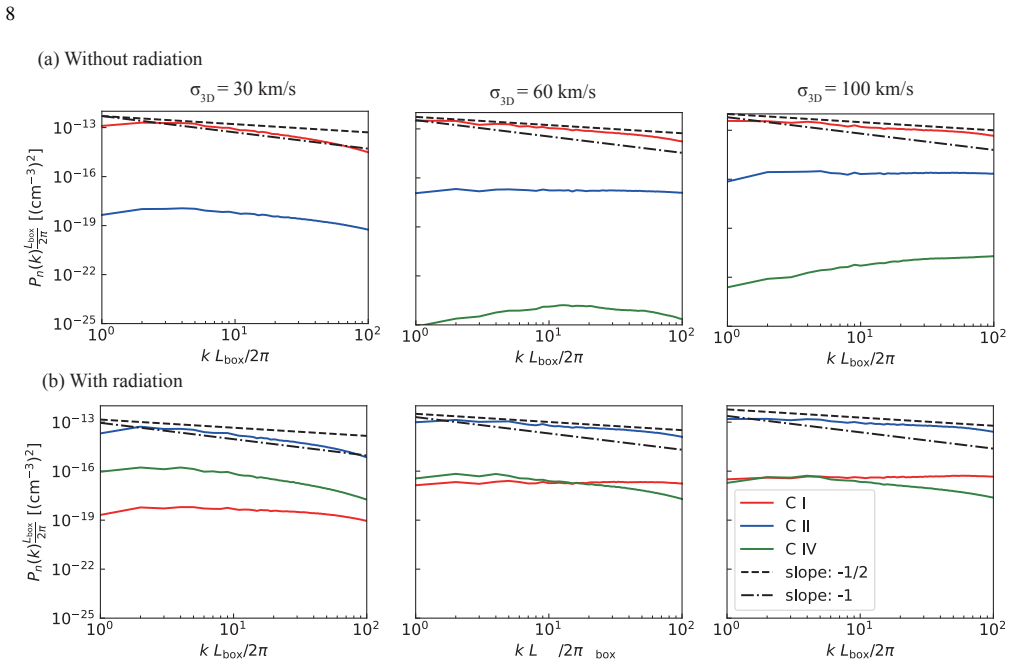
On the paper's own terms, the discovery is a clean division of labor. In the turbulent CGM, turbulence controls where each carbon species is found: at velocity dispersions from 30 to 100 km/s, the gas becomes more filamentary, small-scale density fluctuations grow, and the total kinetic energy spectrum shifts from a Kolmogorov slope near $-5/3$ to a Burgers slope near $-2$, signaling shock-dominated dissipation. C II and C IV form preferentially in shock-heated, high-dissipation regions, and their density fields track the filamentary total-density field. Radiation then controls what fraction of carbon is in each ionization state: with an ionization parameter $U=10^{-3}$, most carbon becomes C II, C IV abundance rises enormously (about $10^{16}$ times relative to the no-radiation case), and C IV is biased toward low-density gas because recombination destroys it more rapidly in dense regions. The combination produces a bimodal density-C IV relation that is the paper's most distinctive signature of the turbulence-radiation interplay.
Load-bearing premise
The results assume the CGM behaves as a uniform gas cube in which turbulence is driven only by vortex motion, with no magnetic fields, gravity, or galactic outflows; if real CGM turbulence is driven by compression or affected by magnetic fields, the predicted patterns may not hold in actual halos.
Editorial extensions
If this is right
- At high turbulent velocity dispersion, the CGM density field becomes filamentary and its power spectrum flattens, so absorption-line components should appear more clustered on small scales as turbulence strengthens.
- Without a UV background, C IV is essentially absent ($\lesssim 10^{-20}\,\mathrm{cm^{-3}}$ even at 100 km/s), so any strong C IV detection implies either a substantial ionizing background or additional heating beyond solenoidal turbulence.
- With a UV background, C IV traces low-density gas, so the ratio of C IV to C II column density is not a simple density tracer; it encodes the local competition between photoionization and recombination.
- The kinetic energy spectrum's transition from Kolmogorov to Burgers scaling marks shock-dominated dissipation as a key heating mechanism, meaning turbulence itself can create ionized carbon even when radiation is weak.
- The density correlation function steepens from roughly $\xi_n\propto r^{-2}$ toward $r^{-2.5}$ or steeper as turbulence rises, quantifying how much more clumpy the CGM becomes.
Reading between the lines
- If the turbulence-radiation decomposition holds, the C II/C IV column-density ratio along a quasar sightline could be inverted to recover the local ionization parameter, while line-width differences between the two ions could recover the turbulent Mach number, effectively turning absorption spectra into two independent physical maps.
- The same simulation machinery should apply to other ions in the 65-ion network, such as O VI or Si IV; if their density spectra show the same turbulence-versus-radiation split, the framework becomes a general tool for interpreting UV metal-line absorbers.
- The bimodal density-C IV relation suggests an observational diagnostic: the density at which C IV switches from tracking to anti-tracking total density is a direct measure of the local UV background strength, so mapping that turnover across different halo environments could calibrate the metagalactic background.
- Magnetic fields are the most likely disruptor: if small-scale turbulent dynamo action makes the density structures anisotropic, the isotropic spectral slopes reported here would need to be replaced by orientation-dependent ones, but the turbulence-radiation decomposition itself may survive.
Signed reviews
Editorial analysis
A structured set of objections, weighed in public.
Referee Report
Summary. The paper presents three-dimensional hydrodynamic simulations of a turbulent, uniformly filled periodic box, using the MAIHEM non-equilibrium chemistry package, to study the spatial distribution and ionization balance of carbon species (C I, C II, C IV) in the circumgalactic medium. The simulations vary the turbulent velocity dispersion (σ_3D = 30, 60, and 100 km/s) and the ionizing background (U = 0 and U = 10^-3), and the authors analyze density and kinetic-energy power spectra, species density distributions, and correlations between density, species abundance, and viscous dissipation. The central claim is that turbulence is the primary driver of the spatial distribution of carbon species, while the background radiation mainly sets the relative ionization fractions, leading to a proposed decomposition of observed C II/C IV absorption into a turbulence-dominated spatial term and a radiation-dominated ionization term.
Significance. If the central claim holds, the paper offers a useful physically motivated framework for interpreting CGM absorption-line observations of carbon ions, and it extends earlier non-equilibrium chemistry work by the same group to a systematic study of how turbulent driving and ionizing background jointly set carbon structure. The use of a 65-ion non-equilibrium network and the comparison of solenoidal turbulence cases across three velocity dispersions are valuable, and the tabulated spectral slopes provide a compact summary of trends that can be compared with future simulations and observations. However, the significance is moderated by the idealized setup (uniform-density box, no magnetic fields, gravity, or outflows, as acknowledged in Section 3.5) and by the quantitative inconsistency between the paper's own Table 1 and the claimed separation of turbulence and radiation effects.
major comments (3)
- [Table 1 and Section 3.3] The claim in Conclusion item 1 that turbulence is the primary driver of the spatial distribution of carbon species is not supported for C IV by the paper's own spectral slope measurements. At fixed σ_3D = 100 km/s, adding radiation changes the C IV density power-spectrum slope from +0.87 (U = 0) to -0.79 (U = 10^-3), a shift of 1.66 in slope units. By comparison, changing σ_3D from 30 to 100 km/s at U = 0 shifts the C IV slope by only 1.80 units (-0.93 to +0.87). Thus radiation has an effect on the spatial clustering of C IV comparable to a factor-of-three change in turbulent velocity. The bimodal density dependence shown in Figure 8, where n_C IV first rises and then falls with increasing density when radiation is present, is a radiation-induced spatial bias, not merely a change in the overall ionization fraction. The proposed decomposition of observed C II/C IV absorption into a turbulence-dominated spatial term and a radiation-dominated ionization term therefore overstates the separation, at least for C IV.
- [Section 3.1 and Table 1] The spectral slopes in Table 1 and Figures 3, 6, and 7 are presented without uncertainties and without a stated fitting procedure or fitting range. Since the central quantitative comparisons (Kolmogorov versus Burgers scaling, effects of radiation on clustering) rest on these slopes, the absence of error bars or a defined fit interval makes it difficult to judge whether the reported differences, such as the total density slope changing from -1.02 to -0.50 across the three velocity dispersions, are numerically robust. I request a description of the fitting method, the wavenumber range used, and the associated uncertainties, as well as a convergence test at different grid resolutions.
- [Section 2.1 and Section 3.5] The simulations use a uniform-density, periodic box with purely solenoidal driving, no magnetic fields, no gravity, and no galactic outflows, and the limitations are acknowledged in Section 3.5. This is a legitimate modeling premise, but the paper does not provide any test of whether the conclusions are robust to the most basic deviations from it. In particular, because the results emphasize power-spectrum slopes and spatial clustering of trace ions, a resolution study and at least one run with a different driving geometry or with a compressive component would be needed to establish that the claimed turbulence-radiation decomposition is not an artifact of the chosen forcing and numerical dissipation.
minor comments (5)
- [Section 2.1] The text refers to 'redshift zero HM2012 EUVB' but the reference for HM2012 is not included in the reference list; please add the citation (e.g., Haardt & Madau 2012).
- [Equation (2)] The definition of ΔX_i/X_i in Equation (2) is ambiguous: the superscripts a and b are not defined, and it is unclear whether the quantity is a fractional change per timestep or a convergence criterion evaluated over a fixed interval. Please clarify in the text.
- [Figure 8 caption] The caption contains the phrase 'taken our simulations' which appears to be a typo for 'taken from our simulations' or 'from our simulations.'
- [Section 3.2 and Equations (6)-(8)] The choice μ = -1 g cm^-1 s^-1 makes Φ a squared rate with units s^-2, but the text calls it 'energy loss per unit volume per unit time.' Since the magnitude of Φ is arbitrary and set by the numerical viscosity convention, correlations with Φ should be described as qualitative; the current wording may be misleading.
- [References] The entries for Pan & Scannapieco 2010a and 2010b both list page 1765 and appear nearly identical; please verify that these are distinct papers and cite them accurately.
Circularity Check
No significant circularity: the reported carbon ion distributions are emergent outputs of the non-equilibrium chemistry simulation, not fitted inputs or a self-citation chain.
full rationale
The paper's derivation chain is self-contained. The carbon ion number-density fields, their power-spectrum slopes, and the 2D PDFs are outputs of the MAIHEM 65-ion non-equilibrium chemistry network evolved in the FLASH hydrodynamics code, not quantities imposed as initial conditions or fit parameters. The model inputs are the driving velocity dispersion, mean density, box size, and the HM2012 UV background amplitude; none of these is tuned to reproduce the reported carbon statistics. The methodological self-citations (Gray & Scannapieco 2016, 2017; Buie et al. 2018) supply the equations and code, and the scaling invariance invoked in Section 2 is a parameter-free property of those equations that does not encode the target conclusion about carbon's spatial distribution; therefore it does not constitute load-bearing circularity. The consistency check against Kim & Ryu (2005) for density-spectrum slopes versus Mach number is an external benchmark, and the Kolmogorov-to-Burgers spectral transition is compared with independent isothermal-turbulence studies. The closest thing to a definitional statement is the qualitative point that radiation preferentially affects low-density gas, which is consistent with the definition of the ionization parameter U = Phi/(n_H c), but the quantitative species abundances and clustering statistics are emergent, and the paper's own Table 1 shows radiation can change C IV spatial slopes, which is a physical result of the simulation rather than a fitted or definitional outcome. The skeptical concern that radiation strongly alters C IV clustering is a correctness or interpretation issue about the strength of the central claim, not a circularity in the derivation.
Assumptions & free parameters
free parameters (6)
- 3D turbulent velocity dispersion (sigma_3D) =
30, 60, and 100 km/s
- Ionization parameter U =
0 and 1e-3
- Box size and mean density (n L product) =
L_box=10 kpc, rho=1e-26 g/cm3, nL=3e20 cm^-2
- Solenoidal driving wavenumber range =
1 <= L_box |k| / 2pi <= 3
- Numerical viscosity normalization (mu) =
-1 g cm^-1 s^-1
- Steady-state cutoff =
0.03 fractional abundance change
assumptions (5)
- domain assumption Scale-free invariance of the MAIHEM equations under (x,t,rho) to (lambda x, lambda t, rho/lambda) leaves abundances unchanged
- domain assumption The 65-ion non-equilibrium chemistry network accurately captures carbon ionization in the CGM
- ad hoc to paper Solenoidal large-scale forcing with wavenumbers 1 to 3 is representative of CGM turbulence generation
- domain assumption The HLL/HLLC hybrid Riemann solver and 512^3 resolution give converged statistics
- domain assumption The steady-state criterion based on global average fractional abundance (3%) indicates local chemical steady state
Cite this review
Pith. "Pith review of Dynamics of Multiphase Carbon in the Turbulent Circumgalactic Medium." pith.science (2026). https://pith.science/paper/SWLDCT62
@misc{pith2026250617554,
  author       = {Pith},
  title        = {Pith review of: Dynamics of Multiphase Carbon in the Turbulent Circumgalactic Medium},
  year         = {2026},
  howpublished = {\url{https://pith.science/paper/SWLDCT62}},
  note         = {Machine review of arXiv:2506.17554}
}
read the original abstract
The circumgalactic medium (CGM) plays a crucial role in regulating material and energy exchange between galaxies and their environments. The best means of observing this medium is through absorption-line spectroscopy, but we have yet to develop a consistent physical model that fully explains these results. Here we investigate the impact of turbulence and non-equilibrium chemistry on the properties of the CGM, using three-dimensional hydrodynamic simulations that include the impact of an ionizing background. Increasing turbulence enhances small-scale density fluctuations, shifting the kinetic energy spectra from Kolmogorov to Burgers scaling. This is indicative of shock-dominated dissipation, which plays a critical role in driving carbon ionization and shaping the multiphase structure of the medium. At the same time, the presence of background radiation significantly alters the ionization balance, increasing the prevalence of C\textsc{ii} and C\textsc{iv}. Thus, turbulence and the background radiation have complementary roles: turbulence governs the spatial distribution and facilitates the formation of ionized species, whereas the background radiation modifies the overall ionization equilibrium, setting the observed distribution of multiphase carbon.
Figures


Figures from the paper (7 more)




Reference graph
Works this paper leans on
-
[1]
, " * write output.state after.block = add.period write newline
ENTRY address archivePrefix author booktitle chapter doi edition editor eprint howpublished institution journal key month number organization pages publisher school series title misctitle type volume year version url label extra.label sort.label short.list INTEGERS output.state before.all mid.sentence after.sentence after.block FUNCTION init.state.consts ...
-
[2]
write newline
" write newline "" before.all 'output.state := FUNCTION format.url url empty "" new.block "" url * "" * if FUNCTION format.eprint eprint empty "" archivePrefix empty "" archivePrefix "arXiv" = new.block " " eprint * " " * new.block " " eprint * " " * if if if FUNCTION format.doi doi empty "" " " doi * " " * if FUNCTION format.pid doi empty eprint empty ur...
-
[3]
thebibliography [1] 20pt to REFERENCES 6pt =0pt -12pt 10pt plus 3pt =0pt =0pt =1pt plus 1pt =0pt =0pt -12pt =13pt plus 1pt =20pt =13pt plus 1pt \@M =10000 =-1.0em =0pt =0pt 0pt =0pt =1.0em @enumiv\@empty 10000 10000 `\.\@m \@noitemerr \@latex@warning Empty `thebibliography' environment \@ifnextchar \@reference \@latexerr Missing key on reference command E...
arXiv 2021
-
[4]
2013, , 178, 163, 10.1007/s11214-013-0009-3
Brandenburg , A., & Lazarian , A. 2013, , 178, 163, 10.1007/s11214-013-0009-3
-
[5]
Buie , Edward, I., Gray , W. J., & Scannapieco , E. 2018, , 864, 114, 10.3847/1538-4357/aad8bd
-
[6]
Burchett, J. N., Tripp, T. M., Prochaska, J. X., et al. 2019, , 877, L20, 10.3847/2041-8213/ab1f7f
-
[7]
2010, , 710, 853, 10.1088/0004-637X/710/1/853
Chepurnov , A., & Lazarian , A. 2010, , 710, 853, 10.1088/0004-637X/710/1/853
-
[8]
Dav \'e , R., Oppenheimer , B. D., & Finlator , K. 2011, , 415, 11, 10.1111/j.1365-2966.2011.18680.x
arXiv 2011
Show all 61 references
-
[9]
L., & Sj \"o green, B
Einfeldt, B., Munz, C.-D., Roe, P. L., & Sj \"o green, B. 1991, Journal of computational physics, 92, 273
1991
-
[10]
G., & Scalo , J
Elmegreen , B. G., & Scalo , J. 2004, , 42, 211, 10.1146/annurev.astro.41.011802.094859
2004 arXiv
-
[11]
Fabian , A. C. 2012, , 50, 455, 10.1146/annurev-astro-081811-125521
2012 doi
-
[12]
Faucher-Gigu \`e re , C.-A., & Oh , S. P. 2023, , 61, 131, 10.1146/annurev-astro-052920-125203
2023 doi
-
[13]
S., Schmidt , W., & Mac Low , M
Federrath , C., Roman-Duval , J., Klessen , R. S., Schmidt , W., & Mac Low , M. M. 2010, , 512, A81, 10.1051/0004-6361/200912437
2010 doi
-
[14]
Fielding , D., Quataert , E., McCourt , M., & Thompson , T. A. 2017, , 466, 3810, 10.1093/mnras/stw3326
2017 doi
-
[15]
2000, , 131, 273
Fryxell, B., Olson, K., Ricker, P., et al. 2000, , 131, 273
2000
-
[16]
1995, , 438, 763, 10.1086/175121
Goldreich , P., & Sridhar , S. 1995, , 438, 763, 10.1086/175121
1995 doi
-
[17]
J., & Scannapieco , E
Gray , W. J., & Scannapieco , E. 2016, , 818, 198, 10.3847/0004-637X/818/2/198
2016 doi
- [18]
-
[19]
J., Scannapieco , E., & Kasen , D
Gray , W. J., Scannapieco , E., & Kasen , D. 2015, , 801, 107, 10.1088/0004-637X/801/2/107
2015 doi
-
[20]
2022, , 934, 7, 10.3847/1538-4357/ac76bf
Ha , T., Li , Y., Kounkel , M., et al. 2022, , 934, 7, 10.3847/1538-4357/ac76bf
2022 doi
- [21]
-
[22]
Hu , Y., Federrath , C., Xu , S., & Mathew , S. S. 2022 a , , 513, 2100, 10.1093/mnras/stac972
2022 doi
-
[23]
2022 b , , 512, 2111, 10.1093/mnras/stac319
Hu , Y., Lazarian , A., & Xu , S. 2022 b , , 512, 2111, 10.1093/mnras/stac319
2022 doi
- [24]
-
[25]
M., & Lazarian , A
Hu , Y., Xu , S., Arzamasskiy , L., Stone , J. M., & Lazarian , A. 2024 b , , 527, 3945, 10.1093/mnras/stad3493
2024 doi
- [26]
-
[27]
B., & Scannapieco , E
Koplitz , B., , II, E. B., & Scannapieco , E. 2023, , 956, 54, 10.3847/1538-4357/acf4fc
2023 doi
-
[28]
2010, , 720, 742, 10.1088/0004-637X/720/1/742
Kowal , G., & Lazarian , A. 2010, , 720, 742, 10.1088/0004-637X/720/1/742
2010 doi
-
[29]
2007, , 658, 423, 10.1086/511515
Kowal , G., Lazarian , A., & Beresnyak , A. 2007, , 658, 423, 10.1086/511515
2007 doi
-
[30]
Lazarian , A., & Vishniac , E. T. 1999, , 517, 700, 10.1086/307233
1999 doi
-
[31]
2013, Journal of Computational Physics, 243, 269
Lee , D. 2013, Journal of Computational Physics, 243, 269. 1303.6988
2013 arXiv
-
[32]
Lehner , N., & Howk , J. C. 2011, Science, 334, 955, 10.1126/science.1209069
2011 doi
-
[33]
B., Howk , J
Lehner , N., Wotta , C. B., Howk , J. C., et al. 2019, , 887, 5, 10.3847/1538-4357/ab41fd
2019 doi
-
[34]
C., Tripp , T
Lehner , N., Howk , J. C., Tripp , T. M., et al. 2013, , 770, 138, 10.1088/0004-637X/770/2/138
2013 doi
-
[35]
L., Li , Y., Li , M., & Fielding , D
Lochhaas , C., Bryan , G. L., Li , Y., Li , M., & Fielding , D. 2020, , 493, 1461, 10.1093/mnras/staa358
2020 doi
-
[36]
F., Creech , S., Brammer , G., et al
Lundgren , B. F., Creech , S., Brammer , G., et al. 2021, , 913, 50, 10.3847/1538-4357/abef6a
2021 doi
-
[37]
D., Tripp , T
Meiring , J. D., Tripp , T. M., Werk , J. K., et al. 2013, , 767, 49, 10.1088/0004-637X/767/1/49
2013 doi
-
[38]
Morini, G. L. 2008, Viscous Dissipation, ed. D. Li (Boston, MA: Springer US), 2155--2164, 10.1007/978-0-387-48998-8_1669
2008 doi
-
[39]
D., Dav \'e , R., Kere s , D., et al
Oppenheimer , B. D., Dav \'e , R., Kere s , D., et al. 2010, , 406, 2325, 10.1111/j.1365-2966.2010.16872.x
2010
-
[41]
2010 b , , 721, 1765, 10.1088/0004-637X/721/2/1765
---. 2010 b , , 721, 1765, 10.1088/0004-637X/721/2/1765
2010 doi
-
[42]
S., Werk , J
Peeples , M. S., Werk , J. K., Tumlinson , J., et al. 2014, , 786, 54, 10.1088/0004-637X/786/1/54
2014 doi
-
[43]
M., Mortonson , M
Pieri , M. M., Mortonson , M. J., Frank , S., et al. 2014, , 441, 1718, 10.1093/mnras/stu577
2014 doi
-
[44]
E., Peek , J
Putman , M. E., Peek , J. E. G., & Joung , M. R. 2012, , 50, 491, 10.1146/annurev-astro-081811-125612
2012 doi
-
[45]
C., Steidel , C
Rudie , G. C., Steidel , C. C., Trainor , R. F., et al. 2012, , 750, 67, 10.1088/0004-637X/750/1/67
2012 doi
-
[46]
I., & Woyczynski, W
Saichev, A. I., & Woyczynski, W. A. 1996, SIAM Journal on Applied Mathematics, 56, 1008, 10.1137/S0036139994266475
1996 doi
-
[47]
2008, , 15, 189, 10.1007/s00159-008-0010-0
Sancisi , R., Fraternali , F., Oosterloo , T., & van der Hulst , T. 2008, , 15, 189, 10.1007/s00159-008-0010-0
2008 doi
-
[48]
2014 a , , 790, L9, 10.1088/2041-8205/790/1/L9
Sur , S., Pan , L., & Scannapieco , E. 2014 a , , 790, L9, 10.1088/2041-8205/790/1/L9
2014 doi
-
[49]
2014 b , , 784, 94, 10.1088/0004-637X/784/2/94
---. 2014 b , , 784, 94, 10.1088/0004-637X/784/2/94
2014 doi
-
[50]
D., McNamara , B
Tamhane , P. D., McNamara , B. R., Russell , H. R., et al. 2023, , 519, 3338, 10.1093/mnras/stac3803
2023 doi
-
[51]
J., Scannapieco , E., & Davis , M
Thacker , R. J., Scannapieco , E., & Davis , M. 2002, , 581, 836, 10.1086/344258
2002 doi
-
[52]
Toro, E. F. 1999, Riemann solvers and numerical methods for fluid dynamics: a practical introduction (Springer)
1999
-
[53]
F., Spruce, M., & Speares, W
Toro, E. F., Spruce, M., & Speares, W. 1994, Shock waves, 4, 25
1994
-
[54]
S., & Werk , J
Tumlinson , J., Peeples , M. S., & Werk , J. K. 2017, , 55, 389, 10.1146/annurev-astro-091916-055240
2017 doi
-
[55]
K., et al
Tumlinson , J., Thom , C., Werk , J. K., et al. 2011, Science, 334, 948, 10.1126/science.1209840
2011 doi
-
[56]
2013, , 777, 59, 10.1088/0004-637X/777/1/59
---. 2013, , 777, 59, 10.1088/0004-637X/777/1/59
2013 doi
-
[57]
Van Rossum, G., & Drake, F. L. 2009, Python 3 Reference Manual (Scotts Valley, CA: CreateSpace)
2009
-
[58]
K., Prochaska , J
Werk , J. K., Prochaska , J. X., Thom , C., et al. 2013, , 204, 17, 10.1088/0067-0049/204/2/17
2013 doi
-
[59]
K., Prochaska , J
Werk , J. K., Prochaska , J. X., Tumlinson , J., et al. 2014, , 792, 8, 10.1088/0004-637X/792/1/8
2014 doi
-
[60]
K., Prochaska , J
Werk , J. K., Prochaska , J. X., Cantalupo , S., et al. 2016, , 833, 54, 10.3847/1538-4357/833/1/54
2016 doi
-
[61]
2019, , 878, 157, 10.3847/1538-4357/ab21be
Xu , S., Ji , S., & Lazarian , A. 2019, , 878, 157, 10.3847/1538-4357/ab21be
2019 doi
-
[62]
2016, , 833, 215, 10.3847/1538-4357/833/2/215
Xu , S., & Lazarian , A. 2016, , 833, 215, 10.3847/1538-4357/833/2/215
2016 doi
Reviewed August 15, 2026 · model on record in the stance chip above.
Discussion (0). Continue with ORCID to comment.