REVIEW 3 major objections 4 minor 4 cited by
Graphs Meet AI Agents: Taxonomy, Progress, and Future Opportunities
T0 review · 3 major / 4 minor · reviewed 2026-08-06 · deepseek-v4-flash
Pith's one-line read This survey argues that graphs can systematically empower AI agents across planning, execution, memory, and multi-agent coordination, and offers the first structured taxonomy of the field.
desk verdict A useful taxonomy of graph-agent integration, but the 'first systematic review' claim needs a documented method and a real resource link. read the letter →
The pith
A machine-rendered reading of the paper's core claim, the machinery that carries it, and where it could break.
The reading
What carries the argument
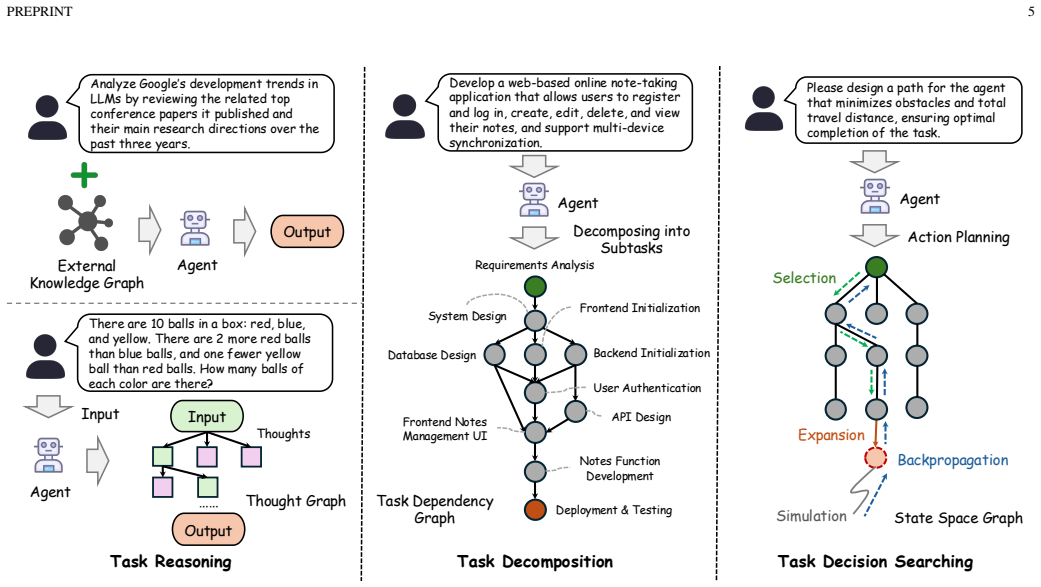
The central organizing device is a five-part taxonomy: graphs for agent planning, execution, memory, and multi-agent coordination, plus agents for graph learning. Each axis has a canonical graph object—task dependency graphs and state space graphs for planning, tool graphs and scene graphs for execution, hierarchical knowledge graphs for memory, and agent coordination graphs for multi-agent systems. These structures convert messy inputs into explicit relational forms over which graph learning (message passing, graph retrieval, graph-based search) can extract task-relevant knowledge. The taxonomy carries the argument by defining what 'graphs empower agents' means for each agent function and by locating roughly a hundred surveyed methods on a single map.
What would settle it
A controlled benchmark that evaluates the same agent task with and without graph-based structuring—for instance, a flat chain-of-thought planner versus a thought-graph planner on one fixed LLM backbone—and finds no consistent advantage for the graph versions across planning, execution, memory, and coordination would undercut the survey's motivating assumption.
Extended reading notes
Core claim
The paper's central claim is that graph techniques and AI agents form a bidirectional stack: graphs empower the core operations of agents, and agent paradigms empower graph learning. Its organizing assertion is that unstructured inputs—task descriptions, tool repositories, accumulated experience, and inter-agent communications—can be reorganized into explicit graph structures, and that graph learning over those structures improves agent capability. For planning, the relevant structures are knowledge graphs, thought trees or thought graphs, task dependency graphs, and state space graphs; for execution, tool graphs and scene or environment graphs; for memory, hierarchical knowledge graphs with graph-based retrieval and maintenance; and for coordination, agent coordination graphs whose topologies can be learned or optimized. In the reverse direction, LLM and RL agents are used to annotate, synthesize, and understand graph data. The contribution is not a new algorithm but the synthesis of these lines into one taxonomy, plus an agenda of applications and open problems.
Load-bearing premise
The survey assumes that converting an agent's information, operations, and interactions into explicit graphs genuinely makes the agent better, and that the papers grouped under each category fairly represent the field; the survey offers no head-to-head comparison of graph-based and non-graph agents to test either assumption.
Editorial extensions
If this is right
- Future agent designs can treat graph construction as a first-class module for each capability rather than an ad hoc trick.
- Graph-structured reasoning and knowledge-graph retrieval become standard components of LLM-agent planning.
- Agent memory systems can be built as evolving knowledge graphs, with retrieval and maintenance handled as graph operations.
- Multi-agent systems can be improved by learning communication topologies—edge pruning, edge weighting, or graph-autoencoder prediction—instead of assuming full connectivity.
- LLM and RL agents become practical tools for generating and annotating graph data, lowering the cost of graph learning.
Reading between the lines
- A direct test of the survey's thesis would hold the LLM backbone fixed and compare a flat chain-of-thought planner with a thought-graph planner on the same task suite; if the graph version shows no consistent gain, the structurization assumption weakens.
- Because existing benchmarks are mostly general agent benchmarks, the taxonomy suggests a gap: graph-centric benchmarks that isolate the graph contribution would turn this qualitative map into a quantitative one.
- If coordination topologies become learnable infrastructure, multi-agent communication effectively becomes a link-prediction and routing problem, which invites network-science tools for security analysis—an implication the paper touches but leaves implicit.
- The Open Agent Network sketch implies graphs could serve as the public registry and routing layer of a decentralized agent ecosystem, making graph learning core infrastructure rather than an optional enhancement.
Editorial analysis
A structured set of objections, weighed in public.
Referee Report
Summary. This manuscript presents a survey of the intersection of graph techniques and AI agents. It proposes a taxonomy organized around four core agent functionalities—planning, execution, memory, and multi-agent coordination—and additionally reviews the reverse direction in which agents support graph learning (annotation, synthesis, and understanding). The survey covers roughly 140 methods, six application domains, and six future research directions. The central claim, stated in the Abstract and Section I, is that this is the first systematic review specifically devoted to how graphs can empower AI agents.
Significance. If the taxonomy and literature coverage are reliable, this survey would be a useful reference for researchers working at the crossroads of graph learning, LLM-based agents, and reinforcement learning. The organization of the field around agentic functionalities is intuitive and the survey covers a broad set of recent works, including many 2024–2025 preprints. The bidirectional framing (graphs for agents, agents for graphs) is a strength. However, the significance is tempered by two verifiability gaps: the paper does not document how the literature was selected, and the promised Github resource link is a placeholder. These issues affect the auditability of the 'systematic' and 'first' claims that anchor the paper's contribution.
major comments (3)
- [Abstract; Section I] The claim that this is a 'first systematic review' is not supported by any documented literature search methodology. The manuscript does not state which bibliographic databases were searched, the date range, the search queries, or the inclusion/exclusion criteria that produced the ~140 methods represented in Figure 2. Without such a protocol, 'systematic' cannot be distinguished from 'selective', and the novelty claim cannot be independently audited. Please add a methodology subsection describing the selection process, or soften the claim to 'comprehensive survey'.
- [Abstract; Section I (footnote); Section X] The paper repeatedly refers to a 'Github link' where related resources are collected and continuously updated, but the actual URL is never provided; only the placeholder phrase 'Github link' appears. Because the linked repository is presented as part of the contribution and as evidence of the survey's community value, the missing link prevents readers from accessing or verifying the promised resources. Please supply the actual URL in the final version, or remove the claim entirely.
- [Sections I and II-D] The motivational argument that graph structurization 'can play a promising role' in empowered agents is asserted without comparative evidence. Section II-D states that organized graphs enable better planning, memory, and coordination, but the survey does not include any quantitative comparisons between graph-based and non-graph agent designs, nor does it report effect sizes or benchmark results from the surveyed papers. This is acceptable for a scoping review only if the paper explicitly acknowledges that it does not establish empirical superiority. Please add a limitations statement to this effect in Section IX or the Conclusion.
minor comments (4)
- [Section I, Taxonomy paragraph] The phrase 'organization of information, operators, and multi-models' appears to contain a typo; 'multi-models' likely should be 'multi-agents' or 'multi-modal'. Please correct the intended term.
- [Table I] All entries in the 'Link' column read simply 'Github', which is not a functional URL. The table also lacks a numbered caption and is not explicitly referenced in the text (Section IX-A says 'As illustrated in Table I', but the table is not introduced with a number in the running text).
- [Section VII-B, 'LLM Multi-Agents'] The statement that GraphAgent-Reasoner is 'the first multi-agent graph reasoning framework based on LLM without fine-tuning' is a strong novelty claim; please support it with a comparative discussion or soften the wording to avoid potential priority disputes.
- [Section VI-A-1, 'Task Allocation-Based Relationship'] The category label is slightly awkward; consider 'Task Allocation Relationships' for consistency with the other subheadings, though this is a stylistic point.
Circularity Check
No circularity: the survey organizes external literature without deriving its claims from fitted inputs or self-citation chains.
full rationale
This paper is a survey/taxonomy, not a derivation with fitted parameters, predictions, or input-output equations. Its central claim, being a 'first systematic review' of graphs for AI agents, is a novelty and scope claim about the literature; nothing in the surveyed papers entails that the review is first, so the claim cannot reduce to its own inputs by construction. The taxonomy (planning, execution, memory, multi-agent coordination, and agents-for-graph-learning) is presented as an organizing scheme, and the cited works, including several authored by members of the survey team (e.g., references 143, 160, 226, 231, 234), function as examples of existing methods rather than as load-bearing premises that force the taxonomy's structure. No uniqueness theorem, ansatz, or fitted value is imported from prior work by the same authors; the survey explicitly contrasts itself with existing RL-with-graphs and LLM-with-graphs surveys rather than relying on them to justify its conclusions. The absence of documented search/inclusion criteria and the placeholder 'Github link' are legitimate auditability limitations, but they concern verifiability of the 'systematic' qualifier, not circularity. Under the stated rules, a verifiability concern without a demonstrated equation-level or self-citation reduction does not raise the circularity score. The derivation chain is therefore self-contained in the sense relevant to this analysis: there is no predicted quantity that is equal to an input by definition, and no claim whose only support is a self-citation.
Assumptions & free parameters
assumptions (2)
- domain assumption AI agents can be decomposed into four core functionalities: planning, execution, memory, and multi-agent coordination.
- domain assumption The cited papers are representative of the field and are grouped correctly.
Cite this review
Pith. "Pith review of Graphs Meet AI Agents: Taxonomy, Progress, and Future Opportunities." pith.science (2026). https://pith.science/paper/OVN44ZHO
@misc{pith2026250618019,
  author       = {Pith},
  title        = {Pith review of: Graphs Meet AI Agents: Taxonomy, Progress, and Future Opportunities},
  year         = {2026},
  howpublished = {\url{https://pith.science/paper/OVN44ZHO}},
  note         = {Machine review of arXiv:2506.18019}
}
read the original abstract
AI agents have experienced a paradigm shift, from early dominance by reinforcement learning (RL) to the rise of agents powered by large language models (LLMs), and now further advancing towards a synergistic fusion of RL and LLM capabilities. This progression has endowed AI agents with increasingly strong abilities. Despite these advances, to accomplish complex real-world tasks, agents are required to plan and execute effectively, maintain reliable memory, and coordinate smoothly with other agents. Achieving these capabilities involves contending with ever-present intricate information, operations, and interactions. In light of this challenge, data structurization can play a promising role by transforming intricate and disorganized data into well-structured forms that agents can more effectively understand and process. In this context, graphs, with their natural advantage in organizing, managing, and harnessing intricate data relationships, present a powerful data paradigm for structurization to support the capabilities demanded by advanced AI agents. To this end, this survey presents a first systematic review of how graphs can empower AI agents. Specifically, we explore the integration of graph techniques with core agent functionalities, highlight notable applications, and identify prospective avenues for future research. By comprehensively surveying this burgeoning intersection, we hope to inspire the development of next-generation AI agents equipped to tackle increasingly sophisticated challenges with graphs. Related resources are collected and continuously updated for the community in the Github link.
Figures


Figures from the paper (4 more)


Forward citations
Cited by 4 Pith papers
-
Towards Self-Evolving Agents: A Human-Inspired Adaptive Exploration-Exploitation Framework for Genetic Network Programming
HGNP improves GNP and its variants via adaptive crossover protecting high-in-degree nodes later, early-favoring mutation of judgment-to-judgment links, and cycle elimination, with HGNP-SBGNP best on Tileworld.
-
Youtu-GraphRAG: Vertically Unified Agents for Graph Retrieval-Augmented Complex Reasoning
A schema-bounded agentic framework unifies graph construction and retrieval, reporting SOTA accuracy and up to 90.71% token-cost savings across six benchmarks, plus a new anonymized QA dataset.
-
Macro Graph of Experts for Billion-Scale Multi-Task Recommendation
MGOE merges multi-task user-item graphs into a small macro graph and combines macro embeddings with mixture-of-experts towers, reporting offline and online gains that need stronger evaluation safeguards.
-
Securing Multi-Agent Systems Against Corruptions via Node Contribution Backpropagation
A backward-propagation scoring scheme over a signed temporal DAG can identify malicious agents in LLM multi-agent systems and cut their communications, improving defended accuracy by 3–7 percentage points in the autho...
Reference graph
Works this paper leans on
-
[1]
Deep reinforcement learning for multiagent systems: A review of challenges, solutions, and applications,
T. T. Nguyen, N. D. Nguyen, and S. Nahavandi, “Deep reinforcement learning for multiagent systems: A review of challenges, solutions, and applications,” IEEE transactions on cybernetics, vol. 50, no. 9, pp. 3826–3839, 2020
2020
-
[2]
Automatic goal genera- tion for reinforcement learning agents,
C. Florensa, D. Held, X. Geng, and P. Abbeel, “Automatic goal genera- tion for reinforcement learning agents,” in International conference on machine learning. PMLR, 2018, pp. 1515–1528
2018
-
[3]
A survey on large language model based autonomous agents,
L. Wang, C. Ma, X. Feng, Z. Zhang, H. Yang, J. Zhang, Z. Chen, J. Tang, X. Chen, Y . Lin et al., “A survey on large language model based autonomous agents,” Frontiers of Computer Science, vol. 18, no. 6, p. 186345, 2024
2024
-
[4]
Expel: Llm agents are experiential learners,
A. Zhao, D. Huang, Q. Xu, M. Lin, Y .-J. Liu, and G. Huang, “Expel: Llm agents are experiential learners,” in Proceedings of the AAAI Conference on Artificial Intelligence, vol. 38, no. 17, 2024, pp. 19 632– 19 642
2024
-
[5]
Agile: A novel reinforcement learning framework of llm agents,
F. Peiyuan, Y . He, G. Huang, Y . Lin, H. Zhang, Y . Zhang, and H. Li, “Agile: A novel reinforcement learning framework of llm agents,” in Advances in Neural Information Processing Systems, vol. 37, 2024, pp. 5244–5284
2024
-
[6]
T. Masterman, S. Besen, M. Sawtell, and A. Chao, “The landscape of emerging ai agent architectures for reasoning, planning, and tool calling: A survey,” arXiv preprint arXiv:2404.11584, 2024
arXiv 2024
-
[7]
Ai agents: Evolution, architecture, and real-world applications,
N. Krishnan, “Ai agents: Evolution, architecture, and real-world applications,” arXiv preprint arXiv:2503.12687, 2025
arXiv 2025
-
[8]
Understanding the planning of llm agents: A survey,
X. Huang, W. Liu, X. Chen, X. Wang, H. Wang, D. Lian, Y . Wang, R. Tang, and E. Chen, “Understanding the planning of llm agents: A survey,” arXiv preprint arXiv:2402.02716, 2024
arXiv 2024
Show all 244 references
-
[9]
Large language model based multi-agents: a survey of progress and challenges,
T. Guo, X. Chen, Y . Wang, R. Chang, S. Pei, N. V . Chawla, O. Wiest, and X. Zhang, “Large language model based multi-agents: a survey of progress and challenges,” in Proceedings of the Thirty-Third International Joint Conference on Artificial Intelligence, 2024, pp. 8048– 8057
2024
-
[10]
A survey on knowledge graph-based recommender systems,
Q. Guo, F. Zhuang, C. Qin, H. Zhu, X. Xie, H. Xiong, and Q. He, “A survey on knowledge graph-based recommender systems,” IEEE Transactions on Knowledge and Data Engineering, vol. 34, no. 8, pp. 3549–3568, 2020
2020
-
[11]
Multimodal learning with graphs,
Y . Ektefaie, G. Dasoulas, A. Noori, M. Farhat, and M. Zitnik, “Multimodal learning with graphs,” Nature Machine Intelligence, vol. 5, no. 4, pp. 340–350, 2023
2023
-
[12]
A survey on graph neural networks and graph transformers in computer vision: A task-oriented perspective,
C. Chen, Y . Wu, Q. Dai, H.-Y . Zhou, M. Xu, S. Yang, X. Han, and Y . Yu, “A survey on graph neural networks and graph transformers in computer vision: A task-oriented perspective,” IEEE Transactions on Pattern Analysis and Machine Intelligence, 2024
2024
-
[13]
A comprehensive survey on graph neural networks,
Z. Wu, S. Pan, F. Chen, G. Long, C. Zhang, and P. S. Yu, “A comprehensive survey on graph neural networks,” IEEE transactions on neural networks and learning systems, vol. 32, no. 1, pp. 4–24, 2020
2020
-
[14]
Graph neural networks for natural language processing: A survey,
L. Wu, Y . Chen, K. Shen, X. Guo, H. Gao, S. Li, J. Pei, B. Long et al., “Graph neural networks for natural language processing: A survey,” Foundations and Trends® in Machine Learning, vol. 16, no. 2, pp. 119–328, 2023
2023
-
[15]
Transfqmix: Transformers for leveraging the graph structure of multi-agent reinforcement learning problems,
M. Gallici, M. Martin, and I. Masmitja, “Transfqmix: Transformers for leveraging the graph structure of multi-agent reinforcement learning problems,” in Proceedings of the 2023 International Conference on Autonomous Agents and Multiagent Systems, 2023, pp. 1679–1687
2023
-
[16]
Gptswarm: Language agents as optimizable graphs,
M. Zhuge, W. Wang, L. Kirsch, F. Faccio, D. Khizbullin, and J. Schmidhuber, “Gptswarm: Language agents as optimizable graphs,” in Forty-first International Conference on Machine Learning, 2024
2024
-
[17]
Toolnet: Connecting large language models with massive tools via tool graph,
X. Liu, Z. Peng, X. Yi, X. Xie, L. Xiang, Y . Liu, and D. Xu, “Toolnet: Connecting large language models with massive tools via tool graph,” arXiv preprint arXiv:2403.00839, 2024
2024 arXiv
-
[18]
Qa-gnn: Reasoning with language models and knowledge graphs for question answering,
M. Yasunaga, H. Ren, A. Bosselut, P. Liang, and J. Leskovec, “Qa-gnn: Reasoning with language models and knowledge graphs for question answering,” in Proceedings of the 2021 Conference of the North American Chapter of the Association for Computational Linguistics: Human Langua...
2021
-
[19]
Kg-cot: Chain-of- thought prompting of large language models over knowledge graphs for knowledge-aware question answering,
R. Zhao, F. Zhao, L. Wang, X. Wang, and G. Xu, “Kg-cot: Chain-of- thought prompting of large language models over knowledge graphs for knowledge-aware question answering,” in Proceedings of the Thirty-Third International Joint Conference on Artificial Intelligence (IJCAI-24). ...
2024
-
[20]
Challenges and opportunities in deep reinforcement learning with graph neural networks: A comprehensive review of algorithms and applications,
S. Munikoti, D. Agarwal, L. Das, M. Halappanavar, and B. Natarajan, “Challenges and opportunities in deep reinforcement learning with graph neural networks: A comprehensive review of algorithms and applications,” IEEE transactions on neural networks and learning systems, 2023
2023
-
[21]
Graph neural network meets multi-agent reinforcement learning: Fundamentals, applications, and future directions,
Z. Liu, J. Zhang, E. Shi, Z. Liu, D. Niyato, B. Ai, and X. S. Shen, “Graph neural network meets multi-agent reinforcement learning: Fundamentals, applications, and future directions,” IEEE Wireless Communications, 2024
2024
-
[22]
A survey of graph meets large language model: progress and future directions,
Y . Li, Z. Li, P. Wang, J. Li, X. Sun, H. Cheng, and J. X. Yu, “A survey of graph meets large language model: progress and future directions,” in Proceedings of the Thirty-Third International Joint Conference on Artificial Intelligence, 2024, pp. 8123–8131
2024
-
[23]
Large language models on graphs: A comprehensive survey,
B. Jin, G. Liu, C. Han, M. Jiang, H. Ji, and J. Han, “Large language models on graphs: A comprehensive survey,” IEEE Transactions on Knowledge and Data Engineering, 2024
2024
-
[24]
Intelligent agents: Theory and practice,
M. Wooldridge and N. R. Jennings, “Intelligent agents: Theory and practice,” The knowledge engineering review, vol. 10, no. 2, pp. 115– 152, 1995
1995
-
[25]
Survey on large language model-enhanced reinforcement learning: Concept, taxonomy, and methods,
Y . Cao, H. Zhao, Y . Cheng, T. Shu, Y . Chen, G. Liu, G. Liang, J. Zhao, J. Yan, and Y . Li, “Survey on large language model-enhanced reinforcement learning: Concept, taxonomy, and methods,” IEEE Transactions on Neural Networks and Learning Systems, 2024
2024
-
[26]
Reinforcement learning enhanced llms: A survey,
S. Wang, S. Zhang, J. Zhang, R. Hu, X. Li, T. Zhang, J. Li, F. Wu, G. Wang, and E. Hovy, “Reinforcement learning enhanced llms: A survey,” arXiv preprint arXiv:2412.10400, 2024
2024 arXiv
-
[27]
Deepseek-r1: Incentivizing reasoning capability in llms via reinforcement learning,
D. Guo, D. Yang, H. Zhang, J. Song, R. Zhang, R. Xu, Q. Zhu, S. Ma, P. Wang, X. Bi et al., “Deepseek-r1: Incentivizing reasoning capability in llms via reinforcement learning,” arXiv preprint arXiv:2501.12948, 2025
2025 arXiv
-
[28]
Deep reinforcement learning: A brief survey,
K. Arulkumaran, M. P. Deisenroth, M. Brundage, and A. A. Bharath, “Deep reinforcement learning: A brief survey,” IEEE Signal Processing Magazine, vol. 34, no. 6, pp. 26–38, 2017
2017
-
[29]
Model- based reinforcement learning: A survey,
T. M. Moerland, J. Broekens, A. Plaat, C. M. Jonker et al., “Model- based reinforcement learning: A survey,” Foundations and Trends® in Machine Learning, vol. 16, no. 1, pp. 1–118, 2023
2023
-
[30]
A survey on evaluation of large language models,
Y . Chang, X. Wang, J. Wang, Y . Wu, L. Yang, K. Zhu, H. Chen, X. Yi, C. Wang, Y . Wang et al., “A survey on evaluation of large language models,” ACM transactions on intelligent systems and technology, vol. 15, no. 3, pp. 1–45, 2024
2024
-
[31]
A survey on the memory mechanism of large language model based agents,
Z. Zhang, X. Bo, C. Ma, R. Li, X. Chen, Q. Dai, J. Zhu, Z. Dong, and J.-R. Wen, “A survey on the memory mechanism of large language model based agents,” arXiv preprint arXiv:2404.13501, 2024
2024 arXiv
-
[32]
A survey on rag meeting llms: Towards retrieval-augmented large language models,
W. Fan, Y . Ding, L. Ning, S. Wang, H. Li, D. Yin, T.-S. Chua, and Q. Li, “A survey on rag meeting llms: Towards retrieval-augmented large language models,” in Proceedings of the 30th ACM SIGKDD Conference on Knowledge Discovery and Data Mining, 2024, pp. 6491– 6501
2024
-
[33]
Llm post-training: A deep dive into reasoning large language models,
K. Kumar, T. Ashraf, O. Thawakar, R. M. Anwer, H. Cholakkal, M. Shah, M.-H. Yang, P. H. Torr, F. S. Khan, and S. Khan, “Llm post-training: A deep dive into reasoning large language models,” arXiv preprint arXiv:2502.21321, 2025
2025 arXiv
-
[34]
Think-on-graph: Deep and responsible reasoning of large language model on knowledge graph,
J. Sun, C. Xu, L. Tang, S. Wang, C. Lin, Y . Gong, L. Ni, H.-Y . Shum, and J. Guo, “Think-on-graph: Deep and responsible reasoning of large language model on knowledge graph,” in The Twelfth International Conference on Learning Representations, 2024
2024
-
[35]
Reasoning on graphs: Faithful and interpretable large language model reasoning,
L. Luo, Y .-F. Li, G. Haffari, and S. Pan, “Reasoning on graphs: Faithful and interpretable large language model reasoning,” in The Twelfth International Conference on Learning Representations, 2024. PREPRINT 16
2024
-
[36]
Mindmap: Knowledge graph prompting sparks graph of thoughts in large language models,
Y . Wen, Z. Wang, and J. Sun, “Mindmap: Knowledge graph prompting sparks graph of thoughts in large language models,” in Proceedings of the 62nd Annual Meeting of the Association for Computational Linguistics (V olume1: Long Papers), 2024, pp. 10 370–10 388
2024
-
[37]
Paths-over- graph: Knowledge graph empowered large language model reasoning,
X. Tan, X. Wang, Q. Liu, X. Xu, X. Yuan, and W. Zhang, “Paths-over- graph: Knowledge graph empowered large language model reasoning,” in Proceedings of the ACM on Web Conference 2025, 2025, pp. 3505– 3522
2025
-
[38]
Tree of thoughts: Deliberate problem solving with large language models,
S. Yao, D. Yu, J. Zhao, I. Shafran, T. Griffiths, Y . Cao, and K. Narasimhan, “Tree of thoughts: Deliberate problem solving with large language models,” in Thirty-seventh Conference on Neural Information Processing Systems, vol. 36, 2023, pp. 11 809–11 822
2023
-
[39]
Ratt: A thought structure for coherent and correct llm reasoning,
J. Zhang, X. Wang, W. Ren, L. Jiang, D. Wang, and K. Liu, “Ratt: A thought structure for coherent and correct llm reasoning,” in Proceedings of the AAAI Conference on Artificial Intelligence, vol. 39, no. 25, 2025, pp. 26 733–26 741
2025
-
[40]
Got: Effective graph-of-thought reasoning in language models,
Y . Yao, Z. Li, and H. Zhao, “Got: Effective graph-of-thought reasoning in language models,” in Findings of the Association for Computational Linguistics: NAACL 2024, 2024, pp. 2901–2921
2024
-
[41]
Graph of thoughts: Solving elaborate problems with large language models,
M. Besta, N. Blach, A. Kubicek, R. Gerstenberger, M. Podstawski, L. Gianinazzi, J. Gajda, T. Lehmann, H. Niewiadomski, P. Nyczyk et al., “Graph of thoughts: Solving elaborate problems with large language models,” in Proceedings of the AAAI Conference on Artificial Intelligence...
2024
-
[42]
Reasoning with graphs: Structuring implicit knowledge to enhance llms reasoning,
H. Han, Y . Xie, H. Liu, X. Tang, S. Nag, W. Headden, Y . Li, C. Luo, S. Ji, Q. He et al., “Reasoning with graphs: Structuring implicit knowledge to enhance llms reasoning,” arXiv preprint arXiv:2501.07845, 2025
2025
-
[43]
Agentkit: Structured LLM reasoning with dynamic graphs,
Y . Wu, Y . Fan, S. Y . Min, S. Prabhumoye, S. M. McAleer, R. Salakhut- dinov, Y . Bisk, Y . Li, and T. Mitchell, “Agentkit: Structured LLM reasoning with dynamic graphs,” in First Conference on Language Modeling, 2024
2024
-
[44]
Villageragent: A graph- based multi-agent framework for coordinating complex task dependen- cies in minecraft,
Y . Dong, X. Zhu, Z. Pan, L. Zhu, and Y . Yang, “Villageragent: A graph- based multi-agent framework for coordinating complex task dependen- cies in minecraft,” in Findings of the Association for Computational Linguistics ACL 2024, 2024, pp. 16 290–16 314
2024
-
[45]
Dyntaskmas: A dynamic task graph- driven framework for asynchronous and parallel llm-based multi-agent systems,
J. Yu, Y . Ding, and H. Sato, “Dyntaskmas: A dynamic task graph- driven framework for asynchronous and parallel llm-based multi-agent systems,” arXiv preprint arXiv:2503.07675, 2025
2025
-
[46]
Plan-over- graph: Towards parallelable llm agent schedule,
S. Zhang, X. Ma, Z. Cao, Z. Zhang, and H. Zhao, “Plan-over- graph: Towards parallelable llm agent schedule,” arXiv preprint arXiv:2502.14563, 2025
2025 arXiv
-
[47]
Dag-plan: Generating directed acyclic dependency graphs for dual-arm cooperative planning,
Z. Gao, Y . Mu, J. Qu, M. Hu, L. Guo, P. Luo, and Y . Lu, “Dag-plan: Generating directed acyclic dependency graphs for dual-arm cooperative planning,” arXiv preprint arXiv:2406.09953, 2024
2024 arXiv
-
[48]
Enhancing multi-agent systems via reinforcement learning with llm-based planner and graph-based policy,
Z. Jia, J. Li, X. Qu, and J. Wang, “Enhancing multi-agent systems via reinforcement learning with llm-based planner and graph-based policy,” in 2025 IEEE International Conference on Robotics and Automation (ICRA). IEEE, 2025
2025
-
[49]
Feudal graph reinforcement learning,
T. Marzi, A. S. Khehra, A. Cini, and C. Alippi, “Feudal graph reinforcement learning,” Transactions on Machine Learning Research, 2024
2024
-
[50]
Can graph learning improve planning in llm-based agents?
X. Wu, Y . Shen, C. Shan, K. Song, S. Wang, B. Zhang, J. Feng, H. Cheng, W. Chen, Y . Xiong et al., “Can graph learning improve planning in llm-based agents?” in The Thirty-eighth Annual Conference on Neural Information Processing Systems, 2024
2024
-
[51]
Deep learning for real-time atari game play using offline monte-carlo tree search planning,
X. Guo, S. Singh, H. Lee, R. L. Lewis, and X. Wang, “Deep learning for real-time atari game play using offline monte-carlo tree search planning,” in Advances in Neural Information Processing Systems, vol. 27, 2014
2014
-
[52]
Memory-augmented monte carlo tree search,
C. Xiao, J. Mei, and M. M ¨uller, “Memory-augmented monte carlo tree search,” in Proceedings of the AAAI conference on artificial intelligence, vol. 32, no. 1, 2018
2018
-
[53]
Evolving interpretable decision trees for reinforcement learning,
V . G. Costa, J. P ´erez-Aracil, S. Salcedo-Sanz, and C. E. Pedreira, “Evolving interpretable decision trees for reinforcement learning,” Artificial Intelligence, vol. 327, p. 104057, 2024
2024
-
[54]
Promptagent: Strategic planning with language models enables expert-level prompt optimization,
X. Wang, C. Li, Z. Wang, F. Bai, H. Luo, J. Zhang, N. Jojic, E. Xing, and Z. Hu, “Promptagent: Strategic planning with language models enables expert-level prompt optimization,” in The Twelfth International Conference on Learning Representations, 2024
2024
-
[55]
Language agent tree search unifies reasoning, acting, and planning in language models,
A. Zhou, K. Yan, M. Shlapentokh-Rothman, H. Wang, and Y .-X. Wang, “Language agent tree search unifies reasoning, acting, and planning in language models,” in Forty-first International Conference on Machine Learning, 2024
2024
-
[56]
Improving alphazero using monte- carlo graph search,
J. Czech, P. Korus, and K. Kersting, “Improving alphazero using monte- carlo graph search,” in Proceedings of the International Conference on Automated Planning and Scheduling, vol. 31, 2021, pp. 103–111
2021
-
[57]
Monte-carlo graph search: the value of merging similar states,
E. Leurent and O.-A. Maillard, “Monte-carlo graph search: the value of merging similar states,” in Asian Conference on Machine Learning. PMLR, 2020, pp. 577–592
2020
-
[58]
Continuous monte carlo graph search,
K. Kujanp ¨a¨a, A. Babadi, Y . Zhao, J. Kannala, A. Ilin, and J. Pajari- nen, “Continuous monte carlo graph search,” in Proceedings of the 23rd International Conference on Autonomous Agents and Multiagent Systems, 2024, pp. 1047–1056
2024
-
[59]
Graph chain-of-thought: Augmenting large language models by reasoning on graphs,
B. Jin, C. Xie, J. Zhang, K. K. Roy, Y . Zhang, Z. Li, R. Li, X. Tang, S. Wang, Y . Meng et al., “Graph chain-of-thought: Augmenting large language models by reasoning on graphs,” inFindings of the Association for Computational Linguistics ACL 2024, 2024, pp. 163–184
2024
-
[60]
Graph rag-tool fusion,
E. Lumer, P. H. Basavaraju, M. Mason, J. A. Burke, and V . K. Subbiah, “Graph rag-tool fusion,” arXiv preprint arXiv:2502.07223, 2025
2025 arXiv
-
[61]
Controlllm: Augment language models with tools by searching on graphs,
Z. Liu, Z. Lai, Z. Gao, E. Cui, Z. Li, X. Zhu, L. Lu, Q. Chen, Y . Qiao, J. Dai et al., “Controlllm: Augment language models with tools by searching on graphs,” in European Conference on Computer Vision. Springer, 2024, pp. 89–105
2024
-
[62]
Multiagent reinforcement learning for autonomous routing and pickup problem with adaptation to variable demand,
D. Garces, S. Bhattacharya, S. Gil, and D. Bertsekas, “Multiagent reinforcement learning for autonomous routing and pickup problem with adaptation to variable demand,” in 2023 IEEE International Conference on Robotics and Automation (ICRA). IEEE, 2023, pp. 3524–3531
2023
-
[63]
A graph rein- forcement learning framework for neural adaptive large neighbourhood search,
S.-N. Johnn, V .-A. Darvariu, J. Handl, and J. Kalcsics, “A graph rein- forcement learning framework for neural adaptive large neighbourhood search,” Computers & Operations Research, vol. 172, p. 106791, 2024
2024
-
[64]
Towards generalizability of multi-agent reinforcement learning in graphs with recurrent message passing,
J. Weil, Z. Bao, O. Abboud, and T. Meuser, “Towards generalizability of multi-agent reinforcement learning in graphs with recurrent message passing,” in Proceedings of the 23rd International Conference on Autonomous Agents and Multiagent Systems, 2024, pp. 1919–1927
2024
-
[65]
Multi-agent auto-bidding with latent graph diffusion models,
D. Huh and P. Mohapatra, “Multi-agent auto-bidding with latent graph diffusion models,” arXiv preprint arXiv:2503.05805, 2025
2025 arXiv
-
[66]
Language-grounded dynamic scene graphs for interactive object search with mobile manipulation,
D. Honerkamp, M. B¨uchner, F. Despinoy, T. Welschehold, and A. Valada, “Language-grounded dynamic scene graphs for interactive object search with mobile manipulation,” IEEE Robotics and Automation Letters, 2024
2024
-
[67]
Planagent: A multi-modal large language agent for closed-loop vehicle motion planning,
Y . Zheng, Z. Xing, Q. Zhang, B. Jin, P. Li, Y . Zheng, Z. Xia, K. Zhan, X. Lang, Y . Chen et al., “Planagent: A multi-modal large language agent for closed-loop vehicle motion planning,” arXiv preprint arXiv:2406.01587, 2024
2024 arXiv
-
[68]
A schema-guided reason-while-retrieve framework for reasoning on scene graphs with large-language-models (llms),
Y . Chen, H. Sawhney, N. Gyd ´e, Y . Jian, J. Saunders, P. Vela, and B. Lundell, “A schema-guided reason-while-retrieve framework for reasoning on scene graphs with large-language-models (llms),” arXiv preprint arXiv:2502.03450, 2025
2025 arXiv
-
[69]
Gui-xplore: Empowering generalizable gui agents with one explo- ration,
Y . Sun, S. Zhao, T. Yu, H. Wen, S. Va, M. Xu, Y . Li, and C. Zhang, “Gui-xplore: Empowering generalizable gui agents with one explo- ration,” in Proceedings of the Computer Vision and Pattern Recognition Conference, 2025, pp. 19 477–19 486
2025
-
[70]
Deep multi-agent reinforcement learning with relevance graphs,
A. Malysheva, T. T. Sung, C.-B. Sohn, D. Kudenko, and A. Shpilman, “Deep multi-agent reinforcement learning with relevance graphs,” arXiv preprint arXiv:1811.12557, 2018
2018 arXiv
-
[71]
Learning control admissibility models with graph neural networks for multi-agent navigation,
C. Yu, H. Yu, and S. Gao, “Learning control admissibility models with graph neural networks for multi-agent navigation,” in Conference on Robot Learning. PMLR, 2023, pp. 934–945
2023
-
[72]
Reinforcement learned multi–agent cooperative navigation in hybrid environment with relational graph learning,
W. Ou, B. Luo, X. Xu, Y . Feng, and Y . Zhao, “Reinforcement learned multi–agent cooperative navigation in hybrid environment with relational graph learning,” IEEE Transactions on Artificial Intelligence, 2024
2024
-
[73]
Graph network-based human movement prediction for socially-aware robot navigation in shared workspaces,
C. Dik, C. Emmanouilidis, and B. Duqueroie, “Graph network-based human movement prediction for socially-aware robot navigation in shared workspaces,” Neural Computing and Applications, vol. 36, no. 34, pp. 21 743–21 759, 2024
2024
-
[74]
Arigraph: Learning knowledge graph world models with episodic memory for llm agents,
P. Anokhin, N. Semenov, A. Sorokin, D. Evseev, M. Burtsev, and E. Burnaev, “Arigraph: Learning knowledge graph world models with episodic memory for llm agents,” arXiv preprint arXiv:2407.04363, 2024
2024 arXiv
-
[75]
Towards self-x cognitive manufacturing network: An industrial knowledge graph-based multi- agent reinforcement learning approach,
P. Zheng, L. Xia, C. Li, X. Li, and B. Liu, “Towards self-x cognitive manufacturing network: An industrial knowledge graph-based multi- agent reinforcement learning approach,” Journal of Manufacturing Systems, vol. 61, pp. 16–26, 2021
2021
-
[76]
Graphusion: a rag framework for knowl- edge graph construction with a global perspective,
R. Yang, B. Yang, A. Feng, S. Ouyang, M. Blum, T. She, Y . Jiang, F. Lecue, J. Lu, and I. Li, “Graphusion: a rag framework for knowl- edge graph construction with a global perspective,” arXiv preprint arXiv:2410.17600, 2024
2024 arXiv
-
[77]
Enhancing the patent matching capability of large language models via memory graph,
Q. Xiong, Z. Xu, Z. Liu, M. Wang, Z. Chen, Y . Sun, Y . Gu, X. Li, and G. Yu, “Enhancing the patent matching capability of large language models via memory graph,” in Proceedings of the 48th International ACM SIGIR Conference on Research and Development in Information Retrieva...
2025
-
[78]
Agentic reasoning: Reasoning llms with tools for the deep research,
J. Wu, J. Zhu, and Y . Liu, “Agentic reasoning: Reasoning llms with tools for the deep research,” arXiv preprint arXiv:2502.04644, 2025
2025 arXiv
-
[79]
On the structural memory of llm agents,
R. Zeng, J. Fang, S. Liu, and Z. Meng, “On the structural memory of llm agents,” arXiv preprint arXiv:2412.15266, 2024
2024 arXiv
-
[80]
Llm-powered decentralized generative agents with adaptive hierar- chical knowledge graph for cooperative planning,
H. Yang, J. Chen, M. Siew, T. Lorido-Botran, and C. Joe-Wong, “Llm-powered decentralized generative agents with adaptive hierar- chical knowledge graph for cooperative planning,” arXiv preprint arXiv:2502.05453, 2025
2025 arXiv
-
[81]
From local to global: A graph rag approach to query-focused summarization,
D. Edge, H. Trinh, N. Cheng, J. Bradley, A. Chao, A. Mody, S. Truitt, D. Metropolitansky, R. O. Ness, and J. Larson, “From local to global: A graph rag approach to query-focused summarization,” arXiv preprint arXiv:2404.16130, 2024
2024 arXiv
-
[82]
Kg-retriever: Efficient knowledge indexing for retrieval-augmented large language models,
W. Chen, T. Bai, J. Su, J. Luan, W. Liu, and C. Shi, “Kg-retriever: Efficient knowledge indexing for retrieval-augmented large language models,” arXiv preprint arXiv:2412.05547, 2024
2024 arXiv
-
[83]
G-retriever: Retrieval-augmented generation for textual graph understanding and question answering,
X. He, Y . Tian, Y . Sun, N. Chawla, T. Laurent, Y . LeCun, X. Bresson, and B. Hooi, “G-retriever: Retrieval-augmented generation for textual graph understanding and question answering,” in Advances in Neural Information Processing Systems, vol. 37, 2024, pp. 132 876–132 907
2024
-
[84]
Gfm-rag: Graph foundation model for retrieval augmented generation,
L. Luo, Z. Zhao, G. Haffari, D. Phung, C. Gong, and S. Pan, “Gfm-rag: Graph foundation model for retrieval augmented generation,” arXiv preprint arXiv:2502.01113, 2025
2025
-
[85]
Simple is effective: The roles of graphs and large language models in knowledge-graph-based retrieval-augmented generation,
M. Li, S. Miao, and P. Li, “Simple is effective: The roles of graphs and large language models in knowledge-graph-based retrieval-augmented generation,” in International Conference on Learning Representations, 2025
2025
-
[86]
Lightrag: Simple and fast retrieval-augmented generation,
Z. Guo, L. Xia, Y . Yu, T. Ao, and C. Huang, “Lightrag: Simple and fast retrieval-augmented generation,” arXiv preprint arXiv:2410.05779, 2024
2024 arXiv
-
[87]
Grag: Graph retrieval-augmented generation,
Y . Hu, Z. Lei, Z. Zhang, B. Pan, C. Ling, and L. Zhao, “Grag: Graph retrieval-augmented generation,” in Findings of the Association for Computational Linguistics: NAACL 2025, 2025
2025
-
[88]
Pathrag: Pruning graph-based retrieval augmented generation with relational paths,
B. Chen, Z. Guo, Z. Yang, Y . Chen, J. Chen, Z. Liu, C. Shi, and C. Yang, “Pathrag: Pruning graph-based retrieval augmented generation with relational paths,” arXiv preprint arXiv:2502.14902, 2025
2025
-
[89]
A-mem: Agentic memory for llm agents,
W. Xu, K. Mei, H. Gao, J. Tan, Z. Liang, and Y . Zhang, “A-mem: Agentic memory for llm agents,” arXiv preprint arXiv:2502.12110, 2025
2025 arXiv
-
[90]
Zep: A temporal knowledge graph architecture for agent memory,
P. Rasmussen, P. Paliychuk, T. Beauvais, J. Ryan, and D. Chalef, “Zep: A temporal knowledge graph architecture for agent memory,” arXiv preprint arXiv:2501.13956, 2025
2025 arXiv
-
[91]
Hipporag: Neurobiologically inspired long-term memory for large language models,
B. Jimenez Gutierrez, Y . Shu, Y . Gu, M. Yasunaga, and Y . Su, “Hipporag: Neurobiologically inspired long-term memory for large language models,” in Advances in Neural Information Processing Systems, vol. 37, 2024, pp. 59 532–59 569
2024
-
[92]
Kg-agent: An efficient autonomous agent framework for complex reasoning over knowledge graph,
J. Jiang, K. Zhou, W. X. Zhao, Y . Song, C. Zhu, H. Zhu, and J.-R. Wen, “Kg-agent: An efficient autonomous agent framework for complex reasoning over knowledge graph,” arXiv preprint arXiv:2402.11163, 2024
2024 arXiv
-
[93]
Instructrag: Leveraging retrieval-augmented generation on instruction graphs for llm-based task planning,
Z. Wang, S. X. Teo, J. J. Chew, and W. Shi, “Instructrag: Leveraging retrieval-augmented generation on instruction graphs for llm-based task planning,” arXiv preprint arXiv:2504.13032, 2025
2025 arXiv
-
[94]
Gnns as predictors of agentic workflow performances,
Y . Zhang, Y . Hou, B. Tang, S. Chen, M. Zhang, X. Dong, and S. Chen, “Gnns as predictors of agentic workflow performances,” arXiv preprint arXiv:2503.11301, 2025
2025 arXiv
-
[95]
Magnnet: Multi-agent graph neural network-based efficient task allocation for autonomous vehicles with deep reinforcement learning,
L. Ratnabala, A. Fedoseev, R. Peter, and D. Tsetserukou, “Magnnet: Multi-agent graph neural network-based efficient task allocation for autonomous vehicles with deep reinforcement learning,” arXiv preprint arXiv:2502.02311, 2025
2025 arXiv
-
[96]
Learning NP-hard multi-agent assignment planning using GNN: Inference on a random graph and provable auction-fitted q-learning,
H. Kang, T. Kwon, J. Park, and J. R. Morrison, “Learning NP-hard multi-agent assignment planning using GNN: Inference on a random graph and provable auction-fitted q-learning,” in Advances in Neural Information Processing Systems, A. H. Oh, A. Agarwal, D. Belgrave, and K. Cho,...
2022
-
[97]
Scaling large language model-based multi-agent collaboration,
C. Qian, Z. Xie, Y . Wang, W. Liu, K. Zhu, H. Xia, Y . Dang, Z. Du, W. Chen, C. Yang, Z. Liu, and M. Sun, “Scaling large language model-based multi-agent collaboration,” in The Thirteenth International Conference on Learning Representations, 2025
2025
-
[98]
Graph convolution-based deep reinforcement learning for multi-agent decision-making in interactive traffic scenarios,
Q. Liu, Z. Li, X. Li, J. Wu, and S. Yuan, “Graph convolution-based deep reinforcement learning for multi-agent decision-making in interactive traffic scenarios,” in 2022 IEEE 25th International Conference on Intelligent Transportation Systems (ITSC). IEEE, 2022, pp. 4074– 4081
2022
-
[99]
Magnneto: A graph neu- ral network-based multi-agent system for traffic engineering,
G. Bern ´ardez, J. Su ´arez-Varela, A. L ´opez, X. Shi, S. Xiao, X. Cheng, P. Barlet-Ros, and A. Cabellos-Aparicio, “Magnneto: A graph neu- ral network-based multi-agent system for traffic engineering,” IEEE Transactions on Cognitive Communications and Networking, vol. 9, no. ...
2023
-
[100]
Exponential topology-enabled scalable communication in multi-agent reinforcement learning,
X. Li, X. Wang, C. Bai, and J. Zhang, “Exponential topology-enabled scalable communication in multi-agent reinforcement learning,” in The Thirteenth International Conference on Learning Representations, 2025
2025
-
[101]
Graphcomm: A graph neural network based method for multi-agent reinforcement learning,
S. Shen, Y . Fu, H. Su, H. Pan, P. Qiao, Y . Dou, and C. Wang, “Graphcomm: A graph neural network based method for multi-agent reinforcement learning,” in ICASSP 2021-2021 IEEE International Conference on Acoustics, Speech and Signal Processing (ICASSP). IEEE, 2021, pp. 3510–3514
2021
-
[102]
Robust multi- agent communication with graph information bottleneck optimization,
S. Ding, W. Du, L. Ding, J. Zhang, L. Guo, and B. An, “Robust multi- agent communication with graph information bottleneck optimization,” IEEE Transactions on Pattern Analysis and Machine Intelligence, vol. 46, no. 5, pp. 3096–3107, 2023
2023
-
[103]
Multi-agent trajectory prediction with heterogeneous edge-enhanced graph attention network,
X. Mo, Z. Huang, Y . Xing, and C. Lv, “Multi-agent trajectory prediction with heterogeneous edge-enhanced graph attention network,” IEEE Transactions on Intelligent Transportation Systems, vol. 23, no. 7, pp. 9554–9567, 2022
2022
-
[104]
Transformer-based multi-agent reinforcement learning for generalization of heterogeneous multi-robot cooperation,
Y . Cai, X. He, H. Guo, W.-Y . Yau, and C. Lv, “Transformer-based multi-agent reinforcement learning for generalization of heterogeneous multi-robot cooperation,” in 2024 IEEE/RSJ International Conference on Intelligent Robots and Systems (IROS). IEEE, 2024, pp. 13 695– 13 702
2024
-
[105]
Deep implicit coordination graphs for multi-agent reinforcement learning,
S. Li, J. K. Gupta, P. Morales, R. Allen, and M. J. Kochenderfer, “Deep implicit coordination graphs for multi-agent reinforcement learning,” in Proceedings of the 20th International Conference on Autonomous Agents and MultiAgent Systems, 2021, pp. 764–772
2021
-
[106]
Learning distilled collaboration graph for multi-agent perception,
Y . Li, S. Ren, P. Wu, S. Chen, C. Feng, and W. Zhang, “Learning distilled collaboration graph for multi-agent perception,” in Advances in Neural Information Processing Systems, A. Beygelzimer, Y . Dauphin, P. Liang, and J. W. Vaughan, Eds., 2021
2021
-
[107]
Online multi-agent forecasting with interpretable collaborative graph neural networks,
M. Li, S. Chen, Y . Shen, G. Liu, I. W. Tsang, and Y . Zhang, “Online multi-agent forecasting with interpretable collaborative graph neural networks,” IEEE Transactions on Neural Networks and Learning Systems, vol. 35, no. 4, pp. 4768–4782, 2022
2022
-
[108]
Deep meta coordination graphs for multi-agent reinforcement learning,
N. Gupta, J. Z. Hare, R. Kannan, and V . Prasanna, “Deep meta coordination graphs for multi-agent reinforcement learning,” arXiv preprint arXiv:2502.04028, 2025
2025
-
[109]
Multi-agent game abstraction via graph attention neural network,
Y . Liu, W. Wang, Y . Hu, J. Hao, X. Chen, and Y . Gao, “Multi-agent game abstraction via graph attention neural network,” in Proceedings of the AAAI conference on artificial intelligence, vol. 34, no. 05, 2020, pp. 7211–7218
2020
-
[110]
Multi-agent graph-attention communication and teaming,
Y . Niu, R. Paleja, and M. Gombolay, “Multi-agent graph-attention communication and teaming,” in Proceedings of the 20th International Conference on Autonomous Agents and MultiAgent Systems, 2021, pp. 964–973
2021
-
[111]
Learning graph-enhanced commander-executor for multi- agent navigation,
X. Yang, S. Huang, Y . Sun, Y . Yang, C. Yu, W.-W. Tu, H. Yang, and Y . Wang, “Learning graph-enhanced commander-executor for multi- agent navigation,” in Proceedings of the 2023 International Conference on Autonomous Agents and Multiagent Systems, 2023, pp. 1652–1660
2023
-
[112]
Learning multi-agent communi- cation from graph modeling perspective,
S. Hu, L. Shen, Y . Zhang, and D. Tao, “Learning multi-agent communi- cation from graph modeling perspective,” in The Twelfth International Conference on Learning Representations, 2024
2024
-
[113]
Cut the crap: An economical communication pipeline for LLM-based multi-agent systems,
G. Zhang, Y . Yue, Z. Li, S. Yun, G. Wan, K. Wang, D. Cheng, J. X. Yu, and T. Chen, “Cut the crap: An economical communication pipeline for LLM-based multi-agent systems,” in The Thirteenth International Conference on Learning Representations, 2025
2025
-
[114]
Adaptive graph pruning for multi-agent communication,
B. Li, Z. Zhao, D.-H. Lee, and G. Wang, “Adaptive graph pruning for multi-agent communication,” arXiv preprint arXiv:2506.02951, 2025
2025 arXiv
-
[115]
G-designer: Architecting multi-agent communication topologies via graph neural networks,
G. Zhang, Y . Yue, X. Sun, G. Wan, M. Yu, J. Fang, K. Wang, T. Chen, and D. Cheng, “G-designer: Architecting multi-agent communication topologies via graph neural networks,” arXiv preprint arXiv:2410.11782, 2024
2024 arXiv
-
[116]
Reliable and efficient multi-agent coordination via graph neural network variational autoencoders,
Y . Meng, N. Majcherczyk, W. Liu, S. Kiesel, C. Fan, and F. Pecora, “Reliable and efficient multi-agent coordination via graph neural network variational autoencoders,” in 2025 IEEE International Conference on Robotics and Automation (ICRA). IEEE, 2025
2025
-
[117]
A dynamic LLM-powered agent network for task-oriented agent collaboration,
Z. Liu, Y . Zhang, P. Li, Y . Liu, and D. Yang, “A dynamic LLM-powered agent network for task-oriented agent collaboration,” in First Conference on Language Modeling, 2024
2024
-
[118]
Adaptive network intervention for complex systems: A hierarchical graph reinforcement learning approach,
Q. Chen and B. Heydari, “Adaptive network intervention for complex systems: A hierarchical graph reinforcement learning approach,” Journal of Computing and Information Science in Engineering, vol. 25, no. 6, 2025
2025
-
[119]
Graph policy network for transferable active learning on graphs,
S. Hu, Z. Xiong, M. Qu, X. Yuan, M.-A. C ˆot´e, Z. Liu, and J. Tang, “Graph policy network for transferable active learning on graphs,” in PREPRINT 18 Advances in neural information processing systems, vol. 33, 2020, pp. 10 174–10 185
2020
-
[120]
Batch active learning with graph neural networks via multi-agent deep reinforcement learning,
Y . Zhang, H. Tong, Y . Xia, Y . Zhu, Y . Chi, and L. Ying, “Batch active learning with graph neural networks via multi-agent deep reinforcement learning,” in Proceedings of the AAAI conference on artificial intelligence, vol. 36, no. 8, 2022, pp. 9118–9126
2022
-
[121]
Exploring the potential of large language models in graph generation,
Y . Yao, X. Wang, Z. Zhang, Y . Qin, Z. Zhang, X. Chu, Y . Yang, W. Zhu, and H. Mei, “Exploring the potential of large language models in graph generation,” arXiv preprint arXiv:2403.14358, 2024
2024 arXiv
-
[122]
Llm-based multi-agent systems are scalable graph generative models,
J. Ji, R. Lei, J. Bi, Z. Wei, X. Chen, Y . Lin, X. Pan, Y . Li, and B. Ding, “Llm-based multi-agent systems are scalable graph generative models,” arXiv preprint arXiv:2410.09824, 2024
2024 arXiv
-
[123]
Igda: Interactive graph discovery through large language model agents,
A. Havrilla, D. Alvarez-Melis, and N. Fusi, “Igda: Interactive graph discovery through large language model agents,” arXiv preprint arXiv:2502.17189, 2025
2025 arXiv
-
[124]
Graphmaster: Automated graph synthesis via llm agents in data-limited environments,
E. Du, X. Li, T. Jin, Z. Zhang, R.-H. Li, and G. Wang, “Graphmaster: Automated graph synthesis via llm agents in data-limited environments,” arXiv preprint arXiv:2504.00711, 2025
2025 arXiv
-
[125]
Policy-gnn: Aggregation optimization for graph neural networks,
K.-H. Lai, D. Zha, K. Zhou, and X. Hu, “Policy-gnn: Aggregation optimization for graph neural networks,” in Proceedings of the 26th ACM SIGKDD International Conference on Knowledge Discovery & Data Mining, 2020, pp. 461–471
2020
-
[126]
Sugar: Subgraph neural network with reinforcement pooling and self-supervised mutual information mechanism,
Q. Sun, J. Li, H. Peng, J. Wu, Y . Ning, P. S. Yu, and L. He, “Sugar: Subgraph neural network with reinforcement pooling and self-supervised mutual information mechanism,” in Proceedings of the web conference 2021, 2021, pp. 2081–2091
2021
-
[127]
Mag-gnn: Reinforcement learning boosted graph neural network,
L. Kong, J. Feng, H. Liu, D. Tao, Y . Chen, and M. Zhang, “Mag-gnn: Reinforcement learning boosted graph neural network,” in Advances in neural information processing systems, vol. 36, 2023, pp. 12 000– 12 021
2023
-
[128]
Agent-based graph neural networks,
K. Martinkus, P. A. Papp, B. Schesch, and R. Wattenhofer, “Agent-based graph neural networks,” in The Eleventh International Conference on Learning Representations, 2023
2023
-
[129]
Graph agent network: Empowering nodes with inference capabilities for adversarial resilience,
A. Liu, W. Li, T. Li, B. Li, G. Xu, P. Zhou, W. Ma, and H. Huang, “Graph agent network: Empowering nodes with inference capabilities for adversarial resilience,” in Proceedings of the AAAI Conference on Artificial Intelligence, vol. 39, no. 18, 2025, pp. 18 746–18 753
2025
-
[130]
A versatile graph learning approach through llm-based agent,
L. Wei, H. Zhao, X. Zheng, Z. He, and Q. Yao, “A versatile graph learning approach through llm-based agent,” arXiv preprint arXiv:2309.04565, 2023
2023 arXiv
-
[131]
Graphgpt: Graph instruction tuning for large language models,
J. Tang, Y . Yang, W. Wei, L. Shi, L. Su, S. Cheng, D. Yin, and C. Huang, “Graphgpt: Graph instruction tuning for large language models,” in Proceedings of the 47th International ACM SIGIR Conference on Research and Development in Information Retrieval, 2024, pp. 491– 500
2024
-
[132]
Graph agent: Explicit reasoning agent for graphs,
Q. Wang, Z. Gao, and R. Xu, “Graph agent: Explicit reasoning agent for graphs,” arXiv preprint arXiv:2310.16421, 2023
2023 arXiv
-
[133]
One for all: Towards training one graph model for all classification tasks,
H. Liu, J. Feng, L. Kong, N. Liang, D. Tao, Y . Chen, and M. Zhang, “One for all: Towards training one graph model for all classification tasks,” in The Twelfth International Conference on Learning Representations, 2024
2024
-
[134]
Zerog: Investigating cross- dataset zero-shot transferability in graphs,
Y . Li, P. Wang, Z. Li, J. X. Yu, and J. Li, “Zerog: Investigating cross- dataset zero-shot transferability in graphs,” in Proceedings of the 30th ACM SIGKDD Conference on Knowledge Discovery and Data Mining, 2024, pp. 1725–1735
2024
-
[135]
LLaGA: Large language and graph assistant,
R. Chen, T. Zhao, A. K. JAISW AL, N. Shah, and Z. Wang, “LLaGA: Large language and graph assistant,” in Forty-first International Conference on Machine Learning, 2024
2024
-
[136]
Graphinstruct: Empowering large language models with graph under- standing and reasoning capability,
Z. Luo, X. Song, H. Huang, J. Lian, C. Zhang, J. Jiang, and X. Xie, “Graphinstruct: Empowering large language models with graph under- standing and reasoning capability,” arXiv preprint arXiv:2403.04483, 2024
2024
-
[137]
Graphwiz: An instruction-following language model for graph computational problems,
N. Chen, Y . Li, J. Tang, and J. Li, “Graphwiz: An instruction-following language model for graph computational problems,” in Proceedings of the 30th ACM SIGKDD Conference on Knowledge Discovery and Data Mining, 2024, pp. 353–364
2024
-
[138]
Scalable and accurate graph reasoning with llm-based multi-agents,
Y . Hu, R. Lei, X. Huang, Z. Wei, and Y . Liu, “Scalable and accurate graph reasoning with llm-based multi-agents,” arXiv preprint arXiv:2410.05130, 2024
2024
-
[139]
Graphagent: Agentic graph language assistant,
Y . Yang, J. Tang, L. Xia, X. Zou, Y . Liang, and C. Huang, “Graphagent: Agentic graph language assistant,” arXiv preprint arXiv:2412.17029, 2024
2024 arXiv
-
[140]
Graphteam: Facilitating large language model- based graph analysis via multi-agent collaboration,
X. S. Li, Q. Chu, Y . Chen, Y . Liu, Y . Liu, Z. Yu, W. Chen, C. Qian, C. Shi, and C. Yang, “Graphteam: Facilitating large language model- based graph analysis via multi-agent collaboration,” arXiv preprint arXiv:2410.18032, 2024
-
[141]
Graph neural networks for friend ranking in large-scale social platforms,
A. Sankar, Y . Liu, J. Yu, and N. Shah, “Graph neural networks for friend ranking in large-scale social platforms,” in Proceedings of the Web Conference 2021, 2021, pp. 2535–2546
2021
-
[142]
Graph repre- sentation learning in bioinformatics: trends, methods and applications,
H.-C. Yi, Z.-H. You, D.-S. Huang, and C. K. Kwoh, “Graph repre- sentation learning in bioinformatics: trends, methods and applications,” Briefings in Bioinformatics, vol. 23, no. 1, p. bbab340, 2022
2022
-
[143]
Macro graph neural networks for online billion-scale recommender systems,
H. Chen, Y . Bei, Q. Shen, Y . Xu, S. Zhou, W. Huang, F. Huang, S. Wang, and X. Huang, “Macro graph neural networks for online billion-scale recommender systems,” in Proceedings of the ACM web conference 2024, 2024, pp. 3598–3608
2024
-
[144]
Chain-of-thought prompting elicits reasoning in large language models,
J. Wei, X. Wang, D. Schuurmans, M. Bosma, F. Xia, E. Chi, Q. V . Le, D. Zhou et al., “Chain-of-thought prompting elicits reasoning in large language models,” in Advances in neural information processing systems, vol. 35, 2022, pp. 24 824–24 837
2022
-
[145]
A survey on knowledge graphs: Representation, acquisition, and applications,
S. Ji, S. Pan, E. Cambria, P. Marttinen, and P. S. Yu, “A survey on knowledge graphs: Representation, acquisition, and applications,” IEEE transactions on neural networks and learning systems, vol. 33, no. 2, pp. 494–514, 2021
2021
-
[146]
Towards reasoning era: A survey of long chain-of-thought for reasoning large language models,
Q. Chen, L. Qin, J. Liu, D. Peng, J. Guan, P. Wang, M. Hu, Y . Zhou, T. Gao, and W. Che, “Towards reasoning era: A survey of long chain-of-thought for reasoning large language models,” arXiv preprint arXiv:2503.09567, 2025
2025 arXiv
-
[147]
Intelligent agents with llm-based process automation,
Y . Guan, D. Wang, Z. Chu, S. Wang, F. Ni, R. Song, and C. Zhuang, “Intelligent agents with llm-based process automation,” in Proceedings of the 30th ACM SIGKDD Conference on Knowledge Discovery and Data Mining, 2024, pp. 5018–5027
2024
-
[148]
Exploration in deep reinforcement learning: A survey,
P. Ladosz, L. Weng, M. Kim, and H. Oh, “Exploration in deep reinforcement learning: A survey,” Information Fusion, vol. 85, pp. 1–22, 2022
2022
-
[149]
A comprehensive survey of scene graphs: Generation and application,
X. Chang, P. Ren, P. Xu, Z. Li, X. Chen, and A. Hauptmann, “A comprehensive survey of scene graphs: Generation and application,” IEEE Transactions on Pattern Analysis and Machine Intelligence, vol. 45, no. 1, pp. 1–26, 2021
2021
-
[150]
Grounded decoding: Guiding text generation with grounded models for embodied agents,
W. Huang, F. Xia, D. Shah, D. Driess, A. Zeng, Y . Lu, P. Florence, I. Mordatch, S. Levine, K. Hausman et al., “Grounded decoding: Guiding text generation with grounded models for embodied agents,” Advances in Neural Information Processing Systems, vol. 36, pp. 59 636–59 661, 2023
2023
-
[151]
Attention is all you need,
A. Vaswani, N. Shazeer, N. Parmar, J. Uszkoreit, L. Jones, A. N. Gomez, L. u. Kaiser, and I. Polosukhin, “Attention is all you need,” in Advances in Neural Information Processing Systems, vol. 30, 2017
2017
-
[152]
Graph attention networks,
P. Veliˇckovi´c, G. Cucurull, A. Casanova, A. Romero, P. Lio, and Y . Bengio, “Graph attention networks,” in International Conference on Learning Representations, 2018
2018
-
[153]
Semi-supervised classification with graph convolutional networks,
T. N. Kipf and M. Welling, “Semi-supervised classification with graph convolutional networks,” in International Conference on Learning Representations, 2017
2017
-
[154]
Large language model agent: A survey on methodology, applications and challenges,
J. Luo, W. Zhang, Y . Yuan, Y . Zhao, J. Yang, Y . Gu, B. Wu, B. Chen, Z. Qiao, Q. Long et al., “Large language model agent: A survey on methodology, applications and challenges,” arXiv preprint arXiv:2503.21460, 2025
2025 arXiv
-
[155]
Personaagent: When large language model agents meet personalization at test time,
W. Zhang, X. Zhang, C. Zhang, L. Yang, J. Shang, Z. Wei, H. P. Zou, Z. Huang, Z. Wang, Y . Gao et al., “Personaagent: When large language model agents meet personalization at test time,” arXiv preprint arXiv:2506.06254, 2025
2025 arXiv
-
[156]
What learning systems do intelligent agents need? complementary learning systems theory updated,
D. Kumaran, D. Hassabis, and J. L. McClelland, “What learning systems do intelligent agents need? complementary learning systems theory updated,” Trends in cognitive sciences, vol. 20, no. 7, pp. 512–534, 2016
2016
-
[157]
Doing more with less: meta-reasoning and meta-learning in humans and machines,
T. L. Griffiths, F. Callaway, M. B. Chang, E. Grant, P. M. Krueger, and F. Lieder, “Doing more with less: meta-reasoning and meta-learning in humans and machines,” Current Opinion in Behavioral Sciences, vol. 29, pp. 24–30, 2019
2019
-
[158]
The probabilistic relevance framework: Bm25 and beyond,
S. Robertson, H. Zaragoza et al., “The probabilistic relevance framework: Bm25 and beyond,” Foundations and Trends® in Information Retrieval, vol. 3, no. 4, pp. 333–389, 2009
2009
-
[159]
Graph retrieval-augmented generation: A survey,
B. Peng, Y . Zhu, Y . Liu, X. Bo, H. Shi, C. Hong, Y . Zhang, and S. Tang, “Graph retrieval-augmented generation: A survey,” arXiv preprint arXiv:2408.08921, 2024
2024 arXiv
-
[160]
A survey of graph retrieval- augmented generation for customized large language models,
Q. Zhang, S. Chen, Y . Bei, Z. Yuan, H. Zhou, Z. Hong, J. Dong, H. Chen, Y . Chang, and X. Huang, “A survey of graph retrieval- augmented generation for customized large language models,” arXiv preprint arXiv:2501.13958, 2025
2025
-
[161]
Memory matters: The need to improve long-term memory in llm-agents,
K. Hatalis, D. Christou, J. Myers, S. Jones, K. Lambert, A. Amos-Binks, Z. Dannenhauer, and D. Dannenhauer, “Memory matters: The need to improve long-term memory in llm-agents,” in Proceedings of the AAAI Symposium Series, vol. 2, no. 1, 2023, pp. 277–280. PREPRINT 19
2023
-
[162]
Consensus in multi-agent systems: a review,
A. Amirkhani and A. H. Barshooi, “Consensus in multi-agent systems: a review,” Artificial Intelligence Review, vol. 55, no. 5, pp. 3897–3935, 2022
2022
-
[163]
Llm multi-agent systems: Challenges and open problems,
S. Han, Q. Zhang, Y . Yao, W. Jin, Z. Xu, and C. He, “Llm multi-agent systems: Challenges and open problems,” arXiv preprint arXiv:2402.03578, 2024
2024 arXiv
-
[164]
Categorical reparameterization with gumbel-softmax,
E. Jang, S. Gu, and B. Poole, “Categorical reparameterization with gumbel-softmax,” in International Conference on Learning Representations, 2017
2017
-
[165]
Gravity-inspired graph autoencoders for directed link prediction,
G. Salha, S. Limnios, R. Hennequin, V .-A. Tran, and M. Vazirgiannis, “Gravity-inspired graph autoencoders for directed link prediction,” in Proceedings of the 28th ACM international conference on information and knowledge management, 2019, pp. 589–598
2019
-
[166]
Graphmae: Self-supervised masked graph autoencoders,
Z. Hou, X. Liu, Y . Cen, Y . Dong, H. Yang, C. Wang, and J. Tang, “Graphmae: Self-supervised masked graph autoencoders,” inProceedings of the 28th ACM SIGKDD conference on knowledge discovery and data mining, 2022, pp. 594–604
2022
-
[167]
Variational graph auto-encoders,
T. N. Kipf and M. Welling, “Variational graph auto-encoders,” in NIPS Workshop on Bayesian Deep Learning, 2016
2016
-
[168]
A survey on deep graph generation: Methods and applications,
Y . Zhu, Y . Du, Y . Wang, Y . Xu, J. Zhang, Q. Liu, and S. Wu, “A survey on deep graph generation: Methods and applications,” in Learning on Graphs Conference. PMLR, 2022, pp. 47–1
2022
-
[169]
Cost-effective data labelling for graph neural networks,
S. Huang, G. Lee, Z. Bao, and S. Pan, “Cost-effective data labelling for graph neural networks,” in Proceedings of the ACM Web Conference 2024, 2024, pp. 353–364
2024
-
[170]
Direct preference optimization: Your language model is secretly a reward model,
R. Rafailov, A. Sharma, E. Mitchell, C. D. Manning, S. Ermon, and C. Finn, “Direct preference optimization: Your language model is secretly a reward model,” in Advances in neural information processing systems, vol. 36, 2023, pp. 53 728–53 741
2023
-
[171]
Scientific discovery in the age of artificial intelligence,
H. Wang, T. Fu, Y . Du, W. Gao, K. Huang, Z. Liu, P. Chandak, S. Liu, P. Van Katwyk, A. Deac et al., “Scientific discovery in the age of artificial intelligence,” Nature, vol. 620, no. 7972, pp. 47–60, 2023
2023
-
[172]
A comprehensive survey of scientific large language models and their applications in scientific discovery,
Y . Zhang, X. Chen, B. Jin, S. Wang, S. Ji, W. Wang, and J. Han, “A comprehensive survey of scientific large language models and their applications in scientific discovery,” in Proceedings of the 2024 Conference on Empirical Methods in Natural Language Processing, 2024, pp. 8783–8817
2024
-
[173]
Sciagents: Automating scientific discovery through bioinspired multi-agent intelligent graph reasoning,
A. Ghafarollahi and M. J. Buehler, “Sciagents: Automating scientific discovery through bioinspired multi-agent intelligent graph reasoning,” Advanced Materials, p. 2413523, 2024
2024
-
[174]
Thought graph: Generating thought process for biological reasoning,
C.-Y . Hsu, K. Cox, J. Xu, Z. Tan, T. Zhai, M. Hu, D. Pratt, T. Chen, Z. Hu, and Y . Ding, “Thought graph: Generating thought process for biological reasoning,” in Companion Proceedings of the ACM Web Conference 2024, 2024, pp. 537–540
2024
-
[175]
Llamo: Large language model-based molecular graph assistant,
J. Park, M. Bae, D. Ko, and H. J. Kim, “Llamo: Large language model-based molecular graph assistant,” in The Thirty-eighth Annual Conference on Neural Information Processing Systems, 2024
2024
-
[176]
Aligning cyber space with physical world: A comprehensive survey on embodied ai,
Y . Liu, W. Chen, Y . Bai, X. Liang, G. Li, W. Gao, and L. Lin, “Aligning cyber space with physical world: A comprehensive survey on embodied ai,” arXiv preprint arXiv:2407.06886, 2024
2024 arXiv
-
[177]
Hierarchical representations and explicit memory: Learning effective navigation policies on 3d scene graphs using graph neural networks,
Z. Ravichandran, L. Peng, N. Hughes, J. D. Griffith, and L. Carlone, “Hierarchical representations and explicit memory: Learning effective navigation policies on 3d scene graphs using graph neural networks,” in 2022 International Conference on Robotics and Automation (ICRA). I...
2022
-
[178]
Sayplan: Grounding large language models using 3d scene graphs for scalable robot task planning,
K. Rana, J. Haviland, S. Garg, J. Abou-Chakra, I. Reid, and N. Suender- hauf, “Sayplan: Grounding large language models using 3d scene graphs for scalable robot task planning,” in Conference on Robot Learning. PMLR, 2023, pp. 23–72
2023
-
[179]
Sg-nav: Online 3d scene graph prompting for llm-based zero-shot object navigation,
H. Yin, X. Xu, Z. Wu, J. Zhou, and J. Lu, “Sg-nav: Online 3d scene graph prompting for llm-based zero-shot object navigation,” in Advances in Neural Information Processing Systems, vol. 37, 2024, pp. 5285– 5307
2024
-
[180]
Task- oriented tool manipulation with robotic dexterous hands: A knowledge graph approach from fingers to functionality,
F. Yang, W. Chen, H. Lin, S. Wu, X. Li, Z. Li, and Y . Wang, “Task- oriented tool manipulation with robotic dexterous hands: A knowledge graph approach from fingers to functionality,” IEEE Transactions on Cybernetics, 2024
2024
-
[181]
Safety control of service robots with llms and embodied knowledge graphs,
Y . Qi, G. Kyebambo, S. Xie, W. Shen, S. Wang, B. Xie, B. He, Z. Wang, and S. Jiang, “Safety control of service robots with llms and embodied knowledge graphs,” arXiv preprint arXiv:2405.17846, 2024
2024
-
[182]
Scene- driven multimodal knowledge graph construction for embodied ai,
Y . Song, P. Sun, H. Liu, Z. Li, W. Song, Y . Xiao, and X. Zhou, “Scene- driven multimodal knowledge graph construction for embodied ai,” IEEE Transactions on Knowledge and Data Engineering, 2024
2024
-
[183]
General video game ai: A multitrack framework for evaluating agents, games, and content generation algorithms,
D. Perez-Liebana, J. Liu, A. Khalifa, R. D. Gaina, J. Togelius, and S. M. Lucas, “General video game ai: A multitrack framework for evaluating agents, games, and content generation algorithms,” IEEE Transactions on Games, vol. 11, no. 3, pp. 195–214, 2019
2019
-
[184]
The graph structure of two-player games,
O. Biggar and I. Shames, “The graph structure of two-player games,” Scientific Reports, vol. 13, no. 1, p. 1833, 2023
2023
-
[185]
Diverse gener- ation for multi-agent sports games,
R. A. Yeh, A. G. Schwing, J. Huang, and K. Murphy, “Diverse gener- ation for multi-agent sports games,” in Proceedings of the IEEE/CVF Conference on Computer Vision and Pattern Recognition, 2019, pp. 4610–4619
2019
-
[186]
A survey on large language model-based game agents,
S. Hu, T. Huang, G. Liu, R. R. Kompella, F. Ilhan, S. F. Tekin, Y . Xu, Z. Yahn, and L. Liu, “A survey on large language model-based game agents,” arXiv preprint arXiv:2404.02039, 2024
2024 arXiv
-
[187]
Monte carlo planning with large language model for text-based game agents,
Z. Shi, M. Fang, and L. Chen, “Monte carlo planning with large language model for text-based game agents,” arXiv preprint arXiv:2504.16855, 2025
2025 arXiv
-
[188]
Learning dynamic belief graphs to generalize on text-based games,
A. Adhikari, X. Yuan, M.-A. C ˆot´e, M. Zelinka, M.-A. Rondeau, R. Laroche, P. Poupart, J. Tang, A. Trischler, and W. Hamilton, “Learning dynamic belief graphs to generalize on text-based games,” in Advances in Neural Information Processing Systems, vol. 33, 2020, pp. 3045–3057
2020
-
[189]
Think-on-graph 2.0: Deep and faithful large language model reasoning with knowledge-guided retrieval augmented generation,
S. Ma, C. Xu, X. Jiang, M. Li, H. Qu, C. Yang, J. Mao, and J. Guo, “Think-on-graph 2.0: Deep and faithful large language model reasoning with knowledge-guided retrieval augmented generation,” in The Twelfth International Conference on Learning Representations, 2025
2025
-
[190]
Search-r1: Training llms to reason and leverage search engines with reinforcement learning,
B. Jin, H. Zeng, Z. Yue, J. Yoon, S. Arik, D. Wang, H. Zamani, and J. Han, “Search-r1: Training llms to reason and leverage search engines with reinforcement learning,” arXiv preprint arXiv:2503.09516, 2025
2025 arXiv
-
[191]
R1-searcher: Incentivizing the search capability in llms via reinforcement learning,
H. Song, J. Jiang, Y . Min, J. Chen, Z. Chen, W. X. Zhao, L. Fang, and J.-R. Wen, “R1-searcher: Incentivizing the search capability in llms via reinforcement learning,” arXiv preprint arXiv:2503.05592, 2025
2025 arXiv
-
[192]
Learning to reason with search for llms via reinforcement learning,
M. Chen, T. Li, H. Sun, Y . Zhou, C. Zhu, H. Wang, J. Z. Pan, W. Zhang, H. Chen, F. Yang et al., “Learning to reason with search for llms via reinforcement learning,” arXiv preprint arXiv:2503.19470, 2025
2025 arXiv
-
[193]
Graph neural networks in iot: A survey,
G. Dong, M. Tang, Z. Wang, J. Gao, S. Guo, L. Cai, R. Gutierrez, B. Campbel, L. E. Barnes, and M. Boukhechba, “Graph neural networks in iot: A survey,” ACM Transactions on Sensor Networks, vol. 19, no. 2, pp. 1–50, 2023
2023
-
[194]
Graph neural network and multi-agent reinforcement learning for machine-process-system integrated control to optimize production yield,
J. Huang, J. Su, and Q. Chang, “Graph neural network and multi-agent reinforcement learning for machine-process-system integrated control to optimize production yield,” Journal of Manufacturing Systems, vol. 64, pp. 81–93, 2022
2022
-
[195]
Data analytics in industry 4.0: A survey,
L. Duan and L. Da Xu, “Data analytics in industry 4.0: A survey,” Information Systems Frontiers, vol. 26, no. 6, pp. 2287–2303, 2024
2024
-
[196]
Content caching- assisted vehicular edge computing using multi-agent graph attention reinforcement learning,
J. Shen, Y . Lin, Y . Zhang, W. Zhang, F. Shu, and J. Li, “Content caching- assisted vehicular edge computing using multi-agent graph attention reinforcement learning,” IEEE Transactions on Vehicular Technology, 2024
2024
-
[197]
Graph neural networks for anomaly detection in industrial internet of things,
Y . Wu, H.-N. Dai, and H. Tang, “Graph neural networks for anomaly detection in industrial internet of things,” IEEE Internet of Things Journal, vol. 9, no. 12, pp. 9214–9231, 2021
2021
-
[198]
Coordinated operation of multiple microgrids with heat–electricity energy based on graph surrogate model-enabled robust multiagent deep reinforcement learning,
S. Li, W. Hu, D. Cao, J. Hu, Z. Chen, and F. Blaabjerg, “Coordinated operation of multiple microgrids with heat–electricity energy based on graph surrogate model-enabled robust multiagent deep reinforcement learning,” IEEE Transactions on Industrial Informatics, 2024
2024
-
[199]
Simulating human society with large language model agents: City, social media, and economic system,
C. Gao, F. Xu, X. Chen, X. Wang, X. He, and Y . Li, “Simulating human society with large language model agents: City, social media, and economic system,” in Companion Proceedings of the ACM Web Conference 2024, 2024, pp. 1290–1293
2024
-
[200]
Network formation and dynamics among multi-llms,
M. Papachristou and Y . Yuan, “Network formation and dynamics among multi-llms,” arXiv preprint arXiv:2402.10659, 2024
2024
-
[201]
Large-scale agent-based simulations of online social networks,
G. Muri´c, A. Tregubov, J. Blythe, A. Abeliuk, D. Choudhary, K. Lerman, and E. Ferrara, “Large-scale agent-based simulations of online social networks,” Autonomous Agents and Multi-Agent Systems, vol. 36, no. 2, p. 38, 2022
2022
-
[202]
S3: Social-network simulation system with large language model- empowered agents,
C. Gao, X. Lan, Z. Lu, J. Mao, J. Piao, H. Wang, D. Jin, and Y . Li, “S3: Social-network simulation system with large language model- empowered agents,” arXiv preprint arXiv:2307.14984, 2023
2023 arXiv
-
[203]
Agent-based modelling meets generative ai in social network simulations,
A. Ferraro, A. Galli, V . La Gatta, M. Postiglione, G. M. Orlando, D. Russo, G. Riccio, A. Romano, and V . Moscato, “Agent-based modelling meets generative ai in social network simulations,” in International Conference on Advances in Social Networks Analysis and Mining. Spring...
2024
-
[204]
When llm meets hypergraph: A sociological analysis on personality via online social networks,
Z. Shu, X. Sun, and H. Cheng, “When llm meets hypergraph: A sociological analysis on personality via online social networks,” in Proceedings of the 33rd ACM International Conference on Information and Knowledge Management, 2024, pp. 2087–2096
2024
-
[205]
Simulating rumor spreading in social networks using llm agents,
T. Hu, D. Liakopoulos, X. Wei, R. Marculescu, and N. J. Yadwadkar, “Simulating rumor spreading in social networks using llm agents,” arXiv preprint arXiv:2502.01450, 2025. PREPRINT 20
2025 arXiv
-
[206]
Benchmarking multi-agent deep reinforcement learning algorithms in cooperative tasks,
G. Papoudakis, F. Christianos, L. Sch ¨afer, and S. V . Albrecht, “Benchmarking multi-agent deep reinforcement learning algorithms in cooperative tasks,” in Thirty-fifth Conference on Neural Information Processing Systems Datasets and Benchmarks Track (Round 1), 2021
2021
-
[207]
Benchmarl: Benchmarking multi- agent reinforcement learning,
M. Bettini, A. Prorok, and V . Moens, “Benchmarl: Benchmarking multi- agent reinforcement learning,” Journal of Machine Learning Research, vol. 25, no. 217, pp. 1–10, 2024
2024
-
[208]
Memory gym: Towards endless tasks to benchmark memory capabilities of agents,
M. Pleines, M. Pallasch, F. Zimmer, and M. Preuss, “Memory gym: Towards endless tasks to benchmark memory capabilities of agents,” Journal of Machine Learning Research, vol. 26, pp. 1–40, 2025
2025
-
[209]
Api-bank: A comprehensive benchmark for tool-augmented llms,
M. Li, Y . Zhao, B. Yu, F. Song, H. Li, H. Yu, Z. Li, F. Huang, and Y . Li, “Api-bank: A comprehensive benchmark for tool-augmented llms,” in Proceedings of the 2023 Conference on Empirical Methods in Natural Language Processing, 2023, pp. 3102–3116
2023
-
[210]
Planbench: An extensible benchmark for evaluating large language models on planning and reasoning about change,
K. Valmeekam, M. Marquez, A. Olmo, S. Sreedharan, and S. Kamb- hampati, “Planbench: An extensible benchmark for evaluating large language models on planning and reasoning about change,” in Advances in Neural Information Processing Systems, vol. 36, 2023, pp. 38 975– 38 987
2023
-
[211]
Agentbench: Evaluating LLMs as agents,
X. Liu, H. Yu, H. Zhang, Y . Xu, X. Lei, H. Lai, Y . Gu, H. Ding, K. Men, K. Yang, S. Zhang, X. Deng, A. Zeng, Z. Du, C. Zhang, S. Shen, T. Zhang, Y . Su, H. Sun, M. Huang, Y . Dong, and J. Tang, “Agentbench: Evaluating LLMs as agents,” in The Twelfth International Conference ...
2024
-
[212]
Toolllm: Facilitating large language models to master 16000+ real-world apis,
Y . Qin, S. Liang, Y . Ye, K. Zhu, L. Yan, Y . Lu, Y . Lin, X. Cong, X. Tang, B. Qian et al., “Toolllm: Facilitating large language models to master 16000+ real-world apis,” in The Twelfth International Conference on Learning Representations, 2024
2024
-
[213]
Gta: a benchmark for general tool agents,
J. Wang, M. Zerun, Y . Li, S. Zhang, C. Chen, K. Chen, and X. Le, “Gta: a benchmark for general tool agents,” in The Thirty-eight Conference on Neural Information Processing Systems Datasets and Benchmarks Track, 2024
2024
-
[214]
Travelplanner: A benchmark for real-world planning with language agents,
J. Xie, K. Zhang, J. Chen, T. Zhu, R. Lou, Y . Tian, Y . Xiao, and Y . Su, “Travelplanner: A benchmark for real-world planning with language agents,” in International Conference on Machine Learning. PMLR, 2024, pp. 54 590–54 613
2024
-
[215]
τ-bench: A benchmark for tool-agent-user interaction in real-world domains,
S. Yao, N. Shinn, P. Razavi, and K. Narasimhan, “τ-bench: A benchmark for tool-agent-user interaction in real-world domains,” arXiv preprint arXiv:2406.12045, 2024
2024 arXiv
-
[216]
Toolsandbox: A stateful, conversational, interactive evaluation benchmark for llm tool use capabilities,
J. Lu, T. Holleis, Y . Zhang, B. Aumayer, F. Nan, F. Bai, S. Ma, S. Ma, M. Li, G. Yin et al., “Toolsandbox: A stateful, conversational, interactive evaluation benchmark for llm tool use capabilities,” arXiv preprint arXiv:2408.04682, 2024
2024 arXiv
-
[217]
Realm-bench: A real-world plan- ning benchmark for llms and multi-agent systems,
L. Geng and E. Y . Chang, “Realm-bench: A real-world plan- ning benchmark for llms and multi-agent systems,” arXiv preprint arXiv:2502.18836, 2025
2025 arXiv
-
[218]
Glbench: A comprehensive benchmark for graph with large language models,
Y . Li, P. Wang, X. Zhu, A. Chen, H. Jiang, D. Cai, V . W. Chan, and J. Li, “Glbench: A comprehensive benchmark for graph with large language models,” in Advances in Neural Information Processing Systems, vol. 37, 2024, pp. 42 349–42 368
2024
-
[219]
Can large language models analyze graphs like professionals? a benchmark, datasets and models,
X. Li, W. Chen, Q. Chu, H. Li, Z. Sun, R. Li, C. Qian, Y . Wei, C. Shi, Z. Liu et al., “Can large language models analyze graphs like professionals? a benchmark, datasets and models,” in Advances in Neural Information Processing Systems, vol. 37, 2024, pp. 141 045– 141 070
2024
-
[220]
Grapharena: Evaluating and exploring large language models on graph computation,
J. Tang, Q. Zhang, Y . Li, N. Chen, and J. Li, “Grapharena: Evaluating and exploring large language models on graph computation,” in The Thirteenth International Conference on Learning Representations, 2025
2025
-
[221]
Graph foundation models: Concepts, opportunities and challenges,
J. Liu, C. Yang, Z. Lu, J. Chen, Y . Li, M. Zhang, T. Bai, Y . Fang, L. Sun, P. S. Yu et al., “Graph foundation models: Concepts, opportunities and challenges,” IEEE Transactions on Pattern Analysis and Machine Intelligence, 2025
2025
-
[222]
Position: Graph foundation models are already here,
H. Mao, Z. Chen, W. Tang, J. Zhao, Y . Ma, T. Zhao, N. Shah, M. Galkin, and J. Tang, “Position: Graph foundation models are already here,” in Forty-first International Conference on Machine Learning, 2024
2024
-
[223]
Gn- nexplainer: Generating explanations for graph neural networks,
Z. Ying, D. Bourgeois, J. You, M. Zitnik, and J. Leskovec, “Gn- nexplainer: Generating explanations for graph neural networks,” in Advances in neural information processing systems, vol. 32, 2019
2019
-
[224]
Explainability in graph neural networks: A taxonomic survey,
H. Yuan, H. Yu, S. Gui, and S. Ji, “Explainability in graph neural networks: A taxonomic survey,” IEEE transactions on pattern analysis and machine intelligence, vol. 45, no. 5, pp. 5782–5799, 2022
2022
-
[225]
Collaborative privacy preserving multi-agent planning: Planners and heuristics,
S. Maliah, G. Shani, and R. Stern, “Collaborative privacy preserving multi-agent planning: Planners and heuristics,” Autonomous agents and multi-agent systems, vol. 31, pp. 493–530, 2017
2017
-
[226]
The emerged security and privacy of llm agent: A survey with case studies,
F. He, T. Zhu, D. Ye, B. Liu, W. Zhou, and P. S. Yu, “The emerged security and privacy of llm agent: A survey with case studies,” arXiv preprint arXiv:2407.19354, 2024
2024
-
[227]
Private graph data release: A survey,
Y . Li, M. Purcell, T. Rakotoarivelo, D. Smith, T. Ranbaduge, and K. S. Ng, “Private graph data release: A survey,” ACM Computing Surveys, vol. 55, no. 11, pp. 1–39, 2023
2023
-
[228]
Personal data privacy semantics in multi-agent systems interactions,
D. Calvaresi, M. Schumacher, and J.-P. Calbimonte, “Personal data privacy semantics in multi-agent systems interactions,” in Advances in Practical Applications of Agents, Multi-Agent Systems, and Trustworthiness. The PAAMS Collection: 18th International Conference, PAAMS 2020,...
2020
-
[229]
Adversarial machine learning attacks and defences in multi-agent reinforcement learning,
M. Standen, J. Kim, and C. Szabo, “Adversarial machine learning attacks and defences in multi-agent reinforcement learning,” ACM Computing Surveys, vol. 57, no. 5, pp. 1–35, 2025
2025
-
[230]
Adversarial attacks on multi-agent communication,
J. Tu, T. Wang, J. Wang, S. Manivasagam, M. Ren, and R. Urtasun, “Adversarial attacks on multi-agent communication,” in Proceedings of the IEEE/CVF International Conference on Computer Vision, 2021, pp. 7768–7777
2021
-
[231]
Adversarial attack and defense on graph data: A survey,
L. Sun, Y . Dou, C. Yang, K. Zhang, J. Wang, P. S. Yu, L. He, and B. Li, “Adversarial attack and defense on graph data: A survey,” IEEE Transactions on Knowledge and Data Engineering, vol. 35, no. 8, pp. 7693–7711, 2022
2022
-
[232]
Eia: Environmental injection attack on generalist web agents for privacy leakage,
Z. Liao, L. Mo, C. Xu, M. Kang, J. Zhang, C. Xiao, Y . Tian, B. Li, and H. Sun, “Eia: Environmental injection attack on generalist web agents for privacy leakage,” arXiv preprint arXiv:2409.11295, 2024
2024 arXiv
-
[233]
Netsafe: Exploring the topological safety of multi-agent networks,
M. Yu, S. Wang, G. Zhang, J. Mao, C. Yin, Q. Liu, Q. Wen, K. Wang, and Y . Wang, “Netsafe: Exploring the topological safety of multi-agent networks,” arXiv preprint arXiv:2410.15686, 2024
2024 arXiv
-
[234]
G-safeguard: A topology-guided security lens and treatment on llm-based multi-agent systems,
S. Wang, G. Zhang, M. Yu, G. Wan, F. Meng, C. Guo, K. Wang, and Y . Wang, “G-safeguard: A topology-guided security lens and treatment on llm-based multi-agent systems,” arXiv preprint arXiv:2502.11127, 2025
2025 arXiv
-
[235]
Lvlm-ehub: A comprehensive evaluation benchmark for large vision-language models,
P. Xu, W. Shao, K. Zhang, P. Gao, S. Liu, M. Lei, F. Meng, S. Huang, Y . Qiao, and P. Luo, “Lvlm-ehub: A comprehensive evaluation benchmark for large vision-language models,” IEEE Transactions on Pattern Analysis and Machine Intelligence, 2024
2024
-
[236]
A survey of multimodel large language models,
Z. Liang, Y . Xu, Y . Hong, P. Shang, Q. Wang, Q. Fu, and K. Liu, “A survey of multimodel large language models,” in Proceedings of the 3rd International Conference on Computer, Artificial Intelligence and Control Engineering, 2024, pp. 405–409
2024
-
[237]
Agent ai: Surveying the horizons of multimodal interaction,
Z. Durante, Q. Huang, N. Wake, R. Gong, J. S. Park, B. Sarkar, R. Taori, Y . Noda, D. Terzopoulos, Y . Choi et al., “Agent ai: Surveying the horizons of multimodal interaction,” arXiv preprint arXiv:2401.03568, 2024
2024 arXiv
-
[238]
Large multimodal agents: A survey,
J. Xie, Z. Chen, R. Zhang, X. Wan, and G. Li, “Large multimodal agents: A survey,” arXiv preprint arXiv:2402.15116, 2024
2024 arXiv
-
[239]
Learning on multimodal graphs: A survey,
C. Peng, J. He, and F. Xia, “Learning on multimodal graphs: A survey,” arXiv preprint arXiv:2402.05322, 2024
2024 arXiv
-
[240]
Graph4MM: Weaving multimodal learning with structural information,
X. Ning, D. Fu, T. Wei, W. Xu, and J. He, “Graph4MM: Weaving multimodal learning with structural information,” in Forty-second International Conference on Machine Learning, 2025
2025
-
[241]
Model context protocol (mcp): Landscape, security threats, and future research directions,
X. Hou, Y . Zhao, S. Wang, and H. Wang, “Model context protocol (mcp): Landscape, security threats, and future research directions,” arXiv preprint arXiv:2503.23278, 2025
2025 arXiv
-
[242]
A survey of ai agent protocols,
Y . Yang, H. Chai, Y . Song, S. Qi, M. Wen, N. Li, J. Liao, H. Hu, J. Lin, G. Chang et al., “A survey of ai agent protocols,” arXiv preprint arXiv:2504.16736, 2025
2025 arXiv
-
[243]
Multi-agent collaboration mechanisms: A survey of llms,
K.-T. Tran, D. Dao, M.-D. Nguyen, Q.-V . Pham, B. O’Sullivan, and H. D. Nguyen, “Multi-agent collaboration mechanisms: A survey of llms,” arXiv preprint arXiv:2501.06322, 2025
2025 arXiv
-
[244]
Agentcities: a worldwide open agent network,
S. Willmott, J. Dale, B. Burg, P. Charlton, and P. O’Brien, “Agentcities: a worldwide open agent network,” Agentlink News, vol. 8, pp. 13–15, 2001
2001
Reviewed August 6, 2026 · model on record in the stance chip above.
Discussion (0). Sign in to comment.