REVIEW 4 major objections 5 minor 39 references
ChordPrompt: Orchestrating Cross-Modal Prompt Synergy for Multi-Domain Incremental Learning in CLIP
T0 review · 4 major / 5 minor · reviewed 2026-08-06 · deepseek-v4-flash
Pith's one-line read ChordPrompt claims that sharing learnable prompts in both directions between CLIP's text and image encoders, with per-domain prototype retrieval, lets a frozen CLIP adapt continuously across 11 image domains while preserving zero-shot…
desk verdict A plausible parameter-efficient continual learning method with a real task-ID leak at inference and an unreported threshold; worth refereeing but needs a corrected protocol. read the letter →
The pith
A machine-rendered reading of the paper's core claim, the machinery that carries it, and where it could break.
The reading
What carries the argument
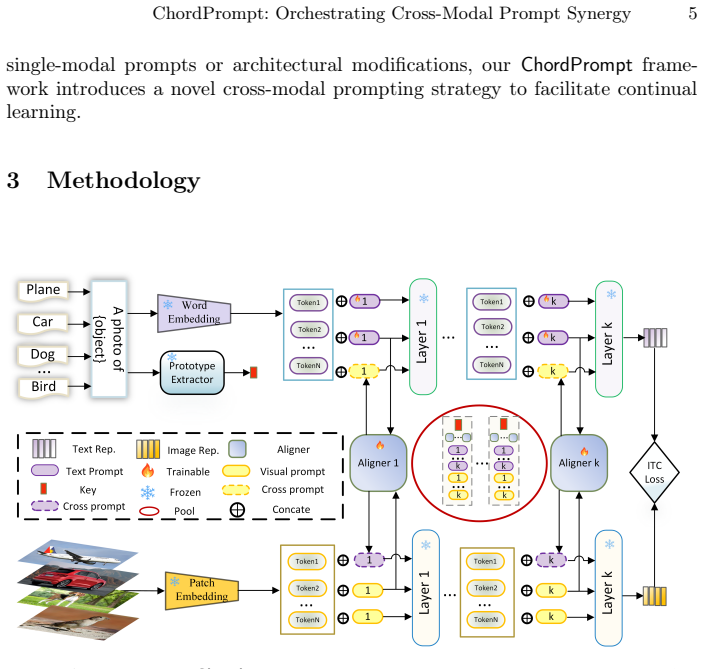
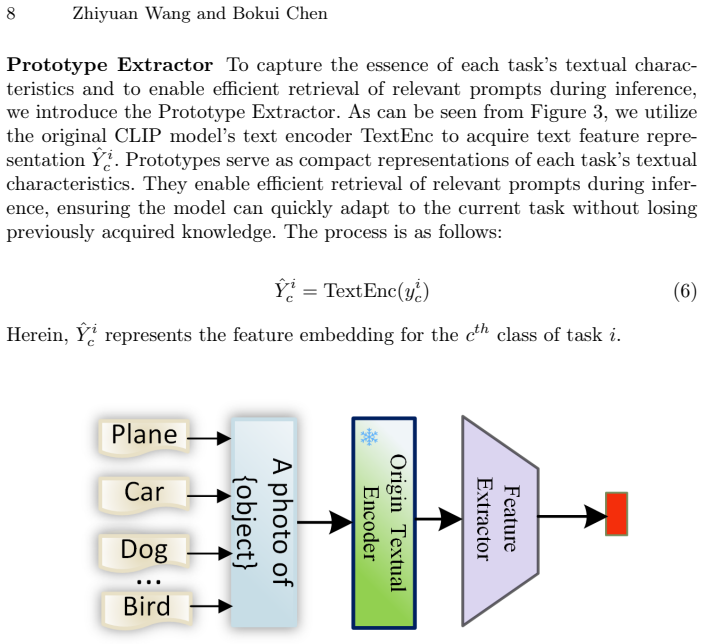
The load-bearing objects are the Aligner module and the Prototype Extractor with its prompt pool. The Aligner consists of two learned matrices, $A_{V2T}$ and $A_{T2V}$, that map visual prompt tokens into text space and text prompt tokens into vision space; these projected tokens are inserted only into the value ($V$) component of self-attention at every layer, so cross-modal information shapes each encoder's output features while the frozen query–key attention pattern is untouched. The Prototype Extractor takes the class-name labels of a domain, runs them through the original frozen CLIP text encoder, and forms a domain key as the $\ell^2$-normalized sum of those text embeddings. That key is stored with the domain's prompts, and at inference the model retrieves the domain whose key has the largest cosine similarity to the prototype computed from the test image's candidate label set, with a threshold falling back to zero-shot CLIP.
What would settle it
Compare, on the same trained prompt pool, three inference variants: prompts chosen by oracle domain ID, prompts chosen by the paper's cosine retrieval, and prompts chosen at random. If cosine retrieval does not closely track the oracle, or if random prompts perform almost as well, then prototype retrieval is not the source of the reported gains; a supporting calculation is the pairwise cosine similarity matrix of the 11 frozen text prototypes, which should show clear domain separation.
Extended reading notes
Core claim
The central claim is that a frozen CLIP can be continually adapted by learning, for each domain, a small set of layer-wise prompts in both encoders, coupled by two learnable projection matrices called the Aligner. The Aligner projects visual prompts into text-attention value slots and text prompts into vision-attention value slots at every layer, so each modality is shaped by the other without disturbing the frozen query-key attention. At the same time, a Prototype Extractor runs the class names of the current dataset through the original CLIP text encoder, averages and normalizes the resulting class vectors into a domain prototype, and stores it with that domain's prompts. At inference the model computes the prototype of the candidate class set for the incoming image, retrieves the stored domain whose prototype has the highest cosine similarity, and uses that domain's prompts; if no prototype clears a threshold, it falls back to original zero-shot CLIP. The paper reports that this design tops prior methods on the 11-task MTIL benchmark in transfer, average, and final accuracy, including in a 5-shot few-shot version.
Load-bearing premise
The whole selection mechanism assumes the test-time candidate class label set is known and that averaging the frozen CLIP text embeddings of those labels points to the correct stored domain prototype, so if the class set is unavailable or text prototypes do not separate domains, prompt retrieval collapses and ChordPrompt degrades to plain zero-shot CLIP.
Editorial extensions
If this is right
- A continual learner can adapt a frozen CLIP to a new domain by storing only a compact prototype vector and per-domain prompts, eliminating replay of old images and cutting trainable parameters to roughly 9.48M, about 4.5% of full fine-tuning's 211M.
- The retrieval-plus-threshold design preserves CLIP's zero-shot behavior when the incoming domain is unfamiliar, since a low prototype match routes the image back to the original CLIP.
- The reported 69.5% transfer score indicates that adapting to early domains no longer destroys the model's accuracy on later unseen domains, the failure mode that continual fine-tuning suffers.
- In the 5-shot setting the domain prototypes still separate the data distributions, so the cross-modal prompt strategy works when each task supplies only a handful of samples.
- Because the Aligner injects prompts only into value projections, a single frozen backbone can host many domain-specific prompt sets, making the approach memory-scalable as the number of tasks grows.
Reading between the lines
- Editorial inference: the same prototype-retrieval mechanism could be repurposed as a novelty detector: an image whose candidate-class prototype falls below the threshold would be flagged as out-of-distribution, letting ChordPrompt decide when to spawn a new prompt set online without any task boundary.
- Editorial inference: because the Aligner only touches value vectors, the attention pattern remains frozen; a natural test is whether adding cross-modal information to query or key projections would improve or destabilize the learned representations, which the paper does not explore.
- Editorial inference: if retrieval quality is set by the frozen text encoder, the framework inherits whatever blind spots CLIP's text space has; a testable alternative is to use the trained prompts to recompute domain prototypes rather than frozen class-name averages and see whether retrieval accuracy rises.
Editorial analysis
A structured set of objections, weighed in public.
Referee Report
Summary. The paper proposes ChordPrompt, a prompt-based continual learning method for CLIP in a multi-domain task-incremental setting (MTIL). It adds learnable prompts to both the text and vision encoders, projects prompts across modalities via learned Aligner matrices, and stores per-task prototype keys derived from frozen CLIP text embeddings of class names to retrieve task-specific prompts at inference. Experiments on an 11-dataset benchmark report Transfer, Average, and Last accuracies that improve over existing continual learning and prompt-based baselines (e.g., Table 1: Transfer 69.5 vs. 68.9, Avg 78.1 vs. 76.7, Last 87.0 vs. 85.0 for the strongest baseline DDAS), with only 9.48M trainable parameters.
Significance. If the experimental protocol is sound, ChordPrompt is a parameter-efficient alternative in a setting where most prior work fine-tunes all 211M CLIP parameters. The idea of cross-modal prompt sharing and prototype-based prompt retrieval is interesting and the paper includes a public implementation. The reported gains are modest but consistent across Tables 1-3, and the 5-shot results in Table 2 suggest the method can be data-efficient. However, the current manuscript leaves the inference-time protocol underspecified, which prevents verification of the central task-ID-free and zero-shot claims.
major comments (4)
- [Section 3.3 / Algorithm 2] Algorithm 2 takes the candidate class set C={y1,...,yNc} as an input for every test image and constructs the prototype Px from these labels. If C is the current task's class set, then the method receives task-boundary information, contradicting the stated goal in Section 3 that the model should classify 'without knowing the specific task ID during inference.' If C is instead the union of all 1,201 classes, then Px is a single fixed vector for every test image, and the cosine-similarity retrieval in lines 3-8 always selects the same prompt from the pool, making the domain-adaptive prompt selection vacuous. The paper must state which C is used to produce Tables 1-3; if the former, it must either drop the task-ID-free claim or report results under a protocol that does not leak task identity.
- [Algorithm 2 / line 9] The discrimination threshold gamma is a free parameter that is never reported, optimized, or ablated. Its value determines how often the method falls back to the original zero-shot CLIP vs. using retrieved prompts; with a very large gamma the method degenerates to zero-shot CLIP, and with a very small gamma it always retrieves. The headline Transfer/Avg/Last numbers are therefore not reproducible without knowing gamma. Please report the gamma value used, a sensitivity analysis over a range, and the proportion of test samples for which Smax < gamma.
- [Section 3.1 / Eq. (4) and Section 3.2 / Eq. (10)] The equations specify that the original and projected prompts are concatenated with the token sequence before being passed to each transformer layer (TextLayer_l([E_{l-1}, T_l, hat{T}_l])), whereas the text and Figure 2 state that the projected prompts are added to the value (V) component of self-attention. These are different operations: concatenation adds input tokens (changing sequence length) while value injection modifies the values without changing the sequence. The implementation must be clarified, and the equations must be updated to match the actual operation, otherwise the method is not reproducible.
- [Table 2 / Few-shot setting] The few-shot results are described as 5-shot, but the number of training iterations differs from the full benchmark (500 iterations for ChordPrompt vs. 2000 in the main setting), and no comparison is reported for the other methods' iteration counts. The 'top block indicates upper-bound solutions' mentioned in the caption is not visible in the submitted table. Please specify the exact few-shot protocol for all methods and make the upper-bound row explicit.
minor comments (5)
- [Algorithm 1] Line 8 of Algorithm 1 contains the typo 'Aligenr'; it should be 'Aligner'.
- [Eqs. (6)-(7)] The notation is inconsistent: Eq. (6) defines \hat{Y}_c^i (the class feature from the original text encoder) but Eq. (7) uses Y_c^i without the hat. Use one symbol throughout to avoid confusion.
- [Table 4] The abbreviation 'Dualp.' is not expanded in the table or text; reference [30] should be cited at that point.
- [Figure 4] The caption says 'For better readability, we only display four tasks with close accuracy,' but this makes the claimed monotonic improvement hard to verify; consider showing all tasks or providing the full accuracy values in the caption.
- [Throughout] There are several wording issues ('continues learning' for 'continual learning') and minor formatting problems in the tables (e.g., missing visible upper-bound rows). A careful proofreading pass is advisable.
Circularity Check
Domain-prompt retrieval is predetermined by the test class list, making the task-ID-free selection self-definitional.
-
self definitional
[Algorithm 2 (Inference Process), lines 1-6; Section 3.1, Prototype Extractor, Eqs. (6)-(7)]
"Px ← ProtoExtrac(y1, ..., yNc ) ... S ← Px·Ki / (∥Px∥∥Ki∥) ... The prototype feature for task i, denoted as P i, is computed as follows: P i = Σ_{c=1}^{Nc} Y_i_c / ||Σ_{c=1}^{Nc} Y_i_c||"
The query Px is built from the test-time class list C using the same ProtoExtrac/TextEnc (Eqs. 6-7) that generated the stored key Ki for each task. If C is the current task's label set, the natural reading of 'dataset class categories', then Px = Ki exactly, so the cosine similarity in Algorithm 2 is 1 by construction and the correct domain prompt is retrieved without any image information. The claimed domain-adaptive selection therefore reduces to label-set matching, and the 'without task ID' claim is violated unless C is withheld. If C is instead the full 1201-class union, the paper never states this, so the protocol is either tautological or unspecified.
full rationale
ChordPrompt is an empirical learning method, not a formal derivation, and its reported gains are comparisons against external baselines. There is no self-citation chain or imported uniqueness theorem: references to works by other Wang/Zhang groups are not the present authors' prior results, and the cross-modal prompt equations, though internally inconsistent between Eq. (4)/(10) and the 'value component' text, are not circular. The one construction-level circularity is the inference-time prompt retrieval: Algorithm 2 builds the query prototype from the candidate class labels via the same function that produced the stored task keys, so under the natural task-specific reading of C the selection is predetermined. This makes the 'domain-adaptive text prompt' contribution and the task-ID-free framing partially circular, even though the final accuracy numbers could still be valid as an empirical result with oracle task information.
Assumptions & free parameters
free parameters (4)
- Discrimination threshold gamma =
not reported
- Layer depth for prompt insertion =
12
- Prompt length =
not explicitly stated (described as short)
- Training iterations per task =
2000 (500 for few-shot)
assumptions (4)
- domain assumption The prototype computed from the candidate class labels uniquely identifies the correct domain.
- domain assumption The original CLIP text encoder produces stable prototypes for prompt retrieval across tasks.
- domain assumption Injecting projected cross-modal prompts into the value component of self-attention preserves the original attention pattern.
- domain assumption A single shared Aligner trained across all tasks can project prompts between modalities consistently.
invented entities (1)
-
Cross-modal Aligner (learnable projection matrices A_V2T and A_T2V)
Cite this review
Pith. "Pith review of ChordPrompt: Orchestrating Cross-Modal Prompt Synergy for Multi-Domain Incremental Learning in CLIP." pith.science (2026). https://pith.science/paper/EZUJ2ZUX
@misc{pith2026250619608,
  author       = {Pith},
  title        = {Pith review of: ChordPrompt: Orchestrating Cross-Modal Prompt Synergy for Multi-Domain Incremental Learning in CLIP},
  year         = {2026},
  howpublished = {\url{https://pith.science/paper/EZUJ2ZUX}},
  note         = {Machine review of arXiv:2506.19608}
}
read the original abstract
Continual learning (CL) empowers pre-trained vision-language models to adapt effectively to novel or previously underrepresented data distributions without comprehensive retraining, enhancing their adaptability and efficiency. While vision-language models like CLIP show great promise, they struggle to maintain performance across domains in incremental learning scenarios. Existing prompt learning methods face two main limitations: 1) they primarily focus on class-incremental learning scenarios, lacking specific strategies for multi-domain task incremental learning; 2) most current approaches employ single-modal prompts, neglecting the potential benefits of cross-modal information exchange. To address these challenges, we propose the \ChordPrompt framework, which facilitates a harmonious interplay between visual and textual prompts. \ChordPrompt introduces cross-modal prompts to leverage interactions between visual and textual information. Our approach also employs domain-adaptive text prompts to select appropriate prompts for continual adaptation across multiple domains. Comprehensive experiments on multi-domain incremental learning benchmarks demonstrate that \ChordPrompt outperforms state-of-the-art methods in zero-shot generalization and downstream task performance.
Figures

Figures from the paper (1 more)

Reference graph
Works this paper leans on
-
[1]
Advances in neural information processing systems35, 23716– 23736 (2022)
Alayrac, J.B., Donahue, J., Luc, P., Miech, A., Barr, I., Hasson, Y., Lenc, K., Men- sch, A., Millican, K., Reynolds, M., et al.: Flamingo: a visual language model for few-shot learning. Advances in neural information processing systems35, 23716– 23736 (2022)
2022
-
[2]
In: Proceedings of the IEEE/CVF conference on computer vision and pat- tern recognition
Dhar, P., Singh, R.V., Peng, K.C., Wu, Z., Chellappa, R.: Learning without mem- orizing. In: Proceedings of the IEEE/CVF conference on computer vision and pat- tern recognition. pp. 5138–5146 (2019)
work page 2019
-
[3]
arXiv preprint arXiv:2207.09248 (2022)
Ding, Y., Liu, L., Tian, C., Yang, J., Ding, H.: Don’t stop learning: Towards con- tinual learning for the clip model. arXiv preprint arXiv:2207.09248 (2022)
arXiv 2022
-
[4]
In: International Con- ference on Learning Representations (2020)
Dosovitskiy, A., Beyer, L., Kolesnikov, A., Weissenborn, D., Zhai, X., Unterthiner, T., Dehghani, M., Minderer, M., Heigold, G., Gelly, S., et al.: An image is worth 16x16 words: Transformers for image recognition at scale. In: International Con- ference on Learning Representations (2020)
2020
-
[5]
In: ECCV 2020-16th European Conference on Computer Vision
Douillard, A., Cord, M., Ollion, C., Robert, T., Valle, E.: Podnet: Pooled outputs distillation for small-tasks incremental learning. In: ECCV 2020-16th European Conference on Computer Vision. vol. 12365, pp. 86–102. Springer (2020)
work page 2020
-
[6]
In: Proceedings of the IEEE/CVF Conference on Computer Vision and Pattern Recognition
Douillard, A., Ramé, A., Couairon, G., Cord, M.: Dytox: Transformers for con- tinual learning with dynamic token expansion. In: Proceedings of the IEEE/CVF Conference on Computer Vision and Pattern Recognition. pp. 9285–9295 (2022)
work page 2022
-
[7]
French, R.M.: Catastrophic forgetting in connectionist networks. Trends in cogni- tive sciences 3(4), 128–135 (1999) ChordPrompt: Orchestrating Cross-Modal Prompt Synergy 17
work page 1999
-
[8]
In: Proceedings of the IEEE/CVF International Conference on Computer Vision
Hendrycks, D., Basart, S., Mu, N., Kadavath, S., Wang, F., Dorundo, E., Desai, R., Zhu, T., Parajuli, S., Guo, M., et al.: The many faces of robustness: A critical analysis of out-of-distribution generalization. In: Proceedings of the IEEE/CVF International Conference on Computer Vision. pp. 8340–8349 (2021)
work page 2021
Show all 39 references
-
[9]
In: International Conference on Machine Learning, ICML 2023
Jeeveswaran, K., Bhat, P.S., Zonooz, B., Arani, E.: Birt: Bio-inspired replay in vision transformers for continual learning. In: International Conference on Machine Learning, ICML 2023. pp. 14817–14835. PMLR (2023), https://proceedings. mlr.press/v202/jeeveswaran23a.html
2023
-
[10]
In: International conference on machine learning
Jia, C., Yang, Y., Xia, Y., Chen, Y.T., Parekh, Z., Pham, H., Le, Q., Sung, Y.H., Li, Z., Duerig, T.: Scaling up visual and vision-language representation learning with noisy text supervision. In: International conference on machine learning. pp. 4904–4916. PMLR (2021)
2021
-
[11]
In: Proceedings of the IEEE/CVF International Conference on Computer Vision
Jung, D., Han, D., Bang, J., Song, H.: Generating instance-level prompts for rehearsal-free continual learning. In: Proceedings of the IEEE/CVF International Conference on Computer Vision. pp. 11847–11857 (2023)
2023
-
[12]
In: Proceedings of the IEEE/CVF Conference on Computer Vi- sion and Pattern Recognition
Khattak, M.U., Rasheed, H., Maaz, M., Khan, S., Khan, F.S.: Maple: Multi-modal prompt learning. In: Proceedings of the IEEE/CVF Conference on Computer Vi- sion and Pattern Recognition. pp. 19113–19122 (2023)
2023
-
[13]
In: Proceedings of the 2021 Conference on Empirical Methods in Natural Language Processing
Lester, B., Al-Rfou, R., Constant, N.: The power of scale for parameter-efficient prompt tuning. In: Proceedings of the 2021 Conference on Empirical Methods in Natural Language Processing. pp. 3045–3059 (2021)
2021
-
[14]
In: International conference on machine learning
Li, J., Li, D., Savarese, S., Hoi, S.: Blip-2: Bootstrapping language-image pre- training with frozen image encoders and large language models. In: International conference on machine learning. pp. 19730–19742. PMLR (2023)
2023
-
[15]
In: Proceedings of the 59th Annual Meeting of the Association for Computational Linguistics
Li, X.L., Liang, P.: Prefix-tuning: Optimizing continuous prompts for generation. In: Proceedings of the 59th Annual Meeting of the Association for Computational Linguistics. pp. 4582–4597 (2021)
2021
-
[16]
IEEE transactions on pattern anal- ysis and machine intelligence40(12), 2935–2947 (2017)
Li, Z., Hoiem, D.: Learning without forgetting. IEEE transactions on pattern anal- ysis and machine intelligence40(12), 2935–2947 (2017)
2017
-
[17]
Advances in neural information processing systems36 (2024)
Liu, H., Li, C., Wu, Q., Lee, Y.J.: Visual instruction tuning. Advances in neural information processing systems36 (2024)
2024
-
[18]
In: International Conference on Learning Representations (2018)
Loshchilov, I., Hutter, F.: Decoupled weight decay regularization. In: International Conference on Learning Representations (2018)
2018
-
[19]
Advances in neural information processing systems 32 (2019)
Lu,J.,Batra,D.,Parikh,D.,Lee,S.:Vilbert:Pretrainingtask-agnosticvisiolinguis- tic representations for vision-and-language tasks. Advances in neural information processing systems 32 (2019)
2019
-
[20]
In: International Conference on Machine Learning, ICML 2023
Ni, Z., Wei, L., Tang, S., Zhuang, Y., Tian, Q.: Continual vision-language rep- resentation learning with off-diagonal information. In: International Conference on Machine Learning, ICML 2023. pp. 26129–26149. PMLR (2023), https:// proceedings.mlr.press/v202/ni23c.html
2023
-
[21]
arXiv preprint arXiv:1807.03748 (2018)
Oord, A.v.d., Li, Y., Vinyals, O.: Representation learning with contrastive predic- tive coding. arXiv preprint arXiv:1807.03748 (2018)
2018 arXiv
-
[22]
In: International conference on machine learning
Radford, A., Kim, J.W., Hallacy, C., Ramesh, A., Goh, G., Agarwal, S., Sastry, G., Askell, A., Mishkin, P., Clark, J., et al.: Learning transferable visual models from natural language supervision. In: International conference on machine learning. pp. 8748–8763. PMLR (2021)
2021
-
[23]
In: Proceedings of the IEEE conference on Computer Vision and Pattern Recognition
Rebuffi, S.A., Kolesnikov, A., Sperl, G., Lampert, C.H.: icarl: Incremental classifier and representation learning. In: Proceedings of the IEEE conference on Computer Vision and Pattern Recognition. pp. 2001–2010 (2017) 18 Zhiyuan Wang and Bokui Chen
2017
-
[24]
arXiv preprint arXiv:1606.04671 (2016)
Rusu, A.A., Rabinowitz, N.C., Desjardins, G., Soyer, H., Kirkpatrick, J., Kavukcuoglu, K., Pascanu, R., Hadsell, R.: Progressive neural networks. arXiv preprint arXiv:1606.04671 (2016)
2016 arXiv
-
[25]
Trends in cognitive sci- ences 12(11), 411–417 (2008)
Shams, L., Seitz, A.R.: Benefits of multisensory learning. Trends in cognitive sci- ences 12(11), 411–417 (2008)
2008
-
[26]
Advances in neural information processing systems30 (2017)
Shin, H., Lee, J.K., Kim, J., Kim, J.: Continual learning with deep generative replay. Advances in neural information processing systems30 (2017)
2017
-
[27]
arXiv preprint arXiv:2210.03114 (2022)
Thengane, V., Khan, S., Hayat, M., Khan, F.: Clip model is an efficient continual learner. arXiv preprint arXiv:2210.03114 (2022)
2022 arXiv
-
[28]
arXiv preprint arXiv:1904.07734 (2019)
Van de Ven, G.M., Tolias, A.S.: Three scenarios for continual learning. arXiv preprint arXiv:1904.07734 (2019)
2019 arXiv
-
[29]
Advances in Neural Information Processing Systems 35, 5682–5695 (2022)
Wang, Y., Huang, Z., Hong, X.: S-prompts learning with pre-trained transformers: An occam’s razor for domain incremental learning. Advances in Neural Information Processing Systems 35, 5682–5695 (2022)
2022
-
[30]
In: European Conference on Computer Vision
Wang, Z., Zhang, Z., Ebrahimi, S., Sun, R., Zhang, H., Lee, C.Y., Ren, X., Su, G., Perot, V., Dy, J., et al.: Dualprompt: Complementary prompting for rehearsal-free continual learning. In: European Conference on Computer Vision. pp. 631–648. Springer (2022)
2022
-
[31]
In: Proceedings of the IEEE/CVF Conference on Computer Vision and Pattern Recognition
Wang, Z., Zhang, Z., Lee, C.Y., Zhang, H., Sun, R., Ren, X., Su, G., Perot, V., Dy, J., Pfister, T.: Learning to prompt for continual learning. In: Proceedings of the IEEE/CVF Conference on Computer Vision and Pattern Recognition. pp. 139–149 (2022)
2022
-
[32]
In: Proceedings of the IEEE/CVF Conference on Computer Vision and Pattern Recognition
Wortsman, M., Ilharco, G., Kim, J.W., Li, M., Kornblith, S., Roelofs, R., Lopes, R.G., Hajishirzi, H., Farhadi, A., Namkoong, H., et al.: Robust fine-tuning of zero- shot models. In: Proceedings of the IEEE/CVF Conference on Computer Vision and Pattern Recognition. pp. 7959–79...
2022
-
[33]
IEEE Transactions on Multimedia (2023)
Xing, Y., Wu, Q., Cheng, D., Zhang, S., Liang, G., Wang, P., Zhang, Y.: Dual modality prompt tuning for vision-language pre-trained model. IEEE Transactions on Multimedia (2023)
2023
-
[34]
In: 6th International Conference on Learning Representations, ICLR (2018)
Yoon, J., Yang, E., Lee, J., Hwang, S.J.: Lifelong learning with dynamically ex- pandable networks. In: 6th International Conference on Learning Representations, ICLR (2018)
2018
-
[35]
Yu, J., Zhuge, Y., Zhang, L., Hu, P., Wang, D., Lu, H., He, Y.: Boosting continual learningofvision-languagemodelsviamixture-of-expertsadapters.In:Proceedings of the IEEE/CVF Conference on Computer Vision and Pattern Recognition. pp. 23219–23230 (2024)
2024
-
[36]
In: Proceed- ings of the IEEE/CVF International Conference on Computer Vision (ICCV)
Zheng, Z., Ma, M., Wang, K., Qin, Z., Yue, X., You, Y.: Preventing zero-shot transfer degradation in continual learning of vision-language models. In: Proceed- ings of the IEEE/CVF International Conference on Computer Vision (ICCV). pp. 19125–19136 (October 2023)
2023
-
[37]
In: Proceedings of the IEEE/CVF Conference on Computer Vi- sion and Pattern Recognition
Zhou, K., Yang, J., Loy, C.C., Liu, Z.: Conditional prompt learning for vision- language models. In: Proceedings of the IEEE/CVF Conference on Computer Vi- sion and Pattern Recognition. pp. 16816–16825 (2022)
2022
-
[38]
International Journal of Computer Vision130(9), 2337–2348 (2022)
Zhou, K., Yang, J., Loy, C.C., Liu, Z.: Learning to prompt for vision-language models. International Journal of Computer Vision130(9), 2337–2348 (2022)
2022
-
[39]
In: Proceedings of the IEEE/CVF Conference on Computer Vision and Pattern Recognition
Zhu, J., Lai, S., Chen, X., Wang, D., Lu, H.: Visual prompt multi-modal tracking. In: Proceedings of the IEEE/CVF Conference on Computer Vision and Pattern Recognition. pp. 9516–9526 (2023)
2023
Reviewed August 6, 2026 · model on record in the stance chip above.
Discussion (0). Continue with ORCID to comment.