REVIEW 3 major objections 7 minor 1 cited by
Position: Intelligent Science Laboratory Requires the Integration of Cognitive and Embodied AI
T0 review · 3 major / 7 minor · reviewed 2026-08-06 · deepseek-v4-flash
Pith's one-line read The paper argues that scientific discovery will remain constrained until AI reasoning and embodied robots are integrated into a single closed loop, and it proposes an Intelligent Science Laboratory framework to achieve that integration.
desk verdict A candid, well-organized position paper whose three-layer taxonomy is useful but whose 'essential' claim is a promissory bet on embodied AI catching up to lab-grade manipulation. read the letter →
The pith
A machine-rendered reading of the paper's core claim, the machinery that carries it, and where it could break.
The reading
What carries the argument
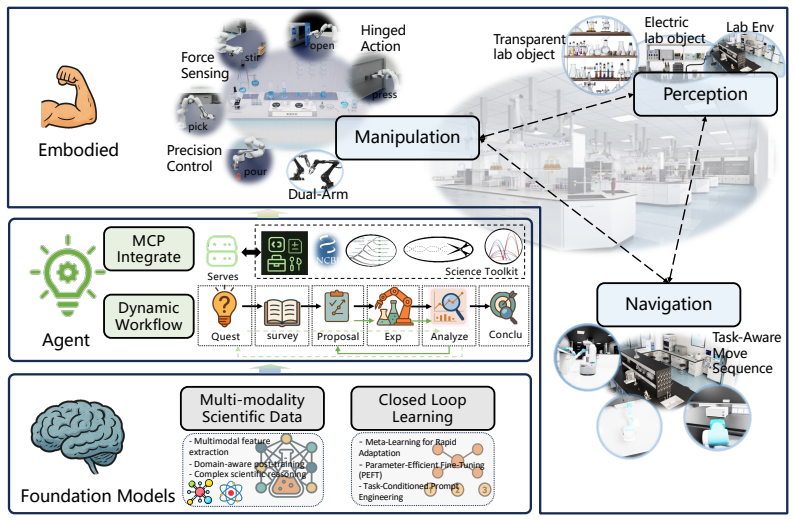
The central object is the three-layer ISL architecture. The Foundation Model Layer is the cognitive core, handling multimodal scientific understanding and closed-loop learning via meta-learning, parameter-efficient fine-tuning, and prompt engineering. The Agent Layer is the strategic orchestrator: a meta-agent that composes workflows on the fly from modular capabilities, plus a Model-Call Protocol for invoking proprietary or specialized tools. The Embodied Layer provides perception, navigation, and manipulation, and operates in a Real2Sim2Real cycle that validates protocols virtually before wet-lab execution. A four-level taxonomy (Level 0 to Level 3) quantifies increasing autonomy, and the load-bearing mechanism is recursive interaction among layers: experimental results refine the foundation model's representations, the meta-agent updates plans, and the embodied layer adapts physical actions.
What would settle it
A controlled benchmark where an open-ended discovery task, such as optimizing a reaction yield with noisy feedback, is run both by a Level-2 ISL and by a scripted high-throughput platform; if the scripted platform matches or exceeds the ISL in discovery rate and cost, the claim that cognitive-embodied integration is essential for transcending current limits would be contradicted.
Extended reading notes
Core claim
The paper's central claim is that the next major leap in AI-driven science will come not from bigger models or faster robots alone, but from tightly coupling the two. The Intelligent Science Laboratory is defined as a multi-layered closed-loop architecture in which foundation models serve as the cognitive core, a meta-agent dynamically designs and adapts experimental workflows, and embodied agents execute, sense, and recover in real laboratories. The framework abstracts scientific discovery into six capabilities and maps them onto four maturity levels (Level 0 automation to Level 3 continual self-evolution). The paper surveys recent embodied-AI advances — diffusion-based action policies, generalist robot foundation models, fine-grained manipulation, sim-to-real transfer — as evidence that the physical layer is now ready to close the loop, and it argues such systems are essential for transcending current limits of scientific discovery.
Load-bearing premise
The load-bearing premise is that current or near-term embodied AI can master the delicate, transparent, and fine-grained liquid-handling tasks of real labs, and that the sim-to-real gap can be kept small enough for virtual validation to guide physical execution.
Editorial extensions
If this is right
- Autonomous labs would shift from executing fixed protocols to designing and adapting experiments on the fly, reducing human labor in routine synthesis and screening.
- AI scientists grounded in physical outcomes could discover through iterative hypothesis-test-adapt cycles rather than reasoning over static datasets alone.
- Closed-loop learning from real experimental feedback can mitigate data scarcity in chemistry, materials, and biology by treating each experiment as a fresh training signal.
- The four-level taxonomy gives the community a common scale for measuring progress from simple automation to self-evolving laboratories.
- Sim-to-real calibration and transparent-object manipulation become central research topics rather than peripheral robotics problems.
Reading between the lines
- If the ISL premise holds, evaluation norms should shift toward shared embodied-lab benchmarks with real manipulation tasks such as transparent glassware and liquid handling, not just language or simulation benchmarks.
- A testable extension: Level-2 autonomy in at least one well-characterized chemistry domain is likely to be demonstrated before a general-purpose Level-3 lab, because the roadmap implies that ordering of progress.
- The paper's serendipity promise suggests ISLs need built-in exploration incentives such as novelty search or curiosity drives, which the framework only gestures at and which remain a missing piece.
- Because ISLs require substantial physical infrastructure, the field may face an equity fork between shared remote-access platforms and a widening gap between well-funded and resource-limited laboratories.
Editorial analysis
A structured set of objections, weighed in public.
Referee Report
Summary. This position paper argues that full automation of scientific discovery requires Intelligent Science Laboratories (ISLs), a closed-loop architecture that unifies foundation models as the cognitive layer, multi-agent orchestration as the agent layer, and embodied robots as the physical execution layer. It defines a four-level autonomy taxonomy from Level 0 (script-driven automation) to Level 3 (self-evolving discovery loops), reviews existing AI scientists, automated laboratory platforms, and recent embodied AI methods, and catalogs open challenges in multimodal scientific understanding, agent specialization and tool use, multi-agent collaboration, and real-world robotic deployment. The central thesis is that current AI scientists remain confined to virtual environments and current automated laboratories remain rigid and task-specific, so integrating cognitive and embodied intelligence within an end-to-end closed loop is essential for transcending the current limits of scientific discovery.
Significance. If realized, the ISL framework would provide a useful organizing vocabulary and roadmap for autonomous scientific discovery, with plausible benefits for chemistry, materials, drug discovery, and beyond. The paper's strengths include its broad and current citation base, a clear four-level autonomy taxonomy, and an unusually candid catalog of open problems in Sections 5 and 7. It also avoids overclaiming about existing systems by explicitly listing their limitations. Its main weakness is that the central claim of 'essential' is a promissory assertion about near-term embodied capability that is not supported by experimental evidence or by a systematic comparison with alternative paradigms such as human-in-the-loop science or simulation-only AI scientists. The contribution is therefore best viewed as a roadmap and set of research questions rather than an established necessity.
major comments (3)
- [§1, §4.4, §5.3] The paper's central claim that ISLs are 'essential' depends on the feasibility of the Embodied Layer executing wet-lab protocols, but the manuscript itself states in §1 that existing embodied AI systems lack specialized capabilities for transparent materials and fine-grained liquid handling, and §5.3 concedes that real-world deployment is limited by data cost, hardware heterogeneity, sim-to-real gaps, and sensor-fusion latency. No benchmark, simulation, or pilot result is provided to show that near-term embodied AI can meet laboratory precision and reliability. I recommend either reframing the thesis from 'essential' to 'a promising and necessary next direction' or adding a concrete feasibility argument with milestones, because as written the 'essential' claim is not supported by the paper's own evidence.
- [§3, §4.6] The motivation in §3 states that existing automation remains 'pre-scripted, brittle, and task-specific,' yet §4.6 describes many existing platforms (HT-READ, RoboRXN, Electrolab, the AI chemist of Zhu et al., DeCost et al., and Gongora et al.) as ISLs that already integrate predictive models with robotic execution and active learning. The paper should clarify the boundary between 'not an ISL' and 'an early or partial ISL'; otherwise the novelty and necessity claims are difficult to evaluate and the reader cannot tell what exactly the proposed three-layer integration adds beyond existing self-driving laboratory systems.
- [§7] Section 7 is titled 'Impact Statement and Alternative Views,' but it contains no alternative views; it discusses equity, domain bias, workforce transformation, and data governance. Since the paper argues for the necessity of ISLs and calls for a paradigm shift, it should engage with genuine alternatives such as human-in-the-loop laboratories, simulation-only AI science, specialized automation without general-purpose embodiment, or the possibility that incremental integration rather than the proposed unified architecture is sufficient. Addressing at least one counter-position would strengthen the persuasiveness of the position paper.
minor comments (7)
- [§2, Table 1] Level 2 is described as 'researcher-level proficiency' and Level 3 as 'surpasses human experts,' but no metrics are given for these thresholds; consider adding measurable evaluation criteria or explicitly stating that they are aspirational.
- [Figure 1] The label 'AgentQuest Conclu' in Figure 1 appears to be a rendering artifact or an incomplete label fragment; it should be fixed.
- [§4.3] The terms 'Meta-Agent' and 'Model-Call Protocol' are introduced as proposed abstractions, but their relationship to existing agent frameworks (e.g., AutoGen, LangGraph, or the Model Context Protocol) is not discussed; a brief comparison would help readers assess what is new.
- [§4.6] Some cited applications, such as AlphaFold-guided design and the HT-READ platform, are not full ISLs under the paper's own definition; use consistent labeling such as 'ISL components' versus 'full ISLs'.
- [References] Several references have formatting issues, including [4] with a line break in the title and [8] with a literal '\pi_0' token; a final copyedit of the reference list is needed.
- [§1] The phrase 'we propose intelligent science laboratory' uses inconsistent capitalization; it should be 'Intelligent Science Laboratory' for consistency with the rest of the text.
- [§5.2] DSPy and GRPO are cited as frameworks for agent specialization, but their primary purposes are prompt optimization and reinforcement-learning training; the characterization should be checked to avoid overstating their relevance.
Circularity Check
No significant circularity: the paper is an argumentative position piece with no derivation chain, fitted parameters, or predictions that reduce to inputs.
full rationale
This is a position paper rather than a technical derivation. It proposes the Intelligent Science Laboratory (ISL) paradigm, defines a three-layer architecture, and argues that integrating cognitive and embodied AI is essential for advancing scientific discovery. The paper contains no equations, no fitted parameters, and no empirical predictions; therefore the standard circularity patterns such as self-definitional derivations, fitted-input-called-prediction, or uniqueness theorems imported from the authors' prior work do not apply. Several cited references include works by the present authors (e.g., ChemCrow [10], Gollum [81], and a CLIP-based data-selection paper [106]), but these citations are used as examples of existing foundation-model or data-analysis capabilities, not as load-bearing justification for the central architectural claim. The central claim that ISLs are 'essential' is a rhetorical position supported by documented gaps between virtual AI scientists and automated laboratories; it is not a result derived from the cited works. Even the weakest assumption identified by the reader, namely that embodied AI can eventually master laboratory-specific manipulation, is presented openly as a challenge in Sections 5.1 and 5.3 rather than disguised as a demonstrated capability. There is no circular step to exhibit: no equation is defined in terms of its own output, and no cited theorem is invoked to forbid alternatives. The appropriate finding is therefore no significant circularity, with a score of 0.
Assumptions & free parameters
assumptions (3)
- domain assumption The bottleneck in scientific automation is the integration of cognitive and embodied intelligence rather than any single sub-capability.
- domain assumption Existing embodied AI can be extended to laboratory-specific manipulation, such as transparent objects and liquid handling, with current or near-term techniques.
- domain assumption Foundation models can provide reliable scientific reasoning and protocol planning once domain-adapted.
invented entities (2)
-
Meta-Agent
-
Model-Call Protocol abstraction
Cite this review
Pith. "Pith review of Position: Intelligent Science Laboratory Requires the Integration of Cognitive and Embodied AI." pith.science (2026). https://pith.science/paper/UTWM2JJC
@misc{pith2026250619613,
  author       = {Pith},
  title        = {Pith review of: Position: Intelligent Science Laboratory Requires the Integration of Cognitive and Embodied AI},
  year         = {2026},
  howpublished = {\url{https://pith.science/paper/UTWM2JJC}},
  note         = {Machine review of arXiv:2506.19613}
}
read the original abstract
Scientific discovery has long been constrained by human limitations in expertise, physical capability, and sleep cycles. The recent rise of AI scientists and automated laboratories has accelerated both the cognitive and operational aspects of research. However, key limitations persist: AI systems are often confined to virtual environments, while automated laboratories lack the flexibility and autonomy to adaptively test new hypotheses in the physical world. Recent advances in embodied AI, such as generalist robot foundation models, diffusion-based action policies, fine-grained manipulation learning, and sim-to-real transfer, highlight the promise of integrating cognitive and embodied intelligence. This convergence opens the door to closed-loop systems that support iterative, autonomous experimentation and the possibility of serendipitous discovery. In this position paper, we propose the paradigm of Intelligent Science Laboratories (ISLs): a multi-layered, closed-loop framework that deeply integrates cognitive and embodied intelligence. ISLs unify foundation models for scientific reasoning, agent-based workflow orchestration, and embodied agents for robust physical experimentation. We argue that such systems are essential for overcoming the current limitations of scientific discovery and for realizing the full transformative potential of AI-driven science.
Figures
Forward citations
Cited by 1 Pith paper
-
CausalGame: Benchmarking Causal Thinking of LLM Agents in Games
No evaluated frontier LLM agent shows reliable causal thinking on CausalGame’s 14 SCM-based drone games; survival and mechanistic understanding remain largely decoupled.
Reference graph
Works this paper leans on
-
[1]
The rise of self-driving labs in chemical and materials sciences
Milad Abolhasani and Eugenia Kumacheva. The rise of self-driving labs in chemical and materials sciences. Nature Synthesis, 2(6):483–492, 2023
2023
-
[2]
Accurate structure prediction of biomolecular interactions with alphafold 3
Josh Abramson, Jonas Adler, Jack Dunger, Richard Evans, Tim Green, Alexander Pritzel, Olaf Ronneberger, Lindsay Willmore, Andrew J Ballard, Joshua Bambrick, et al. Accurate structure prediction of biomolecular interactions with alphafold 3. Nature, 630(8016):493–500, 2024
2024
-
[3]
Learning to learn by gradient descent by gradient descent
Marcin Andrychowicz, Misha Denil, Sergio Gomez, Matthew W Hoffman, David Pfau, Tom Schaul, Brendan Shillingford, and Nando De Freitas. Learning to learn by gradient descent by gradient descent. Advances in neural information processing systems, 29, 2016
2016
-
[4]
A design-build-test-learn tool for synthetic biology
Evan Appleton. A design-build-test-learn tool for synthetic biology . PhD thesis, Boston University, 2016
2016
-
[5]
Jinheon Baek, Sujay Kumar Jauhar, Silviu Cucerzan, and Sung Ju Hwang. Researchagent: Iterative research idea generation over scientific literature with large language models. arXiv preprint arXiv:2404.07738, 2024
arXiv 2024
-
[6]
Possible high t c superconductivity in the ba- la- cu- o system
J George Bednorz and K Alex Müller. Possible high t c superconductivity in the ba- la- cu- o system. Zeitschrift für Physik B Condensed Matter, 64(2):189–193, 1986
1986
-
[7]
Scibert: A pretrained language model for scientific text
Iz Beltagy, Kyle Lo, and Arman Cohan. Scibert: A pretrained language model for scientific text. arXiv preprint arXiv:1903.10676, 2019
arXiv 1903
-
[8]
\pi_0: A vision-language-action flow model for general robot control
Kevin Black, Noah Brown, Danny Driess, Adnan Esmail, Michael Equi, Chelsea Finn, Niccolo Fusai, Lachy Groom, Karol Hausman, Brian Ichter, et al. \pi_0: A vision-language-action flow model for general robot control. arXiv preprint arXiv:2410.24164, 2024
Show all 116 references
-
[9]
Benchmarking the sim-to-real gap in cloth manipulation
David Blanco-Mulero, Oriol Barbany, Gokhan Alcan, Adrià Colomé, Carme Torras, and Ville Kyrki. Benchmarking the sim-to-real gap in cloth manipulation. IEEE Robotics and Automation Letters, 9(3):2981–2988, 2024
2024
-
[10]
Chemcrow: Augmenting large-language models with chemistry tools
Andres M Bran, Sam Cox, Oliver Schilter, Carlo Baldassari, Andrew D White, and Philippe Schwaller. Chemcrow: Augmenting large-language models with chemistry tools. arXiv preprint arXiv:2304.05376, 2023
2023 arXiv
-
[11]
Agibot world colosseo: A large-scale manipulation platform for scalable and intelligent embodied systems
Qingwen Bu, Jisong Cai, Li Chen, Xiuqi Cui, Yan Ding, Siyuan Feng, Shenyuan Gao, Xindong He, Xu Huang, Shu Jiang, et al. Agibot world colosseo: A large-scale manipulation platform for scalable and intelligent embodied systems. arXiv preprint arXiv:2503.06669, 2025
2025 arXiv
-
[12]
Data- centric architecture for self-driving laboratories with autonomous discovery of new nanomate- rials
Maria A Butakova, Andrey V Chernov, Oleg O Kartashov, and Alexander V Soldatov. Data- centric architecture for self-driving laboratories with autonomous discovery of new nanomate- rials. Nanomaterials, 12(1):12, 2021
2021
-
[13]
Diffusion policy: Visuomotor policy learning via action diffusion
Cheng Chi, Siyuan Feng, Yilun Du, Zhenjia Xu, Eric Cousineau, Benjamin Burchfiel, and Shuran Song. Diffusion policy: Visuomotor policy learning via action diffusion. InProceedings of Robotics: Science and Systems (RSS), 2023
2023
-
[14]
Diffusion policy: Visuomotor policy learning via action diffusion
Cheng Chi, Zhenjia Xu, Siyuan Feng, Eric Cousineau, Yilun Du, Benjamin Burchfiel, Russ Tedrake, and Shuran Song. Diffusion policy: Visuomotor policy learning via action diffusion. The International Journal of Robotics Research, 2024
2024
-
[15]
Autonomous discovery in the chemical sciences part i: Progress
Connor W Coley, Natalie S Eyke, and Klavs F Jensen. Autonomous discovery in the chemical sciences part i: Progress. Angewandte Chemie International Edition, 59(51):22858–22893, 2020
2020
-
[16]
A robotic platform for flow synthesis of organic compounds informed by ai planning
Connor W Coley, Dale A Thomas III, Justin AM Lummiss, Jonathan N Jaworski, Christopher P Breen, Victor Schultz, Travis Hart, Joshua S Fishman, Luke Rogers, Hanyu Gao, et al. A robotic platform for flow synthesis of organic compounds informed by ai planning. Science, 365(6453):...
2019
-
[17]
Closed-loop cycles of experiment design, execution, and learning accelerate systems biology model development in yeast
Anthony Coutant, Katherine Roper, Daniel Trejo-Banos, Dominique Bouthinon, Martin Carpenter, Jacek Grzebyta, Guillaume Santini, Henry Soldano, Mohamed Elati, Jan Ramon, et al. Closed-loop cycles of experiment design, execution, and learning accelerate systems biology model dev...
2019
-
[18]
Prediction of peptide mass spectral libraries with machine learning
Jürgen Cox. Prediction of peptide mass spectral libraries with machine learning. Nature Biotechnology, 41(1):33–43, 2023
2023
-
[19]
The advancement of artificial intelligence in biomed- ical research and health innovation: challenges and opportunities in emerging economies
Renan Gonçalves Leonel da Silva. The advancement of artificial intelligence in biomed- ical research and health innovation: challenges and opportunities in emerging economies. Globalization and Health, 20(1):44, 2024
2024
-
[20]
Autonomous discovery of battery electrolytes with robotic experimentation and machine learning
Adarsh Dave, Jared Mitchell, Kirthevasan Kandasamy, Han Wang, Sven Burke, Biswajit Paria, Barnabás Póczos, Jay Whitacre, and Venkatasubramanian Viswanathan. Autonomous discovery of battery electrolytes with robotic experimentation and machine learning. Cell Reports Physical Sc...
2020
-
[21]
Towards automated design of corrosion resistant alloy coatings with an autonomous scanning droplet cell
Brian DeCost, Howie Joress, Suchismita Sarker, Apurva Mehta, and Jason Hattrick-Simpers. Towards automated design of corrosion resistant alloy coatings with an autonomous scanning droplet cell. JOM, 74(8):2941–2950, 2022
2022
-
[22]
Research acceleration in self-driving labs: Technological roadmap toward accelerated materials and molecular discovery
Fernando Delgado-Licona and Milad Abolhasani. Research acceleration in self-driving labs: Technological roadmap toward accelerated materials and molecular discovery. Advanced Intelligent Systems, 5(4):2200331, 2023
2023
-
[23]
Machine learning methods for small data challenges in molecular science
Bozheng Dou, Zailiang Zhu, Ekaterina Merkurjev, Lu Ke, Long Chen, Jian Jiang, Yueying Zhu, Jie Liu, Bengong Zhang, and Guo-Wei Wei. Machine learning methods for small data challenges in molecular science. Chemical Reviews, 123(13):8736–8780, 2023
2023
-
[24]
The lab of the future: Self-driving labs for molecule discovery.GEN Biotechnology, 3(2):83–86, 2024
Sean Ekins. The lab of the future: Self-driving labs for molecule discovery.GEN Biotechnology, 3(2):83–86, 2024
2024
-
[25]
Exploring the integration of chatgpt in education: adapting for the future
Said Elbanna and Loreta Armstrong. Exploring the integration of chatgpt in education: adapting for the future. Management & Sustainability: An Arab Review, 3(1):16–29, 2024
2024
-
[26]
Toward machine learning-enhanced high-throughput experimentation
Natalie S Eyke, Brent A Koscher, and Klavs F Jensen. Toward machine learning-enhanced high-throughput experimentation. Trends in Chemistry, 3(2):120–132, 2021
2021
-
[27]
A critical evaluation of a self-driving laboratory for the optimization of electrodeposited earth-abundant mixed-metal oxide catalysts for the oxygen evolution reaction (oer)
Erfan Fatehi, Manish Thadani, Gabriel Birsan, and Robert W Black. A critical evaluation of a self-driving laboratory for the optimization of electrodeposited earth-abundant mixed-metal oxide catalysts for the oxygen evolution reaction (oer). arXiv preprint arXiv:2305.12541, 2023
2023 arXiv
-
[28]
Scalable meta-learning for bayesian optimization
Matthias Feurer, Benjamin Letham, and Eytan Bakshy. Scalable meta-learning for bayesian optimization. stat, 1050(6):7, 2018
2018
-
[29]
Model-agnostic meta-learning for fast adaptation of deep networks
Chelsea Finn, Pieter Abbeel, and Sergey Levine. Model-agnostic meta-learning for fast adaptation of deep networks. In International conference on machine learning, pages 1126–
-
[30]
Materials acceleration platforms: On the way to autonomous experimentation
Martha M Flores-Leonar, Luis M Mejía-Mendoza, Andrés Aguilar-Granda, Benjamin Sanchez- Lengeling, Hermann Tribukait, Carlos Amador-Bedolla, and Alán Aspuru-Guzik. Materials acceleration platforms: On the way to autonomous experimentation. Current Opinion in Green and Sustainab...
2020
-
[31]
Empowering biomedical discovery with ai agents
Shanghua Gao, Ada Fang, Yepeng Huang, Valentina Giunchiglia, Ayush Noori, Jonathan Richard Schwarz, Yasha Ektefaie, Jovana Kondic, and Marinka Zitnik. Empowering biomedical discovery with ai agents. Cell, 187(22):6125–6151, 2024
2024
-
[32]
Bayesian optimization with unknown constraints
Michael A Gelbart, Jasper Snoek, and Ryan P Adams. Bayesian optimization with unknown constraints. arXiv preprint arXiv:1403.5607, 2014. 12
2014 arXiv
-
[33]
The roles of science in technological innovation.Research policy, 3(3):220–242, 1974
Michael Gibbons and Ron Johnston. The roles of science in technological innovation.Research policy, 3(3):220–242, 1974
1974
-
[34]
A bayesian experimental autonomous researcher for mechanical design
Aldair E Gongora, Bowen Xu, Wyatt Perry, Chika Okoye, Patrick Riley, Kristofer G Reyes, Elise F Morgan, and Keith A Brown. A bayesian experimental autonomous researcher for mechanical design. Science advances, 6(15):eaaz1708, 2020
2020
-
[35]
An open-source drug discovery platform enables ultra-large virtual screens.Nature, 580(7805):663–668, 2020
Christoph Gorgulla, Andras Boeszoermenyi, Zi-Fu Wang, Patrick D Fischer, Paul W Coote, Krishna M Padmanabha Das, Yehor S Malets, Dmytro S Radchenko, Yurii S Moroz, David A Scott, et al. An open-source drug discovery platform enables ultra-large virtual screens.Nature, 580(7805...
2020
-
[36]
Towards an ai co-scientist
Juraj Gottweis, Wei-Hung Weng, Alexander Daryin, Tao Tu, Anil Palepu, Petar Sirkovic, Artiom Myaskovsky, Felix Weissenberger, Keran Rong, Ryutaro Tanno, et al. Towards an ai co-scientist. arXiv preprint arXiv:2502.18864, 2025
2025 arXiv
-
[37]
Controlling an organic synthesis robot with machine learning to search for new reactivity
Jarosław M Granda, Liva Donina, Vincenza Dragone, De-Liang Long, and Leroy Cronin. Controlling an organic synthesis robot with machine learning to search for new reactivity. Nature, 559(7714):377–381, 2018
2018
-
[38]
Matscibert: A materials domain language model for text mining and information extraction
Tanishq Gupta, Mohd Zaki, NM Anoop Krishnan, and Mausam. Matscibert: A materials domain language model for text mining and information extraction. npj Computational Materials, 8(1):102, 2022
2022
-
[39]
Automating the design-build-test-learn cycle towards next-generation bacterial cell factories
Nicolas Gurdo, Daniel C V olke, Douglas McCloskey, and Pablo Ivan Nikel. Automating the design-build-test-learn cycle towards next-generation bacterial cell factories. New Biotechnol- ogy, 74:1–15, 2023
2023
-
[40]
Digitising chemical synthesis in automated and robotic flow
Tomas Hardwick and Nisar Ahmed. Digitising chemical synthesis in automated and robotic flow. Chemical Science, 11(44):11973–11988, 2020
2020
-
[41]
Self- driving laboratories: A paradigm shift in nanomedicine development
Riley J Hickman, Pauric Bannigan, Zeqing Bao, Alán Aspuru-Guzik, and Christine Allen. Self- driving laboratories: A paradigm shift in nanomedicine development. Matter, 6(4):1071–1081, 2023
2023
-
[42]
Atlas: a brain for self-driving laboratories
Riley J Hickman, Malcolm Sim, Sergio Pablo-García, Gary Tom, Ivan Woolhouse, Han Hao, Zeqing Bao, Pauric Bannigan, Christine Allen, Matteo Aldeghi, et al. Atlas: a brain for self-driving laboratories. Digital Discovery, 4(4):1006–1029, 2025
2025
-
[43]
Sim2real in robotics and automation: Applications and challenges
Sebastian Höfer, Kostas Bekris, Ankur Handa, Juan Camilo Gamboa, Melissa Mozifian, Florian Golemo, Chris Atkeson, Dieter Fox, Ken Goldberg, John Leonard, et al. Sim2real in robotics and automation: Applications and challenges. IEEE transactions on automation science and engine...
2021
-
[44]
Parameter-efficient transfer learning for nlp
Neil Houlsby, Andrei Giurgiu, Stanislaw Jastrzebski, Bruna Morrone, Quentin De Laroussilhe, Andrea Gesmundo, Mona Attariyan, and Sylvain Gelly. Parameter-efficient transfer learning for nlp. In International conference on machine learning, pages 2790–2799. PMLR, 2019
2019
-
[45]
Dp4-ai automated nmr data analysis: straight from spectrometer to structure
Alexander Howarth, Kristaps Ermanis, and Jonathan M Goodman. Dp4-ai automated nmr data analysis: straight from spectrometer to structure. Chemical science, 11(17):4351–4359, 2020
2020
-
[46]
Lora: Low-rank adaptation of large language models
Edward J Hu, Yelong Shen, Phillip Wallis, Zeyuan Allen-Zhu, Yuanzhi Li, Shean Wang, Lu Wang, Weizhu Chen, et al. Lora: Low-rank adaptation of large language models. ICLR, 1(2):3, 2022
2022
-
[47]
Toward general-purpose robots via foundation models: A survey and meta-analysis
Yafei Hu, Quanting Xie, Vidhi Jain, Jonathan Francis, Jay Patrikar, Nikhil Keetha, Seungchan Kim, Yaqi Xie, Tianyi Zhang, Hao-Shu Fang, et al. Toward general-purpose robots via foundation models: A survey and meta-analysis. arXiv preprint arXiv:2312.08782, 2023
2023 arXiv
-
[48]
Position paper: Agent ai towards a holistic intelligence
Qiuyuan Huang, Naoki Wake, Bidipta Sarkar, Zane Durante, Ran Gong, Rohan Taori, Yusuke Noda, Demetri Terzopoulos, Noboru Kuno, Ade Famoti, et al. Position paper: Agent ai towards a holistic intelligence. arXiv preprint arXiv:2403.00833, 2024. 13
2024 arXiv
-
[49]
Analyzing the role of chatgpt as a writing assistant at higher education level: A systematic review of the literature
Muhammad Imran and Norah Almusharraf. Analyzing the role of chatgpt as a writing assistant at higher education level: A systematic review of the literature. Contemporary Educational Technology, 15(4):ep464, 2023
2023
-
[50]
Illumi- nating protein space with a programmable generative model
John B Ingraham, Max Baranov, Zak Costello, Karl W Barber, Wujie Wang, Ahmed Ismail, Vincent Frappier, Dana M Lord, Christopher Ng-Thow-Hing, Erik R Van Vlack, et al. Illumi- nating protein space with a programmable generative model. Nature, 623(7989):1070–1078, 2023
2023
-
[51]
Perceiver: General perception with iterative attention
Andrew Jaegle, Felix Gimeno, Andy Brock, Oriol Vinyals, Andrew Zisserman, and Joao Carreira. Perceiver: General perception with iterative attention. In International conference on machine learning, pages 4651–4664. PMLR, 2021
2021
-
[52]
Ai in small-molecule drug discovery: a coming wave
Madura KP Jayatunga, Wen Xie, Ludwig Ruder, Ulrik Schulze, and Christoph Meier. Ai in small-molecule drug discovery: a coming wave. Nat. Rev. Drug Discov, 21(3):175–176, 2022
2022
-
[53]
Highly accurate protein structure prediction with alphafold
John Jumper, Richard Evans, Alexander Pritzel, Tim Green, Michael Figurnov, Olaf Ron- neberger, Kathryn Tunyasuvunakool, Russ Bates, Augustin Žídek, Anna Potapenko, et al. Highly accurate protein structure prediction with alphafold. nature, 596(7873):583–589, 2021
2021
-
[54]
Gen2sim: Scaling up robot learning in simulation with generative models
Pushkal Katara, Zhou Xian, and Katerina Fragkiadaki. Gen2sim: Scaling up robot learning in simulation with generative models. In 2024 IEEE International Conference on Robotics and Automation (ICRA), pages 6672–6679. IEEE, 2024
2024
-
[55]
Dspy: Compiling declarative language model calls into self-improving pipelines
Omar Khattab, Arnav Singhvi, Paridhi Maheshwari, Zhiyuan Zhang, Keshav Santhanam, Sri Vardhamanan, Saiful Haq, Ashutosh Sharma, Thomas T Joshi, Hanna Moazam, et al. Dspy: Compiling declarative language model calls into self-improving pipelines. arXiv preprint arXiv:2310.03714, 2023
-
[56]
Machine learning- guided protein engineering
Petr Kouba, Pavel Kohout, Faraneh Haddadi, Anton Bushuiev, Raman Samusevich, Jiri Sedlar, Jiri Damborsky, Tomas Pluskal, Josef Sivic, and Stanislav Mazurenko. Machine learning- guided protein engineering. ACS catalysis, 13(21):13863–13895, 2023
2023
-
[57]
Automated library generation and serendipity quantification enables diverse discovery in coordination chemistry
Daniel J Kowalski, Catriona M MacGregor, De-Liang Long, Nicola L Bell, and Leroy Cronin. Automated library generation and serendipity quantification enables diverse discovery in coordination chemistry. Journal of the American Chemical Society, 145(4):2332–2341, 2023
2023
-
[58]
An autonomous electrochemical discovery robot that utilises probabilis- tic algorithms: Probing the redox behaviour of inorganic materials
Kristine Laws, Marcus Tze-Kiat Ng, Abhishek Sharma, Yibin Jiang, Alexander JS Hammer, and Leroy Cronin. An autonomous electrochemical discovery robot that utilises probabilis- tic algorithms: Probing the redox behaviour of inorganic materials. ChemElectroChem, 11(1):e202300532, 2024
2024
-
[59]
Multimodal foundation models: From specialists to general-purpose assistants
Chunyuan Li, Zhe Gan, Zhengyuan Yang, Jianwei Yang, Linjie Li, Lijuan Wang, Jianfeng Gao, et al. Multimodal foundation models: From specialists to general-purpose assistants. Foundations and Trends® in Computer Graphics and Vision, 16(1-2):1–214, 2024
2024
-
[60]
Academic collaboration on large language model studies increases overall but varies across disciplines
Lingyao Li, Ly Dinh, Songhua Hu, and Libby Hemphill. Academic collaboration on large language model studies increases overall but varies across disciplines. arXiv preprint arXiv:2408.04163, 2024
2024 arXiv
-
[61]
A comprehensive review of robot intelligent grasping based on tactile perception
Tong Li, Yuhang Yan, Chengshun Yu, Jing An, Yifan Wang, and Gang Chen. A comprehensive review of robot intelligent grasping based on tactile perception. Robotics and Computer- Integrated Manufacturing, 90:102792, 2024
2024
-
[62]
Benchmarking the perfor- mance of bayesian optimization across multiple experimental materials science domains
Qiaohao Liang, Aldair E Gongora, Zekun Ren, Armi Tiihonen, Zhe Liu, Shijing Sun, James R Deneault, Daniil Bash, Flore Mekki-Berrada, Saif A Khan, et al. Benchmarking the perfor- mance of bayesian optimization across multiple experimental materials science domains. npj Computat...
2021
-
[63]
Open x-embodiment: Robotic learning datasets and rt-x models
Joseph Jaewhan Lim. Open x-embodiment: Robotic learning datasets and rt-x models. In IEEE International Conference on Robotics and Automation. IEEE, 2024. 14
2024
-
[64]
The ai scientist: Towards fully automated open-ended scientific discovery
Chris Lu, Cong Lu, Robert Tjarko Lange, Jakob Foerster, Jeff Clune, and David Ha. The ai scientist: Towards fully automated open-ended scientific discovery. arXiv preprint arXiv:2408.06292, 2024
2024 arXiv
-
[65]
Self-driving laboratory for accelerated discovery of thin-film materials.Science Advances, 6(20):eaaz8867, 2020
Benjamin P MacLeod, Fraser GL Parlane, Thomas D Morrissey, Florian Häse, Loïc M Roch, Kevan E Dettelbach, Raphaell Moreira, Lars PE Yunker, Michael B Rooney, Joseph R Deeth, et al. Self-driving laboratory for accelerated discovery of thin-film materials.Science Advances, 6(20)...
2020
-
[66]
What is missing in autonomous discovery: open challenges for the community
Phillip M Maffettone, Pascal Friederich, Sterling G Baird, Ben Blaiszik, Keith A Brown, Stuart I Campbell, Orion A Cohen, Rebecca L Davis, Ian T Foster, Navid Haghmoradi, et al. What is missing in autonomous discovery: open challenges for the community. Digital Discovery, 2(6)...
2023
-
[67]
Transforming r&d with agentic ai: Introducing microsoft discovery, 2025
Microsoft. Transforming r&d with agentic ai: Introducing microsoft discovery, 2025. Accessed: 2025-05-20
2025
-
[68]
New strategies and tests to accelerate discovery and development of multi-principal element structural alloys
Daniel Miracle, Bhaskar Majumdar, Katelun Wertz, and Stéphane Gorsse. New strategies and tests to accelerate discovery and development of multi-principal element structural alloys. Scripta Materialia, 127:195–200, 2017
2017
-
[69]
Scigen: a dataset for reasoning-aware text generation from scientific tables
Nafise Sadat Moosavi, Andreas Rücklé, Dan Roth, and Iryna Gurevych. Scigen: a dataset for reasoning-aware text generation from scientific tables. In Thirty-fifth Conference on Neural Information Processing Systems Datasets and Benchmarks Track (Round 2), 2021
2021
-
[70]
R&d budgets boom, but success rates falter
Asher Mullard. R&d budgets boom, but success rates falter. Nature reviews. Drug discovery, 21(4):249–249, 2022
2022
-
[71]
Total synthesis of taxol
KC Nicolaou, Z Yang, JJ Liu, H Ueno, PG Nantermet, RK Guy, CF Claiborne, J Renaud, EA Couladouros, K Paulvannan, et al. Total synthesis of taxol. Nature, 367(6464):630–634, 1994
1994
-
[72]
The electrolab: An open-source, modular platform for automated characterization of redox-active electrolytes
Inkyu Oh, Michael A Pence, Nikita G Lukhanin, Oliver Rodríguez, Charles M Schroeder, and Joaquín Rodríguez-López. The electrolab: An open-source, modular platform for automated characterization of redox-active electrolytes. Device, 1(5), 2023
2023
-
[73]
Identification of putative palytoxin as the cause of clupeotoxism
Yutaka Onuma, Masayuki Satake, Takanori Ukena, Jean Roux, Suzanne Chanteau, Noelson Rasolofonirina, Mamy Ratsimaloto, Hideo Naoki, and Takeshi Yasumoto. Identification of putative palytoxin as the cause of clupeotoxism. Toxicon, 37(1):55–65, 1999
1999
-
[74]
Ai-driven robotic laboratories show promise
Sean O’Neill. Ai-driven robotic laboratories show promise. Engineering, 7(10):1351, 2021
2021
-
[75]
An affordable platform for automated synthesis and electrochemi- cal characterization
S Pablo-García, Á García, GD Akkoc, M Sim, Y Cao, M Somers, C Hattrick, N Yoshikawa, D Dworschak, H Hao, et al. An affordable platform for automated synthesis and electrochemi- cal characterization. chemrxiv. february 9, 2024
2024
-
[76]
An affordable platform for automated synthesis and electrochemical characterization
Sergio Pablo-García, Ángel García, Gun Deniz Akkoc, Malcolm Sim, Yang Cao, Maxine Somers, Chance Hattrick, Naruki Yoshikawa, Dominik Dworschak, Han Hao, et al. An affordable platform for automated synthesis and electrochemical characterization. Device, 3(2), 2025
2025
-
[77]
Unifying large language models and knowledge graphs: A roadmap
Shirui Pan, Linhao Luo, Yufei Wang, Chen Chen, Jiapu Wang, and Xindong Wu. Unifying large language models and knowledge graphs: A roadmap. IEEE Transactions on Knowledge and Data Engineering, 36(7):3580–3599, 2024
2024
-
[78]
Data-driven strategies for accelerated materials design
Robert Pollice, Gabriel dos Passos Gomes, Matteo Aldeghi, Riley J Hickman, Mario Krenn, Cyrille Lavigne, Michael Lindner-D’Addario, AkshatKumar Nigam, Cher Tian Ser, Zhenpeng Yao, et al. Data-driven strategies for accelerated materials design. Accounts of Chemical Research, 54...
2021
-
[79]
An autonomous chemical robot discovers the rules of inorganic coordination chemistry without prior knowledge
Luzian Porwol, Daniel J Kowalski, Alon Henson, De-Liang Long, Nicola L Bell, and Leroy Cronin. An autonomous chemical robot discovers the rules of inorganic coordination chemistry without prior knowledge. Angewandte Chemie, 132(28):11352–11357, 2020. 15
2020
-
[80]
Bridging the sim2real gap with care: Supervised detection adaptation with conditional alignment and reweighting
Viraj Prabhu, David Acuna, Andrew Liao, Rafid Mahmood, Marc T Law, Judy Hoffman, Sanja Fidler, and James Lucas. Bridging the sim2real gap with care: Supervised detection adaptation with conditional alignment and reweighting. arXiv preprint arXiv:2302.04832, 2023
2023 arXiv
-
[81]
Gollum: Gaussian process optimized llms–reframing llm finetuning through bayesian optimization
Bojana Rankovi´c and Philippe Schwaller. Gollum: Gaussian process optimized llms–reframing llm finetuning through bayesian optimization. arXiv preprint arXiv:2504.06265, 2025
2025
-
[82]
Alphafold accelerates artificial intelligence powered drug discovery: efficient discovery of a novel cdk20 small molecule inhibitor
Feng Ren, Xiao Ding, Min Zheng, Mikhail Korzinkin, Xin Cai, Wei Zhu, Alexey Mantsyzov, Alex Aliper, Vladimir Aladinskiy, Zhongying Cao, et al. Alphafold accelerates artificial intelligence powered drug discovery: efficient discovery of a novel cdk20 small molecule inhibitor. C...
2023
-
[83]
Closed-loop discovery platform integration is needed for artificial intelligence to make an impact in drug discovery
Semion K Saikin, Christoph Kreisbeck, Dennis Sheberla, Jill S Becker, and Alán Aspuru- Guzik. Closed-loop discovery platform integration is needed for artificial intelligence to make an impact in drug discovery. Expert opinion on drug discovery, 14(1):1–4, 2019
2019
-
[84]
Automating drug discovery
Gisbert Schneider. Automating drug discovery. Nature reviews drug discovery, 17(2):97–113, 2018
2018
-
[85]
Automated design of analog circuits using reinforcement learning
Keertana Settaluri, Zhaokai Liu, Rishubh Khurana, Arash Mirhaj, Rajeev Jain, and Borivoje Nikolic. Automated design of analog circuits using reinforcement learning. IEEE Transactions on Computer-Aided Design of Integrated Circuits and Systems, 41(9):2794–2807, 2021
2021
-
[86]
Zhihong Shao, Peiyi Wang, Qihao Zhu, Runxin Xu, Junxiao Song, Xiao Bi, Haowei Zhang, Mingchuan Zhang, Y . K. Li, Y . Wu, and Daya Guo. Deepseekmath: Pushing the limits of mathematical reasoning in open language models, 2024
2024
-
[87]
Bayesian reaction optimization as a tool for chemical synthesis
Benjamin J Shields, Jason Stevens, Jun Li, Marvin Parasram, Farhan Damani, Jesus I Martinez Alvarado, Jacob M Janey, Ryan P Adams, and Abigail G Doyle. Bayesian reaction optimization as a tool for chemical synthesis. Nature, 590(7844):89–96, 2021
2021
-
[88]
Autonomous materials synthesis by machine learning and robotics
Ryota Shimizu, Shigeru Kobayashi, Yuki Watanabe, Yasunobu Ando, and Taro Hitosugi. Autonomous materials synthesis by machine learning and robotics. APL Materials, 8(11), 2020
2020
-
[89]
Self-driving laboratories for development of new functional materials and optimizing known reactions
Mikhail A Soldatov, Vera V Butova, Danil Pashkov, Maria A Butakova, Pavel V Medvedev, Andrey V Chernov, and Alexander V Soldatov. Self-driving laboratories for development of new functional materials and optimizing known reactions. Nanomaterials, 11(3):619, 2021
2021
-
[90]
A multiagent-driven robotic ai chemist enabling autonomous chemical research on demand
Tao Song, Man Luo, Xiaolong Zhang, Linjiang Chen, Yan Huang, Jiaqi Cao, Qing Zhu, Daobin Liu, Baicheng Zhang, Gang Zou, et al. A multiagent-driven robotic ai chemist enabling autonomous chemical research on demand. Journal of the American Chemical Society, 147(15):12534–12545, 2025
2025
-
[91]
Towards robot scientists for autonomous scientific discovery
Andrew Sparkes, Wayne Aubrey, Emma Byrne, Amanda Clare, Muhammed N Khan, Maria Liakata, Magdalena Markham, Jem Rowland, Larisa N Soldatova, Kenneth E Whelan, et al. Towards robot scientists for autonomous scientific discovery. Automated experimentation, 2:1–11, 2010
2010
-
[92]
Autonomous experimentation systems for materials development: A community perspective
Eric Stach, Brian DeCost, A Gilad Kusne, Jason Hattrick-Simpers, Keith A Brown, Kristofer G Reyes, Joshua Schrier, Simon Billinge, Tonio Buonassisi, Ian Foster, et al. Autonomous experimentation systems for materials development: A community perspective. Matter, 4(9):2702–2726, 2021
2021
-
[93]
A deep learning approach to antibiotic discovery
Jonathan M Stokes, Kevin Yang, Kyle Swanson, Wengong Jin, Andres Cubillos-Ruiz, Nina M Donghia, Craig R MacNair, Shawn French, Lindsey A Carfrae, Zohar Bloom-Ackermann, et al. A deep learning approach to antibiotic discovery. Cell, 180(4):688–702, 2020
2020
-
[94]
Robotised screening and characterisation for accelerated discovery of novel lithium-ion battery electrolytes: Building a platform and proof of principle studies
Per H Svensson, Pavel Yushmanov, Aleksandar Tot, Lars Kloo, Erik Berg, and Kristina Ed- ström. Robotised screening and characterisation for accelerated discovery of novel lithium-ion battery electrolytes: Building a platform and proof of principle studies. Chemical Engineering...
2023
-
[95]
Induction of pluripotent stem cells from adult human fibroblasts by defined factors
Kazutoshi Takahashi, Koji Tanabe, Mari Ohnuki, Megumi Narita, Tomoko Ichisaka, Ki- ichiro Tomoda, and Shinya Yamanaka. Induction of pluripotent stem cells from adult human fibroblasts by defined factors. cell, 131(5):861–872, 2007
2007
-
[96]
Galactica: A large language model for science
Ross Taylor, Marcin Kardas, Guillem Cucurull, Thomas Scialom, Anthony Hartshorn, Elvis Saravia, Andrew Poulton, Viktor Kerkez, and Robert Stojnic. Galactica: A large language model for science. arXiv preprint arXiv:2211.09085, 2022
2022 arXiv
-
[97]
Applications of artificial intelligence in drug design: opportunities and challenges
Morgan Thomas, Andrew Boardman, Miguel Garcia-Ortegon, Hongbin Yang, Chris de Graaf, and Andreas Bender. Applications of artificial intelligence in drug design: opportunities and challenges. Artificial Intelligence in Drug Design, pages 1–59, 2021
2021
-
[98]
Self-driving laboratories for chemistry and materials science
Gary Tom, Stefan P Schmid, Sterling G Baird, Yang Cao, Kourosh Darvish, Han Hao, Stanley Lo, Sergio Pablo-García, Ella M Rajaonson, Marta Skreta, et al. Self-driving laboratories for chemistry and materials science. Chemical Reviews, 124(16):9633–9732, 2024
2024
-
[99]
High-throughput rapid experimental alloy development (ht-read)
Kenneth S Vecchio, Olivia F Dippo, Kevin R Kaufmann, and Xiao Liu. High-throughput rapid experimental alloy development (ht-read). Acta Materialia, 221:117352, 2021
2021
-
[100]
Hypothesis search: Inductive reasoning with language models
Ruocheng Wang, Eric Zelikman, Gabriel Poesia, Yewen Pu, Nick Haber, and Noah D Goodman. Hypothesis search: Inductive reasoning with language models. arXiv preprint arXiv:2309.05660, 2023
2023 arXiv
-
[101]
Smiles-bert: large scale unsupervised pre-training for molecular property prediction
Sheng Wang, Yuzhi Guo, Yuhong Wang, Hongmao Sun, and Junzhou Huang. Smiles-bert: large scale unsupervised pre-training for molecular property prediction. In Proceedings of the 10th ACM international conference on bioinformatics, computational biology and health informatics, pa...
2019
-
[102]
Automated synthesis: current platforms and further needs
Zheng Wang, Wei Zhao, Ge-Fei Hao, and Bao-An Song. Automated synthesis: current platforms and further needs. Drug Discovery Today, 25(11):2006–2011, 2020
2006
-
[103]
Methanol oxidation and direct methanol fuel cells: a selective review
S Wasmus and A Küver. Methanol oxidation and direct methanol fuel cells: a selective review. Journal of Electroanalytical Chemistry, 461(1-2):14–31, 1999
1999
-
[104]
De novo design of protein structure and function with rfdiffusion
Joseph L Watson, David Juergens, Nathaniel R Bennett, Brian L Trippe, Jason Yim, Helen E Eisenach, Woody Ahern, Andrew J Borst, Robert J Ragotte, Lukas F Milles, et al. De novo design of protein structure and function with rfdiffusion. Nature, 620(7976):1089–1100, 2023
2023
-
[105]
Autonomous experimentation in practice
Kevin G Yager. Autonomous experimentation in practice. In Methods and Applications of Autonomous Experimentation, pages 5–25. Chapman and Hall/CRC, 2023
2023
-
[106]
A clip-powered framework for robust and generalizable data selection
Suorong Yang, Peng Ye, Wanli Ouyang, Dongzhan Zhou, and Furao Shen. A clip-powered framework for robust and generalizable data selection. arXiv preprint arXiv:2410.11215, 2024
2024 arXiv
-
[107]
Ir-bot: an autonomous robotic system for real-time chemical mixture analysis via infrared spectroscopy and machine learning
Xiaoyu Yue, Tao Song, Jiaqi Cao, Xiaolong Zhang, Shuo Feng, Weiwei Shang, Jun Jiang, and Linjiang Chen. Ir-bot: an autonomous robotic system for real-time chemical mixture analysis via infrared spectroscopy and machine learning. 2025
2025
-
[108]
3d diffusion policy: Generalizable visuomotor policy learning via simple 3d representations
Yanjie Ze, Gu Zhang, Kangning Zhang, Chenyuan Hu, Muhan Wang, and Huazhe Xu. 3d diffusion policy: Generalizable visuomotor policy learning via simple 3d representations. arXiv preprint arXiv:2403.03954, 2024
2024 arXiv
-
[109]
The future of fundamental science led by generative closed-loop artificial intelligence
Hector Zenil, Jesper Tegnér, Felipe S Abrahão, Alexander Lavin, Vipin Kumar, Jeremy G Frey, Adrian Weller, Larisa Soldatova, Alan R Bundy, Nicholas R Jennings, et al. The future of fundamental science led by generative closed-loop artificial intelligence. arXiv preprint arXiv:...
2023 arXiv
-
[110]
Scientific large language models: A survey on biological & chemical domains
Qiang Zhang, Keyan Ding, Tianwen Lv, Xinda Wang, Qingyu Yin, Yiwen Zhang, Jing Yu, Yuhao Wang, Xiaotong Li, Zhuoyi Xiang, et al. Scientific large language models: A survey on biological & chemical domains. ACM Computing Surveys, 57(6):1–38, 2025
2025
-
[111]
A robotic platform for the synthesis of colloidal nanocrystals
Haitao Zhao, Wei Chen, Hao Huang, Zhehao Sun, Zijian Chen, Lingjun Wu, Baicheng Zhang, Fuming Lai, Zhuo Wang, Mukhtar Lawan Adam, et al. A robotic platform for the synthesis of colloidal nanocrystals. Nature Synthesis, 2(6):505–514, 2023. 17
2023
-
[112]
Learning fine-grained bimanual manipulation with low-cost hardware
Tony Z Zhao, Vikash Kumar, Sergey Levine, and Chelsea Finn. Learning fine-grained bimanual manipulation with low-cost hardware. arXiv preprint arXiv:2304.13705, 2023
2023 arXiv
-
[113]
Artificial intelligence meets laboratory automation in discovery and synthesis of metal–organic frameworks: A review
Yiming Zhao, Yongjia Zhao, Jian Wang, and Zhuo Wang. Artificial intelligence meets laboratory automation in discovery and synthesis of metal–organic frameworks: A review. Industrial & Engineering Chemistry Research, 64(9):4637–4668, 2025
2025
-
[114]
Deep learning enables rapid identification of potent ddr1 kinase inhibitors
Alex Zhavoronkov, Yan A Ivanenkov, Alex Aliper, Mark S Veselov, Vladimir A Aladinskiy, Anastasiya V Aladinskaya, Victor A Terentiev, Daniil A Polykovskiy, Maksim D Kuznetsov, Arip Asadulaev, et al. Deep learning enables rapid identification of potent ddr1 kinase inhibitors. Na...
2019
-
[115]
A multi-robot–multi-task scheduling system for autonomous chemistry laboratories
Junyi Zhou, Man Luo, Linjiang Chen, Qing Zhu, Shan Jiang, Fei Zhang, Weiwei Shang, and Jun Jiang. A multi-robot–multi-task scheduling system for autonomous chemistry laboratories. Digital Discovery, 2025
2025
-
[116]
An all-round ai-chemist with a scientific mind
Qing Zhu, Fei Zhang, Yan Huang, Hengyu Xiao, LuYuan Zhao, XuChun Zhang, Tao Song, XinSheng Tang, Xiang Li, Guo He, et al. An all-round ai-chemist with a scientific mind. National Science Review, 9(10):nwac190, 2022. 18
2022
Reviewed August 6, 2026 · model on record in the stance chip above.
Discussion (0). Continue with ORCID to comment.