REVIEW 3 major objections 5 minor 79 references
Varif.ai to Vary and Verify User-Driven Diversity in Scalable Image Generation
T0 review · 3 major / 5 minor · reviewed 2026-08-15 · deepseek-v4-flash
Pith's one-line read The paper claims that letting users define and adjust attribute distributions in an image-generation loop yields measurably more diverse image sets than prompt-only generation, and aligns better with explicit diversity targets.
desk verdict A genuinely useful integrated loop for user-driven image diversity, with a real evaluation gap around how the RQ1 diversity metric was computed. read the letter →
The pith
A machine-rendered reading of the paper's core claim, the machinery that carries it, and where it could break.
The reading
What carries the argument
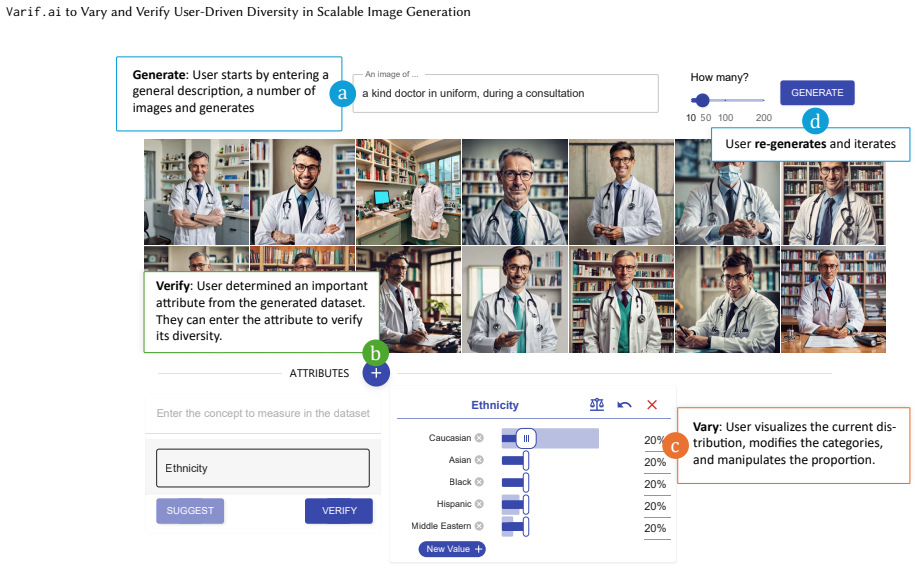
The central mechanism is probabilistic prompt generation driven by user-editable attribute histograms. For each attribute, a large language model proposes labels; the user adjusts each label's weight; Varif.ai samples labels according to those weights and appends them to the base prompt; the diffusion model then generates images whose attribute distribution approximates the histogram. Verification is done by classifying each image with CLIP against the attribute labels and counting matches into the histogram, closing the loop. The work this mechanism does is to make diversity a measurable, steerable quantity rather than a side effect of prompt wording.
What would settle it
Take Varif.ai and a prompt-only baseline, generate image sets for attributes where CLIP is known to misclassify (for instance, object-specific colors such as frog color versus background color), and have users or manual annotators judge diversity. If manual-label diversity shows no advantage for Varif.ai over prompt-only when CLIP accuracy is below roughly 0.6, the user-driven diversity claim fails. A simpler ablation would remove the verification histograms and let users vary distributions blindly; if the diversity span advantage persists, the verify step is not load-bearing.
Extended reading notes
Core claim
The central claim is that an interactive verify-and-vary loop, not the underlying diffusion model, is what lets users achieve their desired image diversity. On the paper's own terms: Varif.ai enables users to define attributes, see their current label distribution as a histogram, adjust sliders to set target proportions, and generate a new batch from probabilistically sampled prompts; this produces image sets with higher CLIP diversity span than prompt-only generation (M=0.65 vs 0.45, p<.0001) and higher diversity alignment when a precise target distribution is given (alignment 0.79 vs 0.73 open-ended, p<.001). The authors argue this shows user-driven diversity control is both feasible and more aligned with user aims than automatic diversification.
Load-bearing premise
The results assume CLIP embeddings capture the diversity attributes users actually care about; if CLIP misreads or entangles attributes, the measured span and alignment gains may not reflect genuine user-perceived diversity.
Editorial extensions
If this is right
- If the central claim holds, image-generation tools can offer diversity control without retraining or fine-tuning the generative model; any text-to-image model can be steered this way.
- Users can satisfy fairness-style requirements, such as balanced ethnicity in doctor images, by setting target proportions, something the paper's comparisons suggest automatic diversification handles worse.
- The measured engagement gain (10.2 vs 6.3 minutes on task) indicates users persist longer when they can see and manipulate attribute distributions, which may matter for creative ideation workflows.
- The sensitivity analysis implies that even when CLIP classification is noisy, the generated image sets remain diverse by manual-label measures, so the vary step is robust to verification error.
Reading between the lines
- One implication the authors leave implicit is that the tool's power is bounded by the classifier: if CLIP's notion of an attribute diverges from the user's, the histograms can mislead, so a natural extension is to let users confirm or correct labels rather than trusting CLIP silently.
- The same verify-and-vary loop could transfer to other generative media such as text, code, or 3D scenes, since it only manipulates prompts and label counts; the paper hints at text generation but does not test it.
- A testable extension is whether setting a label to zero percent actually suppresses the concept, since the paper notes participants wanted to blacklist labels; this could be checked by prompting with zero-weight labels and measuring occurrence in generated images.
- The dependency on CLIP suggests a concrete benchmark: measure diversity gains under attributes CLIP is known to miss, such as fine-grained object-specific styles, and if the gains vanish, the interface is only as good as the classifier.
Signed reviews
Editorial analysis
A structured set of objections, weighed in public.
Referee Report
Summary. The paper introduces Varif.ai, an interactive system for user-driven diversity in text-to-image generation, implementing a generate-verify-vary loop: users specify attributes and label distributions via histograms, the system verifies coverage using CLIP-based classification, and varies generation by probabilistically sampling labels appended to the prompt. The authors report an elicitation study (8 participants) to identify diversity needs, a formative study (8 participants) to evaluate usability, and a controlled summative study (20 participants) comparing Varif.ai to a prompt-only baseline and to automatic diversification baselines (Promptist, GPT-4o). The central quantitative claim is that Varif.ai yields significantly higher image diversity (span M=0.65 vs. 0.45, p<.0001) than prompt-only prompting, and better alignment to user-specified target distributions.
Significance. If the results hold, the paper makes a useful contribution to human-AI interaction for generative image tools, providing a concrete interface for user-controlled diversity, with open-source code and a model-agnostic architecture. The study includes both qualitative and quantitative evaluations and attempts to cover multiple diversity specification degrees. The main claims are plausible and the paper is generally well-written. However, the credibility of the headline quantitative comparison hinges on the evaluation methodology, which contains a potentially serious confound in the augmentation step and a possible circularity in the diversity alignment metric.
major comments (3)
- [Sec. 7.2.2, Diversity Alignment] The augmentation step is asymmetric between conditions and may confound RQ1a. The paper states: 'We augment each participant’s image collection to 50 total images with the original attribute specification.' For Varif.ai, the 'attribute specification' is the user-defined probability distribution over attribute labels (e.g., 20% red, 40% blue), so sampling 50 images from this multi-label distribution will by construction produce a high CLIP span. For Prompt-only, the specification is a single text prompt, and sampling 50 images from a single prompt yields near-duplicate outputs. The paper does not disclose how Prompt-only sets were augmented or whether the diversity metric was also computed on the actual user-generated images before augmentation. Because the reported span difference (M=0.65 vs. 0.45, p<.0001) is computed on augmented sets, it may reflect the difference between sampling from a broad distribution versus a point, rather than the verify-and-vary interaction that is the paper's central claim. The authors should recompute the comparison on the actual generated sets per participant, or use a symmetric augmentation procedure (e.g., sample the same number of images from the final iteration for both conditions).
- [Sec. 7.1, Computed Image Diversity and DV definitions] The diversity alignment result (attribute-label-specific M=0.79 vs. attribute-specific M=0.74, p<.001) appears to be computed between the user-specified target distribution and the distribution that Varif.ai's own CLIP classifier reports after regeneration. If this is the case, the metric partly measures whether the system's internal measurement is consistent with the target, not whether the generated images actually contain the specified attribute proportions. This is a circularity concern because the verification step uses the same CLIP model that defines the measured distribution. The paper should clarify which labels were used for this analysis; if CLIP labels were used, the authors should provide a version of Fig. 9b computed on manually annotated labels for the participants' final image sets, or at least report the CLIP accuracy for the attributes involved. The sensitivity analysis in Sec. 7.3 is reassuring for a uniform-distribution case, but it does not directly address the alignment values reported for the actual study data.
- [Sec. 7.1] The primary dependent variable (span) is computed from CLIP embeddings, but the paper provides no validation that CLIP span correlates with human-perceived diversity. Given that the paper's own sensitivity analysis (Sec. 7.3) documents substantial CLIP misclassification rates and that the formative study reports user-visible inconsistencies between CLIP histograms and perceived attributes, the central RQ1a claim would be substantially strengthened by a human-rated diversity check—for example, having independent judges or the participants themselves rate the diversity of a subset of the final image sets. Without such validation, the reported span advantage may overstate the benefit to users.
minor comments (5)
- [Abstract and Sec. 3/6] The paper uses 'elicitation study' and 'formative study' inconsistently; Section 3 is called 'Elicitation User Study' while Section 6 is 'Formative User Study', but the abstract refers to a 'pilot validation'. Please align the terminology.
- [Sec. 3.2.3] There is a typo: 'wamted' should be 'wanted' in the sentence about E6 wanting frogs in different environments.
- [Sec. 7.1.1] The phrase '3× 2condition setup' lacks spaces and a multiplication symbol; please format as '3 × 2 condition setup'.
- [Sec. 7.2.1] In Fig. 8 and the accompanying text, the p-value threshold for 'very significant' (p<.01) and 'extremely significant' (p<.0001) should be defined in the figure caption or text to avoid ambiguity.
- [Sec. 7.2.3] The comparison with automatic baselines uses only a single run per baseline per scenario, and the manual annotation is performed by the first author. The lack of error bars for the baseline measurements should be at least mentioned as a limitation in the text.
Circularity Check
RQ1 image-diversity gain is partly an artifact of asymmetric augmentation: Varif.ai sets are augmented from the user's broad attribute distribution, while Prompt-only sets are augmented from a single text prompt.
-
self definitional
[Section 7.1.1, Computed Image Diversity (DV), and Section 7.2.3]
"We augment each participant’s image collection to 50 total images with the original attribute specification. ... For each scenario, we prompted the two models to “provide diverse prompts to generate images of [scenario]” and generated 50 image prompts to gemerate 50 images with the diffusion model. This matches the augmented sample for each participant in the summative study."
For Varif.ai, the 'original attribute specification' is the user's final histogram over attribute labels; Varif.ai generates images by sampling labels from that distribution (Sec. 5.3). Thus the 50-image augmented Varif.ai set is, by construction, sampled from a broad multi-label distribution, yielding high CLIP span. For Prompt-only, the only specification is a text prompt, so the 50-image augmentation is generated from a single point prompt, yielding near-duplicate images with low span. The reported difference (M=0.65 vs 0.45, p<.0001) therefore largely measures the breadth of the input specifications used for augmentation, not the user-in-the-loop verify-and-vary process.
full rationale
The paper contains one load-bearing evaluation step that is circular by construction. The diversity span (DV) is computed on image collections augmented to 50 images using the 'original attribute specification.' For Varif.ai, that specification is a probability distribution over attribute labels, and Varif.ai generates prompts by sampling from this distribution. For Prompt-only, the specification is a single text prompt. Hence the augmented Varif.ai set is generated from a broad distribution and the augmented Prompt-only set from a point, so the reported span difference is statistically forced. The comparison with automatic baselines (GPT-4o, Promptist) makes this explicit: those baselines received 50 diverse prompts to generate 50 images, matching the augmented sample for participants; for Prompt-only participants there is only one prompt, so the augmentation cannot introduce diversity. This does not necessarily invalidate the system, but it means the headline RQ1 result does not isolate the verify-and-vary interaction. Other claims, such as the formative qualitative findings, the alignment results (which include a manual-label sensitivity analysis in Sec. 7.3), and the comparison against automatic diversification with manual annotation, are not circular. The paper has no load-bearing self-citation chains and no imported uniqueness theorems. Because the central quantitative claim is partly an artifact of the evaluation construction, the circularity score is 6.
Assumptions & free parameters
assumptions (5)
- domain assumption CLIP zero-shot similarity scores reliably identify the attribute label of a generated image in open-world settings.
- domain assumption LLM (LLaMA-2) suggestions provide reasonable, editable attribute labels.
- domain assumption Appending sampled attribute labels to the context prompt causes the diffusion model to generate images that actually exhibit those attributes.
- domain assumption Attributes are treated as independent and disentangled in generation.
- domain assumption The diversity span metric, the 95th percentile of distances from the mean CLIP embedding, is a valid proxy for user-perceived diversity.
Cite this review
Pith. "Pith review of Varif.ai to Vary and Verify User-Driven Diversity in Scalable Image Generation." pith.science (2026). https://pith.science/paper/IKXVVRSU
@misc{pith2026250619644,
  author       = {Pith},
  title        = {Pith review of: Varif.ai to Vary and Verify User-Driven Diversity in Scalable Image Generation},
  year         = {2026},
  howpublished = {\url{https://pith.science/paper/IKXVVRSU}},
  note         = {Machine review of arXiv:2506.19644}
}
read the original abstract
Diversity in image generation is essential to ensure fair representations and support creativity in ideation. Hence, many text-to-image models have implemented diversification mechanisms. Yet, after a few iterations of generation, a lack of diversity becomes apparent, because each user has their own diversity goals (e.g., different colors, brands of cars), and there are diverse attributions to be specified. To support user-driven diversity control, we propose Varif.ai that employs text-to-image and Large Language Models to iteratively i) (re)generate a set of images, ii) verify if user-specified attributes have sufficient coverage, and iii) vary existing or new attributes. Through an elicitation study, we uncovered user needs for diversity in image generation. A pilot validation showed that Varif.ai made achieving diverse image sets easier. In a controlled evaluation with 20 participants, Varif.ai proved more effective than baseline methods across various scenarios. Thus, this supports user control of diversity in image generation for creative ideation and scalable image generation.
Figures


Figures from the paper (12 more)


Reference graph
Works this paper leans on
-
[1]
Sandhini Agarwal, Gretchen Krueger, Jack Clark, Alec Radford, Jong Wook Kim, and Miles Brundage. 2021. Evaluating CLIP: Towards Characterization of Broader Capabilities and Downstream Implications. arXiv:2108.02818 [cs.CV] https://arxiv.org/abs/2108.02818
arXiv 2021
-
[2]
Yongsu Ahn and Yu-Ru Lin. 2020. FairSight: Visual Analytics for Fairness in Decision Making.IEEE Transactions on Visualization and Computer Graphics26, 1 (2020), 1086–1095. https://doi.org/10.1109/TVCG.2019.2934262
arXiv 2020
-
[3]
Yannick Assogba, Adam Pearce, and Madison Elliott. 2023. Large Scale Qualitative Evaluation of Generative Image Model Outputs. arXiv:2301.04518 [cs.HC] https://arxiv.org/abs/2301.04518
work page Pith review arXiv 2023
-
[4]
Abolfazl Asudeh, Zhongjun Jin, and H. V. Jagadish. 2019. Assessing and Reme- dying Coverage for a Given Dataset. In2019 IEEE 35th International Conference on Data Engineering (ICDE). 554–565. https://doi.org/10.1109/ICDE.2019.00056
arXiv 2019
-
[5]
AUTOMATIC1111. 2022.Stable Diffusion Web UI. Retrieved 14 April 2025 from https://github.com/AUTOMATIC1111/stable-diffusion-webui
work page 2022
-
[6]
Yuanhao Ban, Ruochen Wang, Tianyi Zhou, Minhao Cheng, Boqing Gong, and Cho-Jui Hsieh. 2024. Understanding the Impact of Negative Prompts: When and How Do They Take Effect?. InComputer Vision – ECCV 2024: 18th European Conference, Milan, Italy, September 29–October 4, 2024, Proceedings, Part LXXXIX (Milan, Italy). Springer-Verlag, Berlin, Heidelberg, 190–2...
work page 2024
-
[8]
James Betker, Gabriel Goh, Li Jing, Tim Brooks, Jianfeng Wang, Linjie Li, Long Ouyang, Juntang Zhuang, Joyce Lee, Yufei Guo, et al . 2023. Improving Im- age Generation with Better Captions.Computer Science. https://cdn. openai. com/papers/dall-e-3. pdf2, 3 (2023), 8
work page 2023
-
[9]
Federico Bianchi, Pratyusha Kalluri, Esin Durmus, Faisal Ladhak, Myra Cheng, Debora Nozza, Tatsunori Hashimoto, Dan Jurafsky, James Zou, and Aylin Caliskan. 2023. Easily Accessible Text-to-Image Generation Amplifies Demo- graphic Stereotypes at Large Scale. InProceedings of the 2023 ACM Confer- ence on Fairness, Accountability, and Transparency(Chicago, I...
arXiv 2023
Show all 79 references
-
[10]
Stephen Brade, Bryan Wang, Mauricio Sousa, Sageev Oore, and Tovi Grossman
-
[11]
Nathan Brown, Stavros Tseranidis, and Caitlin Mueller. 2015. Multi-Objective Optimization for Diversity and Performance in Conceptual Structural Design. Proceedings of IASS Annual Symposia2015, 20 (2015), 1–12. https://www. ingentaconnect.com/content/iass/piass/2015/00002015/0...
2015
-
[12]
Angel Alexander Cabrera, Will Epperson, Fred Hohman, Minsuk Kahng, Jamie Morgenstern, and Duen Horng Chau. 2019. FAIRVIS: Visual Analytics for Discovering Intersectional Bias in Machine Learning . In2019 IEEE Conference on Visual Analytics Science and Technology (V AST). IEEE ...
2019
-
[13]
Jaemin Cho, Abhay Zala, and Mohit Bansal. 2023. DALL-EVAL: Probing the Reasoning Skills and Social Biases of Text-to-Image Generation Models . In2023 IEEE/CVF International Conference on Computer Vision (ICCV). IEEE Computer Society, Los Alamitos, CA, USA, 3020–3031. https://d...
2023
-
[14]
John Joon Young Chung and Eytan Adar. 2023. Artinter: AI-powered Boundary Objects for Commissioning Visual Arts. InProceedings of the 2023 ACM Designing Interactive Systems Conference(Pittsburgh, PA, USA)(DIS ’23). Association for Computing Machinery, New York, NY, USA, 1997–2...
2023
-
[17]
Rene Cutura, Michaël Aupetit, Jean-Daniel Fekete, and Michael Sedlmair. 2020. Comparing and Exploring High-Dimensional Data with Dimensionality Re- duction Algorithms and Matrix Visualizations. InProceedings of the 2020 In- ternational Conference on Advanced Visual Interfaces(...
2020
-
[18]
Hai Dang, Frederik Brudy, George Fitzmaurice, and Fraser Anderson. 2023. WorldSmith: Iterative and Expressive Prompting for World Building with a Generative AI. InProceedings of the 36th Annual ACM Symposium on User In- terface Software and Technology(San Francisco, CA, USA)(U...
2023
-
[19]
Prafulla Dhariwal and Alex Nichol. 2021. Diffusion models beat GANs on image synthesis. InProceedings of the 35th International Conference on Neural Informa- tion Processing Systems (NIPS ’21). Curran Associates Inc., Red Hook, NY, USA, Article 672, 15 pages
2021
-
[20]
Steven P Dow, Alana Glassco, Jonathan Kass, Melissa Schwarz, Daniel L Schwartz, and Scott R Klemmer. 2010. Parallel Prototyping Leads to Better Design Results, More Divergence, and Increased Self-efficacy.ACM Transactions on Computer- Human Interaction (TOCHI)17, 4 (2010), 1–24
2010
-
[21]
Niklas Elmqvist, Pierre Dragicevic, and Jean-Daniel Fekete. 2008. Rolling the Dice: Multidimensional Visual Exploration using Scatterplot Matrix Navigation. IEEE Transactions on Visualization and Computer Graphics14, 6 (2008), 1539–1148. https://doi.org/10.1109/TVCG.2008.153
2008 doi
-
[22]
OpenAI et al. 2024. GPT-4 Technical Report. arXiv:2303.08774 [cs.CL] https: //arxiv.org/abs/2303.08774
2024 arXiv
-
[23]
Noyan Evirgen and Xiang ’Anthony Chen. 2023. GANravel: User-Driven Di- rection Disentanglement in Generative Adversarial Networks. InProceedings of the 2023 CHI Conference on Human Factors in Computing Systems(Hamburg, Germany)(CHI ’23). Association for Computing Machinery, Ne...
2023
-
[24]
Fass, Eric A
Adam M. Fass, Eric A. Bier, and Eyton Adar. 2000. Picturepiper: Using a Re- Configurable Pipeline to Find Images on the Web. InProceedings of the 13th Annual ACM Symposium on User Interface Software and Technology(San Diego, California, USA)(UIST ’00). Association for Computin...
2000
-
[25]
Yingchaojie Feng, Xingbo Wang, Kam Kwai Wong, Sijia Wang, Yuhong Lu, Minfeng Zhu, Baicheng Wang, and Wei Chen. 2024. PromptMagician: In- teractive Prompt Engineering for Text-to-Image Creation.IEEE Transactions on Visualization and Computer Graphics30, 1 (Jan. 2024), 295–305. ...
2024
-
[26]
2024.It Seems AI Image Generators Still Have a Diversity Problem
Joe Foley. 2024.It Seems AI Image Generators Still Have a Diversity Problem. Retrieved 14 March 2025 from https://www.creativebloq.com/news/meta-ai- image-generator-diversity
2024
-
[27]
2024.Gemini Image Generation Got It Wrong
Google. 2024.Gemini Image Generation Got It Wrong. We’ll Do Better.Retrieved 14 March 2025 from https://blog.google/products/gemini/gemini-image-generation- issue/
2024
-
[28]
Yaru Hao, Zewen Chi, Li Dong, and Furu Wei. 2023. Optimizing Prompts for Text-to-image Generation. InProceedings of the 37th International Conference on Neural Information Processing Systems(New Orleans, LA, USA)(NIPS ’23). Curran Associates Inc., Red Hook, NY, USA, Article 29...
2023
-
[29]
Shirley Anugrah Hayati, Minhwa Lee, Dheeraj Rajagopal, and Dongyeop Kang
-
[30]
Herring, Chia-Chen Chang, Jesse Krantzler, and Brian P
Scarlett R. Herring, Chia-Chen Chang, Jesse Krantzler, and Brian P. Bailey. 2009. Getting inspired! understanding how and why examples are used in creative design practice. InProceedings of the SIGCHI Conference on Human Factors in Computing Systems(Boston, MA, USA)(CHI ’09). ...
2009
-
[31]
Amir Hertz, Ron Mokady, Jay Tenenbaum, Kfir Aberman, Yael Pritch, and Daniel Cohen-or. 2022. Prompt-to-Prompt Image Editing with Cross-Attention Control. InThe Eleventh International Conference on Learning Representations
2022
-
[32]
Ben Hutchinson, Jason Baldridge, and Vinodkumar Prabhakaran. 2022. Under- specification in Scene Description-to-Depiction Tasks. InProceedings of the 2nd Conference of the Asia-Pacific Chapter of the Association for Computational Lin- guistics and the 12th International Joint ...
2022
-
[33]
Marius Kaminskas and Derek Bridge. 2016. Diversity, Serendipity, Novelty, and Coverage: A Survey and Empirical Analysis of Beyond-Accuracy Objectives in Recommender Systems.ACM Trans. Interact. Intell. Syst.7, 1, Article 2 (Dec. 2016), 42 pages. https://doi.org/10.1145/2926720
2016 doi
-
[34]
Youwen Kang, Zhida Sun, Sitong Wang, Zeyu Huang, Ziming Wu, and Xiao- juan Ma. 2021. MetaMap: Supporting Visual Metaphor Ideation through Multi- dimensional Example-based Exploration. InProceedings of the 2021 CHI Con- ference on Human Factors in Computing Systems(Yokohama, Ja...
2021
-
[35]
2002.User studies: A practical approach to user involvement for gathering user needs and requirements
Sari Kujala et al. 2002.User studies: A practical approach to user involvement for gathering user needs and requirements. Helsinki University of Technology
2002
-
[36]
Klem- mer
Brian Lee, Savil Srivastava, Ranjitha Kumar, Ronen Brafman, and Scott R. Klem- mer. 2010. Designing with Interactive Example Galleries. InProceedings of the SIGCHI Conference on Human Factors in Computing Systems(Atlanta, Georgia, USA)(CHI ’10). Association for Computing Machi...
2010
-
[38]
Yoonjoo Lee, John Joon Young Chung, Tae Soo Kim, Jean Y Song, and Juho Kim. 2022. Promptiverse: Scalable Generation of Scaffolding Prompts Through Human-Ai Hybrid Knowledge Graph Annotation. InProceedings of the 2022 CHI Conference on Human Factors in Computing Systems. 1–18
2022
-
[39]
Joel Lehman and Kenneth O. Stanley. 2011. Abandoning Objectives: Evolution Through the Search for Novelty Alone.Evol. Comput.19, 2 (June 2011), 189–223. https://doi.org/10.1162/EVCO_a_00025
2011 doi
-
[40]
Shanchuan Lin, Anran Wang, and Xiao Yang. 2024. SDXL-Lightning: Progressive Adversarial Diffusion Distillation. arXiv:2402.13929 [cs.CV] https://arxiv.org/ abs/2402.13929
2024 arXiv
-
[41]
Vivian Liu and Lydia B Chilton. 2022. Design Guidelines for Prompt Engineering Text-to-Image Generative Models. InProceedings of the 2022 CHI Conference on Human Factors in Computing Systems(New Orleans, LA, USA)(CHI ’22). Association for Computing Machinery, New York, NY, USA...
2022
-
[42]
Vivian Liu, Han Qiao, and Lydia Chilton. 2022. Opal: Multimodal Image Genera- tion for News Illustration. InProceedings of the 35th Annual ACM Symposium on User Interface Software and Technology(Bend, OR, USA)(UIST ’22). Asso- ciation for Computing Machinery, New York, NY, USA...
2022
-
[43]
Vivian Liu, Jo Vermeulen, George Fitzmaurice, and Justin Matejka. 2023. 3DALL- E: Integrating Text-to-Image AI in 3D Design Workflows. InProceedings of the 2023 ACM Designing Interactive Systems Conference(Pittsburgh, PA, USA)(DIS ’23). Association for Computing Machinery, New...
2023
-
[44]
Alexandra Sasha Luccioni, Christopher Akiki, Margaret Mitchell, and Yacine Jernite. 2023. Stable Bias: Evaluating Societal Representations in Diffusion Models. InProceedings of the 37th International Conference on Neural Information Processing Systems(New Orleans, LA, USA)(NIP...
2023
-
[45]
Andrés Lucero. 2022. Using Affinity Diagrams to Evaluate Interactive Proto- types. InHuman-Computer Interaction – INTERACT 2015. Springer-Verlag, Berlin, Heidelberg, 231–248. https://doi.org/10.1007/978-3-319-22668-2_19
2022 doi
-
[47]
Yan Lyu, Hangxin Lu, Min Kyung Lee, Gerhard Schmitt, and Brian Y. Lim. 2024. IF- City: Intelligible Fair City Planning to Measure, Explain and Mitigate Inequality. IEEE Transactions on Visualization and Computer Graphics30, 7 (July 2024), 3749–3766. https://doi.org/10.1109/TVC...
2024
-
[48]
Zichen Miao, Jiang Wang, Ze Wang, Zhengyuan Yang, Lijuan Wang, Qiang Qiu, and Zicheng Liu. 2024. Training Diffusion Models Towards Diverse Image Gen- eration with Reinforcement Learning. InProceedings of the IEEE/CVF Conference on Computer Vision and Pattern Recognition. 10844–10853
2024
-
[49]
Mohammad Amin Mozaffari, Xinyuan Zhang, Jinghui Cheng, and Jin L.C. Guo
-
[50]
Matt O’Brien. 2024. Google Says Its AI Image-Generator Would Sometimes ’overcompensate’ for Diversity. Retrieved 14 March 2025 from https://finance. yahoo.com/news/google-says-ai-image-generator-225023065.html
2024
-
[51]
Jonas Oppenlaender. 2024. A Taxonomy of Prompt Modifiers for Text-to-image Generation.Behaviour & Information Technology43, 15 (2024), 3763–3776. https: //doi.org/10.1080/0144929X.2023.2286532
2024
-
[52]
Xiaohan Peng, Janin Koch, and Wendy E. Mackay. 2024. DesignPrompt: Using Multimodal Interaction for Design Exploration with Generative AI. InProceedings of the 2024 ACM Designing Interactive Systems Conference(Copenhagen, Denmark) (DIS ’24). Association for Computing Machinery...
2024
-
[53]
Petchey and Kevin J
Owen L. Petchey and Kevin J. Gaston. 2002. Functional diversity (FD), species richness and community composition.Ecology Letters 5, 3 (2002), 402–411. https://doi.org/10.1046/j.1461-0248.2002.00339.x arXiv:https://onlinelibrary.wiley.com/doi/pdf/10.1046/j.1461-0248.2002.00339.x
2002
-
[54]
Dustin Podell, Zion English, Kyle Lacey, Andreas Blattmann, Tim Dockhorn, Jonas Müller, Joe Penna, and Robin Rombach. 2024. SDXL: Improving Latent Diffusion Models for High-Resolution Image Synthesis. InThe Twelfth Interna- tional Conference on Learning Representations. https:...
2024
-
[55]
Alec Radford, Jong Wook Kim, Chris Hallacy, Aditya Ramesh, Gabriel Goh, Sandhini Agarwal, Girish Sastry, Amanda Askell, Pamela Mishkin, Jack Clark, Gretchen Krueger, and Ilya Sutskever. 2021. Learning Transferable Visual Models From Natural Language Supervision. InProceedings ...
2021
-
[56]
Aditya Ramesh, Prafulla Dhariwal, Alex Nichol, Casey Chu, and Mark Chen
-
[57]
Emily Reif, Minsuk Kahng, and Savvas Petridis. 2023. Visualizing Linguistic Diversity of Text Datasets Synthesized by Large Language Models . In2023 IEEE Visualization and Visual Analytics (VIS). IEEE Computer Society, Los Alamitos, CA, USA, 236–240. https://doi.org/10.1109/VI...
2023
-
[58]
Robin Rombach, Andreas Blattmann, Dominik Lorenz, Patrick Esser, and Bjorn Ommer. 2022. High-Resolution Image Synthesis with Latent Diffusion Models . InIEEE/CVF Conference on Computer Vision and Pattern Recognition (CVPR). IEEE Computer Society, Los Alamitos, CA, USA, 10674–1...
2022
-
[59]
Dvir Samuel, Rami Ben-Ari, Simon Raviv, Nir Darshan, and Gal Chechik
- [60]
-
[61]
Xudong Shen, Chao Du, Tianyu Pang, Min Lin, Yongkang Wong, and Mohan Kankanhalli. 2023. Finetuning Text-to-image Diffusion Models for Fairness. arXiv preprint arXiv:2311.07604(2023)
2023 arXiv
-
[62]
Pedro Silva, Bhawna Juneja, Shloka Desai, Ashudeep Singh, and Nadia Fawaz
-
[64]
Generating images of rare concepts using pre-trained diffusion mod- els. InProceedings of the Thirty-Eighth AAAI Conference on Artificial Intelli- gence and Thirty-Sixth Conference on Innovative Applications of Artificial Intel- ligence and Fourteenth Symposium on Educational ...
-
[65]
Patrick Schramowski, Manuel Brack, Björn Deiseroth, and Kristian Kersting
-
[67]
Kelly, Saumya Pareek, Qiushi Zhou, and Eduardo Velloso
Samangi Wadinambiarachchi, Ryan M. Kelly, Saumya Pareek, Qiushi Zhou, and Eduardo Velloso. 2024. The Effects of Generative AI on Design Fixation and Divergent Thinking. InProceedings of the 2024 CHI Conference on Human Factors in Computing Systems(Honolulu, HI, USA)(CHI ’24). ...
2024
-
[68]
Jialu Wang, Xinyue Liu, Zonglin Di, Yang Liu, and Xin Wang. 2023. T2IAT: Mea- suring Valence and Stereotypical Biases in Text-to-Image Generation. InFindings of the Association for Computational Linguistics: ACL 2023, Anna Rogers, Jordan Boyd-Graber, and Naoaki Okazaki (Eds.)....
2023 doi
-
[69]
InProceedings of the 2023 ACM Conference on Fairness, Accountability, and Transparency(Chicago, IL, USA)(FAccT ’23)
Representation Online Matters: Practical End-to-End Diversification in Search and Recommender Systems. InProceedings of the 2023 ACM Conference on Fairness, Accountability, and Transparency(Chicago, IL, USA)(FAccT ’23). Association for Computing Machinery, New York, NY, USA, 1...
2023
-
[70]
Yunlong Wang, Priyadarshini Venkatesh, and Brian Y Lim. 2022. Interpretable Directed Diversity: Leveraging Model Explanations for Iterative Crowd Ideation. InProceedings of the 2022 CHI Conference on Human Factors in Computing Systems (New Orleans, LA, USA)(CHI ’22). Associati...
2022
-
[71]
Sangho Suh, Meng Chen, Bryan Min, Toby Jia-Jun Li, and Haijun Xia. 2024. Luminate: Structured Generation and Exploration of Design Space with Large Language Models for Human-AI Co-Creation. InProceedings of the 2024 CHI Conference on Human Factors in Computing Systems(Honolulu...
2024
-
[72]
Gareth Terry, Nikki Hayfield, Victoria Clarke, Virginia Braun, et al. 2017. The- matic analysis.The SAGE handbook of qualitative research in psychology2, 17-37 (2017), 25
2017
-
[73]
Hugo Touvron, Louis Martin, Kevin Stone, Peter Albert, Amjad Almahairi, Yas- mine Babaei, Nikolay Bashlykov, Soumya Batra, Prajjwal Bhargava, Shruti Bhos- ale, Dan Bikel, Lukas Blecher, Cristian Canton Ferrer, Moya Chen, Guillem Cucurull, David Esiobu, Jude Fernandes, Jeremy F...
2023 arXiv
-
[74]
Peipei Xia, Li Zhang, and Fanzhang Li. 2015. Learning Similarity with Cosine Similarity ensemble.Inf. Sci.307, C (June 2015), 39–52. https://doi.org/10.1016/j. ins.2015.02.024
2015 doi
-
[75]
Ling Yang, Zhilong Zhang, Yang Song, Shenda Hong, Runsheng Xu, Yue Zhao, Wentao Zhang, Bin Cui, and Ming-Hsuan Yang. 2023. Diffusion Models: A Comprehensive Survey of Methods and Applications.ACM Comput. Surv.56, 4, Article 105 (Nov. 2023), 39 pages. https://doi.org/10.1145/3626235
2023 doi
-
[76]
Yunlong Wang, Shuyuan Shen, and Brian Y Lim. 2023. RePrompt: Automatic Prompt Editing to Refine AI-Generative Art Towards Precise Expressions. In Proceedings of the 2023 CHI Conference on Human Factors in Computing Systems (Hamburg, Germany)(CHI ’23). Association for Computing...
2023
-
[77]
Cheng Zhang, Xuanbai Chen, Siqi Chai, Chen Henry Wu, Dmitry Lagun, Thabo Beeler, and Fernando De La Torre. 2023. ITI-Gen: Inclusive Text-to-Image Gen- eration. In2023 IEEE/CVF International Conference on Computer Vision (ICCV). 3946–3957. https://doi.org/10.1109/ICCV51070.2023.00367
2023
-
[79]
Robert Wolfe and Aylin Caliskan. 2022. American == White in Multimodal Language-and-Image AI. InProceedings of the 2022 AAAI/ACM Conference on AI, Ethics, and Society(Oxford, United Kingdom)(AIES ’22). Association for Computing Machinery, New York, NY, USA, 800–812. https://do...
2022
-
[81]
Guangcong Zheng, Xianpan Zhou, Xuewei Li, Zhongang Qi, Ying Shan, and Xi Li
-
[83]
Zamfirescu-Pereira, Richmond Y
J.D. Zamfirescu-Pereira, Richmond Y. Wong, Bjoern Hartmann, and Qian Yang
-
[84]
InProceedings of the 2023 CHI Conference on Human Factors in Computing Systems(Hamburg, Germany)(CHI ’23)
Why Johnny Can’t Prompt: How Non-AI Experts Try (and Fail) to Design LLM Prompts. InProceedings of the 2023 CHI Conference on Human Factors in Computing Systems(Hamburg, Germany)(CHI ’23). Association for Computing Machinery, New York, NY, USA, Article 437, 21 pages. https://d...
2023
-
[86]
Enhao Zhang and Nikola Banovic. 2021. Method for Exploring Generative Adversarial Networks (GANs) via Automatically Generated Image Galleries. In Proceedings of the 2021 CHI Conference on Human Factors in Computing Systems (Yokohama, Japan)(CHI ’21). Association for Computing ...
2021
-
[87]
Lili Zhang, Xi Liao, Zaijia Yang, Baihang Gao, Chunjie Wang, Qiuling Yang, and Deshun Li. 2024. Partiality and Misconception: Investigating Cultural Represen- tativeness in Text-to-Image Models. InProceedings of the 2024 CHI Conference on Human Factors in Computing Systems(Hon...
2024
-
[88]
Shihao Zhao, Dongdong Chen, Yen-Chun Chen, Jianmin Bao, Shaozhe Hao, Lu Yuan, and Kwan-Yee K. Wong. 2023. Uni-ControlNet: all-in-one control to text- to-image diffusion models. InProceedings of the 37th International Conference on Neural Information Processing Systems(New Orle...
2023
-
[90]
You are a useful assistant. You give very brief answers, in very few words, no need to be polite, do not provide explanations
LayoutDiffusion: Controllable Diffusion Model for Layout-to-Image Gen- eration. In2023 IEEE/CVF Conference on Computer Vision and Pattern Recognition (CVPR). 22490–22499. https://doi.org/10.1109/CVPR52729.2023.02154 A PROMPTS A.1 Prompts for Suggesting Attribute Labels. System...
2023
-
[2024]
InProceedings of the 2024 Conference on Empirical Methods in Natural Language Processing, Yaser Al-Onaizan, Mohit Bansal, and Yun-Nung Chen (Eds.)
How Far Can We Extract Diverse Perspectives from Large Language Models?. InProceedings of the 2024 Conference on Empirical Methods in Natural Language Processing, Yaser Al-Onaizan, Mohit Bansal, and Yun-Nung Chen (Eds.). Association for Computational Linguistics, Miami, Florid...
2024 doi
Reviewed August 15, 2026 · model on record in the stance chip above.
Discussion (0). Continue with ORCID to comment.