REVIEW 4 major objections 4 minor 30 references
SPARK: Graph-Based Online Semantic Integration System for Robot Task Planning
T0 review · 4 major / 4 minor · reviewed 2026-08-06 · deepseek-v4-flash
Pith's one-line read SPARK lets a service robot take verbal, written, or gestured hints mid-task and turn them into scene graph updates that drive replanning.
desk verdict Plausible integration system, but the graph-specific enhancement claim is untested for lack of a control condition. read the letter →
The pith
A machine-rendered reading of the paper's core claim, the machinery that carries it, and where it could break.
The reading
What carries the argument
The central object is the online scene graph: a graph whose nodes are objects and rooms and whose edges are spatial relations ("apple on cleaning table"), updated during task execution rather than built once offline. SPARK's mechanism is a promptable loop: Whisper transcribes speech, Detic and CLIP detect and recognize objects in visual input, and GPT-4 decides whether the new semantic information is relevant, updates the graph edges, and—when the update changes the goal location—regenerates the plan. The graph is what carries the new relation into subsequent planning steps, so the planner sees the world the way the cue described it rather than as the original static map did.
What would settle it
Run the three scenarios (verbal, written, gesture) with a control condition in which the same LLM receives the same semantic hint as a plain text instruction and the scene graph is left unchanged; if the control succeeds equally often, the graph-update mechanism is not the source of the improvement. A second check: update the graph but suppress plan regeneration; success would show the graph alone, not replanning, matters.
Extended reading notes
Core claim
On the paper's own terms, SPARK's discovery is that environment-embedded semantic cues — speech, written text, gestures — can be converted into online scene graph updates during execution and that those updates, drawn from the graph at plan time, let a general-purpose service robot complete fetch tasks it would otherwise fail or slow down on. The paper implements this by adapting ConceptGraphs to an online setting and layering a promptable LLM-based decision module on top: the LLM transcribes and interprets the cue, decides whether the scene graph and plan should change, and the robot re-plans with the revised graph. Three real-robot experiments, one per cue type, support the claim that graph representations of spatial relationships improve task performance in dynamic environments.
Load-bearing premise
The central claim assumes that updating the robot's scene graph is what improves performance, rather than simply giving the same location hint to the planner as a direct text prompt.
Editorial extensions
If this is right
- A service robot can finish a fetch task when the target object has been moved to an atypical place, because a spoken hint during execution updates the plan.
- Written signs and pointing gestures work through the same graph-update path, so semantic integration does not depend on speech recognition.
- The robot changes its goal mid-execution rather than restarting the whole mapping or planning pipeline, since only the relevant graph edges are revised.
- Because every component is promptable, new objects, rooms, and cue types can be added without retraining the perception or planning models.
Reading between the lines
- Inference: the paper does not run the control where the same location hint is given to the LLM as plain text without a graph update, so the distinctive contribution—the graph structure—remains unisolated.
- Inference: a natural extension is to assign confidence or reliability scores to cues (speech vs. gestures are not equally trustworthy), letting the graph keep multiple candidate locations and the planner weigh them.
- Inference: because the update mechanism is promptable and graph-based, it should transfer to other semantic relations beyond locations, such as "the cup is fragile" or "the door is locked," as long as those relations are expressible as graph edges.
- Inference: the gesture experiment points toward non-verbal human-robot communication; a stronger test would place the target where the gesture alone can identify it, without any accompanying text.
Editorial analysis
A structured set of objections, weighed in public.
Referee Report
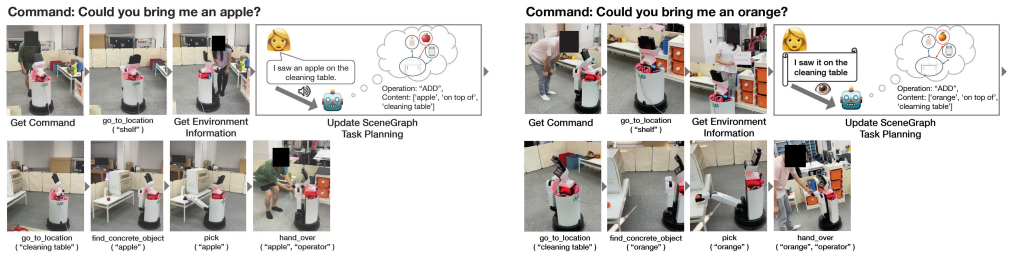
Summary. The paper proposes SPARK, a framework that lets a service robot acquire semantic information from speech, visual text, and gestures during task execution, update an online scene graph, and replan accordingly. The system builds on ConceptGraphs and Self-Recovery Prompting, using Whisper, GPT-4, Detic, and CLIP. The experiments are three single-run demonstrations on a Toyota HSR in a household-like environment, where the robot changes its target location after receiving a cue. The abstract and conclusion claim that graph representations of spatial relationships enhance task performance in dynamic environments.
Significance. If the central claim were established, the paper would address a real gap: most scene graph systems are offline, and online semantic updates from non-geometric cues are indeed underexplored. The authors demonstrate an end-to-end pipeline on real hardware with open-vocabulary perception, which is a useful feasibility result. However, the experiments do not currently support the enhancement claim: there are no baselines, no repeated trials, no success metrics, and the graph update is never isolated from the simultaneous prompt change. The contribution at this stage is a system demonstration rather than a validated improvement.
major comments (4)
- [Section III and Abstract] The central claim that graph representations enhance task ability is confounded. In all three experiments, the robot receives a cue, updates the scene graph, and replans in a single pipeline, so the graph update and the informational content of the cue are varied together. No control condition passes the extracted semantic relation (e.g., "apple is on the cleaning table") directly to the planner without updating the graph. Without this control, the observed behavior could be due entirely to adding the new location to the planner's prompt, not to the graph representation. This is a load-bearing missing experiment for the paper's main claim.
- [Section III-A, III-B, III-C] There is no quantitative evaluation. The experiments are anecdotal single runs with no number of trials, success rate, error bar, timing data, or failure cases. The sentence in Section III-A that the robot "successfully completing the command" is not backed by any recorded metric. To support a claim of enhanced ability in dynamic environments, the authors need repeated runs and a predefined success criterion, ideally across multiple task instances.
- [Section II-B and Section III] The evaluation is self-referential. Section II-B says the LLM is queried to decide whether to update the map and/or plan, and the same LLM performs task planning; success is assessed qualitatively by the authors. There is no stated protocol for judging success independently of the planner's own output, and no check for whether the updated graph was actually used by the planner. This makes it hard to distinguish genuine integration from the LLM coincidentally producing the desired plan.
- [Section II-B] The graph update mechanism is underspecified. The paper does not describe how nodes and edges are added or removed, how conflicting semantic information is resolved, whether old edges are retained or overwritten, or how the updated graph is represented in the prompt to the planner. Since the paper's contribution is the online scene graph update, these details are central to reproducibility and to evaluating whether the graph is truly load-bearing.
minor comments (4)
- [Section III-A heading] The heading "V erbal Input" contains a stray space; it should be "Verbal Input".
- [Figure 1] Figure 1 is referenced but not explained in the text; the pipeline for gesture input in particular is hard to follow from the figure alone. Please add a caption or text description that walks through each modality.
- [Section III-B] The phrase "other settings were nearly identical" is vague; please state exactly which settings differed between the verbal and written text experiments.
- [Introduction and Related Work] The paper should explicitly state what SPARK adds over the authors' prior Self-Recovery Prompting work and over ConceptGraphs; currently the novelty is only implicit.
Circularity Check
No circular derivation: the paper's claims are empirical demonstrations, not consequences of fitted parameters or self-citation chains.
full rationale
This paper contains no equations, fitted parameters, or statistical predictions whose outputs are equivalent by construction to their inputs. Its central claim—that graph representations of spatial relationships enhance task performance—rests on three qualitative demonstrations (Figures 2–4) in which the system updates a scene graph and then replans. There is no formal derivation chain to reduce. The cited prior systems, ConceptGraphs [2] and Self-Recovery Prompting [3], are used as building blocks or related work, not as self-cited uniqueness theorems or smuggled ansatz assumptions. Although the authors overlap with Self-Recovery Prompting [3], that citation is used only to note that its updates are not simultaneous, and it does not carry the paper's argument. The main evidentiary limitation is an experimental confound: the graph update and the semantic content of the cue are changed together, and no control presents the extracted relation directly to the planner without a graph update. That is a validity and control concern, not circular reasoning under the definitions used here, because the paper nowhere defines graph enhancement in terms of its own outputs or fits a parameter that is then renamed as a prediction. No circular step meets the requirement of quoting a specific reduction of a result to its inputs.
Assumptions & free parameters
assumptions (3)
- domain assumption GPT-4, Whisper, Detic, and CLIP operate reliably when prompted during task execution.
- domain assumption Human-provided cues are truthful and directly relevant to the ongoing task.
- ad hoc to paper The scene graph update, not the simultaneous prompt change, causes the improvement.
Cite this review
Pith. "Pith review of SPARK: Graph-Based Online Semantic Integration System for Robot Task Planning." pith.science (2026). https://pith.science/paper/XEU6YPHA
@misc{pith2026250620394,
  author       = {Pith},
  title        = {Pith review of: SPARK: Graph-Based Online Semantic Integration System for Robot Task Planning},
  year         = {2026},
  howpublished = {\url{https://pith.science/paper/XEU6YPHA}},
  note         = {Machine review of arXiv:2506.20394}
}
read the original abstract
The ability to update information acquired through various means online during task execution is crucial for a general-purpose service robot. This information includes geometric and semantic data. While SLAM handles geometric updates on 2D maps or 3D point clouds, online updates of semantic information remain unexplored. We attribute the challenge to the online scene graph representation, for its utility and scalability. Building on previous works regarding offline scene graph representations, we study online graph representations of semantic information in this work. We introduce SPARK: Spatial Perception and Robot Knowledge Integration. This framework extracts semantic information from environment-embedded cues and updates the scene graph accordingly, which is then used for subsequent task planning. We demonstrate that graph representations of spatial relationships enhance the robot system's ability to perform tasks in dynamic environments and adapt to unconventional spatial cues, like gestures.
Figures


Reference graph
Works this paper leans on
-
[1]
Y. Hong, H. Zhen, P. Chen, S. Zheng, Y. Du, Z. Chen, and C. Gan, ``3d-llm: Injecting the 3d world into large language models,'' Advances in Neural Information Processing Systems, vol. 36, pp. 20\,482--20\,494, 2023
work page 2023
-
[2]
Q. Gu, A. Kuwajerwala, S. Morin, K. M. Jatavallabhula, B. Sen, A. Agarwal, C. Rivera, W. Paul, K. Ellis, R. Chellappa et al., ``Conceptgraphs: Open-vocabulary 3d scene graphs for perception and planning,'' arXiv preprint arXiv:2309.16650, 2023
arXiv 2023
-
[3]
M. Shirasaka, T. Matsushima, S. Tsunashima, Y. Ikeda, A. Horo, S. Ikoma, C. Tsuji, H. Wada, T. Omija, D. Komukai et al., ``Self-recovery prompting: Promptable general purpose service robot system with foundation models and self-recovery,'' arXiv preprint arXiv:2309.14425, 2023
work page Pith review arXiv 2023
-
[4]
A. Radford, J. W. Kim, T. Xu, G. Brockman, C. McLeavey, and I. Sutskever, ``Robust speech recognition via large-scale weak supervision,'' in International Conference on Machine Learning. 1em plus 0.5em minus 0.4em PMLR, 2023, pp. 28\,492--28\,518
work page 2023
-
[5]
OpenAI , `` GPT-4 Technical Report ,'' arXiv e-prints, p. arXiv:2303.08774, Mar. 2023
arXiv 2023
- [6]
-
[7]
Radford, J
A. Radford, J. W. Kim, C. Hallacy, A. Ramesh, G. Goh, S. Agarwal, G. Sastry, A. Askell, P. Mishkin, J. Clark et al., ``Learning transferable visual models from natural language supervision,'' in International conference on machine learning. 1em plus 0.5em minus 0.4em PMLR, 2021, pp. 8748--8763
2021
-
[8]
T. Yamamoto, K. Terada, A. Ochiai, F. Saito, Y. Asahara, and K. Murase, ``Development of human support robot as the research platform of a domestic mobile manipulator,'' ROBOMECH journal, vol. 6, no. 1, pp. 1--15, 2019
work page 2019
Show all 30 references
-
[9]
@article guconceptgraphs,
-
[10]
G. O. Young, ÒSynthetic structure of industrial plastics (Book style with paper title and editor),Ó in Plastics, 2nd ed. vol. 3, J. Peters, Ed. New York: McGraw-Hill, 1964, pp. 15Ð64
1964
-
[11]
Chen, Linear Networks and Systems (Book style)
W.-K. Chen, Linear Networks and Systems (Book style). Belmont, CA: Wadsworth, 1993, pp. 123Ð135
1993
-
[12]
Poor, An Introduction to Signal Detection and Estimation
H. Poor, An Introduction to Signal Detection and Estimation. New York: Springer-Verlag, 1985, ch. 4
1985
-
[13]
Smith, ÒAn approach to graphs of linear forms (Unpublished work style),Ó unpublished
B. Smith, ÒAn approach to graphs of linear forms (Unpublished work style),Ó unpublished
-
[14]
E. H. Miller, ÒA note on reflector arrays (Periodical styleÑAccepted for publication),Ó IEEE Trans. Antennas Propagat., to be publised
-
[15]
Wang, ÒFundamentals of erbium-doped fiber amplifiers arrays (Periodical styleÑSubmitted for publication),Ó IEEE J
J. Wang, ÒFundamentals of erbium-doped fiber amplifiers arrays (Periodical styleÑSubmitted for publication),Ó IEEE J. Quantum Electron., submitted for publication
-
[16]
C. J. Kaufman, Rocky Mountain Research Lab., Boulder, CO, private communication, May 1995
1995
-
[17]
Yorozu, M
Y. Yorozu, M. Hirano, K. Oka, and Y. Tagawa, ÒElectron spectroscopy studies on magneto-optical media and plastic substrate interfaces(Translation Journals style),Ó IEEE Transl. J. Magn.Jpn., vol. 2, Aug. 1987, pp. 740Ð741 [Dig. 9th Annu. Conf. Magnetics Japan, 1982, p. 301]
1987
-
[18]
Young, The Techincal Writers Handbook
M. Young, The Techincal Writers Handbook. Mill Valley, CA: University Science, 1989
1989
-
[19]
J. U. Duncombe, ÒInfrared navigationÑPart I: An assessment of feasibility (Periodical style),Ó IEEE Trans. Electron Devices, vol. ED-11, pp. 34Ð39, Jan. 1959
1959
-
[20]
S. Chen, B. Mulgrew, and P. M. Grant, ÒA clustering technique for digital communications channel equalization using radial basis function networks,Ó IEEE Trans. Neural Networks, vol. 4, pp. 570Ð578, July 1993
1993
-
[21]
R. W. Lucky, ÒAutomatic equalization for digital communication,Ó Bell Syst. Tech. J., vol. 44, no. 4, pp. 547Ð588, Apr. 1965
1965
-
[22]
S. P. Bingulac, ÒOn the compatibility of adaptive controllers (Published Conference Proceedings style),Ó in Proc. 4th Annu. Allerton Conf. Circuits and Systems Theory, New York, 1994, pp. 8Ð16
1994
-
[23]
G. R. Faulhaber, ÒDesign of service systems with priority reservation,Ó in Conf. Rec. 1995 IEEE Int. Conf. Communications, pp. 3Ð8
1995
-
[24]
W. D. Doyle, ÒMagnetization reversal in films with biaxial anisotropy,Ó in 1987 Proc. INTERMAG Conf., pp. 2.2-1Ð2.2-6
1987
-
[25]
G. W. Juette and L. E. Zeffanella, ÒRadio noise currents n short sections on bundle conductors (Presented Conference Paper style),Ó presented at the IEEE Summer power Meeting, Dallas, TX, June 22Ð27, 1990, Paper 90 SM 690-0 PWRS
1990
-
[26]
J. G. Kreifeldt, ÒAn analysis of surface-detected EMG as an amplitude-modulated noise,Ó presented at the 1989 Int. Conf. Medicine and Biological Engineering, Chicago, IL
1989
-
[27]
Williams, ÒNarrow-band analyzer (Thesis or Dissertation style),Ó Ph.D
J. Williams, ÒNarrow-band analyzer (Thesis or Dissertation style),Ó Ph.D. dissertation, Dept. Elect. Eng., Harvard Univ., Cambridge, MA, 1993
1993
-
[28]
Kawasaki, ÒParametric study of thermal and chemical nonequilibrium nozzle flow,Ó M.S
N. Kawasaki, ÒParametric study of thermal and chemical nonequilibrium nozzle flow,Ó M.S. thesis, Dept. Electron. Eng., Osaka Univ., Osaka, Japan, 1993
1993
-
[29]
J. P. Wilkinson, ÒNonlinear resonant circuit devices (Patent style),Ó U.S. Patent 3 624 12, July 16, 1990
1990
-
[30]
hXV ֧8 h,NS1ɏS?髴# z I(A>d cN13p8,Tx+tԚw&H4NS)2v yW ^8ȱj wUe*vưws ʏbUw o ph 'a;v(
11em plus .33em minus .07em @technote 4000 4000 100 4000 4000 500 `\.=1000 = #1 #1 #1 0pt [0pt][0pt] #1 * \| ** #1 \@IEEEauthorblockNstyle \@IEEEauthorblockAstyle \@IEEEauthordefaulttextstyle \@IEEEauthorblockconfadjspace -0.25em \@IEEEauthorblockNtopspace 0.0ex \@IEEEauthorbl...
1973
Reviewed August 6, 2026 · model on record in the stance chip above.
Discussion (0). Continue with ORCID to comment.