REVIEW 3 major objections 5 minor 33 references
Interpretable Hierarchical Concept Reasoning through Attention-Guided Graph Learning
T0 review · 3 major / 5 minor · reviewed 2026-08-06 · deepseek-v4-flash
Pith's one-line read This paper introduces H-CMR, a concept-based model that explains every concept prediction as a logic rule over other concepts while remaining a universal classifier with accuracy on par with black-box networks.
desk verdict A clean extension of CMR that adds concept-level rules and DAG guarantees, but the central interpretability claim is undercut by soft mixture inference. read the letter →
The pith
A machine-rendered reading of the paper's core claim, the machinery that carries it, and where it could break.
The reading
What carries the argument
The load-bearing object is an attention-selected rule memory: each concept owns $n_R$ learnable rule embeddings, decoded into conjunctive logic rules over all other concepts, and a rule-selector network maps the latent embedding plus the predicted parent concepts to a categorical distribution over those rules. Equation 2 combines selection and symbolic evaluation, so inference after selection is pure logical reasoning over parent values. A learnable node-priority vector enforces that a concept of lower priority never appears in a rule of a higher-priority concept, which is what guarantees acyclicity and lets the memory define a unique topological ordering over the concept-task graph. The encoder is still a black box, but only for source concepts that have no parents; everything downstream is transparent rule application.
What would settle it
Allow H-CMR to train on a synthetic dataset with fully observed concepts where a forced non-source concept $C_3$ is defined by parents $C_1, C_2$ plus an input feature $z$ that is not a concept, e.g. $C_3 = (C_1 \land C_2) \lor (z > \theta)$, and forbid $C_3$ from becoming a source through a model intervention. If H-CMR's accuracy on $C_3$ stays well below that of a plain MLP on the same inputs, or its selected rule no longer matches the actual prediction on held-out inputs, the rule-disjunction assumption is falsified; if both accuracy and rule fidelity remain high, the assumption holds empirically.
Extended reading notes
Core claim
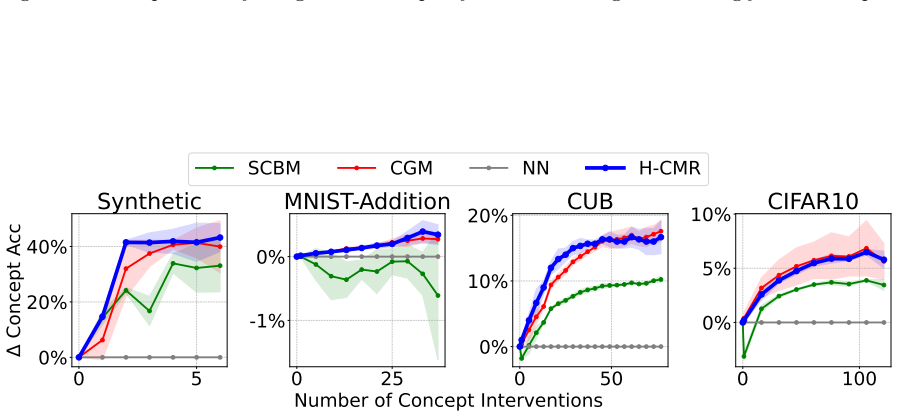
The central claim is that one architecture can deliver expressivity and interpretability at every level of a concept-based pipeline. H-CMR's decoder predicts each non-source concept by selecting one rule from a per-concept memory — e.g. $C_3 \leftarrow C_1 \land \neg C_2$ — based on the parent concepts and a latent embedding, then evaluates that rule symbolically on the parent values. A learnable node-priority vector masks out any rule that would create a cycle, so the graph is always a DAG and every DAG is representable. Two theorems establish that H-CMR is a universal binary classifier ($n_R \geq 2$) and that its graph parameterization covers exactly the class of DAGs. Experiments across CUB, MNIST-Addition, CIFAR10 and a synthetic noisy-XOR dataset show that H-CMR matches the concept accuracy of standard concept predictors while distributing the benefit of test-time concept interventions along the graph; injecting expert rules at training time improves data efficiency.
Load-bearing premise
H-CMR asks that every non-source concept and the task be expressible as a disjunction of conjunctive logical rules over their parent concepts, with the input influencing the prediction only through the attention weights that pick the rule — so any dependence on input details not captured in the parent concepts has to be absorbed by the rule-selection network, which is itself a black box.
Editorial extensions
If this is right
- A human correcting one predicted concept at test time can change the rule selection and the logical evaluation for every descendant concept, making interventions propagate through multiple levels of the graph.
- Expert knowledge can be injected by adding, editing, or fixing rules and by forbidding parent-child edges, which the experiments show improves accuracy when concept labels are scarce.
- Because H-CMR is a universal binary classifier, task accuracy need not degrade when the concept set is small or imperfect, matching the behavior of other universal concept models.
- The stored rule memory is transparent and can in principle be formally verified against constraints using propositional-logic model checking.
- The model works in a neurosymbolic setting where only distant supervision is available, with gradients flowing through the given rules back to source concepts.
Reading between the lines
- The architecture shifts opacity rather than removing it: source concepts (those with no parents) are still predicted by a black-box encoder, so the interpretability guarantee applies to the reasoning chain, not to how the input is grounded into the boundary concepts.
- If the rule-selector network is the only place where raw input enters downstream predictions, then the practical interpretability of H-CMR depends on how often the selected rule alone reproduces the concept prediction — a rule-fidelity metric the paper does not report; readers can compute it post hoc from the attention weights and compare it with accuracy.
- The same memory-and-selection mechanism could be applied where concepts themselves are not annotated, by treating intermediate feature groups as latent concepts and evaluating the rules' stability across seeds as a way to discover concept hierarchies from data.
- The theorem requires only two complementary rules per concept to be universal, suggesting that in high-performing instances the attention mechanism may often settle on rules like $C_i \leftarrow C_k$ and $C_i \leftarrow \neg C_k$, which would make the learned graph informative about task-level logic but thin at the concept level; inspecting the learned rules across seeds would test whether richer
Editorial analysis
A structured set of objections, weighed in public.
Referee Report
Summary. The paper proposes H-CMR, a concept-based model that learns a directed acyclic graph over concepts and represents each non-source concept as a symbolic logic rule selected by a neural attention mechanism. The authors claim that H-CMR is the first CBM that is both a universal classifier and provides interpretability at both the concept and task levels. The model is evaluated on CUB, MNIST-Addition, CIFAR10, and a synthetic dataset, reporting concept accuracy, task accuracy, intervention gains, and data-efficiency improvements from human-provided rules. Formal theorems assert universal binary classification (Theorem 5.1) and full representability of DAGs (Theorem 5.2).
Significance. If the central interpretability claim is substantiated, H-CMR would be a meaningful step beyond existing CBMs, which typically leave concept predictions opaque. The paper contains formal expressivity proofs, a clear model description, and experiments across several datasets, with code promised upon acceptance. The intervention studies and the model-intervention results are valuable. However, the paper's main claim—that predictions are made by selecting and executing a single interpretable logic rule—is not supported by the actual inference procedure, and the most relevant baseline (the authors' own CMR) is not compared empirically. These issues are load-bearing for the contribution and require additional analysis and experiments.
major comments (3)
- [Section 6.1, Competitors] The experiments omit CMR [6], the authors' own prior model that H-CMR directly extends. Table 1 positions H-CMR against CMR, and the paper claims H-CMR 'matches state-of-the-art performance,' but without an empirical comparison to CMR it is impossible to assess whether the added concept-level interpretability comes at an accuracy cost. CMR should be added to the accuracy and intervention comparisons, at minimum on the datasets used in Figure 4 and Figure 7.
- [Appendix E.2, Theorem 5.2 proof] There is an index mismatch in the representability proof. The proof sets p(R'_{i,k,j}=P)=1 for every (i,j)∈E (Eq. 43), but R'_{i,k,j} is the role of concept j in rules for concept i, so this makes j a parent of i (edge j→i). The statement to be proven, however, is Parent_{ij}=1 ⇔ (i,j)∈E (Eq. 46), where (i,j) is conventionally an edge from i to j and Parent_{ij}=1 means j is a parent of i (as defined after Eq. 8 and in Eq. 22). As written, the construction represents the transpose of G, not G itself. The theorem's conclusion H=DAG still follows because the set of DAGs is closed under transposition, but the proof's claim G_θ=G is incorrect. Please fix the indexing (e.g., set p(R'_{j,k,i}=P)=1 when (i,j)∈E) and re-derive the equivalences accordingly.
- [Sections 5.1 and 5.2] The universal-classifier proof (Theorem 5.1) relies on the rule selector being able to encode arbitrary functions of the latent embedding and parent concepts. This implies that the embedding can drive predictions through the selection weights without the logic rules themselves being the operative decision mechanism. The paper does not address whether the learned rules are actually causally involved in a prediction or are a post-hoc rationalization of an embedding-driven decision. Concretely, the authors should report, for a sample of test instances, whether the evaluation of the maximum-weight rule matches the final prediction; without such a check, the claim that task and concept predictions are made by 'logical inference over the structure of the graph' is not fully supported.
minor comments (5)
- [Section 2.2.1] Typo: 'abbevriate' should be 'abbreviate'.
- [Section 6.1, Data and tasks] The description of the CIFAR10 experiments says concepts are extracted 'using the same technique as [20]' without stating which technique; the reference is to a label-free CBM paper, but the sentence should specify that a vision-language model provides the annotations.
- [Appendix D.1, Table 2] Several rules are truncated with '...' (e.g., 'digit1is0 ← ¬digit1is1 ∧ ¬digit1is2 ∧...'). Since these rules are the main qualitative evidence for 'meaningful rules,' the full rule or a clear note about the abbreviation should be provided.
- [Eq. (14)] The notation in the prototypicality term 'p_reg(ri,k = ĉ)β·ŷ)' is ambiguous: the parentheses are unbalanced and the exponent placement is unclear. Please re-typeset the equation so that the regularization term is properly defined.
- [Section 4, Scalability] The sentence 'At inference time, this becomes the worst-case complexity, depending on the structure of the learned graph' is vague; please state the explicit worst-case complexity in terms of nC and nR.
Circularity Check
No significant circularity: the expressivity and DAG theorems are proved from explicit constructions, and self-citations to CMR are descriptive rather than load-bearing.
full rationale
The paper's derivation chain is self-contained. Theorem 5.1 (universal binary classifier) is proved in Appendix E.1 by an explicit construction: source concepts use the universal approximation theorem, and each non-source concept can be predicted with two rules Ci <- Ck and Ci <- ¬Ck while the neural rule selector supplies the arbitrary mapping from input and parent values to the desired label; the phrase 'in a similar fashion as done by Debot et al. [6]' is descriptive, not load-bearing, because the proof is fully reproduced. Theorem 5.2 is proved directly from the priority-vector constraint in Equations 4-5, which explicitly zeros out any role that would create a cycle; this is a consistency guarantee of the parametrization rather than a circular re-derivation. References to CMR for the rule-memory representation and prototypicality regularization are accompanied by this paper's own parametrization (Equations 3-5, 14-15), so no ansatz is smuggled in solely via citation. No fitted parameter is renamed as a prediction, and no reported experimental quantity is defined in terms of the quantity it is supposed to predict. One non-circular faithfulness concern: inference in Equation 7 uses the soft convex combination over all rules from Equation 2, so the 'selected rule' local-interpretability narrative is not literally the computation performed; this is a correctness/faithfulness gap, not a circularity, and does not raise the circularity score.
Assumptions & free parameters
free parameters (2)
- nR (number of rules per concept) =
5 for CUB, 10 for other datasets
- beta (prototypicality regularization weight) =
0.1
assumptions (3)
- standard math Neural networks are universal approximators for binary functions (Hornik et al. 1989).
- domain assumption CIFAR10 concept annotations obtained from a vision-language model are reliable enough to serve as ground truth for evaluation.
- domain assumption Concept relationships in the tested domains can be approximated by conjunctive logic rules over a DAG of concepts.
Cite this review
Pith. "Pith review of Interpretable Hierarchical Concept Reasoning through Attention-Guided Graph Learning." pith.science (2026). https://pith.science/paper/2QKUSL3Q
@misc{pith2026250621102,
  author       = {Pith},
  title        = {Pith review of: Interpretable Hierarchical Concept Reasoning through Attention-Guided Graph Learning},
  year         = {2026},
  howpublished = {\url{https://pith.science/paper/2QKUSL3Q}},
  note         = {Machine review of arXiv:2506.21102}
}
read the original abstract
Concept-Based Models (CBMs) are a class of deep learning models that provide interpretability by explaining predictions through high-level concepts. These models first predict concepts and then use them to perform a downstream task. However, current CBMs offer interpretability only for the final task prediction, while the concept predictions themselves are typically made via black-box neural networks. To address this limitation, we propose Hierarchical Concept Memory Reasoner (H-CMR), a new CBM that provides interpretability for both concept and task predictions. H-CMR models relationships between concepts using a learned directed acyclic graph, where edges represent logic rules that define concepts in terms of other concepts. During inference, H-CMR employs a neural attention mechanism to select a subset of these rules, which are then applied hierarchically to predict all concepts and the final task. Experimental results demonstrate that H-CMR matches state-of-the-art performance while enabling strong human interaction through concept and model interventions. The former can significantly improve accuracy at inference time, while the latter can enhance data efficiency during training when background knowledge is available.
Figures


Figures from the paper (8 more)


Reference graph
Works this paper leans on
-
[6]
David Debot, Pietro Barbiero, Francesco Giannini, Gabriele Ciravegna, Michelangelo Diligenti, and Giuseppe Marra. Interpretable concept-based memory reasoning.Advances of neural information processing systems 37, NeurIPS 2024, 2024
work page 2024
-
[1]
Concept bottleneck models
Pang Wei Koh, Thao Nguyen, Yew Siang Tang, Stephen Mussmann, Emma Pierson, Been Kim, and Percy Liang. Concept bottleneck models. InInternational conference on machine learning, pages 5338–5348. PMLR, 2020
2020
-
[2]
David Alvarez Melis and Tommi Jaakkola. Towards robust interpretability with self-explaining neural networks.Advances in neural information processing systems, 31, 2018
work page 2018
-
[3]
Concept whitening for interpretable image recognition
Zhi Chen, Yijie Bei, and Cynthia Rudin. Concept whitening for interpretable image recognition. Nature Machine Intelligence, 2(12):772–782, 2020
2020
-
[4]
Concept embedding models: Beyond the accuracy-explainability trade-off
Mateo Espinosa Zarlenga, Pietro Barbiero, Gabriele Ciravegna, Giuseppe Marra, Francesco Giannini, Michelangelo Diligenti, Zohreh Shams, Frederic Precioso, Stefano Melacci, Adrian Weller, Pietro Lio, and Mateja Jamnik. Concept embedding models: Beyond the accuracy-explainability trade-off. Advances in Neural Information Processing Systems, 35, 2022
work page 2022
-
[5]
Promises and pitfalls of black-box concept learning models.arXiv preprint arXiv:2106.13314, 2021
Anita Mahinpei, Justin Clark, Isaac Lage, Finale Doshi-Velez, and Weiwei Pan. Promises and pitfalls of black-box concept learning models.arXiv preprint arXiv:2106.13314, 2021
arXiv 2021
-
[7]
Interpretable neural-symbolic concept reasoning
Pietro Barbiero, Gabriele Ciravegna, Francesco Giannini, Mateo Espinosa Zarlenga, Lucie Charlotte Magister, Alberto Tonda, Pietro Lio’, Frederic Precioso, Mateja Jamnik, and Giuseppe Marra. Interpretable neural-symbolic concept reasoning. InICML, 2023
work page 2023
-
[8]
Concept- based explainable artificial intelligence: A survey.arXiv preprint arXiv:2312.12936, 2023
Eleonora Poeta, Gabriele Ciravegna, Eliana Pastor, Tania Cerquitelli, and Elena Baralis. Concept- based explainable artificial intelligence: A survey.arXiv preprint arXiv:2312.12936, 2023
arXiv 2023
Show all 33 references
-
[9]
Causal concept graph models: Beyond causal opacity in deep learning.arXiv preprint arXiv:2405.16507, 2024
Gabriele Dominici, Pietro Barbiero, Mateo Espinosa Zarlenga, Alberto Termine, Martin Gjoreski, Giuseppe Marra, and Marc Langheinrich. Causal concept graph models: Beyond causal opacity in deep learning.arXiv preprint arXiv:2405.16507, 2024
2024 arXiv
-
[10]
Stochastic concept bottleneck models.Advances in Neural Information Processing Systems, 37:51787–51810, 2024
Moritz Vandenhirtz, Sonia Laguna, Ričards Marcinkevičs, and Julia Vogt. Stochastic concept bottleneck models.Advances in Neural Information Processing Systems, 37:51787–51810, 2024. 10
2024
-
[11]
Learning to receive help: Intervention-aware concept embedding models
Mateo Espinosa Zarlenga, Katie Collins, Krishnamurthy Dvijotham, Adrian Weller, Zohreh Shams, and Mateja Jamnik. Learning to receive help: Intervention-aware concept embedding models. Advances in Neural Information Processing Systems, 36:37849–37875, 2023
2023
-
[12]
Addressing leakage in concept bottleneck models.Advances in Neural Information Processing Systems, 35:23386–23397, 2022
Marton Havasi, Sonali Parbhoo, and Finale Doshi-Velez. Addressing leakage in concept bottleneck models.Advances in Neural Information Processing Systems, 35:23386–23397, 2022
2022
-
[13]
Multilayer feedforward networks are universal approximators.Neural networks, 2(5):359–366, 1989
Kurt Hornik, Maxwell Stinchcombe, and Halbert White. Multilayer feedforward networks are universal approximators.Neural networks, 2(5):359–366, 1989
1989
-
[14]
Constraint-free structure learning with smooth acyclic orientations.arXiv preprint arXiv:2309.08406, 2023
Riccardo Massidda, Francesco Landolfi, Martina Cinquini, and Davide Bacciu. Constraint-free structure learning with smooth acyclic orientations.arXiv preprint arXiv:2309.08406, 2023
2023 arXiv
-
[15]
Glancenets: Interpretable, leak-proof concept-based models.Advances in Neural Information Processing Systems, 35:21212–21227, 2022
Emanuele Marconato, Andrea Passerini, and Stefano Teso. Glancenets: Interpretable, leak-proof concept-based models.Advances in Neural Information Processing Systems, 35:21212–21227, 2022
2022
-
[16]
Caltech-ucsd birds 200
Peter Welinder, Steve Branson, Takeshi Mita, Catherine Wah, Florian Schroff, Serge Be- longie, and Pietro Perona. Caltech-ucsd birds 200. Technical Report CNS-TR-201, Cal- tech, 2010. URL /se3/wp-content/uploads/2014/09/WelinderEtal10_CUB-200.pdf,http:// www.vision.caltech.edu...
2010
-
[17]
DeepProbLog: Neural Probabilistic Logic Programming
Robin Manhaeve, Sebastijan Dumancic, Angelika Kimmig, Thomas Demeester, and Luc De Raedt. DeepProbLog: Neural Probabilistic Logic Programming. InNeurIPS, pages 3753–3763, 2018
2018
-
[18]
Lecun, L
Y. Lecun, L. Bottou, Y. Bengio, and P. Haffner. Gradient-based learning applied to document recognition.Proceedings of the IEEE, 86(11):2278–2324, 1998. doi: 10.1109/5.726791
1998 doi
-
[19]
Learning multiple layers of features from tiny images.(2009), 2009
Alex Krizhevsky, Geoffrey Hinton, et al. Learning multiple layers of features from tiny images.(2009), 2009
2009
-
[20]
Nguyen, and Tsui-Wei Weng
Tuomas Oikarinen, Subhro Das, Lam M. Nguyen, and Tsui-Wei Weng. Label-free concept bottleneck models, 2023
2023
-
[21]
Rlogic: Recursive logical rule learning from knowledge graphs
Kewei Cheng, Jiahao Liu, Wei Wang, and Yizhou Sun. Rlogic: Recursive logical rule learning from knowledge graphs. InProceedings of the 28th ACM SIGKDD conference on knowledge discovery and data mining, pages 179–189, 2022
2022
-
[22]
Rnnlogic: Learning logic rules for reasoning on knowledge graphs.arXiv preprint arXiv:2010.04029, 2020
Meng Qu, Junkun Chen, Louis-Pascal Xhonneux, Yoshua Bengio, and Jian Tang. Rnnlogic: Learning logic rules for reasoning on knowledge graphs.arXiv preprint arXiv:2010.04029, 2020
2010 arXiv
-
[23]
Synthesizing datalog programs using numerical relaxation.arXiv preprint arXiv:1906.00163, 2019
Xujie Si, Mukund Raghothaman, Kihong Heo, and Mayur Naik. Synthesizing datalog programs using numerical relaxation.arXiv preprint arXiv:1906.00163, 2019
1906 arXiv
-
[24]
Deep symbolic learning: Discovering symbols and rules from perceptions.arXiv preprint arXiv:2208.11561, 2022
Alessandro Daniele, Tommaso Campari, Sagar Malhotra, and Luciano Serafini. Deep symbolic learning: Discovering symbols and rules from perceptions.arXiv preprint arXiv:2208.11561, 2022
2022 arXiv
-
[25]
From perception to programs: regularize, overparameterize, and amortize
Hao Tang and Kevin Ellis. From perception to programs: regularize, overparameterize, and amortize. InInternational Conference on Machine Learning, pages 33616–33631. PMLR, 2023
2023
-
[26]
Gradient-based learning applied to document recognition.IEEE, 86(11):2278–2324, 1998
Yann LeCun, Léon Bottou, Yoshua Bengio, and Patrick Haffner. Gradient-based learning applied to document recognition.IEEE, 86(11):2278–2324, 1998
1998
-
[27]
Deep residual learning for image recognition
Kaiming He, Xiangyu Zhang, Shaoqing Ren, and Jian Sun. Deep residual learning for image recognition. InProceedings of the IEEE conference on computer vision and pattern recognition, pages 770–778, 2016
2016
-
[28]
Principles of categorization
Eleanor Rosch. Principles of categorization. InCognition and categorization, pages 27–48. Routledge, 1978
1978
-
[29]
Stop explaining black box machine learning models for high stakes decisions and use interpretable models instead.Nature machine intelligence, 1(5):206–215, 2019
Cynthia Rudin. Stop explaining black box machine learning models for high stakes decisions and use interpretable models instead.Nature machine intelligence, 1(5):206–215, 2019
2019
-
[30]
Deep learning for case-based reasoning through prototypes: A neural network that explains its predictions
Oscar Li, Hao Liu, Chaofan Chen, and Cynthia Rudin. Deep learning for case-based reasoning through prototypes: A neural network that explains its predictions. InProceedings of the AAAI Conference on Artificial Intelligence, volume 32, 2018. 11
2018
-
[31]
This looks like that: deep learning for interpretable image recognition.Advances in neural information processing systems, 32, 2019
Chaofan Chen, Oscar Li, Daniel Tao, Alina Barnett, Cynthia Rudin, and Jonathan K Su. This looks like that: deep learning for interpretable image recognition.Advances in neural information processing systems, 32, 2019
2019
-
[32]
Pytorch: An imperative style, high-performance deep learning library, 2019
Adam Paszke, Sam Gross, Francisco Massa, Adam Lerer, James Bradbury, Gregory Chanan, Trevor Killeen, Zeming Lin, Natalia Gimelshein, Luca Antiga, Alban Desmaison, Andreas Köpf, Edward Yang, Zach DeVito, Martin Raison, Alykhan Tejani, Sasank Chilamkurthy, Benoit Steiner, Lu Fan...
2019
-
[33]
whenever the concept ’black wings’ is predicted as True, the concept ’white wings’ is predicted as False and the task ’pigeon’ is predicted as False
F. Pedregosa, G. Varoquaux, A. Gramfort, V. Michel, B. Thirion, O. Grisel, M. Blondel, P. Pretten- hofer, R. Weiss, V. Dubourg, J. Vanderplas, A. Passos, D. Cournapeau, M. Brucher, M. Perrot, and E. Duchesnay. Scikit-learn: Machine learning in Python.Journal of Machine Learnin...
2011
Reviewed August 6, 2026 · model on record in the stance chip above.
Discussion (0). Sign in to comment.