REVIEW 2 major objections 5 minor 101 references
On the rank-reduced relativistic coupled cluster method
T0 review · 2 major / 5 minor · reviewed 2026-08-06 · deepseek-v4-flash
Pith's one-line read The paper claims that relativistic CCSD double-excitation amplitudes are so compressible that keeping singular values above about $10^{-4}$ reproduces 1 kJ/mol-accurate correlation and reaction energies while storing only a few percent of…
desk verdict Solid feasibility study for relativistic rank-reduced CCSD; the compression benchmarks are informative, but the central claim rests on post-hoc truncation of converged amplitudes, not on solving the rank-reduced equations. read the letter →
The pith
A machine-rendered reading of the paper's core claim, the machinery that carries it, and where it could break.
The reading
What carries the argument
The load-bearing object is the Tucker/SVD decomposition of the doubles amplitude supermatrix $t_{ia,jb}\approx\sum_{XY} T_{XY} U^X_{ia} U^Y_{jb}$, where the unitary projectors $U$ come from the SVD of MP3 amplitudes. Because the relativistic amplitude matrix is complex symmetric but not Hermitian, the paper uses SVD rather than eigendecomposition; the compressed working equations $ET+TE=-R$ (with $E$ the transformed energy denominator matrix) are derived by projecting onto the $U$ subspace. To keep the quadratic ladder-type terms from restoring $O(N^6)$ cost, the paper adopts the device of decomposing the intermediate tensors $O_{ki,lj}$ and $Z_{kj,bc}$ into additional Tucker factors, which drives the formal cost toward $O(N^5)$.
What would settle it
Implement the full iterative rank-reduced RCCSD equations for one of the benchmark systems, such as Au3 or the YbCl7@CTEP cluster, with $\varepsilon=10^{-4}$, and compare the correlation energy to the exact CCSD value; if the discrepancy exceeds 1 kJ/mol, or if the MP3-derived projector subspace misses the dominant doubly-excited configurations, the central feasibility claim would be refuted.
Extended reading notes
Core claim
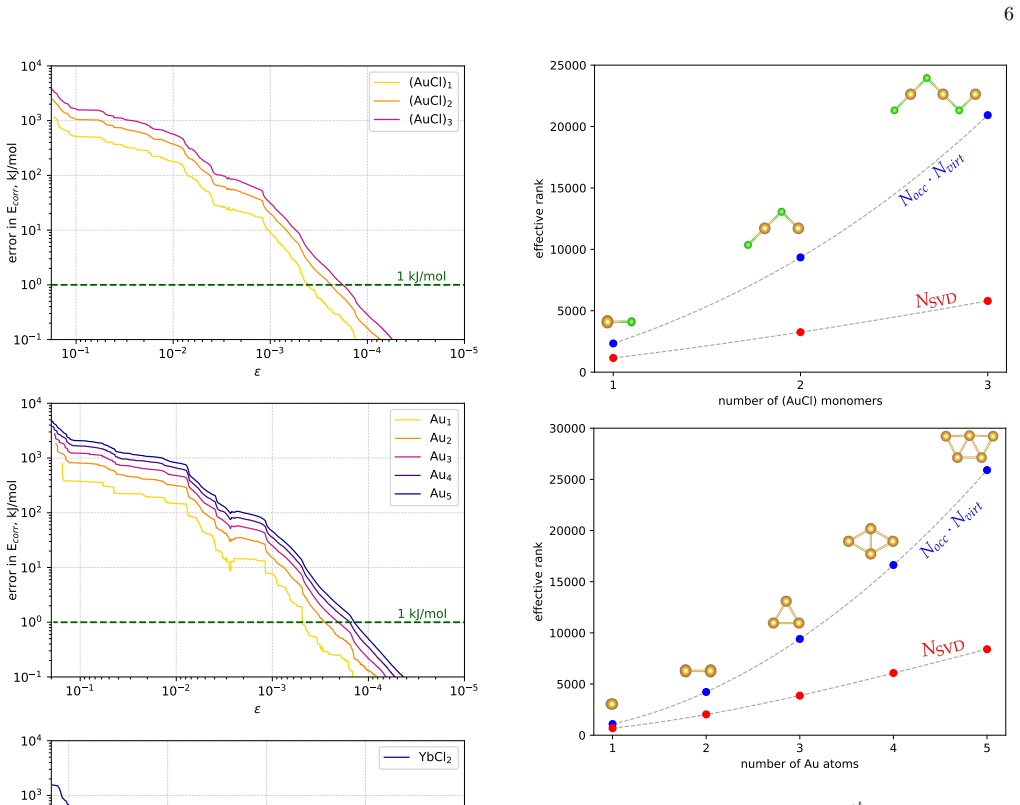
The central discovery is that the tensor $t^{ab}_{ij}$ of double-excitation amplitudes, viewed as a complex symmetric matrix $t_{ia,jb}$, has a low effective rank: $t_{ia,jb} \approx \sum_{XY} T_{XY} U^X_{ia} U^Y_{jb}$, with unitary projectors $U$ obtained by singular value decomposition of MP3 amplitudes. For three families of relativistic benchmarks, singular values below $\varepsilon \sim 10^{-4}$ can be discarded with correlation-energy errors below 1 kJ/mol, and for the largest embedded cluster only about 3% of the compressed doubles amplitudes remain significant. The paper also establishes that MP3 projectors are substantially superior to MP2 projectors and that compression must be applied to symmetric Goldstone amplitudes, because antisymmetrized Brandow amplitudes cannot be reformulated efficiently in reduced rank.
Load-bearing premise
The accuracy claims are tested by cutting small pieces out of already-finished exact calculations, not by running the compressed method itself; if the compressed equations behave differently, the 1 kJ/mol estimate could change.
Editorial extensions
If this is right
- Relativistic CCSD correlation energies of moderate-size heavy-element systems can be computed within about 1 kJ/mol while storing only a few percent of doubles amplitudes, dramatically reducing memory and disk requirements.
- A singular-value threshold near $\varepsilon\sim 10^{-4}$ appears to control accuracy across the benchmarked systems, making the truncation a tunable one-parameter approximation.
- Relative energies such as cohesion energies benefit from error compensation, allowing a looser threshold of about $3\times10^{-4}$ for the same 1 kJ/mol target.
- The effective rank grows slower than the full rank $N_{occ}N_{virt}$, roughly as $N_{occ}^{1.5}$ for the compact systems studied, so a sub-$N^6$ relativistic rank-reduced CCSD is plausible for spatially extended objects.
- The framework is positioned for extension to CCSD(T) and CCSDT, although the number of Goldstone diagrams grows and becomes a practical challenge.
Reading between the lines
- The benchmarks test compression by truncating already-converged exact amplitudes and reconstructing the tensor, not by iteratively solving the compressed equations (13); the true rank-reduced solver could show different errors, and the first test should compare the two on the smaller systems.
- Because SVD applies naturally to non-square matrices, the same compression route should extend to Fock-space multireference relativistic coupled cluster, where amplitude tensors are rectangular; this is a direct next step the paper does not implement.
- The generality of the $\varepsilon\sim 10^{-4}$ threshold could be probed by applying it to actinide-containing molecules or to property calculations, where the amplitude subspaces may need to remain field-independent.
- If the effective rank keeps growing only as a low power of system size for three-dimensional embedded clusters, the method could make two-component CCSD with large basis sets routine for impurity centers in crystals, where basis-set incompleteness errors already exceed the truncation error.
Editorial analysis
A structured set of objections, weighed in public.
Referee Report
Summary. The paper presents a relativistic generalization of rank-reduced coupled cluster theory with single and double excitations (RR-CCSD), based on a Tucker/SVD decomposition of the complex symmetric doubles amplitude tensor. The authors derive compressed working equations (Eqs. (13)–(16)), argue for the Goldstone rather than the antisymmetrized Brandow diagrammatic formalism because the decomposition does not respect antisymmetry, and recommend SVD over Takagi factorization for obtaining projectors. Benchmarks are reported for (AuCl)_n chains, Au_n clusters, and a YbCl_7@CTEP cluster model of solid YbCl_2. In these benchmarks, converged exact RCCSD amplitudes are truncated by discarding singular values below a threshold ε, and correlation energies are reconstructed from the truncated tensor. The authors find that ε ≈ 10^-4 gives errors near 1 kJ/mol, with only a few percent of double-amplitude components retained for the largest system, and conclude that rank reduction for relativistic CCSD with sub-O(N^6) scaling is feasible.
Significance. If the central numerical claims were established for the actual rank-reduced algorithm, this would be a practically useful step toward relativistic coupled-cluster calculations on embedded clusters and medium-sized heavy-element systems. The theoretical part is self-contained and the working equations appear algebraically coherent. The choice of an absolute 1 kJ/mol accuracy target is sensible and avoids the extensivity problem of relative-error criteria. The Goldstone-versus-Brandow discussion is a useful practical contribution for implementers. However, the benchmark protocol does not solve the rank-reduced equations at all; it only truncates converged exact CCSD amplitudes and reconstructs energies. The paper itself states in Section V that the implementation of the relativistic RR-CCSD method is ongoing and no self-consistent RR-CCSD results are reported. The headline accuracy and compression claims therefore rest on an optimistic proxy rather than on a test of the proposed method, which is the main weakness of the manuscript.
major comments (2)
- [Section IV and Eq. (13)] The benchmark protocol described in Section IV ('converged cluster amplitudes were decomposed, singular values below the given threshold ε were discarded, and then the full tensor was reconstructed to simulate the rank-reduced CC approach') does not simulate the rank-reduced RCCSD method defined by Eq. (13). The actual method fixes projectors from MP3 amplitudes and iteratively solves the compressed amplitude equations, while the reported test performs an optimal low-rank truncation of the converged exact CCSD amplitude tensor. These two procedures coincide only if the MP3-generated subspace exactly contains the exact CCSD amplitudes, which is not demonstrated and is generally false. The projected residual equations discard couplings to the orthogonal complement, and nonlinear terms such as the ladder-type contribution in Eq. (A3) can amplify small projector errors. Consequently, the error curves in Figs. 4 and 6 and the claimed universal threshold ε ≈ 10^-4 are optimistic estimates, not error bounds for the proposed algorithm. Since no self-consistent RR-CCSD energies are provided, the central feasibility claim is not yet supported by the numerical evidence.
- [Section IV, Fig. 3] The statement in the Conclusions that MP3 projectors are 'substantially superior' to MP2 projectors is inferred only from the singular value spectra shown in Fig. 3. No benchmark is reported that actually uses MP2- or MP3-derived projectors to project the exact CCSD residual or to solve Eq. (13). Since the projector choice is the key approximation that determines the accuracy of the rank-reduced iteration, this inference is not established. A minimally sufficient test would be to compare reconstructed energies using MP2 versus MP3 projectors on the converged amplitudes, or to report the norm of the exact residual projected onto the MP3 subspace.
minor comments (5)
- [Abstract] There is a typo in the abstract: 'amplitudesvia' should read 'amplitudes via'.
- [Section II C] The definition of the transformed residual is misprinted: the sentence beginning 'where R_{X'Y'} = sum_{X'Y'} r_ab^ij ...' uses summation indices that duplicate the free indices. It should read R_{X'Y'} = sum_{ia,jb} r_{ab}^{ij} U_{X'}^{ia*} U_{Y'}^{jb*}.
- [Section IV, Fig. 6 discussion] The comparison 'cf. Fig. 4a' is ambiguous because Fig. 4 panels are not labeled (a), (b), (c) in the caption; the relevant comparison for Au_n cohesion energies should refer to the middle panel of Fig. 4 or to a specifically labeled panel.
- [Section II B, Eqs. (9)-(10)] For a complex symmetric matrix, the SVD in Eq. (9) has right singular vectors V related to U by V = U^* up to column phases (the Takagi form). The text should state this explicitly and explain how the phases are handled when the same projector U is used on both indices in Eq. (10), since a general-purpose SVD routine returns U and V independently.
- [Section IV] The percentage 'only 2.6% of doubles amplitudes are significant' refers to the fraction N_SVD^2/(N_occ N_virt)^2, but this is not directly the storage or operation-count reduction of the full RR-CCSD method, which also stores the projectors, the additional intermediate decompositions of Appendix A, and the density-fitting integrals. The text should avoid implying that this percentage equals the overall memory saving.
Circularity Check
No significant circularity found: the rank-reduced equations are derived self-contained, and the numerical benchmark is a direct compressibility test rather than a fitted prediction.
full rationale
The paper's derivation chain is self-contained. Section II derives the compressed amplitude equations (Eq. 13) from the exact CCSD equations (Eq. 8) by projection onto the Tucker subspace, and the SVD-based generalization is a mathematically standard replacement for the non-relativistic eigendecomposition; no load-bearing step is justified only by a self-citation. The numerical evidence in Section IV measures the singular-value spectrum and truncation error of already converged CCSD amplitudes for the Au/Cl/Yb systems. This protocol is a compressibility test: the error is the truncation loss of the exact amplitude tensor, which is precisely the quantity needed to assess whether low effective ranks can meet the stated 1 kJ/mol accuracy target. The epsilon threshold is not a hidden fitted parameter renamed as a prediction; it is chosen a posteriori from the error curves against the explicitly stated accuracy goal, and the paper openly states that the iterative rank-reduced equations were not solved ('converged cluster amplitudes were decomposed, singular values below the given threshold were discarded, and then the full tensor was reconstructed to simulate the rank-reduced CC approach'). The absence of a self-consistent RR-CCSD solve is a validation gap, not a circularity. The authors' self-citations are to their own program packages and prior method papers; none is used to assert the central feasibility claim. Hence no circular step can be exhibited.
Assumptions & free parameters
free parameters (2)
- singular value threshold epsilon =
~1e-4
- intermediate compression rank N_O =
not specified
assumptions (4)
- domain assumption Truncating exact converged CCSD amplitudes is a faithful proxy for the error of the iterative rank-reduced RCCSD method.
- domain assumption MP3 amplitudes provide near-optimal projectors for the Tucker decomposition of RCCSD doubles amplitudes.
- domain assumption The single-reference exponential ansatz is valid for the open-shell Kramers-unrestricted heavy-element systems studied.
- domain assumption Effective tensor ranks grow slowly enough with system size to yield sub-N^6 scaling for spatially extended objects.
Cite this review
Pith. "Pith review of On the rank-reduced relativistic coupled cluster method." pith.science (2026). https://pith.science/paper/RG54VDDK
@misc{pith2026250621133,
  author       = {Pith},
  title        = {Pith review of: On the rank-reduced relativistic coupled cluster method},
  year         = {2026},
  howpublished = {\url{https://pith.science/paper/RG54VDDK}},
  note         = {Machine review of arXiv:2506.21133}
}
abstract
An efficiency of the Tucker decomposition of amplitude tensors within the single-reference relativistic coupled cluster method with single and double excitations (RCCSD) was studied in a series of benchmark calculations for (AuCl)$_n$ chains, Au$_n$ clusters, and the cluster model of solid YbCl$_2$. The 1 kJ/mol level of accuracy for correlation energy estimates of moderate-size systems and typical reaction energies can be achieved with relatively high compression rates of amplitude tensors via rejecting singular values smaller than $\sim 10^{-4}$. For the most extensive system studied (YbCl$_7$ cluster used for modeling of ytterbium center in ytterbium dichloride crystal), only $\sim 3$% of compressed doubles amplitudes were shown to be significant. Thus, the rank reduction for the relativistic CCSD theory improving its computational scaling is feasible. The advantage (if not necessity) of using the Goldstone diagrammatic technique rather than the "antisymmetrized" Brandow one is underlined. The proposed approach is promising for high-precision modeling of relatively large systems with heavy atoms.
Figures


Figures from the paper (3 more)


Reference graph
Works this paper leans on
-
[1]
R. J. Bartlett and M. Musia l, Coupled-cluster theory in quantum chemistry, Rev. Mod. Phys.79, 291–352 (2007)
2007
-
[2]
I. Y. Zhang and A. Gr¨ uneis, Coupled cluster theory in materials science, Front. Mater.6, 123 (2019)
2019
-
[3]
R. J. Bartlett, Perspective on coupled-cluster theory. The evolution toward simplicity in quantum chemistry, Phys. Chem. Chem. Phys.26, 8013–8037 (2024)
2024
-
[4]
Eliav, U
E. Eliav, U. Kaldor, and Y. Ishikawa, Open-shell rel- ativistic coupled-cluster method with Dirac-Fock-Breit wave functions: Energies of the gold atom and its cation, Phys. Rev. A49, 1724–1729 (1994)
1994
-
[5]
Visscher, T
L. Visscher, T. J. Lee, and K. G. Dyall, Formulation and implementation of a relativistic unrestricted coupled- cluster method including noniterative connected triples, J. Chem. Phys.105, 8769–8776 (1996)
1996
-
[6]
Visscher, E
L. Visscher, E. Eliav, and U. Kaldor, Formulation and implementation of the relativistic Fock-space coupled cluster method for molecules, J. Chem. Phys.115, 9720 (2001)
2001
-
[7]
H. S. Nataraj, M. K´ allay, and L. Visscher, General im- plementation of the relativistic coupled-cluster method, J. Chem. Phys.133, 234109 (2010)
2010
-
[8]
Eliav, A
E. Eliav, A. Borschevsky, A. Zaitsevskii, A. V. Oleyn- ichenko, and U. Kaldor, Relativistic Fock-space coupled cluster method: theory and recent applications, inCom- prehensive Computational Chemistry, Vol. 3, edited by M. Y´ anez and R. J. Boyd (Elsevier, Oxford, 2024) first edition ed., pp. 79–93
2024
Show all 101 references
-
[9]
T. Saue, R. Bast, A. S. P. Gomes, H. J. A. Jensen, L. Visscher, I. A. Aucar, R. Di Remigio, K. G. Dyall, E. Eliav, E. Fasshauer, T. Fleig, L. Halbert, E. D. Hedeg ˚ ard, B. Helmich-Paris, M. Iliaˇ s, C. R. Jacob, S. Knecht, J. K. Laerdahl, M. L. Vidal, M. K. Nayak, M. Olejnicz...
2020
-
[10]
K´ allay, P
M. K´ allay, P. R. Nagy, D. Mester, Z. Rolik, G. Samu, J. Csontos, J. Cs´ oka, P. B. Szab´ o, L. Gyevi-Nagy, B. H´ egely, I. Ladj´ anszki, L. Szegedy, B. Lad´ oczki, K. Petrov, M. Farkas, P. D. Mezei, and A. Ganyecz, The MRCC program system: Accurate quantum chemistry from wat...
2020
-
[11]
A. V. Oleynichenko, A. Zaitsevskii, and E. Eliav, To- wards high performance relativistic electronic structure modelling: the EXP-T program package, inSupercom- puting, Vol. 1331, edited by V. Voevodin and S. Sobolev (Springer International Publishing, Cham, 2020) pp. 375–386,...
2020 doi
-
[12]
J. V. Pototschnig, A. Papadopoulos, D. I. Lyakh, M. Repisky, L. Halbert, A. S. P. Gomes, H. J. A. Jensen, and L. Visscher, Implementation of relativistic coupled cluster theory for massively parallel GPU-accelerated computing architectures, J. Chem. Theory Comput.17, 5509–5529 (2021)
2021
-
[13]
G. D. Purvis and R. J. Bartlett, A full coupled-cluster singles and doubles model: The inclusion of discon- nected triples, J. Chem. Phys.76, 1910–1918 (1982)
1982
-
[14]
V. M. Anisimov, G. H. Bauer, K. Chadalavada, R. M. Olson, J. W. Glenski, W. T. C. Kramer, E. Apr` a, and K. Kowalski, Optimization of the coupled cluster imple- mentation in NWChem on petascale parallel architec- tures, J. Chem. Theory Comput.10, 4307–4316 (2014)
2014
-
[15]
I. A. Kaliman and A. I. Krylov, New algorithm for ten- sor contractions on multi-core CPUs, GPUs, and ac- celerators enables CCSD and EOM-CCSD calculations with over 1000 basis functions on a single compute node, J. Comput. Chem.38, 842–853 (2017)
2017
-
[16]
Raghavachari, G
K. Raghavachari, G. W. Trucks, J. A. Pople, and M. Head-Gordon, A fifth-order perturbation compari- son of electron correlation theories, Chem. Phys. Lett. 157, 479–483 (1989)
1989
-
[17]
Noga and R
J. Noga and R. J. Bartlett, The full CCSDT model for molecular electronic structure, J. Chem. Phys.86, 7041–7050 (1987)
1987
-
[18]
S. A. Kucharski and R. J. Bartlett, Coupled-cluster methods that include connected quadruple excitations, T4: CCSDTQ-1 and Q(CCSDT), Chem. Phys. Lett. 158, 550–555 (1989)
1989
-
[19]
Y. J. Bomble, J. F. Stanton, M. K´ allay, and J. Gauss, Coupled-cluster methods including noniterative correc- tions for quadruple excitations, J. Chem. Phys.123, 054101 (2005)
2005
-
[20]
A. V. Oleynichenko, A. Zaitsevskii, L. V. Skripnikov, and E. Eliav, Relativistic Fock space coupled cluster method for many-electron systems: non-perturbative account for connected triple excitations, Symmetry12, 1101 (2020)
2020
-
[21]
Saue and H
T. Saue and H. J. A. Jensen, Quaternion sym- metry in relativistic molecular calculations: The Dirac–Hartree–Fock method, J. Chem. Phys.111, 6211–6222 (1999)
1999
-
[22]
Sch¨ utz and H.-J
M. Sch¨ utz and H.-J. Werner, Low-order scaling local electron correlation methods. IV. Linear scaling local coupled-cluster (LCCSD), J. Chem. Phys.114, 661–681 (2001)
2001
-
[23]
Riplinger and F
C. Riplinger and F. Neese, An efficient and near linear scaling pair natural orbital based local coupled cluster method, J. Chem. Phys.138, 034106 (2013)
2013
-
[24]
P. R. Nagy and M. K´ allay, Optimization of the linear-scaling local natural orbital CCSD(T) method: Redundancy-free triples correction using Laplace trans- form, J. Chem. Phys.146, 214106 (2017)
2017
-
[25]
Throughout this paper, we follow the usual practice of referring to multidimensional arrays withNdimensions asNth-order tensors, irrespective of their transforma- tion properties,
-
[26]
T. G. Kolda and B. W. Bader, Tensor decompositions and applications, SIAM Rev.51, 455–500 (2009)
2009
-
[27]
B. N. Khoromskij, V. Khoromskaia, S. R. Chinnam- setty, and H.-J. Flad, Tensor decomposition in electronic structure calculations on 3D Cartesian grids, J. Com- put. Phys.228, 5749–5762 (2009)
2009
-
[28]
Aquilante, L
F. Aquilante, L. Boman, J. Bostr¨ om, H. Koch, R. Lindh, A. S. de Mer´ as, and T. B. Pedersen, Cholesky decom- position techniques in electronic structure theory, in Linear-Scaling Techniques in Computational Chemistry and Physics(Springer Netherlands, 2011) p. 301–343
2011
-
[29]
T. B. Pedersen, S. Lehtola, I. F. Galv´ an, and R. Lindh, The versatility of the Cholesky decomposition in elec- 11 tronic structure theory, Wiley Interdiscip. Rev. Com- put. Mol. Sci.14, e1692 (2023)
2023
-
[30]
Nottoli, J
T. Nottoli, J. Gauss, and F. Lipparini, A novel coupled- cluster singles and doubles implementation that com- bines the exploitation of point-group symmetry and Cholesky decomposition of the two-electron integrals, J. Chem. Phys.159, 231101 (2023)
2023
-
[31]
Helmich-Paris, M
B. Helmich-Paris, M. Repisky, and L. Visscher, Rel- ativistic Cholesky-decomposed density matrix MP2, Chem. Phys.518, 38–46 (2019)
2019
-
[32]
Zhang, F
C. Zhang, F. Lipparini, S. Stopkowicz, J. Gauss, and L. Cheng, Cholesky decomposition-based implementa- tion of relativistic two-component coupled-cluster meth- ods for medium-sized molecules, J. Chem. Theory Com- put.20, 787–798 (2024)
2024
-
[33]
Chamoli, X
S. Chamoli, X. Wang, C. Zhang, M. K. Nayak, and A. K. Dutta, Frozen natural spinors for Cholesky decomposi- tion based two-component relativistic coupled cluster method (2025), arXiv:2412.18395 [physics.chem-ph]
2025 arXiv
-
[34]
T. J. Martinez and E. A. Carter, Pseudospectral meth- ods applied to the electron correlation problem, inMod- ern Electronic Structure Theory(World Scientific Pub- lishing Company, 1995) p. 1132–1165
1995
-
[35]
A. K. Dutta, F. Neese, and R. Izs´ ak, Speeding up equa- tion of motion coupled cluster theory with the chain of spheres approximation, J. Chem. Phys.144, 034102 (2016)
2016
-
[36]
E. G. Hohenstein, R. M. Parrish, and T. J. Mart ´ ınez, Tensor hypercontraction density fitting. I. Quartic scal- ing second- and third-order Møller-Plesset perturbation theory, J. Chem. Phys.137, 044103 (2012)
2012
-
[37]
E. G. Hohenstein, R. M. Parrish, C. D. Sherrill, and T. J. Mart ´ ınez, Communication: Tensor hypercontrac- tion. III. Least-squares tensor hypercontraction for the determination of correlated wavefunctions, J. Chem. Phys.137, 221101 (2012)
2012
-
[38]
R. M. Parrish, E. G. Hohenstein, T. J. Mart ´ ınez, and C. D. Sherrill, Tensor hypercontraction. II. Least- squares renormalization, J. Chem. Phys.137, 224106 (2012)
2012
-
[39]
R. M. Parrish, E. G. Hohenstein, T. J. Mart ´ ınez, and C. D. Sherrill, Discrete variable representation in elec- tronic structure theory: Quadrature grids for least- squares tensor hypercontraction, J. Chem. Phys.138, 194107 (2013)
2013
-
[40]
R. M. Parrish, E. G. Hohenstein, N. F. Schunck, C. D. Sherrill, and T. J. Mart ´ ınez, Exact tensor hypercontrac- tion: a universal technique for the resolution of ma- trix elements of local finite-rangeN-body potentials in many-body quantum problems, Phys. Rev. Lett.111, 1325...
2013
-
[41]
Benedikt, A
U. Benedikt, A. A. Auer, M. Espig, and W. Hackbusch, Tensor decomposition in post-Hartree–Fock methods. I. Two-electron integrals and MP2, J. Chem. Phys.134, 054118 (2011)
2011
-
[42]
Benedikt, H
U. Benedikt, H. Auer, M. Espig, W. Hackbusch, and A. A. Auer, Tensor representation techniques in post- Hartree–Fock methods: matrix product state tensor for- mat, Mol. Phys.111, 2398–2413 (2013)
2013
-
[43]
Benedikt, K.-H
U. Benedikt, K.-H. B¨ ohm, and A. A. Auer, Tensor de- composition in post-Hartree–Fock methods. II. CCD implementation, J. Chem. Phys.139, 224101 (2013)
2013
-
[44]
E. G. Hohenstein, S. I. L. Kokkila, R. M. Parrish, and T. J. Mart ´ ınez, Quartic scaling second-order approxi- mate coupled cluster singles and doubles via tensor hy- percontraction: THC-CC2, J. Chem. Phys.138, 124111 (2013)
2013
-
[45]
E. G. Hohenstein, S. I. L. Kokkila, R. M. Parrish, and T. J. Mart ´ ınez, Tensor hypercontraction equation-of- motion second-order approximate coupled cluster: elec- tronic excitation energies inO(N 4) time, J. Phys. Chem. B117, 12972–12978 (2013)
2013
-
[46]
R. M. Parrish, C. D. Sherrill, E. G. Hohenstein, S. I. L. Kokkila, and T. J. Mart ´ ınez, Communication: Ac- celeration of coupled cluster singles and doubles via orbital-weighted least-squares tensor hypercontraction, J. Chem. Phys.140, 181102 (2014)
2014
-
[47]
L. R. Tucker, Some mathematical notes on three-mode factor analysis, Psychometrika31, 279–311 (1966)
1966
-
[48]
R. M. Parrish, Y. Zhao, E. G. Hohenstein, and T. J. Mart ´ ınez, Rank reduced coupled cluster theory. I. Ground state energies and wavefunctions, J. Chem. Phys.150, 164118 (2019)
2019
-
[49]
Lesiuk, Efficient singular-value decomposition of the coupled-cluster triple excitation amplitudes, J
M. Lesiuk, Efficient singular-value decomposition of the coupled-cluster triple excitation amplitudes, J. Comput. Chem.40, 1319–1332 (2019)
2019
-
[50]
Lesiuk, When gold is not enough: platinum standard of quantum chemistry withN 7 cost, J
M. Lesiuk, When gold is not enough: platinum standard of quantum chemistry withN 7 cost, J. Chem. Theory Comput.18, 6537–6556 (2022)
2022
-
[51]
Lesiuk, Quintic-scaling rank-reduced coupled clus- ter theory with single and double excitations, J
M. Lesiuk, Quintic-scaling rank-reduced coupled clus- ter theory with single and double excitations, J. Chem. Phys.156, 064103 (2022)
2022
-
[52]
E. G. Hohenstein, B. S. Fales, R. M. Parrish, and T. J. Mart ´ ınez, Rank-reduced coupled-cluster. III. Tensor hy- percontraction of the doubles amplitudes, J. Chem. Phys.156, 054102 (2022)
2022
-
[53]
T. Zhao, J. H. Thorpe, and D. A. Matthews, Prospects for rank-reduced CCSD(T) in the context of high- accuracy thermochemistry, J. Chem. Phys.161, 154110 (2024)
2024
-
[54]
O. Hino, T. Kinoshita, and R. J. Bartlett, Singular value decomposition applied to the compression ofT 3 ampli- tude for the coupled cluster method, J. Chem. Phys. 121, 1206–1213 (2004)
2004
-
[55]
Lesiuk, Implementation of the coupled-cluster method with single, double, and triple excitations us- ing tensor decompositions, J
M. Lesiuk, Implementation of the coupled-cluster method with single, double, and triple excitations us- ing tensor decompositions, J. Chem. Theory Comput. 16, 453–467 (2019)
2019
-
[56]
Lesiuk, Near-exact CCSDT energetics from rank- reduced formalism supplemented by non-iterative cor- rections, J
M. Lesiuk, Near-exact CCSDT energetics from rank- reduced formalism supplemented by non-iterative cor- rections, J. Chem. Theory Comput.17, 7632–7647 (2021)
2021
-
[57]
E. G. Hohenstein, Y. Zhao, R. M. Parrish, and T. J. Mart ´ ınez, Rank reduced coupled cluster theory. II. Equation-of-motion coupled-cluster singles and doubles, J. Chem. Phys.151, 164121 (2019)
2019
-
[58]
Michalak and M
P. Michalak and M. Lesiuk, Rank-reduced equation-of- motion coupled cluster triples: an accurate and afford- able way of calculating electronic excitation energies, J. Chem. Theory Comput.20, 8970–8983 (2024)
2024
-
[59]
This is also true for cluster operators representing higher excitations, which are not the subject of the present work,
-
[60]
Lindgren, A coupled-cluster approach to the many- body perturbation theory for open-shell systems, Int
I. Lindgren, A coupled-cluster approach to the many- body perturbation theory for open-shell systems, Int. J. Quantum Chem.14, 33–58 (1978)
1978
-
[61]
D. A. Matthews and J. F. Stanton, Diagrams in coupled- cluster theory: algebraic derivation of a new diagram- 12 matic method for closed shells, inMathematical Physics in Theoretical Chemistry(Elsevier, 2019) p. 327–375
2019
-
[62]
Shavitt and R
I. Shavitt and R. J. Bartlett,Many-Body Methods in Chemistry and Physics: MBPT and Coupled-Cluster Theory, Cambridge Molecular Science (Cambridge Uni- versity Press, 2009)
2009
-
[63]
Golub and W
G. Golub and W. Kahan, Calculating the singular values and pseudo-inverse of a matrix, SIAM J. Numer. Anal. 2, 205–224 (1965)
1965
-
[64]
H. D. Simon and H. Zha, Low-rank matrix approx- imation using the Lanczos bidiagonalization process with applications, SIAM J. Sci. Comput.21, 2257–2274 (2000)
2000
-
[65]
Baglama and L
J. Baglama and L. Reichel, Augmented implicitly restarted Lanczos bidiagonalization methods, SIAM J. Sci. Comput.27, 19–42 (2005)
2005
-
[66]
H¨ aser and J
M. H¨ aser and J. Alml¨ of, Laplace transform techniques in Møller–Plesset perturbation theory, J. Chem. Phys. 96, 489–494 (1992)
1992
-
[67]
Takagi, Remarks on an algebraic problem, inCol- lected Papers(Springer Japan, Tokyo, 1990) pp
T. Takagi, Remarks on an algebraic problem, inCol- lected Papers(Springer Japan, Tokyo, 1990) pp. 240– 243
1990
-
[68]
Dieci, A
L. Dieci, A. Papini, and A. Pugliese, Takagi factoriza- tion of matrices depending on parameters and locating degeneracies of singular values, SIAM J. Matrix Anal. Appl.43, 1148–1161 (2022)
2022
-
[69]
Xu and S
W. Xu and S. Qiao, A divide-and-conquer method for the Takagi factorization, SIAM J. Matrix Anal. Appl. 30, 142–153 (2008)
2008
-
[70]
A. M. Chebotarev and A. E. Teretenkov, Singular value decomposition for the Takagi factorization of symmetric matrices, Appl. Math. Comput.234, 380–384 (2014)
2014
-
[71]
E. M. W. Janssen, J. C. W. Folmer, and G. A. Wiegers, The preparation and crystal structure of gold monochlo- ride, AuCl, Journal of the Less Common Metals38, 71–76 (1974)
1974
-
[72]
V. M. Shakhova, D. A. Maltsev, Y. V. Lomachuk, N. S. Mosyagin, L. V. Skripnikov, and A. V. Titov, Compound-tunable embedding potential method: anal- ysis of pseudopotentials for Yb in YbF 2, YbF 3, YbCl 2 and YbCl 3 crystals, Phys. Chem. Chem. Phys.24, 19333–19345 (2022)
2022
-
[73]
L. Xiao, B. Tollberg, X. Hu, and L. Wang, Structural study of gold clusters, J. Chem. Phys.124, 114309 (2006)
2006
-
[74]
Assadollahzadeh and P
B. Assadollahzadeh and P. Schwerdtfeger, A systematic search for minimum structures of small gold clusters Aun (n= 2−20) and their electronic properties, J. Chem. Phys.131, 064306 (2009)
2009
-
[75]
Takei, T
T. Takei, T. Akita, I. Nakamura, T. Fujitani, M. Oku- mura, K. Okazaki, J. Huang, T. Ishida, and M. Haruta, Heterogeneous catalysis by gold, inAdvances in Catal- ysis(Elsevier, 2012) p. 1–126
2012
-
[76]
Pershina, Electronic structure and properties of su- perheavy elements, Nucl
V. Pershina, Electronic structure and properties of su- perheavy elements, Nucl. Phys. A944, 578–613 (2015)
2015
-
[77]
Rusakov, Y
A. Rusakov, Y. Demidov, and A. Zaitsevskii, Estimating the adsorption energy of element 113 on a gold surface, Cent. Eur. J. Phys.11, 1537–1540 (2013)
2013
-
[78]
Y. A. Demidov, A. A. Shalaevsky, A. V. Oleynichenko, and A. A. Rusakov, Uncovering chemical homology of superheavy elements: a close look at astatine, Phys. Chem. Chem. Phys.26, 23823–23834 (2024)
2024
-
[79]
A. A. Rusakov, E. Rykova, G. E. Scuseria, and A. Za- itsevskii, Importance of spin-orbit effects on the iso- merism profile of Au 3: Anab initiostudy, J. Chem. Phys.127, 164322 (2007)
2007
-
[80]
Potential energy surface of group 11 trimers (Cu, Ag, Au): Bond angle isomerism in Au3
A. A. Rusakov, Comment on “Potential energy surface of group 11 trimers (Cu, Ag, Au): Bond angle isomerism in Au3”, J. Phys. Chem. A127, 7673–7675 (2023)
2023
-
[81]
H. Baek, J. Moon, and J. Kim, Benchmark study of density functional theory for neutral gold clusters, Au n (n= 2−8), J. Phys. Chem. A121, 2410–2419 (2017)
2017
-
[82]
G. A. Bishea and M. D. Morse, Spectroscopic stud- ies of jet-cooled AgAu and Au 2, J. Chem. Phys.95, 5646–5659 (1991)
1991
-
[83]
A. V. Titov and N. S. Mosyagin, Generalized relativis- tic effective core potential: theoretical grounds, Int. J. Quantum Chem.71, 359 (1999)
1999
-
[84]
A. N. Petrov, N. S. Mosyagin, A. V. Titov, and I. I. Tupitsyn, Accounting for the Breit interaction in rela- tivistic effective core potential calculations of actinides, J. Phys. B: At. Mol. Opt. Phys.37, 4621 (2004)
2004
-
[85]
N. S. Mosyagin, A. Zaitsevskii, and A. V. Titov, Shape- consistent relativistic effective potentials of small atomic cores, Int. Rev. At. Mol. Phys.1, 63 (2010)
2010
-
[86]
A. V. Oleynichenko, A. Zaitsevskii, N. S. Mosyagin, A. N. Petrov, E. Eliav, and A. V. Titov, LIBGRPP: A library for the evaluation of molecular integrals of the generalized relativistic pseudopotential operator over Gaussian functions, Symmetry15, 197 (2022)
2022
-
[87]
Gatchina pseudopotentials and (pseudo)atomic basis sets,http://www.qchem.pnpi.spb.ru/recp(accessed on 27 February 2025)
2025
-
[88]
Alml¨ of and P
J. Alml¨ of and P. R. Taylor, Atomic natural orbital (ANO) basis sets for quantum chemical calculations, inAdv. Quantum Chem., Vol. 22 (Elsevier, 1991) p. 301–373
1991
-
[89]
A. V. Oleynichenko, A. Zaitsevskii, L. V. Skripnikov, and E. Eliav, Finite-order method to calculate approx- imate density matrices in the Fock-space multirefer- ence coupled cluster theory, Mol. Phys.Alexander Ne- mukhin Special Issue, e2413416 (2024)
2024
-
[90]
K. G. Dyall, Relativistic double-zeta, triple-zeta, and quadruple-zeta basis sets for the 5delements Hf–Hg, Theor. Chem. Acc.112, 403–409 (2004)
2004
-
[91]
D. E. Woon and T. H. Dunning, Gaussian basis sets for use in correlated molecular calculations. III. The atoms aluminum through argon, J. Chem. Phys.98, 1358–1371 (1993)
1993
-
[92]
P. A. Khadeeva, V. M. Shakhova, Y. V. Lomachuk, N. S. Mosyagin, L. V. Skripnikov, and A. V. Titov, Quantum chemical study of the electronic structure of ytterbium halides, Mosc. Univ. Chem. Bull.79, 288–294 (2024)
2024
-
[93]
A. V. Titov, Y. V. Lomachuk, and L. V. Skripnikov, Concept of effective states of atoms in compounds to describe properties determined by the densities of va- lence electrons in atomic cores, Phys. Rev. A90, 052522 (2014)
2014
-
[94]
D. A. Maltsev, Y. V. Lomachuk, V. M. Shakhova, N. S. Mosyagin, L. V. Skripnikov, and A. V. Titov, Compound-tunable embedding potential method and its application to calcium niobate crystal CaNb2O6 with point defects containing tantalum and uranium, Phys. Rev. B103, 205105 (2021)
2021
-
[95]
A. V. Oleynichenko, Y. V. Lomachuk, D. A. Malt- sev, N. S. Mosyagin, V. M. Shakhova, A. Zaitsevskii, and A. V. Titov, Compound-tunable embedding poten- tial method to model local electronic excitations onf- 13 element ions in solids: pilot relativistic coupled cluster study of...
2024
-
[96]
N. S. Mosyagin, Generalized relativistic effective core potentials for lanthanides, Nonlin. Phenom. Comp. Syst.20, 111 (2017)
2017
-
[97]
Q. Sun, T. C. Berkelbach, N. S. Blunt, G. H. Booth, S. Guo, Z. Li, J. Liu, J. D. McClain, E. R. Sayfutyarova, S. Sharma, S. Wouters, and G. K.-L. Chan, PySCF: the Python-based simulations of chemistry framework, Wi- ley Interdiscip. Rev. Comput. Mol. Sci.8, e1340 (2017)
2017
-
[98]
Q. Sun, X. Zhang, S. Banerjee, P. Bao, M. Barbry, N. S. Blunt, N. A. Bogdanov, G. H. Booth, J. Chen, Z.-H. Cui, J. J. Eriksen, Y. Gao, S. Guo, J. Hermann, M. R. Hermes, K. Koh, P. Koval, S. Lehtola, Z. Li, J. Liu, N. Mardirossian, J. D. McClain, M. Motta, B. Mussard, H. Q. Pha...
2020
-
[99]
A. V. Oleynichenko, Parallelization and a new Python interface of the LIBGRPP library for the evaluation of molecular integrals over generalized relativistic pseu- dopotentials, To be published (2025)
2025
-
[100]
A. V. Oleynichenko, A. S. Rumiantsev, A. Zaitsevskii, and E. Eliav, (2025), EXP-T, an extensible code for Fock space relativistic coupled cluster calculations (see http://www.qchem.pnpi.spb.ru/expt) (accessed on 27 February 2025)
2025
-
[101]
Momma and F
K. Momma and F. Izumi, VESTA: a three-dimensional visualization system for electronic and structural anal- ysis, J. Appl. Crystallogr.41, 653–658 (2008)
2008
Reviewed August 6, 2026 · model on record in the stance chip above.
Discussion (0). Continue with ORCID to comment.