Taylor-mode AD automates vibration Hamiltonians
Users supply one coordinate mapping; kinetic and potential operators follow, and vibrational energies converge.

Atomic and Molecular Clusters
Atomic and molecular clusters, nanoparticles: geometric, electronic, optical, chemical, magnetic properties, shell structure, phase transitions, optical spectroscopy, mass spectrometry, photoelectron spectroscopy, ionization potential, electron affinity, interaction with intense light pulses, electron diffraction, light scattering, ab initio calculations, DFT theory, fragmentation, Coulomb explosion, hydrodynamic expansion.
sort pith recommended most recent
Users supply one coordinate mapping; kinetic and potential operators follow, and vibrational energies converge.
Four polymorphs of the same molecule span direct and indirect band gaps with strong excitons for optoelectronic design.
· “C₆₀ building blocks with tuneable structures for tailored functionalities”

Simulations show ±100-attosecond delay and advance patterns that survive orientational averaging and can be seen by pump-probe chronoscopy.
· “Diffraction patterns in attosecond photoionization time delay”

Per-monomer energy sums reproduce water's structure and dynamics at force-field-level cost.

Quantum simulation of a 21-molecule water cluster shows strong coupling opens new energy pathways, even to remote OH bonds.

Measuring one number per particle—the surface field—predicts how much trihydrogen forms on silica dust.
· “X-ray Driven Trihydrogen Formation on Silica Nanosurfaces”

Measured decoherence still lets Yb(trensal) beat CHSH and CGLMP bounds, opening molecular magnets to qudit tests.
· “Molecular spin qudits to test generalized Bell inequalities”

Non-Hermitian gain and loss cancel finite-size splitting, producing a sharp impedance peak in a topolectrical circuit.
· “Topological Zero Modes in Non-Hermitian Topolectrical Systems: Size and Impedance Control”

Full pump-probe simulation shows the shell is held together only by the surrounding helium, and detected clusters keep reshuffling atoms.

A 200-picosecond scan pins rotational coherences in O2+ and confirms 800-nm resonant coupling.
· “Rotational coherences in O₂^+ following strong-field ionization”

The missing high-order response in liquid harmonics comes from electrons rejoining at the second solvation shell.
· “Multi-plateau high-harmonic generation in liquids driven by off-site recombination”

Three AOM-controlled frequencies plus a tilted magnetic field raise scattered photons for MgF laser cooling.
· “Optical cycling of MgF molecules within the hyperfine states in X(N=1) state”

Even low-level potential and dipole surfaces give ~10% collision-induced absorption at room temperature, and better when hot.

Exact identity maps multi-controlled qudit gates onto spin-spin Hamiltonians, opening a route to hypergraph states.

Per-dataset heads beat single-task baselines on 24M structures and scale to 1,920 GPUs

Model traces the 4-fold rate gain to out-of-phase acceptor vibrations amplified by low temperature.

SVD-based compression with a 1e-4 cutoff keeps heavy-element correlation energies within 1 kJ/mol.

A charge-pair analysis of ultrafast electron diffraction separates valence-electron motion from N-H bond breaking.

FeCl2 and CoCl2 match bulk values; dimers are antiferromagnetic, opening a route to cluster magnetometry.
· “Stern-Gerlach deflection of cryogenically cold polyatomic molecules in superfluid nanodroplets”

Counting dipole-quadrupole transfer raises the predicted quenching radius from ~3 to ~3.6 nm, matching device data.

Absolute line intensities plus emission cross sections yield monomer density, condensate fraction, and cluster density.
· “Diagnostics of the condensate fraction in a clustered supersonic argon jet”

Uncertainty sampling needs a quarter of the simulated data, and streaming trims training time by ~20%.

Adding the first excited electronic state lifts the zero-temperature rate to 1.32e-10 cm3/s, inside the experimental error bar.

Isotropic light, spin-resolved detection: the current follows the spin axis and flips with the enantiomer.
· “Spin-current correlations in photoionization of chiral molecules”

Zero-bias light-STM images on a single PTCDA anion reveal both configurations of its excited doublet state.
· “Disentangling the components of a multiconfigurational excited state in isolated chromophore”
Simulations show six trapped hydrogen atoms passing through metallic-liquid and solid phases inside a molecular cage.

Temperature-extrapolated measurement agrees with theoretical 43.334 ns, validating bound-free decay calculations.

Absolute cross sections show clusters of 3000+ atoms emit mostly polarization bremsstrahlung, not ordinary bremsstrahlung.
· “Size effect on polarization bremsstrahlung emission from xenon clusters”

DFT plus rigid-rotor analysis predicts N2 and AlF lock to the cage axis while keeping gas-phase constants.

Calculations place the 0-0 absorptions at 280.7, 279.6, and 285.8 eV and assign CN- to a degenerate π* transition.

Quantum shell effects survive the flat cut, giving an uncharged cluster a built-in field for nanoscale tweezers.

Closed coefficients for all angular momenta, tested in a multipole Hartree potential that converges at ℓ=14 for La2.
· “Spherical to Cartesian Coordinates Transformation for Solid Harmonics Revisited”

Magnetic quadrupole moments on spin trimers explain coexisting anisotropies and stabilize the skyrmion phase

Crystal Bragg mirrors plus an ion-source gain medium aim to deliver stable coherent X-rays from a lab-scale device.
· “A Compact X-Ray Laser with Ion Source and Crystal Cavity”

Simulations show the vortex array shields the condensate from thermal fluctuations, not just marks it.
· “Vortex lattice melting and critical temperature shift in rotating Bose-Einstein condensates”

In large helium droplets, scattered electrons beat direct photons at ionizing lithium dopants.

A helium atom can transfer circular polarization to camphor and reverse the electron asymmetry.

Delayed photoelectron band reveals collapse of a metastable Mg foam and energy pooling in helium nanodroplets.

A 50-fs laser pulse maps bond length in K2 and Rb2 on helium droplets through 180 vibrations

Finite-element minmax method pins H2+ and heavy Th2^179+ energies with fractional uncertainties down to 1e-23.
· “High-precision minmax solution of the two-center Dirac equation”

By charging through bright states and storing in dark ones, excitonic quantum batteries can beat the superradiance leak.
· “Molecular triplets and other metastable states for excitonic quantum batteries”

Microwave parameters tune the interaction without breaking the protection that keeps losses low, opening a path to stable degenerate samples
· “Tunable Field-Linked s-wave Interactions in Dipolar Fermi Mixtures”

Block-diagonal Hessian cuts coarse-graining cost to all-atom levels while keeping heat capacity and structure nearly exact.

Mass spectrometry plus collisional-loss corrections suggest this low-power source rivals kilowatt-class negative-ion sources.
Repurposed simulation features match 2D fingerprint baselines and distinguish mirror-image molecules.
· “Rem3Di: Learning smooth, chiral 3D molecular descriptors from atomistic foundation models”
A Laplace average over local inverse temperatures converts the Boltzmann factor into a two-parameter decay law for complex systems.
The simplified approach matches experiments on MgO and TiO2 at low computational cost.
· “A first-principles approach for predicting infrared optical properties of solids”

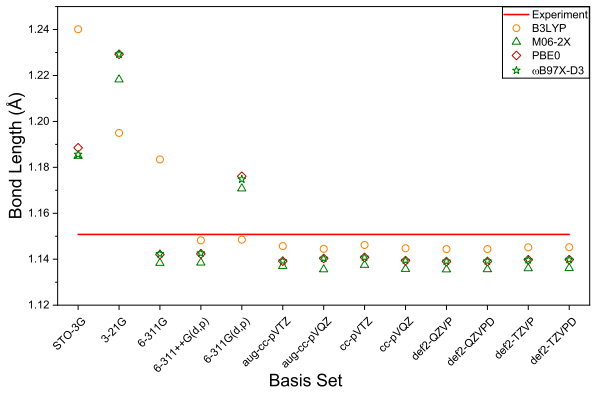
Target properties from different functionals move resonance positions and alter cross sections in R-matrix models of nitric oxide.
· “Influence of DFT Functionals on Low-Energy Electron Scattering Cross Sections of Nitric Oxide”
Trapped ions in a scalable chip design enable pT-sensitive detection and precise field gradient measurements across separate zones.
· “Scalable surface ion trap design for magnetic quantum sensing and gradiometry”
Angular distributions show partial-wave shifts that invalidate the dipole-Born model and point to quasi-resonant superexcited states.

On Au(111), planar six-membered spin rings stay symmetric, while buckled five-membered rings localize spins.
· “Quantum Spin-1/2 Rings Built from [2]Triangulene Molecular Units”

Density-dependent interaction strength lets researchers compute quantum-droplet states and breathing modes without extra parameters.
· “Generalized Gross-Pitaevskii Equation for 2D Bosons with Attractive Interactions”

First valence double-ionization spectrum and calculations show both ground and excited O+ fragments, revealing more breakup pathways than此前已

Ionization-free rotation probe sizes argon and neon clusters; finds Hagena scaling law undercounts large ones.

Counter-rotating light–matter terms shift the effective detuning and nonlinearity, moving the S-curve and hysteresis loop.
· “Bistability of Exciton-Photon Microcavities in the Ultrastrong-Coupling Regime”

SU(4) tetrahedral lattice unifies tripod, diamond, and five other topologies under a single rate equation, with peak intensity scaling as N^
· “Multi-channel collective dissipation via the symmetric irreducible representation of SU(4)”

MC-BE/TMMM matches benzene and naphthalene experiments near threshold using only TDDFT amplitudes

A dark collisional state opens a narrow transparency window inside a Feshbach resonance

Augmenting Gaussian bases with exponential tails aligns theory with measured angular distributions except in the weakest-binding cases.
Simulations show proton transfer and dissociation rise sharply from dimer to tetramer while net charge per molecule stays nearly constant.
· “Size Effects in the Strong-Field Ionization and Dissociation Dynamics of (H₂O)_n (n=1-4)”

Interference between electrons 0.031 per angstrom apart in gold and graphene patterns yields the value at 30 keV.
Leading-order theory uses only dimer and trimer energies to predict results up to 15 particles that match realistic potentials.

Axial separation starts circulation and lateral offset tunes frequency for dynamical sensing

It remains accurate yet cheaper, while rotation adds nonadiabatic effects through light-induced conical intersections
· “Light-induced nonadiabatic dissipative quantum dynamics of the Na2 molecule”

The decomposition enables asynchronous execution across heterogeneous hardware and produces vibrational spectra of a protonated water cluste
· “Tensor-Network-Based Distributed Quantum Dynamics on Independent Quantum Computers”

Wave-packet results on a large manifold show rotational couplings boost the rate well above previous models

Intra-sideband phase varies by nearly pi across its width and flattens at exact resonance, showing the method reads accumulated dynamical ph

Left edge state localizes on left-handed molecules and right edge on right-handed ones in dimerized dipolar arrays.
· “Topological Edge States from Molecular Chirality: A General Framework for Dimerized Dipolar Arrays”

Beijing measurements show DEA and PZ drive more nucleation than dimethylamine, requiring updates to standard urban aerosol models
· “Emerging Amines reshape the paradigm of urban atmospheric particle formation”
ChatMOSP retrieves parameters from literature to reproduce Pd nanoparticle shape changes and Pt activity oscillations under CO oxidation con
· “ChatMOSP: A Chemistry-Grounded Mobile Agent for Working-State Catalyst Simulations”
Tests on five neural potentials show equivariant models like MACE and PaiNN generalize better to new molecules than SchNet.
· “Benchmarking machine-learned interatomic potentials for molecular infrared spectroscopy”

Accelerated simulations treating both electron correlation and nuclear quantum effects shift the shared proton closer to the bond center.

Spectroscopy and simulations link distinct doublet and singlet behaviors to different lattice environments and reorganization.

Tidal splitting of bound hydrogen atoms creates an enhanced absorption signature that radio surveys could use to constrain PBH dark matter.
· “The Gravitational Spectral Radio Forest: A Signature of Primordial Black Holes”

In clusters of 5-20 atoms both sets reconstruct the density, but natural orbitals from the density matrix do so more accurately, with thegap
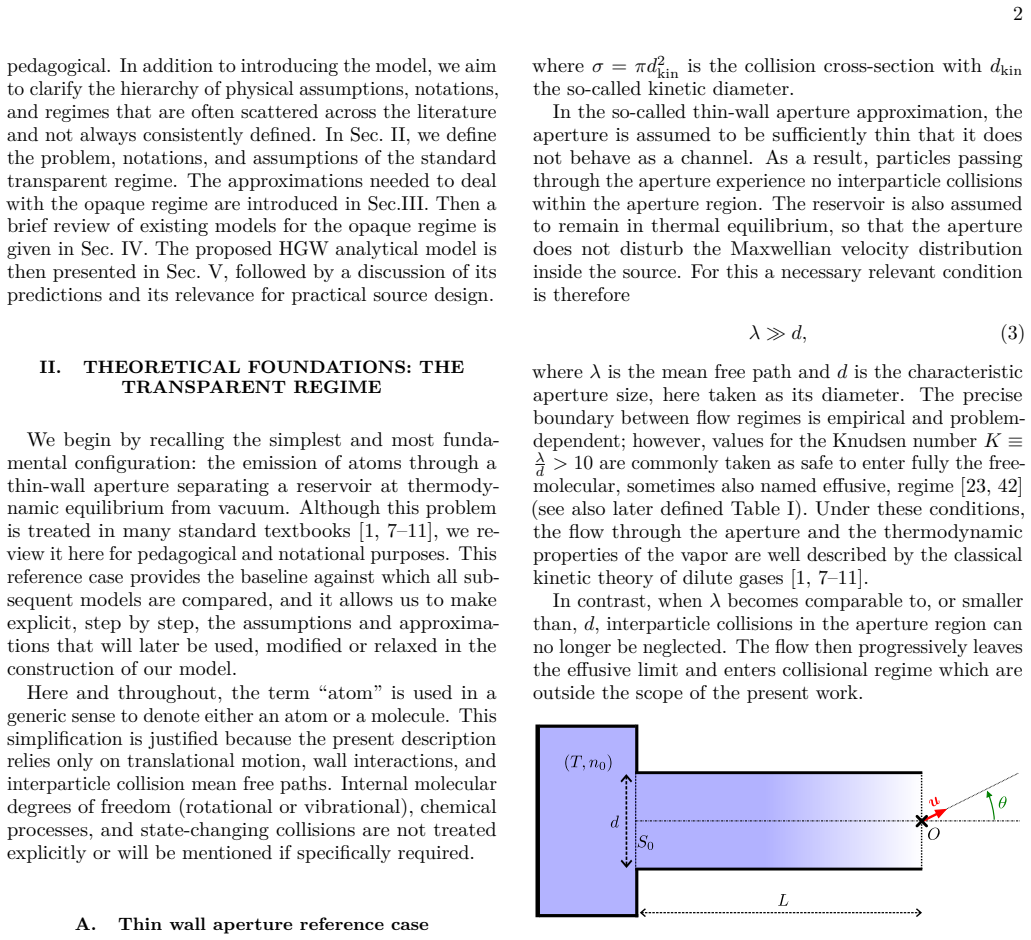
Covers transparent to opaque regimes in long tubes and recovers standard axial flux for source design.
· “Analytical emission model for the design of primary effusive sources”
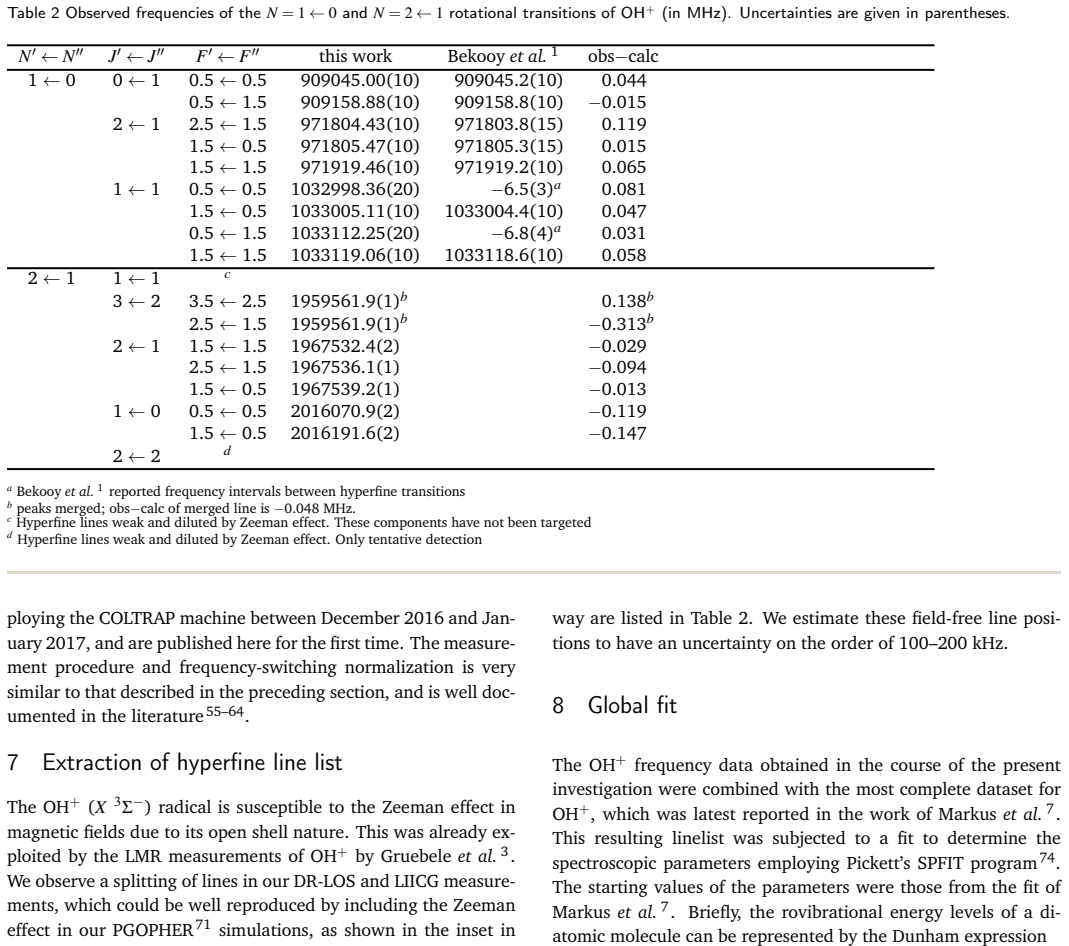
New IR and THz measurements of hyperfine-resolved transitions in a cold ion trap tighten the ground-state parameters of the molecular ion.
· “Hyperfine-Resolved Rovibrational and Rotational Spectroscopy of OH^+ (X ³Sigma^-)”
Dark states sharpen while bright states diverge at asymmetric positions, showing direct electric control over long-lived collective modes.
· “Locally-Induced Stark Shifts of Collective Excitonic Modes in Polyradical Aggregates”
Contributors share perspectives on unresolved questions in nanocluster electron dynamics and behavior
Emitter interactions cause Raman-type anharmonicities to show as sidebands on collective resonances, allowing control of spectral features.
· “Hidden optical nonlinearities in linear spectra of quantum emitter arrays”
