REVIEW 3 major objections 4 minor 1 cited by
BASS. XLIV. Morphological preferences of local hard X-ray selected AGN
T0 review · 3 major / 4 minor · reviewed 2026-08-06 · deepseek-v4-flash
Pith's one-line read Hard X-ray selected AGN hosts are about four times likelier to be mergers and roughly 70% less likely to be smooth ellipticals than matched inactive galaxies, and they are more often barred.
desk verdict A careful, large morphological catalog of hard X-ray selected AGN hosts, but the headline merger and bar excesses rest on comparing two image presentations that the paper itself shows are not directly comparable. read the letter →
The pith
A machine-rendered reading of the paper's core claim, the machinery that carries it, and where it could break.
The reading
What carries the argument
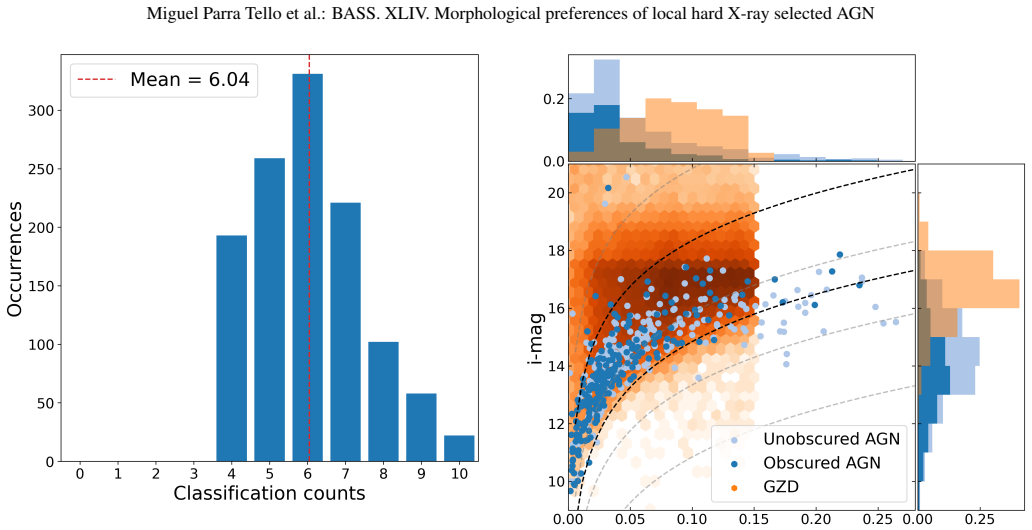
The machinery is a volunteer-based morphological classification workflow on the Zooniverse platform, deliberately adapted from the Galaxy Zoo DECaLS (GZD-5) decision tree so that active and inactive samples answer the same questions. Each BASS host was shown as a pair of grz color composite images—one shallow stretch to preserve the nucleus and bright features, one deep stretch to reveal tidal tails and faint surroundings—and volunteer answers were converted into seven broad morphological classes (smooth, disk-spiral, disk-no-spiral, edge-on, merger-strongly disturbed, point-like, other-uncertain) using the 60% quorum rules of GZD plus conservative tie-breaking. The comparison arm is a control sample of roughly 2550 inactive GZD galaxies, generated 6000 times by resampling to match the redshift and absolute i-band magnitude distributions of the 215 obscured (Seyfert 1.8–2) BASS AGN, with class fractions taken as the median over draws; redshift-resolution debias weights from Walmsley et al. (2022a) are applied to the AGN trends. This design lets the paper isolate morphology differences between active and inactive galaxies while controlling for distance and stellar mass, and it is the bar and merger questions in this shared tree that carry the central results.
What would settle it
Reclassify the 1189 BASS hosts with strictly Galaxy Zoo DECaLS-style images—single shallow stretch, washed-out uniform color, Petrosian-radius framing—and recompute the class fractions against the same matched control; if the ~400% merger excess and the ~48% versus ~30% bar difference shrink toward unity, the reported effects are largely imaging artifacts rather than properties of AGN hosts. A complementary automated check would run one identical classifier on both samples after harmonizing stretch, field of view, and color.
Extended reading notes
Core claim
On the paper's own terms, the discovery is that AGN selected at 14–195 keV live in systematically different galaxies from their inactive peers. Relative to a redshift- and i-band-magnitude-matched control of inactive galaxies drawn from the Galaxy Zoo DECaLS citizen-science catalog, the hard X-ray selected hosts from the BASS survey (BAT AGN Spectroscopic Survey) are deficient in smooth ellipticals ($\sim 6.4\sigma$), deficient in disks with prominent spiral arms ($\sim 4.3\sigma$), and overabundant in disks without spiral structure ($\sim 5.2\sigma$), edge-on disks ($\sim 3.4\sigma$), and especially mergers or strongly disturbed systems, which are almost four times more frequent in the active sample ($\sim 8.4\sigma$). The bar fraction among face-on disk AGN hosts is also elevated (roughly 48–50% versus 26–30%), with the weak-bar excess at $\sim 4.3\sigma$ and the strong-bar excess at $\sim 2.9\sigma$. When all disk classes are pooled, the active and inactive samples are consistent within $\sim 0.1\sigma$, showing that the disk family as a whole is not special; what stands out is which kind of disk. Finally, after redshift-debiasing, the fraction of mergers trends upward with X-ray luminosity, black hole mass, and Eddington ratio (accretion rate relative to the black hole's maximum), while the smooth-galaxy fraction flattens and disks dominate at the low-luminosity end, which the authors take as evidence that interactions and gas supply, not host mass alone, set the stage for the brightest AGN phases.
Load-bearing premise
The comparison assumes that the systematic differences in how the images were made for the two projects—dual-stretch color composites with wide fields for the AGN sample versus single, washed-out, more zoomed images for the control sample—do not bias how often volunteers called a galaxy a merger or a bar; the paper's own check on 105 galaxies classified by both projects found only about 70% agreement, with disagreements running mainly toward the BASS images being labeled mergers.
Editorial extensions
If this is right
- Merger- or interaction-driven fueling emerges as a major channel for local black hole growth: mergers and strongly disturbed systems are almost four times more frequent among hard X-ray selected AGN hosts than among matched inactive galaxies, at $\sim 8.4\sigma$ significance.
- Gas-poor ellipticals rarely host active nuclei: the roughly 70% deficit of smooth galaxies in the active sample implies that passive spheroids are inhospitable to black hole fueling in the local universe.
- The roughly 300% excess of spiral-less disks suggests AGN activity marks a transitional phase in which spiral arms have faded while nuclear fuel remains, consistent with quenching proceeding from the galaxy outskirts inward.
- Bars appear to be a genuine but secondary secular fueling channel: the bar fraction is higher among AGN hosts (about 50% versus 30%), yet bar strength shows no significant correlation with Eddington ratio.
- The released catalog of 1189 morphological classifications provides a benchmark for upcoming wide-area surveys (LSST, Roman, Euclid) and for training automated galaxy classifiers.
Reading between the lines
- Imaging systematics may account for part of the reported differences: on the 105 galaxies classified by both projects, agreement was only about 70%, with disagreements running mainly toward the BASS images being labeled mergers; a reclassification of the BASS sample using single-stretch, washed-out, more zoomed images would quantify how much of the ~400% merger excess is presentation rather than p
- The redshift-debiasing corrections are extrapolated with first-order splines beyond the calibrated $z=0.02$ to $z=0.15$ range; simulating spatially degraded images of the BASS hosts themselves would test whether the rising merger fraction with luminosity and Eddington ratio is a real physical trend or a resolution artifact.
- The 'transitional disk' interpretation is directly testable: if spiral-less AGN disks are truly quenching from the outside in, their star formation rates and molecular gas fractions should be measurably suppressed relative to matched inactive disks of the same morphology.
- Because the control matching assumes obscured and unobscured AGN host similar galaxies, any future evidence of a Type 1/Type 2 morphological difference would force the matching to be redone; the paper's own consistency check currently supports the assumption at roughly the $1\sigma$ level.
Editorial analysis
A structured set of objections, weighed in public.
Referee Report
Summary. The paper presents visual morphological classifications for 1189 hard X-ray selected (14-195 keV) AGN host galaxies from the Swift-BAT 105-month catalog (BASS), using a Zooniverse volunteer workflow adapted from Galaxy Zoo DECaLS (GZD). The authors compare the BASS morphological fractions against a control sample of inactive GZD galaxies matched in redshift and i-band absolute magnitude. Relative to this control, they report a deficiency of smooth ellipticals (~70% lower) and prominent-arm spirals (~80% lower), an excess of mergers/strongly disturbed systems (~400% higher) and spiral-less disks (~300% higher), and a higher bar fraction (~50% versus ~30%). They also examine how morphology depends on X-ray luminosity, black hole mass, Eddington ratio, and obscuration, after applying redshift-debiasing weights imported from Walmsley et al. (2022a).
Significance. If the morphological preferences hold, the paper provides a valuable benchmark for AGN-host galaxy studies, exploiting the obscuration-unbiased selection of the Swift-BAT sample. The strengths include a large all-sky hard-X-ray-selected sample, a carefully constructed matched control sample, an explicit test of the obscured/unobscured matching assumption (Appendix D), and a public morphological catalog. The central comparison, however, rests on the assumption that the BASS and GZD classification efforts are directly comparable. The paper itself demonstrates in Sec. 9.1 that this assumption is not fully met: on 105 objects, only ~70% of the consensus classifications agree, and the authors attribute most disagreements to systematic differences in image presentation (dual-stretch, color, and field-of-view). Because the disagreements point preferentially toward BASS classifying objects as mergers, the headline results could be substantially biased. This issue is load-bearing for the paper's central claims, and a revision should address it quantitatively.
major comments (3)
- [Sec. 9.1, Fig. 10, Sec. 9.2] The common-object comparison shows only ~70% agreement between BASS and GZD classifications, with disagreements mainly in the direction of BASS labeling objects as mergers or strongly disturbed. The paper states that 'the different amounts of information provided to the respective volunteers can explain most of these disagreements over the same galaxies.' Since the deep-stretch and wider-field images make tidal features and companions more visible, the ~400% merger excess reported in Sec. 9.2 could be inflated (or possibly entirely produced) by this systematic difference. The paper should convert the common-object confusion matrix into a quantitative bias assessment, or at least show that the headline result survives when the comparison is restricted to a subset where the two image presentations are more uniform, or when a conservative correction for the disagreement rate is applied.
- [Sec. 9.3, Table 5] The bar fraction comparison is also affected by the same differential information issue: BASS volunteers saw color images that make bars more visible, while GZD images were deliberately washed out. Moreover, the bar classification threshold uses vote fractions computed from only ~6 classifications per BASS galaxy, versus 25 or more for GZD, which can produce noisier and less reliable bar detections. The common-object comparison in Fig. 10 does not separately validate bar classifications. The paper should provide a bar-specific validation (e.g., bar vote fractions on the 105 common objects or expert reinspection for the bar sub-sample) and, if needed, recompute the bar fractions with a more conservative threshold.
- [Sec. 6, Table 3] The treatment of the 'other-uncertain' class is asymmetric between BASS and GZD. BASS point-like sources are reclassified using a child-node question that has no GZD counterpart, while GZD other-uncertains have artifact votes removed. This asymmetric processing can shift class fractions and the quoted statistical errors do not capture that systematic. The paper should quantify how the main conclusions (especially the excess of spiral-less disks and the deficit of smooth galaxies) change if reclassification is applied symmetrically, or if the other-uncertain galaxies are all kept separate in the comparison.
minor comments (4)
- [Sec. 4.2] The text states that the imperfect match between the BASS and GZD parameter spaces could cause a bias at the ~10% level, but this systematic uncertainty is not propagated into the final morphological fractions. It would be helpful to include this as an additional error term in Fig. 12 and Table 5.
- [Appendix C] The assignment of the smooth correction weight to point-like galaxies and the featured weight to mergers is an arbitrary substitution. Please justify this choice or propagate its uncertainty into the debiased trends shown in Fig. 8.
- [Sec. 3, Fig. 4] Fig. 4 is labeled 'as of January 2025' but the manuscript was accepted in June 2025; please clarify whether the final catalog uses a different classification cutoff and whether the vote counts in Fig. 4 match the released catalog.
- [Sec. 2.5] The text contains rendering artifacts such as 'V oorwerpjes' and 'V oorwerp'; these should be corrected to 'Voorwerpjes' and 'Voorwerp'.
Circularity Check
No circularity: the BASS-vs-GZD comparison rests on an external control sample and external classification/debiasing references; the reported image-presentation differences are a measurement caveat, not a circular derivation.
full rationale
The central claims are empirical comparisons between volunteer classifications of BASS AGN hosts (this paper) and an external GZD control sample (Walmsley et al. 2022a). The control matching uses external photometry and redshifts; quorum thresholds and debiasing weights come from Walmsley et al. (2022a) and Masters et al. (2012), not from fitting to BASS data. The obscured-only matching assumption is explicitly tested in Appendix D. The redshift-debiasing corrections applied to the BASS sample are imported from external GZD simulations and are parameter-free with respect to the BASS classification output. No parameter is fitted to the BASS data and then renamed a prediction: the morphological classes are defined by fixed quorum rules (Table 2) applied to both BASS and GZD, with documented workflow differences. The image-stretch, color, and field-of-view differences discussed in Section 9.1 are a potential systematic bias in comparing the two volunteer projects, and the paper transparently reports the 70% agreement on 105 common objects; however, this is a measurement-validity concern, not circularity, because the comparison still relies on independent external classifications and does not reduce by construction to the paper's own inputs. Self-citations to BASS survey papers are references to data products and prior catalogs, not to unverified theorems or fitted predictions. Therefore no significant circularity is present.
Assumptions & free parameters
free parameters (4)
- Morphological quorum threshold =
0.6
- Reclassification thresholds for uncertain galaxies =
Merging + Strongly disturbed <= 0.6; Face-on > 0.4
- Tidal debris conversion thresholds for GZD-1-2 =
p>0.5 strong, 0.2<p<=0.5 weak, p<=0.2 none
- Redshift debias weight substitutions =
smooth weight given to point-like class; featured weight to merger class
assumptions (4)
- domain assumption Obscured and unobscured AGN host galaxies have similar morphology distributions.
- domain assumption GZD redshift-resolution debias corrections transfer to BASS.
- domain assumption The i-band magnitude of obscured AGN traces host stellar mass with negligible AGN contamination.
- domain assumption GZD after AGN removal is a representative sample of inactive galaxies.
Cite this review
Pith. "Pith review of BASS. XLIV. Morphological preferences of local hard X-ray selected AGN." pith.science (2026). https://pith.science/paper/RTVK45LC
@misc{pith2026250621800,
  author       = {Pith},
  title        = {Pith review of: BASS. XLIV. Morphological preferences of local hard X-ray selected AGN},
  year         = {2026},
  howpublished = {\url{https://pith.science/paper/RTVK45LC}},
  note         = {Machine review of arXiv:2506.21800}
}
read the original abstract
We present morphological classifications for the hosts of 1189 hard X-ray selected (14-195 keV) active galactic nuclei (AGNs) from the Swift-BAT 105-month catalog as part of the BAT AGN Spectroscopic Survey (BASS). BASS provides a powerful all-sky census of nearby AGN, minimizing obscuration biases and providing a robust dataset for studying AGN-host galaxy connections. Classifications are based on volunteer-based visual inspection on the Zooniverse platform, adapted from Galaxy Zoo DECaLS (GZD). Dual-contrast grz color composite images, generated from public surveys (e.g., NOAO Legacy Survey, Pan-STARRS, SDSS) and dedicated observations enabled key morphological features to be identified. Our analysis reveals that, with respect to a control sample of inactive galaxies matched in redshift and i-band magnitude, BASS AGN hosts show a deficiency of smooth ellipticals (~70%) and disks with prominent arms (~80%), while displaying an excess of mergers or disturbed systems (~400%), and disk galaxies without a spiral structure (~300%). These trends suggest a preference for AGN activity in gas-rich, dynamically disturbed environments or transitional disk systems. We also find a higher bar fraction among AGN hosts than the control sample (~50% vs. ~30%). We further explore the relations between AGN properties (e.g., X-ray luminosity, black hole mass, and Eddington ratio) and host morphology, and find that high-luminosity and high-accretion AGN preferentially reside in smooth or point-like hosts. In parallel, lower-luminosity AGN are more common in disk galaxies. These results underscore the importance of morphological studies in understanding the fueling and feedback mechanisms that drive AGN activity and their role in galaxy evolution. Our dataset provides a valuable benchmark for future multiwavelength surveys (e.g. LSST, Roman, and Euclid) and automated morphological classification efforts.
Figures


Figures from the paper (15 more)


Forward citations
Cited by 1 Pith paper
-
BASS LII: The prevalence of double-peaked broad lines at low accretion rates among hard X-ray selected AGN
About 21% of hard X-ray selected broad-line AGN show double-peaked broad H-alpha lines, and these objects tend to have higher black hole masses and lower Eddington ratios.
Reference graph
Works this paper leans on
-
[1]
Adams, T. F. 1977, ApJS, 33, 19
work page 1977
-
[2]
D., Allende Prieto, C., et al
Alam, S., Albareti, F. D., Allende Prieto, C., et al. 2015, ApJS, 219, 12
2015
-
[3]
Alonso, S., Coldwell, G., Duplancic, F., Mesa, V ., & Lambas, D. G. 2018, A&A, 618, A149
work page 2018
- [4]
-
[5]
Barnes, J. E. & Hernquist, L. E. 1991, ApJ, 370, L65
work page 1991
-
[6]
D., Barbier, L
Barthelmy, S. D., Barbier, L. M., Cummings, J. R., et al. 2005, Space Sci. Rev., 120, 143
2005
-
[7]
N., Kauffmann, G., Heckman, T
Best, P. N., Kauffmann, G., Heckman, T. M., et al. 2005, MNRAS, 362, 25
2005
-
[8]
& Gerhard, O
Bland-Hawthorn, J. & Gerhard, O. 2016, ARA&A, 54, 529
2016
Show all 72 references
-
[9]
Blanton, M. R. & Moustakas, J. 2009, ARA&A, 47, 159
2009
-
[10]
& García Lambas, D
Bornancini, C. & García Lambas, D. 2018, MNRAS, 479, 2308
2018
-
[11]
2005, MNRAS, 364, L18
Bournaud, F., Combes, F., & Semelin, B. 2005, MNRAS, 364, L18
2005
-
[12]
2020, A&A, 634, A114
Caglar, T., Burtscher, L., Brandl, B., et al. 2020, A&A, 634, A114
2020
-
[13]
J., Burtscher, L., et al
Caglar, T., Koss, M. J., Burtscher, L., et al. 2023, ApJ, 956, 60
2023
-
[14]
A., Clayton, G
Cardelli, J. A., Clayton, G. C., & Mathis, J. S. 1989, ApJ, 345, 245
1989
-
[15]
C., Magnier, E
Chambers, K. C., Magnier, E. A., Metcalfe, N., et al. 2016, arXiv e-prints, arXiv:1612.05560
2016 arXiv
-
[16]
A., Knapen, J
Cisternas, M., Gadotti, D. A., Knapen, J. H., et al. 2013, ApJ, 776, 50
2013
-
[17]
J., et al
Cisternas, M., Jahnke, K., Inskip, K. J., et al. 2011, ApJ, 726, 57
2011
-
[18]
Conselice, C. J. 2014, ARA&A, 52, 291
2014
-
[19]
G., Buta, R
Corwin, Jr., H. G., Buta, R. J., & de Vaucouleurs, G. 1994, AJ, 108, 2128
1994
-
[20]
2013, MNRAS, 431, 2661
Cotini, S., Ripamonti, E., Caccianiga, A., et al. 2013, MNRAS, 431, 2661
2013
-
[21]
J., Lang, D., et al
Dey, A., Schlegel, D. J., Lang, D., et al. 2019, AJ, 157, 168 Di Matteo, T., Springel, V ., & Hernquist, L. 2005, Nature, 433, 604
2019
-
[22]
2016, MNRAS, 463, 3948
Dubois, Y ., Peirani, S., Pichon, C., et al. 2016, MNRAS, 463, 3948
2016
-
[23]
L., Viswanathan, A., Patton, D
Ellison, S. L., Viswanathan, A., Patton, D. R., et al. 2019, MNRAS, 487, 2491 Euclid Collaboration, La Marca, A., Wang, L., et al. 2025, arXiv e-prints, arXiv:2503.15317
2019 arXiv
-
[24]
J., Sazonova, E., et al
Ferreira, L., Conselice, C. J., Sazonova, E., et al. 2023, ApJ, 955, 94
2023
-
[25]
Flesch, E. W. 2023, The Open Journal of Astrophysics, 6, 49
2023
-
[26]
A., Magnier, E
Flewelling, H. A., Magnier, E. A., Chambers, K. C., et al. 2020, ApJS, 251, 7
2020
-
[27]
& Benz, W
Friedli, D. & Benz, W. 1993, A&A, 268, 65
1993
-
[28]
L., Walmsley, M., Silcock, M
Garland, I. L., Walmsley, M., Silcock, M. S., et al. 2024, MNRAS, 532, 2320
2024
-
[29]
2021, A&A, 650, A75
Gkini, A., Plionis, M., Chira, M., & Koulouridis, E. 2021, A&A, 650, A75
2021
-
[30]
D., Matthaey, E., Greene, J
Goulding, A. D., Matthaey, E., Greene, J. E., et al. 2017, ApJ, 843, 135
2017
-
[31]
2008, PASP, 120, 405
Greiner, J., Bornemann, W., Clemens, C., et al. 2008, PASP, 120, 405
2008
-
[32]
E., Bamford, S
Hart, R. E., Bamford, S. P., Willett, K. W., et al. 2016, MNRAS, 461, 3663
2016
-
[33]
Hickox, R. C. & Alexander, D. M. 2018, ARA&A, 56, 625
2018
-
[34]
2013, ApJS, 208, 19
Hinshaw, G., Larson, D., Komatsu, E., et al. 2013, ApJS, 208, 19
2013
-
[35]
F., Hernquist, L., Cox, T
Hopkins, P. F., Hernquist, L., Cox, T. J., et al. 2006, ApJS, 163, 1
2006
-
[36]
1926, Contributions from the Mount Wilson Observatory / Carnegie Institution of Washington, 324, 1
Hubble, E. 1926, Contributions from the Mount Wilson Observatory / Carnegie Institution of Washington, 324, 1
1926
-
[37]
M., Tremonti, C., et al
Kauffmann, G., Heckman, T. M., Tremonti, C., et al. 2003, MNRAS, 346, 1055
2003
-
[38]
C., Chojnowski, S
Keel, W. C., Chojnowski, S. D., Bennert, V . N., et al. 2012, MNRAS, 420, 878
2012
-
[39]
Kennicutt, Jr., R. C. 1998, ARA&A, 36, 189
1998
-
[40]
Kormendy, J. & Ho, L. C. 2013, ARA&A, 51, 511
2013
-
[41]
2010, ApJ, 716, L125
Koss, M., Mushotzky, R., Veilleux, S., & Winter, L. 2010, ApJ, 716, L125
2010
-
[42]
2011, ApJ, 739, 57
Koss, M., Mushotzky, R., Veilleux, S., et al. 2011, ApJ, 739, 57
2011
-
[43]
2017, ApJ, 850, 74
Koss, M., Trakhtenbrot, B., Ricci, C., et al. 2017, ApJ, 850, 74
2017
-
[44]
J., Assef, R., Balokovi´c, M., et al
Koss, M. J., Assef, R., Balokovi´c, M., et al. 2016, ApJ, 825, 85
2016
-
[45]
J., Strittmatter, B., Lamperti, I., et al
Koss, M. J., Strittmatter, B., Lamperti, I., et al. 2021, ApJS, 252, 29
2021
-
[46]
J., Treister, E., Kakkad, D., et al
Koss, M. J., Treister, E., Kakkad, D., et al. 2023, ApJ, 942, L24
2023
-
[47]
H., & Peletier, R
Laine, S., Shlosman, I., Knapen, J. H., & Peletier, R. F. 2002, ApJ, 567, 97
2002
-
[48]
J., Schawinski, K., Keel, W., et al
Lintott, C. J., Schawinski, K., Keel, W., et al. 2009, MNRAS, 399, 129
2009
-
[49]
R., Fekete, G., et al
Lupton, R., Blanton, M. R., Fekete, G., et al. 2004, PASP, 116, 133
2004
-
[50]
& Rieke, G
Maiolino, R. & Rieke, G. H. 1995, ApJ, 454, 95
1995
-
[51]
2019, MNRAS, 488, 89
Man, Z.-y., Peng, Y .-j., Kong, X., et al. 2019, MNRAS, 488, 89
2019
-
[52]
L., Nichol, R
Masters, K. L., Nichol, R. C., Haynes, M. P., et al. 2012, MNRAS, 424, 2180
2012
-
[53]
A., Morgan, W
Matthews, T. A., Morgan, W. W., & Schmidt, M. 1964, ApJ, 140, 35
1964
-
[54]
H., Harbeck, D.-R., et al
McCully, C., V olgenau, N. H., Harbeck, D.-R., et al. 2018, in Society of Photo- Optical Instrumentation Engineers (SPIE) Conference Series, V ol. 10707, Software and Cyberinfrastructure for Astronomy V , ed. J. C. Guzman & J. Ib- sen, 107070K Mejía-Restrepo, J. E., Trakhtenbr...
2018
-
[55]
2021, A&A, 653, A70
Mountrichas, G., Buat, V ., Georgantopoulos, I., et al. 2021, A&A, 653, A70
2021
-
[56]
B., et al
Oh, K., Koss, M., Markwardt, C. B., et al. 2018, ApJS, 235, 4
2018
-
[57]
Oh, S., Oh, K., & Yi, S. K. 2012, ApJS, 198, 4
2012
-
[58]
Y ., Ho, L
Peng, C. Y ., Ho, L. C., Impey, C. D., & Rix, H.-W. 2002, AJ, 124, 266
2002
-
[59]
Y ., Ho, L
Peng, C. Y ., Ho, L. C., Impey, C. D., & Rix, H.-W. 2010, AJ, 139, 2097 Pérez, E., Cid Fernandes, R., González Delgado, R. M., et al. 2013, ApJ, 764, L1 Planck Collaboration, Abergel, A., Ade, P. A. R., et al. 2014, A&A, 571, A11
2010
-
[60]
J., et al
Ricci, C., Ueda, Y ., Koss, M. J., et al. 2015, ApJ, 815, L13
2015
-
[61]
K., Schlafly, E
Saydjari, A. K., Schlafly, E. F., Lang, D., et al. 2023, ApJS, 264, 28
2023
-
[62]
2013, ApJS, 209, 21
Schirmer, M. 2013, ApJS, 209, 21
2013
-
[63]
M., Harrison, C
Scholtz, J., Alexander, D. M., Harrison, C. M., et al. 2018, MNRAS, 475, 1288
2018
-
[64]
Shlosman, I., Frank, J., & Begelman, M. C. 1989, Nature, 338, 45
1989
-
[65]
M., Renzini, A., et al
Tacchella, S., Carollo, C. M., Renzini, A., et al. 2015, Science, 348, 314
2015
-
[66]
Tinsley, B. M. 1980, Fund. Cosmic Phys., 5, 287
1980
-
[67]
M., & Simmons, B
Treister, E., Schawinski, K., Urry, C. M., & Simmons, B. D. 2012, ApJ, 758, L39
2012
-
[68]
2020, MNRAS, 491, 1554
Walmsley, M., Smith, L., Lintott, C., et al. 2020, MNRAS, 491, 1554
2020
-
[69]
Weedman, D. W. 1977, ARA&A, 15, 69
1977
-
[70]
C., Rieke, M., et al
Woodrum, C., Williams, C. C., Rieke, M., et al. 2024, ApJ, 974, 305
2024
-
[71]
Zhuang, M.-Y . & Ho, L. C. 2023, Nature Astronomy, 7, 1376
2023
-
[72]
Smooth”, “Featured
Zou, F., Yang, G., Brandt, W. N., & Xue, Y . 2019, ApJ, 878, 11 Article number, page 18 of 20 Miguel Parra Tello et al.: BASS. XLIV . Morphological preferences of local hard X-ray selected AGN Appendix A: Fringe pattern mitigation of Sinistro sources Fig. A.1: Examples of deep...
2022
Reviewed August 6, 2026 · model on record in the stance chip above.
Discussion (0). Continue with ORCID to comment.