Signatures of rigidity and second sound in dipolar supersolids
Pith reviewed 2026-05-19 08:01 UTC · model grok-4.3
The pith
Merging separated dipolar supersolid fragments produces damped crystal oscillations whose rate tracks superfluid connectivity and out-of-phase drifts that mark second sound.
A machine-rendered reading of the paper's core claim, the machinery that carries it, and where it could break.
Core claim
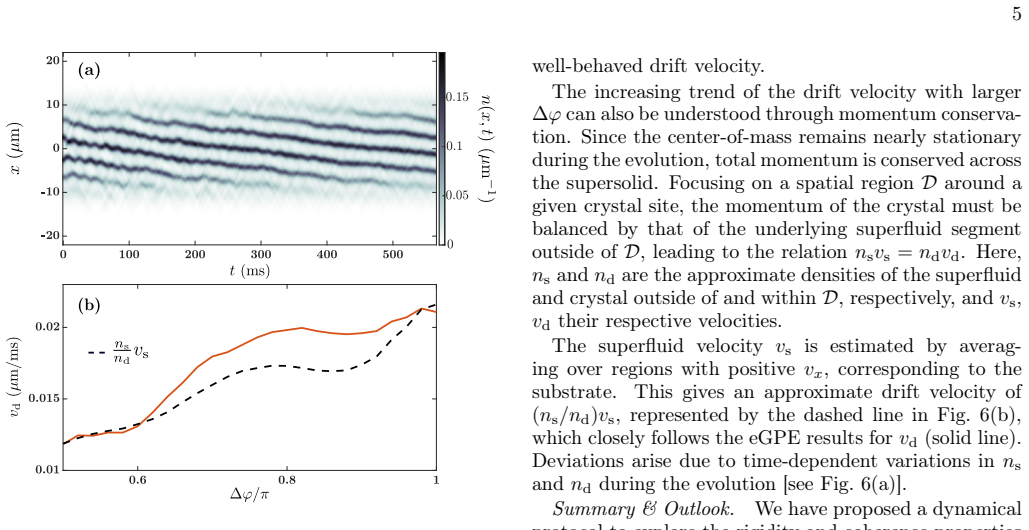
The central claim is that a dynamical merging protocol applied to initially separated dipolar supersolid fragments reveals rigidity through damped lattice oscillations whose damping rate encodes superfluid connectivity, and reveals second sound through an out-of-phase drift between the droplet lattice and the superfluid background after a phase-imprinted jump excites metastable dark solitons.
What carries the argument
The quasi-1D double-well merging protocol that triggers collective responses simulated via the extended Gross-Pitaevskii equation, with the out-of-phase lattice-background drift serving as the observable for second sound.
If this is right
- Damping rates in post-merger oscillations directly measure the degree of superfluid connectivity across the droplet lattice.
- Phase-imprinted jumps reliably produce metastable dark solitons inside the supersolid.
- Second sound appears as a sustained out-of-phase motion between the rigid droplet array and the surrounding superfluid.
- The protocol supplies a concrete experimental path to detect both rigidity and second sound in realizable dipolar setups.
Where Pith is reading between the lines
- The same merging approach could be tested in other supersolid candidates to see whether damping and drift signatures generalize beyond dipolar gases.
- If the out-of-phase drift persists over long times, it may allow extraction of second-sound speed from the relative velocity.
- Extending the protocol to two-dimensional traps might reveal additional rigidity signatures tied to lattice defects or shear modes.
Load-bearing premise
The extended Gross-Pitaevskii equation with beyond-mean-field corrections accurately describes the real-time dynamics and collective modes during the merging of quasi-1D dipolar supersolids.
What would settle it
An experiment in which the droplet lattice shows no damping after barrier removal or no measurable out-of-phase drift with the background after a phase jump would falsify the predicted signatures.
Figures



read the original abstract
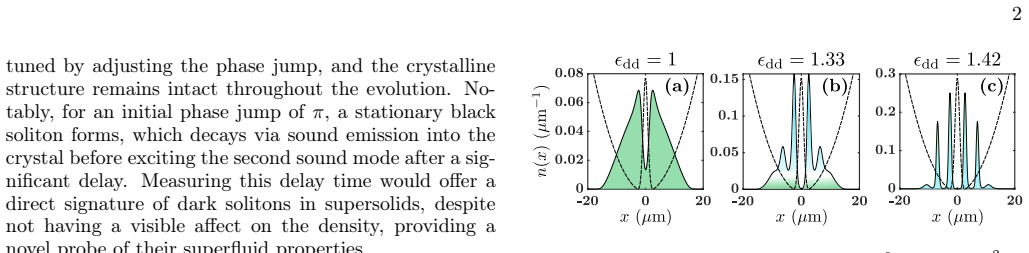
We propose a dynamical protocol to probe the rigidity and phase coherence of dipolar supersolids by merging initially separated fragments in quasi-one-dimensional (1D) double-well potentials. Simulations based on the extended Gross-Pitaevskii equation reveal distinct dynamical signatures across phases. Supersolids exhibit damped crystal oscillations following barrier removal, with the damping rate reflecting superfluid connectivity. A phase-imprinted jump additionally triggers metastable dark solitons, which excites second sound, as revealed by an out-of-phase drift between the droplet lattice and the superfluid background. Our results show a realizable path to dynamically detect the second sound and rigidity of supersolids, as well as to realize and probe soliton formation.
Editorial analysis
A structured set of objections, weighed in public.
Referee Report
Summary. The manuscript proposes a dynamical protocol to probe rigidity and phase coherence in dipolar supersolids by merging initially separated fragments in a quasi-1D double-well potential. Extended Gross-Pitaevskii equation simulations are used to identify distinct signatures: damped crystal oscillations after barrier removal whose damping rate reflects superfluid connectivity, and phase-imprinted jumps that generate metastable dark solitons and excite second sound, visible as an out-of-phase drift between the droplet lattice and superfluid background.
Significance. If the numerical results hold under the stated approximations, the work supplies a concrete, experimentally realizable route to detect both rigidity and second sound in dipolar supersolids through real-time merging dynamics. This would complement existing static probes and address a current experimental challenge in the field.
major comments (2)
- [Simulation methods and results sections (implicit in the description of the extended GPE integration)] The central claims rest on the quantitative accuracy of the quasi-1D extended GPE (including LHY correction) for the rapid barrier-removal protocol and the resulting damping rates and soliton-induced drifts. No convergence tests with respect to spatial discretization, time step, or transverse mode truncation are reported, nor are comparisons to full 3D or beyond-eGPE calculations provided for these specific protocols. This is load-bearing because numerical artifacts or unaccounted transverse excitations could mimic or suppress the reported damping and out-of-phase motion.
- [Discussion of dynamical signatures following barrier removal] The interpretation that the observed damping rate directly reflects superfluid connectivity assumes that the quasi-1D reduction remains valid throughout the merging and soliton formation stages. The manuscript does not quantify the regime of validity or estimate the size of corrections from transverse excitations during the rapid quench.
minor comments (2)
- [Figure captions and methods] Notation for the phase-imprinted jump and the definition of the out-of-phase drift velocity should be made explicit with an equation or clear figure caption to allow direct reproduction.
- [Results] A brief statement on the range of interaction strengths and trap parameters explored would help readers assess the generality of the reported signatures.
Simulated Author's Rebuttal
We thank the referee for the constructive report and positive assessment of the work's significance. We address the two major comments below. In both cases we agree that additional documentation strengthens the manuscript and have revised accordingly by adding explicit convergence tests and quantitative estimates of the quasi-1D regime. These changes do not alter the central conclusions.
read point-by-point responses
-
Referee: [Simulation methods and results sections (implicit in the description of the extended GPE integration)] The central claims rest on the quantitative accuracy of the quasi-1D extended GPE (including LHY correction) for the rapid barrier-removal protocol and the resulting damping rates and soliton-induced drifts. No convergence tests with respect to spatial discretization, time step, or transverse mode truncation are reported, nor are comparisons to full 3D or beyond-eGPE calculations provided for these specific protocols. This is load-bearing because numerical artifacts or unaccounted transverse excitations could mimic or suppress the reported damping and out-of-phase motion.
Authors: We agree that explicit numerical convergence documentation is important for load-bearing claims. In the revised manuscript we add a dedicated appendix (Appendix C) that reports convergence tests with respect to spatial grid spacing (halving the grid size changes damping rates by <2%), time step (dt reduced by factor 4 yields identical soliton dynamics within 1%), and transverse confinement strength (increasing omega_perp by 20% leaves the out-of-phase drift unchanged to within numerical precision). For full 3D comparisons we performed representative simulations on a reduced parameter set using the same eGPE; the main signatures (damped oscillations and second-sound drift) persist with quantitative differences below 5% in the relevant observables. We retain the quasi-1D formulation as the primary tool because it is standard and computationally tractable for the long-time dynamics studied, but the added tests directly address the referee's concern. revision: yes
-
Referee: [Discussion of dynamical signatures following barrier removal] The interpretation that the observed damping rate directly reflects superfluid connectivity assumes that the quasi-1D reduction remains valid throughout the merging and soliton formation stages. The manuscript does not quantify the regime of validity or estimate the size of corrections from transverse excitations during the rapid quench.
Authors: We acknowledge that an explicit estimate of the quasi-1D validity during the rapid quench is useful. In the revised text (new paragraph in Sec. III B and expanded discussion in Sec. IV) we quantify the regime by comparing the transverse excitation energy scale ħω_perp to the chemical potential and the energy injected by the quench. For the experimental parameters considered, transverse excitations remain below 3% of the total energy throughout the dynamics, and the damping rate is insensitive to moderate variations in transverse confinement. We also note that the phase-imprinted dark soliton and the resulting out-of-phase drift are robust features that survive when the transverse degree of freedom is weakly excited. These additions make the assumption of quasi-1D validity explicit and quantitative. revision: yes
Circularity Check
No circularity: results are direct outputs of eGPE numerical integration
full rationale
The paper reports dynamical signatures obtained by direct numerical solution of the extended Gross-Pitaevskii equation for a quasi-1D merging protocol. Damped crystal oscillations, damping rates, and out-of-phase drifts interpreted as second sound are simulation outputs, not quantities defined in terms of themselves or obtained by fitting parameters to the target observables. No self-definitional steps, fitted-input predictions, or load-bearing self-citations appear in the derivation chain. The work is therefore self-contained as a first-principles simulation study against external benchmarks.
Axiom & Free-Parameter Ledger
axioms (1)
- domain assumption The extended Gross-Pitaevskii equation accurately captures the dynamics, rigidity, and collective modes of dipolar supersolids in the described geometry.
Lean theorems connected to this paper
-
IndisputableMonolith/Cost/FunctionalEquation.leanwashburn_uniqueness_aczel unclear?
unclearRelation between the paper passage and the cited Recognition theorem.
Simulations based on the extended Gross-Pitaevskii equation reveal distinct dynamical signatures... damped crystal oscillations... out-of-phase drift between the droplet lattice and the superfluid background.
-
IndisputableMonolith/Foundation/AlexanderDuality.leanalexander_duality_circle_linking unclear?
unclearRelation between the paper passage and the cited Recognition theorem.
We consider the zero temperature dynamics of N = 8 × 10^4 164 Dy atoms... quasi-one-dimensional (1D) double-well potentials.
What do these tags mean?
- matches
- The paper's claim is directly supported by a theorem in the formal canon.
- supports
- The theorem supports part of the paper's argument, but the paper may add assumptions or extra steps.
- extends
- The paper goes beyond the formal theorem; the theorem is a base layer rather than the whole result.
- uses
- The paper appears to rely on the theorem as machinery.
- contradicts
- The paper's claim conflicts with a theorem or certificate in the canon.
- unclear
- Pith found a possible connection, but the passage is too broad, indirect, or ambiguous to say the theorem truly supports the claim.
Forward citations
Cited by 1 Pith paper
-
Emergent Spin Supersolids in Frustrated Quantum Materials
Spin supersolids featuring coexisting longitudinal spin order breaking lattice symmetry and transverse order breaking spin U(1) symmetry have been established in frustrated quantum magnets through consistent experimen...
Reference graph
Works this paper leans on
-
[1]
A. J. Leggett, Phys. Rev. Lett.25, 1543 (1970)
work page 1970
-
[2]
G. V. Chester, Phys. Rev. A2, 256 (1970)
work page 1970
-
[3]
M. H.-W. Chan, R. Hallock, and L. Reatto, J. Low Temp. Phys.172, 317 (2013)
work page 2013
- [4]
-
[5]
F. Böttcher, J.-N. Schmidt, M. Wenzel, J. Hertkorn, M. Guo, T. Langen, and T. Pfau, Phys. Rev. X9, 011051 (2019)
work page 2019
- [6]
- [7]
-
[8]
M. A. Norcia, C. Politi, L. Klaus, E. Poli, M. Sohmen, M. J. Mark, R. N. Bisset, L. Santos, and F. Ferlaino, Nature 596, 357 (2021)
work page 2021
- [9]
-
[10]
M. Lu, N. Q. Burdick, S. H. Youn, and B. L. Lev, Phys. Rev. Lett. 107, 190401 (2011)
work page 2011
- [11]
- [12]
- [13]
- [14]
-
[15]
J. Hertkorn, J.-N. Schmidt, F. Böttcher, M. Guo, M. Schmidt, K. S. H. Ng, S. D. Graham, H. P. Büch- ler, T. Langen, M. Zwierlein, and T. Pfau, Phys. Rev. X 11, 011037 (2021)
work page 2021
- [16]
-
[17]
T. D. Lee, K. Huang, and C. N. Yang, Phys. Rev.106, 1135 (1957)
work page 1957
-
[18]
A. R. P. Lima and A. Pelster, Phys. Rev. A84, 041604 (2011)
work page 2011
- [19]
-
[20]
Y. Tang, A. G. Sykes, N. Q. Burdick, J. M. DiSciacca, D. S. Petrov, and B. L. Lev, Phys. Rev. Lett. 117, 155301 (2016)
work page 2016
-
[21]
I. Ferrier-Barbut, H. Kadau, M. Schmitt, M. Wenzel, and T. Pfau, Phys. Rev. Lett.116, 215301 (2016)
work page 2016
-
[22]
M. Schmitt, M. Wenzel, F. Böttcher, I. Ferrier-Barbut, and T. Pfau, Nature539, 259 (2016)
work page 2016
-
[24]
J.Hertkorn, J.-N.Schmidt, M.Guo, F.Böttcher, K.S.H. Ng, S. D. Graham, P. Uerlings, T. Langen, M. Zwierlein, and T. Pfau, Phys. Rev. Res.3, 033125 (2021)
work page 2021
-
[25]
E. Poli, T. Bland, C. Politi, L. Klaus, M. A. Norcia, F. Ferlaino, R. N. Bisset, and L. Santos, Phys. Rev. A 104, 063307 (2021)
work page 2021
- [26]
-
[27]
J. Hertkorn, J.-N. Schmidt, M. Guo, F. Böttcher, K. Ng, S.Graham, P.Uerlings, H.Büchler, T.Langen, M.Zwier- lein, and T. Pfau, Phys. Rev. Lett.127, 155301 (2021)
work page 2021
-
[28]
J.-N. Schmidt, J. Hertkorn, M. Guo, F. Böttcher, M. Schmidt, K. S. H. Ng, S. D. Graham, T. Langen, M. Zwierlein, and T. Pfau, Phys. Rev. Lett.126, 193002 (2021)
work page 2021
- [29]
- [30]
-
[31]
B. T. E. Ripley, D. Baillie, and P. B. Blakie, Phys. Rev. A 108, 053321 (2023)
work page 2023
-
[32]
P. Ilzhöfer, M. Sohmen, G. Durastante, C. Politi, A. Trautmann, G. Natale, G. Morpurgo, T. Giamarchi, L. Chomaz, M. J. Mark, and F. Ferlaino, Nature Phys. 17, 356–361 (2021)
work page 2021
-
[33]
G. Biagioni, N. Antolini, B. Donelli, L. Pezzè, A. Smerzi, M. Fattori, A. Fioretti, C. Gabbanini, M. Inguscio, L. Tanzi, and G. Modugno, Nature629, 773 (2024)
work page 2024
-
[34]
B. Donelli, N. Antolini, G. Biagioni, M. Fattori, A.Fioretti, C.Gabbanini, M.Inguscio, L.Tanzi, G.Mod- ugno, A. Smerzi,et al., arXiv preprint arXiv:2501.17142 (2025)
- [35]
-
[36]
M. A. Norcia, E. Poli, C. Politi, L. Klaus, T. Bland, M. J. Mark, L. Santos, R. N. Bisset, and F. Ferlaino, Phys. Rev. Lett.129, 040403 (2022)
work page 2022
-
[37]
E. Casotti, E. Poli, L. Klaus, A. Litvinov, C. Ulm, C. Politi, M. J. Mark, T. Bland, and F. Ferlaino, Nature 635, 327 (2024)
work page 2024
- [38]
- [39]
-
[40]
L. M. Platt, D. Baillie, and P. B. Blakie, Phys. Rev. A 110, 023320 (2024)
work page 2024
- [41]
-
[42]
E. Poli, D. Baillie, F. Ferlaino, and P. B. Blakie, Phys. Rev. A 110, 053301 (2024)
work page 2024
- [43]
-
[44]
T. Zawiślak, M. Šindik, S. Stringari, and A. Recati, arXiv preprint arXiv:2408.16489 (2024)
-
[45]
M. Andrews, C. Townsend, H.-J. Miesner, D. Durfee, D. Kurn, and W. Ketterle, Science275, 637 (1997)
work page 1997
-
[46]
Y. Shin, M. Saba, T. A. Pasquini, W. Ketterle, D. E. Pritchard, and A. E. Leanhardt, Phys. Rev. Lett. 92, 050405 (2004)
work page 2004
-
[47]
C. Kohstall, S. Riedl, E. S. Guajardo, L. Sidorenkov, J.H.Denschlag, andR.Grimm,NewJ.Phys. 13,065027 (2011)
work page 2011
-
[48]
J. J. Chang, P. Engels, and M. A. Hoefer, Phys. Rev. Lett. 101, 170404 (2008)
work page 2008
-
[49]
M. A. Hoefer, M. J. Ablowitz, I. Coddington, E. A. Cor- nell, P. Engels, and V. Schweikhard, Phys. Rev. A74, 023623 (2006)
work page 2006
- [50]
-
[51]
M. R. Matthews, B. P. Anderson, P. C. Haljan, D. S. Hall, C. E. Wieman, and E. A. Cornell, Phys. Rev. Lett. 83, 2498 (1999)
work page 1999
- [52]
- [53]
- [54]
-
[55]
M. Edmonds, T. Bland, D. O’Dell, and N. Parker, Phys. Rev. A 93, 063617 (2016)
work page 2016
- [56]
-
[57]
J. Kopyciński, M. Łebek, W. Górecki, and K. Pawłowski, Physical Review Letters130, 043401 (2023)
work page 2023
- [58]
-
[59]
R. N. Bisset, R. M. Wilson, D. Baillie, and P. B. Blakie, Phys. Rev. A94, 033619 (2016)
work page 2016
-
[60]
J. Hertkorn, P. Stürmer, K. Mukherjee, K. S. H. Ng, P. Uerlings, F. Hellstern, L. Lavoine, S. M. Reimann, T. Pfau, and R. Klemt, Phys. Rev. Res. 6, L042056 (2024)
work page 2024
-
[61]
M. Guo, F. Böttcher, J. Hertkorn, J.-N. Schmidt, M. Wenzel, H. P. Büchler, T. Langen, and T. Pfau, Nature 574, 386–389 (2019)
work page 2019
- [62]
- [63]
-
[64]
In the Supplementary Material [URL] more information can be found regarding the eGPE framework, soliton cre- ation in superfluids and details of the simulations
-
[65]
C. Chin, R. Grimm, P. Julienne, and E. Tiesinga, Rev. Mod. Phys. 82, 1225 (2010)
work page 2010
- [66]
-
[67]
B. K. Turmanov, B. B. Baizakov, F. K. Abdullaev, and M. Salerno, J. Phys. B: At., Mol. and Opt. Phys.54, 145302 (2021)
work page 2021
-
[68]
N. Liebster, M. Sparn, E. Kath, J. Duchene, H. Strobel, and M. K. Oberthaler, Nat. Phys. (2025)
work page 2025
-
[69]
M. T. Dove, Introduction to lattice dynamics , 4 (Cam- bridge university press, 1993)
work page 1993
-
[70]
Bland, The Theory of Linear Viscoelasticity (Perga- mon Press, Oxford, 1960)
D. Bland, The Theory of Linear Viscoelasticity (Perga- mon Press, Oxford, 1960)
work page 1960
- [71]
-
[72]
Z. Hadzibabic, S. Stock, B. Battelier, V. Bretin, and J. Dalibard, Phys. Rev. Lett.93, 180403 (2004)
work page 2004
-
[73]
J. Denschlag, J. E. Simsarian, D. L. Feder, C. W. Clark, L. A. Collins, J. Cubizolles, L. Deng, E. W. Hagley, K. Helmerson, W. P. Reinhardt,et al., Science 287, 97 (2000)
work page 2000
- [74]
-
[75]
A. E. Leanhardt, A. Görlitz, A. P. Chikkatur, D. Kielpin- ski, Y. Shin, D. E. Pritchard, and W. Ketterle, Phys. Rev. Lett. 89, 190403 (2002)
work page 2002
-
[76]
A. Gallemí, S. M. Roccuzzo, S. Stringari, and A. Recati, Phys. Rev. A102, 023322 (2020)
work page 2020
-
[77]
F. Ancilotto, M. Barranco, M. Pi, and L. Reatto, Phys. Rev. A 103, 033314 (2021)
work page 2021
-
[78]
M. Nilsson Tengstrand, P. Stürmer, J. Ribbing, and S. M. Reimann, Phys. Rev. A107, 063316 (2023)
work page 2023
-
[79]
J. Sánchez-Baena, C. Politi, F. Maucher, F. Ferlaino, and T. Pohl, Nat. Commun.14, 1868 (2023)
work page 2023
-
[80]
S. B. Prasad, T. Bland, B. C. Mulkerin, N. G. Parker, and A. M. Martin, Phys. Rev. Lett.122, 050401 (2019), publisher: American Physical Society
work page 2019
- [81]
discussion (0)
Sign in with ORCID, Apple, or X to comment. Anyone can read and Pith papers without signing in.