REVIEW 3 major objections 5 minor 3 cited by
Quantum-Classical Auxiliary Field Quantum Monte Carlo with Matchgate Shadows on Trapped Ion Quantum Computers
T0 review · 3 major / 5 minor · reviewed 2026-08-06 · deepseek-v4-flash
Pith's one-line read This paper claims that QC-AFQMC, long dismissed as too costly, can now model transition-metal reaction barriers to within 4 kcal/mol of a coupled-cluster reference on ideal samples and 10 kcal/mol on real quantum hardware.
desk verdict Largest QC-AFQMC hardware demo to date, with a real algorithmic speedup in post-processing; the ideal-simulator chemistry looks good, but the truncation validation shows a 5 kcal/mol hole that undercuts the headline accuracy claim. read the letter →
The pith
A machine-rendered reading of the paper's core claim, the machinery that carries it, and where it could break.
The reading
What carries the argument
Three mechanisms carry the argument. (1) Matchgate-shadow tomography: the trial state is prepared by a VQE/upCCD circuit, extended to $|\Psi\rangle = (|0\rangle^{\otimes N} + |\Psi_T\rangle)/\sqrt{2}$, and measured in bases defined by random signed-permutation Gaussian circuits; each measurement returns a covariance matrix $C_{|b\rangle}$, and the overlap $\langle\Psi_T|\varphi\rangle$ with an AFQMC walker determinant is recovered from Pfaffians of the antisymmetric matrix $A_{p|b\rangle}(z) = C_{|0\rangle}^{(s)} + z\,B_{p|b\rangle}^{(s)}$ via polynomial interpolation at Chebyshev nodes. (2) Algorithmic differentiation of the Pfaffian: the identities $\partial\,\mathrm{Pf}(A)/\partial\lambda = \frac{\mathrm{Pf}(A)}{2}\,\mathrm{Tr}(A^{-1}\partial A/\partial\lambda)$ and its second-order analogue turn the overlap derivatives that define force bias and local energy into matrix products that reuse a single Pfaffian and inverse per time step, which is what collapses the asymptotic cost. (3) Virtual correlation energy: the trial state lives in an (8-electron, 8-orbital) active space, while the overlap formula is factored so that core and virtual orbitals collapse into determinants times a renormalized active-space overlap, giving the full-space energy at a post-processing cost that grows only linearly with the total basis size.
What would settle it
Recompute the 77-atom and 41-atom oxidative-addition barriers with a polarized double-zeta basis and a method that respects transition-metal spin-state ordering; if truncation moves the B to [B-C]‡ barrier by more than about 4 kcal/mol, the claimed agreement with CCSD(T) is an artifact of the reduced model. A cheaper check already sits in the paper's own data: its four STO-3G functionals scatter by several kcal/mol and even disagree in sign on where the product sits relative to the reactant, so repeating the QC-AFQMC barrier on the 34-atom truncation would reveal how much the headline number depends on model size.
Extended reading notes
Core claim
The paper's central discovery is that the classical post-processing bottleneck of QC-AFQMC is removable, and that the method then delivers reference-grade chemistry from a modest quantum device. The key move is to compute force bias and local energy not by enumerating Hamiltonian terms, but by differentiating the Pfaffian expression for the trial-state overlap with respect to one-body rotation parameters; because the Pfaffian and its inverse are needed only once per time step, the extra cost per Cholesky vector is $O(N^2)$, and the overall scaling drops from $O(N^{8.5})$ to $O(N^{5.5})$ for energy evaluation and from $O(N^{7.5})$ to $O(N^{4.5})$ for the force-bias propagation step. With GPU-accelerated linear algebra and distributed parallelism, a projected six-hour-per-step calculation becomes roughly 1.8 minutes per step. On the chemistry side, the paper reports that for a 41-atom truncated nickel complex, active-space QC-AFQMC with a VQE/upCCD trial state and matchgate-shadow overlaps reproduces the CCSD(T) reaction barrier of the oxidative-addition step to within the $\pm4$ kcal/mol AFQMC statistical uncertainty when shadows come from an ideal simulator, and within 10 kcal/mol when they come from the noisy trapped-ion processor. The energy is far more noise-resilient than the trial-state particle number, because the energy is a ratio of overlaps in which common noise factors cancel.
Load-bearing premise
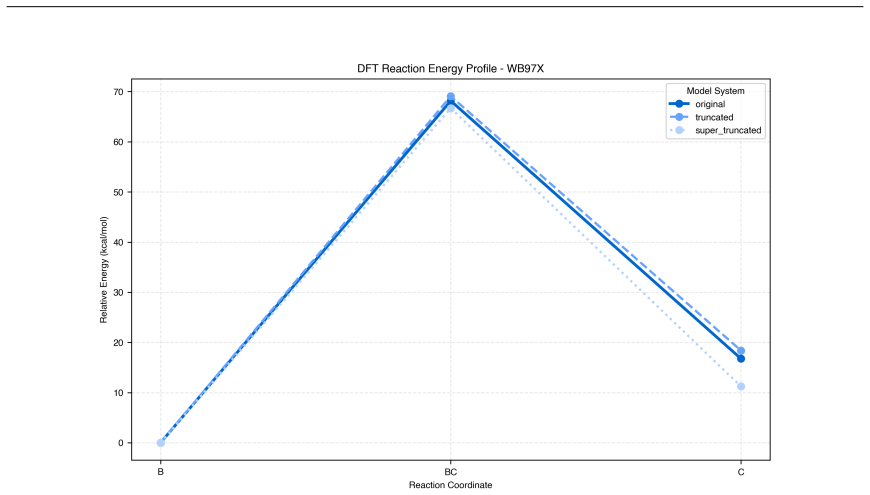
The load-bearing premise is that trimming the catalyst from 77 atoms to 41 atoms leaves the reaction barrier essentially unchanged; the paper checks this only with minimal-basis DFT across four functionals, a level of theory that is not reliable for transition-metal spin-state energetics.
Editorial extensions
If this is right
- QC-AFQMC post-processing moves from hours to minutes per imaginary-time step, turning the method from a theoretical proposal into a practical option for strongly correlated organometallic systems.
- With ideally sampled matchgates, the oxidative-addition barrier of the nickel complex matches CCSD(T) within the $\pm4$ kcal/mol statistical window, supporting VQE/upCCD trial states as sufficient for this class of catalysts.
- Because the AFQMC energy is a ratio of overlaps, hardware noise cancels to leading order: the QPU result stays within 10 kcal/mol of the reference even when the measured trial-state particle number is off by more than two electrons.
- Application-specific tuning of the quantum control stack, caching common waveforms and pipelining single-shot circuits, delivers a $9\times$ throughput gain that shrinks the measurement stage to a small fraction of the total time to solution.
- For a fixed active space the post-processing cost scales linearly with the basis-set size, so basis-set convergence studies at the same 16-qubit trial-state cost are within reach.
Reading between the lines
- My read: the $\pm4$ kcal/mol chemistry claim inherits a validation gap — the 77-to-41 atom truncation was checked only at the STO-3G level, where the functionals already scatter by several kcal/mol — so a larger-basis truncation test is the cheapest experiment that could break or confirm the chemical headline.
- My read: the $656\times$ speedup combines an algorithmic change, a GPU-versus-CPU hardware change, and a different problem size, so it is an engineering speedup rather than a pure algorithm benchmark; a same-machine rerun of the enumeration-based algorithm would separate the two contributions.
- My read: the noisy-hardware barrier flips the relative ordering of reactant and product, so the natural next milestone is showing that error-mitigated shadows, for instance post-selecting on particle number near 8, restore the CCSD(T) ordering on the QPU.
- My read: because the workflow cleanly separates the quantum measurement stage from the classical propagation stage, the same pipeline should transfer to other trial-state ansätze and newer processors without redesign.
Editorial analysis
A structured set of objections, weighed in public.
Referee Report
Summary. The manuscript reports an end-to-end implementation of quantum-classical auxiliary-field quantum Monte Carlo (QC-AFQMC) with matchgate shadow tomography, executed on the IonQ Forte trapped-ion QPU (24 qubits: 16 trial-state qubits plus 8 ancillas) and NVIDIA GPU clusters on AWS. The demonstration system is the oxidative addition step of a nickel-catalyzed Suzuki-Miyaura reaction, modeled via a 77-to-41-atom truncation and an (8,8) active space. The paper claims algorithmic improvements in force-bias and local-energy evaluation through algorithmic differentiation, a 9x QPU throughput speedup, and a 656x post-processing time-to-solution speedup over a projected baseline from Huang et al. (2024). Ideal-simulator matchgate shadows give barriers of 57(4) and 44(4) kcal/mol versus CCSD(T) references of 53.3 and 45.4 kcal/mol, while QPU shadows give 43(3) and 55(3) kcal/mol and invert the B/C ordering, a qualitative failure the paper acknowledges.
Significance. If the central claims hold, this is a substantial demonstration for near-term quantum chemistry: it is the largest QC-AFQMC-with-matchgate-shadows experiment to date, it reduces the asymptotic post-processing cost, and it validates the shadow-based overlap protocol on real quantum hardware. The paper is unusually transparent in reporting timings, containerized reproducibility, and explicit limitations of the QPU results. The main concern is that the chemical relevance of the demonstration rests on a molecular truncation validated only at DFT/STO-3G level, where the paper's own supplementary data show a truncation shift exceeding the claimed uncertainty interval.
major comments (3)
- [Section III.B and Supplementary Table VIII] The manuscript states that energetic differences across truncation levels 'were on the order of the expected statistical error margins of AFQMC (~1-2 kcal/mol).' Supplementary Table VIII directly contradicts this for M06-2X/STO-3G: the C-B relative energy changes from -0.83 kcal/mol in the 77-atom model to +4.37 kcal/mol in the 41-atom model, a 5.20 kcal/mol shift; this corresponds to a shift of about 6 kcal/mol in the C-to-[B-C]‡ barrier (58.91 to 52.86 kcal/mol). PBE0/STO-3G shifts the C-to-[B-C]‡ barrier by about 3.2 kcal/mol (44.46 to 47.71 kcal/mol). These changes exceed the claimed +-4 kcal/mol uncertainty and also exceed the 1-2 kcal/mol figure stated in the text. Because the central accuracy claim is demonstrated on the 41-atom model, a truncation error of this size can dominate the agreement with CCSD(T) and is not covered by the AFQMC sampling error bars. The STO-3G basis is not a reliable probe of transition-metal spin-state energetics, so this validation is insufficient to support extrapolation to the full chemical system.
- [Section IV.C.2 and Table VII] The claimed '656x time-to-solution improvement over the prior state-of-the-art' is not a directly measured speedup. It is obtained by extrapolating Huang et al.'s 4-qubit H2 timings to 16 qubits using an assumed O(N_q^8) scaling, then further applying a 50x GPU-over-CPU factor and ignoring VCE in the lower-end estimate. These projections are not validated against the same code, the same system, or the same hardware. The paper should either provide a direct benchmark of the prior implementation on the same GPU cluster or clearly label the abstract's speedup claim as an extrapolated estimate rather than a measured time-to-solution improvement.
- [Section IV.B and Table III] The uncertainty interval quoted for the ideal-simulator result, +-4 kcal/mol, is only the AFQMC statistical reblocking error. It does not include systematic errors from the upCCD trial-state approximation, the (8,8) active-space choice, or the molecular truncation. The truncation analysis in Section III.B shows that such systematic errors can exceed 5 kcal/mol for one of the four tested functionals. The paper should state explicitly that the +-4 kcal/mol interval is a statistical sampling uncertainty, not a total error bar, and should discuss the systematic contributions that can affect the comparison with CCSD(T).
minor comments (5)
- [Abstract and Table III] The abstract says QPU results are 'within 10 kcal/mol' of the reference, but the B-to-[B-C]‡ barrier differs from CCSD(T) by 10.3 kcal/mol (43(3) versus 53.3 kcal/mol). This should be rephrased as 'approximately 10 kcal/mol' or the threshold should be stated as 11 kcal/mol.
- [Section IV.B and Figure 5] The outlier-removal procedure discards blocks at least 200 mHartree above or below adjacent points, and spikes of almost 2 Hartree are attributed to numerical errors in VCE. The manuscript should report how many blocks were removed per molecule and whether the final energies are stable under reasonable changes to the 200 mHartree threshold.
- [Section II.E] There is a typo in 'overalp' (should be 'overlap'). Also, the section numbering 'Section III E 0 b' in Section IV.A should be cleaned up.
- [Table VII] The row 'Baseline: 4 qubits, (2,2) space, 160,000 shadows' has value 60 with no explicit unit in the table; the surrounding text states it is seconds, but the table should be self-contained. The mixing of total time and per-shadow time in the same column makes the comparison difficult to follow.
- [Section III.C] The paper selects the (8,8) active space from a hierarchy of candidate spaces but does not test the sensitivity of the final QC-AFQMC barrier to this choice. A short test with the (6,6) or (12e,11o) spaces would strengthen the claim that the barrier is robust within the reported uncertainty.
Circularity Check
No circularity: AFQMC barriers are independently benchmarked against CCSD(T); truncation-validation gap is a correctness concern, not circularity.
full rationale
None of the paper's central results reduces to its inputs by construction. The QC-AFQMC reaction barriers (Table III) are obtained by imaginary-time projection with a VQE/upCCD trial state whose parameters are optimized against the variational energy for each molecule, not against the target barrier or against the CCSD(T) reference; the CCSD(T) values in Table II are an independent external benchmark, so the reported ±4 kcal/mol agreement is an empirical result rather than a fitted identity. The active space is selected via DMRG single-orbital entropy, a criterion independent of the barrier. The 656× post-processing speedup is computed against the published and projected baseline of Huang et al. (Ref. [41]); although Ref. [41] shares an author with the present work, the baseline numbers are externally stated and the current timings are measured, so the comparison is not a self-citation chain that dictates the outcome. Self-citations such as Ref. [68] for the upCCD ansatz are not load-bearing for the accuracy claim. One non-circular correctness concern should be flagged: the truncation validation in Section III B states that energetic differences in Supplementary Table VIII 'were on the order of the expected statistical error margins of AFQMC (~1–2 kcal/mol)', but the M06-2X/STO-3G relative energy of C vs B shifts from −0.83 kcal/mol (77 atoms) to +4.37 kcal/mol (41 atoms), a 5.20 kcal/mol change that exceeds the claimed ±4 kcal/mol barrier uncertainty. This is a validation-quality issue — STO-3G is a weak probe for nickel spin-state energetics — and a legitimate threat to the chemical conclusion, but it is an accuracy/robustness problem, not an input-output equivalence. The 10 kcal/mol QPU deviation is reported honestly as a hardware-noise limitation, again supporting the absence of a circular 'prediction equals fit' structure.
Assumptions & free parameters
free parameters (3)
- upCCD variational parameters =
Optimized on ideal simulator with COBYLA
- Active space entropy threshold =
S > 0.2 (chosen by hand)
- Outlier removal threshold =
200 mHartree
assumptions (5)
- domain assumption The phaseless approximation in AFQMC introduces a bias proportional to the trial state's deviation from the true ground state, and this bias is small for the used trial states.
- domain assumption The (8,8) active space plus virtual correlation energy captures the electron correlation relevant to the reaction barrier.
- domain assumption The truncated 41-atom model preserves the reaction barrier of the 77-atom system.
- standard math Matchgate shadow theory (Wan et al.) and the Pfaffian-based overlap evaluation are correct and efficient as used.
- domain assumption CCSD(T) is a reliable reference for this mononuclear nickel complex.
Cite this review
Pith. "Pith review of Quantum-Classical Auxiliary Field Quantum Monte Carlo with Matchgate Shadows on Trapped Ion Quantum Computers." pith.science (2026). https://pith.science/paper/BB7E2PIV
@misc{pith2026250622408,
  author       = {Pith},
  title        = {Pith review of: Quantum-Classical Auxiliary Field Quantum Monte Carlo with Matchgate Shadows on Trapped Ion Quantum Computers},
  year         = {2026},
  howpublished = {\url{https://pith.science/paper/BB7E2PIV}},
  note         = {Machine review of arXiv:2506.22408}
}
abstract
We demonstrate an end-to-end workflow to model chemical reaction barriers with the quantum-classical auxiliary field quantum Monte Carlo (QC-AFQMC) algorithm with quantum tomography using matchgate shadows. The workflow operates within an accelerated quantum supercomputing environment with the IonQ Forte quantum computer and NVIDIA GPUs on Amazon Web Services. We present several algorithmic innovations and an efficient GPU-accelerated execution, which achieves a several orders of magnitude speedup over the state-of-the-art implementation of QC-AFQMC. We apply the algorithm to simulate the oxidative addition step of the nickel-catalyzed Suzuki-Miyaura reaction using 24 qubits of IonQ Forte with 16 qubits used to represent the trial state, plus 8 additional ancilla qubits for error mitigation, resulting in the largest QC-AFQMC with matchgate shadow experiments ever performed on quantum hardware. We achieve a $9\times$ speedup in collecting matchgate circuit measurements, and our distributed-parallel post-processing implementation attains a $656\times$ time-to-solution improvement over the prior state-of-the-art. Chemical reaction barriers for the model reaction evaluated with active-space QC-AFQMC are within the uncertainty interval of $\pm4$ kcal/mol from the reference CCSD(T) result when matchgates are sampled on the ideal simulator and within 10 kcal/mol from reference when measured on QPU. This work marks a step towards practical quantum chemistry simulations on quantum devices while identifying several opportunities for further development.
Figures


Figures from the paper (11 more)




Forward citations
Cited by 3 Pith papers
-
Performance Model for Hybrid Quantum-Classical Workflows
A two-level runtime model decomposes hybrid quantum-classical cycles into quantum, classical, and communication time, allowing a communication-to-computation ratio to classify workflows as compute- or communication-bound.
-
AEGISS -- Atomic orbital and Entropy-based Guided Inference for Space Selection -- A novel semi-automated active space selection workflow for quantum chemistry and quantum computing applications
AEGISS combines DMRG single-orbital entropy screening with per-cluster atomic-orbital projections to semi-automatically construct compact active spaces, demonstrated on five molecular benchmarks.
-
Coupled Cluster Downfolding Theory in Simulations of Chemical Systems on Quantum Hardware
A coupled-cluster downfolding pipeline (QRDR) computes effective Hamiltonians in small active spaces and solves them with quantum algorithms, recovering about 98% of CCSD(T) correlation energy for benzene and free-bas...
Reference graph
Works this paper leans on
-
[1]
Quantum processing time In the course of collecting matchgate shadow measurements on Forte QPU, we exe- cuted 300,983 circuits in total, including a number of trial runs and results that were later discarded in error mitigation post-selection. Those circuits were executed over a period of 35 0 100 200 300 400 500 600 700 800 900 Execution timeline, hrs 0 ...
-
[2]
We executed the post-processing workload on AWS ParallelCluster equipped with NVIDIA H100 and H200 GPUs
HPC post-processing time The second key contributor to the time to solution of QC-AFQMC is the classical post- processing step, which converts matchgate measurements to QC-AFQMC energies. We executed the post-processing workload on AWS ParallelCluster equipped with NVIDIA H100 and H200 GPUs. Because of difficulties obtaining a large allocation of GPU-enab...
-
[3]
V . K. Mulligan, H. Melo, H. I. Merritt, S. Slocum, B. D. Weitzner, A. M. Watkins, P. D. Ren- frew, C. Pelissier, P. S. Arora, and R. Bonneau. Designing peptides on a quantum computer. bioRxiv, 2019
2019
-
[4]
Robert, P
A. Robert, P. K. Barkoutsos, S. Woerner, and I. Tavernelli. Resource-efficient quantum algorithm for protein folding. npj Quantum Information, 7:38, 2021
2021
-
[5]
Fingerhuth, T
M. Fingerhuth, T. Babej, and C. Ing. A quantum alternating operator ansatz with hard and soft constraints for lattice protein folding, 2018
2018
-
[6]
A. M. Smaldone and V . S. Batista. Quantum-to-classical neural network transfer learn- ing applied to drug toxicity prediction. Journal of Chemical Theory and Computation , 20(11):4901–4908, 2024. PMID: 38795030
2024
-
[7]
Mensa, E
S. Mensa, E. Sahin, F. Tacchino, P. K. Barkoutsos, and I. Tavernelli. Quantum machine learning framework for virtual screening in drug discovery: a prospective quantum advan- tage. Machine Learning: Science and Technology , 4(1):015023, feb 2023
2023
-
[8]
Allcock, A
J. Allcock, A. Vangone, A. Meyder, S. Adaszewski, M. Strahm, C.-Y . Hsieh, and S. Zhang. The prospects of monte carlo antibody loop modelling on a fault-tolerant quantum computer. Frontiers in Drug Discovery, V olume 2 - 2022, 2022
2022
Show all 119 references
-
[9]
F. M. Weidner, J. D. Schwab, S. Wölk, F. Rupprecht, N. Ikonomi, S. D. Werle, S. Hoffmann, M. Kühl, and H. A. Kestler. Leveraging quantum computing for dynamic analyses of logical networks in systems biology. Patterns, 4(3):100705, 2023
2023
-
[10]
Kovyrshin, L
A. Kovyrshin, L. Tornberg, J. Crain, S. Mensa, I. Tavernelli, and A. Broo. Prioritizing quan- tum computing use cases in the drug discovery and development pipeline. Drug Discovery Today, 30(3):104323, 2025
2025
-
[11]
Boström, D
J. Boström, D. G. Brown, R. J. Young, and G. M. Keserü. Expanding the medicinal chem- istry synthetic toolbox. Nat. Rev. Drug Discov., 17(10):709–727, 2018. 45
2018
-
[12]
R. G. Parr and W. Yang. Density-Functional Theory of Atoms and Molecules . Oxford University Press, New York, 1989
1989
-
[13]
J. N. Harvey. Spin-forbidden reactions: computational insight into mechanisms and kinetics. WIREs Computational Molecular Science , 4(1):1–14, 2014
2014
-
[14]
M. Reiher. A Theoretical Challenge: Transition-Metal Compounds. CHIMIA, 63(3):140– 145, 2009
2009
-
[15]
Raghavachari, G
K. Raghavachari, G. W. Trucks, J. A. Pople, and M. Head-Gordon. A Fifth-Order Perturba- tion Comparison of Electron Correlation Theories. Chem. Phys. Lett., 157:479–483, 1989
1989
-
[16]
Rado ´n, G
M. Rado ´n, G. Drabik, M. Hodorowicz, and J. Szklarzewicz. Performance of quantum chem- istry methods for a benchmark set of spin-state energetics derived from experimental data of 17 transition metal complexes (SSE17). Chem. Sci., 15:20189–20204, 2024
2024
-
[17]
B. O. Roos, P. R. Taylor, and P. E. M. Siegbahn. A Complete Active Space SCF Method (CASSCF) using a Density Matrix Formulated Super-CI Approach. Chem. Phys., 48:157– 173, 1980
1980
-
[18]
S. R. White. Density matrix formulation for quantum renormalization groups. Phys. Rev. Lett., 69:2863–2866, 1992
1992
-
[19]
H. Zhai, H. R. Larsson, S. Lee, Z.-H. Cui, T. Zhu, C. Sun, L. Peng, R. Peng, K. Liao, J. Tölle, J. Yang, S. Li, and G. K.-L. Chan. Block2: A Comprehensive Open Source Framework to Develop and Apply State-of-the-art DMRG Algorithms in Electronic Structure and Beyond. J. Chem. P...
2023
-
[20]
K. H. Marti, I. M. Ondík, G. Moritz, and M. Reiher. Density matrix renormalization group calculations on relative energies of transition metal complexes and clusters. The Journal of Chemical Physics, 128(1):014104, 2008
2008
-
[21]
G. K.-L. Chan and S. Sharma. The density matrix renormalization group in quantum chem- istry. Annual Review of Physical Chemistry , 62(V olume 62, 2011):465–481, 2011
2011
-
[22]
Menczer, M
A. Menczer, M. van Damme, A. Rask, L. Huntington, J. Hammond, S. S. Xantheas, 46 M. Ganahl, and Ö. Legeza. Parallel implementation of the density matrix renormalization group method achieving a quarter petaflops performance on a single DGX-H100 GPU node. Journal of Chemical Th...
2024
-
[23]
Menczer, Ádám Ganyecz, M
Örs Legeza, A. Menczer, Ádám Ganyecz, M. A. Werner, K. Kapás, J. Hammond, S. S. Xantheas, M. Ganahl, and F. Neese. Orbital optimization of large active spaces via AI- accelerators. arXiv, 2503.20700, 2025
2025 arXiv
-
[24]
Xiang, W
C. Xiang, W. Jia, W.-H. Fang, and Z. Li. Distributed multi-gpu ab initio density matrix renormalization group algorithm with applications to the p-cluster of nitrogenase. Journal of Chemical Theory and Computation , 20(2):775–786, 2024
2024
-
[25]
H. Liu, G. H. Low, D. S. Steiger, T. Häner, M. Reiher, and M. Troyer. Prospects of quan- tum computing for molecular sciences. Journal of Materials Science: Materials Theory , 6(11):1–10, 2022
2022
-
[26]
Aspuru-Guzik, A
A. Aspuru-Guzik, A. D. Dutoi, P. J. Love, and M. Head-Gordon. Simulated Quantum Com- putation of Molecular Energies. Science, 309:1704–1707, 2005
2005
-
[27]
B. P. Lanyon, J. D. Whitfield, G. G. Gillett, M. E. Goggin, M. P. Almeida, I. Kassal, J. D. Biamonte, M. Mohseni, B. J. Powell, M. Barbieri, A. Aspuru-Guzik, and A. G. White. Towards Quantum Chemistry on a Quantum Computer. Nat. Chem., 2:106–111, 2010
2010
-
[28]
G. H. Low and I. L. Chuang. Hamiltonian Simulation by Qubitization. Quantum, 3:163, 2019
2019
-
[29]
Babbush, C
R. Babbush, C. Gidney, D. W. Berry, N. Wiebe, J. McClean, A. Paler, A. Fowler, and H. Neven. Encoding Electronic Spectra in Quantum Circuits with Linear T Complexity. Phys. Rev. X, 8:041015, 2018
2018
-
[30]
J. Lee, D. W. Berry, C. Gidney, W. J. Huggins, J. R. McClean, N. Wiebe, and R. Babbush. Even More Efficient Quantum Computations of Chemistry Through Tensor Hypercontrac- tion. PRX Quantum, 2:030305, 2021
2021
-
[31]
Peruzzo, J
A. Peruzzo, J. McClean, P. Shadbolt, M.-H. Yung, X.-Q. Zhou, P. J. Love, A. Aspuru-Guzik, 47 and J. O’Brien. A Variational Eigenvalue Solver on a Photonic Quantum Processor. Nat. Commun., 5:5213, 2014
2014
-
[32]
P. J. J. O’Malley, R. Babbush, I. D. Kivlichan, J. Romero, J. R. McClean, and et al. Scalable Quantum Simulation of Molecular Energies. Phys. Rev. X, 6:031007, 2016
2016
-
[33]
Kandala, A
A. Kandala, A. Mezzacapo, K. Temme, M. Takita, M. Brink, J. M. Chow, and J. M. Gam- betta. Hardware-Efficient Variational Quantum Eigensolver for Small Molecules and Quan- tum Magnets. Nature, 549:242–246, 2017
2017
-
[34]
Hartree-Fock on a Superconducting Qubit Quantum Computer
Google AI Quantum and Collaborators. Hartree-Fock on a Superconducting Qubit Quantum Computer. Science, 369:1084–1089, 2020
2020
-
[35]
Nam, J.-S
Y . Nam, J.-S. Chen, N. C. Pisenti, K. Wright, C. Delaney, D. Maslov, K. R. Brown, S. Allen, J. M. Amini, J. Apisdorf, K. M. Beck, A. Blinov, V . Chaplin, M. Chmielewski, C. Collins, S. Debnath, K. M. Hudek, A. M. Ducore, M. Keesan, S. M. Kreikemeier, J. Mizrahi, P. Solomon, M...
2020
-
[36]
J. F. Gonthier, M. D. Radin, C. Buda, E. J. Doskocil, C. M. Abuan, and J. Romero. Mea- surements as a roadblock to near-term practical quantum advantage in chemistry: Resource analysis. Physical review research, (3), 26 Aug. 2022
2022
-
[37]
W. J. Huggins, B. A. O’Gorman, N. C. Rubin, D. R. Reichman, R. Babbush, and J. Lee. Unbiasing Fermionic Quantum Monte Carlo with a Quantum Computer. Nature, 603:416– 420, 2022
2022
-
[38]
Zhang, J
S. Zhang, J. Carlson, and J. E. Gubernatis. Constrained Path Monte Carlo Method for Fermion Ground States. Phys. Rev. B, 55:7464, 1997
1997
-
[39]
Zhang and H
S. Zhang and H. Krakauer. Quantum Monte Carlo Method using Phase-Free Random Walks with Slater Determinants. Phys. Rev. Lett., 90:136401, 2003
2003
-
[40]
Motta and S
M. Motta and S. Zhang. Ab Initio Computations of Molecular Systems by the Auxiliary- 48 Field Quantum Monte Carlo Method. Wiley Interdiscip. Rev. Comput. Mol. Sci. , 8:e1364, 2018
2018
-
[41]
J. Lee, H. Q. Pham, and D. R. Reichman. Twenty Years of Auxiliary-Field Quantum Monte Carlo in Quantum Chemistry: An Overview and Assessment on Main Group Chemistry and Bond-Breaking. J. Chem. Theory Comput., 18:7024–7042, 2022
2022
-
[42]
J. Shee, J. L. Weber, D. R. Reichman, R. A. Friesner, and S. Zhang. On the Potentially Transformative Role of Auxiliary-Field Quantum Monte Carlo in Quantum Chemistry: A Highly Accurate Method for Transition Metals and Beyond. J. Chem. Phys. , 158:140901, 2023
2023
-
[43]
Huang, Y .-T
B. Huang, Y .-T. Chen, B. Gupt, M. Suchara, A. Tran, S. McArdle, and G. Galli. Evaluating a Quantum-Classical Quantum Monte Carlo Algorithm with Matchgate Shadows. Phys. Rev. Research, 6:043063, 2024
2024
-
[44]
Mazzola and G
G. Mazzola and G. Carleo. Exponential Challenges in Unbiasing Quantum Monte Carlo Algorithms with Quantum Computers. arXiv [quant-ph], 2022
2022
-
[45]
Amsler, P
M. Amsler, P. Deglmann, M. Degroote, M. P. Kaicher, M. Kiser, M. Kühn, C. Kumar, A. Maier, G. Samsonidze, A. Schroeder, M. Streif, D. V odola, and C. Wever. Quantum- Enhanced Quantum Monte Carlo: An Industrial View. arXiv [quant-ph], 2023
2023
-
[46]
Kiser, A
M. Kiser, A. Schroeder, G.-L. R. Anselmetti, C. Kumar, N. Moll, M. Streif, and D. V odola. Classical and Quantum Cost of Measurement Strategies for Quantum-Enhanced Auxiliary Field Quantum Monte Carlo. New J. Phys., 26:033022, 2024
2024
-
[47]
Jiang, B
T. Jiang, B. O’Gorman, A. Mahajan, and J. Lee. Unbiasing Fermionic Auxiliary-Field Quantum Monte Carlo with Matrix Product State Trial Wavefunctions.Phys. Rev. Research, 7:013038, 2025
2025
-
[48]
Amazon braket: a fully managed quantum computing service provided by aws, 2019
Braket contributors. Amazon braket: a fully managed quantum computing service provided by aws, 2019
2019
-
[49]
L. Guo, W. Srimontree, C. Zhu, B. Maity, X. Liu, L. Cavallo, and M. Rueping. Nickel- 49 Catalyzed Suzuki-Miyaura Cross-Couplings of Aldehydes. Nat. Commun., 10:1957, 2019
1957
-
[50]
W. M. C. Foulkes, L. Mitas, R. J. Needs, and G. Rajagopal. Quantum Monte Carlo Simula- tions of Solid. Rev. Mod. Phys., 73:33–83, 2001
2001
-
[51]
P. R. C. Kent, A. Annaberdiyev, A. Benali, M. C. Bennet, E. J. L. Borda, P. Doak, and et al. QMCPACK: Advances in the Development, Efficiency, and Application of Auxiliary Field and Real-Space Variational and Diffusion Quantum Monte Carlo. J. Chem. Phys. , 152:174105, 2020
2020
-
[52]
C. J. Umrigar. Observations on Variational and Projector Monte Carlo Methods. J. Chem. Phys., 143:164105, 2015
2015
-
[53]
L. R. Schwartz, A. Alavi, and G. H. Booth. Projector Quantum Monte Carlo Method for Nonlinear Wave Functions. Phys. Rev. Lett., 118:176403, 2017
2017
-
[54]
Malone, A
F. Malone, A. Mahajan, J. Spencer, and J. Lee. Ipie: A Python-Based Auxiliary-Field Quantum Monte Carlo Program with Flexibility and Efficiency on CPUs and GPUs. J. Chem. Theory Comput., 2022
2022
-
[55]
S. Zhang. Ab Initio Electronic Structure Calculations by Auxiliary-Field Quantum Monte Carlo. arXiv [cond-mat.str-el], 2018
2018
-
[56]
Stratonovich
R. Stratonovich. On a Method of Calculating Quantum Distrubuition Functions. Soviet Physics Doklady, 2:416, 1957
1957
-
[57]
J. Hubbard. Calculation of Partition Functions. Phys. Rev. Lett., 3:77, 1959
1959
-
[58]
S. Zhang. Auxiliary-Field Quantum Monte Carlo for Correlated Electron Systems, in Emer- gent Phenomena in Correlated Matter , Lecture Notes of the Autumn School Correlated Elec- trons, chapter 15. Forschungszentrum Jülich, 2013
2013
-
[59]
Motta and S
M. Motta and S. Zhang. Ab Initio Computations of Molecular Systems by the Auxiliary- Field Quantum Monte Carlo Method. Wiley Interdiscip. Rev. Comput. Mol. Sci. , page 8:e1364, 2018
2018
-
[60]
Mahajan, J
A. Mahajan, J. Lee, and S. Sharma. Selected Configuration Interaction Wave Functions in 50 Phaseless Auxiliary Field Quantum Monte Carlo. J. Chem. Phys., 156:174111, 2022
2022
-
[61]
Mahajan and S
A. Mahajan and S. Sharma. Taming the Sign Problem in Auxiliary-Field Quantum Monte Carlo Using Accurate Wave Functions. J. Chem. Theory Comput., 17:4786–4798, 2021
2021
- [62]
-
[63]
Gu, H.-Y
A. Gu, H.-Y . Hu, D. Luo, T. L. Patti, N. C. Rubin, and S. F. Yelin. Zero and Finite Temper- ature Quantum Simulations Powered by Quantum Magic. Quantum, 8:1422, 2024
2024
-
[64]
I. O. Sokolov, P. K. Barkoutsos, P. J. Ollitrault, D. Greenberg, J. Rice, M. Pistoia, and I. Tavernelli. Quantum Orbital-Optimized Unitary Coupled Cluster Methods in the Strongly Correlated Regime: Can Quantum Algorithms Outperform Their Classical Equivalents? J. Chem. Phys., ...
2020
-
[65]
I. Khan, M. Tudorovskaya, J. Kirsopp, D. M. Ramo, P. Warrier, D. Papanastasiou, and R. Singh. Chemically Aware Unitary Coupled Cluster with ab initio Calculations on System Model H1: A Refrigerant Chemicals Application. J. Chem. Phys., 158:214114, 2023
2023
-
[66]
Huang, R
H.-Y . Huang, R. Kueng, and J. Preskill. Predicting Many Properties of a Quantum System from Very Few Measurements. Nat. Phys., 16:1050–1057, 2020
2020
-
[67]
Huang, R
H.-Y . Huang, R. Kueng, G. Torlai, V . V . Albert, and J. Preskill. Provably Efficient Machine Learning for Quantum Many-Body Problems. Science, 377, 1397
-
[68]
K. Wan, W. J. Huggins, J. Lee, and R. Babbush. Matchgate Shadows for Fermionic Quantum Simulation. Commun. Math. Phys., pages 629–700, 2023
2023
-
[69]
M. Wimmer. Efficient Numerical Computation of the Pfaffian for Dense and Banded Skew- Symmetric Matrices. ACM Trans. Math. Softw., 38:1–17, 2012
2012
-
[70]
L. Zhao, J. Goings, K. Wright, J. Nguyen, J. Kim, S. Johri, K. Shin, W. Kyoung, J. I. Fuks, J.-K. K. Rhee, and Y . M. Rhee. Orbital-Optimized Pair-Correlated Electron Simulations on Trapped-Ion Quantum Computers. npj Quantum Inf., 9(60), 2023
2023
-
[71]
Q. Sun, X. Zhang, S. Banerjee, P. Bao, M. Barbry, N. S. Blunt, N. A. Bogdanov, G. H. Booth, 51 J. Chen, Z.-H. Cui, J. J. Eriksen, Y . Gao, S. Guo, J. Hermann, M. R. Hermes, K. Koh, P. Ko- val, S. Lehtola, Z. Li, J. Liu, N. Mardirossian, J. D. McClain, M. Motta, B. Mussard, H. ...
2020
-
[72]
Lehtola, C
S. Lehtola, C. Steigemann, M. J. T. Oliveira, and M. A. L. Marques. Recent Developments in Libxc — A Comprehensive Library of Functionals for Density Functional Theory. Soft- wareX, 7:1–5, 2018
2018
-
[73]
Active Space Finder (ASF)
HQS Quantum Simulations. Active Space Finder (ASF)
-
[74]
Jiang, M
T. Jiang, M. K. A. Baumgarten, P.-F. Loos, A. Mahajan, A. Scemama, S. F. Ung, J. Zhang, F. D. Malone, and J. Lee. Improved Modularity and New Features in ipie: Toward even Larger AFQMC Calculations on CPUs and GPUs at Zero and Finite Temperatures.J. Chem. Phys., 161:162502, 2024
2024
-
[75]
A. Zhao. Symmetry-Adjusted-Classical-Shadows: Classical Shadows Codes for Quantum Simulations of Fermions and Qubits, with Error-Mitigation Routines for Systems with Sym- metries
-
[76]
A. Zhao, N. C. Rubin, and A. Miyake. Fermionic Partial Tomography via Classical Shad- ows. Phys. Rev. Lett., 127:110504, 2021
2021
-
[77]
Zhao and A
A. Zhao and A. Miyake. Group-Theoretic Error Mitigation Enabled by Classical Shadows and Symmetries. Npj Quantum Inf., 10:57, 2024
2024
-
[78]
S. A. Macgregor and O. Eisenstein, editors. Computational studies in organometallic chem- istry. Structure and Bonding. Springer International Publishing, Cham, Switzerland, 1 edi- tion, 2016
2016
-
[79]
Chai and M
J.-D. Chai and M. Head-Gordon. Systematic Optimization of Long-Range Corrected Hybrid 52 Density Functionals. J. Chem. Phys., 128:084106, 2008
2008
-
[80]
S. H. V osko, L. Wilk, and M. Nusair. Accurate Spin-Dependent Electron Liquid Correlation Energies for Local Spin Density Calculations: A Critical Analysis. Can. J. Phys., 58:1200– 1211, 1980
1980
-
[81]
C. Lee, W. Yang, and R. G. Parr. Development of the Colle-Salvetti Correlation-Energy Formula into a Functional of the Electron Density. Phys. Rev. B Condens. Matter , 37:785– 789, 1988
1988
-
[82]
A. D. Becke. Density-Functional Thermochemistry. III. The Role of Exact Exchange. J. Chem. Phys., 98:5648–5652, 1993
1993
-
[83]
P. J. Stephens, F. J. Devlin, C. S. Ashvar, C. F. Chabalowski, and M. J. Frisch. Theoreti- cal Calculation of Vibrational Circular Dichroism Spectra. Faraday Discuss., 99:103–119, 1994
1994
-
[84]
J. P. Perdew, K. Burke, and M. Ernzerhof. Generalized Gradient Approximation Made Simple. Phys. Rev. Lett., 77:3865–3868, 1996
1996
-
[85]
Ernzerhof and G
M. Ernzerhof and G. E. Scuseria. Assessment of the Perdew-Burke-Ernzerhof Exchange- Correlation Functional. J. Chem. Phys., 110:5029–5036, 1999
1999
-
[86]
Adamo and V
C. Adamo and V . Barone. Toward Reliable Density Functional Methods without Adjustable Parameters: The PBE0 Model. J. Chem. Phys., 110:6158–6170, 1999
1999
-
[87]
Zhao and D
Y . Zhao and D. G. Truhlar. The M06 Suite of Density Functionals for Main Group Thermo- chemistry, Thermochemical Kinetics, Noncovalent Interactions, Excited States, and Transi- tion Elements: Two New Functionals and Systematic Testing of Four M06-Class Functionals and 12 othe...
2008
-
[88]
W. J. Pietro and W. J. Hehre. Molecular Orbital Theory of the Properties of Inorganic and Organometallic Compounds. 3. STO-3G Basis Sets for First- and Second-Row Transition Metals. J. Comput. Chem., 4:241–251, 1983
1983
-
[89]
W. J. Pietro, E. S. Blurock, R. F. Hout Jr., W. J. Hehre, D. J. DeFrees, and R. F. Stewart. 53 Molecular Orbital Theory of the Properties of Inorganic and Organometallic Compounds. 2. STO-NG Basis Sets for Fourth-Row Main-Group Elements. Inorg. Chem., 20:3650–3654, 1981
1981
-
[90]
W. J. Pietro, B. A. Levi, W. J. Hehre, and R. F. Stewart. Molecular Orbital Theory of the Properties of Inorganic and Organometallic Compounds. 1. STO-NG Basis Sets for Third- Row Main-Group Elements. Inorg. Chem., 19:2225–2229, 1980
1980
-
[91]
W. J. Hehre, R. F. Stewart, and J. A. Pople. Self-Consistent Molecular-Orbital Methods. I. Use of Gaussian Expansions of Slater-Type Atomic Orbitals.J. Chem. Phys., 51:2657–2664, 1969
1969
-
[92]
W. J. Hehre, R. Ditchfield, and J. A. Pople. Self-Consistent Molecular Orbital Methods. XII. Further Extensions of Gaussian-Type Basis Sets for Use in Molecular Orbital Studies of Organic Molecules. J. Chem. Phys., 56:2257–2261, 1972
1972
-
[93]
C. J. Stein and M. Reiher. Automated Selection of Active Orbital Spaces. J. Chem. Theory Comput., 12(4):1760–1771, 2016
2016
-
[94]
C. J. Stein and M. Reiher. AUTOCAS: A Program for Fully Automated Multi- Configurational Calculations. J. Comput. Chem., 40:2216–2226, 2019
2019
-
[95]
Robledo-Moreno, M
J. Robledo-Moreno, M. Motta, H. Haas, A. Javadi-Abhari, P. Jurcevic, W. Kirby, S. Martiel, K. Sharma, S. Sharma, T. Shirakawa, I. Sitdikov, R.-Y . Sun, K. J. Sung, M. Takita, M. C. Tran, S. Yunoki, and A. Mezzacapo. Chemistry Beyond Exact Solutions on a Quantum- Centric Superc...
-
[96]
M. R. Hirsbrunner, D. Chamaki, J. W. Mullinax, and N. M. Tubman. Beyond MP2 Initial- ization for Unitary Coupled Cluster Quantum Circuits. Quantum, 8:1538, 2024
2024
-
[97]
NVIDIA. CUDA-Q. https://nvidia.github.io/cuda-quantum/latest/index. html, 2025. Accessed: 2025-06-06
2025
-
[98]
Bayraktar, A
H. Bayraktar, A. Charara, D. Clark, S. Cohen, T. Costa, Y .-L. L. Fang, Y . Gao, J. Guan, J. Gunnels, A. Haidar, A. Hehn, M. Hohnerbach, M. Jones, T. Lubowe, D. Lyakh, S. Morino, 54 P. Springer, S. Stanwyck, I. Terentyev, S. Varadhan, J. Wong, and T. Yamaguchi. cuquan- tum sdk...
2023
-
[99]
NVIDIA. CUDA-QX. https://nvidia.github.io/cudaqx/, 2025. Accessed: 2025- 06-06
2025
-
[100]
J.-S. Chen, E. Nielsen, M. Ebert, V . Inlek, K. Wright, V . Chaplin, A. Maksymov, E. Páez, A. Poudel, P. Maunz, and J. Gamble. Benchmarking a Trapped-Ion Quantum Computer with 30 Qubits. Quantum, 8:1516, 2024
2024
-
[101]
S. Chen, W. Yu, P. Zeng, and S. T. Flammia. Robust shadow estimation. PRX Quantum, 2(3):030348, 2021
2021
-
[102]
D. E. Koh and S. Grewal. Classical shadows with noise. Quantum, 6:776, 2022
2022
-
[103]
Zhao and A
A. Zhao and A. Miyake. Group-theoretic error mitigation enabled by classical shadows and symmetries. npj Quantum Information, 10(1):57, 2024
2024
-
[104]
Brieger, M
R. Brieger, M. Heinrich, I. Roth, and M. Kliesch. Stability of classical shadows under gate- dependent noise. Physical Review Letters, 134(9):090801, 2025
2025
-
[105]
Ozeri, W
R. Ozeri, W. M. Itano, R. Blakestad, J. Britton, J. Chiaverini, J. D. Jost, C. Langer, D. Leibfried, R. Reichle, S. Seidelin, et al. Errors in trapped-ion quantum gates due to spon- taneous photon scattering. Physical Review A—Atomic, Molecular , and Optical Physics , 75(4):04...
2007
-
[106]
Moore, W
I. Moore, W. Campbell, E. Hudson, M. Boguslawski, D. Wineland, and D. Allcock. Photon scattering errors during stimulated raman transitions in trapped-ion qubits. Physical Review A, 107(3):032413, 2023
2023
-
[107]
Stricker, D
R. Stricker, D. V odola, A. Erhard, L. Postler, M. Meth, M. Ringbauer, P. Schindler, T. Monz, M. Müller, and R. Blatt. Experimental deterministic correction of qubit loss. Nature, 585(7824):207–210, Sept. 2020. 55
2020
-
[108]
Flyvberg and H
H. Flyvberg and H. G. Petersen. Error Estimates on Averages of Correlated Data. J. Chem. Phys., 91:461–466, 1989
1989
-
[109]
Zhao and A
A. Zhao and A. Miyake. Group-Theoretic Error Mitigation Enabled by Classical Shadows and Symmetries. npj Quantum Inf., 10:57, 2024
2024
-
[110]
Hayashi, S
H. Hayashi, S. Maeda, and T. Mita. Quantum Chemical Calculations for Reaction Prediction in the Development of Synthetic Methodologies. Chem. Sci., 14:11601–11616, 2023
2023
-
[111]
E. v. Lenthe, E. J. Baerends, and J. G. Snijders. Relativistic regular two-component hamil- tonians. J. Chem. Phys., 99(6):4597–4610, 09 1993
1993
-
[112]
A. Wolf, M. Reiher, and B. A. Hess. The generalized douglas–kroll transformation.J. Chem. Phys., 117(20):9215–9226, 11 2002
2002
-
[113]
M. Dolg. Chapter 14 - relativistic effective core potentials. In P. Schwerdtfeger, editor, Rel- ativistic Electronic Structure Theory , volume 11 of Theoretical and Computational Chem- istry, pages 793–862. Elsevier, 2002. 56 VI. SUPPLEMENTAL INFORMATION A. Matrix Definitions
2002
-
[114]
The W matrix for a N qubit, ζ electron system is W = ξM j=1 1√ 2 1 −i 1 i ⊕ NM j=ξ +1 1 0 0 1 (33)
-
[115]
The covariance matrix is: C|b⟩ = NM j=1 0 (−1)b j −(−1)b j 0 (34)
-
[116]
Bring Your Own Container
For a ζ -electron Slater determinant (walker), it could be written as |φ ⟩ = ˜a† 1 · · ·˜a† ζ |0⟩ , where ˜ a j = N ∑ k=1 Vjkak, (35) in which one could think that ak is the annihilation operator in the HF molecular orbital basis, and V is the orbital rotation matrix. The defi...
-
[117]
Full Model (77 atoms, original complex) Nickel-Complex (B) (77 atoms) 77 Ni 0.01087 -0.65034 -0.82192 P -2.11214 -0.34418 -0.26552 P 1.28203 1.03861 -0.33963 C 1.20132 -1.99109 -1.53283 O -0.03666 -2.40446 -1.42497 C 2.24029 -2.42578 -0.56130 C 3.59793 -2.18194 -0.81437 C 4.20...
-
[118]
Reduced Model (41 atoms) Nickel-Complex (B) (41 atoms) 41 Ni 0.01087 -0.65034 -0.82192 P -2.11214 -0.34418 -0.26552 P 1.28203 1.03861 -0.33963 C 1.20132 -1.99109 -1.53283 O -0.03665 -2.40446 -1.42497 C 2.24029 -2.42578 -0.56130 C 3.59793 -2.18194 -0.81437 C 4.20131 -3.03680 1....
-
[119]
Minimal Model (34 atoms) Nickel-Complex (B) (34 atoms) 34 Ni 0.01087 -0.65034 -0.82192 P -2.11214 -0.34418 -0.26552 P 1.28203 1.03861 -0.33963 C 1.20132 -1.99109 -1.53283 O -0.03665 -2.40446 -1.42497 88 C 2.24029 -2.42578 -0.56130 C 2.49398 1.41965 -1.69188 C 0.55710 2.69169 0...
Reviewed August 6, 2026 · model on record in the stance chip above.
Discussion (0). Continue with ORCID to comment.