REVIEW 4 major objections 6 minor 84 references
PPFL-RDSN: Privacy-Preserving Federated Learning-based Residual Dense Spatial Networks for Encrypted Lossy Image Reconstruction
T0 review · 4 major / 6 minor · reviewed 2026-08-06 · deepseek-v4-flash
Pith's one-line read This paper claims that a federated, privacy-preserving variant of the Residual Dense Spatial Network reconstructs encrypted lossy images with quality matching centralized training, by noising only high-frequency DCT coefficients and…
desk verdict The privacy guarantee is mathematically invalid because Eq. (2) releases the exact low-frequency DCT part; the rest is an incremental FL-plus-watermark system. read the letter →
The pith
A machine-rendered reading of the paper's core claim, the machinery that carries it, and where it could break.
The reading
What carries the argument
The central object is the DCT-domain activation perturbation: for a hidden activation $H$, the client computes $C = T H T^{\top}$, partitions the spectrum by a fixed threshold $\tau$ into low-frequency (structure) and high-frequency (detail) sets, clips $H$ by L2 norm $C_{\mathrm{max}}$, adds Gaussian noise of scale $\sigma = \frac{2C_{\mathrm{max}}\sqrt{2\ln(1.25/\delta)}}{\epsilon}$ to the high-frequency coefficients, and reconstructs the noisy activation as $\tilde{H}=H_L + T^{\top}\operatorname{reshape}(\tilde{f})T$. The orthonormality of $T$ is what makes the L2 sensitivity invariant across the transform, so the Gaussian mechanism's guarantee transfers to the DCT domain. The watermark machinery is a secret-keyed PRF that selects a sparse carrier set $J$ and sign pattern $w$, with a quadratic regularization loss $\frac{\lambda}{|J|}\sum_{j\in J}(\theta_j w_j - \beta)^2$, yielding a test statistic $S = \frac{1}{|J|}\sum_{j\in J}\theta_j w_j$ whose concentration separates watermarked from unmarked models.
What would settle it
Compute or measure the actual sensitivity of the full released activation $\tilde{H}$ with respect to a single training sample, not just the high-frequency projection; or run a membership-inference attack using $H_L$ alone at $\epsilon=2.75$, $\delta=10^{-5}$. If the attack achieves non-trivial advantage, or the true sensitivity exceeds $2C_{\mathrm{max}}$, the mechanism is not $(\epsilon,\delta)$-DP as claimed.
Extended reading notes
Core claim
The paper's central claim is that privacy and integrity can be added to learned lossy-image reconstruction without sacrificing quality, by shifting the problem from protecting whole models to protecting a carefully chosen slice of the computation. For a hidden activation $H$, the client clips it to L2 norm $C_{\mathrm{max}}$, applies an orthonormal 2D DCT, splits the spectrum at a fixed frequency threshold $\tau$, adds Gaussian noise of standard deviation $\sigma = \frac{2C_{\mathrm{max}}\sqrt{2\ln(1.25/\delta)}}{\epsilon}$ to the high-frequency coefficients, and reconstructs the noisy activation $\tilde{H}=H_L + T^{\top}\operatorname{reshape}(\tilde{f})T$ for the remaining forward and backward passes. Because the DCT is an isometry, the paper argues the L2 sensitivity of the noised projection is exactly $2C_{\mathrm{max}}$, so the Gaussian mechanism yields per-round $(\epsilon,\delta)$-local differential privacy, with rounds composed through the moments accountant. In parallel, a secret-keyed PRF picks an identical sparse carrier set $J$ in every client; the clients nudge those coordinates toward a shared secret sign pattern, and the aligned perturbations accumulate in FedAvg so the aggregate score $S = \frac{1}{|J|}\sum_{j\in J} \theta_j w_j$ separates watermarked from unmarked models with the reported probabilities. Empirically, the framework reports PSNR/SSIM statistically indistinguishable from the centralized RDSN and a 6.56% wall-clock saving.
Load-bearing premise
The formal privacy guarantee assumes that releasing the un-noised low-frequency activation $H_L$ leaks nothing about the input; if an adversary can infer private content from those low-frequency coefficients, the claimed $(\epsilon,\delta)$-local differential privacy does not hold.
Editorial extensions
If this is right
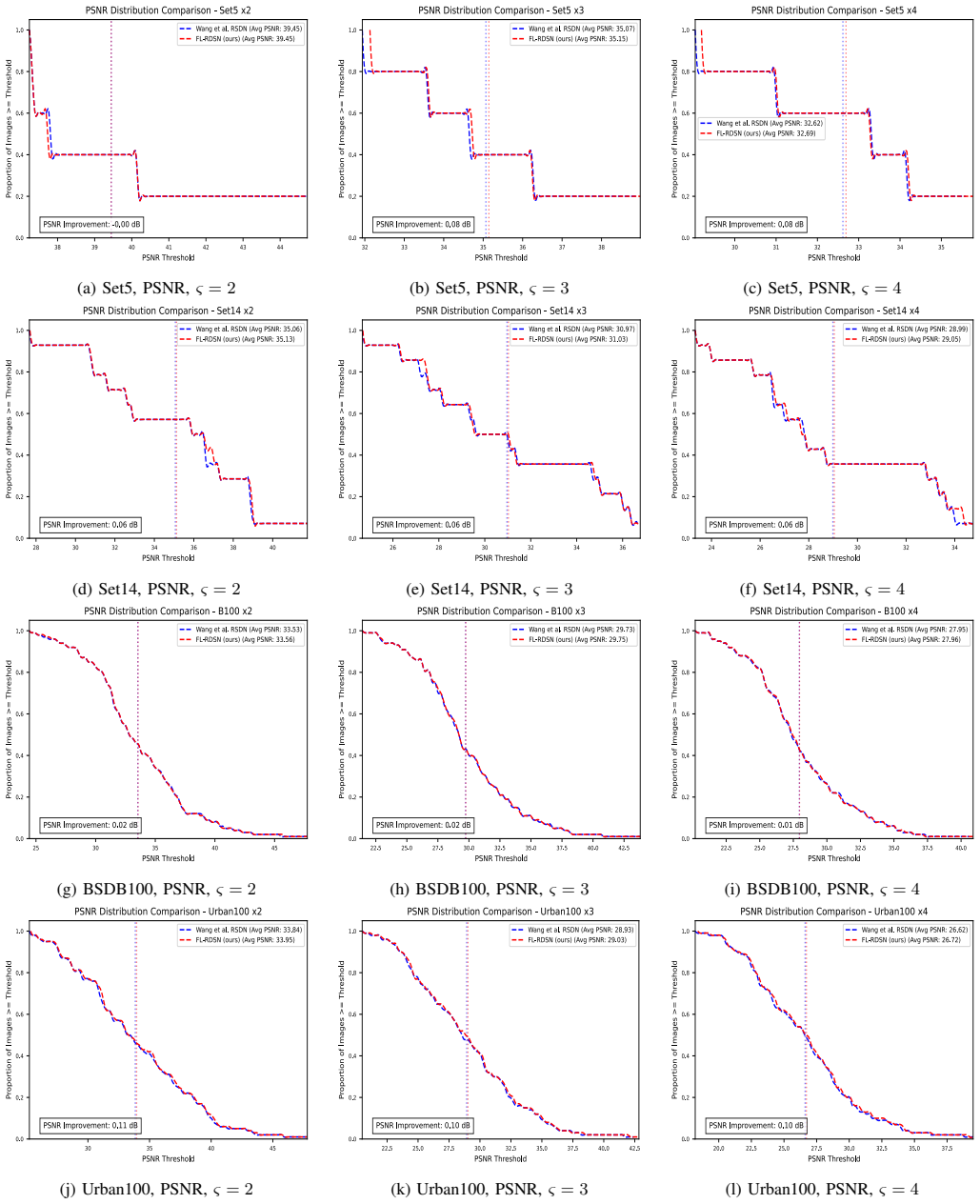
- With the reported privacy budget $\epsilon=2.75$, reconstruction quality on Set5, Set14, BSDS100, and Urban100 stays within about 0.4 dB PSNR of the un-noised federated model across scaling factors 2, 3, and 4.
- Training time drops from 82,800 to 77,368 seconds (about 6.56%) while adding local differential privacy and watermark verification, so the privacy protections are not bought with extra epochs.
- A coordinated watermark with $|J|\geq 500$ and per-client SNR $\ll 1$ should survive aggregation, with false-positive probability below $10^{-6}$ and missed-detection below $10^{-3}$, letting any key-holder verify the global model before use.
- The multi-party EtLC layer means a client can act as sender or receiver of encrypted, compressed, low-resolution images and reconstruct them with the verified global model, extending the two-party EtLC paradigm.
- Scaling the client pool from 5 to 15 clients degrades PSNR/SSIM only marginally under DP, suggesting the framework's cost grows sublinearly with federation size.
Reading between the lines
- Because the privacy proof bounds only the high-frequency projection and leaves $H_L$ exactly intact, a natural next experiment is measuring how much training-data information survives in $H_L$ alone (e.g., via reconstruction or membership-inference probes); quantifying that leakage would reveal the gap between the formal and practical guarantees.
- The frequency-splitting trick is architecture-agnostic and could be transferred to other learned reconstruction networks (MRI, remote sensing, video) where high frequencies are perceptually secondary; the same $\tau$, $C_{\mathrm{max}}$ calibration would need retuning per task.
- The watermark's secrecy rests entirely on the shared PRF key $mk$; an obvious extension is a hierarchical or threshold key-sharing scheme so that no single compromised client can forge or erase the global watermark.
- For heterogeneous clients with very different local data distributions, the fixed $\tau$ and $C_{\mathrm{max}}$ may not be optimal; an adaptive, privacy-budgeted allocation of noise across frequency bands could extend the quality-privacy plateau beyond $\epsilon=2.75$.
Editorial analysis
A structured set of objections, weighed in public.
Referee Report
Summary. The paper proposes PPFL-RDSN, a federated learning framework for super-resolution reconstruction of encrypted or lossy images. It combines FedAvg with a local differential privacy mechanism that adds Gaussian noise to high-frequency DCT coefficients of client activations (Section III-B), together with a coordinated sparse watermarking scheme for model integrity (Section III-C). The authors report PSNR/SSIM results close to those of the centralized baseline, claim a wall-clock training improvement of about 6.56%, and argue that the method provides formal (epsilon,delta)-LDP guarantees and watermark-based protection against model substitution. The manuscript also extends the encryption-then-lossy-compression paradigm to a multi-party setting and includes an explicit threat model and a Limitations paragraph.
Significance. If the privacy and efficiency claims were valid, the framework would be a useful contribution to privacy-preserving federated image reconstruction, combining FL, frequency-domain local differential privacy, and watermarking in one pipeline. The paper has some strengths: it states a clear threat model, explicitly disclaims defenses against poisoning and backdoor attacks, provides pseudocode for the client update and watermarking algorithms, and includes an honest Limitations section. However, the central technical claim is not sound: the released activation includes exact low-frequency DCT coefficients that are not covered by the DP proof, so the mechanism does not satisfy (epsilon,delta)-DP for any finite epsilon with delta < 1. In addition, the reported utility result is obtained by sweeping the privacy budget on the test benchmarks, and the efficiency comparison uses different amounts of hardware for the two systems. No code, machine-checked proofs, or falsifiable predictions are provided. Because the main advertised contribution is the privacy guarantee, the paper does not currently meet the bar for acceptance in a serious journal.
major comments (4)
- [Section III-B, Steps 3–9 and Eq. (2)] The DP claim is invalid. The Gaussian mechanism is applied only to f(X)=vec(T Ĥ Tᵀ)_{S_H}, with claimed sensitivity 2C_max, but the released activation is eH = H_L + Tᵀ(reshape(ef))T, where H_L = Tᵀ C_L T is an exact, data-dependent function of the clipped activation. For neighboring inputs whose activations differ only in the low-frequency DCT subspace (for example, a global brightness shift), the low-frequency parts differ deterministically while the noised high-frequency part can be identical. The event S = {y : y_L = H_L(X)} then has probability 1 under X and probability 0 under X′, so the (ε,δ)-DP inequality forces δ ≥ 1 for every finite ε, regardless of the noise scale σ. Consequently, the gradient updates sent to the server are not protected, and the claim in Section III-A that the mechanism “satisfies local (ε, δ)-differential privacy” is unsupported. This is a load-bearing structural gap, not a tuning issue.
- [Section IV-C, Table II and Figure 2] The privacy budget ε=2.75 is selected by sweeping ε∈[0.25,4] on the test benchmarks and choosing the plateau visible in the PSNR/SSIM curves of Figure 2; Table II then reports performance only at this selected value. This makes the headline “negligible quality loss at ε=2.75” result a test-set fit rather than a predictive evaluation. The paper should reserve a validation split for hyperparameter selection and report the utility of the final model on a genuinely held-out test set; without this, the claimed utility–privacy trade-off is not established.
- [Section IV-A, Baseline timing] The wall-clock comparison is not apples-to-apples. The centralized baseline was re-run on two NVIDIA L40 GPUs (82,800 s), while the PPFL-RDSN simulation allocates 10 clients, with each client bound to its own NVIDIA L40 GPU (10 GPUs in total). Reporting a saving from 82,800 s to 77,368 s therefore does not account for the fivefold increase in GPU resources; the total GPU-hours consumed are substantially larger for PPFL-RDSN. The claim of “reducing computational burdens” and the “improving training efficiency by approximately 6.56%” statement in the introduction are not supported by this comparison.
- [Section III-C, Statistical verification] The watermark detection analysis is not supported. The Hoeffding bound requires that X_j = θ_j w_j are independent, zero-mean, and bounded by σ under the null hypothesis, but none of these conditions is established for trained neural-network weights: after training, the θ_j are strongly dependent, and the value of σ is never defined. The parameters δ=β/2, λ≪β, and |J|≥500 are then inserted into the formula to obtain the stated rates Pr_H0[S>β/2]<10^{-6} and Pr_H1[S≤β/2]<10^{-3}, so these rates are consequences of unverified assumptions rather than measured or proven properties of the actual model distribution. The paper should either justify the independence and boundedness assumptions (empirically or analytically) or replace the exact tail bounds with empirical false-positive and false-negative rates.
minor comments (6)
- [Figures 3 and 4 captions] The caption of Figure 3 says “Effect of privacy budgets” although the figure varies the number of clients, and Figure 4’s caption is similarly imprecise; both captions should be corrected.
- [Figures 2–4, text body] Several figure captions and axis labels contain rendering artifacts such as “PS/glyph1197R” and “E psilon” instead of PSNR and Epsilon; these should be fixed before resubmission.
- [Section II-A] The formulas for the residual path and dense connectivity contain unfinished notation, including a “??” placeholder and undefined subscripts in y_l = H_l([x0, x1, ..., x_{l−1}]); these equations should be cleaned up and defined precisely.
- [Section III-B and IV-A] The statement that “Opacus is modified to provide record-level DP” is not accompanied by any description of the modification, making the privacy accounting non-reproducible; the modifications should be specified or the dependency stated exactly.
- [Sections I, III-A, and V] The manuscript is internally inconsistent about the threat of model poisoning: the introduction and conclusion mention protection against “model poisoning” while Section III-A explicitly states that the design does not defend against poisoning and backdoor attacks. These claims should be aligned.
- [Section III-C] The symbol λ is overloaded: it denotes the watermark regularization weight in the objective and Algorithm 2, but in the statistical verification analysis it is also used as an upper bound on adversarial bias. These two uses should be assigned distinct symbols.
Circularity Check
No significant circularity: the reported reconstruction quality is an empirical benchmark result, and neither the watermark detection bounds nor the LDP accuracy claims reduce by construction to their own inputs.
full rationale
The paper's central claims are empirical and architectural rather than derived from a self-referential chain. The reconstruction-quality results at epsilon = 2.75 are obtained by sweeping the privacy budget on the evaluation benchmarks and selecting a plateau; this is test-set hyperparameter tuning, not a fitted parameter renamed as a prediction, and the paper does not claim to predict the accuracy from first principles. The watermark verification statistic S is a direct functional of the training objective that embeds the watermark, so detecting the embedded watermark is a definitional property of the scheme rather than a circular derivation; the Hoeffding bounds and threshold choices are standard concentration arguments, not reductions of the conclusion to the hypothesis. The LDP proof in Section III-B is mathematically unsound because Eq. (2) releases the exact low-frequency component H_L alongside the noised high-frequency part, so the released activation cannot satisfy the claimed differential privacy guarantee; however, this is a correctness and formal-verification gap, not a circularity. There are no load-bearing self-citations, no imported uniqueness theorems from the authors' prior work, and no ansatz smuggled in via citation. The Limitations section explicitly notes adaptive frequency protection, richer collusion models, and Byzantine-robust aggregation as extensions, which is consistent with an honest empirical proposal. Consequently, no step of the paper's derivation is equivalent to its own inputs by construction.
Assumptions & free parameters
free parameters (7)
- Cmax (L2 clipping bound) =
not specified in text
- τ (frequency partition threshold) =
τ = 8 (example)
- ε (privacy budget) =
2.75
- λ (watermark regularization weight) =
1e-4
- β (watermark target strength) =
not specified
- p (watermark sparsity) =
10^-4 to 10^-2
- Local epochs per round =
47 (as converged)
assumptions (6)
- standard math The 2-D DCT matrix T is orthonormal, making the transform an isometry for Frobenius and L2 norms.
- standard math The Gaussian mechanism and post-processing properties of differential privacy hold as stated in Dwork and Roth.
- ad hoc to paper The released activation eH = H_L + T^T(noise)T with exact low-frequency part H_L is covered by the DP guarantee derived for the high-frequency projection f(X) only.
- ad hoc to paper In the watermark analysis, the products X_j = θ_j w_j are independent, zero-mean, and bounded by σ under the null hypothesis.
- domain assumption The shared PRF key mk remains secret from the untrusted aggregator and all adversaries.
- domain assumption All clients have synchronized, mutually authenticated key exchange for the EtLC module.
Cite this review
Pith. "Pith review of PPFL-RDSN: Privacy-Preserving Federated Learning-based Residual Dense Spatial Networks for Encrypted Lossy Image Reconstruction." pith.science (2026). https://pith.science/paper/TK4FANCQ
@misc{pith2026250700230,
  author       = {Pith},
  title        = {Pith review of: PPFL-RDSN: Privacy-Preserving Federated Learning-based Residual Dense Spatial Networks for Encrypted Lossy Image Reconstruction},
  year         = {2026},
  howpublished = {\url{https://pith.science/paper/TK4FANCQ}},
  note         = {Machine review of arXiv:2507.00230}
}
read the original abstract
Reconstructing high-quality images from low-resolution inputs using Residual Dense Spatial Networks (RDSNs) is crucial yet challenging. It is even more challenging in centralized training where multiple collaborating parties are involved, as it poses significant privacy risks, including data leakage and inference attacks, as well as high computational and communication costs. We propose a novel Privacy-Preserving Federated Learning-based RDSN (PPFL-RDSN) framework specifically tailored for encrypted lossy image reconstruction. PPFL-RDSN integrates Federated Learning (FL), local differential privacy, and robust model watermarking techniques to ensure that data remains secure on local clients/devices, safeguards privacy-sensitive information, and maintains model authenticity without revealing underlying data. Empirical evaluations show that PPFL-RDSN achieves comparable performance to the state-of-the-art centralized methods while reducing computational burdens, and effectively mitigates security and privacy vulnerabilities, making it a practical solution for secure and privacy-preserving collaborative computer vision applications.
Figures


Figures from the paper (3 more)


Reference graph
Works this paper leans on
-
[1]
Image Reconstruction Using Deep Learning
P.-Y . Liu and E. Y . Lam, “Image reconstruction using deep learning,” arXiv preprint arXiv:1809.10410, 2018. 5 10 15 Clients 34 35 36 37 38 39PS/glyph1197R P S/glyph1197R vs C lient /glyph1197o. ( = 2.75, S.F . = 2) Set5 Set14 B100 Urban100 (a)clientto PSNR,ς= 2 5 10 15 Clients 0.93 0.94 0.95 0.96SSIM SSIM vs C lient /glyph1197o. ( = 2.75, S.F . = 2) Set...
work page Pith review arXiv 2018
-
[2]
Deep convolutional autoencoder-based lossy image compression,
Z. Cheng, H. Sun, M. Takeuchi, and J. Katto, “Deep convolutional autoencoder-based lossy image compression,” in2018 Picture Coding Symposium (PCS). IEEE, 2018, pp. 253–257
2018
-
[3]
Unsupervised deep learning methods for biological image reconstruction and enhancement: An overview from a signal processing perspective,
M. Akc ¸akaya, B. Yaman, H. Chung, and J. C. Ye, “Unsupervised deep learning methods for biological image reconstruction and enhancement: An overview from a signal processing perspective,”IEEE Signal Pro- cessing Magazine, vol. 39, no. 2, pp. 28–44, 2022
2022
-
[4]
Centralized machine learning versus federated averaging: A comparison using mnist dataset,
S. Peng, Y . Yang, M. Mao, and D.-S. Park, “Centralized machine learning versus federated averaging: A comparison using mnist dataset,” KSII Transactions on Internet and Information Systems (TIIS), vol. 16, no. 2, pp. 742–756, 2022
2022
-
[5]
Recent advances of differen- tial privacy in centralized deep learning: A systematic survey,
L. Demelius, R. Kern, and A. Tr ¨ugler, “Recent advances of differen- tial privacy in centralized deep learning: A systematic survey,”arXiv preprint arXiv:2309.16398, 2023
-
[6]
Gradient centralization: A new optimization technique for deep neural networks,
H. Yong, J. Huang, X. Hua, and L. Zhang, “Gradient centralization: A new optimization technique for deep neural networks,” inComputer Vision–ECCV 2020: 16th European Conference, Glasgow, UK, August 23–28, 2020, Proceedings, Part I 16. Springer, 2020, pp. 635–652
2020
-
[7]
Federated Learning Versus Classical Machine Learning: A Convergence Comparison
M. Asad, A. Moustafa, and T. Ito, “Federated learning versus clas- sical machine learning: A convergence comparison,”arXiv preprint arXiv:2107.10976, 2021
work page Pith review arXiv 2021
-
[8]
Communication-efficient learning of deep networks from decentralized data,
B. McMahan, E. Moore, D. Ramage, S. Hampson, and B. A. y Arcas, “Communication-efficient learning of deep networks from decentralized data,” inArtificial intelligence and statistics. PMLR, 2017, pp. 1273– 1282. 0 20 40 Epochs 34 36 38PS/glyph1197R P S/glyph1197R vs E pochs. ( = 2.75, S.F . = 2) Set5 Set14 B100 Urban100 (a)epochto PSNR,ς= 2 0 20 40 Epochs ...
work page 2017
Show all 84 references
-
[9]
Differential privacy,
C. Dwork, “Differential privacy,” inInternational colloquium on au- tomata, languages, and programming. Springer, 2006, pp. 1–12
2006
-
[10]
Differential privacy: A survey of results,
——, “Differential privacy: A survey of results,” inInternational con- ference on theory and applications of models of computation. Springer, 2008, pp. 1–19
2008
-
[11]
Boosting and differential privacy,
C. Dwork, G. N. Rothblum, and S. Vadhan, “Boosting and differential privacy,” in2010 IEEE 51st Annual Symposium on Foundations of Computer Science. IEEE, 2010, pp. 51–60
2010
-
[12]
Gaussian differential privacy,
J. Dong, A. Roth, and W. J. Su, “Gaussian differential privacy,”Journal of the Royal Statistical Society Series B: Statistical Methodology, vol. 84, no. 1, pp. 3–37, 2022
2022
-
[13]
X. Yi, R. Paulet, E. Bertino, X. Yi, R. Paulet, and E. Bertino,Homo- morphic encryption. Springer, 2014
2014
-
[14]
A survey on homomorphic encryption schemes: Theory and implementation,
A. Acar, H. Aksu, A. S. Uluagac, and M. Conti, “A survey on homomorphic encryption schemes: Theory and implementation,”ACM Computing Surveys (Csur), vol. 51, no. 4, pp. 1–35, 2018
2018
-
[15]
Homomorphic encryption,
M. Ogburn, C. Turner, and P. Dahal, “Homomorphic encryption,” Procedia Computer Science, vol. 20, pp. 502–509, 2013
2013
-
[16]
Somewhat practical fully homomorphic encryption,
J. Fan and F. Vercauteren, “Somewhat practical fully homomorphic encryption,”Cryptology ePrint Archive, 2012
2012
-
[17]
Cramer, I
R. Cramer, I. B. Damg ˚ardet al.,Secure multiparty computation. Cambridge University Press, 2015
2015
-
[18]
Secure multiparty computation,
Y . Lindell, “Secure multiparty computation,”Communications of the ACM, vol. 64, no. 1, pp. 86–96, 2020
2020
-
[19]
Secure multi-party computation,
O. Goldreich, “Secure multi-party computation,”Manuscript. Prelimi- nary version, vol. 78, no. 110, pp. 1–108, 1998
1998
-
[20]
A novel encryption-then-lossy-compression scheme of color images using customized residual dense spatial network,
C. Wang, T. Zhang, H. Chen, Q. Huang, J. Ni, and X. Zhang, “A novel encryption-then-lossy-compression scheme of color images using customized residual dense spatial network,”IEEE Transactions on Multimedia, 2022
2022
-
[21]
Lossy compression and iterative reconstruction for encrypted image,
X. Zhang, “Lossy compression and iterative reconstruction for encrypted image,”IEEE transactions on information forensics and security, vol. 6, no. 1, pp. 53–58, 2010
2010
-
[22]
A new lossy compression scheme for encrypted gray-scale images,
R. Hu, X. Li, and B. Yang, “A new lossy compression scheme for encrypted gray-scale images,” in2014 IEEE International Conference on Acoustics, Speech and Signal Processing (ICASSP). Ieee, 2014, pp. 7387–7390
2014
-
[23]
Encryption-then- compression systems using grayscale-based image encryption for jpeg images,
T. Chuman, W. Sirichotedumrong, and H. Kiya, “Encryption-then- compression systems using grayscale-based image encryption for jpeg images,”IEEE Transactions on Information Forensics and security, vol. 14, no. 6, pp. 1515–1525, 2018
2018
-
[24]
Compressive sampling and lossy compression,
V . K. Goyal, A. K. Fletcher, and S. Rangan, “Compressive sampling and lossy compression,”IEEE Signal Processing Magazine, vol. 25, no. 2, pp. 48–56, 2008
2008
-
[25]
Lossy compression of noisy images,
O. K. Al-Shaykh and R. M. Mersereau, “Lossy compression of noisy images,”IEEE Transactions on Image Processing, vol. 7, no. 12, pp. 1641–1652, 1998
1998
-
[26]
Rethinking lossy compression: The rate- distortion-perception tradeoff,
Y . Blau and T. Michaeli, “Rethinking lossy compression: The rate- distortion-perception tradeoff,” inInternational Conference on Machine Learning. PMLR, 2019, pp. 675–685
2019
-
[27]
Residual dense net- work for image super-resolution,
Y . Zhang, Y . Tian, Y . Kong, B. Zhong, and Y . Fu, “Residual dense net- work for image super-resolution,” inProceedings of the IEEE conference on computer vision and pattern recognition, 2018, pp. 2472–2481
2018
-
[28]
U-net: Convolutional networks for biomedical image segmentation,
O. Ronneberger, P. Fischer, and T. Brox, “U-net: Convolutional networks for biomedical image segmentation,” inMedical image computing and computer-assisted intervention–MICCAI 2015: 18th international con- ference, Munich, Germany, October 5-9, 2015, proceedings, part III 18. ...
2015
-
[29]
Theory of deep convolutional neural networks: Downsam- pling,
D.-X. Zhou, “Theory of deep convolutional neural networks: Downsam- pling,”Neural Networks, vol. 124, pp. 319–327, 2020
2020
-
[30]
An encryption-then-compression system for jpeg standard,
K. Kurihara, S. Shiota, and H. Kiya, “An encryption-then-compression system for jpeg standard,” in2015 Picture Coding Symposium (PCS). IEEE, 2015, pp. 119–123
2015
-
[31]
Federated learning: Challenges, methods, and future directions,
T. Li, A. K. Sahu, A. Talwalkar, and V . Smith, “Federated learning: Challenges, methods, and future directions,”IEEE signal processing magazine, vol. 37, no. 3, pp. 50–60, 2020
2020
-
[32]
On the convergence of fedavg on non-iid data,
X. Li, K. Huang, W. Yang, S. Wang, and Z. Zhang, “On the convergence of fedavg on non-iid data,”arXiv preprint arXiv:1907.02189, 2019
1907 arXiv
-
[33]
Revisiting distributed synchronous sgd,
J. Chen, X. Pan, R. Monga, S. Bengio, and R. Jozefowicz, “Revisiting distributed synchronous sgd,”arXiv preprint arXiv:1604.00981, 2016
2016 arXiv
-
[34]
Asynchronous decentralized parallel stochastic gradient descent,
X. Lian, W. Zhang, C. Zhang, and J. Liu, “Asynchronous decentralized parallel stochastic gradient descent,” inInternational Conference on Machine Learning. PMLR, 2018, pp. 3043–3052
2018
-
[35]
Federated learning with hierarchical clustering of local updates to improve training on non-iid data,
C. Briggs, Z. Fan, and P. Andras, “Federated learning with hierarchical clustering of local updates to improve training on non-iid data,” in2020 International Joint Conference on Neural Networks (IJCNN). IEEE, 2020, pp. 1–9
2020
-
[36]
Timely communication in federated learning,
B. Buyukates and S. Ulukus, “Timely communication in federated learning,” inIEEE INFOCOM 2021-IEEE Conference on Computer Communications Workshops (INFOCOM WKSHPS). IEEE, 2021, pp. 1–6
2021
-
[37]
Federated learning: Opportunities and challenges,
P. M. Mammen, “Federated learning: Opportunities and challenges,” arXiv preprint arXiv:2101.05428, 2021
2021 arXiv
-
[38]
How to backdoor federated learning,
E. Bagdasaryan, A. Veit, Y . Hua, D. Estrin, and V . Shmatikov, “How to backdoor federated learning,” inInternational conference on artificial intelligence and statistics. PMLR, 2020, pp. 2938–2948
2020
-
[39]
A survey on federated learning,
C. Zhang, Y . Xie, H. Bai, B. Yu, W. Li, and Y . Gao, “A survey on federated learning,”Knowledge-Based Systems, vol. 216, p. 106775, 2021
2021
-
[40]
Federated learning: Strategies for improving communication efficiency,
J. Konecn `y, H. B. McMahan, F. X. Yu, P. Richt ´arik, A. T. Suresh, and D. Bacon, “Federated learning: Strategies for improving communication efficiency,”arXiv preprint arXiv:1610.05492, vol. 8, 2016
2016 arXiv
-
[41]
Federated learning on non-iid data: A survey,
H. Zhu, J. Xu, S. Liu, and Y . Jin, “Federated learning on non-iid data: A survey,”Neurocomputing, vol. 465, pp. 371–390, 2021
2021
-
[42]
Threats to federated learning: A survey,
L. Lyu, H. Yu, and Q. Yang, “Threats to federated learning: A survey,” arXiv preprint arXiv:2003.02133, 2020
2003 arXiv
-
[43]
Communication-efficient federated learning,
M. Chen, N. Shlezinger, H. V . Poor, Y . C. Eldar, and S. Cui, “Communication-efficient federated learning,”Proceedings of the Na- tional Academy of Sciences, vol. 118, no. 17, p. e2024789118, 2021
2021
-
[44]
Federated learning for internet of things: Recent advances, taxonomy, and open challenges,
L. U. Khan, W. Saad, Z. Han, E. Hossain, and C. S. Hong, “Federated learning for internet of things: Recent advances, taxonomy, and open challenges,”IEEE Communications Surveys & Tutorials, vol. 23, no. 3, pp. 1759–1799, 2021
2021
-
[45]
Specificity- preserving federated learning for mr image reconstruction,
C.-M. Feng, Y . Yan, S. Wang, Y . Xu, L. Shao, and H. Fu, “Specificity- preserving federated learning for mr image reconstruction,”IEEE Trans- actions on Medical Imaging, vol. 42, no. 7, pp. 2010–2021, 2022
2010
-
[46]
Federated learning of generative image priors for mri reconstruction,
G. Elmas, S. U. Dar, Y . Korkmaz, E. Ceyani, B. Susam, M. Ozbey, S. Avestimehr, and T. C ¸ ukur, “Federated learning of generative image priors for mri reconstruction,”IEEE Transactions on Medical Imaging, vol. 42, no. 7, pp. 1996–2009, 2022
1996
-
[47]
Multi-institutional collaborations for improving deep learning-based magnetic resonance image reconstruction using federated learning,
P. Guo, P. Wang, J. Zhou, S. Jiang, and V . M. Patel, “Multi-institutional collaborations for improving deep learning-based magnetic resonance image reconstruction using federated learning,” inProceedings of the IEEE/CVF conference on computer vision and pattern recognition, 2...
2021
-
[48]
Dpadapter: Improving differentially private deep learning through noise tolerance pre-training,
Z. Wang, R. Zhu, D. Zhou, Z. Zhang, J. Mitchell, H. Tang, and X. Wang, “Dpadapter: Improving differentially private deep learning through noise tolerance pre-training,”arXiv preprint arXiv:2403.02571, 2024
2024 arXiv
-
[49]
Fine-tuning language models with differential privacy through adaptive noise allocation,
X. Li, R. Zmigrod, Z. Ma, X. Liu, and X. Zhu, “Fine-tuning language models with differential privacy through adaptive noise allocation,” arXiv preprint arXiv:2410.02912, 2024
2024 arXiv
-
[50]
Adaptive laplace mechanism: Differential privacy preservation in deep learning,
N. Phan, X. Wu, H. Hu, and D. Dou, “Adaptive laplace mechanism: Differential privacy preservation in deep learning,” in2017 IEEE inter- national conference on data mining (ICDM). IEEE, 2017, pp. 385–394
2017
-
[51]
Secure random sampling in differential privacy,
N. Holohan and S. Braghin, “Secure random sampling in differential privacy,” inComputer Security–ESORICS 2021: 26th European Sympo- sium on Research in Computer Security, Darmstadt, Germany, October 4–8, 2021, Proceedings, Part II 26. Springer, 2021, pp. 523–542
2021
-
[52]
On significance of the least significant bits for differential privacy,
I. Mironov, “On significance of the least significant bits for differential privacy,” inProceedings of the 2012 ACM conference on Computer and communications security, 2012, pp. 650–661
2012
-
[53]
Precision-based attacks and interval refining: how to break, then fix, dif- ferential privacy on finite computers,
S. Haney, D. Desfontaines, L. Hartman, R. Shrestha, and M. Hay, “Precision-based attacks and interval refining: how to break, then fix, dif- ferential privacy on finite computers,”arXiv preprint arXiv:2207.13793, 2022
2022 arXiv
-
[54]
Widespread underestimation of sensitivity in differentially private libraries and how to fix it,
S. Casacuberta, M. Shoemate, S. Vadhan, and C. Wagaman, “Widespread underestimation of sensitivity in differentially private libraries and how to fix it,” inProceedings of the 2022 ACM SIGSAC Conference on Computer and Communications Security, 2022, pp. 471–484
2022
-
[55]
Practical black-box attacks against machine learning,
N. Papernot, P. McDaniel, I. Goodfellow, S. Jha, Z. B. Celik, and A. Swami, “Practical black-box attacks against machine learning,” in Proceedings of the 2017 ACM on Asia conference on computer and communications security, 2017, pp. 506–519
2017
-
[56]
How to prove yourself: Practical solutions to identification and signature problems,
A. Fiat and A. Shamir, “How to prove yourself: Practical solutions to identification and signature problems,” inConference on the theory and application of cryptographic techniques. Springer, 1986, pp. 186–194
1986
-
[57]
Membership inference attacks against machine learning models,
R. Shokri, M. Stronati, C. Song, and V . Shmatikov, “Membership inference attacks against machine learning models,” 2017. [Online]. Available: https://arxiv.org/abs/1610.05820
2017 arXiv
-
[58]
Model inversion attacks that exploit confidence information and basic countermeasures,
M. Fredrikson, S. Jha, and T. Ristenpart, “Model inversion attacks that exploit confidence information and basic countermeasures,” in Proceedings of the 22nd ACM SIGSAC conference on computer and communications security, 2015, pp. 1322–1333
2015
-
[59]
Property inference attacks on fully connected neural networks using permutation invariant representations,
K. Ganju, Q. Wang, W. Yang, C. A. Gunter, and N. Borisov, “Property inference attacks on fully connected neural networks using permutation invariant representations,” inProceedings of the 2018 ACM SIGSAC conference on computer and communications security, 2018, pp. 619– 633
2018
-
[60]
The algorithmic foundations of differential privacy,
C. Dwork, A. Rothet al., “The algorithmic foundations of differential privacy,”Foundations and Trends® in Theoretical Computer Science, vol. 9, no. 3–4, pp. 211–407, 2014
2014
-
[61]
Advances and open problems in federated learning,
P. Kairouz, H. B. McMahan, B. Avent, A. Bellet, M. Bennis, A. N. Bhagoji, K. Bonawitz, Z. Charles, G. Cormode, R. Cummingset al., “Advances and open problems in federated learning,”Foundations and trends® in machine learning, vol. 14, no. 1–2, pp. 1–210, 2021
2021
-
[62]
Transferability in ma- chine learning: from phenomena to black-box attacks using adversarial samples,
N. Papernot, P. McDaniel, and I. Goodfellow, “Transferability in ma- chine learning: from phenomena to black-box attacks using adversarial samples,”arXiv preprint arXiv:1605.07277, 2016
2016 arXiv
-
[63]
How to backdoor federated learning,
E. Bagdasaryan, A. Veit, Y . Hua, D. Estrin, and V . Shmatikov, “How to backdoor federated learning,” 2019. [Online]. Available: https://arxiv.org/abs/1807.00459
2019 arXiv
-
[64]
Local differential privacy for deep learning,
P. C. M. Arachchige, P. Bertok, I. Khalil, D. Liu, S. Camtepe, and M. Atiquzzaman, “Local differential privacy for deep learning,”IEEE Internet of Things Journal, vol. 7, no. 7, pp. 5827–5842, 2019
2019
-
[65]
Ldp-fed: Federated learning with local differential privacy,
S. Truex, L. Liu, K.-H. Chow, M. E. Gursoy, and W. Wei, “Ldp-fed: Federated learning with local differential privacy,” inProceedings of the third ACM international workshop on edge systems, analytics and networking, 2020, pp. 61–66
2020
-
[66]
Privacy-preserving face recognition with learnable privacy budgets in frequency domain,
J. Ji, H. Wang, Y . Huang, J. Wu, X. Xu, S. Ding, S. Zhang, L. Cao, and R. Ji, “Privacy-preserving face recognition with learnable privacy budgets in frequency domain,” inEuropean Conference on Computer Vision. Springer, 2022, pp. 475–491
2022
-
[67]
Privacy preserving face recognition utilizing differential privacy,
P. M. Arachchige, P. Bertok, I. Khalil, D. Liu, and S. Camtepe, “Privacy preserving face recognition utilizing differential privacy,”Computers and Security, vol. 97, pp. 1–12, 2020
2020
-
[68]
Embedding watermarks into deep neural networks,
Y . Uchida, Y . Nagai, S. Sakazawa, and S. Satoh, “Embedding watermarks into deep neural networks,” inProceedings of the 2017 ACM on International Conference on Multimedia Retrieval, ser. ICMR ’17. ACM, Jun. 2017, p. 269–277. [Online]. Available: http://dx.doi.org/10.1145/3078...
2017
-
[69]
Robust watermarking for deep neural networks via bi-level optimization,
P. Yang, Y . Lao, and P. Li, “Robust watermarking for deep neural networks via bi-level optimization,” inProceedings of the IEEE/CVF international conference on computer vision, 2021, pp. 14 841–14 850
2021
-
[70]
Embedding water- marks into deep neural networks,
Y . Uchida, Y . Nagai, S. Sakazawa, and S. Satoh, “Embedding water- marks into deep neural networks,” inProceedings of the 2017 ACM on international conference on multimedia retrieval, 2017, pp. 269–277
2017
-
[71]
A systematic review on model watermarking for neural networks,
F. Boenisch, “A systematic review on model watermarking for neural networks,”Frontiers in big Data, vol. 4, p. 729663, 2021
2021
-
[72]
Fedipr: Ownership verification for federated deep neural network models,
B. Li, L. Fan, H. Gu, J. Li, and Q. Yang, “Fedipr: Ownership verification for federated deep neural network models,”IEEE Transactions on Pattern Analysis and Machine Intelligence, vol. 45, no. 4, pp. 4521– 4536, 2022
2022
-
[73]
A downsampling method addressing the modifiable areal unit problem in remote sensing,
A. M ˆırt,, J. Reiche, J. Verbesselt, and M. Herold, “A downsampling method addressing the modifiable areal unit problem in remote sensing,” Remote Sensing, vol. 14, no. 21, p. 5538, 2022
2022
-
[74]
Opacus: User-friendly differential privacy library in PyTorch,
A. Yousefpour, I. Shilov, A. Sablayrolles, D. Testuggine, K. Prasad, M. Malek, J. Nguyen, S. Ghosh, A. Bharadwaj, J. Zhao, G. Cormode, and I. Mironov, “Opacus: User-friendly differential privacy library in PyTorch,”arXiv preprint arXiv:2109.12298, 2021
2021 arXiv
-
[75]
Adam: A method for stochastic optimization,
P. K. Diederik, “Adam: A method for stochastic optimization,”(No Title), 2014
2014
-
[76]
Enhancing communication efficiency and training time uniformity in federated learning through multi-branch networks and the oort algorithm,
P.-H. Juan and J.-L. Wu, “Enhancing communication efficiency and training time uniformity in federated learning through multi-branch networks and the oort algorithm,”Algorithms, vol. 17, p. 52,
-
[77]
Chacha20 and poly1305 for ietf protocols,
Y . Nir and A. Langley, “Chacha20 and poly1305 for ietf protocols,” Tech. Rep., 2018
2018
-
[78]
Hybrid public key encryption (hpke),
R. L. Barnes, K. Bhargavan, B. Lipp, and C. A. Wood, “Hybrid public key encryption (hpke),” RFC 9180, May 2022. [Online]. Available: https://www.rfc-editor.org/rfc/rfc9180
2022
-
[79]
The messaging layer security (mls) protocol,
E. Rescorla, R. Barnes, K. Cohn-Gordon, R. Misoczki, A. D. McGrew et al., “The messaging layer security (mls) protocol,” RFC 9420, July
-
[80]
The x3dh key agreement protocol,
M. Marlinspike and T. Perrin, “The x3dh key agreement protocol,” Signal Specification, 2016, pDF available at https://signal.org/docs/specifications/x3dh/x3dh.pdf. [Online]. Available: https://signal.org/docs/specifications/x3dh/
2016
-
[81]
Available: https://www.rfc-editor.org/rfc/rfc9420
[Online]. Available: https://www.rfc-editor.org/rfc/rfc9420
-
[82]
Ntire 2017 challenge on single image super-resolution: Dataset and study,
E. Agustsson and R. Timofte, “Ntire 2017 challenge on single image super-resolution: Dataset and study,” inThe IEEE Conference on Com- puter Vision and Pattern Recognition (CVPR) Workshops, July 2017. APPENDIX A. Comparisons In this section, we draw a comparison between our mo...
2017
-
[83]
Divertible protocols and atomic proxy cryptography,
M. Blaze, G. Bleumer, and M. Strauss, “Divertible protocols and atomic proxy cryptography,” inAdvances in Cryptology – EUROCRYPT ’98, ser. Lecture Notes in Computer Science, vol. 1403. Springer, 1998, pp. 127–144
1998
-
[2024]
Available: https://api.semanticscholar.org/CorpusID: 267234091
[Online]. Available: https://api.semanticscholar.org/CorpusID: 267234091
Reviewed August 6, 2026 · model on record in the stance chip above.
Discussion (0). Sign in to comment.