REVIEW 5 major objections 6 minor 3 cited by
Thinking Beyond Tokens: From Brain-Inspired Intelligence to Cognitive Foundations for Artificial General Intelligence and its Societal Impact
T0 review · 5 major / 6 minor · reviewed 2026-08-06 · deepseek-v4-flash
Pith's one-line read The paper argues that reaching artificial general intelligence requires integrating memory, reasoning, and grounded agency—scale and token prediction alone will not get there.
desk verdict A broad, useful AGI survey that overreaches its central claim; the key empirical exhibit is wrong and the proposal is a placeholder. read the letter →
The pith
A machine-rendered reading of the paper's core claim, the machinery that carries it, and where it could break.
The reading
What carries the argument
The load-bearing mechanism is architectural integration: a modular cognitive scaffold in which specialized components—perception, reasoning, memory, action, and world modeling—interact through coordination loops. The paper concretizes this through agentic retrieval–planning–tool-use loops that combine retrieval, planning, and dynamic tool use, and through the mapping of brain regions to neural network models that serves as a design blueprint. It also treats information compression as the bridge between memorization and reasoning: high compression of training data into abstract principles is what enables flexible generalization. This mechanism carries the argument because it is what the paper says scaling lacks: inductive biases for structured reasoning, persistent memory, and self-models.
What would settle it
A concrete test: benchmark a large next-token predictor with no external memory, no explicit world model, and no multi-agent coordination against an equally sized agentic system with those components on long-horizon open-ended tasks; if the monolithic predictor matches or beats the agentic system, the paper's integration claim is falsified. A weaker check is to ablate memory and action modules while holding parameter count fixed and show no improvement in out-of-distribution generalization.
Extended reading notes
Core claim
On its own terms, the paper's central claim is that token-level prediction is a foundation, not a destination: current models 'remain fundamentally limited by their reliance on token-level prediction and lack of grounded agency.' The argument is that intelligence requires the integration of memory and reasoning—an orchestration of modular, interactive, and self-improving components—in which compression enables adaptive behavior. The paper presents a cognitive blueprint in which brain-region specialization, memory hierarchies, and perception-action loops map onto AI modules, and it argues that agentic architectures with retrieval, planning, tool use, persistent memory, and world models are the concrete instantiation of that blueprint. It concludes that reaching AGI means building systems that are grounded, embodied, memory-augmented, and value-aligned, not merely larger.
Load-bearing premise
The load-bearing premise is that the human cognitive blueprint—specialized brain regions, memory hierarchies, and perception–action loops—is the necessary template for general intelligence, so a system without these components cannot reach AGI; if a radically non-brain-like architecture succeeded, the paper's conclusion would not follow.
Editorial extensions
If this is right
- Larger parameter counts and better post-training will hit diminishing returns; further AGI progress depends on adding persistent memory, world models, and goal-directed agency to architectures.
- Agentic retrieval–planning–tool-use systems become a primary design route rather than a peripheral add-on to language models.
- Vision-language models should be treated as perception modules embedded in agentic systems, not as standalone general intelligences.
- Generalization efforts should focus on compression, test-time adaptation, and training-free methods as core capabilities, not merely regularization tricks.
- AGI development must proceed together with societal governance, cognitive-debt mitigation, and energy-aware design, because the same integration that enables intelligence also raises systemic risks.
Reading between the lines
- If the integration thesis is correct, an ablation test follows: holding parameter count fixed, systems with external memory and action loops should outperform monolithic predictors on long-horizon, open-ended tasks—this comparison is implied but not run in the paper.
- The compression-as-reasoning view can be pushed to a testable continuum: models that compress training data more (by minimum-description-length-style measures) should show stronger out-of-distribution reasoning, which could be measured directly.
- The brain-region mapping suggests a falsifiable architectural recipe: adding modules that mimic episodic replay and planning-like prefrontal loops should improve continual learning more than equal-parameter generic additions.
- A societal consequence the paper leaves implicit: if AGI depends on agency and memory, then evaluation should shift from single-turn benchmark accuracy to sustained autonomy and goal-directed behavior over time.
Editorial analysis
A structured set of objections, weighed in public.
Referee Report
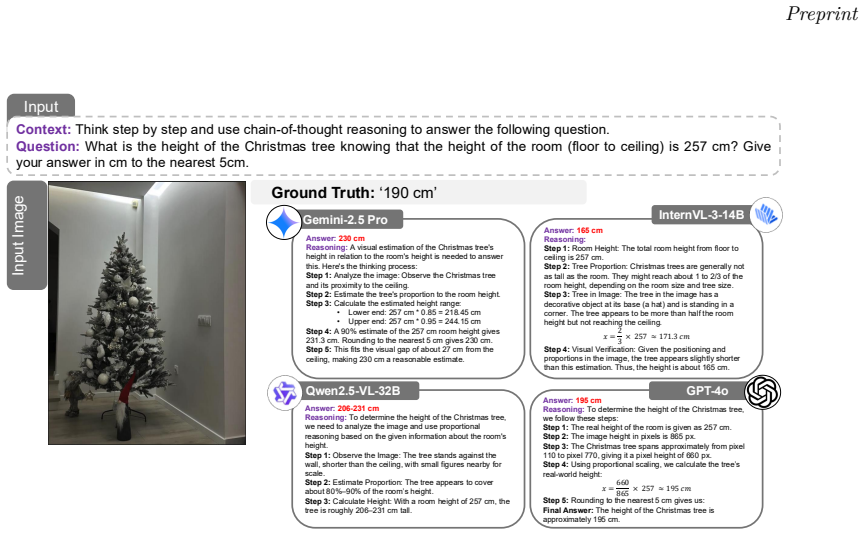
Summary. The paper is a cross-disciplinary position/review paper arguing that AGI cannot be reached by scaling token-prediction models alone and that true intelligence requires the integration of modular memory, reasoning, agency, world models, and cognitive scaffolding. It surveys historical AI, brain-inspired computing, generalization theory, reinforcement learning and alignment, agentic architectures, VLMs, recent advances such as Large Concept Models and Large Reasoning Models, benchmarks, and societal/ethical governance. The paper claims to offer a unified framework and roadmap for AGI that synthesizes computational architectures, cognitive neuroscience, and societal alignment, and it uses an anecdotal visual-reasoning example (Figure 4) and brain-region-to-network mappings (Table 1) to support the claim that current models are fundamentally limited by token-level prediction.
Significance. If the central thesis were established, the paper would be a valuable roadmap for redirecting AGI research toward architectural innovation rather than pure scaling. The survey is broad and timely, and it collects useful material in one place: agent communication protocols (MCP, ACP, A2A, ANP), test-time adaptation, Agentic RAG, self-play frameworks such as AZR, and recent model families (LCMs, LRMs, MoE). The paper includes algorithmic sketches and comparative tables that could serve as a convenient entry point for researchers. However, the paper provides no new experiments, machine-checked proofs, parameter-free derivations, or falsifiable predictions; its main claim is supported primarily by analogy and a single anecdotal evaluation. The contribution is therefore taxonomic and synthetic rather than demonstrative, and its central necessity claim is not established.
major comments (5)
- [Figure 4 and Section 3.1.4] There are two load-bearing problems with Figure 4. First, Section 3.1.4 states that Figure 4 illustrates a cognitive pipeline using a soccer player example, but the actual Figure 4 shows the Christmas-tree VLM evaluation; the figure and its caption do not match the surrounding text. Second, the caption claims that 'all models... fail to estimate the Christmas tree height correctly,' yet GPT-4o's answer of 195 cm differs from the ground truth of 190 cm by exactly 5 cm, which is the rounding increment requested in the prompt ('to the nearest 5 cm'). GPT-4o's answer is therefore correct under the stated output convention. Since this figure is the only concrete empirical evidence in Section 1 for the paper's central claim that token-prediction models are 'fundamentally limited,' the misreporting directly undermines that claim. Please correct the figure/caption and either provide multiple controlled trials or weaken the claim to 'these four models, on this prompt, were unreliable.'
- [Section 1 ('Why Further Scaling Will Not Lead to AGI?')] The paper asserts that limitations of current LLMs are 'architectural, not parametric' and that scaling alone 'cannot achieve AGI.' This modal claim is load-bearing because it motivates the entire paper. However, no formal argument or controlled comparison is provided; the cited references [14, 15] concern data minimization and AI-native memory, not scaling limits. Moreover, the paper itself later surveys Decision Transformers, Large Concept Models, Large Reasoning Models, Tree-of-Thoughts, ReAct, and test-time compute—all of which operate within or alongside autoregressive token-prediction frameworks and improve reasoning. The necessity claim is a plausible research hypothesis, but the text states it as an established result. Please rephrase the claim as a hypothesis ('we argue' / 'the evidence suggests') and add a discussion of whether monolithic architectures with test-time search or other non-brain-like designs could achieve the same capabilities.
- [Section 10 and Figure 8] Section 10, titled 'Our Proposal,' contains only a single paragraph enumerating five intelligence components (spatial, geometrical, sequential, multimodal, social), and Figure 8 includes the placeholder text 'Merge our proposal.' No architecture, training objective, evaluation protocol, or relationship to the surveyed cognitive modules is specified. The paper's own engineering roadmap is therefore never actually presented. Either expand Section 10 with a concrete design and validation plan, or remove the 'proposal' framing and label this section as 'outlook' or 'research agenda.'
- [Section 5.2.2] The paragraph under 'Solving Inductive Bias Technique' contains the dangling reference '(further discussed in Section X)' with no target section, indicating an incomplete draft. The paragraph is also too short to justify the heading; it mentions uncertainty estimation and adaptive regularization without connecting them to 'solving inductive bias.' Please fix the cross-reference and either expand the content or revise the heading.
- [Table 1 and Section 3.2.3] The brain-region-to-neural-network mappings in Table 1 are descriptive analogies, not evidence that AGI must be organized in this way. The paper uses these mappings (e.g., the 'Key Insight' in Section 3.2.3) to conclude that AGI 'may benefit from' and later 'must' integrate modular, brain-like components. There is no controlled comparison with non-brain-inspired architectures, and the possibility of a monolithic architecture with sufficient compute, data, or test-time search is not considered. This is an anthropocentric modeling choice, not a derivation. Please frame the brain-inspired mappings as heuristics or hypotheses, and explicitly acknowledge that alternative architectural routes to general intelligence are not ruled out.
minor comments (6)
- [Abstract] The phrase 'lack grounded agency' is grammatically awkward; consider 'lack grounding and agency.'
- [Section 8.1.1] The agent communication protocols MCP, ACP, A2A, and ANP are referenced as 'Source Link' without proper citations or URLs; please provide full references.
- [Section 9.4] The term 'techical' in Section 7.3 should be 'technical.'
- [Section 10] The word 'componensts' in Section 10 should be 'components.'
- [Section 9.3] The word 'empathatically' in Section 9.3 should be 'empathetically.'
- [Table A1] The glossary entry for ARC appears truncated ('Benchmark that eva...'); the table should be completed.
Circularity Check
Survey with no circular derivation; central claims rest on external citations and independent arguments.
full rationale
This is a survey/position paper rather than a derivation of new results. Its central claim — that next-token prediction is architecturally insufficient for AGI and that modular memory, reasoning, agency, and compression are necessary — is supported by external citations (e.g., scaling-law analyses [14], AI-native memory work [15], information-bottleneck and MDL theory [187, 191], and chain-of-thought/ReAct papers [20, 21, 18]). The paper's own illustrative experiment (Figure 4) shows four specific LMMs failing a visual-proportion task; while anecdotal and not sufficient to prove the architectural necessity claim, it is not circular because the conclusion is not assumed in the example. Several co-authors' prior works are cited (e.g., [22, 73, 74, 154, 185]), but these are supporting survey references, not load-bearing premises; the central thesis does not reduce to those citations. No uniqueness theorem from the authors' own prior work is invoked, no fitted parameter is relabeled as a prediction, and no result is shown to be equivalent to its inputs by construction. The brain-to-AI mappings in Table 1 and Section 3 are analogical design suggestions, not derivations, so their anthropocentric framing is a scope limitation rather than circularity. Minor incompleteness (the dangling 'further discussed in Section X' and the placeholder 'Merge our proposal') does not create a circular step. Overall, the paper's derivation chain is self-contained relative to its claims, with self-citations present but not load-bearing.
Assumptions & free parameters
assumptions (3)
- domain assumption Human brain architecture is a valid blueprint for AGI design, including the mapping of brain regions to AI modules.
- domain assumption Current LLM limitations, such as lack of embodiment, causality, and self-reflection, are architectural and cannot be overcome by scaling alone.
- domain assumption The cited empirical and theoretical studies, such as the information bottleneck work by Shwartz-Ziv and Tishby, correctly support the claim that compression drives generalization.
Cite this review
Pith. "Pith review of Thinking Beyond Tokens: From Brain-Inspired Intelligence to Cognitive Foundations for Artificial General Intelligence and its Societal Impact." pith.science (2026). https://pith.science/paper/L7DQBVXG
@misc{pith2026250700951,
  author       = {Pith},
  title        = {Pith review of: Thinking Beyond Tokens: From Brain-Inspired Intelligence to Cognitive Foundations for Artificial General Intelligence and its Societal Impact},
  year         = {2026},
  howpublished = {\url{https://pith.science/paper/L7DQBVXG}},
  note         = {Machine review of arXiv:2507.00951}
}
read the original abstract
Can machines truly think, reason and act in domains like humans? This enduring question continues to shape the pursuit of Artificial General Intelligence (AGI). Despite the growing capabilities of models such as GPT-4.5, DeepSeek, Claude 3.5 Sonnet, Phi-4, and Grok 3, which exhibit multimodal fluency and partial reasoning, these systems remain fundamentally limited by their reliance on token-level prediction and lack of grounded agency. This paper offers a cross-disciplinary synthesis of AGI development, spanning artificial intelligence, cognitive neuroscience, psychology, generative models, and agent-based systems. We analyze the architectural and cognitive foundations of general intelligence, highlighting the role of modular reasoning, persistent memory, and multi-agent coordination. In particular, we emphasize the rise of Agentic RAG frameworks that combine retrieval, planning, and dynamic tool use to enable more adaptive behavior. We discuss generalization strategies, including information compression, test-time adaptation, and training-free methods, as critical pathways toward flexible, domain-agnostic intelligence. Vision-Language Models (VLMs) are reexamined not just as perception modules but as evolving interfaces for embodied understanding and collaborative task completion. We also argue that true intelligence arises not from scale alone but from the integration of memory and reasoning: an orchestration of modular, interactive, and self-improving components where compression enables adaptive behavior. Drawing on advances in neurosymbolic systems, reinforcement learning, and cognitive scaffolding, we explore how recent architectures begin to bridge the gap between statistical learning and goal-directed cognition. Finally, we identify key scientific, technical, and ethical challenges on the path to AGI.
Figures


Figures from the paper (5 more)


Forward citations
Cited by 3 Pith papers
-
Consistent but Miscalibrated: Evaluating LLM Limitations for Risk Communication in Natural Language
Current LLMs produce consistent but miscalibrated natural-language descriptors of likelihood and uncertainty from probabilistic predictions and are not yet reliable zero-shot risk communicators.
-
STROKEVISION-BENCH: A Multimodal Video And 2D Pose Benchmark For Tracking Stroke Recovery
A new 1,000-video benchmark of stroke patients performing box-and-block sub-actions, with raw frames and 2D skeletons, establishes baseline action classification accuracy for seven models.
-
Mind Meets Space: Rethinking Agentic Spatial Intelligence from a Neuroscience-inspired Perspective
Agent spatial intelligence is organized into six neuroscience-inspired modules, and the field is reviewed through that lens without any experimental validation.
Reference graph
Works this paper leans on
-
[1]
Springer, 2009
Alan M Turing.Computing machinery and intelli- gence. Springer, 2009. 29 Preprint
2009
-
[2]
A study of thinking
Jerome Bruner. A study of thinking. Routledge, 2017
2017
-
[3]
MIT press, 2001
Rolf Pfeifer and Christian Scheier.Understanding intelligence. MIT press, 2001
2001
-
[4]
Consciousness: here, there and everywhere? Philosophical Trans- actions of the Royal Society B: Biological Sciences, 370(1668):20140167, 2015
Giulio Tononi and Christof Koch. Consciousness: here, there and everywhere? Philosophical Trans- actions of the Royal Society B: Biological Sciences, 370(1668):20140167, 2015
2015
-
[5]
The agi-cybersecurity nexus: Ex- ploring implications and applications
Inayat Khan, Abid Jameel, Inam Ullah, Ijaz Khan, and Habib Ullah. The agi-cybersecurity nexus: Ex- ploring implications and applications. InArtificial General Intelligence (AGI) Security: Smart Appli- cations and Sustainable Technologies, pages 271–
-
[6]
What if gpt4 be- came autonomous: The auto-gpt project and use cases
Mehmet Fırat and Saniye Kuleli. What if gpt4 be- came autonomous: The auto-gpt project and use cases. Journal of Emerging Computer Technologies, 3(1):1–6, 2023
2023
-
[7]
Aixin Liu, Bei Feng, Bing Xue, Bingxuan Wang, Bochao Wu, Chengda Lu, Chenggang Zhao, Chengqi Deng, Chenyu Zhang, Chong Ruan, et al. Deepseek-v3 technical report. arXiv preprint arXiv:2412.19437, 2024
arXiv 2024
-
[8]
Visual reasoning evaluation of grok, deepseek janus, gemini, qwen, mistral, and chatgpt
Nidhal Jegham, Marwan Abdelatti, and Ab- deltawab Hendawi. Visual reasoning evaluation of grok, deepseek janus, gemini, qwen, mistral, and chatgpt. arXiv preprint arXiv:2502.16428, 2025
arXiv 2025
Show all 300 references
-
[9]
Is next token prediction sufficient for gpt? explo- ration on code logic comprehension.arXiv preprint arXiv:2404.08885, 2024
Mengnan Qi, Yufan Huang, Yongqiang Yao, Mao- quan Wang, Bin Gu, and Neel Sundaresan. Is next token prediction sufficient for gpt? explo- ration on code logic comprehension.arXiv preprint arXiv:2404.08885, 2024
2024 arXiv
-
[10]
Em- bodied agent interface: Benchmarking llms for em- bodied decision making
Manling Li, Shiyu Zhao, Qineng Wang, Kangrui Wang, Yu Zhou, Sanjana Srivastava, Cem Gokmen, Tony Lee, Erran Li Li, Ruohan Zhang, et al. Em- bodied agent interface: Benchmarking llms for em- bodied decision making. Advances in Neural In- formation Processing Systems, 37:100428–...
2024
-
[11]
Llm post- training: A deep dive into reasoning large language models
Komal Kumar, Tajamul Ashraf, Omkar Thawakar, Rao Muhammad Anwer, Hisham Cholakkal, Mubarak Shah, Ming-Hsuan Yang, Phillip HS Torr, Fahad Shahbaz Khan, and Salman Khan. Llm post- training: A deep dive into reasoning large language models. arXiv preprint arXiv:2502.21321, 2025
2025 arXiv
-
[12]
Visual instruction tuning.Advances in neural information processing systems, 36:34892– 34916, 2023
Haotian Liu, Chunyuan Li, Qingyang Wu, and Yong Jae Lee. Visual instruction tuning.Advances in neural information processing systems, 36:34892– 34916, 2023
2023
-
[13]
A survey of reinforcement learning from human feedback
Timo Kaufmann, Paul Weng, Viktor Bengs, and Eyke Hüllermeier. A survey of reinforcement learning from human feedback. arXiv preprint arXiv:2312.14925, 10, 2023
2023
-
[14]
Learning to limit data collection via scaling laws: A com- putational interpretation for the legal principle of data minimization
Divya Shanmugam, Fernando Diaz, Samira Sha- banian, Michèle Finck, and Asia Biega. Learning to limit data collection via scaling laws: A com- putational interpretation for the legal principle of data minimization. InProceedings of the 2022 ACM Conference on Fairness, Accountab...
2022
-
[15]
Ai-native memory: A pathway from llms towards agi.arXiv preprint arXiv:2406.18312, 2024
Jingbo Shang, Zai Zheng, Jiale Wei, Xiang Ying, Felix Tao, and Mindverse Team. Ai-native memory: A pathway from llms towards agi.arXiv preprint arXiv:2406.18312, 2024
2024 arXiv
-
[16]
Decision transformer: Reinforcement learning via sequence modeling
Lili Chen, Kevin Lu, Aravind Rajeswaran, Kimin Lee, Aditya Grover, Misha Laskin, Pieter Abbeel, Aravind Srinivas, and Igor Mordatch. Decision transformer: Reinforcement learning via sequence modeling. Advances in neural information process- ing systems, 34:15084–15097, 2021
2021
-
[17]
Latent diffusion planning for imi- tation learning
Amber Xie, Oleh Rybkin, Dorsa Sadigh, and Chelsea Finn. Latent diffusion planning for imi- tation learning. arXiv preprint arXiv:2504.16925, 2025
2025 arXiv
-
[18]
Re- act: Synergizing reasoning and acting in language models
Shunyu Yao, Jeffrey Zhao, Dian Yu, Nan Du, Izhak Shafran, Karthik Narasimhan, and Yuan Cao. Re- act: Synergizing reasoning and acting in language models. In International Conference on Learning Representations (ICLR), 2023
2023
-
[19]
Deepseek-vl: towards real-world vision-language understanding
Haoyu Lu, Wen Liu, Bo Zhang, Bingxuan Wang, Kai Dong, Bo Liu, Jingxiang Sun, Tongzheng Ren, Zhuoshu Li, Hao Yang, et al. Deepseek-vl: towards real-world vision-language understanding. arXiv preprint arXiv:2403.05525, 2024
2024 arXiv
-
[20]
Chain-of-thought prompting elicits reasoning in large language models.Advances in neural information processing systems, 35:24824– 24837, 2022
Jason Wei, Xuezhi Wang, Dale Schuurmans, Maarten Bosma, Fei Xia, Ed Chi, Quoc V Le, Denny Zhou, et al. Chain-of-thought prompting elicits reasoning in large language models.Advances in neural information processing systems, 35:24824– 24837, 2022
2022
-
[21]
Tree of thoughts: Deliberate problem solving with large language models
Shunyu Yao, Dian Yu, Jeffrey Zhao, Izhak Shafran, Tom Griffiths, Yuan Cao, and Karthik Narasimhan. Tree of thoughts: Deliberate problem solving with large language models. Advances in neural infor- mation processing systems, 36:11809–11822, 2023
2023
-
[22]
Large language models: a compre- hensive survey of its applications, challenges, limi- tations, and future prospects
Muhammad Usman Hadi, Rizwan Qureshi, Ab- bas Shah, Muhammad Irfan, Anas Zafar, Muham- mad Bilal Shaikh, Naveed Akhtar, Jia Wu, Seyedali Mirjalili, et al. Large language models: a compre- hensive survey of its applications, challenges, limi- tations, and future prospects. Autho...
2023
-
[23]
M Jae Moon. Searching for inclusive artificial in- telligence for social good: Participatory governance and policy recommendations for making ai more in- clusive and benign for society.Public Administra- tion Review, 83(6):1496–1505, 2023
2023
-
[24]
I, rodney brooks, am a robot
Rodney Brooks. I, rodney brooks, am a robot. IEEE spectrum, 45(6):68–71, 2008
2008
-
[25]
Navigating artificial general intelligence develop- ment: societal, technological, ethical, and brain- inspired pathways
Raghu Raman, Robin Kowalski, Krishnashree Achuthan, Akshay Iyer, and Prema Nedungadi. Navigating artificial general intelligence develop- ment: societal, technological, ethical, and brain- inspired pathways. Scientific Reports, 15(1):1–22, 2025
2025
-
[26]
How far are we from agi: Are llms all we need? Transactions on Machine Learning Research
Tao Feng, Chuanyang Jin, Jingyu Liu, Kunlun Zhu, Haoqin Tu, Zirui Cheng, Guanyu Lin, and Jiaxuan You. How far are we from agi: Are llms all we need? Transactions on Machine Learning Research. 30 Preprint
-
[27]
A methodological framework to inte- grate agi into personalized healthcare
Sajib Alam. A methodological framework to inte- grate agi into personalized healthcare. Quarterly Journal of Computational Technologies for Health- care, 7(3):10–21, 2022
2022
-
[28]
Gpt-4 technical report
Josh Achiam, Steven Adler, Sandhini Agarwal, Lama Ahmad, Ilge Akkaya, Florencia Leoni Ale- man, Diogo Almeida, Janko Altenschmidt, Sam Altman, Shyamal Anadkat, et al. Gpt-4 technical report. arXiv preprint arXiv:2303.08774, 2023
2023 arXiv
-
[29]
Amazon nova sonic: Technical report and model card
Amazon Artificial General Intelligence. Amazon nova sonic: Technical report and model card. 2025
2025
-
[30]
Phi-4 technical re- port
Marah Abdin, Jyoti Aneja, Harkirat Behl, Sébastien Bubeck, Ronen Eldan, Suriya Gunasekar, Michael Harrison, Russell J Hewett, Mojan Java- heripi, Piero Kauffmann, et al. Phi-4 technical re- port. arXiv preprint arXiv:2412.08905, 2024
2024 arXiv
-
[31]
Gemini: a family of highly capable multimodal models.arXiv preprint arXiv:2312.11805, 2023
Gemini Team, Rohan Anil, Sebastian Borgeaud, Jean-Baptiste Alayrac, Jiahui Yu, Radu Soricut, Johan Schalkwyk, Andrew M Dai, Anja Hauth, Katie Millican, et al. Gemini: a family of highly capable multimodal models.arXiv preprint arXiv:2312.11805, 2023
2023 arXiv
-
[32]
Llama: Open and ef- ficient foundation language models.arXiv preprint arXiv:2302.13971, 2023
Hugo Touvron, Thibaut Lavril, Gautier Izacard, Xavier Martinet, Marie-Anne Lachaux, Timothée Lacroix, Baptiste Rozière, Naman Goyal, Eric Hambro, Faisal Azhar, et al. Llama: Open and ef- ficient foundation language models.arXiv preprint arXiv:2302.13971, 2023
2023 arXiv
-
[33]
Agi safety literature review
Tom Everitt, Gary Lea, and Marcus Hutter. Agi safety literature review. arXiv preprint arXiv:1805.01109, 2018
2018 arXiv
-
[34]
Towards artificial general intelligence (agi) in the internet of things (iot): Opportunities and challenges
Fei Dou, Jin Ye, Geng Yuan, Qin Lu, Wei Niu, Hai- jianSun, LeGuan, GuoyuLu, GengchenMai, Ning- hao Liu, et al. Towards artificial general intelligence (agi) in the internet of things (iot): Opportunities and challenges. arXiv preprint arXiv:2309.07438, 2023
2023 arXiv
-
[35]
When brain- inspired ai meets agi.Meta-Radiology, page 100005, 2023
Lin Zhao, Lu Zhang, Zihao Wu, Yuzhong Chen, Haixing Dai, Xiaowei Yu, Zhengliang Liu, Tuo Zhang, Xintao Hu, Xi Jiang, et al. When brain- inspired ai meets agi.Meta-Radiology, page 100005, 2023
2023
-
[36]
A review of findings from neuroscience and cognitive psychology as possible inspiration for the path to artificial general intelligence
Florin Leon. A review of findings from neuroscience and cognitive psychology as possible inspiration for the path to artificial general intelligence. arXiv preprint arXiv:2401.10904, 2024
2024 arXiv
-
[37]
Computational intelligence methods for rule- baseddataunderstanding
Wlodzislaw Duch, Rudy Setiono, and Jacek M Zu- rada. Computational intelligence methods for rule- baseddataunderstanding. Proceedings of the IEEE, 92(5):771–805, 2004
2004
-
[38]
From statistical re- lational to neurosymbolic artificial intelligence: A survey
GiuseppeMarra, SebastijanDumančić, RobinMan- haeve, and Luc De Raedt. From statistical re- lational to neurosymbolic artificial intelligence: A survey. Artificial Intelligence, page 104062, 2024
2024
-
[39]
Computer: A history of the information ma- chine
Martin Campbell-Kelly, William F Aspray, Jef- frey R Yost, Honghong Tinn, and Gerardo Con Díaz. Computer: A history of the information ma- chine. Routledge, 2023
2023
-
[40]
what it can create, it may not understand
Peter West, Ximing Lu, Nouha Dziri, Faeze Brahman, Pingqing Fu, Jena D. Hwang, Liwei Jiang, Jillian Fisher, Abhilasha Ravichander, Khy- athi Raghavi Chandu, Benjamin T. Newman, Pang Wei Koh, Allyson Ettinger, and Yejin Choi. The generative ai paradox: "what it can create, it m...
2023
-
[41]
A survey of knowledge-enhanced text generation
Wenhao Yu, Chenguang Zhu, Zaitang Li, Zhiting Hu, Qingyun Wang, Heng Ji, and Meng Jiang. A survey of knowledge-enhanced text generation. ACM Computing Surveys, 54(11s):1–38, 2022
2022
-
[42]
Speechgpt: Empowering large language models with intrinsic cross-modal conversational abilities
Dong Zhang, Shimin Li, Xin Zhang, Jun Zhan, Pengyu Wang, Yaqian Zhou, and Xipeng Qiu. Speechgpt: Empowering large language models with intrinsic cross-modal conversational abilities. arXiv preprint arXiv:2305.11000, 2023
2023 arXiv
-
[43]
Syn- thetic data–what, why and how? arXiv preprint arXiv:2205.03257, 2022
James Jordon, Lukasz Szpruch, Florimond Hous- siau, Mirko Bottarelli, Giovanni Cherubin, Carsten Maple, Samuel N Cohen, and Adrian Weller. Syn- thetic data–what, why and how? arXiv preprint arXiv:2205.03257, 2022
2022 arXiv
-
[44]
Can llms learn from previous mistakes? investigating llms’ er- rors to boost for reasoning
Yongqi Tong, Dawei Li, Sizhe Wang, Yujia Wang, Fei Teng, and Jingbo Shang. Can llms learn from previous mistakes? investigating llms’ er- rors to boost for reasoning. arXiv preprint arXiv:2403.20046, 2024
2024 arXiv
-
[45]
Sparks of artificial general in- telligence: Early experiments with gpt-4
Sébastien Bubeck, Varun Chandrasekaran, Ronen Eldan, Johannes Gehrke, Eric Horvitz, Ece Ka- mar, Peter Lee, Yin Tat Lee, Yuanzhi Li, Scott Lundberg, et al. Sparks of artificial general in- telligence: Early experiments with gpt-4. arXiv preprint arXiv:2303.12712, 2023
2023 arXiv
-
[46]
On the planning abilities of openai’s o1 models: Feasibility, optimality, and generalizability.arXiv preprint arXiv:2409.19924, 2024
Kevin Wang, Junbo Li, Neel P Bhatt, Yihan Xi, Qiang Liu, Ufuk Topcu, and Zhangyang Wang. On the planning abilities of openai’s o1 models: Feasibility, optimality, and generalizability.arXiv preprint arXiv:2409.19924, 2024
2024 arXiv
-
[47]
The genai is out of the bottle: generative artificial intelligence from a business model inno- vation perspective
Dominik K Kanbach, Louisa Heiduk, Georg Blue- her, Maximilian Schreiter, and Alexander Lah- mann. The genai is out of the bottle: generative artificial intelligence from a business model inno- vation perspective. Review of Managerial Science, 18(4):1189–1220, 2024
2024
-
[48]
Reinforcement learning algo- rithms: A brief survey
Ashish Kumar Shakya, Gopinatha Pillai, and So- hom Chakrabarty. Reinforcement learning algo- rithms: A brief survey. Expert Systems with Ap- plications, 231:120495, 2023
2023
-
[49]
Deep Reinforcement Learning Hands-On: Apply modern RL methods, with deep Q-networks, value iteration, policy gradients, TRPO, AlphaGo Zero and more
Maxim Lapan. Deep Reinforcement Learning Hands-On: Apply modern RL methods, with deep Q-networks, value iteration, policy gradients, TRPO, AlphaGo Zero and more. Packt Publishing Ltd, 2018
2018
-
[50]
Highly accurate pro- tein structure prediction with alphafold
John Jumper, Richard Evans, Alexander Pritzel, Tim Green, Michael Figurnov, Olaf Ronneberger, Kathryn Tunyasuvunakool, Russ Bates, Augustin Žídek, Anna Potapenko, et al. Highly accurate pro- tein structure prediction with alphafold. nature, 596(7873):583–589, 2021
2021
-
[51]
Proximal policy optimization algorithms
John Schulman, Filip Wolski, Prafulla Dhari- wal, Alec Radford, and Oleg Klimov. Proximal policy optimization algorithms. arXiv preprint arXiv:1707.06347, 2017. 31 Preprint
2017 arXiv
-
[52]
Direct preference optimization: Your language model is secretly a reward model
Rafael Rafailov, Archit Sharma, Eric Mitchell, Christopher D Manning, Stefano Ermon, and Chelsea Finn. Direct preference optimization: Your language model is secretly a reward model. Ad- vances in Neural Information Processing Systems, 36:53728–53741, 2023
2023
-
[53]
Reflexion: Language agents with verbal reinforcement learn- ing
Noah Shinn, Federico Cassano, Ashwin Gopinath, Karthik Narasimhan, and Shunyu Yao. Reflexion: Language agents with verbal reinforcement learn- ing. Advances in Neural Information Processing Systems, 36:8634–8652, 2023
2023
-
[54]
Reconciling deep learning with symbolic artificial intelligence: representing objects and relations.Current Opinion in Behavioral Sciences, 29:17–23, 2019
Marta Garnelo and Murray Shanahan. Reconciling deep learning with symbolic artificial intelligence: representing objects and relations.Current Opinion in Behavioral Sciences, 29:17–23, 2019
2019
-
[55]
From machine learning to ar- tificial general intelligence: A roadmap and implica- tions
Omar Ibrahim Obaid. From machine learning to ar- tificial general intelligence: A roadmap and implica- tions. Mesopotamian Journal of Big Data, 2023:81– 91, 2023
2023
-
[56]
The risks of low level narrow artificial intelligence
John Page, Michael Bain, and Faqihza Mukhlish. The risks of low level narrow artificial intelligence. In 2018 IEEE international conference on intel- ligence and safety for robotics (ISR), pages 1–6. IEEE, 2018
2018
-
[57]
The emperor of strong ai has no clothes: limits to artificial intel- ligence
Adriana Braga and Robert K Logan. The emperor of strong ai has no clothes: limits to artificial intel- ligence. Information, 8(4):156, 2017
2017
-
[58]
Cog- nitive computational neuroscience
Nikolaus Kriegeskorte and Pamela K Douglas. Cog- nitive computational neuroscience. Nature neuro- science, 21(9):1148–1160, 2018
2018
-
[59]
Human and artificial cognition.Computers and Education: Artificial Intelligence, 3:100107, 2022
George Siemens, Fernando Marmolejo-Ramos, Flo- rence Gabriel, Kelsey Medeiros, Rebecca Marrone, Srecko Joksimovic, and Maarten de Laat. Human and artificial cognition.Computers and Education: Artificial Intelligence, 3:100107, 2022
2022
-
[60]
A critical review towards artifi- cial general intelligence: Challenges, ethical consid- erations, and the path forward
Sedat Sonko, Adebunmi Okechukwu Adewusi, Ogugua Chimezie Obi, Shedrack Onwusinkwue, and Akoh Atadoga. A critical review towards artifi- cial general intelligence: Challenges, ethical consid- erations, and the path forward. World Journal of Advanced Research and Reviews, 21(3):...
2024
-
[61]
Neurosymbolic value-inspired artificial intelligence (why, what, and how)
Amit Sheth and Kaushik Roy. Neurosymbolic value-inspired artificial intelligence (why, what, and how). IEEE Intelligent Systems, 39(1):5–11, 2024
2024
-
[62]
Connectionist- symbolic integration: From unified to hybrid ap- proaches
Ron Sun and Frederic Alexandre. Connectionist- symbolic integration: From unified to hybrid ap- proaches. Psychology Press, 2013
2013
-
[63]
Agibench: a multi-granularity, multi- modal, human-referenced, auto-scoring benchmark for large language models
Fei Tang, Wanling Gao, LuZhou Peng, and Jian- feng Zhan. Agibench: a multi-granularity, multi- modal, human-referenced, auto-scoring benchmark for large language models. InInternational Sympo- sium on Benchmarking, Measuring and Optimiza- tion, pages 137–152. Springer, 2023
2023
-
[64]
Artificial general intelligence: con- cept, state of the art, and future prospects.Journal of Artificial General Intelligence, 5(1):1, 2014
Ben Goertzel. Artificial general intelligence: con- cept, state of the art, and future prospects.Journal of Artificial General Intelligence, 5(1):1, 2014
2014
-
[65]
Toward mapping the paths to agi
Ross Gruetzemacher and David Paradice. Toward mapping the paths to agi. In Artificial General Intelligence: 12th International Conference, AGI 2019, Shenzhen, China, August 6–9, 2019, Proceed- ings 12, pages 70–79. Springer, 2019
2019
-
[66]
Cognitive architecture requirements for achieving agi
John E Laird and Robert E Wray III. Cognitive architecture requirements for achieving agi. In3d Conference on Artificial General Intelligence (AGI- 2010), pages 3–8. Atlantis Press, 2010
2010
-
[67]
Mobillama: Towards accurate and lightweight fully transparent gpt
Omkar Thawakar, Ashmal Vayani, Salman Khan, Hisham Cholakal, Rao M Anwer, Michael Fels- berg, Tim Baldwin, Eric P Xing, and Fahad Shah- baz Khan. Mobillama: Towards accurate and lightweight fully transparent gpt. arXiv preprint arXiv:2402.16840, 2024
2024 arXiv
-
[68]
Regulating artificial general intelli- gence (agi)
Tobias Mahler. Regulating artificial general intelli- gence (agi). InLaw and artificial intelligence: Reg- ulating AI and applying AI in legal practice, pages 521–540. Springer, 2022
2022
-
[69]
The Turing test: the elusive standard of artificial intelligence, volume 30
James Moor. The Turing test: the elusive standard of artificial intelligence, volume 30. Springer Sci- ence & Business Media, 2003
2003
-
[70]
Intelligence as a social concept: a socio-technological interpretation of the turing test
Shlomo Danziger. Intelligence as a social concept: a socio-technological interpretation of the turing test. Philosophy & Technology, 35(3):68, 2022
2022
-
[71]
Generative ai vs
Ben Goertzel. Generative ai vs. agi: The cognitive strengths and weaknesses of modern llms. arXiv preprint arXiv:2309.10371, 2023
2023 arXiv
-
[72]
Human-ai interaction: intermittent, continu- ous, and proactive.Interactions, 28(6):67–71, 2021
Niels Van Berkel, Mikael B Skov, and Jesper Kjeld- skov. Human-ai interaction: intermittent, continu- ous, and proactive.Interactions, 28(6):67–71, 2021
2021
-
[73]
Vibe coding vs
Ranjan Sapkota, Konstantinos I Roumeliotis, and Manoj Karkee. Vibe coding vs. agentic coding: Fundamentals and practical implications of agentic ai. arXiv preprint arXiv:2505.19443, 2025
2025 arXiv
-
[74]
Ai agents vs
Ranjan Sapkota, Konstantinos I Roumeliotis, and Manoj Karkee. Ai agents vs. agentic ai: A concep- tual taxonomy, applications and challenges.arXiv preprint arXiv:2505.10468, 2025
2025
-
[75]
Mindstorms in natural language-based societies of mind
Mingchen Zhuge, Haozhe Liu, Francesco Faccio, Dylan R Ashley, Róbert Csordás, Anand Gopalakr- ishnan, Abdullah Hamdi, Hasan Abed Al Kader Hammoud, Vincent Herrmann, Kazuki Irie, et al. Mindstorms in natural language-based societies of mind. arXiv preprint arXiv:2305.17066, 2023
2023
-
[76]
Simon and Schus- ter, 1986
Marvin Minsky.Society of mind. Simon and Schus- ter, 1986
1986
-
[77]
Agentic ai: Autonomous intelligence for complex goals–a comprehensive survey
Deepak Bhaskar Acharya, Karthigeyan Kuppan, and B Divya. Agentic ai: Autonomous intelligence for complex goals–a comprehensive survey. IEEE Access, 2025
2025
-
[78]
Towards mental time travel: a hierarchical memory for reinforcement learning agents
Andrew Lampinen, Stephanie Chan, Andrea Ban- ino, and Felix Hill. Towards mental time travel: a hierarchical memory for reinforcement learning agents. Advances in Neural Information Process- ing Systems, 34:28182–28195, 2021
2021
-
[79]
Annotated history of modern ai and deep learning
Juergen Schmidhuber. Annotated history of modern ai and deep learning. arXiv preprint arXiv:2212.11279, 2022
2022
-
[80]
A brief his- tory of artificial intelligence: On the past, present, and future of artificial intelligence.California man- agement review, 61(4):5–14, 2019
Michael Haenlein and Andreas Kaplan. A brief his- tory of artificial intelligence: On the past, present, and future of artificial intelligence.California man- agement review, 61(4):5–14, 2019. 32 Preprint
2019
-
[81]
Intel- ligent computing: the latest advances, challenges, and future
Shiqiang Zhu, Ting Yu, Tao Xu, Hongyang Chen, Schahram Dustdar, Sylvain Gigan, Deniz Gunduz, Ekram Hossain, Yaochu Jin, Feng Lin, et al. Intel- ligent computing: the latest advances, challenges, and future. Intelligent Computing, 2:0006, 2023
2023
-
[82]
Cognitive architectures: Research issues and challenges, volume 10
Ron Sun. Cognitive architectures: Research issues and challenges, volume 10. Elsevier, 2006
2006
-
[83]
The human brain in numbers: a linearly scaled-up primate brain.Fron- tiers in human neuroscience, 3:857, 2009
Suzana Herculano-Houzel. The human brain in numbers: a linearly scaled-up primate brain.Fron- tiers in human neuroscience, 3:857, 2009
2009
-
[84]
Neural modelling: Abstractions of the mind
Kelly Rae Chi. Neural modelling: Abstractions of the mind. Nature, 531(7592):S16–S17, 2016
2016
-
[85]
Richard B Buxton. The thermodynamics of think- ing: connections between neural activity, energy metabolism and blood flow.Philosophical Transac- tions of the Royal Society B, 376(1815):20190624, 2021
2021
-
[86]
Current tech- nical approaches to brain energy metabolism.Glia, 66(6):1138–1159, 2018
L Felipe Barros, Juan P Bolanos, Gilles Bonvento, Anne-KarineBouzier-Sore, AngusBrown, Johannes Hirrlinger, Sergey Kasparov, Frank Kirchhoff, Anne N Murphy, Luc Pellerin, et al. Current tech- nical approaches to brain energy metabolism.Glia, 66(6):1138–1159, 2018
2018
-
[87]
Beyond cortex: The evolution of the hu- man brain.Psychological Review, 130(2):285, 2023
Rowena Chin, Steve WC Chang, and Avram J Holmes. Beyond cortex: The evolution of the hu- man brain.Psychological Review, 130(2):285, 2023
2023
-
[88]
Functional specificity in the hu- man brain: a window into the functional archi- tecture of the mind
Nancy Kanwisher. Functional specificity in the hu- man brain: a window into the functional archi- tecture of the mind. Proceedings of the national academy of sciences, 107(25):11163–11170, 2010
2010
-
[89]
Equal numbers of neuronal and nonneuronal cells make the human brain an isometrically scaled-up pri- mate brain
Frederico AC Azevedo, Ludmila RB Carvalho, Lea T Grinberg, José Marcelo Farfel, Renata EL Ferretti, Renata EP Leite, Wilson Jacob Filho, RobertoLent, andSuzanaHerculano-Houzel. Equal numbers of neuronal and nonneuronal cells make the human brain an isometrically scaled-up pri-...
2009
-
[90]
Yes, the human brain has around 86 billion neurons
Roberto Lent. Yes, the human brain has around 86 billion neurons. Brain, page awaf048, 2025
2025
-
[91]
The evolution of distributed association networks in the human brain
Randy L Buckner and Fenna M Krienen. The evolution of distributed association networks in the human brain. Trends in cognitive sciences, 17(12):648–665, 2013
2013
-
[92]
Network design and the brain
Saket Navlakha, Ziv Bar-Joseph, and Alison L Barth. Network design and the brain. Trends in cognitive sciences, 22(1):64–78, 2018
2018
-
[93]
Small-world human brain networks: perspec- tives and challenges.Neuroscience & Biobehavioral Reviews, 77:286–300, 2017
Xuhong Liao, Athanasios V Vasilakos, and Yong He. Small-world human brain networks: perspec- tives and challenges.Neuroscience & Biobehavioral Reviews, 77:286–300, 2017
2017
-
[94]
Advances and challenges in foundation agents: From brain- inspired intelligence to evolutionary, collaborative, and safe systems.arXiv preprint arXiv:2504.01990, 2025
Bang Liu, Xinfeng Li, Jiayi Zhang, Jinlin Wang, Tanjin He, Sirui Hong, Hongzhang Liu, Shaokun Zhang, Kaitao Song, Kunlun Zhu, et al. Advances and challenges in foundation agents: From brain- inspired intelligence to evolutionary, collaborative, and safe systems.arXiv preprint ...
2025 arXiv
-
[95]
The role of the pre- frontal cortex in higher cognitive functions.Cogni- tive brain research, 5(1-2):175–181, 1996
Chris Frith and Ray Dolan. The role of the pre- frontal cortex in higher cognitive functions.Cogni- tive brain research, 5(1-2):175–181, 1996
1996
-
[96]
Self-awareness in natural and artifi- cial intelligent systems: a unified information-based approach
Serge Dolgikh. Self-awareness in natural and artifi- cial intelligent systems: a unified information-based approach. Evolutionary Intelligence, 17(5):4095– 4114, 2024
2024
-
[97]
The emergence of generative artificial intelligence: Enhancing critical thinking skills in chatgpt-integrated cognitive flex- ibility approach
Jaitip Na-songkhla, Vorapon Mahakaew, and Roumiana Peytcheva-Forsyth. The emergence of generative artificial intelligence: Enhancing critical thinking skills in chatgpt-integrated cognitive flex- ibility approach. Generative Artificial Intelligence in Higher Education: A Handb...
2024
-
[98]
Dissociating language and thought in large language models
Kyle Mahowald, Anna A Ivanova, Idan A Blank, Nancy Kanwisher, Joshua B Tenenbaum, and Evelina Fedorenko. Dissociating language and thought in large language models. Trends in cog- nitive sciences, 2024
2024
-
[99]
The human cerebellum contributes to motor, emotional and cognitive associative learning
Dagmar Timmann, Johannes Drepper, Marcus Frings, Michael Maschke, Stephanie Richter, MEEA Gerwig, and Florian P Kolb. The human cerebellum contributes to motor, emotional and cognitive associative learning. a review. Cortex, 46(7):845–857, 2010
2010
-
[100]
The cerebellum, predictive control and motor coordination
RC Miall. The cerebellum, predictive control and motor coordination. In Novartis Foundation Sym- posium 218-Sensory Guidance of Movement: Sen- sory Guidance of Movement: Novartis Foundation Symposium 218, pages 272–290. Wiley Online Li- brary, 2007
2007
-
[101]
Cerebellar roles in motor and social functions and implications for asd
Azhagu Madhavan Sivalingam and Arjun Pandian. Cerebellar roles in motor and social functions and implications for asd. The Cerebellum, 23(6):2564– 2574, 2024
2024
-
[102]
How human–ai feedback loops alter human perceptual, emotional and social judgements
Moshe Glickman and Tali Sharot. How human–ai feedback loops alter human perceptual, emotional and social judgements. Nature Human Behaviour, pages 1–15, 2024
2024
-
[103]
Ai technology panic—is ai dependence bad for mental health? a cross-lagged panel model and the mediating roles of motivations for ai use among adolescents
Shunsen Huang, Xiaoxiong Lai, Li Ke, Yajun Li, Huanlei Wang, Xinmei Zhao, Xinran Dai, and Yun Wang. Ai technology panic—is ai dependence bad for mental health? a cross-lagged panel model and the mediating roles of motivations for ai use among adolescents. Psychology Research a...
2024
-
[104]
Brain-inspired artificial in- telligence: A comprehensive review.arXiv preprint arXiv:2408.14811, 2024
Jing Ren and Feng Xia. Brain-inspired artificial in- telligence: A comprehensive review.arXiv preprint arXiv:2408.14811, 2024
2024 arXiv
-
[105]
Challeng- ing cognitive load theory: The role of educational neuroscience and artificial intelligence in redefining learning efficacy.Brain Sciences, 15(2):203, 2025
Evgenia Gkintoni, Hera Antonopoulou, Andrew Sortwell, and Constantinos Halkiopoulos. Challeng- ing cognitive load theory: The role of educational neuroscience and artificial intelligence in redefining learning efficacy.Brain Sciences, 15(2):203, 2025
2025
-
[106]
Social cognition, language acquisition and the development of the theory of mind
Jay L Garfield, Candida C Peterson, and Tricia Perry. Social cognition, language acquisition and the development of the theory of mind. Mind & Language, 16(5):494–541, 2001
2001
-
[107]
The first idea: How symbols, language, and intelligence evolved from our primate ancestors to modern hu- mans
Stanley I Greenspan and Stuart Shanker. The first idea: How symbols, language, and intelligence evolved from our primate ancestors to modern hu- mans. Da Capo, 2009. 33 Preprint
2009
-
[108]
Machine memory intelligence: Inspired by human memory mechanisms
Qinghua Zheng, Huan Liu, Xiaoqing Zhang, Caixia Yan, Xiangyong Cao, Tieliang Gong, Yong-Jin Liu, Bin Shi, Zhen Peng, Xiaocen Fan, et al. Machine memory intelligence: Inspired by human memory mechanisms. Engineering, 2025
2025
-
[109]
Advances in emerging memory technologies: From data stor- age to artificial intelligence
Gabriel Molas and Etienne Nowak. Advances in emerging memory technologies: From data stor- age to artificial intelligence. Applied Sciences, 11(23):11254, 2021
2021
-
[110]
Human-inspired perspectives: A survey on ai long- term memory
Zihong He, Weizhe Lin, Hao Zheng, Fan Zhang, Matt W Jones, Laurence Aitchison, Xuhai Xu, Miao Liu, Per Ola Kristensson, and Junxiao Shen. Human-inspired perspectives: A survey on ai long- term memory. arXiv preprint arXiv:2411.00489, 2024
2024 arXiv
-
[111]
Is the ‘technological singular- ity scenario’possible: Can ai parallel and surpass all human mental capabilities? World Futures, 79(2):200–266, 2023
Sadia Tariq, Asif Iftikhar, Puruesh Chaudhary, and Khurram Khurshid. Is the ‘technological singular- ity scenario’possible: Can ai parallel and surpass all human mental capabilities? World Futures, 79(2):200–266, 2023
2023
-
[112]
A path toward explainable ai and autonomous adaptive intelligence: deep learn- ing, adaptive resonance, and models of perception, emotion, and action
Stephen Grossberg. A path toward explainable ai and autonomous adaptive intelligence: deep learn- ing, adaptive resonance, and models of perception, emotion, and action. Frontiers in neurorobotics, 14:36, 2020
2020
-
[113]
Should we develop agi? artificial suffer- ing and the moral development of humans.AI and Ethics, 5(1):641–651, 2025
Oliver Li. Should we develop agi? artificial suffer- ing and the moral development of humans.AI and Ethics, 5(1):641–651, 2025
2025
-
[114]
A survey of artificial cognitive systems: Implica- tions for the autonomous development of mental ca- pabilities in computational agents
David Vernon, Giorgio Metta, and Giulio Sandini. A survey of artificial cognitive systems: Implica- tions for the autonomous development of mental ca- pabilities in computational agents. IEEE transac- tions on evolutionary computation, 11(2):151–180, 2007
2007
-
[115]
Parallel driving with big models andfoundationintelligenceincyber–physical–social spaces
Xiao Wang, Jun Huang, Yonglin Tian, Chen Sun, Lie Yang, Shanhe Lou, Chen Lv, Changyin Sun, and Fei-Yue Wang. Parallel driving with big models andfoundationintelligenceincyber–physical–social spaces. Research, 7:0349, 2024
2024
-
[116]
Intention, action planning, and decision making in parietal-frontal circuits
Richard A Andersen and He Cui. Intention, action planning, and decision making in parietal-frontal circuits. Neuron, 63(5):568–583, 2009
2009
-
[117]
Social interaction-aware dynamical models and decision-making for autonomous vehicles.Advanced Intelligent Systems, 6(3):2300575, 2024
Luca Crosato, Kai Tian, Hubert PH Shum, Ed- mond SL Ho, Yafei Wang, and Chongfeng Wei. Social interaction-aware dynamical models and decision-making for autonomous vehicles.Advanced Intelligent Systems, 6(3):2300575, 2024
2024
-
[118]
Applying artificial intelligence to virtual reality: Intelligent virtual en- vironments
Michael Luck and Ruth Aylett. Applying artificial intelligence to virtual reality: Intelligent virtual en- vironments. Applied artificial intelligence, 14(1):3– 32, 2000
2000
-
[119]
The adaptive affective loop: how ai agents can generate empathetic systemic experiences
Sara Colombo, Lucia Rampino, and Filippo Zam- brelli. The adaptive affective loop: how ai agents can generate empathetic systemic experiences. In Advances in Information and Communication: Pro- ceedings of the 2021 Future of Information and Communication Conference (FICC), Vol...
2021
-
[120]
Explor- ing large language model based intelligent agents: Definitions, methods, and prospects.arXiv preprint arXiv:2401.03428, 2024
Yuheng Cheng, Ceyao Zhang, Zhengwen Zhang, Xi- angrui Meng, Sirui Hong, Wenhao Li, Zihao Wang, Zekai Wang, Feng Yin, Junhua Zhao, et al. Explor- ing large language model based intelligent agents: Definitions, methods, and prospects.arXiv preprint arXiv:2401.03428, 2024
2024 arXiv
-
[121]
The large ac- tion model: Pioneering the next generation of web and app engagement
Garima Singhal and Aniket Singh. The large ac- tion model: Pioneering the next generation of web and app engagement. In 2024 11th Interna- tional Conference on Reliability, Infocom Technolo- gies and Optimization (Trends and Future Direc- tions)(ICRITO), pages 1–6. IEEE, 2024
2024
-
[122]
Towardsacognitiveassistantsupportinghumanop- erators in the artificial intelligence of things.Inter- net of Things, 21:100673, 2023
Cecilio Angulo, Alejandro Chacón, and Pere Ponsa. Towardsacognitiveassistantsupportinghumanop- erators in the artificial intelligence of things.Inter- net of Things, 21:100673, 2023
2023
-
[123]
Language mod- els, agent models, and world models: The law for machine reasoning and planning
Zhiting Hu and Tianmin Shu. Language mod- els, agent models, and world models: The law for machine reasoning and planning. arXiv preprint arXiv:2312.05230, 2023
2023 arXiv
-
[124]
Mental models and human reasoning
Philip N Johnson-Laird. Mental models and human reasoning. Proceedings of the National Academy of Sciences, 107(43):18243–18250, 2010
2010
-
[125]
Human’s in- tuitive mental models as a source of realistic artifi- cial intelligence and engineering.Frontiers in psy- chology, 13:873289, 2022
Jyrki Suomala and Janne Kauttonen. Human’s in- tuitive mental models as a source of realistic artifi- cial intelligence and engineering.Frontiers in psy- chology, 13:873289, 2022
2022
-
[126]
Sin- gle stage adaptive multi-attention network for im- age restoration
Anas Zafar, Danyal Aftab, Rizwan Qureshi, Xinqi Fan, Pingjun Chen, Jia Wu, Hazrat Ali, Shah Nawaz, Sheheryar Khan, and Mubarak Shah. Sin- gle stage adaptive multi-attention network for im- age restoration. IEEE Transactions on Image Pro- cessing, 2024
2024
-
[127]
Mapping cognition to the brain through neural interactions.memory, 7(5- 6):523–548, 1999
Anthony Randal McIntosh. Mapping cognition to the brain through neural interactions.memory, 7(5- 6):523–548, 1999
1999
-
[128]
Nick Lee and Laura Chamberlain. Neuroimaging and psychophysiological measurement in organiza- tional research: an agenda for research in organi- zational cognitive neuroscience.Annals of the New York Academy of Sciences, 1118(1):18–42, 2007
2007
-
[129]
Adams, Alexandra B
Wynn Legon, Steven Punzell, Ehsan Dowlati, Sarah E. Adams, Alexandra B. Stiles, and Ros- alyn J. Moran. Altered prefrontal excitation/inhi- bition balance and prefrontal output: Markers of aging in human memory networks. Cerebral Cor- tex, 26(11):4315–4326, 2016
2016
-
[130]
Khambhati, Danielle S
Chang-Hao Kao, Ankit N. Khambhati, Danielle S. Bassett, Matthew R. Nassar, Joseph T. McGuire, Joshua I. Gold, and Joseph W. Kable. Functional brain network reconfiguration during learning in a dynamic environment. Nature Communications, 11(1):1682, 2020
2020
-
[131]
How localized are language brain areas? a review of brodmann areas involvement in oral language
Alfredo Ardila, Byron Bernal, and Monica Rosselli. How localized are language brain areas? a review of brodmann areas involvement in oral language. Archives of Clinical Neuropsychology, 31(1):112– 122, 2016
2016
-
[132]
Spielberg, Gregory A
Jeffrey M. Spielberg, Gregory A. Miller, Wendy Heller, and Marie T. Banich. Flexible brain net- work reconfiguration supporting inhibitory control. Proceedings of the National Academy of Sciences, 112(32):10020–10025, 2015. 34 Preprint
2015
-
[133]
Salimpoor, Iris van den Bosch, Natasa Kovacevic, Anthony Randal McIntosh, Alain Dagher, and Robert J
Valorie N. Salimpoor, Iris van den Bosch, Natasa Kovacevic, Anthony Randal McIntosh, Alain Dagher, and Robert J. Zatorre. Interactions between the nucleus accumbens and auditory cortices predict music reward value. Science, 340(6129):216–219, 2013
2013
-
[134]
Hopp, Ori Amir, Jacob T
Frederic R. Hopp, Ori Amir, Jacob T. Fisher, Scott Grafton, Walter Sinnott-Armstrong, and René We- ber. Moral foundations elicit shared and dissociable cortical activation modulated by political ideology. Nature Human Behaviour, 7(12):2182–2198, 2023
2023
-
[135]
The connectomics of brain disorders.Nature Reviews Neuroscience, 16(3):159–172, 2015
Alex Fornito, Andrew Zalesky, and Michael Break- spear. The connectomics of brain disorders.Nature Reviews Neuroscience, 16(3):159–172, 2015
2015
-
[136]
Un- derstanding complexity in the human brain.Trends in cognitive sciences, 15(5):200–209, 2011
Danielle S Bassett and Michael S Gazzaniga. Un- derstanding complexity in the human brain.Trends in cognitive sciences, 15(5):200–209, 2011
2011
-
[137]
Linking brain structure, activity, and cognitive function through computation
Katrin Amunts, Javier DeFelipe, Cyriel Pennartz, Alain Destexhe, Michele Migliore, Philippe Ryvlin, Steve Furber, Alois Knoll, Lise Bitsch, Jan G Bjaalie, et al. Linking brain structure, activity, and cognitive function through computation. Eneuro, 9(2), 2022
2022
-
[138]
Toward autonomous adaptive intelligence: Building upon neural models of how brainsmakeminds
Stephen Grossberg. Toward autonomous adaptive intelligence: Building upon neural models of how brainsmakeminds. IEEE Transactions on Systems, Man, and Cybernetics: Systems, 51(1):51–75, 2020
2020
-
[139]
Neuroscience and network dynam- ics toward brain-inspired intelligence.IEEE Trans- actions on Cybernetics, 52(10):10214–10227, 2021
Bin Hu, Zhi-Hong Guan, Guanrong Chen, and CL Philip Chen. Neuroscience and network dynam- ics toward brain-inspired intelligence.IEEE Trans- actions on Cybernetics, 52(10):10214–10227, 2021
2021
-
[140]
Nikolaus Kriegeskorte and Pamela K. Douglas. Cognitive computational neuroscience.Nature Neu- roscience, 21(9):1148–1160, 2018
2018
-
[141]
Structural and functional brain networks: From connections to cognition
Hae-Jeong Park and Karl Friston. Structural and functional brain networks: From connections to cognition. Science, 342(6158):1238411, 2013. doi: 10.1126/science.1238411
2013 doi
-
[142]
Fundamentals of Brain Network Analysis
Alex Fornito, Andrew Zalesky, and Edward Bull- more. Fundamentals of Brain Network Analysis. Academic Press, 2016
2016
-
[143]
Structure and function of complex brain networks.Dialogues in Clinical Neuroscience, 15(3):247–262, 2013
Olaf Sporns. Structure and function of complex brain networks.Dialogues in Clinical Neuroscience, 15(3):247–262, 2013
2013
-
[144]
Buldú, and Stefano Boc- caletti
David Papo, Javier M. Buldú, and Stefano Boc- caletti. Network Theory in Neuroscience, pages 2190–2206. Springer New York, New York, NY, 2022
2022
-
[145]
van den Heuvel and Olaf Sporns
Martijn P. van den Heuvel and Olaf Sporns. Rich- club organization of the human connectome. The Journal of Neuroscience, 31(44):15775–15786, 2011
2011
-
[146]
Olaf Sporns and Richard F. Betzel. Modular brain networks. Annual Review of Psychology, 67:613– 640, 2016
2016
-
[147]
Medaglia, Mary-Ellen Lynall, and Danielle S
John D. Medaglia, Mary-Ellen Lynall, and Danielle S. Bassett. Cognitive network neu- roscience. Journal of Cognitive Neuroscience , 27(8):1471–1491, 2015
2015
-
[148]
Understanding brain networks and brain organization
Luiz Pessoa. Understanding brain networks and brain organization. Physics of Life Reviews , 11(3):400–435, 2014
2014
-
[149]
Jung and Richard J
Rex E. Jung and Richard J. Haier. The parieto- frontal integration theory (p-fit) of intelligence: Converging neuroimaging evidence.Behavioral and Brain Sciences, 30(2):135–154, 2007
2007
-
[150]
Fiebach, and Ulrike Basten
Kirsten Hilger, Matthias Ekman, Christian J. Fiebach, and Ulrike Basten. Intelligence is asso- ciated with the modular structure of intrinsic brain networks. Scientific Reports, 7(1):16088, 2017
2017
-
[151]
Farahani, Waldemar Karwowski, and Nichole R
Farzad V. Farahani, Waldemar Karwowski, and Nichole R. Lighthall. Application of graph theory foridentifyingconnectivitypatternsinhumanbrain networks: A systematic review. Frontiers in Neu- roscience, 13, 2019
2019
-
[152]
Cole, Jeremy R
Michael W. Cole, Jeremy R. Reynolds, Jonathan D. Power, Grega Repovs, Alan Anticevic, and Todd S. Braver. Multi-task connectivity reveals flexible hubs for adaptive task control. Nature Neuro- science, 16(9):1348–1355, 2013
2013
-
[153]
Kringelbach
Gustavo Deco, Diego Vidaurre, and Morten L. Kringelbach. Revisiting the global workspace or- chestrating the hierarchical organization of the hu- man brain. Nature Human Behaviour, 5(4):497– 511, 2021
2021
-
[154]
Who is responsible? the data, models, users or regulations? responsible gener- ative ai for a sustainable future
Shaina Raza, Rizwan Qureshi, Anam Zahid, Joseph Fioresi, Ferhat Sadak, Muhammad Saeed, Ran- jan Sapkota, Aditya Jain, Anas Zafar, Muneeb Ul Hassan, et al. Who is responsible? the data, models, users or regulations? responsible gener- ative ai for a sustainable future. arXiv pr...
2025
-
[155]
Maziar Raissi, Paris Perdikaris, and George E Kar- niadakis. Physics-informed neural networks: A deep learning framework for solving forward and inverse problems involving nonlinear partial differ- ential equations.Journal of Computational physics, 378:686–707, 2019
2019
-
[156]
Kan: Kolmogorov-arnold networks
Ziming Liu, Yixuan Wang, Sachin Vaidya, Fabian Ruehle, James Halverson, Marin Soljačić, Thomas Y Hou, and Max Tegmark. Kan: Kolmogorov-arnold networks. arXiv preprint arXiv:2404.19756, 2024
2024 arXiv
-
[157]
Computational intelligence: Foundations, perspec- tives, and recent trends
Swagatam Das, Ajith Abraham, and BK Panigrahi. Computational intelligence: Foundations, perspec- tives, and recent trends. Computational Intelli- gence and Pattern Analysis in Biological Informat- ics, pages 1–37, 2010
2010
-
[158]
A systematic review on supervised and unsupervised machine learning algorithms for data science.Su- pervised and unsupervised learning for data science, pages 3–21, 2020
Mohamed Alloghani, Dhiya Al-Jumeily, Jamila Mustafina, Abir Hussain, and Ahmed J Aljaaf. A systematic review on supervised and unsupervised machine learning algorithms for data science.Su- pervised and unsupervised learning for data science, pages 3–21, 2020
2020
-
[159]
Xls-r: Self-supervisedcross-lingual speech representation learning at scale
Arun Babu, Changhan Wang, Andros Tjandra, Kushal Lakhotia, Qiantong Xu, Naman Goyal, Kri- tika Singh, Patrick Von Platen, Yatharth Saraf, JuanPino, etal. Xls-r: Self-supervisedcross-lingual speech representation learning at scale. arXiv preprint arXiv:2111.09296, 2021. 35 Preprint
2021 arXiv
-
[160]
A survey of transfer learning.Journal of Big data, 3:1–40, 2016
Karl Weiss, Taghi M Khoshgoftaar, and DingDing Wang. A survey of transfer learning.Journal of Big data, 3:1–40, 2016
2016
-
[161]
On the convergence theory of gradient- based model-agnostic meta-learning algorithms
Alireza Fallah, Aryan Mokhtari, and Asuman Ozdaglar. On the convergence theory of gradient- based model-agnostic meta-learning algorithms. In International Conference on Artificial Intelligence and Statistics, pages 1082–1092. PMLR, 2020
2020
-
[162]
Hier- archical reinforcement learning based on subgoal discovery and subpolicy specialization
Bram Bakker, Jürgen Schmidhuber, et al. Hier- archical reinforcement learning based on subgoal discovery and subpolicy specialization. InProc. of the 8-th Conf. on Intelligent Autonomous Systems, pages 438–445. Citeseer, 2004
2004
-
[163]
Learning to think: Information-theoretic reinforcement fine-tuning for llms
Jingyao Wang, Wenwen Qiang, Zeen Song, Chang- wen Zheng, and Hui Xiong. Learning to think: Information-theoretic reinforcement fine-tuning for llms. arXiv preprint arXiv:2505.10425, 2025
2025
-
[164]
Learning from few examples: A summary of approaches to few- shot learning
Archit Parnami and Minwoo Lee. Learning from few examples: A summary of approaches to few- shot learning. arXiv preprint arXiv:2203.04291, 2022
2022 arXiv
-
[165]
Humanibench: A human-centric frame- work for large multimodal models evaluation.arXiv preprint arXiv:2505.11454, 2025
Shaina Raza, Aravind Narayanan, Vahid Reza Khazaie, Ashmal Vayani, Mukund S Chettiar, Amandeep Singh, Mubarak Shah, and Deval Pandya. Humanibench: A human-centric frame- work for large multimodal models evaluation.arXiv preprint arXiv:2505.11454, 2025
2025 arXiv
-
[166]
Learning transferable visual mod- els from natural language supervision
Alec Radford, Jong Wook Kim, Chris Hallacy, Aditya Ramesh, Gabriel Goh, Sandhini Agarwal, Girish Sastry, Amanda Askell, Pamela Mishkin, Jack Clark, et al. Learning transferable visual mod- els from natural language supervision. InInterna- tional conference on machine learning,...
-
[167]
Shortcut learning in deep neural networks.Nature Machine Intelligence, 2(11):665–673, 2020
Robert Geirhos, Jörn-Henrik Jacobsen, Clau- dio Michaelis, Richard Zemel, Wieland Brendel, Matthias Bethge, and Felix A Wichmann. Shortcut learning in deep neural networks.Nature Machine Intelligence, 2(11):665–673, 2020
2020
-
[168]
Symmetry-based representations for ar- tificial and biological general intelligence.Frontiers in Computational Neuroscience, 16:836498, 2022
Irina Higgins, Sébastien Racanière, and Danilo Rezende. Symmetry-based representations for ar- tificial and biological general intelligence.Frontiers in Computational Neuroscience, 16:836498, 2022
2022
-
[169]
From tokens to thoughts: How llms and humans trade compression for meaning.arXiv preprint arXiv:2505.17117, 2025
Chen Shani, Dan Jurafsky, Yann LeCun, and Ravid Shwartz-Ziv. From tokens to thoughts: How llms and humans trade compression for meaning.arXiv preprint arXiv:2505.17117, 2025
2025
-
[170]
Distilling the knowledge in a neural network
Geoffrey Hinton. Distilling the knowledge in a neural network. arXiv preprint arXiv:1503.02531, 2015
2015 arXiv
-
[171]
Compression represents intelligence linearly
Yuzhen Huang, Jinghan Zhang, Zifei Shan, and Junxian He. Compression represents intelligence linearly. arXiv preprint arXiv:2404.09937, 2024
2024 arXiv
-
[172]
Supervised learning in spiking neural net- works: A review of algorithms and evaluations
Xiangwen Wang, Xianghong Lin, and Xiaochao Dang. Supervised learning in spiking neural net- works: A review of algorithms and evaluations. Neural Networks, 125:258–280, 2020
2020
-
[173]
Connectionist ai, symbolic ai, and the brain
Paul Smolensky. Connectionist ai, symbolic ai, and the brain. Artificial Intelligence Review, 1(2):95– 109, 1987
1987
-
[174]
A sea- sonal direct optimal hybrid model of computa- tional intelligence and soft computing techniques for electricity load forecasting
Fatemeh Chahkoutahi and Mehdi Khashei. A sea- sonal direct optimal hybrid model of computa- tional intelligence and soft computing techniques for electricity load forecasting. Energy, 140:988– 1004, 2017
2017
-
[175]
Multi- disciplinary trends in modern artificial intelligence: Turing’s way
Elena N Benderskaya and Sofya V Zhukova. Multi- disciplinary trends in modern artificial intelligence: Turing’s way. Artificial Intelligence, Evolutionary Computing and Metaheuristics: In the Footsteps of Alan Turing, pages 319–343, 2013
2013
-
[176]
An overview of heuristic so- lution methods.Journal of the operational research society, 55(9):936–956, 2004
Edward Allen Silver. An overview of heuristic so- lution methods.Journal of the operational research society, 55(9):936–956, 2004
2004
-
[177]
Auto-gptfor online decision making: Benchmarks and additional opinions
HuiYang, SifuYue, andYunzhongHe. Auto-gptfor online decision making: Benchmarks and additional opinions. arXiv preprint arXiv:2306.02224, 2023
2023 arXiv
-
[178]
Voyager: An open-ended em- bodied agent with large language models
Guanzhi Wang, Yuqi Xie, Yunfan Jiang, Ajay Man- dlekar, Chaowei Xiao, Yuke Zhu, Linxi Fan, and Anima Anandkumar. Voyager: An open-ended em- bodied agent with large language models. arXiv preprint arXiv:2305.16291, 2023
2023 arXiv
-
[179]
A review of the latest research achievements in the basic theory of generative ai and artificial general intelligence (agi)
Xiaohui Zou. A review of the latest research achievements in the basic theory of generative ai and artificial general intelligence (agi). Computer Science and Technology, 3(3):82, 2024
2024
-
[180]
Explainable artificial intelligence (xai) as a foundation for trustworthy artificial intelligence.Trustworthy Artificial Intelli- gence in Industry and Society, pages 1–27, 2024
NL Rane and M Paramesha. Explainable artificial intelligence (xai) as a foundation for trustworthy artificial intelligence.Trustworthy Artificial Intelli- gence in Industry and Society, pages 1–27, 2024
2024
-
[181]
Ex- plainable ai in radiology: a white paper of the ital- ian society of medical and interventional radiology
Emanuele Neri, Gayane Aghakhanyan, Marta Zeru- nian, Nicoletta Gandolfo, Roberto Grassi, Vitto- rio Miele, Andrea Giovagnoni, Andrea Laghi, and SIRM expert group on Artificial Intelligence. Ex- plainable ai in radiology: a white paper of the ital- ian society of medical and in...
2023
-
[182]
Explainable ai: From black box to glass box
Arun Rai. Explainable ai: From black box to glass box. Journal of the Academy of Marketing Science, 48:137–141, 2020
2020
-
[183]
Surveying neuro-symbolic approaches for reliable artificial intelligence of things
Zhen Lu, Imran Afridi, Hong Jin Kang, Ivan Ruchkin, and Xi Zheng. Surveying neuro-symbolic approaches for reliable artificial intelligence of things. Journal of Reliable Intelligent Environ- ments, pages 1–23, 2024
2024
-
[184]
A meta- transfer objective for learning to disentangle causal mechanisms
Yoshua Bengio, Tristan Deleu, Nasim Rahaman, Rosemary Ke, Sébastien Lachapelle, Olexa Bila- niuk, Anirudh Goyal, and Christopher Pal. A meta- transfer objective for learning to disentangle causal mechanisms. arXiv preprint arXiv:1901.10912 , 2019
1901 arXiv
-
[185]
Just as humans need vaccines, so do models: Model immunization to combat falsehoods
ShainaRaza, Rizwan Qureshi, Marcelo Lotif, Aman Chadha, Deval Pandya, and Christos Emmanoui- lidis. Just as humans need vaccines, so do models: Model immunization to combat falsehoods. arXiv preprint arXiv:2505.17870, 2025
2025
-
[186]
Generalization in deep learning
Kenji Kawaguchi, Leslie Pack Kaelbling, and Yoshua Bengio. Generalization in deep learning. arXiv preprint arXiv:1710.05468, 1(8), 2017. 36 Preprint
2017 arXiv
-
[187]
The information bottleneck method.arXiv preprint physics/0004057, 2000
Naftali Tishby, Fernando C Pereira, and William Bialek. The information bottleneck method.arXiv preprint physics/0004057, 2000
2000 arXiv
-
[188]
Opening the black box of deep neural networks via information
Ravid Shwartz-Ziv and Naftali Tishby. Opening the black box of deep neural networks via information. arXiv preprint arXiv:1703.00810, 2017
2017 arXiv
-
[189]
Representation compression and general- ization in deep neural networks
Ravid Shwartz-Ziv, Amichai Painsky, and Naftali Tishby. Representation compression and general- ization in deep neural networks. arXiv preprint arXiv:1805.00915, 2018
2018 arXiv
-
[190]
To compress or not to compress—self-supervised learning and in- formation theory: A review
Ravid Shwartz-Ziv and Yann LeCun. To compress or not to compress—self-supervised learning and in- formation theory: A review. Entropy, 26(3):252, 2024
2024
-
[191]
Simple algorithmic principles of discovery, subjective beauty, selective attention, curiosity & creativity
Jürgen Schmidhuber. Simple algorithmic principles of discovery, subjective beauty, selective attention, curiosity & creativity. InInternational conference on discovery science, pages 26–38. Springer, 2007
2007
-
[192]
In search of the real inductive bias: On the role of implicit regularization in deep learning
Behnam Neyshabur, Ryota Tomioka, and Nathan Srebro. In search of the real inductive bias: On the role of implicit regularization in deep learning. arXiv preprint arXiv:1412.6614, 2014
2014 arXiv
-
[193]
Neural tangent kernel: Convergence and gen- eralization in neural networks.Advances in neural information processing systems, 31, 2018
Arthur Jacot, Franck Gabriel, and Clément Hon- gler. Neural tangent kernel: Convergence and gen- eralization in neural networks.Advances in neural information processing systems, 31, 2018
2018
-
[194]
Reconciling modern machine- learning practice and the classical bias–variance trade-off
Mikhail Belkin, Daniel Hsu, Siyuan Ma, and Soumik Mandal. Reconciling modern machine- learning practice and the classical bias–variance trade-off. Proceedings of the National Academy of Sciences, 116(32):15849–15854, 2019
2019
-
[195]
Pac-bayesian model averag- ing
David A McAllester. Pac-bayesian model averag- ing. InProceedings of the twelfth annual conference on Computational learning theory, pages 164–170, 1999
1999
-
[196]
Toward causal representation learning
Bernhard Schölkopf, Francesco Locatello, Stefan Bauer, Nan Rosemary Ke, Nal Kalchbrenner, Anirudh Goyal, and Yoshua Bengio. Toward causal representation learning. Proceedings of the IEEE, 109(5):612–634, 2021
2021
-
[197]
Variational dropout and the local reparameteriza- tion trick.Advances in neural information process- ing systems, 28, 2015
Durk P Kingma, Tim Salimans, and Max Welling. Variational dropout and the local reparameteriza- tion trick.Advances in neural information process- ing systems, 28, 2015
2015
-
[198]
Deep learning generalizes because the parameter-function map is biased towards simple functions
Guillermo Valle-Perez, Chico Q Camargo, and Ard A Louis. Deep learning generalizes because the parameter-function map is biased towards simple functions. arXiv preprint arXiv:1805.08522, 2018
2018 arXiv
-
[199]
Mul- tilayer perceptron and neural networks
Marius-Constantin Popescu, Valentina E Balas, Lil- iana Perescu-Popescu, and Nikos Mastorakis. Mul- tilayer perceptron and neural networks. WSEAS Transactions on Circuits and Systems, 8(7):579– 588, 2009
2009
-
[200]
Fundamentals of recurrent neu- ral network (rnn) and long short-term memory (lstm) network.Physica D: Nonlinear Phenomena, 404:132306, 2020
Alex Sherstinsky. Fundamentals of recurrent neu- ral network (rnn) and long short-term memory (lstm) network.Physica D: Nonlinear Phenomena, 404:132306, 2020
2020
-
[201]
Attention is all you need
Ashish Vaswani, Noam Shazeer, Niki Parmar, Jakob Uszkoreit, Llion Jones, Aidan N Gomez, Łukasz Kaiser, and Illia Polosukhin. Attention is all you need. Advances in neural information pro- cessing systems, 30, 2017
2017
-
[202]
Unified-io 2: Scaling autoregressive multimodal models with vision lan- guage audio and action
Jiasen Lu, Christopher Clark, Sangho Lee, Zichen Zhang, Savya Khosla, Ryan Marten, Derek Hoiem, and Aniruddha Kembhavi. Unified-io 2: Scaling autoregressive multimodal models with vision lan- guage audio and action. In Proceedings of the IEEE/CVF Conference on Computer Vision ...
2024
-
[203]
Mamba: Linear-time se- quence modeling with selective state spaces.arXiv preprint arXiv:2312.00752, 2023
Albert Gu and Tri Dao. Mamba: Linear-time se- quence modeling with selective state spaces.arXiv preprint arXiv:2312.00752, 2023
2023 arXiv
-
[204]
Relationalinductivebiases, deeplearning, and graph networks
Peter W Battaglia, Jessica B Hamrick, Victor Bapst, Alvaro Sanchez-Gonzalez, Vinicius Zam- baldi, Mateusz Malinowski, Andrea Tacchetti, David Raposo, Adam Santoro, Ryan Faulkner, etal. Relationalinductivebiases, deeplearning, and graph networks. arXiv preprint arXiv:1806.01261, 2018
2018 arXiv
-
[205]
Generative adversarial nets
Ian J Goodfellow, Jean Pouget-Abadie, Mehdi Mirza, Bing Xu, David Warde-Farley, Sherjil Ozair, Aaron Courville, and Yoshua Bengio. Generative adversarial nets. Advances in neural information processing systems, 27, 2014
2014
-
[206]
A dif- fusion theory for deep learning dynamics: Stochas- tic gradient descent exponentially favors flat min- ima
Zeke Xie, Issei Sato, and Masashi Sugiyama. A dif- fusion theory for deep learning dynamics: Stochas- tic gradient descent exponentially favors flat min- ima. arXiv preprint arXiv:2002.03495, 2020
2002 arXiv
-
[207]
Convergence guarantees for rmsprop and adam in non-convex optimization and an empirical com- parison to nesterov acceleration
Soham De, Anirbit Mukherjee, and Enayat Ul- lah. Convergence guarantees for rmsprop and adam in non-convex optimization and an empirical com- parison to nesterov acceleration. arXiv preprint arXiv:1807.06766, 2018
2018 arXiv
-
[208]
A comprehensive survey of loss functions in ma- chine learning
Qi Wang, Yue Ma, Kun Zhao, and Yingjie Tian. A comprehensive survey of loss functions in ma- chine learning. Annals of Data Science, 9(2):187– 212, 2022
2022
-
[209]
Quantifying multimodality in world models.arXiv preprint arXiv:2112.07263, 2021
Andreas Sedlmeier, Michael Kölle, Robert Müller, Leo Baudrexel, and Claudia Linnhoff-Popien. Quantifying multimodality in world models.arXiv preprint arXiv:2112.07263, 2021
2021 arXiv
-
[210]
Memory efficient adaptive optimiza- tion
Rohan Anil, Vineet Gupta, Tomer Koren, and Yoram Singer. Memory efficient adaptive optimiza- tion. Advances in Neural Information Processing Systems, 32, 2019
2019
-
[211]
A compre- hensive survey on test-time adaptation under dis- tribution shifts.International Journal of Computer Vision, 133(1):31–64, 2025
Jian Liang, Ran He, and Tieniu Tan. A compre- hensive survey on test-time adaptation under dis- tribution shifts.International Journal of Computer Vision, 133(1):31–64, 2025
2025
-
[212]
Test-time training with self-supervision for generalization under dis- tribution shifts
Yu Sun, Xiaolong Wang, Zhuang Liu, John Miller, Alexei Efros, and Moritz Hardt. Test-time training with self-supervision for generalization under dis- tribution shifts. InInternational conference on ma- chine learning, pages 9229–9248. PMLR, 2020
2020
-
[213]
Test-time prompt tuning for zero-shot gen- eralization in vision-language models.Advances in Neural Information Processing Systems, 35:14274– 14289, 2022
Manli Shu, Weili Nie, De-An Huang, Zhiding Yu, Tom Goldstein, Anima Anandkumar, and Chaowei Xiao. Test-time prompt tuning for zero-shot gen- eralization in vision-language models.Advances in Neural Information Processing Systems, 35:14274– 14289, 2022. 37 Preprint
2022
-
[214]
Efficient test-time adaptation of vision-language models
Adilbek Karmanov, Dayan Guan, Shijian Lu, Ab- dulmotaleb El Saddik, and Eric Xing. Efficient test-time adaptation of vision-language models. In Proceedings of the IEEE/CVF Conference on Com- puter Vision and Pattern Recognition, pages 14162– 14171, 2024
2024
-
[215]
Dual memory net- works: A versatile adaptation approach for vision- language models
Yabin Zhang, Wenjie Zhu, Hui Tang, Zhiyuan Ma, Kaiyang Zhou, and Lei Zhang. Dual memory net- works: A versatile adaptation approach for vision- language models. InProceedings of the IEEE/CVF conference on computer vision and pattern recogni- tion, pages 28718–28728, 2024
2024
-
[216]
Retrieval-augmented generation for knowledge-intensive nlp tasks.Advances in neu- ral information processing systems, 33:9459–9474, 2020
Patrick Lewis, Ethan Perez, Aleksandra Piktus, Fabio Petroni, Vladimir Karpukhin, Naman Goyal, Heinrich Küttler, Mike Lewis, Wen-tau Yih, Tim Rocktäschel, et al. Retrieval-augmented generation for knowledge-intensive nlp tasks.Advances in neu- ral information processing system...
2020
-
[217]
Replug: Retrieval- augmented black-box language models
Weijia Shi, Sewon Min, Michihiro Yasunaga, Min- joon Seo, Rich James, Mike Lewis, Luke Zettle- moyer, and Wen-tau Yih. Replug: Retrieval- augmented black-box language models. arXiv preprint arXiv:2301.12652, 2023
2023 arXiv
-
[218]
A call for embodied ai.arXiv preprint arXiv:2402.03824, 2024
Giuseppe Paolo, Jonas Gonzalez-Billandon, and Balázs Kégl. A call for embodied ai.arXiv preprint arXiv:2402.03824, 2024
2024 arXiv
-
[219]
The alignment problem from a deep learn- ing perspective
Richard Ngo, Lawrence Chan, and Sören Minder- mann. The alignment problem from a deep learn- ing perspective. arXiv preprint arXiv:2209.00626, 2022
2022 arXiv
-
[220]
Reinforce- ment learning: an introduction mit press
Richard S Sutton and Andrew G Barto. Reinforce- ment learning: an introduction mit press. Cam- bridge, MA, 22447(10), 1998
1998
-
[221]
Mastering the game of go without hu- man knowledge.nature, 550(7676):354–359, 2017
DavidSilver, JulianSchrittwieser, KarenSimonyan, Ioannis Antonoglou, Aja Huang, Arthur Guez, ThomasHubert, LucasBaker, MatthewLai, Adrian Bolton, et al. Mastering the game of go without hu- man knowledge.nature, 550(7676):354–359, 2017
2017
-
[222]
Soft actor-critic: Off-policy max- imum entropy deep reinforcement learning with a stochastic actor
Tuomas Haarnoja, Aurick Zhou, Pieter Abbeel, and Sergey Levine. Soft actor-critic: Off-policy max- imum entropy deep reinforcement learning with a stochastic actor. InInternational conference on ma- chine learning, pages 1861–1870. Pmlr, 2018
2018
-
[223]
Metagpt: Meta programming for multi- agent collaborative framework
Sirui Hong, Xiawu Zheng, Jonathan Chen, Yuheng Cheng, Jinlin Wang, Ceyao Zhang, Zili Wang, Steven Ka Shing Yau, Zijuan Lin, Liyang Zhou, et al. Metagpt: Meta programming for multi- agent collaborative framework. arXiv preprint arXiv:2308.00352, 3(4):6, 2023
2023 arXiv
-
[224]
Swarm-gpt: Combining large language models with safe motion planning for robot choreography design
Aoran Jiao, Tanmay P Patel, Sanjmi Khurana, Anna-Mariya Korol, Lukas Brunke, Vivek K Ada- jania, Utku Culha, Siqi Zhou, and Angela P Schoel- lig. Swarm-gpt: Combining large language models with safe motion planning for robot choreography design. arXiv preprint arXiv:2312.01059, 2023
2023 arXiv
-
[225]
Training language models to fol- low instructions with human feedback
Long Ouyang, Jeffrey Wu, Xu Jiang, Diogo Almeida, Carroll Wainwright, Pamela Mishkin, Chong Zhang, Sandhini Agarwal, Katarina Slama, Alex Ray, et al. Training language models to fol- low instructions with human feedback. Advances in neural information processing systems, 35:27...
2022
-
[226]
Deep rein- forcement learning from human preferences
Paul F Christiano, Jan Leike, Tom Brown, Miljan Martic, Shane Legg, and Dario Amodei. Deep rein- forcement learning from human preferences. Ad- vances in neural information processing systems, 30, 2017
2017
-
[227]
Training a helpful and harmless assistant with re- inforcement learning from human feedback.arXiv preprint arXiv:2204.05862, 2022
Yuntao Bai, Andy Jones, Kamal Ndousse, Amanda Askell, Anna Chen, Nova DasSarma, Dawn Drain, Stanislav Fort, Deep Ganguli, Tom Henighan, et al. Training a helpful and harmless assistant with re- inforcement learning from human feedback.arXiv preprint arXiv:2204.05862, 2022
2022 arXiv
-
[228]
Ar- tificial intelligence in manufacturing: State of the art, perspectives, and future directions.CIRP An- nals, 2024
Robert X Gao, Jörg Krüger, Marion Merklein, Hans-Christian Möhring, and József Váncza. Ar- tificial intelligence in manufacturing: State of the art, perspectives, and future directions.CIRP An- nals, 2024
2024
-
[229]
Managing the risks of arti- ficial general intelligence: A human factors and ergonomics perspective
Paul M Salmon, Chris Baber, Catherine Burns, Tony Carden, Nancy Cooke, Missy Cummings, Pe- ter Hancock, Scott McLean, Gemma JM Read, and Neville A Stanton. Managing the risks of arti- ficial general intelligence: A human factors and ergonomics perspective. Human Factors and Er...
2023
-
[230]
Enhancing au- tonomous system security and resilience with gen- erative ai: A comprehensive survey.IEEE Access, 2024
Martin Andreoni, Willian T Lunardi, George Law- ton, and Shreekant Thakkar. Enhancing au- tonomous system security and resilience with gen- erative ai: A comprehensive survey.IEEE Access, 2024
2024
-
[231]
Yue Zhao and Jiequn Han. Offline supervised learn- ing vs online direct policy optimization: A compar- ative study and a unified training paradigm for neu- ral network-based optimal feedback control.Phys- ica D: Nonlinear Phenomena, 462:134130, 2024
2024
-
[232]
Vldbench: Vision language models disinformation detection benchmark
Shaina Raza, Ashmal Vayani, Aditya Jain, Ar- avind Narayanan, Vahid Reza Khazaie, Syed Raza Bashir, Elham Dolatabadi, Gias Uddin, Christos Emmanouilidis, Rizwan Qureshi, et al. Vldbench: Vision language models disinformation detection benchmark. arXiv preprint arXiv:2502.11361, 2025
2025
-
[233]
Rethinking machine unlearning for large language models
Sijia Liu, Yuanshun Yao, Jinghan Jia, Stephen Casper, Nathalie Baracaldo, Peter Hase, Yuguang Yao, Chris Yuhao Liu, Xiaojun Xu, Hang Li, et al. Rethinking machine unlearning for large language models. Nature Machine Intelligence, pages 1–14, 2025
2025
-
[234]
Sb-bench: Stereotype bias benchmark for large multimodal models
Vishal Narnaware, Ashmal Vayani, Rohit Gupta, Sirnam Swetha, and Mubarak Shah. Sb-bench: Stereotype bias benchmark for large multimodal models. arXiv preprint arXiv:2502.08779, 2025
2025
-
[235]
Bridging the gap between ethics and practice: guidelines for reliable, safe, and trust- worthy human-centered ai systems
Ben Shneiderman. Bridging the gap between ethics and practice: guidelines for reliable, safe, and trust- worthy human-centered ai systems. ACM Trans- actions on Interactive Intelligent Systems (TiiS), 10(4):1–31, 2020
2020
-
[236]
Artificial in- telligence (ai) trust framework and maturity model: applying an entropy lens to improve security, pri- vacy, and ethical ai.Entropy, 25(10):1429, 2023
Michael Mylrea and Nikki Robinson. Artificial in- telligence (ai) trust framework and maturity model: applying an entropy lens to improve security, pri- vacy, and ethical ai.Entropy, 25(10):1429, 2023. 38 Preprint
2023
-
[237]
Practi- cal and ethical challenges of large language models in education: A systematic scoping review.British Journal of Educational Technology, 55(1):90–112, 2024
Lixiang Yan, Lele Sha, Linxuan Zhao, Yuheng Li, Roberto Martinez-Maldonado, Guanliang Chen, Xinyu Li, Yueqiao Jin, and Dragan Gašević. Practi- cal and ethical challenges of large language models in education: A systematic scoping review.British Journal of Educational Technolog...
2024
-
[238]
Navigating artificial general intelligence (agi): societal implications, eth- ical considerations, and governance strategies
Dileesh Chandra Bikkasani. Navigating artificial general intelligence (agi): societal implications, eth- ical considerations, and governance strategies. AI and Ethics, pages 1–16, 2024
2024
-
[239]
The risks associated with artificial gen- eral intelligence: A systematic review
Scott McLean, Gemma JM Read, Jason Thomp- son, Chris Baber, Neville A Stanton, and Paul M Salmon. The risks associated with artificial gen- eral intelligence: A systematic review. Journal of Experimental & Theoretical Artificial Intelligence, 35(5):649–663, 2023
2023
-
[240]
so what if chatgpt wrote it?
Yogesh K Dwivedi, Nir Kshetri, Laurie Hughes, Emma Louise Slade, Anand Jeyaraj, Arpan Kumar Kar, Abdullah M Baabdullah, Alex Koohang, Vish- nupriya Raghavan, Manju Ahuja, et al. Opinion pa- per:“so what if chatgpt wrote it?” multidisciplinary perspectives on opportunities, cha...
2023
-
[241]
A critical review of inductive logic programming techniques for explainable ai
Zheng Zhang, Levent Yilmaz, and Bo Liu. A critical review of inductive logic programming techniques for explainable ai. IEEE Transactions on Neural Networks and Learning Systems, 2023
2023
-
[242]
Gener- ative artificial intelligence in innovation manage- ment: A preview of future research developments
Marcello Mariani and Yogesh K Dwivedi. Gener- ative artificial intelligence in innovation manage- ment: A preview of future research developments. Journal of Business Research, 175:114542, 2024
2024
-
[243]
Cognitive systems and interoper- ability in the enterprise: A systematic literature re- view
Jana Al Haj Ali, Ben Gaffinet, Hervé Panetto, and Yannick Naudet. Cognitive systems and interoper- ability in the enterprise: A systematic literature re- view. Annual Reviews in Control, 57:100954, 2024
2024
-
[244]
Gaea: A geolocation aware conversational model
Ron Campos, Ashmal Vayani, Parth Parag Kulka- rni, RohitGupta, AritraDutta, andMubarakShah. Gaea: A geolocation aware conversational model. arXiv preprint arXiv:2503.16423, 2025
2025 arXiv
-
[245]
Self in nars, an agi system.Frontiers in Robotics and AI, 5:20, 2018
Pei Wang, Xiang Li, and Patrick Hammer. Self in nars, an agi system.Frontiers in Robotics and AI, 5:20, 2018
2018
-
[246]
Deep learning
Yann LeCun, Yoshua Bengio, and Geoffrey Hinton. Deep learning. nature, 521(7553):436–444, 2015
2015
-
[247]
Advancing sustainable manufac- turing: Reinforcement learning with adaptive re- ward machine using an ontology-based approach
Fatemeh Golpayegani, Saeedeh Ghanadbashi, and Akram Zarchini. Advancing sustainable manufac- turing: Reinforcement learning with adaptive re- ward machine using an ontology-based approach. Sustainability, 16(14):5873, 2024
2024
-
[248]
Understanding of ma- chine learning with deep learning: architectures, workflow, applications and future directions.Com- puters, 12(5):91, 2023
Mohammad Mustafa Taye. Understanding of ma- chine learning with deep learning: architectures, workflow, applications and future directions.Com- puters, 12(5):91, 2023
2023
-
[249]
Cern for ai: a theoretical framework for autonomous simulation-based arti- ficial intelligence testing and alignment.European Journal of Futures Research, 12(1):15, 2024
Ljubiša Bojić, Matteo Cinelli, Dubravko Ćulibrk, and Boris Delibašić. Cern for ai: a theoretical framework for autonomous simulation-based arti- ficial intelligence testing and alignment.European Journal of Futures Research, 12(1):15, 2024
2024
-
[250]
A vertical- horizontal integrated neuro-symbolic framework to- wardsartificialgeneralintelligence
Lukai Li, Luping Shi, and Rong Zhao. A vertical- horizontal integrated neuro-symbolic framework to- wardsartificialgeneralintelligence. In International Conference on Artificial General Intelligence, pages 197–206. Springer, 2023
2023
-
[251]
Digital genome and self-regulating dis- tributed software applications with associative memory and event-driven history
Rao Mikkilineni, W Patrick Kelly, and Gideon Crawley. Digital genome and self-regulating dis- tributed software applications with associative memory and event-driven history. Computers, 13(9):220, 2024
2024
-
[252]
Memory system and memory types for real-time reasoning systems
Peter Isaev and Patrick Hammer. Memory system and memory types for real-time reasoning systems. In International Conference on Artificial General Intelligence, pages 147–157. Springer, 2023
2023
-
[253]
Long short-term memory
Jürgen Schmidhuber, Sepp Hochreiter, et al. Long short-term memory. Neural Comput, 9(8):1735– 1780, 1997
1997
-
[254]
Advances in multimodal data fusion in neuroimag- ing: overview, challenges, and novel orientation.In- formation Fusion, 64:149–187, 2020
Yu-Dong Zhang, Zhengchao Dong, Shui-Hua Wang, XiangYu, XujingYao, QinghuaZhou, HuaHu, Min Li, Carmen Jiménez-Mesa, Javier Ramirez, et al. Advances in multimodal data fusion in neuroimag- ing: overview, challenges, and novel orientation.In- formation Fusion, 64:149–187, 2020
2020
-
[255]
Guilford Press, 2012
Michael I Posner.Cognitive neuroscience of atten- tion. Guilford Press, 2012
2012
-
[256]
Global workspace theory of con- sciousness: Toward a cognitive neuroscience of hu- man experience, volume 150
Bernard J Baars. Global workspace theory of con- sciousness: Toward a cognitive neuroscience of hu- man experience, volume 150. Elsevier, 2005
2005
-
[257]
Theory of mind and causal learning in children: The devil is in the details
Alison Gopnik and Laura Schulz. Theory of mind and causal learning in children: The devil is in the details. Behavioral and Brain Sciences, 27(1):126– 127, 2004
2004
-
[258]
Does the chim- panzee have a theory of mind? Behavioral and Brain Sciences, 1(4):515–526, 1978
David Premack and Guy Woodruff. Does the chim- panzee have a theory of mind? Behavioral and Brain Sciences, 1(4):515–526, 1978
1978
-
[259]
Combining psychology with artificial intel- ligence: What could possibly go wrong? Nature Machine Intelligence, 4:12–13, 2022
Iyad Rahwan, Manuel Cebrian, Josh Bongard, and et al. Combining psychology with artificial intel- ligence: What could possibly go wrong? Nature Machine Intelligence, 4:12–13, 2022
2022
-
[260]
A systematic literature review on ai safety: Identifying trends, challenges and future directions
Wissam Salhab, Darine Ameyed, Fehmi Jaafar, and Hamid Mcheick. A systematic literature review on ai safety: Identifying trends, challenges and future directions. IEEE Access, 2024
2024
-
[261]
Towards best prac- tices in agi safety and governance: A survey of expert opinion
Jonas Schuett, Noemi Dreksler, Markus An- derljung, David McCaffary, Lennart Heim, Emma Bluemke, and Ben Garfinkel. Towards best prac- tices in agi safety and governance: A survey of expert opinion. arXiv preprint arXiv:2305.07153, 2023
2023 arXiv
-
[262]
Security of ai agents.arXiv preprint arXiv:2406.08689, 2024
YifengHe, EthanWang, YuyangRong, ZifeiCheng, and Hao Chen. Security of ai agents.arXiv preprint arXiv:2406.08689, 2024
2024 arXiv
-
[263]
Chilling autonomy: Policy enforce- mentforhumanoversightofaiagents
Peter Cihon. Chilling autonomy: Policy enforce- mentforhumanoversightofaiagents. In 41st Inter- national Conference on Machine Learning, Work- shop on Generative AI and Law, 2024. 39 Preprint
2024
-
[264]
A review of safe reinforcement learning: Meth- ods, theory and applications
Shangding Gu, Long Yang, Yali Du, Guang Chen, Florian Walter, Jun Wang, and Alois Knoll. A review of safe reinforcement learning: Meth- ods, theory and applications. arXiv preprint arXiv:2205.10330, 2022
2022 arXiv
-
[265]
Uncertainty-aware evaluation of quantitative ml safety requirements
Simon Burton, Benjamin Herd, and João-Vitor Za- cchi. Uncertainty-aware evaluation of quantitative ml safety requirements. In International Confer- ence on Computer Safety, Reliability, and Security, pages 391–404. Springer, 2024
2024
-
[266]
Advancing nsfw detection in ai: Training models to detect drawings, animations, andassessdegreesofsexiness
Nicolas Guzman. Advancing nsfw detection in ai: Training models to detect drawings, animations, andassessdegreesofsexiness. Journal of Knowledge Learning and Science Technology ISSN: 2959-6386 (online), 2(2):275–294, 2023
2023
-
[267]
Your brain on chatgpt: Accumulation of cognitive debt when using an ai assistant for essay writing task
Nataliya Kosmyna, Eugene Hauptmann, Ye Tong Yuan, Jessica Situ, Xian-Hao Liao, Ashly Vivian Beresnitzky, Iris Braunstein, and Pattie Maes. Your brain on chatgpt: Accumulation of cognitive debt when using an ai assistant for essay writing task. arXiv preprint arXiv:2506.08872, 2025
2025 arXiv
-
[268]
The future of jobs report
World Economic Forum. The future of jobs report. Technical report, World Economic Forum, 2025
2025
-
[269]
The race for an ar- tificial general intelligence: implications for public policy
Wim Naudé and Nicola Dimitri. The race for an ar- tificial general intelligence: implications for public policy. AI & society, 35:367–379, 2020
2020
-
[270]
Artificial intelligence risk management framework (ai rmf 1.0).URL: https://nvlpubs
NIST AI. Artificial intelligence risk management framework (ai rmf 1.0).URL: https://nvlpubs. nist. gov/nistpubs/ai/nist. ai, pages 100–1, 2023
2023
-
[271]
The ethics of artificial in- telligence, unesco and the african ubuntu perspec- tive
Dorine Eva Van Norren. The ethics of artificial in- telligence, unesco and the african ubuntu perspec- tive. Journal of Information, Communication and Ethics in Society, 21(1):112–128, 2023
2023
-
[272]
Data science and ai: Everything ev- erywhere all at once.Harvard Data Science Review, 7(1), 2025
Xiao-Li Meng. Data science and ai: Everything ev- erywhere all at once.Harvard Data Science Review, 7(1), 2025
2025
-
[273]
Developing safe and responsible large language models–a comprehensive framework.arXiv preprint arXiv:2404.01399, 2024
Shaina Raza, Oluwanifemi Bamgbose, Shardul Ghuge, Fatemeh Tavakoli, and Deepak John Reji. Developing safe and responsible large language models–a comprehensive framework.arXiv preprint arXiv:2404.01399, 2024
2024 arXiv
-
[274]
Why we don’t have agi yet
Peter Voss and Mladjan Jovanovic. Why we don’t have agi yet. arXiv preprint arXiv:2308.03598, 2023
2023 arXiv
-
[275]
Designing the future of the fourth in- dustrial revolution, 2023
Jianxi Luo. Designing the future of the fourth in- dustrial revolution, 2023
2023
-
[276]
Beyond the imitation game: Quantifying and extrapolating the capabilities of language models.arXiv preprint arXiv:2206.04615, 2022
Aarohi Srivastava et al. Beyond the imitation game: Quantifying and extrapolating the capabilities of language models.arXiv preprint arXiv:2206.04615, 2022
2022 arXiv
-
[277]
On the measure of intelligence
François Chollet. On the measure of intelligence. arXiv preprint arXiv:1911.01547, 2019
1911 arXiv
-
[278]
Minedojo: Building open-ended embodied agents with internet-scale knowledge.Advances in Neural Information Processing Systems, 35:18343– 18362, 2022
Linxi Fan, Guanzhi Wang, Yunfan Jiang, Ajay Mandlekar, Yuncong Yang, Haoyi Zhu, Andrew Tang, De-An Huang, Yuke Zhu, and Anima Anand- kumar. Minedojo: Building open-ended embodied agents with internet-scale knowledge.Advances in Neural Information Processing Systems, 35:18343– ...
2022
-
[279]
Babyai: A platform to study the sample efficiency of grounded language learning
Maxime Chevalier-Boisvert, Dzmitry Bahdanau, Salem Lahlou, Lucas Willems, Chitwan Saharia, Thien Huu Nguyen, and Yoshua Bengio. Babyai: A platform to study the sample efficiency of grounded language learning. arXiv preprint arXiv:1810.08272, 2018
-
[280]
Agent- bench: Evaluating llms as agents
Xiao Liu, Hao Yu, Hanchen Zhang, Yifan Xu, Xu- anyu Lei, Hanyu Lai, Yu Gu, Hangliang Ding, Kaiwen Men, Kejuan Yang, et al. Agent- bench: Evaluating llms as agents. arXiv preprint arXiv:2308.03688, 2023
2023 arXiv
-
[281]
On the evaluation of engineer- ing artificial general intelligence
Sandeep Neema, Susmit Jha, Adam Nagel, Ethan Lew, Chandrasekar Sureshkumar, Aleksa Gordic, Chase Shimmin, Hieu Nguygen, and Paul Eremenko. On the evaluation of engineer- ing artificial general intelligence. arXiv preprint arXiv:2505.10653, 2025
2025 arXiv
-
[282]
Neocortex– cerebellum circuits for cognitive processing.Trends in neurosciences, 43(1):42–54, 2020
Mark J Wagner and Liqun Luo. Neocortex– cerebellum circuits for cognitive processing.Trends in neurosciences, 43(1):42–54, 2020
2020
-
[283]
Hip- pocampus and neocortex: recognition and spa- tial memory
Seralynne D Vann and Mathieu M Albasser. Hip- pocampus and neocortex: recognition and spa- tial memory. Current opinion in neurobiology, 21(3):440–445, 2011
2011
-
[284]
Brain-inspired Approaches for Ad- vancing Artificial Intelligence
Haixing Dai. Brain-inspired Approaches for Ad- vancing Artificial Intelligence. PhD thesis, Univer- sity of Georgia, 2023
2023
-
[285]
Beyond long-term declarative memory: Evaluating hippocampal contributions to uncon- scious memory expression, perception, and short- term retention
Deborah E Hannula, Jennifer D Ryan, and David E Warren. Beyond long-term declarative memory: Evaluating hippocampal contributions to uncon- scious memory expression, perception, and short- term retention. Springer, 2017
2017
-
[286]
Enhancing large language models through dynamic contextual memory embedding: A technical evalu- ation
Igor Dakat, Isadora Langley, Lysander Mont- gomery, RosalinBennett, andLysandraBlackwood. Enhancing large language models through dynamic contextual memory embedding: A technical evalu- ation. Authorea Preprints, 2024
2024
-
[287]
Exploration behaviors, body representations, and simulation processes for the development of cogni- tion in artificial agents
Guido Schillaci, Verena V Hafner, and Bruno Lara. Exploration behaviors, body representations, and simulation processes for the development of cogni- tion in artificial agents. Frontiers in Robotics and AI, 3:39, 2016
2016
-
[288]
Large lan- guage models for artificial general intelligence (agi): A survey of foundational principles and approaches
Alhassan Mumuni and Fuseini Mumuni. Large lan- guage models for artificial general intelligence (agi): A survey of foundational principles and approaches. arXiv preprint arXiv:2501.03151, 2025
2025 arXiv
-
[289]
Ai-assisted real-time spatial delphi: integrating artificial intelligence models for advanc- ing future scenarios analysis
Yuri Calleo, Amos Taylor, Francesco Pilla, and Si- mone Di Zio. Ai-assisted real-time spatial delphi: integrating artificial intelligence models for advanc- ing future scenarios analysis. Quality & Quantity, pages 1–33, 2025
2025
-
[290]
Absolute zero: Reinforced self-play reasoning with zero data.arXiv preprint arXiv:2505.03335, 2025
Andrew Zhao, Yiran Wu, Yang Yue, Tong Wu, QuentinXu, MatthieuLin, ShenzhiWang, Qingyun Wu, Zilong Zheng, and Gao Huang. Absolute zero: Reinforced self-play reasoning with zero data.arXiv preprint arXiv:2505.03335, 2025
2025 arXiv
-
[291]
S-agents: Self-organizing agents in open-ended environments
Jiaqi Chen, Yuxian Jiang, Jiachen Lu, and Li Zhang. S-agents: Self-organizing agents in open-ended environments. arXiv preprint arXiv:2402.04578, 2024. 40 Preprint
2024 arXiv
-
[292]
Organisation for economic co- operation and development—oecd
Helen Canton. Organisation for economic co- operation and development—oecd. In The Eu- ropa Directory of International Organizations 2021, pages 677–687. Routledge, 2021
2021
-
[293]
Eee ethically aligned design: A vision for prioritizing human well-being with autonomous and intelligent sys- tems
IEEE Standards Association et al. Eee ethically aligned design: A vision for prioritizing human well-being with autonomous and intelligent sys- tems. IEEE Standards Association: Piscataway, NJ, USA, 2019
2019
-
[294]
Show and tell: A neural image caption generator
OriolVinyals, AlexanderToshev, SamyBengio, and Dumitru Erhan. Show and tell: A neural image caption generator. InProceedings of the IEEE con- ference on computer vision and pattern recognition, pages 3156–3164, 2015
2015
-
[295]
Vqa: Visual question an- swering
Stanislaw Antol, Aishwarya Agrawal, Jiasen Lu, Margaret Mitchell, Dhruv Batra, C Lawrence Zit- nick, and Devi Parikh. Vqa: Visual question an- swering. In Proceedings of the IEEE international conference on computer vision, pages 2425–2433, 2015
2015
-
[296]
Object detec- tion with multimodal large vision-language models: An in-depth review
Ranjan Sapkota and Manoj Karkee. Object detec- tion with multimodal large vision-language models: An in-depth review. Available at SSRN 5233953, 2025
2025
-
[297]
Foundations of computer vision: computational geometry, visual image structures and object shape detection, volume 124
James F Peters. Foundations of computer vision: computational geometry, visual image structures and object shape detection, volume 124. Springer, 2017
2017
-
[298]
Pascal voc dataset, 2024
Papers with Code. Pascal voc dataset, 2024. Ac- cessed: 2025-04-18
2024
-
[299]
Flickr30k dataset, 2024
Papers with Code. Flickr30k dataset, 2024. Ac- cessed: 2025-04-18
2024
-
[300]
Bert: Pre-training of deep bidirectional transformers for language understand- ing
Jacob Devlin, Ming-Wei Chang, Kenton Lee, and Kristina Toutanova. Bert: Pre-training of deep bidirectional transformers for language understand- ing. In Proceedings of the 2019 conference of the North American chapter of the association for com- putational linguistics: human l...
2019
Reviewed August 6, 2026 · model on record in the stance chip above.
Discussion (0). Sign in to comment.