REVIEW 3 major objections 6 minor 2 cited by
Searching for intermediate mass ratio binary black hole mergers in the third observing run of LIGO-Virgo-KAGRA
T0 review · 3 major / 6 minor · reviewed 2026-08-06 · deepseek-v4-flash
Pith's one-line read A search of LIGO's third observing run finds no intermediate mass ratio binary black hole mergers, setting 90% upper limits on their local merger rate of roughly 30 to 10^3 Gpc^-3 yr^-1, and shows that including higher-order waveform…
desk verdict Solid, honest IMRI non-detection search; the first O3 upper limits at q<1/18 with higher modes, but the waveform-systematics correction factor is arithmetically murky and the 'first HM' claim needs softening. read the letter →
The pith
A machine-rendered reading of the paper's core claim, the machinery that carries it, and where it could break.
The reading
What carries the argument
The load-bearing object is the higher-mode template bank: waveforms sampled with the SEOBNRv5HM model, divided into 12 banks by amplitude, and placed with a singular-value-decomposition (SVD) geometric algorithm so that templates cover a grid in the dominant phase coordinates. The pipeline filters each detector's data mode-by-mode for the 22, 33, and 44 harmonics, marginalizes over the relative amplitudes of the higher modes with a normalizing-flow prior, and ranks candidates with a coherent detection statistic corrected for non-Gaussian noise. Sensitivity is then characterized by an injection-recovery campaign that reweights recovered precessing injections to a log-normal mass prior, producing the sensitivity volume-time VT used to convert the null search into rate limits.
What would settle it
A single confident IMRI detection in O4 or O5 with parameters inside the searched range would directly contradict the O3 rate limits. Short of a detection, one could independently compute or numerically simulate the 33 and 44 mode amplitudes and phases at q between 1/18 and 1/100 with a method not sharing the assumptions of the three models compared here, and check whether the mismatch to SEOBNRv5HM exceeds the roughly 7% effectualness budget the paper corrects for.
Extended reading notes
Core claim
The central claim is a non-detection with quantified consequences: after filtering about 202 days of data from the two LIGO detectors with a higher-mode template bank covering mass ratios 1/100 < q < 1/18 and primary masses near 54 to 400 solar masses, the most significant candidate has an inverse false alarm rate of only 0.16 years, and the candidate distribution is consistent with pure noise. Treating the loudest candidate as the detection threshold, the paper derives 90% upper limits on the local IMRI merger rate density R0(m1, q) that range from about 30 to $10^{3}$ $Gpc^{-3}$ $yr^{-1}$ across the searched mass-ratio and primary-mass grid. A secondary claim is that the search's sensitivity volume grows by up to about 500% when the 33 and 44 spherical harmonic modes are added to the templates, establishing that higher modes are not optional for IMRI searches.
Load-bearing premise
The rate limits assume the SEOBNRv5HM waveform model, and its precessing sibling used for injections, faithfully represents real IMRI signals in the q < 1/18 regime, where it is not calibrated to numerical relativity.
Editorial extensions
If this is right
- Future IMRI searches should include the 33 and 44 modes by default, because a 22-only template bank loses a factor of a few in sensitive volume.
- Projected O4 and O5 constraints could reach the merger rates predicted by several formation models for intermediate-mass black holes in dense star clusters and galactic nuclei, allowing those models to be tested.
- The non-detection already rules out detection rates above roughly one IMRI per year in O3, which constrains the most optimistic globular-cluster and nuclear-cluster formation scenarios.
- The same higher-mode pipeline can be extended to include Virgo and KAGRA data and to push to even more extreme mass ratios, sharpening the limits further.
- If an IMRI is detected in later observing runs, the higher-mode content will be a direct handle for tests of general relativity in the strong-field, highly asymmetric regime.
Reading between the lines
- If the uncalibrated waveform models share a systematic error in the 33/44 mode amplitudes or phases, the quoted rate limits could shift by more than the correction factor applied; an independent numerical-relativity or self-force benchmark in the q < 1/18 range would settle this.
- The demonstrated 500% volume gain from higher modes suggests that for future detectors with lower noise floors, higher modes will become even more valuable, since distant IMRIs are fainter and their higher-mode content is a larger fraction of the total signal.
- The technique of marginalizing over relative mode amplitudes with a learned prior could be adapted to other extreme-mass-ratio searches, including space-based gravitational-wave observatories, where mode structure is similarly rich.
- A natural testable extension is to rerun this search on O4 data: if the waveform models are accurate, the projected constraints in Figure 1 should be reached or beaten, and a detection in O4 would directly violate the O3 rate limits.
Editorial analysis
A structured set of objections, weighed in public.
Referee Report
Summary. The paper presents a matched-filter search for intermediate-mass-ratio inspirals (IMRIs) with mass ratios 1/100 < q < 1/18 in the two LIGO detectors' O3 data, using the IAS-HM pipeline with SEOBNRv5HM templates that include the 22, 33, and 44 modes. It constructs 12 template banks, validates effectualness against SEOBNRv5HM, IMRPhenomXHM, and BHPTNRSur2dq1e3, estimates background with 2000 time slides, and runs an injection-recovery campaign using precessing SEOBNRv5PHM waveforms. No candidate has an overall IFAR > 1 year; the loudest has IFAR ≈ 0.16 years. From this non-detection and the injection-recovery volume-time, the paper derives 90% upper limits on the local IMRI merger rate R0(m1s, q) shown in Fig. 1, ranging roughly 30–10^3 Gpc^-3 yr^-1, and projects O4/O5 sensitivities. A secondary result is that adding the 33/44 modes increases the recovered sensitivity volume by up to ~500% at high masses.
Significance. If the rate limits survive the concerns below, this is a valuable first IMRI search with higher modes in the template banks. Strengths include a publicly available pipeline, template-bank validation against multiple waveform models, injection-recovery with precessing waveforms rather than aligned-spin injections, time-slide background estimation, and an explicit noise-consistency check in Appendix G. The non-detection statement itself is robust: no candidate approaches IFAR ~1 year, and the IFAR distributions in Fig. 10 are consistent with Poisson noise. The main quantitative output—the upper limits in Fig. 1—requires clarification and possibly correction of the waveform-systematics factor and a justification of using O3b noise to estimate the full O3 volume-time.
major comments (3)
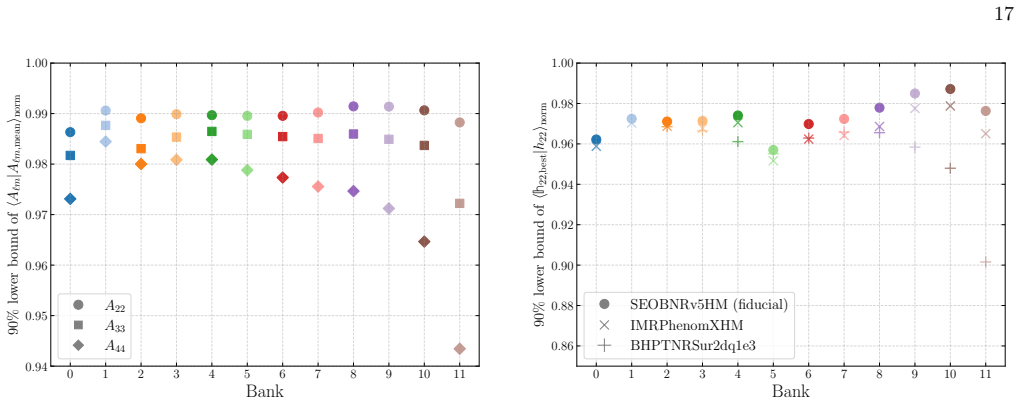
- [Sec. IV A and Eq. (24)] The waveform-systematics correction applied to the rate limits is arithmetically ambiguous and is not supported by the cited figure. The text says the upper bounds are multiplied by 'a factor of 1/0.93 ∼ 1.37' and refers to the right panel of Fig. 4. But 1/0.93 = 1.075, not 1.37; if the intended factor is 1/(0.93)^3 it is ~1.24, and if it is 1/(0.9)^3 it is ~1.37. The right panel of Fig. 4 does not contain a single number 0.93: the 90% lower bounds on match vary by bank from roughly 0.86 to 0.97. Since VT scales approximately as match^3, the correction in the low-match banks should be about 1/0.86^3 ≈ 1.57, larger than any of the candidate interpretations of the stated factor. Appendix D also contains the garbled phrase 'a sensitivity of 0.93∼0.7'. Because Fig. 1 is the paper's main result, the authors should specify exactly which quantity (match, match^3, or volume) is being corrected, quote the bank-by-bank values, and either adopt a conservative bank-dependent factor or validate the chosen factor end-to-end by injecting waveforms from IMRPhenomXHM and BHPTNRSur2dq1e3 and running the full detection statistic, including the R_lm marginalization and the IFAR threshold.
- [Sec. IIA4 and Fig. 4] The sensitivity volume-time used for the rate limits is estimated from injections into O3b data only, but Eq. (24) multiplies the Monte Carlo estimate by the total O3 observation time (Tobs ≈ 202 days). The paper never states or justifies the assumption that O3a and O3b have the same detection sensitivity. If the O3a noise PSD or glitch population differs from O3b, the true VT is a run-weighted combination of VT_O3a and VT_O3b, and the rate limits in Fig. 1 would shift. The authors should either inject into both O3a and O3b segments and combine the run-specific VT, or explicitly demonstrate (for example, by repeating a subset of injections in O3a) that O3b is representative within the quoted uncertainties.
- [Sec. IV B and Fig. 5] The cross-model robustness claim is based only on the effectualness match maximized over the entire bank; it does not propagate through the full detection statistic, the veto tests, or the IFAR threshold. The paper states that the search results are 'relatively robust against waveform systematics,' but the correction factor applied to the rate limits lacks end-to-end validation with non-SEOBNRv5 waveforms. For a subset of injections generated from IMRPhenomXHM and BHPTNRSur2dq1e3, the authors should run the full pipeline and compute Prec(θ, z | τthresh) to check whether the bank-level match predicts the recovered VT. This is especially important because the effectualness test for banks 0 and 1 does not include BHPTNRSur2dq1e3, leaving part of the low-mass parameter space without a cross-model check.
minor comments (6)
- [Fig. 5] The caption says 'HM pipeline sensite volume outperforms'; 'sensite' should be 'sensitive'.
- [Footnote, page 1] The footnote appears to read 'IAS-HMa pipeline'; this should be 'IAS-HM pipeline'.
- [Appendix D] The sentence 'the effectualness comparisons in Fig. 4 (which gives a sensitivity of 0.93 ∼ 0.7)' is unclear; presumably it means 0.9^3 ≈ 0.7 or match^3, but as written it is ambiguous and should be corrected.
- [Abstract] The abstract's phrase 'including higher modes in the template banks for the first time' is potentially misleading; the introduction clarifies that this is the first IMRI search with higher modes, not the first use of higher modes in templated searches. Consider rewording.
- [Sec. III] The statement that 'there is a ~3% probability of finding no candidates with an IFAR > 0.16 years' uses the loudest candidate's IFAR; the text should clarify that this is a posterior predictive check conditional on the observed loudest IFAR, not a frequentist p-value for the entire search.
- [Eq. (E2)] The bank weights w_b are computed using only the 22-mode optimal SNR, even though the search uses 33 and 44 modes; given the paper's emphasis on higher modes, the authors should justify that the relative bank weights are insensitive to including the higher modes.
Circularity Check
No significant circularity: the non-detection and rate limits are derived from an injection-recovery search with independent time-slide FAR estimates; self-citations are methodological, not load-bearing.
full rationale
This is an observational search, not a derivation of a first-principles prediction. The main result is a non-detection converted into rate upper limits through the chain: template-bank construction with SEOBNRv5HM, matched filtering of O3 LIGO data with the IAS-HM pipeline, FAR estimation from time-slid background, injection-recovery evaluation of the sensitive volume-time VT, and a Poisson upper limit using the loudest observed candidate. None of these steps reduces to its own input. The use of IFARmax = 0.16 yr, the loudest foreground candidate from the same data, is the standard loudest-event Poisson bound rather than a fitted parameter renamed as a prediction; it does not force the non-detection, because the candidate ranking and the time-slid background are independently constructed. The claimed up-to-~500% sensitivity gain from higher modes is a pipeline comparison obtained from injection-recovery, and is not an input that is later recycled as a result. The waveform-model dependence (SEOBNRv5HM templates, SEOBNRv5PHM injections) is a real systematic, but the paper does not disguise it: Fig. 4 and Appendix D quantify cross-model effectualness against IMRPhenomXHM and BHPTNRSur2dq1e3, and the paper explicitly notes that the comparison may overestimate systematics because the true waveform may lie between the models. A numerical statement is ambiguous ('1/0.93 ~ 1.37' is arithmetically inconsistent with 1/0.93 = 1.075 unless a cube was intended), and the uniform correction may under-cover low-match banks whose 90% lower match is ~0.86; however, that is a correctness or robustness concern, not circularity, because the correction is not a parameter later presented as a prediction. Self-citations to prior IAS pipeline papers are methodological references to public code and documented algorithms, not load-bearing assertions that substitute for the present analysis. The search is self-contained against external O3 data and previously published catalogs, so no circular step is present.
Assumptions & free parameters
free parameters (5)
- IFARmax threshold =
0.16 yr
- Number of template banks =
12
- SVD grid spacing Delta c_n =
0.3
- Waveform systematics correction factor =
1.37 (1/0.93)
- Restricted prior width sigma =
0.1
assumptions (6)
- domain assumption SEOBNRv5HM waveform accuracy in the IMRI regime q<1/18
- domain assumption Detector noise is stationary and Gaussian after preprocessing
- domain assumption LVK detector calibration and PSD estimates are accurate
- ad hoc to paper O3b noise is representative of O3a for VT estimates
- domain assumption The merger rate density is constant in time and f(z)=1
- ad hoc to paper The loudest foreground candidate is a noise fluctuation
Cite this review
Pith. "Pith review of Searching for intermediate mass ratio binary black hole mergers in the third observing run of LIGO-Virgo-KAGRA." pith.science (2026). https://pith.science/paper/EMDBSY6S
@misc{pith2026250701083,
  author       = {Pith},
  title        = {Pith review of: Searching for intermediate mass ratio binary black hole mergers in the third observing run of LIGO-Virgo-KAGRA},
  year         = {2026},
  howpublished = {\url{https://pith.science/paper/EMDBSY6S}},
  note         = {Machine review of arXiv:2507.01083}
}
abstract
Intermediate mass ratio inspirals (IMRIs) of binary black holes with mass ratios $10^{-4}\lesssim q \lesssim 0.1$ are astrophysically interesting sources of gravitational waves. Mergers of intermediate-mass black holes (IMBHs) with stellar-mass black holes would be IMRIs, so their detection can help us probe the formation mechanisms of IMBHs. They can also help us perform precise tests of general relativity due to the presence of strong higher-order mode emission. We perform a search for aligned-spin IMRIs within the data of the two LIGO detectors in the third observing run (O3) of the LIGO-Virgo-KAGRA (LVK) collaboration, including higher modes in the template banks for the first time. We use the IAS-HM pipeline for our search and construct template banks in the range $1/100 < q<1/18$ using the SEOBNRv5HM waveform model. Our banks retain a similar level of effectualness for IMRPhenomXHM and BHPTNRSur2dq1e3 waveforms, making our search results relatively robust against waveform systematics. We show that the sensitivity volume of the search increases by up to $\sim 500\%$ upon inclusion of higher modes. We do not find any significant candidates with inverse false alarm rate (IFAR) $> 1$ year in the O3 data. This gives us upper limits on the IMRI merger rate in the local Universe, ranging from $\sim 30$ to $10^3$ Gpc$^{-3}$ yr$^{-1}$ depending on the masses of the black holes in the binary. These constraints are consistent with rate predictions in the literature. Our projections indicate that we would be able to detect IMRIs or constrain some of their proposed formation channels in the fourth (O4) and fifth (O5) observing runs.
Figures


Figures from the paper (6 more)




Forward citations
Cited by 2 Pith papers
-
Trails of clouds in binary black holes
Boson clouds around binary black holes generically deplete through orbital resonances, driving eccentricity and spin-orbit tilt toward fixed points—including off-equatorial ones—leaving observable gravitational-wave trails.
-
Improving gravitational wave search sensitivity with TIER: Trigger Inference using Extended strain Representation
A machine learning classifier trained on the extended noise environment around gravitational wave candidates improves search sensitivity for heavy, unequal-mass black hole mergers by up to roughly 20 percent.
Reference graph
Works this paper leans on
-
[53]
S. F. Portegies Zwart and S. L. W. McMillan, Astrophys. J. 576, 899 (2002), arXiv:astro-ph/0201055
arXiv 2002
-
[1]
Therefore, we apply the procedure in Ref
Data preprocessing While the detector data noise is approximately Gaus- sian and stationary, non-Gaussian noise artifacts such as loud glitches and power lines could contaminate our search results. Therefore, we apply the procedure in Ref. [11] to clean the data stream before we perform the search. In brief, we remove stretches of data with excessive powe...
-
[2]
The procedures discussed in this section fol- low closely Sec
Detection statistic The remaining parts of the search pipeline will be dedi- cated to searching for and ranking potential GW event candidates. The procedures discussed in this section fol- low closely Sec. III of Ref. [92]. Let us denote the signal hypothesis asS and the null, or noise hypothesis asN. Note that the noise in our detector is not Gaussian in...
-
[3]
Again, note that the wave- form samples we have simulated are used to facilitate the construction of the template bank, but they are not the templates themselves
Geometrical placement algorithm We have now determined an amplitude to be shared by all templates in a bank. Again, note that the wave- form samples we have simulated are used to facilitate the construction of the template bank, but they are not the templates themselves. Now, we make use of the phase of the waveform samples. For a given bank, the geometri...
-
[4]
This can be done by checking whether most waveforms lying in the parameter space can be effectually represented by at least one template in the banks
Effectualness of the template bank Before going ahead with the GW search, we check whether the template bank actually covers the target pa- rameter space with the expected effectualness. This can be done by checking whether most waveforms lying in the parameter space can be effectually represented by at least one template in the banks. For this purpose, w...
-
[5]
triggers
Triggering and candidate collection Now that we have defined an optimal detection statistic ρ2 score, we can search for GWs by going through the whole GW detector data stream and computing the detection statistic over small time steps, at least in principle. By defining a tolerance in the false alarm rate (FAR)r, we can find GWs in the data by identifying...
-
[6]
Candidate vetoing The triggering and candidate collection explained in the previous paragraphs are performed using the approxi- mate scoresρ2 single-det and ρ2 multi-det. As mentioned, these do not include the non-Gaussian correction∆ρ2 k, so we would have picked up many candidates triggered by non- Gaussian noise transients, especially for higher mass te...
-
[7]
time-sliding
Collecting background candidates by time-sliding We can now address the determination of P ( |ρk|2⏐⏐α,v,N ) in Eq. (17). This is actually sim- plified by making use of the trigger-collecting procedure in the previous paragraph. That is, if we only care about the significant candidates withρ2 score >c (r), then P ( |ρk|2⏐⏐α,v,N ) =P ( |ρk|2⏐⏐α,v,N,ρ 2 mult...
Show all 130 references
-
[8]
The first one is the waveform samples prior, from which we draw parameter samples and simulate the waveforms for generating the template bank
Waveform samples prior In this work, we use three different prior distributions. The first one is the waveform samples prior, from which we draw parameter samples and simulate the waveforms for generating the template bank. These waveforms are not the template themselves, but ...
-
[9]
Astrophysical Prior for search When performing templated searches, we need to spec- ify astrophysical priors for the intrinsic parameters (i.e., P (α) in Eq.(12)). This astrophysical prior is similar to the waveform samples prior, but with a steeper power law in Mtot: P (Mtot)...
-
[10]
Injection Prior Other than the two priors mentioned above, we also need a prior to generate injection samples for testing our pipeline (see Sec. IV). This does not need to follow our astrophysical prior because the results of the injection campaign can later be reweighted. Our...
-
[11]
Restricted astrophysical prior for rate calculation In the main text, we want to constrain the rates of IMRIs at different masses and mass ratios. We need to reweight the injection-recovery results to a prior distribution centered at source-frame massesm1s and m2s =qm1s, so th...
-
[12]
B. P. Abbottet al.(LIGO Scientific, Virgo), Phys. Rev. Lett. 116, 061102 (2016), arXiv:1602.03837 [gr-qc]
2016 arXiv
-
[13]
B. P. Abbottet al.(LIGO Scientific, Virgo), Phys. Rev. X 6, 041015 (2016), [Erratum: Phys.Rev.X 8, 039903 (2018)], arXiv:1606.04856 [gr-qc]
2016 arXiv
-
[14]
B. P. Abbottet al.(LIGO Scientific, Virgo), Phys. Rev. X 9, 031040 (2019), arXiv:1811.12907 [astro-ph.HE]
2019 arXiv
-
[15]
Abbottet al.(LIGO Scientific, Virgo), Phys
R. Abbottet al.(LIGO Scientific, Virgo), Phys. Rev. X 11, 021053 (2021), arXiv:2010.14527 [gr-qc]
2021 arXiv
-
[16]
Abbottet al.(LIGO Scientific, VIRGO), Phys
R. Abbottet al.(LIGO Scientific, VIRGO), Phys. Rev. D 109, 022001 (2024), arXiv:2108.01045 [gr-qc]
2024 arXiv
-
[17]
Abbottet al.(KAGRA, VIRGO, LIGO Scientific), Phys
R. Abbottet al.(KAGRA, VIRGO, LIGO Scientific), Phys. Rev. X13, 041039 (2023), arXiv:2111.03606 [gr- qc]
2023 arXiv
-
[18]
A. H. Nitz, C. Capano, A. B. Nielsen, S. Reyes, R. White, D. A. Brown, and B. Krishnan, The Astrophysical Journal 872, 195 (2019)
2019
-
[19]
A. H. Nitz, T. Dent, G. S. Davies, S. Kumar, C. D. Capano, I. Harry, S. Mozzon, L. Nuttall, A. Lund- gren, and M. Tápai, Astrophys. J. 891, 123 (2020), arXiv:1910.05331 [astro-ph.HE]
2020 arXiv
-
[20]
A. H. Nitz, C. D. Capano, S. Kumar, Y.-F. Wang, S. Kastha, M. Schäfer, R. Dhurkunde, and M. Cabero, (2021), arXiv:2105.09151 [astro-ph.HE]
2021 arXiv
-
[21]
A. H. Nitz, S. Kumar, Y.-F. Wang, S. Kastha, S. Wu, M. Schäfer, R. Dhurkunde, and C. D. Capano, The Astrophysical Journal946, 59 (2023)
2023
-
[22]
Venumadhav, B
T. Venumadhav, B. Zackay, J. Roulet, L. Dai, and M. Zaldarriaga, Phys. Rev. D 100, 023011 (2019), arXiv:1902.10341 [astro-ph.IM]
2019 arXiv
-
[23]
Venumadhav, B
T. Venumadhav, B. Zackay, J. Roulet, L. Dai, and M. Zaldarriaga, Phys. Rev. D 101, 083030 (2020), arXiv:1904.07214 [astro-ph.HE]
2020 arXiv
-
[24]
Olsen, T
S. Olsen, T. Venumadhav, J. Mushkin, J. Roulet, B. Za- ckay, and M. Zaldarriaga, Phys. Rev. D106, 043009 (2022), arXiv:2201.02252 [astro-ph.HE]
2022 arXiv
-
[25]
A. K. Mehta, S. Olsen, D. Wadekar, J. Roulet, T. Venu- madhav, J. Mushkin, B. Zackay, and M. Zaldarriaga, Phys. Rev. D111, 024049 (2025), arXiv:2311.06061 [gr- qc]
2025 arXiv
-
[26]
Wadekar, J
D. Wadekar, J. Roulet, T. Venumadhav, A. K. Mehta, B. Zackay, J. Mushkin, S. Olsen, and M. Zaldarriaga, (2023), arXiv:2312.06631 [gr-qc]
2023 arXiv
-
[27]
B. P. Abbottet al.(LIGO Scientific, Virgo and other collaborations), Astrophys. J. Lett. 848, L12 (2017), arXiv:1710.05833 [astro-ph.HE]
2017 arXiv
-
[28]
B. P. Abbottet al.(LIGO Scientific, Virgo), Phys. Rev. Lett. 119, 161101 (2017), arXiv:1710.05832 [gr-qc]
2017 arXiv
-
[29]
Abbott et al
R. Abbott et al. (LIGO Scientific, Virgo), Phys. Rev. Lett. 125, 101102 (2020), arXiv:2009.01075 [gr-qc]
2020
-
[32]
B. P. Abbottet al.(LIGO Scientific, Virgo), Astrophys. J. Lett.892, L3 (2020), arXiv:2001.01761 [astro-ph.HE]
2020 arXiv
-
[33]
A. G. Abacet al. (LIGO Scientific, Virgo, KAGRA), Astrophys. J. Lett.970, L34 (2024), arXiv:2404.04248 [astro-ph.HE]
2024 arXiv
-
[34]
Abbottet al.(LIGO Scientific, KAGRA, VIRGO), Astrophys
R. Abbottet al.(LIGO Scientific, KAGRA, VIRGO), Astrophys. J. Lett.915, L5 (2021), arXiv:2106.15163 [astro-ph.HE]
2021 arXiv
-
[35]
D. A. Brown, H. Fang, J. R. Gair, C. Li, G. Lovelace, I. Mandel, and K. S. Thorne, Phys. Rev. Lett. 99, 201102 (2007), arXiv:gr-qc/0612060
2007 arXiv
-
[36]
Mandel, D
I. Mandel, D. A. Brown, J. R. Gair, and M. C. Miller, Astrophys. J.681, 1431 (2008), arXiv:0705.0285 [astro- ph]
2008 arXiv
-
[37]
Amaro-Seoane, Physical Review D98, 063018 (2018)
P. Amaro-Seoane, Physical Review D98, 063018 (2018)
2018
-
[38]
J. E. Greene, J. Strader, and L. C. Ho, Ann. Rev. Astron. Astrophys. 58, 257 (2020), arXiv:1911.09678 [astro-ph.GA]
2020 arXiv
-
[39]
Inayoshi, E
K. Inayoshi, E. Visbal, and Z. Haiman, Ann. Rev. As- tron. Astrophys.58, 27 (2020), arXiv:1911.05791 [astro- ph.GA]
2020 arXiv
-
[40]
Häberle, N
M. Häberle, N. Neumayer, A. Seth, A. Bellini, M. Li- bralato, H. Baumgardt, M. Whitaker, A. Dumont, M. Alfaro-Cuello, J. Anderson,et al., Nature631, 285 (2024)
2024
- [41]
- [42]
-
[43]
M. C. Begelman, M. Volonteri, and M. J. Rees, Mon. Not. Roy. Astron. Soc.370, 289 (2006), arXiv:astro- ph/0602363
2006
-
[44]
Lodato and P
G. Lodato and P. Natarajan, Mon. Not. Roy. Astron. Soc. 371, 1813 (2006), arXiv:astro-ph/0606159
2006 arXiv
-
[45]
M. A. Latif, D. J. Whalen, S. Khochfar, N. P. Herrington, and T. E. Woods, (2022), 10.1038/s41586-022-04813-y, arXiv:2207.05093 [astro-ph.GA]
2022 arXiv
-
[46]
C. L. Fryer, S. E. Woosley, and A. Heger, Astrophys. J. 550, 372 (2001), arXiv:astro-ph/0007176
2001 arXiv
-
[47]
Bromm and R
V. Bromm and R. B. Larson, Ann. Rev. Astron. Astro- phys. 42, 79 (2004), arXiv:astro-ph/0311019
2004 arXiv
-
[48]
Karlsson, V
T. Karlsson, V. Bromm, and J. Bland-Hawthorn, Rev. Mod. Phys. 85, 809 (2013), arXiv:1101.4024 [astro- ph.CO]
2013 arXiv
-
[49]
G. D. Quinlan and S. L. Shapiro, Astrophysical Journal, Part 1 (ISSN 0004-637X), vol. 321, Oct. 1, 1987, p. 199-
1987
-
[50]
Abbottet al.(LIGO Scientific, VIRGO, KAGRA), Astron
R. Abbottet al.(LIGO Scientific, VIRGO, KAGRA), Astron. Astrophys.659, A84 (2022), arXiv:2105.15120 [astro-ph.HE]
2022 arXiv
-
[51]
G. D. Quinlan and S. L. Shapiro, Astrophysical Journal, Part 1 (ISSN 0004-637X), vol. 343, Aug. 15, 1989, p. 725-749. Research supported by the US Army.343, 725 (1989)
1989
-
[52]
M. C. Miller and D. P. Hamilton, Mon. Not. Roy. Astron. Soc. 330, 232 (2002), arXiv:astro-ph/0106188
2002 arXiv
-
[54]
M. B. Davies, M. C. Miller, and J. M. Bellovary, The Astrophysical Journal Letters740, L42 (2011)
2011
-
[55]
A. Lupi, M. Colpi, B. Devecchi, G. Galanti, and M. Volonteri, Monthly Notices of the Royal Astronomical Society 442, 3616 (2014)
2014
-
[56]
Antonini, M
F. Antonini, M. Gieles, and A. Gualandris, Mon. Not. Roy. Astron. Soc.486, 5008 (2019), arXiv:1811.03640 [astro-ph.HE]
2019 arXiv
-
[57]
C. L. Rodriguez, M. Zevin, P. Amaro-Seoane, S. Chat- terjee, K. Kremer, F. A. Rasio, and C. S. Ye, Phys. Rev. D 100, 043027 (2019), arXiv:1906.10260 [astro-ph.HE]
2019 arXiv
-
[58]
Kritos, E
K. Kritos, E. Berti, and J. Silk, Phys. Rev. D108, 083012 (2023), arXiv:2212.06845 [astro-ph.HE]. 22
2023 arXiv
-
[59]
Kritos, E
K. Kritos, E. Berti, and J. Silk, Mon. Not. Roy. Astron. Soc. 531, 133 (2024), arXiv:2404.11676 [astro-ph.HE]
2024 arXiv
-
[60]
B. P. Abbottet al.(LIGO Scientific, Virgo), Phys. Rev. D 96, 022001 (2017), arXiv:1704.04628 [gr-qc]
2017 arXiv
-
[61]
B. P. Abbottet al.(LIGO Scientific, Virgo), Phys. Rev. D 100, 064064 (2019), arXiv:1906.08000 [gr-qc]
2019 arXiv
-
[62]
Abbott, LIGO Scientific Collaboration, and Virgo Collaboration, Phys
R. Abbott, LIGO Scientific Collaboration, and Virgo Collaboration, Phys. Rev. D 102, 043015 (2020), arXiv:2004.08342 [astro-ph.HE]
2020 arXiv
-
[63]
Chandra, V
K. Chandra, V. Villa-Ortega, T. Dent, C. McIsaac, A. Pai, I. W. Harry, G. S. C. Davies, and K. Soni, Phys. Rev. D104, 042004 (2021), arXiv:2106.00193 [gr-qc]
2021 arXiv
-
[64]
Chandra, A
K. Chandra, A. Pai, V. Villa-Ortega, T. Dent, C. McIsaac, I. W. Harry, G. S. C. Davies, and K. Soni, in 16th Marcel Grossmann Meeting on Recent Develop- ments in Theoretical and Experimental General Relativ- ity, Astrophysics and Relativistic Field Theories(2021) arXiv:2110.01...
2021 arXiv
-
[65]
Chandra, J
K. Chandra, J. Calderón Bustillo, A. Pai, and I. W. Harry, Phys. Rev. D 106, 123003 (2022), arXiv:2207.01654 [gr-qc]
2022 arXiv
-
[66]
J. R. Gair, I. Mandel, M. C. Miller, and M. Volonteri, Gen. Rel. Grav.43, 485 (2011), arXiv:0907.5450 [astro- ph.CO]
2011 arXiv
-
[67]
Fragione, A
G. Fragione, A. Loeb, B. Kocsis, and F. A. Rasio, Astrophys. J.933, 170 (2022), arXiv:2204.03745 [astro- ph.HE]
2022 arXiv
-
[68]
L. Wang, A. Tanikawa, and M. Fujii, Mon. Not. Roy. Astron. Soc.515, 5106 (2022), arXiv:2207.09621 [astro- ph.GA]
2022 arXiv
-
[69]
S. Lee, H. M. Lee, J.-h. Kim, R. Spurzem, J. Hong, and E. Chung, (2025), arXiv:2503.22109 [astro-ph.GA]
2025 arXiv
-
[70]
Fragione and N
G. Fragione and N. Leigh, Monthly Notices of the Royal Astronomical Society480, 5160 (2018)
2018
-
[71]
A. M. Derdzinski, D. D’Orazio, P. Duffell, Z. Haiman, and A. MacFadyen, Mon. Not. Roy. Astron. Soc.486, 2754 (2019), [Erratum: Mon.Not.Roy.Astron.Soc. 489, 4860–4861 (2019)], arXiv:1810.03623 [astro-ph.HE]
2019 arXiv
-
[72]
Derdzinski, D
A. Derdzinski, D. D’Orazio, P. Duffell, Z. Haiman, and A. MacFadyen, Mon. Not. Roy. Astron. Soc.501, 3540 (2021), arXiv:2005.11333 [astro-ph.HE]
2021 arXiv
-
[73]
Abbottet al., Astrophys
R. Abbottet al., Astrophys. J. Lett.896, L44 (2020), arXiv:2006.12611 [astro-ph.HE]
2020 arXiv
-
[74]
Sachdev, S
S. Sachdev, S. Caudill, H. Fong, R. K. Lo, C. Messick, D. Mukherjee, R. Magee, L. Tsukada, K. Blackburn, P. Brady,et al., arXiv preprint arXiv:1901.08580 (2019)
2019 arXiv
-
[75]
García-Quirós, M
C. García-Quirós, M. Colleoni, S. Husa, H. Estellés, G. Pratten, A. Ramos-Buades, M. Mateu-Lucena, and R. Jaume, Physical Review D102, 064002 (2020)
2020
-
[76]
K. Rink, R. Bachhar, T. Islam, N. E. M. Rifat, K. González-Quesada, S. E. Field, G. Khanna, S. A. Hughes, and V. Varma, Phys. Rev. D 110, 124069 (2024), arXiv:2407.18319 [gr-qc]
2024 arXiv
-
[77]
Pompili, A
L. Pompili, A. Buonanno, H. Estellés, M. Khalil, M. van de Meent, D. P. Mihaylov, S. Ossokine, M. Pürrer, A. Ramos-Buades, A. K. Mehta, R. Cotesta, S. Marsat, M. Boyle, L. E. Kidder, H. P. Pfeiffer, M. A. Scheel, H. R. Rüter, N. Vu, R. Dudi, S. Ma, K. Mitman, D. Melchor, S. Th...
2023 arXiv
-
[78]
Nagar, J
A. Nagar, J. Healy, C. O. Lousto, S. Bernuzzi, and A. Albertini, Phys. Rev. D105, 124061 (2022), arXiv:2202.05643 [gr-qc]
2022 arXiv
-
[79]
Islam, S
T. Islam, S. E. Field, S. A. Hughes, G. Khanna, V. Varma, M. Giesler, M. A. Scheel, L. E. Kidder, and H. P. Pfeiffer, Phys. Rev. D106, 104025 (2022), arXiv:2204.01972 [gr-qc]
2022 arXiv
-
[80]
J. Yoo, V. Varma, M. Giesler, M. A. Scheel, C.-J. Haster, H. P. Pfeiffer, L. E. Kidder, and M. Boyle, Phys. Rev. D 106, 044001 (2022), arXiv:2203.10109 [gr-qc]
2022 arXiv
-
[81]
C. O. Lousto and J. Healy, Phys. Rev. Lett.125, 191102 (2020), arXiv:2006.04818 [gr-qc]
2020 arXiv
-
[82]
C. O. Lousto and J. Healy, Class. Quant. Grav.40, 09LT01 (2023), arXiv:2203.08831 [gr-qc]
2023 arXiv
-
[83]
N. E. M. Rifat, S. E. Field, G. Khanna, and V. Varma, Phys. Rev. D101, 081502 (2020), arXiv:1910.10473 [gr- qc]
2020 arXiv
-
[84]
van de Meent and H
M. van de Meent and H. P. Pfeiffer, Phys. Rev. Lett. 125, 181101 (2020), arXiv:2006.12036 [gr-qc]
2020 arXiv
-
[85]
Messick, K
C. Messick, K. Blackburn, P. Brady, P. Brockill, K. Can- non, R. Cariou, S. Caudill, S. J. Chamberlin, J. D. Creighton, R. Everett, et al., Physical Review D95, 042001 (2017)
2017
-
[86]
Klimenko and G
S. Klimenko and G. Mitselmakher, Class. Quantum Grav. 21, S1819 (2004)
2004
-
[87]
Hanna, S
C. Hanna, S. Caudill, C. Messick, A. Reza, S. Sachdev, L. Tsukada, K. Cannon, K. Blackburn, J. D. Creighton, H. Fong,et al., Physical Review D101, 022003 (2020)
2020
-
[88]
Cannon, S
K. Cannon, S. Caudill, C. Chan, B. Cousins, J. D. Creighton, B. Ewing, H. Fong, P. Godwin, C. Hanna, S. Hooper,et al., SoftwareX14, 100680 (2021)
2021
-
[89]
Montani, B
T.Adams, D.Buskulic, V.Germain, G.Guidi, F.Marion, M. Montani, B. Mours, F. Piergiovanni, and G. Wang, Class. Quantum Grav.33, 175012 (2016)
2016
-
[90]
Aubin, F
F. Aubin, F. Brighenti, R. Chierici, D. Estevez, G. Greco, G. M. Guidi, V. Juste, F. Marion, B. Mours, E. Nitoglia, et al., Class. Quantum Grav.38, 095004 (2021)
2021
-
[91]
Allen, Physical Review D—Particles, Fields, Gravita- tion, and Cosmology71, 062001 (2005)
B. Allen, Physical Review D—Particles, Fields, Gravita- tion, and Cosmology71, 062001 (2005)
2005
-
[92]
Allen, W
B. Allen, W. G. Anderson, P. R. Brady, D. A. Brown, and J. D. Creighton, Physical Review D—Particles, Fields, Gravitation, and Cosmology85, 122006 (2012)
2012
-
[93]
Dal Canton, A
T. Dal Canton, A. H. Nitz, A. P. Lundgren, A. B. Nielsen, D. A. Brown, T. Dent, I. W. Harry, B. Krishnan, A. J. Miller, K. Wette,et al., Physical Review D90, 082004 (2014)
2014
-
[94]
S. A. Usman, A. H. Nitz, I. W. Harry, C. M. Biwer, D. A. Brown, M. Cabero, C. D. Capano, T. Dal Canton, T. Dent, S. Fairhurst,et al., Class. Quantum Grav.33, 215004 (2016)
2016
-
[95]
A. H. Nitz, T. Dent, T. Dal Canton, S. Fairhurst, and D. A. Brown, The Astrophysical Journal849, 118 (2017)
2017
-
[96]
G. S. Davies, T. Dent, M. Tápai, I. Harry, C. McIsaac, and A. H. Nitz, Physical Review D102, 022004 (2020)
2020
-
[97]
Chu et al., Phys
Q. Chu et al., Phys. Rev. D 105, 024023 (2022), arXiv:2011.06787 [gr-qc]
2022 arXiv
-
[98]
Buonanno, G
A. Buonanno, G. B. Cook, and F. Pretorius, Phys. Rev. D 75, 124018 (2007), arXiv:gr-qc/0610122
2007 arXiv
-
[99]
Klimenko, G
S. Klimenko, G. Vedovato, M. Drago, G. Mazzolo, G. Mitselmakher, C. Pankow, G. Prodi, V. Re, F. Salemi, and I. Yakushin, Physical Review D—Particles, Fields, Gravitation, and Cosmology83, 102001 (2011)
2011
-
[100]
Klimenko, G
S. Klimenko, G. Vedovato, M. Drago, F. Salemi, V. Ti- wari, G. Prodi, C. Lazzaro, K. Ackley, S. Tiwari, C. Da Silva,et al., Physical Review D93, 042004 (2016). 23
2016
-
[101]
Roulet, L
J. Roulet, L. Dai, T. Venumadhav, B. Zackay, and M. Zaldarriaga, Phys. Rev. D 99, 123022 (2019), arXiv:1904.01683 [astro-ph.IM]
2019 arXiv
-
[102]
Zackay, T
B. Zackay, T. Venumadhav, J. Roulet, L. Dai, and M. Zaldarriaga, Phys. Rev. D 104, 063034 (2021), arXiv:1908.05644 [astro-ph.IM]
2021 arXiv
-
[103]
Wadekar, T
D. Wadekar, T. Venumadhav, A. K. Mehta, J. Roulet, S. Olsen, J. Mushkin, B. Zackay, and M. Zaldarriaga, Phys. Rev. D110, 084035 (2024), arXiv:2310.15233 [gr- qc]
2024 arXiv
-
[104]
Wadekar, T
D. Wadekar, T. Venumadhav, J. Roulet, A. K. Mehta, B. Zackay, J. Mushkin, and M. Zaldarriaga, Phys. Rev. D 110, 044063 (2024), arXiv:2405.17400 [gr-qc]
2024 arXiv
-
[105]
A. K. Mehta, D. Wadekar, J. Roulet, I. Anantpurkar, T. Venumadhav, J. Mushkin, B. Zackay, M. Zaldarriaga, and T. Islam, (2025), arXiv:2501.17939 [gr-qc]
2025 arXiv
-
[106]
Pompili, A
L. Pompili, A. Buonanno, H. Estellés, M. Khalil, M. van de Meent, D. P. Mihaylov, S. Ossokine, M. Pür- rer, A. Ramos-Buades, A. K. Mehta,et al., Physical Review D108, 124035 (2023)
2023
-
[107]
Khalil, A
M. Khalil, A. Buonanno, H. Estelles, D. P. Mihaylov, S. Ossokine, L. Pompili, and A. Ramos-Buades, Phys. Rev. D108, 124036 (2023), arXiv:2303.18143 [gr-qc]
2023 arXiv
-
[108]
D. P. Mihaylov, S. Ossokine, A. Buonanno, H. Estelles, L. Pompili, M. Pürrer, and A. Ramos-Buades, (2023), arXiv:2303.18203 [gr-qc]
2023 arXiv
-
[109]
van de Meent, A
M. van de Meent, A. Buonanno, D. P. Mihaylov, S. Os- sokine, L. Pompili, N. Warburton, A. Pound, B. Wardell, L. Durkan, and J. Miller, Phys. Rev. D108, 124038 (2023), arXiv:2303.18026 [gr-qc]
2023 arXiv
-
[110]
Roulet, S
J. Roulet, S. Olsen, J. Mushkin, T. Islam, T. Venumad- hav, B. Zackay, and M. Zaldarriaga, Phys. Rev. D106, 123015 (2022), arXiv:2207.03508 [gr-qc]
2022 arXiv
-
[111]
Berti, V
E. Berti, V. Cardoso, J. A. Gonzalez, U. Sperhake, M. Hannam, S. Husa, and B. Bruegmann, Phys. Rev. D 76, 064034 (2007), arXiv:gr-qc/0703053
2007 arXiv
-
[112]
L. E. Kidder, Phys. Rev. D 77, 044016 (2008), arXiv:0710.0614 [gr-qc]
2008 arXiv
-
[113]
Berti, V
E. Berti, V. Cardoso, J. A. Gonzalez, U. Sperhake, and B. Bruegmann, Class. Quant. Grav.25, 114035 (2008), arXiv:0711.1097 [gr-qc]
2008 arXiv
-
[114]
García-Quirós, M
C. García-Quirós, M. Colleoni, S. Husa, H. Estel- lés, G. Pratten, A. Ramos-Buades, M. Mateu-Lucena, and R. Jaume, Phys. Rev. D 102, 064002 (2020), arXiv:2001.10914 [gr-qc]
2020 arXiv
-
[115]
C. K. Mishra, A. Kela, K. G. Arun, and G. Faye, Phys. Rev. D93, 084054 (2016), arXiv:1601.05588 [gr-qc]
2016 arXiv
-
[116]
B. F. Schutz, Class. Quantum Grav.28, 125023 (2011), arXiv:1102.5421 [astro-ph.IM]
2011 arXiv
-
[117]
Pedregosa, G
F. Pedregosa, G. Varoquaux, A. Gramfort, V. Michel, B. Thirion, O. Grisel, M. Blondel, P. Prettenhofer, R. Weiss, V. Dubourg,et al., the Journal of machine Learning research12, 2825 (2011)
2011
-
[118]
Islam and G
T. Islam and G. Khanna, Phys. Rev. D108, 044012 (2023), arXiv:2306.08767 [gr-qc]
2023 arXiv
-
[119]
Islam and G
T. Islam and G. Khanna (SXS), Phys. Rev. D108, 124046 (2023), arXiv:2307.03155 [gr-qc]
2023 arXiv
-
[120]
Neyman and E
J. Neyman and E. S. Pearson, Philosophical Transactions of the Royal Society of London. Series A, Containing Papers of a Mathematical or Physical Character231, 289 (1933)
1933
-
[121]
Wadekaret al., in prep
D. Wadekaret al., in prep
- [123]
-
[124]
Roulet, J
J. Roulet, J. Mushkin, D. Wadekar, T. Venumadhav, B. Zackay, and M. Zaldarriaga, Phys. Rev. D 110, 044010 (2024), arXiv:2404.02435 [gr-qc]
2024 arXiv
-
[125]
Ramos-Buades, A
A. Ramos-Buades, A. Buonanno, H. Estellés, M. Khalil, D. P. Mihaylov, S. Ossokine, L. Pompili, and M. Shiferaw, Physical Review D108, 124037 (2023)
2023
-
[126]
Tanikawa, H
A. Tanikawa, H. Susa, T. Yoshida, A. A. Trani, and T. Kinugawa, Astrophys. J. 910, 30 (2021), arXiv:2008.01890 [astro-ph.HE]
2021 arXiv
-
[127]
Arca-Sedda, P
M. Arca-Sedda, P. Amaro-Seoane, and X. Chen, Astron. Astrophys. 652, A54 (2021), arXiv:2007.13746 [astro- ph.GA]
2021 arXiv
-
[128]
B. P. Abbottet al.(KAGRA, LIGO Scientific, Virgo), Living Rev. Rel.19, 1 (2016), arXiv:1304.0670 [gr-qc]
2016 arXiv
-
[129]
Barsotti, L
L. Barsotti, L. McCuller, M. Evans, and P. Fritschel, The A+ design curve, Tech. Rep. LIGO-T1800042-v5 (LIGO, 2018)
2018
-
[130]
Abbottet al.(KAGRA, VIRGO, LIGO Scientific), Phys
R. Abbottet al.(KAGRA, VIRGO, LIGO Scientific), Phys. Rev. X13, 011048 (2023), arXiv:2111.03634 [astro- ph.HE]
2023 arXiv
-
[131]
Aghanimet al.(Planck), Astron
N. Aghanimet al.(Planck), Astron. Astrophys.641, A6 (2020), [Erratum: Astron.Astrophys. 652, C4 (2021)], arXiv:1807.06209 [astro-ph.CO]
2020 arXiv
-
[132]
Roulet, T
J. Roulet, T. Venumadhav, B. Zackay, L. Dai, and M. Zaldarriaga, Phys. Rev. D102, 123022 (2020)
2020
-
[210]
NSERC-supported research.321, 199 (1987)
1987
Reviewed August 6, 2026 · model on record in the stance chip above.
Discussion (0). Sign in to comment.