REVIEW 5 major objections 5 minor 53 references
FlashDP: Private Training Large Language Models with Efficient DP-SGD
T0 review · 5 major / 5 minor · reviewed 2026-08-06 · deepseek-v4-flash
Pith's one-line read FlashDP claims private 13B LLM pretraining at 90% of non-DP speed.
desk verdict A solid DP-SGD kernel optimization with code, undermined by unmeasured efficiency percentages and a single-kernel claim that contradicts its own implementation. read the letter →
The pith
A machine-rendered reading of the paper's core claim, the machinery that carries it, and where it could break.
The reading
What carries the argument
The machinery is a fused per-layer DP-SGD kernel built on a Block-wise All-Reduce algorithm inside a Hierarchical Reduction Architecture. Per-sample gradient blocks are computed with batched GEMM in SRAM, norms are reduced within each block and then across blocks with atomics in HBM, and after a synchronization point the same blocks are clipped and noised before aggregation. Because CUDA cannot synchronize blocks inside one kernel, the implementation uses an adaptive kernel design that launches kernels serially over the batch dimension, using kernel boundaries as synchronization points.
What would settle it
Measure FlashDP's throughput at batch sizes much larger than 8 while holding the model fixed: if per-batch-element kernel launches add overhead linearly, throughput will fall visibly below the 90% non-DP ratio as batch size grows. A cleaner test is to compare FlashDP against a cooperative-groups single-kernel implementation with identical math; if the single kernel is faster, the adaptive launch strategy, not the fusion, is responsible for the headline number.
Extended reading notes
Core claim
The paper's central claim is that the expensive parts of per-layer DP-SGD can be reorganized so that per-sample gradients are produced once on-chip, their norms are aggregated with a block-wise all-reduce, clipping and noise are applied in SRAM, and only the final parameter gradient is written to HBM. FlashDP reports that this reduces memory movement relative to prior implicit methods and cuts redundant computation, so it matches non-DP memory usage and reaches 90% of non-DP throughput while preserving the same accuracy and privacy guarantees as standard per-layer clipped DP-SGD and DP-Adam.
Load-bearing premise
FlashDP assumes that launching many small kernels serially, one per batch element, costs little enough that the fused computation still reaches near-non-DP throughput; the paper does not report kernel-launch overhead or large-batch scaling.
Editorial extensions
If this is right
- Pretraining 13B-parameter models under DP can avoid extra memory beyond the non-private baseline.
- Private pretraining at near-non-DP speed becomes feasible on a four-GPU server rather than a large cluster.
- The same fused pattern should transfer to DP-Adam, since the clipping and noise-addition stage is identical.
- Memory use stays flat as micro-batch size grows, unlike explicit methods that exhaust memory at larger batches.
- Per-layer clipping becomes a practical default for LLM DP training because its main cost has been removed.
Reading between the lines
- The paper's 90% figure is measured at batch sizes up to 8; an untested implication is that the serial per-batch-element kernel launches could erode the advantage at much larger batch sizes, where launch overhead begins to dominate.
- The same fusion strategy could apply to other per-sample operations beyond DP-SGD, such as per-sample loss penalties or per-sample evaluation metrics, which currently pay the same storage or recomputation tax.
- A direct testable extension is to benchmark FlashDP against a cooperative-groups single-kernel implementation on newer GPUs; if launch overhead is negligible, a single-kernel version would be both simpler and faster.
Editorial analysis
A structured set of objections, weighed in public.
Referee Report
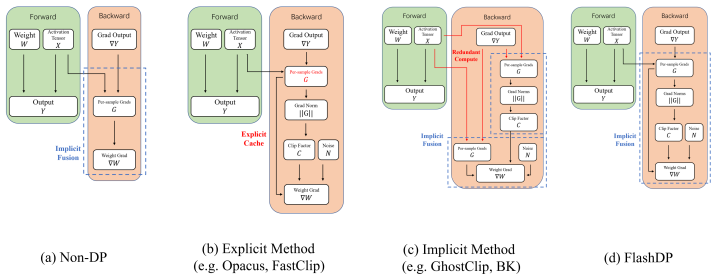
Summary. The paper proposes FlashDP, an implementation of per-layer clipped DP-SGD for training large language models. FlashDP uses block-wise all-reduce and a hierarchical reduction architecture to compute per-sample gradient norms and perform clipping in a cache-friendly way, avoiding both the explicit per-sample gradient storage of Opacus and the gradient recomputation of GhostClip/BK. The authors report memory usage close to non-private training, throughput up to 90% of non-DP training for Llama-13B on four A100s, and validation loss identical to standard per-layer DP-SGD, alongside qualitative claims of 50% lower memory movement and 20% lower redundant computation.
Significance. If fully substantiated, FlashDP would be a valuable systems contribution: it targets a real bottleneck in differentially private LLM pre-training, and the open-source release is a concrete reproducibility asset. The underlying DP-SGD arithmetic is standard, and the reported numerical parity with per-layer DP-SGD is a reasonable correctness check. However, the paper's headline quantitative claims—50% memory-movement reduction, 20% redundant-computation reduction, and 90% of non-DP throughput on Llama-13B—are not directly measured with profiling or FLOP counts, and the implementation narrative contains a direct contradiction between the claimed single-kernel design and the actual adaptive multi-kernel implementation. These gaps make the central efficiency claims currently under-supported.
major comments (5)
- [§4.2 vs §1 and contribution bullets] Section 4.2 states that FlashDP does not rely on a monolithic kernel and instead splits the process across different kernels executed iteratively over the batch dimension, using kernel termination as the synchronization point. This directly contradicts Section 1 and the contribution list, which claim that FlashDP consolidates the entire DP-SGD process into a single GPU kernel. Because the adaptive multi-kernel design introduces kernel-launch and inter-kernel synchronization overhead that the paper does not measure, please either report this overhead as a function of batch size or revise the single-kernel claims.
- [Abstract, §1, Tables 1–4 and Figures 4–7] The abstract and Section 1 claim reductions of up to 50% in memory movement and 20% in redundant computation, but no experiment in the paper measures memory traffic or computational redundancy. Tables 1 and 2 report memory capacity and throughput, and Figures 4–7 report memory and throughput; no CUPTI/NCU profiling, memory-transaction counts, or FLOP counts are provided. These two numbers are headline contributions and need direct measurement, or the claims should be removed.
- [Table 1] In Table 1, FlashDP's memory usage is identical to NonDP in every reported row (e.g., GPT2-large B=4: 6.60 vs 6.60; GPT2-medium B=8: 6.60 vs 6.60). Exact equality across all configurations is difficult to reconcile with the extra per-layer clipping thresholds, noise states, and synchronization buffers required by DP-SGD. Please state precisely what is included in the memory measurement and explain why FlashDP adds zero memory overhead; if the numbers are rounded or dominated by a shared buffer, say so explicitly.
- [Algorithm 1 vs Algorithm 2/3] Algorithm 1 presents a single clipped-gradient update with a single threshold C and noise scale σ, with no layer index, while the paper's stated method is per-layer clipping (Algorithm 3). Moreover, line 13 accumulates the per-block clipped gradients and adds noise without dividing by batch size, whereas Algorithm 2 and Appendix A.1 define the DP-SGD update as (1/B)∑ g'_i + N(0, σ²C²I). Please clarify the relationship between the block-level sums and the final averaged update, and show how per-layer thresholds enter the kernel; this is needed to verify the privacy semantics of the implementation.
- [§5.3 and Figure 6] The abstract's headline '90% throughput compared to the Non-DP method' for Llama-13B is not stated in the experimental section; Section 5.3 only says FlashDP shows 'minimal throughput degradation.' Please report the exact Llama-13B throughput values, the pipeline-parallel configuration, batch and micro-batch sizes, and how the 90% figure is computed. Without these details, the central scaling claim is not verifiable.
minor comments (5)
- [Appendix B.1] The inserted 'Clarification on Gradient Formulations and Reviewer Feedback' is a reviewer-response artifact that should not appear in a submitted manuscript; it also states that Figure 2(a)'s per-sample nodes are 'purely illustrative' while the actual NonDP baseline uses batched GEMM. Please remove the self-referential text and revise the Figure 2 caption so the figure accurately represents the implemented baseline.
- [§4.1 vs Algorithm 1] Section 4.1 says the block-wise all-reduce is 'executed efficiently within the SRAM,' but Algorithm 1 line 9 says to offload the norm-square blocks from SRAM to HBM and perform the all-reduce there, with line 11 uploading the result back. Please resolve this internal inconsistency and describe where the all-reduce actually takes place.
- [Table 3 and §5.1] The utility experiment in Table 3 reports identical validation loss for DP-SGD and FlashDP at three epsilon values, but no non-private baseline, no error bars or seeds, and no training curves are shown. Also, Section 5.1 says the dataset is Wikitext, while Appendix C.1 says the utility experiment uses Fineweb-edu; please clarify which dataset is used where.
- [Tables 1–2 and Figure 7] The unit notation 'x1e4' in the table headers is confusing and should be replaced with standard units (e.g., MB and tokens/sec). There are also typos such as 'implicate methods' in the Section 3 heading and 'GPT-samll' in the Figure 7 caption.
- [Figures 4 and 6] Figures 4 and 6 appear to be identical plots of the pipeline-parallel Llama experiments; please avoid duplicating the same figure in the main text and appendix without cross-referencing.
Circularity Check
No significant circularity: FlashDP is a systems optimization whose accuracy parity is arithmetic equivalence and whose throughput/memory claims are external benchmark measurements, not fitted predictions.
full rationale
FlashDP is an implementation-level optimization of standard per-layer DP-SGD: it fuses per-sample gradient computation, norm computation, clipping, noise addition, and aggregation without changing the mathematical operations. The claimed accuracy parity with per-layer DP-SGD is therefore an arithmetic equivalence, and the paper explicitly verifies it in Table 3 by reporting identical validation losses for DP-SGD and FlashDP across privacy levels, which is an equivalence check rather than a fitted prediction. The throughput and memory claims are measured against NonDP, Opacus, GhostClip, and BK baselines, not derived from any fitted parameter or from the definition of the target quantity. There is no load-bearing self-citation: the cited prior work on per-layer clipping (Bu et al., 2023a; He et al., 2022) is external to the authors and is used only to justify the choice of per-layer clipping rather than to establish FlashDP's efficiency or accuracy. The paper's use of per-sample gradient arithmetic and its reporting of identical validation loss confirm that FlashDP performs the same computation as the baseline. The open-sourced code and external benchmarks make the results independently checkable. The weakest point noted by the reader—absence of a measured kernel-launch overhead scaling study—is an empirical validation gap, not a circular derivation. Therefore no circular step can be exhibited, and the appropriate score is 0.
Assumptions & free parameters
free parameters (1)
- Block dimensions (b, t, d, p) =
Chosen based on GPU SRAM capacity M
assumptions (3)
- domain assumption Per-layer clipping in DP-SGD provides DP guarantees and maintains accuracy comparable to global clipping (from Bu et al. 2023a; He et al. 2022).
- domain assumption GPU memory hierarchy (SRAM/HBM) behaves as described, and blocking improves data locality (standard CUDA/GPU architecture).
- domain assumption CUDA cooperative groups grid synchronization is impractical for DP applications due to requirement to launch all blocks simultaneously (statement in Section 4.2).
Cite this review
Pith. "Pith review of FlashDP: Private Training Large Language Models with Efficient DP-SGD." pith.science (2026). https://pith.science/paper/UWWS3KEY
@misc{pith2026250701154,
  author       = {Pith},
  title        = {Pith review of: FlashDP: Private Training Large Language Models with Efficient DP-SGD},
  year         = {2026},
  howpublished = {\url{https://pith.science/paper/UWWS3KEY}},
  note         = {Machine review of arXiv:2507.01154}
}
read the original abstract
As large language models (LLMs) increasingly underpin technological advancements, the privacy of their training data emerges as a critical concern. Differential Privacy (DP) serves as a rigorous mechanism to protect this data, yet its integration via Differentially Private Stochastic Gradient Descent (DP-SGD) introduces substantial challenges, primarily due to the complexities of per-sample gradient clipping. Current explicit methods, such as Opacus, necessitate extensive storage for per-sample gradients, significantly inflating memory requirements. Conversely, implicit methods like GhostClip reduce storage needs by recalculating gradients multiple times, which leads to inefficiencies due to redundant computations. This paper introduces FlashDP, an innovative cache-friendly per-layer DP-SGD that consolidates necessary operations into a single task, calculating gradients only once in a fused manner. This approach not only diminishes memory movement by up to \textbf{50\%} but also cuts down redundant computations by \textbf{20\%}, compared to previous methods. Consequently, FlashDP does not increase memory demands and achieves a \textbf{90\%} throughput compared to the Non-DP method on a four-A100 system during the pre-training of the Llama-13B model, while maintaining parity with standard per-layer clipped DP-SGD in terms of accuracy. These advancements establish FlashDP as a pivotal development for efficient and privacy-preserving training of LLMs. FlashDP's code has been open-sourced in https://github.com/kaustpradalab/flashdp.
Figures


Figures from the paper (4 more)


Reference graph
Works this paper leans on
-
[1]
write newline
" write newline "" before.all 'output.state := FUNCTION n.dashify 't := "" t empty not t #1 #1 substring "-" = t #1 #2 substring "--" = not "--" * t #2 global.max substring 't := t #1 #1 substring "-" = "-" * t #2 global.max substring 't := while if t #1 #1 substring * t #2 global.max substring 't := if while FUNCTION format.date year duplicate empty "emp...
-
[2]
Mart\' n Abadi, Ashish Agarwal, Paul Barham, Eugene Brevdo, Zhifeng Chen, Craig Citro, Greg S. Corrado, Andy Davis, Jeffrey Dean, Matthieu Devin, Sanjay Ghemawat, Ian Goodfellow, Andrew Harp, Geoffrey Irving, Michael Isard, Yangqing Jia, Rafal Jozefowicz, Lukasz Kaiser, Manjunath Kudlur, Josh Levenberg, Dan Man\' e , Rajat Monga, Sherry Moore, Derek Murra...
work page 2015
-
[3]
Deep learning with differential privacy
Martin Abadi, Andy Chu, Ian Goodfellow, H Brendan McMahan, Ilya Mironov, Kunal Talwar, and Li Zhang. Deep learning with differential privacy. In Proceedings of the 2016 ACM SIGSAC conference on computer and communications security, pp.\ 308--318, 2016
2016
-
[4]
Josh Achiam, Steven Adler, Sandhini Agarwal, Lama Ahmad, Ilge Akkaya, Florencia Leoni Aleman, Diogo Almeida, Janko Altenschmidt, Sam Altman, Shyamal Anadkat, et al. Gpt-4 technical report. arXiv preprint arXiv:2303.08774, 2023
arXiv 2023
-
[5]
Using chatgpt to write patient clinic letters
Stephen R Ali, Thomas D Dobbs, Hayley A Hutchings, and Iain S Whitaker. Using chatgpt to write patient clinic letters. The Lancet Digital Health, 5 0 (4): 0 e179--e181, 2023
work page 2023
-
[6]
Large-scale differentially private bert
Rohan Anil, Badih Ghazi, Vineet Gupta, Ravi Kumar, and Pasin Manurangsi. Large-scale differentially private bert. arXiv preprint arXiv:2108.01624, 2021
arXiv 2021
-
[7]
Large-scale differentially private bert
Rohan Anil, Badih Ghazi, Vineet Gupta, Ravi Kumar, and Pasin Manurangsi. Large-scale differentially private bert. In Findings of the Association for Computational Linguistics: EMNLP 2022, pp.\ 6481--6491, 2022
work page 2022
-
[8]
Towards end-to-end 4-bit inference on generative large language models
Saleh Ashkboos, Ilia Markov, Elias Frantar, Tingxuan Zhong, Xincheng Wang, Jie Ren, Torsten Hoefler, and Dan Alistarh. Towards end-to-end 4-bit inference on generative large language models. arXiv preprint arXiv:2310.09259, 2023
Show all 53 references
-
[9]
Role of chat gpt in public health
Som S Biswas. Role of chat gpt in public health. Annals of biomedical engineering, 51 0 (5): 0 868--869, 2023
2023
-
[10]
On the opportunities and risks of foundation models
Rishi Bommasani, Drew A Hudson, Ehsan Adeli, Russ Altman, Simran Arora, Sydney von Arx, Michael S Bernstein, Jeannette Bohg, Antoine Bosselut, Emma Brunskill, et al. On the opportunities and risks of foundation models. arXiv preprint arXiv:2108.07258, 2021
2021 arXiv
-
[11]
Scalable and efficient training of large convolutional neural networks with differential privacy
Zhiqi Bu, Jialin Mao, and Shiyun Xu. Scalable and efficient training of large convolutional neural networks with differential privacy. Advances in Neural Information Processing Systems, 35: 0 38305--38318, 2022
2022
-
[12]
On the accuracy and efficiency of group-wise clipping in differentially private optimization
Zhiqi Bu, Ruixuan Liu, Yu-Xiang Wang, Sheng Zha, and George Karypis. On the accuracy and efficiency of group-wise clipping in differentially private optimization. arXiv preprint arXiv:2310.19215, 2023 a
2023 arXiv
-
[13]
Differentially private optimization on large model at small cost
Zhiqi Bu, Yu-Xiang Wang, Sheng Zha, and George Karypis. Differentially private optimization on large model at small cost. In International Conference on Machine Learning, pp.\ 3192--3218. PMLR, 2023 b
2023
-
[14]
A comprehensive survey of ai-generated content (aigc): A history of generative ai from gan to chatgpt
Yihan Cao, Siyu Li, Yixin Liu, Zhiling Yan, Yutong Dai, Philip S Yu, and Lichao Sun. A comprehensive survey of ai-generated content (aigc): A history of generative ai from gan to chatgpt. arXiv preprint arXiv:2303.04226, 2023
2023 arXiv
-
[15]
Quantifying memorization across neural language models
Nicholas Carlini, Daphne Ippolito, Matthew Jagielski, Katherine Lee, Florian Tramer, and Chiyuan Zhang. Quantifying memorization across neural language models. In International Conference on Learning Representations, 2023
2023
-
[16]
A survey of embodied ai: From simulators to research tasks
Jiafei Duan, Samson Yu, Hui Li Tan, Hongyuan Zhu, and Cheston Tan. A survey of embodied ai: From simulators to research tasks. IEEE Transactions on Emerging Topics in Computational Intelligence, 6 0 (2): 0 230--244, 2022
2022
-
[17]
An efficient dp-sgd mechanism for large scale nlu models
Christophe Dupuy, Radhika Arava, Rahul Gupta, and Anna Rumshisky. An efficient dp-sgd mechanism for large scale nlu models. In ICASSP 2022-2022 IEEE International Conference on Acoustics, Speech and Signal Processing (ICASSP), pp.\ 4118--4122. IEEE, 2022
2022
-
[18]
Differential privacy
Cynthia Dwork. Differential privacy. In International colloquium on automata, languages, and programming, pp.\ 1--12. Springer, 2006
2006
-
[19]
Calibrating noise to sensitivity in private data analysis
Cynthia Dwork, Frank McSherry, Kobbi Nissim, and Adam Smith. Calibrating noise to sensitivity in private data analysis. In Theory of Cryptography: Third Theory of Cryptography Conference, TCC 2006, New York, NY, USA, March 4-7, 2006. Proceedings 3, pp.\ 265--284. Springer, 2006
2006
-
[20]
Llm-based nlg evaluation: Current status and challenges
Mingqi Gao, Xinyu Hu, Jie Ruan, Xiao Pu, and Xiaojun Wan. Llm-based nlg evaluation: Current status and challenges. arXiv preprint arXiv:2402.01383, 2024
2024 arXiv
-
[21]
Efficient per-example gradient computations
Ian Goodfellow. Efficient per-example gradient computations. arXiv preprint arXiv:1510.01799, 2015
2015 arXiv
-
[22]
Exploring the limits of differentially private deep learning with group-wise clipping
Jiyan He, Xuechen Li, Da Yu, Huishuai Zhang, Janardhan Kulkarni, Yin Tat Lee, Arturs Backurs, Nenghai Yu, and Jiang Bian. Exploring the limits of differentially private deep learning with group-wise clipping. arXiv preprint arXiv:2212.01539, 2022
2022 arXiv
-
[23]
Learning and evaluating a differentially private pre-trained language model
Shlomo Hoory, Amir Feder, Avichai Tendler, Sofia Erell, Alon Peled-Cohen, Itay Laish, Hootan Nakhost, Uri Stemmer, Ayelet Benjamini, Avinatan Hassidim, et al. Learning and evaluating a differentially private pre-trained language model. In Findings of the Association for Comput...
2021
-
[24]
Preventing verbatim memorization in language models gives a false sense of privacy
Daphne Ippolito, Florian Tram \`e r, Milad Nasr, Chiyuan Zhang, Matthew Jagielski, Katherine Lee, Christopher A Choquette-Choo, and Nicholas Carlini. Preventing verbatim memorization in language models gives a false sense of privacy. arXiv preprint arXiv:2210.17546, 2022
-
[25]
Differentially private language models benefit from public pre-training
Gavin Kerrigan, Dylan Slack, and Jens Tuyls. Differentially private language models benefit from public pre-training. arXiv preprint arXiv:2009.05886, 2020
2009 arXiv
-
[26]
torchgpipe: On-the-fly pipeline parallelism for training giant models
Chiheon Kim, Heungsub Lee, Myungryong Jeong, Woonhyuk Baek, Boogeon Yoon, Ildoo Kim, Sungbin Lim, and Sungwoong Kim. torchgpipe: On-the-fly pipeline parallelism for training giant models. arXiv preprint arXiv:2004.09910, 2020
2004 arXiv
-
[27]
Scaling up differentially private deep learning with fast per-example gradient clipping
Jaewoo Lee and Daniel Kifer. Scaling up differentially private deep learning with fast per-example gradient clipping. arXiv preprint arXiv:2009.03106, 2020
2009 arXiv
-
[28]
Scaling up differentially private deep learning with fast per-example gradient clipping
Jaewoo Lee and Daniel Kifer. Scaling up differentially private deep learning with fast per-example gradient clipping. Proceedings on Privacy Enhancing Technologies, 2021
2021
-
[29]
Pytorch distributed: Experiences on accelerating data parallel training
Shen Li, Yanli Zhao, Rohan Varma, Omkar Salpekar, Pieter Noordhuis, Teng Li, Adam Paszke, Jeff Smith, Brian Vaughan, Pritam Damania, et al. Pytorch distributed: Experiences on accelerating data parallel training. arXiv preprint arXiv:2006.15704, 2020
2006 arXiv
-
[30]
Large language models can be strong differentially private learners
Xuechen Li, Florian Tramer, Percy Liang, and Tatsunori Hashimoto. Large language models can be strong differentially private learners. arXiv preprint arXiv:2110.05679, 2021
2021 arXiv
-
[31]
Large language models can be strong differentially private learners
Xuechen Li, Florian Tramer, Percy Liang, and Tatsunori Hashimoto. Large language models can be strong differentially private learners. In International Conference on Learning Representations, 2022
2022
-
[32]
Fineweb-edu: the finest collection of educational content, 2024
Anton Lozhkov, Loubna Ben Allal, Leandro von Werra, and Thomas Wolf. Fineweb-edu: the finest collection of educational content, 2024. URL https://huggingface.co/datasets/HuggingFaceFW/fineweb-edu
2024
-
[33]
How much do language models copy from their training data? evaluating linguistic novelty in text generation using raven
R Thomas McCoy, Paul Smolensky, Tal Linzen, Jianfeng Gao, and Asli Celikyilmaz. How much do language models copy from their training data? evaluating linguistic novelty in text generation using raven. Transactions of the Association for Computational Linguistics, 11: 0 652--670, 2023
2023
-
[34]
The wikitext long term dependency language modeling dataset
Stephen Merity. The wikitext long term dependency language modeling dataset. Salesforce Metamind, 9, 2016
2016
-
[35]
Mixed precision training
Paulius Micikevicius, Sharan Narang, Jonah Alben, Gregory Diamos, Erich Elsen, David Garcia, Boris Ginsburg, Michael Houston, Oleksii Kuchaiev, Ganesh Venkatesh, et al. Mixed precision training. arXiv preprint arXiv:1710.03740, 2017
-
[36]
Scalable extraction of training data from (production) language models
Milad Nasr, Nicholas Carlini, Jonathan Hayase, Matthew Jagielski, A Feder Cooper, Daphne Ippolito, Christopher A Choquette-Choo, Eric Wallace, Florian Tram \`e r, and Katherine Lee. Scalable extraction of training data from (production) language models. arXiv preprint arXiv:23...
2023 arXiv
-
[37]
Bolt: Privacy-preserving, accurate and efficient inference for transformers
Qi Pang, Jinhao Zhu, Helen M \"o llering, Wenting Zheng, and Thomas Schneider. Bolt: Privacy-preserving, accurate and efficient inference for transformers. In 2024 IEEE Symposium on Security and Privacy (SP), pp.\ 130--130. IEEE Computer Society, 2024
2024
-
[38]
Pytorch: An imperative style, high-performance deep learning library
Adam Paszke, Sam Gross, Francisco Massa, Adam Lerer, James Bradbury, Gregory Chanan, Trevor Killeen, Zeming Lin, Natalia Gimelshein, Luca Antiga, et al. Pytorch: An imperative style, high-performance deep learning library. Advances in neural information processing systems, 32, 2019
2019
-
[39]
Privacy-adaptive bert for natural language understanding
Chen Qu, Weize Kong, Liu Yang, Mingyang Zhang, Michael Bendersky, and Marc Najork. Privacy-adaptive bert for natural language understanding. arXiv preprint arXiv:2104.07504, 190, 2021
2021 arXiv
-
[40]
Language models are unsupervised multitask learners
Alec Radford, Jeffrey Wu, Rewon Child, David Luan, Dario Amodei, Ilya Sutskever, et al. Language models are unsupervised multitask learners. OpenAI blog, 1 0 (8): 0 9, 2019
2019
-
[41]
Efficient per-example gradient computations in convolutional neural networks
Gaspar Rochette, Andre Manoel, and Eric W Tramel. Efficient per-example gradient computations in convolutional neural networks. arXiv preprint arXiv:1912.06015, 2019
1912 arXiv
-
[42]
Chatgpt utility in healthcare education, research, and practice: systematic review on the promising perspectives and valid concerns
Malik Sallam. Chatgpt utility in healthcare education, research, and practice: systematic review on the promising perspectives and valid concerns. In Healthcare, volume 11, pp.\ 887. MDPI, 2023
2023
-
[43]
Natural language processing of clinical notes on chronic diseases: systematic review
Seyedmostafa Sheikhalishahi, Riccardo Miotto, Joel T Dudley, Alberto Lavelli, Fabio Rinaldi, Venet Osmani, et al. Natural language processing of clinical notes on chronic diseases: systematic review. JMIR medical informatics, 7 0 (2): 0 e12239, 2019
2019
-
[44]
Llm-planner: Few-shot grounded planning for embodied agents with large language models
Chan Hee Song, Jiaman Wu, Clayton Washington, Brian M Sadler, Wei-Lun Chao, and Yu Su. Llm-planner: Few-shot grounded planning for embodied agents with large language models. In Proceedings of the IEEE/CVF International Conference on Computer Vision, pp.\ 2998--3009, 2023
2023
-
[45]
Memorization without overfitting: Analyzing the training dynamics of large language models
Kushal Tirumala, Aram Markosyan, Luke Zettlemoyer, and Armen Aghajanyan. Memorization without overfitting: Analyzing the training dynamics of large language models. Advances in Neural Information Processing Systems, 35: 0 38274--38290, 2022
2022
-
[46]
Clinical camel: An open-source expert-level medical language model with dialogue-based knowledge encoding
Augustin Toma, Patrick R Lawler, Jimmy Ba, Rahul G Krishnan, Barry B Rubin, and Bo Wang. Clinical camel: An open-source expert-level medical language model with dialogue-based knowledge encoding. arXiv preprint arXiv:2305.12031, 2023
2023 arXiv
-
[47]
Llama: Open and efficient foundation language models
Hugo Touvron, Thibaut Lavril, Gautier Izacard, Xavier Martinet, Marie-Anne Lachaux, Timoth \'e e Lacroix, Baptiste Rozi \`e re, Naman Goyal, Eric Hambro, Faisal Azhar, et al. Llama: Open and efficient foundation language models. arXiv preprint arXiv:2302.13971, 2023
2023 arXiv
-
[48]
Attention is all you need
Ashish Vaswani, Noam Shazeer, Niki Parmar, Jakob Uszkoreit, Llion Jones, Aidan N Gomez, ukasz Kaiser, and Illia Polosukhin. Attention is all you need. Advances in neural information processing systems, 30, 2017
2017
-
[49]
Ai-generated content (aigc): A survey
Jiayang Wu, Wensheng Gan, Zefeng Chen, Shicheng Wan, and Hong Lin. Ai-generated content (aigc): A survey. arXiv preprint arXiv:2304.06632, 2023
2023 arXiv
-
[50]
Translating natural language to planning goals with large-language models
Yaqi Xie, Chen Yu, Tongyao Zhu, Jinbin Bai, Ze Gong, and Harold Soh. Translating natural language to planning goals with large-language models. arXiv preprint arXiv:2302.05128, 2023
2023 arXiv
-
[51]
A survey on robotics with foundation models: toward embodied ai
Zhiyuan Xu, Kun Wu, Junjie Wen, Jinming Li, Ning Liu, Zhengping Che, and Jian Tang. A survey on robotics with foundation models: toward embodied ai. arXiv preprint arXiv:2402.02385, 2024
2024 arXiv
-
[52]
Opacus: User-friendly differential privacy library in pytorch
Ashkan Yousefpour, Igor Shilov, Alexandre Sablayrolles, Davide Testuggine, Karthik Prasad, Mani Malek, John Nguyen, Sayan Ghosh, Akash Bharadwaj, Jessica Zhao, et al. Opacus: User-friendly differential privacy library in pytorch. arXiv preprint arXiv:2109.12298, 2021
2021 arXiv
-
[53]
Counterfactual memorization in neural language models
Chiyuan Zhang, Daphne Ippolito, Katherine Lee, Matthew Jagielski, Florian Tram \`e r, and Nicholas Carlini. Counterfactual memorization in neural language models. Advances in Neural Information Processing Systems, 36: 0 39321--39362, 2023
2023
Reviewed August 6, 2026 · model on record in the stance chip above.
Discussion (0). Sign in to comment.