REVIEW 4 major objections 6 minor 86 references
The Evolutionary Pathway of Low-mass Supermassive Black Holes at Intermediate Redshift: Insights from the JADES Survey
T0 review · 4 major / 6 minor · reviewed 2026-08-06 · deepseek-v4-flash
Pith's one-line read The paper claims that at intermediate redshifts some low-mass supermassive black holes lag far behind their host bulges, pointing to a galaxy-first evolutionary path.
desk verdict Useful new sample of low-mass AGNs at z~2-4, but the headline galaxy-first claim rests on a selection-biased comparison that the paper itself flags and never fixes. read the letter →
The pith
A machine-rendered reading of the paper's core claim, the machinery that carries it, and where it could break.
The reading
What carries the argument
Three tools carry the argument. The first is the single-epoch virial estimator of Greene & Ho (2005), $M_{\rm BH}/M_\odot = 2.0\times10^6\,(L_{\mathrm{H}\alpha}/10^{42}\,\mathrm{erg\,s^{-1}})^{0.55}(\Delta V_{\mathrm{H}\alpha,BL}/10^3\,\mathrm{km\,s^{-1}})^{2.06}$, which converts broad-line luminosity and width into black hole mass. The second is the CIGALE spectral energy distribution fit, which supplies stellar masses and AGN fractions for each object. The third is two-dimensional GALFIT decomposition of the NIRCam F444W images into PSF and Sérsic components, which isolates the bulge and yields bulge masses via bulge-to-total ratios; the paper then compares black hole and bulge growth rates, $\dot{M}_{\rm BH}/M_{\rm BH}$ versus $\mathrm{SFR}/M_{\star}$, to infer which component is growing faster at the observed epoch.
What would settle it
Dynamically calibrate the black hole masses: obtain reverberation-mapping or CO dynamical measurements for a handful of the nine AGNs; if those masses sit on the local $M_{\rm BH}$–$M_{\rm bulge}$ relation rather than below it, the undermassive claim and the galaxy-first conclusion collapse. Alternatively, a selection-free census of $z=2$-$4$ AGNs that reproduced the $z>4$ mass ratios would falsify the claimed dichotomy between the two epochs.
Extended reading notes
Core claim
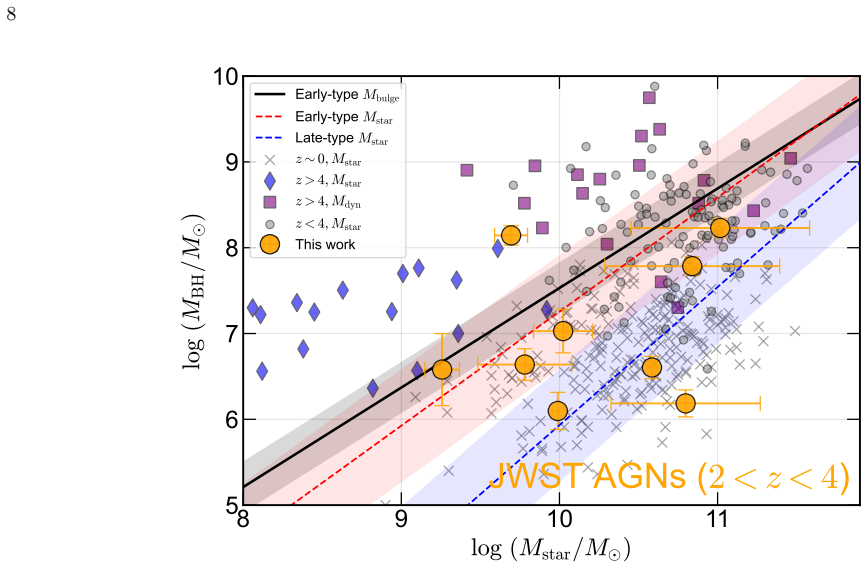
Using medium-resolution NIRSpec spectra and NIRCam imaging from the JADES survey, the paper identifies nine type 1 AGNs at $2<z<4$ with broad $\mathrm{H}\alpha$ emission and a non-zero AGN contribution in their spectral energy distributions, spanning black hole masses $10^{6.1}$–$10^{8.2}\,M_\odot$ and stellar masses $10^{9.3}$–$10^{11.0}\,M_\odot$. Black hole masses are estimated by the single-epoch virial method applied to the broad $\mathrm{H}\alpha$ line, with luminosities taken from combined broad and narrow components, and stellar masses come from CIGALE SED fitting. The central claim is that in the low-mass black hole regime ($M_{\rm BH}<10^8\,M_\odot$) these intermediate-redshift AGNs have $M_{\rm BH}/M_{\star}$ ratios of 0.01–0.1%, in contrast to the 1–10% ratios reported for $z>4$ JWST AGNs, implying a different growth path. From two-dimensional GALFIT decomposition of the F444W images, most of the sample falls below the local $M_{\rm BH}$–$M_{\rm bulge}$ relation of Kormendy & Ho (2013), and the paper reports the first discovery of an undermassive black hole with a prominent bulge at intermediate redshift. The conclusion is a galaxy-first evolutionary pathway in which substantial bulge formation precedes efficient gas accretion onto the central engine.
Load-bearing premise
The load-bearing premise is that the locally calibrated single-epoch estimator (Greene & Ho 2005) yields unbiased black hole masses at $z=2$-$4$, and that the additional broad $\mathrm{H}\alpha$ component in one source (ID 49729) is an outflow rather than a second black hole; if either fails, the inferred masses shift by up to a dex and the under- or overmassive classification that supports the galaxy-first conclusion can flip.
Editorial extensions
If this is right
- The local $M_{\rm BH}$–$M_{\star}$ and $M_{\rm BH}$–$M_{\rm bulge}$ relations are not universal at $z\sim3$; bulges can assemble without commensurate black hole growth, so the present-day scaling relations must be built by later, faster black hole growth.
- The 1–2 dex offset in mass ratio between $z=2$–$4$ and $z>4$ AGNs in the low-mass regime implies the overmassive systems seen at $z>4$ do not evolve directly into the undermassive systems seen here; two distinct assembly channels are required.
- Seven of the nine AGNs show specific black hole growth exceeding specific star formation, so the same systems that are undermassive today are converging toward the local scaling relations rather than diverging from them.
- Bulge-dominated hosts with undermassive black holes (the first reported at intermediate redshift) provide a new population for testing bulge-formation scenarios, favoring mechanisms that build bulges without feeding the black hole.
Reading between the lines
- If the galaxy-first interpretation is right, a mass-selected census at $z\sim3$ should find the undermassive fraction rising with bulge mass; the authors' sample is too small to test this, but the next generation of JWST/NIRSpec surveys could.
- The 0.33 dex average upward shift when masses are recomputed from the 5100 Å continuum (instead of $\mathrm{H}\alpha$ luminosity) means the absolute location of the under/overmassive boundary is calibration-sensitive; reconciling the $\mathrm{H}\alpha$- and continuum-based estimators is a direct way to test the claim's robustness.
- A natural descendant prediction: today's early-type galaxies with undermassive black holes (already suspected in local samples) could be the $z=2$–$4$ galaxy-first systems after a period of sub-Eddington growth; checking their bulges' formation redshifts would link the two epochs.
Editorial analysis
A structured set of objections, weighed in public.
Referee Report
Summary. The paper presents a sample of nine type 1 AGNs at 2<z<4 from the JADES survey, based on the detection of broad H-alpha emission lines and an AGN component in SED fits. Black hole masses are estimated with the single-epoch virial method using the Greene & Ho (2005) H-alpha calibration; stellar masses come from CIGALE SED fitting; bulge masses are inferred from GALFIT two-dimensional image decomposition in the rest-frame near-infrared. The authors report that the MBH/Mstar ratios of their low-mass SMBHs (<10^8 Msun) differ from those of z>4 JWST AGNs, suggest different evolutionary pathways, and identify undermassive BH systems with bulges, claiming a galaxy-first evolutionary path.
Significance. If the claims hold, this is a valuable contribution: it provides a rare sample of low-mass SMBHs at intermediate redshift, a regime that is still sparsely populated, and it directly probes the MBH-bulge relation at 2<z<4 with JWST imaging. The analysis is largely based on public JADES data, the spectral fitting is described in detail with BIC-based model selection, and the GALFIT decomposition tests several structural models. These are strengths. The significance is currently limited by the small sample size (nine objects), by several objects whose SED AGN fractions are consistent with zero, by unresolved or barely resolved bulge components, and by a comparison with z>4 samples that does not yet account for selection effects. The paper is therefore a promising pilot study whose headline claims need to be made more robust.
major comments (4)
- [Section 3.2, Figure 3] The statement that there is a 'significant difference' in MBH/Mstar ratios between the present sample (0.01-0.1%) and z>4 JWST AGNs (1-10%) is not supported by any statistical test. The two samples are selected by very different criteria (H-alpha S/N>10 in JADES vs luminous broad-line AGN selection at z>4), and the paper itself cites Pacucci et al. (2023) and Li et al. (2024) on selection biases in the introduction but does not propagate these caveats into the comparison. I ask for a quantitative treatment: restrict the comparison to a common luminosity or black-hole-mass window, apply a KS or bootstrap test, and discuss completeness. Without this, the offset could be a selection artifact rather than an evolutionary signal.
- [Section 4.1, Table 4] For IDs 28074, 49729, and 209777, the effective radii of the Sersic components are 1.61, 1.78, and 1.64 pixels, respectively, which are comparable to or smaller than the PSF FWHM of 2.22 pixels (0.14 arcsec). These components are unresolved or barely resolved, so the recovered Sersic indices (including n>2 for 209777) are not robust. The conclusion that some of these objects are bulge-dominated and the 'first discovery of an undermassive BH system with a prominent bulge' claim depend on the stability of the decomposition. A resolution test (e.g., fitting pure PSF models to point sources, or injecting simulated galaxies with known n) is needed before interpreting these Sersic indices as physical.
- [Section 4.2, Figure 6] The claim that 'most of our sample shows undermassive BH systems relative to the local MBH-Mbulge relation' is weakened by the use of upper limits for late-type galaxies (n<2). For these objects, method (3) gives Mbulge < Mstar, and upper limits cannot establish that the BH-to-bulge ratio is low; they only place a lower limit on the ratio. The conclusion should be restricted to the objects with actual bulge mass measurements (IDs 22456, 29648, and, after addressing the resolution issue, possibly 209777), and the sample size behind the 'undermassive BH with bulge' claim should be stated explicitly.
- [Section 2.4, Table 1, Abstract] Several objects have SED-derived AGN fractions that are consistent with zero at the 1-sigma level: ID 22456 (0.07±0.17), ID 23682 (0.19±0.25), ID 29648 (0.13±0.19), and ID 78109 (0.22±0.22). Yet the abstract states that 'All of them show ... the AGN contribution in spectral energy distribution.' This is an overstatement: for these objects the AGN identification rests essentially on the broad H-alpha line alone. Please quantify the significance of the AGN fraction or soften the claim to 'most of them'.
minor comments (6)
- [Table 2] Table 2 appears misaligned for rows where the [O III] measurement is blank; for example, for ID 22456 the value 41.65±0.04 appears under the [O III] FWHM column, but comparison with ID 23682 shows that this is log L_Halpha and all subsequent columns are shifted. Please reformat the table so that blank entries are clearly marked.
- [Section 2.3] The text says 'based on the AGN sample of the Sloan Digital Sky Survey (?)' with a missing reference; Vanden Berk et al. (2001) appears in the reference list and is presumably the intended citation.
- [Throughout] There are several typos: 'NI I' should be [N II], 'OI I I' should be [O III], 'SI I' should be [S II], 'Saplpeter' should be 'Salpeter' (Table 3), 'Black allows' should be 'Black arrows' (Figure 6 caption), 'doted lines' should be 'dotted lines' (Figure 4 caption), and 'Galfitting' should be 'GALFIT fitting' (Table 4 caption).
- [Section 4.1] The text states: 'For two lower-redshift AGNs (ID 28074 and ID 49729 at z=2.0, 2.3)', but Table 1 gives z=2.261 for ID 28074 and z=3.189 for ID 49729. The redshifts and the adjective 'lower-redshift' are inconsistent with the table.
- [Section 3.2] The sentence 'The gray cross symbols represent the MBH-Mstar relation for the AGN sample at z<0.055' should be rephrased, since symbols represent individual objects, not a relation.
- [Section 2.3] The sentence 'The narrower broad component (~2200 km/s) is likely associated with a galaxy-scale outflow and was therefore excluded from the LHalpha measurement used for the LHalpha calculation' repeats 'LHalpha measurement'; please rephrase for clarity.
Circularity Check
No significant circularity: BH and bulge masses are independently derived from external calibrations and image decomposition.
full rationale
The derivation chain is self-contained against external benchmarks. Black hole masses (Equation 1) use the Greene & Ho (2005) single-epoch virial calibration applied to measured H-alpha luminosity and broad-line FWHM, with no parameter fitted to the paper's conclusions. Stellar masses come from CIGALE SED fitting, and bulge masses come from independent GALFIT 2D decomposition of NIRCam images, so the low MBH/Mbulge result does not reduce to an input assumption. The z>4 comparison in Section 3.2 uses literature measurements; selection-function differences are a correctness caveat that the paper itself cites (Pacucci et al. 2023; Li et al. 2024), not a circular reduction. The growth-rate diagnostic in Section 3.3 couples Lbol and MBH through the same H-alpha luminosity, but it is an interpretive diagram rather than a prediction, and the central galaxy-first claim rests on the independent bulge-mass comparison. The self-citations to Hoshi et al. (2024) are comparative and not load-bearing. No circular step is present.
Assumptions & free parameters
free parameters (4)
- AGN fraction fAGN in SED fitting =
0.07 to 0.90 (Table 1)
- Radiative efficiency eta =
0.1
- Photometric aperture CIRC5 =
0.35 arcsec radius
- Bulge-to-total ratio B/T from GALFIT =
Not tabulated; derived from Sersic and PSF magnitudes in Table 4
assumptions (6)
- domain assumption Greene & Ho (2005) single-epoch virial calibration remains valid at z=2-4 and for low-mass BHs.
- domain assumption The broad H-alpha component traces virial motion in the BLR, and the combined broad and narrow H-alpha luminosity is the correct L_Halpha for the calibration.
- domain assumption GALFIT PSF plus Sersic decomposition correctly separates the AGN PSF from the host galaxy, and the F444W or F277W band traces stellar mass.
- ad hoc to paper For ID 49729, the second broad H-alpha component is an outflow rather than a second SMBH.
- domain assumption Local MBH-Mbulge and MBH-Mstar relations (Kormendy & Ho 2013; Greene et al. 2020) are the correct benchmarks for evaluating overmassive and undermassive systems.
- domain assumption The radiative efficiency eta=0.1 is appropriate for all sources.
Cite this review
Pith. "Pith review of The Evolutionary Pathway of Low-mass Supermassive Black Holes at Intermediate Redshift: Insights from the JADES Survey." pith.science (2026). https://pith.science/paper/LJLZNL7H
@misc{pith2026250701293,
  author       = {Pith},
  title        = {Pith review of: The Evolutionary Pathway of Low-mass Supermassive Black Holes at Intermediate Redshift: Insights from the JADES Survey},
  year         = {2026},
  howpublished = {\url{https://pith.science/paper/LJLZNL7H}},
  note         = {Machine review of arXiv:2507.01293}
}
abstract
Understanding the relationship between supermassive black holes (SMBHs) and their host galaxies at different redshifts is crucial for unraveling the processes of SMBH-galaxy co-evolution. We present the properties of nine type 1 Active Galactic Nuclei (AGNs) at intermediate redshift ($2<z<4$) using the JWST Advanced Deep Extragalactic Survey (JADES). All of them show the significant $\mathrm{H\alpha}$ broad line and the AGN contribution in spectral energy distribution. Our sample covers SMBH masses of $10^{6.1-8.2}\ M_\odot$ and stellar masses of $10^{9.3-11.0}\ M_\odot$, comparable to those of the AGNs observed in the local universe. In the low-mass SMBH regime ($<10^{8}\ M_\odot$), the BH-to-stellar mass ratios in our sample ($0.01-0.1\%$) differ from those of the AGNs at $z>4$ ($1-10\%$), suggesting that black holes and galaxies may trace different evolutionary pathways at intermediate and high redshift. We also perform 2D image decomposition using GALFIT to constrain the bulge mass by evaluating the bulge contribution in the rest-frame near-infrared flux. We identify the AGNs with low BH-to-bulge mass ratios compared to those observed in the nearby bulge-dominant galaxies. This finding suggests the existence of a galaxy-first evolutionary path, in which bulge formation occurs before substantial gas is efficiently accreted onto the central engine.
Figures


Figures from the paper (6 more)


Reference graph
Works this paper leans on
-
[1]
, " * write output.state after.block = add.period write newline
ENTRY address archivePrefix author booktitle chapter doi edition editor eprint howpublished institution journal key month number organization pages publisher school series title misctitle type volume year version url label extra.label sort.label short.list INTEGERS output.state before.all mid.sentence after.sentence after.block FUNCTION init.state.consts ...
-
[2]
write newline
" write newline "" before.all 'output.state := FUNCTION format.url url empty "" new.block "" url * "" * if FUNCTION format.eprint eprint empty "" archivePrefix empty "" archivePrefix "arXiv" = new.block " " eprint * " " * new.block " " eprint * " " * if if if FUNCTION format.doi doi empty "" " " doi * " " * if FUNCTION format.pid doi empty eprint empty ur...
-
[3]
## 2 _|&MϒHbbyl7==D oM#۶m #FX ץK
thebibliography [1] 20pt to REFERENCES 6pt =0pt -12pt 10pt plus 3pt =0pt =0pt =1pt plus 1pt =0pt =0pt -12pt =13pt plus 1pt =20pt =13pt plus 1pt \@M =10000 =-1.0em =0pt =0pt 0pt =0pt =1.0em @enumiv\@empty 10000 10000 `\.\@m \@noitemerr \@latex@warning Empty `thebibliography' environment \@ifnextchar \@reference \@latexerr Missing key on reference command E...
2021
-
[4]
Alexander , D. M., Bauer , F. E., Brandt , W. N., et al. 2003, , 126, 539, 10.1086/376473
doi:10.1086/376473 2003
-
[5]
T., Bogd \'a n , \'A ., Kov \'a cs , O
Ananna , T. T., Bogd \'a n , \'A ., Kov \'a cs , O. E., Natarajan , P., & Hickox , R. C. 2024, , 969, L18, 10.3847/2041-8213/ad5669
-
[6]
Barro , G., P \'e rez-Gonz \'a lez , P. G., Cava , A., et al. 2019, , 243, 22, 10.3847/1538-4365/ab23f2
-
[7]
Benton , C. E., Nelson , E. J., Miller , T. B., et al. 2024, , 974, L28, 10.3847/2041-8213/ad7e27
-
[8]
2019, A&A, 622, A103
Boquien, M., Burgarella, D., Roehlly, Y., et al. 2019, A&A, 622, A103
2019
Show all 86 references
-
[9]
2016, in Astrophysics and Space Science Library, Vol
Brooks , A., & Christensen , C. 2016, in Astrophysics and Space Science Library, Vol. 418, Galactic Bulges, ed. E. Laurikainen , R. Peletier , & D. Gadotti , 317, 10.1007/978-3-319-19378-6_12
2016 doi
-
[10]
2003, MNRAS, 344, 1000
Bruzual, G., & Charlot, S. 2003, MNRAS, 344, 1000
2003
-
[11]
J., Cameron , A
Bunker , A. J., Cameron , A. J., Curtis-Lake , E., et al. 2024, , 690, A288, 10.1051/0004-6361/202347094
2024 doi
-
[12]
C., et al
Calzetti , D., Armus , L., Bohlin , R. C., et al. 2000, , 533, 682, 10.1086/308692
2000 doi
-
[13]
2017, A&A, 608, A41
Ciesla, L., Elbaz, D., & Fensch, J. 2017, A&A, 608, A41
2017
-
[14]
Clauwens , B., Schaye , J., Franx , M., & Bower , R. G. 2018, , 478, 3994, 10.1093/mnras/sty1229
2018 doi
-
[15]
S., & Broeils , A
Courteau , S., de Jong , R. S., & Broeils , A. H. 1996, , 457, L73, 10.1086/309906
1996 doi
-
[16]
Croton, D. J. 2006, MNRAS, 369, 1808
2006
-
[17]
A., Helou, G., Magdis, G
Dale, D. A., Helou, G., Magdis, G. E., et al. 2014, ApJ, 784, 83
2014
- [18]
-
[19]
2020, ApJ, 888, 37
Ding, X., Silverman, J., Treu, T., et al. 2020, ApJ, 888, 37
2020
- [20]
-
[21]
J., Johnson , B
Eisenstein , D. J., Johnson , B. D., Robertson , B., et al. 2023 b , arXiv e-prints, arXiv:2310.12340, 10.48550/arXiv.2310.12340
2023 doi
-
[22]
G., Bournaud , F., & Elmegreen , D
Elmegreen , B. G., Bournaud , F., & Elmegreen , D. M. 2008, , 688, 67, 10.1086/592190
2008 doi
-
[23]
2022, , 661, A81, 10.1051/0004-6361/202142673
Ferruit , P., Jakobsen , P., Giardino , G., et al. 2022, , 661, A81, 10.1051/0004-6361/202142673
2022 doi
- [24]
-
[25]
Greene, J. E. 2012, Nature Communications, 3, 1304
2012
-
[26]
E., & Ho, L
Greene, J. E., & Ho, L. C. 2005, ApJ, 630, 122
2005
-
[27]
E., Strader , J., & Ho , L
Greene , J. E., Strader , J., & Ho , L. C. 2020, , 58, 257, 10.1146/annurev-astro-032620-021835
2020 doi
-
[28]
C., Giavalisco , M., et al
Guo , Y., Ferguson , H. C., Giavalisco , M., et al. 2013, , 207, 24, 10.1088/0067-0049/207/2/24
2013 doi
-
[29]
2023, , 959, 39, 10.3847/1538-4357/ad029e
Harikane , Y., Zhang , Y., Nakajima , K., et al. 2023, , 959, 39, 10.3847/1538-4357/ad029e
2023 doi
-
[30]
F., Hernquist, L., Cox, T
Hopkins, P. F., Hernquist, L., Cox, T. J., & Kere s , D. 2008, ApJS, 175, 356
2008
-
[31]
2024, , 969, 11, 10.3847/1538-4357/ad414c
Hoshi , A., Yamada , T., Kokubo , M., Matsuoka , Y., & Nagao , T. 2024, , 969, 11, 10.3847/1538-4357/ad414c
2024 doi
-
[32]
2004, ApJ, 604, L89, 10.1086/383567
Häring, N., & Rix, H.-W. 2004, ApJ, 604, L89, 10.1086/383567
2004 doi
-
[33]
Inoue, A. K. 2011, MNRAS, 415, 2920
2011
-
[34]
2019, PASJ, 71, 111
Izumi, T., Onoue, M., Matsuoka, Y., et al. 2019, PASJ, 71, 111
2019
-
[35]
2021, ApJ, 914, 36
Izumi, T., Matsuoka, Y., Fujimoto, S., et al. 2021, ApJ, 914, 36
2021
-
[36]
2020, ApJ, 894, 24
Kimura, Y., Yamada, T., Kokubo, M., et al. 2020, ApJ, 894, 24
2020
-
[37]
2024, arXiv e-prints, arXiv:2407.04777, 10.48550/arXiv.2407.04777
Kokubo , M., & Harikane , Y. 2024, arXiv e-prints, arXiv:2407.04777, 10.48550/arXiv.2407.04777
2024 doi
-
[38]
Kormendy, J., & Ho, L. C. 2013, ARA&A, 51, 511
2013
-
[39]
Kormendy , J., & Kennicutt , Jr., R. C. 2004, , 42, 603, 10.1146/annurev.astro.42.053102.134024
2004
-
[40]
E., Bezanson , R., et al
Labbe , I., Greene , J. E., Bezanson , R., et al. 2025, , 978, 92, 10.3847/1538-4357/ad3551
2025 doi
-
[41]
H., Calzetti , D., & Heckman , T
Leitherer , C., Li , I. H., Calzetti , D., & Heckman , T. M. 2002, , 140, 303, 10.1086/342486
2002 doi
- [42]
-
[43]
2019, ApJS, 243, 21
Liu, H.-Y., Liu, W.-J., Dong, X.-B., et al. 2019, ApJS, 243, 21
2019
-
[44]
N., Xue , Y
Luo , B., Brandt , W. N., Xue , Y. Q., et al. 2017, , 228, 2, 10.3847/1538-4365/228/1/2
2017 doi
-
[45]
H., et al
Lyu , J., Alberts , S., Rieke , G. H., et al. 2024, , 966, 229, 10.3847/1538-4357/ad3643
2024 doi
-
[46]
1998, AJ, 115, 2285
Magorrian, J., Tremaine, S., Richstone, D., et al. 1998, AJ, 115, 2285
1998
-
[47]
2024, , 691, A145, 10.1051/0004-6361/202347640
Maiolino , R., Scholtz , J., Curtis-Lake , E., et al. 2024, , 691, A145, 10.1051/0004-6361/202347640
2024 doi
-
[48]
P., Brammer , G., et al
Matthee , J., Naidu , R. P., Brammer , G., et al. 2024, , 963, 129, 10.3847/1538-4357/ad2345
2024 doi
-
[49]
J., & Ma, C.-P
McConnell, N. J., & Ma, C.-P. 2013, ApJ, 764, 184
2013
-
[50]
2001, ApJ, 547, 140
Merritt, D., & Ferrarese, L. 2001, ApJ, 547, 140
2001
-
[51]
2023, , 672, A98, 10.1051/0004-6361/202345924
Mountrichas , G. 2023, , 672, A98, 10.1051/0004-6361/202345924
2023 doi
- [52]
-
[53]
2009, , 507, 1793, 10.1051/0004-6361/200912497
Noll , S., Burgarella , D., Giovannoli , E., et al. 2009, , 507, 1793, 10.1051/0004-6361/200912497
2009 doi
- [54]
- [55]
-
[56]
2011, , 417, 2721, 10.1111/j.1365-2966.2011.19439.x
Orban de Xivry , G., Davies , R., Schartmann , M., et al. 2011, , 417, 2721, 10.1111/j.1365-2966.2011.19439.x
2011
-
[57]
2023, , 957, L3, 10.3847/2041-8213/ad0158
Pacucci , F., Nguyen , B., Carniani , S., Maiolino , R., & Fan , X. 2023, , 957, L3, 10.3847/2041-8213/ad0158
2023 doi
-
[58]
K., Dubois , Y., et al
Park , M.-J., Yi , S. K., Dubois , Y., et al. 2019, , 883, 25, 10.3847/1538-4357/ab3afe
2019 doi
-
[59]
Y., Ho , L
Peng , C. Y., Ho , L. C., Impey , C. D., & Rix , H.-W. 2002, , 124, 266, 10.1086/340952
2002 doi
-
[60]
Y., Ho, L
Peng, C. Y., Ho, L. C., Impey, C. D., & Rix, H.-W. 2010, The Astronomical Journal, 139, 2097
2010
-
[61]
2020, A&A, 637, A84
Pensabene, A., Carniani, S., Perna, M., et al. 2020, A&A, 637, A84
2020
-
[62]
D., Sivaramakrishnan , A., Lajoie , C.-P., et al
Perrin , M. D., Sivaramakrishnan , A., Lajoie , C.-P., et al. 2014, in Society of Photo-Optical Instrumentation Engineers (SPIE) Conference Series, Vol. 9143, Space Telescopes and Instrumentation 2014: Optical, Infrared, and Millimeter Wave, ed. J. M. Oschmann , Jr., M. Clampi...
2014 doi
-
[63]
D., Soummer, R., Elliott, E
Perrin, M. D., Soummer, R., Elliott, E. M., Lallo, M. D., & Sivaramakrishnan, A. 2012, in Space telescopes and instrumentation 2012: optical, infrared, and millimeter wave, Vol. 8442, SPIE, 1193--1203
2012
-
[64]
2020, , 641, A6, 10.1051/0004-6361/201833910
Planck Collaboration , Aghanim , N., Akrami , Y., et al. 2020, , 641, A6, 10.1051/0004-6361/201833910
2020 doi
-
[65]
E., & Volonteri, M
Reines, A. E., & Volonteri, M. 2015, ApJ, 813, 82
2015
-
[66]
T., Lacy, M., Storrie-Lombardi, L
Richards, G. T., Lacy, M., Storrie-Lombardi, L. J., et al. 2006, ApJS, 166, 470
2006
-
[67]
J., Robertson , B., Tacchella , S., et al
Rieke , M. J., Robertson , B., Tacchella , S., et al. 2023, , 269, 16, 10.3847/1538-4365/acf44d
2023 doi
-
[68]
Salpeter, E. E. 1955, ApJ, 121, 161
1955
-
[69]
B., Soifer , B
Sanders , D. B., Soifer , B. T., Elias , J. H., et al. 1988, , 325, 74, 10.1086/165983
1988 doi
-
[70]
Scannapieco , C., White , S. D. M., Springel , V., & Tissera , P. B. 2009, , 396, 696, 10.1111/j.1365-2966.2009.14764.x
2009
-
[71]
1978, Annals of Statistics, 6, 461
Schwarz , G. 1978, Annals of Statistics, 6, 461
1978
-
[72]
Sersic , J. L. 1968, Atlas de Galaxias Australes
1968
-
[73]
T., Strauss, M
Shen, Y., Richards, G. T., Strauss, M. A., et al. 2011, ApJS, 194, 45
2011
-
[74]
2024, , 531, 851, 10.1093/mnras/stae1226
Shimizu , T., Oogi , T., Okamoto , T., Nagashima , M., & Enoki , M. 2024, , 531, 851, 10.1093/mnras/stae1226
2024 doi
-
[75]
2019, , 482, 4846, 10.1093/mnras/sty2958
Shirakata , H., Okamoto , T., Kawaguchi , T., et al. 2019, , 482, 4846, 10.1093/mnras/sty2958
2019 doi
-
[76]
Stalevski, M., Fritz, J., Baes, M., Nakos, T., & Popovi \'c , L. C . 2012, MNRAS, 420, 2756
2012
-
[77]
2016, MNRAS, 458, 2288
Stalevski, M., Ricci, C., Ueda, Y., et al. 2016, MNRAS, 458, 2288
2016
-
[78]
R., & Reines , A
Sturm , M. R., & Reines , A. E. 2024, , 971, 173, 10.3847/1538-4357/ad55e6
2024 doi
-
[79]
2020, ApJ, 889, 32
Suh, H., Civano, F., Trakhtenbrot, B., et al. 2020, ApJ, 889, 32
2020
-
[80]
D., & Schramm , M
Suh , H., Hasinger , G., Steinhardt , C., Silverman , J. D., & Schramm , M. 2015, , 815, 129, 10.1088/0004-637X/815/2/129
2015 doi
-
[81]
S., Silverman , J
Tanaka , T. S., Silverman , J. D., Ding , X., et al. 2025, , 979, 215, 10.3847/1538-4357/ad9d0a
2025 doi
-
[82]
E., Richards , G
Vanden Berk , D. E., Richards , G. T., Bauer , A., et al. 2001, , 122, 549, 10.1086/321167
2001 doi
-
[83]
E., et al
Virtanen, P., Gommers, R., Oliphant, T. E., et al. 2020, Nature methods, 17, 261
2020
-
[84]
Q., Luo , B., Brandt , W
Xue , Y. Q., Luo , B., Brandt , W. N., et al. 2016, , 224, 15, 10.3847/0067-0049/224/2/15
2016 doi
-
[85]
2011, , 195, 10, 10.1088/0067-0049/195/1/10
---. 2011, , 195, 10, 10.1088/0067-0049/195/1/10
2011 doi
-
[86]
2020, MNRAS, 491, 740, 10.1093/mnras/stz3001
Yang , G., Boquien , M., Buat , V., et al. 2020, MNRAS, 491, 740, 10.1093/mnras/stz3001
2020 doi
Reviewed August 6, 2026 · model on record in the stance chip above.
Discussion (0). Continue with ORCID to comment.