REVIEW 2 major objections 4 minor 19 references
Efficient Out-of-Scope Detection in Dialogue Systems via Uncertainty-Driven LLM Routing
T0 review · 2 major / 4 minor · reviewed 2026-08-06 · deepseek-v4-flash
Pith's one-line read The reported system, UDRIL, sends only high-uncertainty utterances to a fine-tuned Llama 3.1-8B and leaves the rest to a DistilBERT classifier, reaching an average HINT3 F1 of 0.761, the highest in its comparison.
desk verdict UDRIL is a plausible engineering contribution that deserves referee time, but the unresolved Algorithm 1 train/serve skew and missing error bars keep it from being solid yet. read the letter →
The pith
A machine-rendered reading of the paper's core claim, the machinery that carries it, and where it could break.
The reading
What carries the argument
The load-bearing object is the routing decision: an EC-NNK-Means soft-clustering dictionary learned on the classifier's [CLS] embeddings, whose reconstruction error at inference serves as the uncertainty score $s_u$. A threshold $\tau$ converts $s_u$ into a routing rate (low, moderate, high, or full), and the LLM's prompt is restricted to the top-k intents plus an OOS option. The second piece is the negative-example construction that manufactures OOS training pairs from INS data by sampling k intents from the intent inventory without the gold label; LoRA fine-tuning then teaches the LLM to reject those misaligned candidate sets.
What would settle it
On a deployed UDRIL setup at its moderate-routing threshold, add a held-out set of OOS utterances about topics unrelated to the intent inventory, and compute the fine-tuned LLM's recall on exactly the utterances the router sends it. If that recall does not exceed the router's own catch rate for those utterances, the synthetic-negative training is not transferring to the regime the framework is meant to protect.
Extended reading notes
Core claim
The paper establishes that uncertainty signals computed from a frozen classifier's own embeddings can gate a stronger model effectively. UDRIL's uncertainty score is the EC-NNK-Means reconstruction error of the DistilBERT [CLS] embedding; when the score exceeds a threshold $\tau$, the utterance goes to the LLM. The LLM is not asked to classify freely: it receives the classifier's top-k intent candidates with natural-language descriptions and must either choose one or output OOS. The training set for the LLM is built entirely from in-scope data by negative sampling: each utterance is paired once with its gold intent and again with k intents sampled from the intent set excluding the gold, labeled OOS. With this setup the paper reports average HINT3 F1 of 0.761 for high routing, versus 0.752 for the best two-step LLM baseline, with moderate routing tying that baseline at 0.752, and BookData F1 of 0.857; fine-tuning raises OOS recall from 0.403 to 0.698 at roughly stable precision while increasing INS accuracy by five points.
Load-bearing premise
The whole design leans on the assumption that OOS utterances encountered in production are similar enough to the synthetic negatives—each training utterance paired with a set of wrong intents sampled from the same intent inventory—that fine-tuning on those negatives teaches rejection of real out-of-scope inputs.
Editorial extensions
If this is right
- A deployed TODS can add OOS detection to its existing intent classifier without retraining that classifier, because the uncertainty scorer operates on the classifier's embeddings.
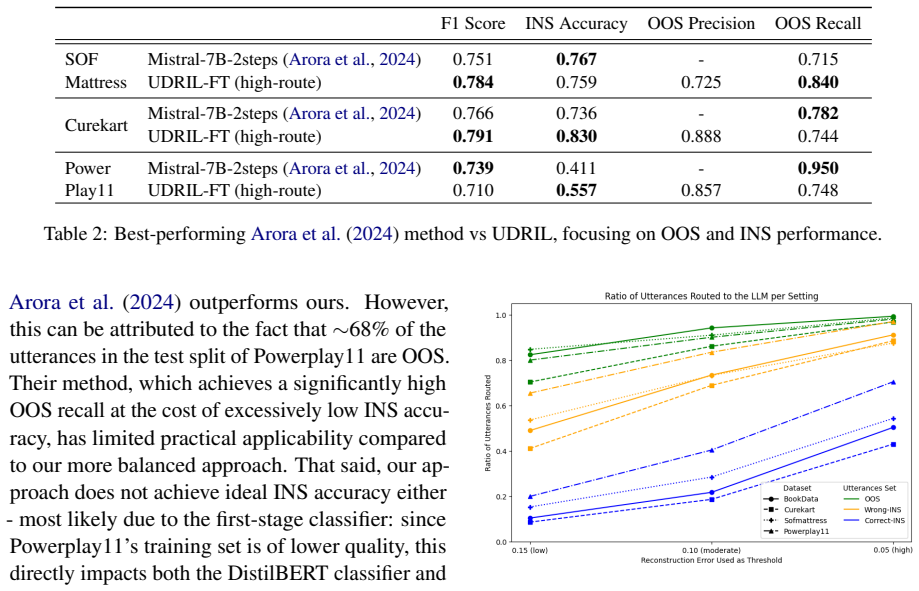
- Routing can be tuned to production constraints: lower thresholds mean fewer LLM calls, while higher routing recovers more OOS recall; across the test sets UDRIL routes 70-98% of OOS utterances depending on strategy.
- Fine-tuned UDRIL beats off-the-shelf use of the same LLM on both OOS recall and INS accuracy; on BookData, INS accuracy rises from 0.768 to 0.856 in the full-routing setting.
- Intent guidelines from one dataset suffice at fine-tuning time and transfer to other datasets with comparable performance, lowering the maintenance burden when intent spaces change.
- Because the LLM only adjudicates the classifier's top-k candidates, the extra cost is bounded by the routing ratio rather than by the full traffic volume.
Reading between the lines
- An unresolved transfer question is whether the synthetic OOS examples teach true rejection or only near-miss rejection; feeding topically unrelated OOS utterances from a different domain and comparing the fine-tuned LLM's recall to the router's routing rate would settle it.
- The single global threshold $\tau$ may leave performance on the table; per-class thresholds fitted to the uncertainty-score distribution are a direct optimization of the reported efficiency-performance trade-off.
- The same routing pattern—cheap predictor plus an uncertainty gate plus an expensive LLM adjudicator—applies to other NLU decisions, such as slot-filling disagreement, ambiguous paraphrases, or safety-related rejection, not only to OOS detection.
Editorial analysis
A structured set of objections, weighed in public.
Referee Report
Summary. The paper proposes UDRIL, a modular framework for joint in-scope (INS) intent classification and out-of-scope (OOS) detection. A DistilBERT classifier produces an initial prediction and an EC-NNK-Means uncertainty score; utterances whose uncertainty exceeds a threshold are routed to a LoRA fine-tuned Llama 3.1-8B, which chooses among the classifier's top-k intent candidates or OOS. Fine-tuning data is created by Algorithm 1 from INS utterances: for each utterance the classifier's top-k candidates are paired with the gold label as a positive example, and a separate negative example is created by sampling k intents excluding the gold label and labeling the utterance OOS. The authors evaluate on the HINT3 public datasets and on an internal real-world dataset (BookData), reporting average F1 improvements over the hybrid and LLM-based baselines of Arora et al. (2024), with routing analyses showing that the uncertainty signal captures both misclassified INS and OOS utterances.
Significance. If the reported results hold, UDRIL is a practically valuable contribution: it demonstrates that a relatively small fine-tuned LLM can be triggered selectively by an inexpensive uncertainty signal, achieving strong OOS detection while keeping most traffic on a fast classifier. The finding that moderate-to-high routing outperforms full routing is an interesting and non-obvious result that argues for uncertainty-based gating rather than blind LLM substitution. The framework is simple, modular, and directly applicable to deployed systems, and the use of a real-world internal benchmark is a strength. The paper also provides a useful routing analysis (Figure 2) that supports the claim that reconstruction-error uncertainty correlates with both OOS utterances and misclassified INS utterances. However, the central empirical claim of state-of-the-art performance is weakened by the absence of variance estimates or significance tests, by baselines taken from an external paper without re-running, and by a train/serve inconsistency in the fine-tuning data construction that has not been diagnosed.
major comments (2)
- [§3.3, Algorithm 1] Algorithm 1 creates the positive fine-tuning example (u, (ŷ^(1),...,ŷ^(k)), yu) without checking that the gold label yu is among the classifier's top-k candidates. At inference the LLM's output space is restricted to the candidates plus OOS (Eq. 1), so whenever yu is not in the top-k, the training target is outside the model's permitted output space. The manuscript never reports the frequency of this mismatch. On PowerPlay11, where the first-stage classifier's INS accuracy after refinement is only 0.557 (Section 4.3), the mismatch is likely to be frequent, and training on such examples may teach the LLM to fall back to OOS for in-scope utterances or to ignore the candidate-set constraint. This is a load-bearing issue because the gains of UDRIL-FT over UDRIL-noFT are attributed to this fine-tuning procedure. The authors should report the per-dataset frequency of gold-label-not-in-top-k, and either filter such examples or guarantee the gold label is included in the candidate list, then re-run the experiments.
- [§4, Table 1] The central claim of state-of-the-art performance rests on point estimates without variance, confidence intervals, or significance tests. For example, the main comparison between UDRIL-FT (high-route) at 0.761 average F1 and Mistral-7B-2steps at 0.752 is a 0.009 difference, and the per-dataset differences are similarly small; with no repeated runs or error bars it is impossible to determine whether these differences are reliable. The baselines are also taken directly from Arora et al. (2024) rather than re-run in the same experimental setup. Please report multiple seeds with standard deviations and, where feasible, re-run the most important baselines under matched conditions, or state explicitly why this is infeasible.
minor comments (4)
- [§4.3] The phrase "slight drops" understates the PowerPlay11 INS accuracy decrease from 0.599 to 0.547, which is an approximately 8.7% relative reduction; please either rephrase or add context explaining why this does not undermine the claimed INS/OOS balance.
- [§3.4] The internal BookData benchmark is described only by size and number of intents; since the data is not released, please provide additional basic statistics (e.g., number of OOS test utterances, average utterance length, intent frequency distribution) and describe the annotation procedure and any agreement measure to help readers assess the difficulty of the benchmark.
- [§3.3] The selection of the routing thresholds (τ = 0.15, 0.10, 0.05) is reported, but the manuscript does not describe how these thresholds were chosen or whether they were tuned on a validation set; please clarify the threshold selection procedure so that the reported routing fractions in Figure 2 can be interpreted properly.
- [Throughout] There are several minor presentation issues: inconsistent spelling of "Sofmattress" vs "SOFMattress" in Section 4.3, and a missing comma after "However" in Section 2; please proofread for these small errors.
Circularity Check
No significant circularity: UDRIL's reported gains are empirical comparisons on held-out benchmarks, with fixed routing thresholds and no fitted quantity reused as a prediction.
full rationale
The paper's central claim is empirical: Tables 1 and 2 report F1, INS accuracy, OOS precision and OOS recall on held-out HINT3 and BookData test sets, compared against external baselines from Arora et al. (2024). The DistilBERT classifier is trained on in-scope data; the NNK-Means uncertainty scorer is an externally published method; and the LoRA fine-tuned Llama 3.1-8B is trained on a synthetic dataset produced by Algorithm 1 from the same classifier. This reuse of the classifier's outputs in fine-tuning is a deliberate design choice, not a circular derivation: the test-time OOS labels come from real human-annotated out-of-scope utterances, not from the training construction, so the reported predictions are not equal to training inputs by construction. The three routing thresholds (tau = 0.15, 0.10, 0.05) are presented as fixed strategies and reported across the same three values rather than selected on the test set. There are no load-bearing self-citations: the cited external methods (NNK-Means, LoRA, HINT3, prior LLM baselines) are independent prior work and are not used to define away the evaluation. The skeptical concern about Algorithm 1 -- that a positive training example may place the gold label outside the top-k candidate set, and the model can then only choose among candidates or OOS -- is a train/serve consistency risk and a correctness concern, but it does not make any reported benchmark quantity reduce to a fitted parameter or to a self-citation. Accordingly, no significant circularity is present.
Assumptions & free parameters
free parameters (3)
- routing threshold tau =
0.05 (high routing), 0.10 (moderate), 0.15 (low)
- number of candidate intents k =
3
- fine-tuning sample size per intent =
5 utterances
assumptions (4)
- domain assumption High EC-NNK-Means reconstruction error indicates that an utterance is out-of-scope or ambiguous.
- domain assumption Fine-tuning the LLM on synthetic negative examples, created by replacing a true intent with sampled alternative intents, transfers to real out-of-scope utterances.
- domain assumption The DistilBERT [CLS] embedding is a sufficient representation for the uncertainty-scoring function.
- domain assumption Intent guidelines generated by GPT-3.5, without human verification, are adequate substitutes for the unavailable official guidelines.
Cite this review
Pith. "Pith review of Efficient Out-of-Scope Detection in Dialogue Systems via Uncertainty-Driven LLM Routing." pith.science (2026). https://pith.science/paper/XCAZ2EQQ
@misc{pith2026250701541,
  author       = {Pith},
  title        = {Pith review of: Efficient Out-of-Scope Detection in Dialogue Systems via Uncertainty-Driven LLM Routing},
  year         = {2026},
  howpublished = {\url{https://pith.science/paper/XCAZ2EQQ}},
  note         = {Machine review of arXiv:2507.01541}
}
read the original abstract
Out-of-scope (OOS) intent detection is a critical challenge in task-oriented dialogue systems (TODS), as it ensures robustness to unseen and ambiguous queries. In this work, we propose a novel but simple modular framework that combines uncertainty modeling with fine-tuned large language models (LLMs) for efficient and accurate OOS detection. The first step applies uncertainty estimation to the output of an in-scope intent detection classifier, which is currently deployed in a real-world TODS handling tens of thousands of user interactions daily. The second step then leverages an emerging LLM-based approach, where a fine-tuned LLM is triggered to make a final decision on instances with high uncertainty. Unlike prior approaches, our method effectively balances computational efficiency and performance, combining traditional approaches with LLMs and yielding state-of-the-art results on key OOS detection benchmarks, including real-world OOS data acquired from a deployed TODS.
Figures

Reference graph
Works this paper leans on
-
[1]
Gaurav Arora, Chirag Jain, Manas Chaturvedi, and Krupal Modi. 2020. https://doi.org/10.18653/v1/2020.insights-1.16 HINT 3: Raising the bar for intent detection in the wild . In Proceedings of the First Workshop on Insights from Negative Results in NLP, pages 100--105, Online. Association for Computational Linguistics
-
[2]
Gaurav Arora, Shreya Jain, and Srujana Merugu. 2024. Intent detection in the age of LLM s. In Proceedings of the 2024 Conference on Empirical Methods in Natural Language Processing: Industry Track, EMNLP'24, pages 1559--1570
work page 2024
-
[3]
I \ n igo Casanueva, Tadas Tem c inas, Daniela Gerz, Matthew Henderson, and Ivan Vuli \'c . 2020. https://doi.org/10.18653/v1/2020.nlp4convai-1.5 Efficient intent detection with dual sentence encoders . In Proceedings of the 2nd Workshop on Natural Language Processing for Conversational AI, pages 38--45, Online. Association for Computational Linguistics
-
[4]
Abhimanyu Dubey, Abhinav Jauhri, Abhinav Pandey, Abhishek Kadian, Ahmad Al-Dahle, Aiesha Letman, Akhil Mathur, Alan Schelten, Amy Yang, Angela Fan, et al. 2024. The llama 3 herd of models. arXiv preprint arXiv:2407.21783
arXiv 2024
-
[5]
Aryan Gulati, Xingjian Dong, Carlos Hurtado, Sarath Shekkizhar, Swabha Swayamdipta, and Antonio Ortega. 2024. https://doi.org/10.18653/v1/2024.findings-emnlp.758 Out-of-distribution detection through soft clustering with non-negative kernel regression . In Findings of the Association for Computational Linguistics: EMNLP 2024, pages 12943--12959, Miami, Fl...
-
[6]
Taesuk Hong, Youbin Ahn, Dongkyu Lee, Joongbo Shin, Seungpil Won, Janghoon Han, Stanley Jungkyu Choi, and Jungyun Seo. 2024. https://doi.org/10.18653/v1/2024.sigdial-1.39 Exploring the use of natural language descriptions of intents for large language models in zero-shot intent classification . In Proceedings of the 25th Annual Meeting of the Special Inte...
-
[7]
Hu, Yelong Shen, Phillip Wallis, Zeyuan Allen - Zhu, Yuanzhi Li, Shean Wang, and Weizhu Chen
Edward J. Hu, Yelong Shen, Phillip Wallis, Zeyuan Allen - Zhu, Yuanzhi Li, Shean Wang, and Weizhu Chen. 2021. https://arxiv.org/abs/2106.09685 Lora: Low-rank adaptation of large language models . CoRR, abs/2106.09685
arXiv 2021
-
[8]
Peper, Christopher Clarke, Andrew Lee, Parker Hill, Jonathan K
Stefan Larson, Anish Mahendran, Joseph J. Peper, Christopher Clarke, Andrew Lee, Parker Hill, Jonathan K. Kummerfeld, Kevin Leach, Michael A. Laurenzano, Lingjia Tang, and Jason Mars. 2019. https://doi.org/10.18653/v1/D19-1131 An evaluation dataset for intent classification and out-of-scope prediction . In Proceedings of the 2019 Conference on Empirical M...
Show all 19 references
-
[9]
Bo Liu, Li-Ming Zhan, Zexin Lu, Yujie Feng, Lei Xue, and Xiao-Ming Wu. 2024. How good are LLM s at out-of-distribution detection? In Proceedings of the 2024 Joint International Conference on Computational Linguistics, Language Resources and Evaluation, LREC-COLING'24, pages 8211--8222
2024
-
[10]
Paramita Mirza, Viju Sudhi, Soumya Ranjan Sahoo, and Sinchana Ramakanth Bhat. 2024. ILLUMINER : Instruction-tuned large language models as few-shot intent classifier and slot filler. In Proceedings of the 2024 Joint International Conference on Computational Linguistics, Langua...
2024
-
[11]
Soham Parikh, Mitul Tiwari, Prashil Tumbade, and Quaizar Vohra. 2023. Exploring zero and few-shot techniques for intent classification. In Proceedings of the 61st Annual Meeting of the Association for Computational Linguistics (Volume 5: Industry Track), ACL'23, pages 744--751
2023
-
[12]
T-YLPG Ross and GKHP Doll \'a r. 2017. Focal loss for dense object detection. In proceedings of the IEEE conference on computer vision and pattern recognition, pages 2980--2988
2017
-
[13]
Victor Sanh, Lysandre Debut, Julien Chaumond, and Thomas Wolf. 2019. https://arxiv.org/abs/1910.01108 Distilbert, a distilled version of BERT: smaller, faster, cheaper and lighter . CoRR, abs/1910.01108
2019 arXiv
-
[14]
Sarath Shekkizhar and Antonio Ortega. 2021. https://arxiv.org/abs/2110.08212 Nnk-means: Dictionary learning using non-negative kernel regression . CoRR, abs/2110.08212
2021 arXiv
-
[15]
Fanshu Sun, Heyan Huang, Puhai Yang, Hengda Xu, and Xianling Mao. 2024. https://doi.org/10.1016/j.knosys.2023.111167 Out-of-scope intent detection with intent-invariant data augmentation . Knowledge-Based Systems, 283:111167
2024
-
[16]
Pei Wang, Keqing He, Yejie Wang, Xiaoshuai Song, Yutao Mou, Jingang Wang, Yunsen Xian, Xunliang Cai, and Weiran Xu. 2024. Beyond the known: Investigating LLM s performance on out-of-domain intent detection". In Proceedings of the 2024 Joint International Conference on Computat...
2024
-
[17]
Feng Zhang, Wei Chen, Fei Ding, Meng Gao, Tengjiao Wang, Jiahui Yao, and Jiabin Zheng. 2024. From discrimination to generation: Low-resource intent detection with language model instruction tuning. In Findings of the Association for Computational Linguistics: ACL 2024, ACL fin...
2024
-
[18]
online" 'onlinestring :=
ENTRY address archivePrefix author booktitle chapter edition editor eid eprint eprinttype howpublished institution journal key month note number organization pages publisher school series title type volume year doi pubmed url lastchecked label extra.label sort.label short.list...
-
[19]
write newline
" write newline "" before.all 'output.state := FUNCTION n.dashify 't := "" t empty not t #1 #1 substring "-" = t #1 #2 substring "--" = not "--" * t #2 global.max substring 't := t #1 #1 substring "-" = "-" * t #2 global.max substring 't := while if t #1 #1 substring * t #2 gl...
Reviewed August 6, 2026 · model on record in the stance chip above.
Discussion (0). Continue with ORCID to comment.