Freeze-In Dark Matter and Leptogenesis: a psi'SM route
Pith reviewed 2026-05-19 06:06 UTC · model grok-4.3
The pith
In the ψ'SM model, freeze-in production from scalar decay gives the correct dark matter relic abundance for masses from a few MeV to a few hundred GeV while leptogenesis from heavy neutrinos explains the baryon asymmetry.
A machine-rendered reading of the paper's core claim, the machinery that carries it, and where it could break.
Core claim
The spontaneous breaking of the U(1)_ψ' symmetry in the ψ'SM model produces a stable singlet fermion dark matter candidate via freeze-in from scalar decays, while heavy right-handed neutrinos account for light neutrino masses through the type-I seesaw and the observed baryon asymmetry through leptogenesis.
What carries the argument
The residual U(1)_ψ' gauge symmetry arising from E6 subgroups, which breaks spontaneously to stabilize the singlet fermion dark matter candidate produced by freeze-in from scalar decay.
If this is right
- The observed dark matter relic density can be achieved for dark matter masses between a few MeV and a few hundred GeV through freeze-in production.
- Light neutrino masses arise naturally from the type-I seesaw mechanism involving heavy right-handed neutrinos.
- The baryon asymmetry of the universe is generated via leptogenesis from the out-of-equilibrium decays of the heavy neutrinos.
- The discrete symmetry ensures the dark matter particle remains stable and does not decay into Standard Model particles.
Where Pith is reading between the lines
- If the discrete symmetry can be derived from the E6 structure, the model would provide a more complete unification of dark matter stability with the gauge symmetry breaking.
- Future precision measurements of the baryon asymmetry or neutrino mass parameters could constrain the right-handed neutrino masses and couplings in this setup.
- Direct detection experiments might probe the scalar decay channels if the freeze-in production involves specific interaction strengths.
Load-bearing premise
The discrete symmetry that prevents the singlet fermion from decaying is imposed by hand following the breaking of the U(1)_ψ' symmetry.
What would settle it
A detailed computation of the freeze-in relic density showing it cannot match observations for any dark matter mass in the stated range, or a failure to reproduce the correct baryon asymmetry with the neutrino parameters required by the seesaw.
Figures

read the original abstract
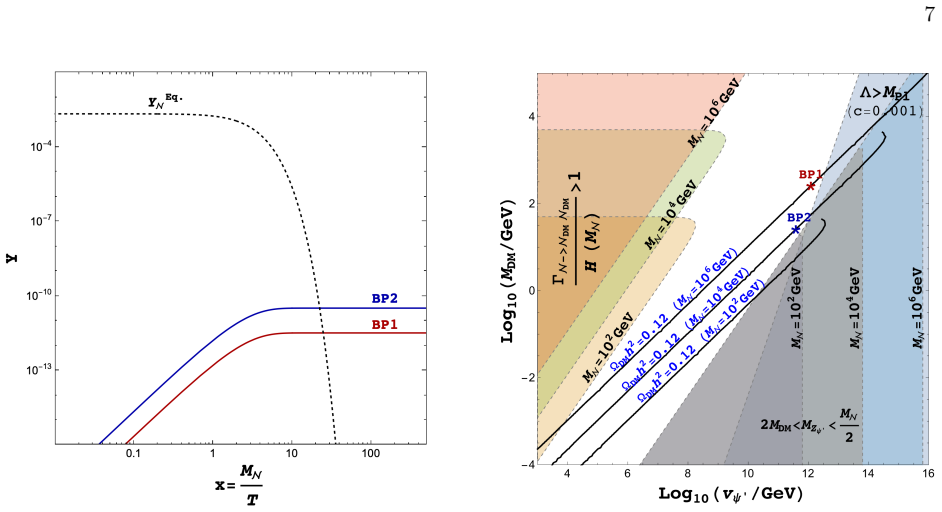
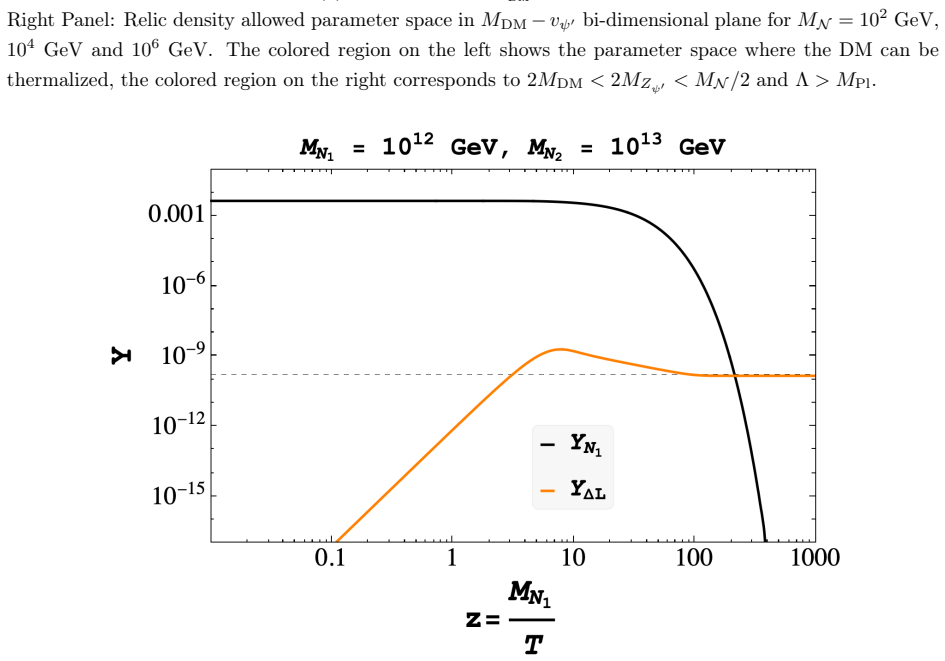
We investigate the possibility of \emph{freeze-in} dark matter production and baryogenesis via leptogenesis in a $\psi'$SM model, which is an $E_6$ extension of the Standard Model, featuring a residual $U(1)_{\psi'}$ gauge symmetry. This symmetry arises from a linear combination of $U(1)_\chi$ and $U(1)_{\psi}$, both of which are subgroups of the $E_6$. The spontaneous breaking of $U(1)_{\psi'}$ symmetry governs the dynamics of a singlet fermion, which serves as a freeze-in dark matter candidate. The dark matter mass arises from dimension-five operators, and a discrete symmetry ensures its stability. We show that freeze-in production from scalar decay can yield the correct relic abundance for dark matter masses between a few MeV to a few hundred GeV. Simultaneously, heavy right-handed neutrinos generate light neutrino masses via the type-I seesaw and produce the observed baryon asymmetry via leptogenesis.
Editorial analysis
A structured set of objections, weighed in public.
Referee Report
Summary. The manuscript presents a ψ'SM model based on an E6 extension of the Standard Model with a residual U(1)_ψ' gauge symmetry. A singlet fermion is proposed as a freeze-in dark matter candidate whose mass is generated via dimension-five operators and whose stability is ensured by an additional discrete symmetry. The authors claim that scalar decays produce the observed relic density for dark matter masses between a few MeV and a few hundred GeV. Simultaneously, heavy right-handed neutrinos generate light neutrino masses via the type-I seesaw and the baryon asymmetry via leptogenesis.
Significance. If the numerical results hold, the work offers a unified framework for dark matter and leptogenesis within an E6-inspired extension, with the freeze-in mechanism permitting a wide mass range. The combination of mechanisms is of interest for model-building in GUT extensions. However, the central relic-density claim depends on tuning the scalar-DM coupling and scalar mass, and the stabilizing symmetry is introduced without derivation from the E6 structure, limiting the model's predictivity and robustness.
major comments (2)
- [Model construction and symmetry discussion] The discrete symmetry stabilizing the singlet fermion DM is imposed by hand after U(1)_ψ' breaking by the scalar VEV. The manuscript does not derive this symmetry from the E6 → SO(10)×U(1)_χ×U(1)_ψ decomposition or the linear combination defining U(1)_ψ', nor does it demonstrate radiative stability against higher-dimensional operators that could induce DM decay and invalidate the Boltzmann solutions for the relic abundance.
- [Dark matter relic density section] The relic abundance is matched by adjusting the scalar-DM coupling and scalar mass as free parameters. This reduces the quoted mass window (few MeV to few hundred GeV) to a fit rather than an independent prediction. The Boltzmann equations, branching ratios, and washout factors must be shown explicitly with the numerical integration details to verify the central claim.
minor comments (2)
- [Model section] A table summarizing the U(1)_ψ' charges and field content under the full gauge group would improve clarity of the model definition.
- [Introduction and references] Some relevant prior works on freeze-in production in gauged extensions and E6-inspired leptogenesis models are not cited.
Simulated Author's Rebuttal
We thank the referee for the careful review and constructive feedback on our manuscript. We address each major comment in detail below, providing clarifications and indicating revisions where the manuscript will be updated in the next version.
read point-by-point responses
-
Referee: [Model construction and symmetry discussion] The discrete symmetry stabilizing the singlet fermion DM is imposed by hand after U(1)_ψ' breaking by the scalar VEV. The manuscript does not derive this symmetry from the E6 → SO(10)×U(1)_χ×U(1)_ψ decomposition or the linear combination defining U(1)_ψ', nor does it demonstrate radiative stability against higher-dimensional operators that could induce DM decay and invalidate the Boltzmann solutions for the relic abundance.
Authors: We agree that the discrete symmetry is introduced to guarantee DM stability and is not explicitly derived from the E6 breaking chain in the current text. Such symmetries are frequently added in effective models to forbid unwanted operators while remaining compatible with the gauge structure. We have revised the model-construction section to discuss possible motivations for this Z_2 (e.g., as a remnant of a larger discrete group or an anomaly-free choice consistent with the U(1)_ψ' charges) and to estimate the suppression scale of higher-dimensional decay operators. A complete UV derivation from the full E6 theory would require additional assumptions about the compactification or intermediate symmetries and is left for future work; the present analysis focuses on the low-energy phenomenology consistent with the imposed symmetry. revision: partial
-
Referee: [Dark matter relic density section] The relic abundance is matched by adjusting the scalar-DM coupling and scalar mass as free parameters. This reduces the quoted mass window (few MeV to few hundred GeV) to a fit rather than an independent prediction. The Boltzmann equations, branching ratios, and washout factors must be shown explicitly with the numerical integration details to verify the central claim.
Authors: The quoted mass range is the interval in which the observed relic density can be reproduced for perturbative values of the scalar-DM coupling and scalar mass; it is therefore a characterization of viable parameter space rather than a parameter-free prediction. To make the calculation fully transparent, we have added an appendix containing the complete set of Boltzmann equations for the freeze-in process, the relevant branching ratios of the scalar decays, and a description of the numerical integration routine (including the treatment of washout effects). These additions allow the reader to reproduce the relic-density curves shown in the figures. revision: yes
Circularity Check
No significant circularity; derivation is self-contained within model assumptions
full rationale
The paper constructs an E6-based ψ'SM extension with residual U(1)_ψ' symmetry, introduces a singlet fermion DM candidate whose mass arises from dimension-five operators and whose stability is ensured by an additional discrete symmetry imposed after U(1)_ψ' breaking. It then performs standard freeze-in Boltzmann-equation calculations to demonstrate that scalar-decay production can reproduce the observed relic density for DM masses in the MeV–hundreds GeV range, while separately applying the type-I seesaw and leptogenesis from heavy right-handed neutrinos. These steps rely on external cosmological benchmarks (relic density, baryon asymmetry) and standard model-building choices rather than any self-definitional loop, fitted parameter renamed as prediction, or load-bearing self-citation chain; the central results are feasibility calculations inside the stated framework and do not reduce to their inputs by construction.
Axiom & Free-Parameter Ledger
free parameters (3)
- scalar-DM coupling
- scalar mass
- right-handed neutrino masses and CP phases
axioms (2)
- standard math E6 contains U(1)_χ and U(1)_ψ whose linear combination yields U(1)_ψ'
- domain assumption Type-I seesaw formula for light neutrino masses
invented entities (2)
-
singlet fermion DM candidate
no independent evidence
-
U(1)_ψ' gauge boson
no independent evidence
Lean theorems connected to this paper
-
IndisputableMonolith/Foundation/AbsoluteFloorClosure.leanabsolute_floor_iff_bare_distinguishability contradicts?
contradictsCONTRADICTS: the theorem conflicts with this paper passage, or marks a claim that would need revision before publication.
To ensure the stability of DM, we impose a discrete Z2 symmetry under which N1 is odd... Here we impose an extra Z2 symmetry under which the lightest SO(10) singlet fermion N1 is non-trivially charged. This Z2 prohibits the N1 from decaying, making it a viable DM candidate.
-
IndisputableMonolith/Foundation/BranchSelection.leanbranch_selection unclear?
unclearRelation between the paper passage and the cited Recognition theorem.
The dark matter mass arises from dimension-five operators, and a discrete symmetry ensures its stability... DM production is only restricted to the decay of the scalar N.
What do these tags mean?
- matches
- The paper's claim is directly supported by a theorem in the formal canon.
- supports
- The theorem supports part of the paper's argument, but the paper may add assumptions or extra steps.
- extends
- The paper goes beyond the formal theorem; the theorem is a base layer rather than the whole result.
- uses
- The paper appears to rely on the theorem as machinery.
- contradicts
- The paper's claim conflicts with a theorem or certificate in the canon.
- unclear
- Pith found a possible connection, but the passage is too broad, indirect, or ambiguous to say the theorem truly supports the claim.
Reference graph
Works this paper leans on
-
[1]
E. W. Kolb and M. S. Turner,The Early Universe, Vol. 69 (Taylor and Francis, 2019)
work page 2019
-
[2]
G. Jungman, M. Kamionkowski, and K. Griest, Phys. Rept.267, 195 (1996), arXiv:hep-ph/9506380
work page internal anchor Pith review Pith/arXiv arXiv 1996
-
[3]
Particle Dark Matter: Evidence, Candidates and Constraints
G. Bertone, D. Hooper, and J. Silk, Phys. Rept.405, 279 (2005), arXiv:hep-ph/0404175
work page internal anchor Pith review Pith/arXiv arXiv 2005
-
[4]
J. L. Feng, Ann. Rev. Astron. Astrophys.48, 495 (2010), arXiv:1003.0904 [astro-ph.CO]
work page internal anchor Pith review Pith/arXiv arXiv 2010
-
[5]
The Waning of the WIMP? A Review of Models, Searches, and Constraints
G. Arcadi, M. Dutra, P. Ghosh, M. Lindner, Y. Mambrini, M. Pierre, S. Profumo, and F. S. Queiroz, Eur. Phys. J. C78, 203 (2018), arXiv:1703.07364 [hep-ph]
work page internal anchor Pith review Pith/arXiv arXiv 2018
-
[6]
WIMP dark matter candidates and searches - current status and future prospects
L. Roszkowski, E. M. Sessolo, and S. Trojanowski, Rept. Prog. Phys.81, 066201 (2018), arXiv:1707.06277 [hep-ph]
work page internal anchor Pith review Pith/arXiv arXiv 2018
- [7]
-
[8]
E. W. Kolb and S. Wolfram, Nucl. Phys. B172, 224 (1980), [Erratum: Nucl.Phys.B 195, 542 (1982)]
work page 1980
- [9]
-
[10]
Review of LHC Dark Matter Searches
F. Kahlhoefer, Int. J. Mod. Phys. A32, 1730006 (2017), arXiv:1702.02430 [hep-ph]
work page internal anchor Pith review Pith/arXiv arXiv 2017
-
[11]
First Dark Matter Search Results from the LUX-ZEPLIN (LZ) Experiment
J. Aalberset al.(LZ), Phys. Rev. Lett.131, 041002 (2023), arXiv:2207.03764 [hep-ex]
work page internal anchor Pith review arXiv 2023
-
[12]
L. J. Hall, K. Jedamzik, J. March-Russell, and S. M. West, JHEP03, 080 (2010), arXiv:0911.1120 [hep-ph]
work page internal anchor Pith review Pith/arXiv arXiv 2010
-
[13]
The Dawn of FIMP Dark Matter: A Review of Models and Constraints
N. Bernal, M. Heikinheimo, T. Tenkanen, K. Tuominen, and V. Vaskonen, Int. J. Mod. Phys. A32, 1730023 (2017), arXiv:1706.07442 [hep-ph]
work page internal anchor Pith review Pith/arXiv arXiv 2017
-
[14]
S. Bhattacharya, N. Chakrabarty, R. Roshan, and A. Sil, JCAP04, 013 (2020), arXiv:1910.00612 [hep-ph]
- [15]
- [16]
- [17]
-
[18]
S. Bhattacharya, R. Roshan, A. Sil, and D. Vatsyayan, Phys. Rev. D106, 075005 (2022), arXiv:2105.06189 [hep-ph]
- [19]
-
[20]
S. Bhattacharya, N. Mondal, R. Roshan, and D. Vatsyayan, JCAP06, 029 (2024), arXiv:2312.15053 [hep-ph]
- [21]
- [22]
- [23]
- [24]
- [25]
- [26]
- [27]
- [28]
-
[29]
G. Lazarides and Q. Shafi, JHEP10, 193 (2019), arXiv:1904.06880 [hep-ph]
-
[30]
Light sterile neutrinos, dark matter, and new resonances in a $U(1)$ extension of the MSSM
A. Hebbar, G. Lazarides, and Q. Shafi, Phys. Rev. D96, 055026 (2017), arXiv:1706.09630 [hep-ph]
work page internal anchor Pith review Pith/arXiv arXiv 2017
- [31]
- [32]
-
[33]
Complex Spinors and Unified Theories
M. Gell-Mann, P. Ramond, and R. Slansky, Conf. Proc. C790927, 315 (1979), arXiv:1306.4669 [hep-th]
work page internal anchor Pith review Pith/arXiv arXiv 1979
-
[34]
R. N. Mohapatra and G. Senjanovic, Phys. Rev. Lett.44, 912 (1980)
work page 1980
- [35]
- [36]
-
[37]
G. Lazarides, Q. Shafi, and A. Tiwari, JHEP05, 119 (2023), arXiv:2303.15159 [hep-ph]
- [38]
- [39]
-
[40]
Freeze-in Production of Sterile Neutrino Dark Matter in U(1)$_{\rm B-L}$ Model
A. Biswas and A. Gupta, JCAP09, 044 (2016), [Addendum: JCAP 05, A01 (2017)], arXiv:1607.01469 [hep-ph]
work page internal anchor Pith review Pith/arXiv arXiv 2016
-
[41]
Planck 2018 results. VI. Cosmological parameters
N. Aghanimet al.(Planck), Astron. Astrophys.641, A6 (2020), [Erratum: Astron.Astrophys. 652, C4 (2021)], arXiv:1807.06209 [astro-ph.CO]
work page internal anchor Pith review Pith/arXiv arXiv 2020
-
[42]
S. Davidson, E. Nardi, and Y. Nir, Phys. Rept.466, 105 (2008), arXiv:0802.2962 [hep-ph]
work page internal anchor Pith review Pith/arXiv arXiv 2008
-
[43]
L. Covi, E. Roulet, and F. Vissani, Phys. Lett. B384, 169 (1996), arXiv:hep-ph/9605319
work page internal anchor Pith review Pith/arXiv arXiv 1996
-
[44]
J. A. Casas and A. Ibarra, Nucl. Phys. B618, 171 (2001), arXiv:hep-ph/0103065
work page internal anchor Pith review Pith/arXiv arXiv 2001
-
[45]
P. A. Zylaet al.(Particle Data Group), PTEP2020, 083C01 (2020)
work page 2020
-
[46]
Leptogenesis in the two right-handed neutrino model revisited
S. Antusch, P. Di Bari, D. A. Jones, and S. F. King, Phys. Rev. D86, 023516 (2012), arXiv:1107.6002 [hep-ph]
work page internal anchor Pith review Pith/arXiv arXiv 2012
discussion (0)
Sign in with ORCID, Apple, or X to comment. Anyone can read and Pith papers without signing in.