REVIEW 4 major objections 6 minor 60 references
Optimising task allocation to balance business goals and worker well-being for financial service workforces
T0 review · 4 major / 6 minor · reviewed 2026-08-15 · deepseek-v4-flash
Pith's one-line read This paper claims that a genetic algorithm allocating error-checking tasks across financial analysts can raise the likelihood that the whole task list is completed by at least seven orders of magnitude while also making the workload and…
desk verdict A sound and clearly written multi-objective allocation model whose headline '7 orders of magnitude' advantage over current practice rests on simulated manager strawmen, not observed allocations. read the letter →
The pith
A machine-rendered reading of the paper's core claim, the machinery that carries it, and where it could break.
The reading
What carries the argument
The central object is a formal task-allocation model whose fitness function is the product over analysts of each analyst's utility: completion probability $U^c_a$ (a normal cumulative distribution over expected execution times and variances, priority-weighted), precision $U^p_a$ (average true-positive likelihood of assigned tasks), and preference $U^t_a$ (average normalized Likert rating for assigned task types). The product form is a Nash bargaining solution, chosen because it rewards allocations that are fair across analysts and invariant to scaling of individual utilities. The optimiser is a genetic algorithm with adaptive mutation (high mutation for low-fitness solutions, low for high-fitness ones), steady-state parent selection, and elitism, implemented via an open-source genetic algorithm library; it encodes each task's analyst assignment as a gene and evolves a population of allocations over 50 generations.
What would settle it
If a controlled study at a financial services firm recorded actual manager allocations over a period, ran the proposed GA on the same task lists and analyst availabilities, and then compared realized completion rates, overtime hours, and task-reward distributions on matched days, finding no meaningful difference or worse outcomes for the GA, the central claim would be falsified. More narrowly, simulating a smarter manager heuristic (e.g., a greedy policy with task swapping, or a human-like prioritization of short tasks) that achieves completion likelihood within a small factor of the GA would also undercut the headline improvement.
Extended reading notes
Core claim
The core claim is that a genetic algorithm optimizing a formal multi-objective allocation model can simultaneously improve business efficiency and worker well-being in financial-service task allocation. The model defines per-analyst utility as the product of a completion-probability term (based on expected task times, task priority, and analyst availability) and a well-being term (average task reward and average task preference), then combines analysts' utilities through a Nash product. Validated on simulated data based on a global asset manager's operations, the GA outperforms greedy and hill-climbing baselines and, in the headline comparison, increases the product of completion probabilities across analysts by at least seven orders of magnitude relative to a simulated manager who assigns tasks to the most efficient analyst until overburdened, and also relative to a manager who balances task counts. The multi-objective version that also optimizes reward and preference yields significantly fairer allocations, measured as the largest gap between the best- and worst-scoring analyst's allocation, while retaining the completion-likelihood improvement.
Load-bearing premise
The load-bearing assumption is that the two simulated manager strategies — assigning each task in priority order to the most efficient available analyst until that analyst is overburdened, and dividing tasks evenly at random — fairly represent how real workforce managers currently allocate these tasks; if real managers already use smarter heuristics or contextual judgment, the claimed seven-orders-of-magnitude improvement over current practice would shrink considerably.
Editorial extensions
If this is right
- Financial services firms could adopt the model as a decision-support tool that proposes an allocation, with a human manager reviewing and tweaking it before rollout.
- Because the model natively handles pre-assigned and partially completed tasks, it can re-optimize allocations several times per day as task lists and analyst availability change.
- Explicitly optimizing reward and preference alongside completion probability means well-being goals need not be sacrificed for efficiency; the two are balanced through the Nash product.
- The empirical runtime scaling holds for typical batch sizes up to 325 tasks and 50 analysts, suggesting real-time use is feasible within a working day.
- The framing suggests the same formal model could transfer to other high-pressure task allocation domains, such as medical triage, as the authors note.
Reading between the lines
- The seven-orders-of-magnitude figure compares against deliberately simplistic simulated managers; real-world gains are likely smaller, but even a fraction of that improvement would be operationally significant given the cost of missed error-resolution tasks and analyst turnover.
- Using the Nash product as the fitness function implicitly penalizes allocations that overload star analysts, which may reduce burnout and turnover even if no well-being objective were explicitly added.
- A testable extension would be to run the model on anonymized historical task data and compare its recommended allocations against a manager's actual allocations on objective metrics such as completion rate, average overtime, and the spread of task reward — not just the model's own utility score.
Signed reviews
Editorial analysis
A structured set of objections, weighed in public.
Referee Report
Summary. The paper proposes a formal task-allocation and scheduling model for financial-service analyst workforces, with three modular objective components: a priority-weighted completion probability (Eq. 5), an average task-precision score (Eq. 6), and an average individual preference score (Eq. 7). These are combined per analyst and aggregated across analysts via the Nash product (Eq. 10). A genetic algorithm implemented with PyGAD is used to optimize the assignment, and the authors report hyperparameter experiments, scaling analysis, and comparisons against greedy, hill-climbing, and two simulated 'manager' allocation strategies. The central empirical claim is that the GA allocations increase the global likelihood of task completion by at least seven orders of magnitude relative to the simulated manager allocations (Section 4.5).
Significance. If the empirical claims were established, the paper would make a useful contribution to workforce scheduling by explicitly embedding worker well-being (task reward and preference) alongside business efficiency in a single formal framework. The mathematical formulation is largely coherent: Eq. (4) is a correct conditional-probability decomposition under the stated priority-order and independence assumptions, and the Nash product in Eq. (10) is a standard aggregation with known fairness properties. The modular objective structure and the human-in-the-loop design are practical strengths, and the paper is explicit about the simulated nature of the evaluation. However, the headline results rest on a comparison against simulated manager heuristics rather than observed practice, and the evaluation metrics are the same objectives the GA is designed to maximize. These issues are load-bearing for the paper's main claim of outperforming 'current working practice.'
major comments (4)
- [Section 4.5, Figure 4] The claim that the GA outperforms 'current working practice' is not supported by the evidence presented, because the two manager strategies are simulated heuristics that are never validated against observed manager allocations. Section 5 itself concedes that real managers bring contextual domain knowledge 'difficult to capture in modelling.' Since the headline result (the 'at least 7 orders of magnitude' improvement) is computed against these two assumed strategies, the authors must either provide real manager allocations or a defensible empirical basis for treating these heuristics as representative of current practice; otherwise the claim should be explicitly limited to 'relative to the simulated heuristics.'
- [Section 4.5, Eq. (10)] The evaluation is in-sample and partly circular: the GA allocations are scored using the same product objective U(T_1,...,T_m) that the GA maximizes, while the manager baselines do not optimize this objective. A large gap is therefore expected by construction. To support the outperformance claim, the authors should add baselines that also optimize the same objective under the same evaluation budget (for example, greedy or local search directly on U), and supplement the internal fitness metric with external, non-optimized outcome measures such as simulated overtime, rework, or held-out task-completion data.
- [Section 3.4, Section 4.5] All empirical validation uses simulated data generated from a small set of assumptions (efficiency factors in [0.9,1.1], 5% pre-allocation, workload ratio 1.01-1.1), and no sensitivity analysis is reported for these parameters or for random seeds. The abstract's claim that the model is 'applicable to a range of single and multi-objective real-world scenarios' is therefore not established. The authors should report robustness of the key comparisons to these simulation parameters and, ideally, demonstrate the method on real task and allocation data from the collaborating asset manager.
- [Section 4.5, Figure 4] The quantitative headline comparison ('7 orders of magnitude') is based on the average of only 5 GA runs, with no confidence intervals, error bars, or statistical tests reported for the comparison in Figure 4. The fairness metric (maximum difference between the best and worst analyst score) is also highly sensitive to a single outlier. The authors should report the distribution over repeated independent runs and include appropriate uncertainty quantification before making a claim of this strength.
minor comments (6)
- [Section 3.2.4, after Eq. (9)] The sentence 'In words, this represents the expected completion time multiplied by the average satisfaction of the tasks' should read 'completion probability' rather than 'expected completion time,' since U^c_a is a probability and not an expected duration.
- [Section 4.1, Figure references] The text refers to 'Figure 1 (left panel)' and 'Figure 1 right panel' when discussing GA performance, but Figure 1 is the workflow diagram; the performance plots are in Figure 2. The figure cross-references should be corrected throughout Section 4.
- [Section 4.1, mutation comparison] The bullet list says 'Scramble mutation (blue) performs particularly poorly,' but in Figure 2 the blue line is labeled as tournament parent selection with adaptive mutation, and the red line is the steady-state scramble-mutation variant. The color references appear to be swapped.
- [Algorithm 1] In the pseudocode, the final evaluation step says 'Compute fitness(i) for each i in P_k' when it should refer to P_{k+1}; this is a typo in an otherwise clear algorithmic description.
- [Section 3.2.1, Eq. (3)] The independence and normality assumptions for execution times should be stated explicitly immediately before Eq. (3), including the assumption that task execution times are independent across tasks and analysts, since the completion-probability expression depends on those assumptions.
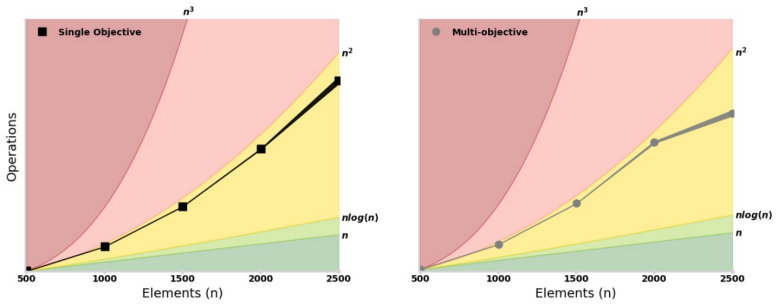
- [Section 4.4, complexity analysis] The Big-O analysis uses n for the GA population size and later n_task for the number of tasks; the statement that the number of workers 'is assumed to scale with the number of tasks' should be an explicit modeling assumption, not an aside, because it is not true in general and affects the claimed O(n^2) scaling.
Circularity Check
No circularity found: the model derivation is self-contained and all benchmarks are external heuristic or simulated-manager baselines.
full rationale
The paper's task-allocation model defines its own objectives (completion probability, precision, and preference) in Section 3.2 and optimizes them with a genetic algorithm in Section 3.3; it does not claim to derive an externally observed quantity from fitted parameters. The comparisons in Sections 4.2 and 4.5 are against greedy, hill-climbing, and two simulated manager heuristics, which are stated assumptions rather than quantities defined by the model. Although the GA is scored on the same utility functions it optimizes, that is a standard in-sample evaluation of an optimizer, not a circular derivation, and the paper explicitly states that data are simulated and that the manager strategies 'emulate' working practice rather than being estimated from the model. No load-bearing self-citations or imported uniqueness theorems appear; the Nash-product citation is standard external game theory. Consequently there is no equation that reduces to its own input and no fitted input relabeled as a prediction.
Assumptions & free parameters
free parameters (5)
- GA hyperparameters =
population 500, generations 50, mutation probability [0.9, 0.05], parents mating 50, elitism 10
- Efficiency factor range =
0.9 to 1.1
- Task type parameters =
mu_theta in seconds, sigma^2_theta, relative frequency (Table 2)
- Workload ratio =
1.01 to 1.1 times total availability
- Pre-allocation fraction =
5%
assumptions (5)
- domain assumption Execution times are normally and independently distributed with variance independent of allocation
- domain assumption Each analyst executes tasks in priority order
- domain assumption Expected execution time follows E(t,a) = mu_theta_t * c_t / eta_a,theta_t
- ad hoc to paper The Nash product is the appropriate aggregation of individual utilities
- ad hoc to paper Precision (gamma_t) and preference (zeta_t,a) are valid proxies for worker well-being
Cite this review
Pith. "Pith review of Optimising task allocation to balance business goals and worker well-being for financial service workforces." pith.science (2026). https://pith.science/paper/ASRZFBPJ
@misc{pith2026250701968,
  author       = {Pith},
  title        = {Pith review of: Optimising task allocation to balance business goals and worker well-being for financial service workforces},
  year         = {2026},
  howpublished = {\url{https://pith.science/paper/ASRZFBPJ}},
  note         = {Machine review of arXiv:2507.01968}
}
read the original abstract
Purpose: Financial service companies manage huge volumes of data which requires timely error identification and resolution. The associated tasks to resolve these errors frequently put financial analyst workforces under significant pressure leading to resourcing challenges and increased business risk. To address this challenge, we introduce a formal task allocation model which considers both business orientated goals and analyst well-being. Methodology: We use a Genetic Algorithm (GA) to optimise our formal model to allocate and schedule tasks to analysts. The proposed solution is able to allocate tasks to analysts with appropriate skills and experience, while taking into account staff well-being objectives. Findings: We demonstrate our GA model outperforms baseline heuristics, current working practice, and is applicable to a range of single and multi-objective real-world scenarios. We discuss the potential for metaheuristics (such as GAs) to efficiently find sufficiently good allocations which can provide recommendations for financial service managers in-the-loop. Originality: A key gap in existing allocation and scheduling models, is fully considering worker well-being. This paper presents an allocation model which explicitly optimises for well-being while still improving on current working practice for efficiency.
Figures


Figures from the paper (2 more)


Reference graph
Works this paper leans on
-
[1]
Suh, A systematic approach to predicting nav errors, Retrieved from (2024)
B. Suh, A systematic approach to predicting nav errors, Retrieved from (2024). URL https://www.oncorps.ai/briefs/nav-errors
work page 2024
-
[2]
F. Europe, Preventing the “huge consequences” of nav oversight error, Retrieved from (2021). URL https://funds-europe.com/the-huge-consequences-of-nav-oversight-error/
work page 2021
-
[3]
Labor, Financial analysts - work environment, us bureau of labor statistics, Retrieved from (2023)
U. Labor, Financial analysts - work environment, us bureau of labor statistics, Retrieved from (2023). URL https://www.bls.gov/ooh/business-and-financial/ financial-analysts.htm#tab-3
work page 2023
-
[4]
Sachs, Working conditions survey, Retrieved from (2022)
G. Sachs, Working conditions survey, Retrieved from (2022). URL https://assets.bwbx.io/documents/users/iqjWHBFdfxIU/ rSEzNw9cve9E/v0
work page 2022
-
[5]
WSO, Wso 2021 investment banking work-conditions survey, Retrieved from (2021). URL https://www.wallstreetoasis.com/forum/ investment-banking/wso-2021-investment-banking-work-conditions-survey-part-22
work page 2021
-
[6]
Labor, Job openings and labor turnover summary, us bureau of labor statistics, Retrieved from (2022)
U. Labor, Job openings and labor turnover summary, us bureau of labor statistics, Retrieved from (2022). URL https://www.bls.gov/news.release/jolts.nr0.htm 26
work page 2022
-
[7]
A. Ernst, H. Jiang, M. Krishnamoorthy, D. Sier, Staff scheduling and rostering: A review of applications, methods and models, European Journal of Operational Research 153 (1) (2004) 3–27, timetabling and Rostering. doi:https://doi.org/10.1016/S0377-2217(03)00095-X. URL https://www.sciencedirect.com/science/article/pii/ S037722170300095X
-
[8]
J. Van den Bergh, J. Beli¨ en, P. De Bruecker, E. Demeulemeester, L. De Boeck, Personnel scheduling: A literature review, European jour- nal of operational research 226 (3) (2013) 367–385
work page 2013
Show all 60 references
-
[9]
Ahmadian Fard Fini, A
A. Ahmadian Fard Fini, A. Akbarnezhad, T. H. Rashidi, S. T. Waller, Job assignment based on brain demands and human resource strategies, Journal of Construction Engineering and Management 143 (5) (2017) 04016123
2017
-
[10]
Starkey, H
A. Starkey, H. Hagras, S. Shakya, G. Owusu, A genetic algorithm based approach for the simultaneous optimisation of workforce skill sets and team allocation, in: Research and Development in Intelligent Systems XXXIII: Incorporating Applications and Innovations in Intelligent S...
2016
-
[11]
D. A. Nembhard, F. Bentefouet, Selection policies for a multifunctional workforce, International journal of production research 52 (16) (2014) 4785–4802
2014
-
[12]
Mourtzis, V
D. Mourtzis, V. Siatras, J. Angelopoulos, N. Panopoulos, An intelligent model for workforce allocation taking into consideration the operator skills, Procedia CIRP 97 (2021) 196–201
2021
-
[13]
Derkinderen, J
V. Derkinderen, J. Bekker, P. Smet, Optimizing workforce allocation under uncertain activity duration, Computers & Industrial Engineering 179 (2023) 109228
2023
-
[14]
F. B. Review, Companies need to know the dollar cost of employee turnover, Retrieved from (2018). URL https://www.forbes.com/sites/billconerly/2018/08/12/ companies-need-to-know-the-dollar-cost-of-employee-turnover/ amp/ 27
2018
-
[15]
A. F. Gad, Pygad: An intuitive genetic algorithm python library (2021). arXiv:2106.06158
2021 arXiv
-
[16]
J. E. Gomar, C. T. Haas, D. P. Morton, Assignment and allocation optimization of partially multiskilled workforce, Journal of construction Engineering and Management 128 (2) (2002) 103–109
2002
-
[17]
Shahbazi, A
B. Shahbazi, A. Akbarnezhad, D. Rey, A. Ahmadian Fard Fini, M. Loosemore, Optimization of job allocation in construction organi- zations to maximize workers’ career development opportunities, Journal of Construction Engineering and Management 145 (6) (2019) 04019036
2019
-
[18]
Cowling, N
P. Cowling, N. Colledge, K. Dahal, S. Remde, The trade off between diversity and quality for multi-objective workforce scheduling, in: Evo- lutionary Computation in Combinatorial Optimization: 6th European Conference, EvoCOP 2006, Budapest, Hungary, April 10-12, 2006. Pro- cee...
2006
-
[19]
G. Quan, G. W. Greenwood, D. Liu, S. Hu, Searching for multiobjective preventive maintenance schedules: Combining preferences with evolu- tionary algorithms, European Journal of Operational Research 177 (3) (2007) 1969–1984
2007
-
[20]
Demerouti, A
E. Demerouti, A. B. Bakker, F. Nachreiner, W. B. Schaufeli, The job demands-resources model of burnout., Journal of Applied psychology 86 (3) (2001) 499
2001
-
[21]
H. Bao, C. Liu, J. Ma, J. Feng, H. He, When job resources func- tion as a stress buffer: A resource allocation perspective of the job demands-resources model, Personality and Individual Differences 192 (2022) 111591
2022
-
[22]
A. B. Bakker, E. Demerouti, Job demands–resources theory: Taking stock and looking forward., Journal of occupational health psychology 22 (3) (2017) 273
2017
-
[23]
T. L. Saaty, What is the analytic hierarchy process?, Springer, 1988
1988
-
[24]
Vincke, Multicriteria decision-aid, John Wiley & Sons, 1992
P. Vincke, Multicriteria decision-aid, John Wiley & Sons, 1992. 28
1992
-
[25]
Tzeng, J.-J
G.-H. Tzeng, J.-J. Huang, Multiple attribute decision making: methods and applications, CRC press, 2011
2011
-
[26]
Brans, P
J.-P. Brans, P. Vincke, Note—a preference ranking organisation method: (the promethee method for multiple criteria decision-making), Manage- ment science 31 (6) (1985) 647–656
1985
-
[27]
R. L. Keeney, H. Raiffa, Decisions with multiple objectives: preferences and value trade-offs, Cambridge university press, 1993
1993
-
[28]
J. R. Eastman, H. Jiang, J. Toledano, Multi-criteria and multi-objective decision making for land allocation using gis, Multicriteria analysis for land-use management (1998) 227–251
1998
-
[29]
S. L. Gebre, D. Cattrysse, J. Van Orshoven, Multi-criteria decision- making methods to address water allocation problems: A systematic review, Water 13 (2) (2021) 125
2021
-
[30]
Shyalika, T
C. Shyalika, T. Silva, A. Karunananda, Reinforcement learning in dy- namic task scheduling: A review, SN Computer Science 1 (6) (2020) 306
2020
-
[31]
Pawlak, Rough sets, International journal of computer & information sciences 11 (1982) 341–356
Z. Pawlak, Rough sets, International journal of computer & information sciences 11 (1982) 341–356
1982
-
[32]
Zimmermann, Fuzzy set theory—and its applications, Springer Science & Business Media, 2011
H.-J. Zimmermann, Fuzzy set theory—and its applications, Springer Science & Business Media, 2011
2011
-
[33]
S. J. Russell, P. Norvig, Artificial intelligence a modern approach, Lon- don, 2010
2010
-
[34]
J. H. Holland, Adaptation in natural and artificial systems: an intro- ductory analysis with applications to biology, control, and artificial in- telligence, MIT press, 1992
1992
-
[35]
Beyer, H.-P
H.-G. Beyer, H.-P. Schwefel, Evolution strategies–a comprehensive in- troduction, Natural computing 1 (2002) 3–52
2002
-
[36]
Dorigo, V
M. Dorigo, V. Maniezzo, A. Colorni, Ant system: optimization by a colony of cooperating agents, IEEE transactions on systems, man, and cybernetics, part b (cybernetics) 26 (1) (1996) 29–41. 29
1996
-
[37]
Yang, Nature-inspired metaheuristic algorithms, Luniver press, 2010
X.-S. Yang, Nature-inspired metaheuristic algorithms, Luniver press, 2010
2010
-
[38]
Kennedy, R
J. Kennedy, R. Eberhart, Particle swarm optimization, in: Proceedings of ICNN’95-international conference on neural networks, Vol. 4, IEEE, 1995, pp. 1942–1948
1995
-
[39]
T. D. Braun, H. J. Siegel, N. Beck, L. L. B¨ ol¨ oni, M. Maheswaran, A. I. Reuther, J. P. Robertson, M. D. Theys, B. Yao, D. Hensgen, et al., A comparison of eleven static heuristics for mapping a class of indepen- dent tasks onto heterogeneous distributed computing systems, J...
2001
-
[40]
D. P. Vidyarthi, A. K. Tripathi, Maximizing reliability of distributed computing system with task allocation using simple genetic algorithm, Journal of Systems Architecture 47 (6) (2001) 549–554
2001
-
[41]
Rekha, M
P. Rekha, M. Dakshayini, Efficient task allocation approach using ge- netic algorithm for cloud environment, Cluster Computing 22 (4) (2019) 1241–1251
2019
-
[42]
Z. Zhou, F. Li, H. Zhu, H. Xie, J. H. Abawajy, M. U. Chowdhury, An im- proved genetic algorithm using greedy strategy toward task scheduling optimization in cloud environments, Neural Computing and Applica- tions 32 (2020) 1531–1541
2020
-
[43]
G. Chen, J. B. Cruz, Genetic algorithm for task allocation in uav cooper- ative control, in: AIAA Guidance, Navigation, and Control Conference and Exhibit, 2003, p. 5582
2003
-
[44]
W. Zhu, L. Li, L. Teng, W. Yonglu, Multi-uav reconnaissance task allo- cation for heterogeneous targets using an opposition-based genetic algo- rithm with double-chromosome encoding, Chinese Journal of Aeronau- tics 31 (2) (2018) 339–350
2018
-
[45]
X. Wu, Y. Yin, L. Xu, X. Wu, F. Meng, R. Zhen, Multi-uav task al- location based on improved genetic algorithm, IEEE Access 9 (2021) 100369–100379. 30
2021
-
[46]
F. Chen, K. Sekiyama, T. Fukuda, A genetic algorithm for subtask al- location within human and robot coordinated assembly, in: 2012 Inter- national Symposium on Micro-NanoMechatronics and Human Science (MHS), IEEE, 2012, pp. 507–511
2012
-
[47]
Nunes, M
E. Nunes, M. Gini, Multi-robot auctions for allocation of tasks with tem- poral constraints, in: Proceedings of the AAAI conference on artificial intelligence, Vol. 29, 2015, p. 1
2015
-
[48]
Raatz, S
A. Raatz, S. Blankemeyer, T. Recker, D. Pischke, P. Nyhuis, Task scheduling method for hrc workplaces based on capabilities and exe- cution time assumptions for robots, CIRP Annals 69 (1) (2020) 13–16
2020
-
[49]
Y. Y. Liau, K. Ryu, Genetic algorithm-based task allocation in multiple modes of human–robot collaboration systems with two cobots, The In- ternational Journal of Advanced Manufacturing Technology 119 (11-12) (2022) 7291–7309
2022
-
[50]
Yeh, W.-S
J.-Y. Yeh, W.-S. Lin, Using simulation technique and genetic algorithm to improve the quality care of a hospital emergency department, Expert Systems with Applications 32 (4) (2007) 1073–1083
2007
-
[51]
Yousefi, M
M. Yousefi, M. Yousefi, R. P. M. Ferreira, J. H. Kim, F. S. Fogliatto, Chaotic genetic algorithm and adaboost ensemble metamodeling ap- proach for optimum resource planning in emergency departments, Arti- ficial intelligence in medicine 84 (2018) 23–33
2018
-
[52]
Sieja, K
M. Sieja, K. Wach, The use of evolutionary algorithms for optimization in the modern entrepreneurial economy: interdisciplinary perspective, Entrepreneurial Business and Economics Review 7 (4) (2019) 117–130
2019
-
[53]
S. A. DeVaney, Z. Chen, Job satisfaction of recent graduates in financial services, Retrieved on 12 (12) (2003) 2006
2003
-
[54]
Sypniewska, Evaluation of factors influencing job satisfaction, Con- temporary economics 8 (1) (2014) 57–72
B. Sypniewska, Evaluation of factors influencing job satisfaction, Con- temporary economics 8 (1) (2014) 57–72
2014
-
[55]
J. F. Nash Jr, The bargaining problem, Econometrica: Journal of the econometric society (1950) 155–162. 31
1950
-
[56]
Binmore, Bargaining and fairness, Proceedings of the National Academy of Sciences 111 (supplement 3) (2014) 10785–10788
K. Binmore, Bargaining and fairness, Proceedings of the National Academy of Sciences 111 (supplement 3) (2014) 10785–10788
2014
-
[57]
Marsili Libelli, P
S. Marsili Libelli, P. Alba, Adaptive mutation in genetic algorithms, Soft computing 4 (2000) 76–80
2000
-
[58]
E. W. Dijkstra, A note on two problems in connexion with graphs, in: Edsger Wybe Dijkstra: His Life, Work, and Legacy, 2022, pp. 287–290
2022
-
[59]
Goel, An extensive review of computational intelligence-based opti- mization algorithms: trends and applications, Soft Computing 24 (2020) 16519–16549
L. Goel, An extensive review of computational intelligence-based opti- mization algorithms: trends and applications, Soft Computing 24 (2020) 16519–16549
2020
-
[60]
S. Han, L. Xiao, An improved adaptive genetic algorithm, in: SHS Web of Conferences, Vol. 140, EDP Sciences, 2022, p. 01044. 32
2022
Reviewed August 15, 2026 · model on record in the stance chip above.
Discussion (0). Continue with ORCID to comment.