REVIEW 4 major objections 3 minor 64 references
LocalDyGS: Multi-view Global Dynamic Scene Modeling via Adaptive Local Implicit Feature Decoupling
T0 review · 4 major / 3 minor · reviewed 2026-08-06 · deepseek-v4-flash
Pith's one-line read LocalDyGS argues that a dynamic scene can be reconstructed globally by decomposing it into seed-anchored local spaces, each generating time-varying Temporal Gaussians from decoupled static and dynamic features, allowing one method to…
desk verdict A plausible architecture with real ablations, but the 'first large-scale' claim is undercut by the omitted Swift4D comparison and thin VRU evidence. read the letter →
The pith
A machine-rendered reading of the paper's core claim, the machinery that carries it, and where it could break.
The reading
What carries the argument
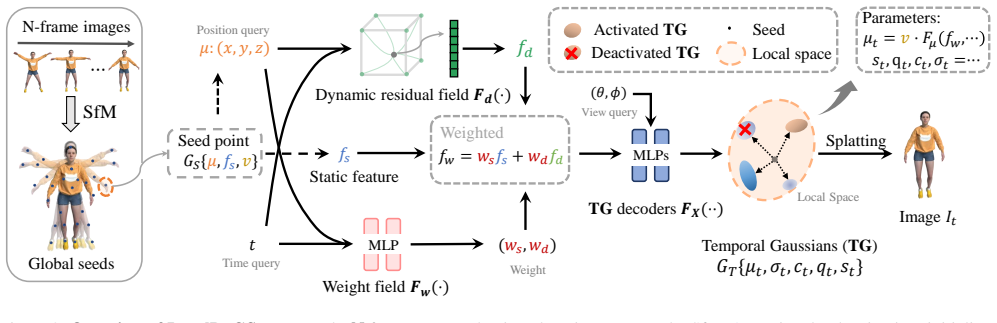
The central object is the seed-anchored local space with its accompanying Temporal Gaussian. A seed is a 3D point, initialized by fusing Structure-from-Motion point clouds from several video frames, and it carries a learnable static feature and a scale that controls how far its influence reaches. For every query time, a shared dynamic residual field built from multi-resolution hash encoding over space and time and a shallow MLP produces a time-specific residual feature; a weight field predicts how much static versus dynamic content to use; and a decoder MLP outputs the parameters of k Temporal Gaussians, including their positions relative to the seed. Two mechanisms keep this efficient: Temporal Gaussians with opacity below a threshold are deactivated for a given time, and an adaptive seed-growing process adds new seeds wherever the maximum 2D projection gradient of a Temporal Gaussian exceeds a threshold. The load-bearing idea is that local, independently parameterized motion is enough to explain global dynamics, so no persistent per-Gaussian trajectory or canonical deformation field is needed.
What would settle it
Train LocalDyGS on a multi-view dynamic sequence where a fast-moving object passes through a textureless region completely absent from the Structure-from-Motion point cloud, and inspect whether any new seeds are grown inside that region and whether rendering there shows blur or ghosting; if no seeds appear and quality collapses, the coverage assumption is necessary for the claimed large-scale performance.
Extended reading notes
Core claim
On its own terms, the paper's central discovery is that long-range motion can be represented by short-range local responses: a moving object is never followed as a persistent point; it simply activates different seed-centered local spaces at different times. Each local space stores a time-invariant static feature, and a shared dynamic residual field supplies a small time-specific correction; a weight field blends the two, and a decoder turns the blend into a set of Temporal Gaussians, i.e., 3D Gaussians whose mean, rotation, scale, opacity, and color all depend on the query time. An adaptive seed-growing step monitors the 2D projection gradient of these Gaussians and inserts new seeds wherever motion is under-covered, which the paper argues makes the model robust to incomplete Structure-from-Motion initialization. The paper reports state-of-the-art or competitive PSNR and LPIPS on the N3DV and MeetRoom datasets, competitive results on a basketball-court dataset with large-scale motion, and higher speed and lower storage than prior dynamic Gaussian methods.
Load-bearing premise
The method assumes the fused Structure-from-Motion point cloud from a few frames already places seeds in every region where moving objects will appear, and that the adaptive seed-growing strategy can fill any remaining gaps; if SfM misses a region entirely, rendering quality in that region will degrade.
Editorial extensions
If this is right
- A moving object no longer needs to be followed as a persistent point across time; different local spaces activate as it moves, so long-range motion can be decomposed into short-range pieces.
- Because the dynamic residual field carries only time-specific corrections, the model stays compact (about 100 MB for 300 N3DV frames) and trains in under an hour on a single GPU.
- Temporal Gaussian deactivation and adaptive seed growing trade a small amount of storage for large speedups and robustness to incomplete Structure-from-Motion point clouds.
- The same model achieves state-of-the-art or competitive quality on fine-scale datasets and on a basketball-court dataset with large-scale motion, supporting the claim that one framework spans motion scales.
- The static/dynamic decoupling and local-space structure may also make the representation easier to edit, stream, or extend to longer sequences, since each local space has independent parameters.
Reading between the lines
- An implicit extension not tested in the paper: because motion is local and seeds are independent, the representation may be amenable to incremental or streaming updates, where only newly activated local spaces need to be refined as a long video progresses.
- The static/dynamic split is a natural handle for editing: freezing the dynamic residual field and modifying static features could let a user change a background or object while keeping motion intact, though the paper does not demonstrate editing.
- A testable consequence of the coverage assumption is that the required seed density should scale with the spatial extent and speed of motion; measuring PSNR against deliberately removed seed regions would directly quantify this dependence.
- As the paper itself notes, a pretrained geometric prior could replace or augment the multi-view Structure-from-Motion point cloud, potentially extending the method to monocular input.
Editorial analysis
A structured set of objections, weighed in public.
Referee Report
Summary. The paper proposes LocalDyGS, a multi-view dynamic scene reconstruction method based on 3D Gaussian Splatting. Seeds are initialized from SfM point clouds fused over N frames, each seed defines a local space with a static feature shared across time, and a global dynamic residual field supplies time-specific features. These are combined and decoded into Temporal Gaussians, with a deactivation mechanism and an adaptive seed growing strategy. The method is evaluated on N3DV, MeetRoom, and the VRU basketball court dataset, reporting competitive PSNR/LPIPS, compact model size, and fast training and rendering.
Significance. If the reported results are reliable, the local-space decomposition is a promising approach to reducing the complexity of dynamic scene modeling, and the efficiency numbers (0.58h training, 100MB model, 105 FPS on N3DV) are attractive. The ablations support the individual design choices: static/dynamic decoupling, Temporal Gaussian deactivation, and adaptive seed growing all improve quality or speed. However, the central claims of being the 'first' to model large-scale dynamic scenes and of superior performance on the VRU dataset are not supported by the presented evidence, largely because the closest baseline, Swift4D, is omitted from the comparison and the large-scale experiments lack the analyses needed to substantiate the seed-coverage mechanism.
major comments (4)
- [Abstract; Section 1; Section 4.2; Table 3] The abstract and contribution list claim that LocalDyGS is 'the first attempt to model larger and more complex highly dynamic scenes.' This is contradicted by the paper's own related work: Swift4D [49] is described as validating on the same VRU basketball court dataset, and Section 4.2 states that this dataset 'is used for the first time in Swift4D.' Swift4D is not included in Table 3, so the firstness claim is unsupported. The authors should remove or substantially qualify this claim and should include Swift4D as a baseline or justify its absence.
- [Table 3; Section 4.3] The VRU quantitative results do not show that LocalDyGS outperforms static single-frame methods on all metrics. In Table 3, 2DGS achieves higher PSNR (30.78 vs 30.58), and GOF has higher SSIM (0.949 vs 0.944) and lower LPIPS (0.141 vs 0.173). In addition, the caption says static methods are 'tested on frame 0' while dynamic methods are evaluated over the sequence; this protocol needs clarification because a static fit to a single frame is not directly comparable to a dynamic reconstruction over the full sequence. The text in Section 4.3 calling the VRU performance 'robust' overstates what the table shows.
- [Section 3.2; Section 3.5; Section 5; Tables 4 and 6] The claim that LocalDyGS adapts to large-scale motion depends on seed coverage of all regions where moving objects appear. The initial seeds come from SfM point clouds fused from N=6 frames, and Section 5 concedes that significant SfM failure can impact rendering quality. Adaptive Seed Growing (Section 3.5) adds a seed only at the 3D position of an existing Temporal Gaussian whose projected gradient exceeds tau_g, so it cannot create coverage in regions that have no Temporal Gaussian at all. The only large-scale dataset, VRU, is not accompanied by seed-coverage statistics, an ASG ablation, or an N-variation study; the ASG ablation in Table 4 is on MeetRoom and the N study in Table 6 is on N3DV, both fine-scale datasets. Additional evidence on VRU is needed to support the large-scale adaptivity claim.
- [Tables 1-3] No error bars, variance estimates, or multiple-seed statistics are reported for any quantitative comparison. The margins over some baselines on N3DV are small (e.g., PSNR 32.28 vs 32.05), and Table 3 shows mixed results. Without variance information, the state-of-the-art claim is not statistically supported.
minor comments (3)
- [Section 3.4, Eq. (9)] The symbol T is used both for the set of query times and for the number of iterations; please use a distinct notation to avoid ambiguity.
- [Table 4] The metric names 'SSIM1' and 'SSIM2' in Table 4 are inconsistent with 'DSSIM1' and 'DSSIM2' used in Table 1; please unify the naming and define the data ranges in the caption.
- [Figure 1] Panel (c) reports PSNR 34.10 and FPS 105 without specifying the scene or the comparison setting; please refer to the corresponding table entry so that the figure can be interpreted independently.
Circularity Check
No circular derivation: LocalDyGS is an empirical reconstruction method whose components (seed initialization, static/dynamic feature decoupling, Temporal Gaussian decoding, ASG) are not constructed from the quantities they are used to predict; the only self-citation is contextual and not load-bearing.
full rationale
LocalDyGS makes no closed-form predictive claim that could collapse into its inputs. Seeds are initialized from SfM point clouds (Sec. 3.2) and used to define local spaces; Temporal Gaussians are decoded from static/dynamic features (Eqs. 6-8) and supervised by the multi-view rendering loss (Eq. 11). The 'large-scale' capability is asserted conditionally on seed coverage ('When seeds cover all regions where a moving object appears...', Sec. 1) and then tested on the VRU dataset (Tab. 3); while the paper does not provide seed-coverage statistics or an N-variation/ASG ablation on VRU, that is an evidence gap about assumption sensitivity, not a definitional reduction. The Adaptive Seed Growing rule (Sec. 3.5) adds seeds where the projection gradient of an existing Temporal Gaussian exceeds tau_g; this can densify but not invent coverage in empty regions, which the paper itself hedges in Sec. 5 ('If SfM fails significantly, it may impact rendering quality'). That is a stated limitation, not a circular step. The one self-citation, Swift4D [49] by overlapping authors, is used only as related work describing the VRU dataset and as one of several inspirations for feature decoupling (Sec. 3.3), alongside independent [48] and [56]; no load-bearing argument reduces to this citation. The Abstract's 'first attempt' claim is inconsistent with the paper's own acknowledgment that Swift4D already validated on the basketball-court dataset, but this is a novelty/soundness overclaim, not circularity. No equation in the paper is defined in terms of the result it is used to establish, and no fitted parameter is relabeled as a prediction. Therefore no significant circularity is present.
Assumptions & free parameters
free parameters (5)
- Deactivation threshold tau_alpha =
0.01
- Seed growing threshold tau_g =
0.001
- Volume regularization weight lambda_v =
0.001
- SSIM loss weight lambda_SSIM =
0.2
- Temporal Gaussians per seed k =
10
assumptions (4)
- domain assumption SfM point clouds provide sufficient seed coverage for dynamic scenes.
- domain assumption Multi-view synchronized cameras provide dense spatiotemporal supervision.
- domain assumption Static/dynamic feature decoupling is sufficient to represent scenes.
- standard math 3D Gaussian splatting and hash encoding from prior work are reliable.
Cite this review
Pith. "Pith review of LocalDyGS: Multi-view Global Dynamic Scene Modeling via Adaptive Local Implicit Feature Decoupling." pith.science (2026). https://pith.science/paper/ICXRWP7M
@misc{pith2026250702363,
  author       = {Pith},
  title        = {Pith review of: LocalDyGS: Multi-view Global Dynamic Scene Modeling via Adaptive Local Implicit Feature Decoupling},
  year         = {2026},
  howpublished = {\url{https://pith.science/paper/ICXRWP7M}},
  note         = {Machine review of arXiv:2507.02363}
}
read the original abstract
Due to the complex and highly dynamic motions in the real world, synthesizing dynamic videos from multi-view inputs for arbitrary viewpoints is challenging. Previous works based on neural radiance field or 3D Gaussian splatting are limited to modeling fine-scale motion, greatly restricting their application. In this paper, we introduce LocalDyGS, which consists of two parts to adapt our method to both large-scale and fine-scale motion scenes: 1) We decompose a complex dynamic scene into streamlined local spaces defined by seeds, enabling global modeling by capturing motion within each local space. 2) We decouple static and dynamic features for local space motion modeling. A static feature shared across time steps captures static information, while a dynamic residual field provides time-specific features. These are combined and decoded to generate Temporal Gaussians, modeling motion within each local space. As a result, we propose a novel dynamic scene reconstruction framework to model highly dynamic real-world scenes more realistically. Our method not only demonstrates competitive performance on various fine-scale datasets compared to state-of-the-art (SOTA) methods, but also represents the first attempt to model larger and more complex highly dynamic scenes. Project page: https://wujh2001.github.io/LocalDyGS/.
Figures


Figures from the paper (8 more)


Reference graph
Works this paper leans on
-
[49]
Jiahao Wu, Rui Peng, Zhiyan Wang, Lu Xiao, Luyang Tang, Jinbo Yan, Kaiqiang Xiong, and Ronggang Wang. Swift4d: Adaptive divide-and-conquer gaussian splatting for compact and efficient reconstruction of dynamic scene. In The Thirteenth International Conference on Learning Representations. 2, 4, 6
-
[1]
HyperReel: High-fidelity 6-DoF video with ray-conditioned sampling
Benjamin Attal, Jia-Bin Huang, Christian Richardt, Michael Zollhoefer, Johannes Kopf, Matthew O’Toole, and Changil Kim. HyperReel: High-fidelity 6-DoF video with ray-conditioned sampling. arXiv preprint arXiv:2301.02238,
-
[2]
https://www.avs.org.cn/
A VS. https://www.avs.org.cn/. 2024. 6
2024
-
[3]
Per-gaussian embedding-based deformation for deformable 3d gaussian splatting
Jeongmin Bae, Seoha Kim, Youngsik Yun, Hahyun Lee, Gun Bang, and Youngjung Uh. Per-gaussian embedding-based deformation for deformable 3d gaussian splatting. arXiv preprint arXiv:2404.03613, 2024. 3
arXiv 2024
-
[4]
4d visualization of dynamic events from unconstrained multi-view videos
Aayush Bansal, Minh V o, Yaser Sheikh, Deva Ramanan, and Srinivasa Narasimhan. 4d visualization of dynamic events from unconstrained multi-view videos. In Proceedings of the IEEE/CVF Conference on Computer Vision and Pattern Recognition, pages 5366–5375, 2020. 2
2020
-
[5]
Mip-nerf: A multiscale representation for anti-aliasing neural radiance fields
Jonathan T Barron, Ben Mildenhall, Matthew Tancik, Peter Hedman, Ricardo Martin-Brualla, and Pratul P Srinivasan. Mip-nerf: A multiscale representation for anti-aliasing neural radiance fields. In Proceedings of the IEEE/CVF international conference on computer vision, pages 5855–5864, 2021. 2
2021
-
[6]
Mip-nerf 360: Unbounded anti-aliased neural radiance fields
Jonathan T Barron, Ben Mildenhall, Dor Verbin, Pratul P Srinivasan, and Peter Hedman. Mip-nerf 360: Unbounded anti-aliased neural radiance fields. In Proceedings of the IEEE/CVF conference on computer vision and pattern recognition, pages 5470–5479, 2022
2022
-
[7]
Zip-nerf: Anti-aliased grid-based neural radiance fields
Jonathan T Barron, Ben Mildenhall, Dor Verbin, Pratul P Srinivasan, and Peter Hedman. Zip-nerf: Anti-aliased grid-based neural radiance fields. In Proceedings of the IEEE/CVF International Conference on Computer Vision , pages 19697–19705, 2023. 2
2023
Show all 64 references
-
[8]
6dgs: 6d pose estimation from a single image and a 3d gaussian splatting model
Matteo Bortolon, Theodore Tsesmelis, Stuart James, Fabio Poiesi, and Alessio Del Bue. 6dgs: 6d pose estimation from a single image and a 3d gaussian splatting model. arXiv preprint arXiv:2407.15484, 2024. 2
2024 arXiv
-
[9]
Hexplane: A fast representation for dynamic scenes
Ang Cao and Justin Johnson. Hexplane: A fast representation for dynamic scenes. In Proceedings of the IEEE/CVF Conference on Computer Vision and Pattern Recognition , pages 130–141, 2023. 2, 6
2023
-
[10]
Tensorf: Tensorial radiance fields
Anpei Chen, Zexiang Xu, Andreas Geiger, Jingyi Yu, and Hao Su. Tensorf: Tensorial radiance fields. In European conference on computer vision , pages 333–350. Springer,
-
[11]
4d-rotor gaussian splatting: towards efficient novel view synthesis for dynamic scenes
Yuanxing Duan, Fangyin Wei, Qiyu Dai, Yuhang He, Wenzheng Chen, and Baoquan Chen. 4d-rotor gaussian splatting: towards efficient novel view synthesis for dynamic scenes. In ACM SIGGRAPH 2024 Conference Papers, pages 1–11, 2024. 3
2024
-
[12]
Instantsplat: Unbounded sparse-view pose-free gaussian splatting in 40 seconds
Zhiwen Fan, Wenyan Cong, Kairun Wen, Kevin Wang, Jian Zhang, Xinghao Ding, Danfei Xu, Boris Ivanovic, Marco Pavone, Georgios Pavlakos, et al. Instantsplat: Unbounded sparse-view pose-free gaussian splatting in 40 seconds. arXiv preprint arXiv:2403.20309, 2024. 2
2024 arXiv
-
[13]
Plenoxels: Radiance fields without neural networks
Sara Fridovich-Keil, Alex Yu, Matthew Tancik, Qinhong Chen, Benjamin Recht, and Angjoo Kanazawa. Plenoxels: Radiance fields without neural networks. In Proceedings of the IEEE/CVF conference on computer vision and pattern recognition, pages 5501–5510, 2022. 2, 6
2022
-
[14]
K-planes: Explicit radiance fields in space, time, and appearance
Sara Fridovich-Keil, Giacomo Meanti, Frederik Rahbæk Warburg, Benjamin Recht, and Angjoo Kanazawa. K-planes: Explicit radiance fields in space, time, and appearance. In Proceedings of the IEEE/CVF Conference on Computer Vision and Pattern Recognition, pages 12479–12488, 2023. 2, 6
2023
-
[15]
Efros, and Xiaolong Wang
Yang Fu, Sifei Liu, Amey Kulkarni, Jan Kautz, Alexei A. Efros, and Xiaolong Wang. Colmap-free 3d gaussian splatting. In Proceedings of the IEEE/CVF Conference on Computer Vision and Pattern Recognition (CVPR), pages 20796–20805,
-
[16]
Dynamic view synthesis from dynamic monocular video
Chen Gao, Ayush Saraf, Johannes Kopf, and Jia-Bin Huang. Dynamic view synthesis from dynamic monocular video. In Proceedings of the IEEE/CVF International Conference on Computer Vision, pages 5712–5721, 2021. 2
2021
-
[17]
Tri-miprf: Tri-mip representation for efficient anti-aliasing neural radiance fields
Wenbo Hu, Yuling Wang, Lin Ma, Bangbang Yang, Lin Gao, Xiao Liu, and Yuewen Ma. Tri-miprf: Tri-mip representation for efficient anti-aliasing neural radiance fields. In Proceedings of the IEEE/CVF International Conference on Computer Vision, pages 19774–19783, 2023. 2
2023
-
[18]
2d gaussian splatting for geometrically accurate radiance fields
Binbin Huang, Zehao Yu, Anpei Chen, Andreas Geiger, and Shenghua Gao. 2d gaussian splatting for geometrically accurate radiance fields. arXiv preprint arXiv:2403.17888,
-
[19]
Sc-gs: Sparse-controlled gaussian splatting for editable dynamic scenes
Yi-Hua Huang, Yang-Tian Sun, Ziyi Yang, Xiaoyang Lyu, Yan-Pei Cao, and Xiaojuan Qi. Sc-gs: Sparse-controlled gaussian splatting for editable dynamic scenes. In Proceedings of the IEEE/CVF Conference on Computer Vision and Pattern Recognition, pages 4220–4230, 2024. 2, 3
2024
-
[20]
3d gaussian splatting for real-time radiance field rendering
Bernhard Kerbl, Georgios Kopanas, Thomas Leimk¨uhler, and George Drettakis. 3d gaussian splatting for real-time radiance field rendering. ACM Trans. Graph., 42(4):139–1, 2023. 2, 3, 5, 6, 7
2023
-
[21]
Adam: A method for stochastic optimization
Diederik P Kingma and Jimmy Ba. Adam: A method for stochastic optimization. arXiv preprint arXiv:1412.6980 ,
-
[22]
Dynmf: Neural motion factorization for real-time dynamic view synthesis with 3d gaussian splatting
Agelos Kratimenos, Jiahui Lei, and Kostas Daniilidis. Dynmf: Neural motion factorization for real-time dynamic view synthesis with 3d gaussian splatting. arXiv preprint arXiv:2312.00112, 2023. 3
2023 arXiv
-
[23]
Streaming radiance fields for 3d video synthesis
Lingzhi Li, Zhen Shen, Zhongshu Wang, Li Shen, and Ping Tan. Streaming radiance fields for 3d video synthesis. Advances in Neural Information Processing Systems , 35: 13485–13498, 2022. 6, 7, 9
2022
-
[24]
Neural 3d video synthesis from multi-view video
Tianye Li, Mira Slavcheva, Michael Zollhoefer, Simon Green, Christoph Lassner, Changil Kim, Tanner Schmidt, Steven Lovegrove, Michael Goesele, Richard Newcombe, et al. Neural 3d video synthesis from multi-view video. In Proceedings of the IEEE/CVF Conference on Computer Vision...
2022
-
[25]
Neural scene flow fields for space-time view synthesis of dynamic scenes
Zhengqi Li, Simon Niklaus, Noah Snavely, and Oliver Wang. Neural scene flow fields for space-time view synthesis of dynamic scenes. In Proceedings of the IEEE/CVF Conference on Computer Vision and Pattern Recognition , pages 6498–6508, 2021. 2, 6
2021
-
[26]
Spacetime gaussian feature splatting for real-time dynamic view synthesis
Zhan Li, Zhang Chen, Zhong Li, and Yi Xu. Spacetime gaussian feature splatting for real-time dynamic view synthesis. In Proceedings of the IEEE/CVF Conference on Computer Vision and Pattern Recognition, pages 8508–8520,
-
[27]
Gaussian-flow: 4d reconstruction with dynamic 3d gaussian particle
Youtian Lin, Zuozhuo Dai, Siyu Zhu, and Yao Yao. Gaussian-flow: 4d reconstruction with dynamic 3d gaussian particle. In Proceedings of the IEEE/CVF Conference on Computer Vision and Pattern Recognition , pages 21136–21145, 2024. 3
2024
-
[28]
Neural volumes: Learning dynamic renderable volumes from images
Stephen Lombardi, Tomas Simon, Jason Saragih, Gabriel Schwartz, Andreas Lehrmann, and Yaser Sheikh. Neural volumes: Learning dynamic renderable volumes from images. arXiv preprint arXiv:1906.07751, 2019. 2
1906 arXiv
-
[29]
Mixture of volumetric primitives for efficient neural rendering
Stephen Lombardi, Tomas Simon, Gabriel Schwartz, Michael Zollhoefer, Yaser Sheikh, and Jason Saragih. Mixture of volumetric primitives for efficient neural rendering. ACM Transactions on Graphics (ToG), 40(4):1–13, 2021. 5
2021
-
[30]
Scaffold-gs: Structured 3d gaussians for view-adaptive rendering
Tao Lu, Mulin Yu, Linning Xu, Yuanbo Xiangli, Limin Wang, Dahua Lin, and Bo Dai. Scaffold-gs: Structured 3d gaussians for view-adaptive rendering. In Proceedings of the IEEE/CVF Conference on Computer Vision and Pattern Recognition , pages 20654–20664, 2024. 2, 4, 5, 8
2024
-
[31]
Instant neural graphics primitives with a multiresolution hash encoding
Thomas M ¨uller, Alex Evans, Christoph Schied, and Alexander Keller. Instant neural graphics primitives with a multiresolution hash encoding. ACM transactions on graphics (TOG), 41(4):1–15, 2022. 4, 6
2022
-
[32]
Nerfies: Deformable neural radiance fields
Keunhong Park, Utkarsh Sinha, Jonathan T Barron, Sofien Bouaziz, Dan B Goldman, Steven M Seitz, and Ricardo Martin-Brualla. Nerfies: Deformable neural radiance fields. In Proceedings of the IEEE/CVF International Conference on Computer Vision, pages 5865–5874, 2021. 2
2021
-
[33]
Hypernerf: A higher-dimensional representation for topologically varying neural radiance fields
Keunhong Park, Utkarsh Sinha, Peter Hedman, Jonathan T Barron, Sofien Bouaziz, Dan B Goldman, Ricardo Martin-Brualla, and Steven M Seitz. Hypernerf: A higher-dimensional representation for topologically varying neural radiance fields. arXiv preprint arXiv:2106.13228, 2021. 1, 3, 4
2021 arXiv
-
[34]
D-nerf: Neural radiance fields for dynamic scenes
Albert Pumarola, Enric Corona, Gerard Pons-Moll, and Francesc Moreno-Noguer. D-nerf: Neural radiance fields for dynamic scenes. In Proceedings of the IEEE/CVF Conference on Computer Vision and Pattern Recognition , pages 10318–10327, 2021. 1, 2, 3
2021
-
[35]
Stopthepop: Sorted gaussian splatting for view-consistent real-time rendering
Lukas Radl, Michael Steiner, Mathias Parger, Alexander Weinrauch, Bernhard Kerbl, and Markus Steinberger. Stopthepop: Sorted gaussian splatting for view-consistent real-time rendering. ACM Transactions on Graphics (TOG), 43(4):1–17, 2024. 2
2024
-
[36]
Octree-gs: Towards consistent real-time rendering with lod-structured 3d gaussians
Kerui Ren, Lihan Jiang, Tao Lu, Mulin Yu, Linning Xu, Zhangkai Ni, and Bo Dai. Octree-gs: Towards consistent real-time rendering with lod-structured 3d gaussians. arXiv preprint arXiv:2403.17898, 2024. 2
2024 arXiv
-
[37]
Structure-from-motion revisited
Johannes L Schonberger and Jan-Michael Frahm. Structure-from-motion revisited. In Proceedings of the IEEE conference on computer vision and pattern recognition, pages 4104–4113, 2016. 2, 3
2016
-
[38]
Nerfplayer: A streamable dynamic scene representation with decomposed neural radiance fields
Liangchen Song, Anpei Chen, Zhong Li, Zhang Chen, Lele Chen, Junsong Yuan, Yi Xu, and Andreas Geiger. Nerfplayer: A streamable dynamic scene representation with decomposed neural radiance fields. IEEE Transactions on Visualization and Computer Graphics, 29(5):2732–2742, 2023. 2, 6
2023
-
[39]
3dgstream: On-the-fly training of 3d gaussians for efficient streaming of photo-realistic free-viewpoint videos
Jiakai Sun, Han Jiao, Guangyuan Li, Zhanjie Zhang, Lei Zhao, and Wei Xing. 3dgstream: On-the-fly training of 3d gaussians for efficient streaming of photo-realistic free-viewpoint videos. In Proceedings of the IEEE/CVF Conference on Computer Vision and Pattern Recognition , pa...
2024
-
[40]
https://anonymous.4open.science/r/vru-sequence/
VRU. https://anonymous.4open.science/r/vru-sequence/
-
[41]
Superpoint gaussian splatting for real-time high-fidelity dynamic scene reconstruction
Diwen Wan, Ruijie Lu, and Gang Zeng. Superpoint gaussian splatting for real-time high-fidelity dynamic scene reconstruction. arXiv preprint arXiv:2406.03697, 2024. 2, 3
2024 arXiv
-
[42]
Mixed neural voxels for fast multi-view video synthesis
Feng Wang, Sinan Tan, Xinghang Li, Zeyue Tian, and Huaping Liu. Mixed neural voxels for fast multi-view video synthesis. arXiv preprint arXiv:2212.00190, 2022. 2, 6
2022 arXiv
-
[43]
Mixed neural voxels for fast multi-view video synthesis
Feng Wang, Sinan Tan, Xinghang Li, Zeyue Tian, Yafei Song, and Huaping Liu. Mixed neural voxels for fast multi-view video synthesis. In Proceedings of the IEEE/CVF International Conference on Computer Vision , pages 19706–19716, 2023. 2, 6
2023
-
[44]
Neus: Learning neural implicit surfaces by volume rendering for multi-view reconstruction
Peng Wang, Lingjie Liu, Yuan Liu, Christian Theobalt, Taku Komura, and Wenping Wang. Neus: Learning neural implicit surfaces by volume rendering for multi-view reconstruction. arXiv preprint arXiv:2106.10689, 2021. 2
2021 arXiv
-
[45]
Shape of motion: 4d reconstruction from a single video
Qianqian Wang, Vickie Ye, Hang Gao, Weijia Zeng, Jake Austin, Zhengqi Li, and Angjoo Kanazawa. Shape of motion: 4d reconstruction from a single video. 2024. 3
2024
-
[46]
Neus2: Fast learning of neural implicit surfaces for multi-view reconstruction
Yiming Wang, Qin Han, Marc Habermann, Kostas Daniilidis, Christian Theobalt, and Lingjie Liu. Neus2: Fast learning of neural implicit surfaces for multi-view reconstruction. In Proceedings of the IEEE/CVF International Conference on Computer Vision, pages 3295–3306, 2023. 2
2023
-
[47]
4d gaussian splatting for real-time dynamic scene rendering
Guanjun Wu, Taoran Yi, Jiemin Fang, Lingxi Xie, Xiaopeng Zhang, Wei Wei, Wenyu Liu, Qi Tian, and Xinggang Wang. 4d gaussian splatting for real-time dynamic scene rendering. In Proceedings of the IEEE/CVF Conference on Computer Vision and Pattern Recognition, pages 20310–20320,...
2024
-
[48]
Dynamic lidar re-simulation using compositional neural fields
Hanfeng Wu, Xingxing Zuo, Stefan Leutenegger, Or Litany, Konrad Schindler, and Shengyu Huang. Dynamic lidar re-simulation using compositional neural fields. In Proceedings of the IEEE/CVF Conference on Computer Vision and Pattern Recognition, pages 19988–19998, 2024. 2, 4
2024
-
[50]
Hdrgs: High dynamic range gaussian splatting
Jiahao Wu, Lu Xiao, Rui Peng, Kaiqiang Xiong, and Ronggang Wang. Hdrgs: High dynamic range gaussian splatting. arXiv preprint arXiv:2408.06543, 2024. 2
2024 arXiv
-
[51]
Mars: An instance-aware, modular and realistic simulator for autonomous driving
Zirui Wu, Tianyu Liu, Liyi Luo, Zhide Zhong, Jianteng Chen, Hongmin Xiao, Chao Hou, Haozhe Lou, Yuantao Chen, Runyi Yang, et al. Mars: An instance-aware, modular and realistic simulator for autonomous driving. In CAAI International Conference on Artificial Intelligence , pages...
2023
-
[52]
Multi-view image enhancement inconsistency decoupling guided 3d gaussian splatting
Lu Xiao, Jiahao Wu, Zhanke Wang, Guanhua Wu, Runling Liu, Zhiyan Wang, and Ronggang Wang. Multi-view image enhancement inconsistency decoupling guided 3d gaussian splatting. In ICASSP 2025-2025 IEEE International Conference on Acoustics, Speech and Signal Processing (ICASSP), ...
2025
-
[53]
Instant gaussian stream: Fast and generalizable streaming of dynamic scene reconstruction via gaussian splatting
Jinbo Yan, Rui Peng, Zhiyan Wang, Luyang Tang, Jiayu Yang, Jie Liang, Jiahao Wu, and Ronggang Wang. Instant gaussian stream: Fast and generalizable streaming of dynamic scene reconstruction via gaussian splatting. In Proceedings of the Computer Vision and Pattern Recognition C...
2025
-
[54]
Nerf-ds: Neural radiance fields for dynamic specular objects
Zhiwen Yan, Chen Li, and Gim Hee Lee. Nerf-ds: Neural radiance fields for dynamic specular objects. In Proceedings of the IEEE/CVF Conference on Computer Vision and Pattern Recognition, pages 8285–8295, 2023. 1, 3
2023
-
[55]
Real-time photorealistic dynamic scene representation and rendering with 4d gaussian splatting
Zeyu Yang, Hongye Yang, Zijie Pan, Xiatian Zhu, and Li Zhang. Real-time photorealistic dynamic scene representation and rendering with 4d gaussian splatting. arXiv preprint arXiv:2310.10642, 2023. 3, 6
2023 arXiv
-
[56]
Deformable 3d gaussians for high-fidelity monocular dynamic scene reconstruction
Ziyi Yang, Xinyu Gao, Wen Zhou, Shaohui Jiao, Yuqing Zhang, and Xiaogang Jin. Deformable 3d gaussians for high-fidelity monocular dynamic scene reconstruction. In Proceedings of the IEEE/CVF Conference on Computer Vision and Pattern Recognition, pages 20331–20341, 2024. 3, 4
2024
-
[57]
Viewcrafter: Taming video diffusion models for high-fidelity novel view synthesis
Wangbo Yu, Jinbo Xing, Li Yuan, Wenbo Hu, Xiaoyu Li, Zhipeng Huang, Xiangjun Gao, Tien-Tsin Wong, Ying Shan, and Yonghong Tian. Viewcrafter: Taming video diffusion models for high-fidelity novel view synthesis. arXiv preprint arXiv:2409.02048, 2024. 2
2024 arXiv
-
[58]
Gaussian opacity fields: Efficient and compact surface reconstruction in unbounded scenes
Zehao Yu, Torsten Sattler, and Andreas Geiger. Gaussian opacity fields: Efficient and compact surface reconstruction in unbounded scenes. arXiv preprint arXiv:2404.10772, 2024. 2, 6
2024 arXiv
-
[59]
Rade-gs: Rasterizing depth in gaussian splatting
Baowen Zhang, Chuan Fang, Rakesh Shrestha, Yixun Liang, Xiaoxiao Long, and Ping Tan. Rade-gs: Rasterizing depth in gaussian splatting. arXiv preprint arXiv:2406.01467, 2024. 2
2024 arXiv
-
[60]
Gaussianprediction: Dynamic 3d gaussian prediction for motion extrapolation and free view synthesis
Boming Zhao, Yuan Li, Ziyu Sun, Lin Zeng, Yujun Shen, Rui Ma, Yinda Zhang, Hujun Bao, and Zhaopeng Cui. Gaussianprediction: Dynamic 3d gaussian prediction for motion extrapolation and free view synthesis. In ACM SIGGRAPH 2024 Conference Papers, pages 1–12, 2024. 3
2024
-
[61]
Nice-slam: Neural implicit scalable encoding for slam
Zihan Zhu, Songyou Peng, Viktor Larsson, Weiwei Xu, Hujun Bao, Zhaopeng Cui, Martin R Oswald, and Marc Pollefeys. Nice-slam: Neural implicit scalable encoding for slam. In Proceedings of the IEEE/CVF conference on computer vision and pattern recognition, pages 12786–12796, 2022. 2
2022
-
[62]
Fsgs: Real-time few-shot view synthesis using gaussian splatting
Zehao Zhu, Zhiwen Fan, Yifan Jiang, and Zhangyang Wang. Fsgs: Real-time few-shot view synthesis using gaussian splatting. In European Conference on Computer Vision, pages 145–163. Springer, 2025. 2
2025
-
[63]
High-quality video view interpolation using a layered representation
C Lawrence Zitnick, Sing Bing Kang, Matthew Uyttendaele, Simon Winder, and Richard Szeliski. High-quality video view interpolation using a layered representation. ACM transactions on graphics (TOG), 23(3):600–608, 2004. 2
2004
-
[64]
Ewa splatting
Matthias Zwicker, Hanspeter Pfister, Jeroen Van Baar, and Markus Gross. Ewa splatting. IEEE Transactions on Visualization and Computer Graphics, 8(3):223–238, 2002. 3
2002
Reviewed August 6, 2026 · model on record in the stance chip above.
Discussion (0). Sign in to comment.