REVIEW 3 major objections 5 minor 21 references
Parametric shape models for vessels learned from segmentations via differentiable voxelization
T0 review · 3 major / 5 minor · reviewed 2026-08-06 · deepseek-v4-flash
Pith's one-line read A parametric vessel model—centerline and radius as cubic B-splines—can be fitted to a segmentation end-to-end using a differentiable voxelization loss, without any ground-truth shape parameters.
desk verdict A useful, well-engineered fitting pipeline whose core claim is softer than advertised: the differentiable voxelization is a local refinement over a centerline prior, not a standalone learner. read the letter →
The pith
A machine-rendered reading of the paper's core claim, the machinery that carries it, and where it could break.
The reading
What carries the argument
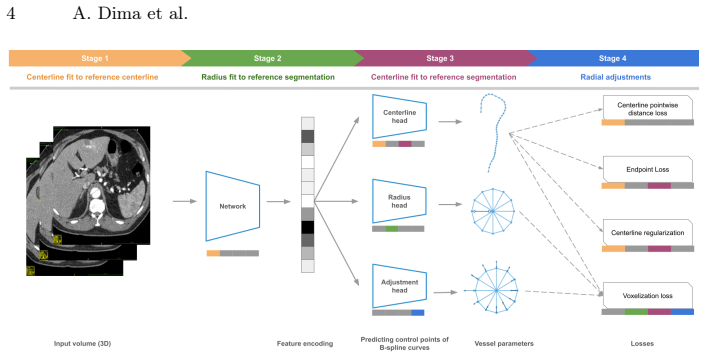
The load-bearing mechanism is the differentiable voxelization loss: the parametric mesh is rasterized into a soft voxelized mask via a signed-distance field, and a Dice loss against the reference segmentation propagates gradients all the way back to the spline control points. To make this tractable in 3D, the signed-distance computation is sliced plane-by-plane: each slice is intersected with the mesh, the intersection graph is split into polygons by cycle detection, and occupancy and distance are computed with point-in-polygon tests. The parameters are cubic B-splines over centerline coordinates and radius, giving smoothness by construction, and a four-stage training scheme (centerline initialization, radius fit, centerline correction, radial adjustment) prevents the conflicting gradients that arise when the centerline and radius are optimized together.
What would settle it
On a synthetic tube with a known ground-truth centerline and radius, initialize the model from a centerline shifted by more than one voxel-radius and run the full four-stage fit; if the Dice score does not recover to the level reported for unperturbed initialization, the local-minimum limitation would be confirmed as a hard bound on the method's ability to learn shape from segmentation alone.
Extended reading notes
Core claim
The central claim is that a parametric vessel model—a centerline and cross-sectional radii represented as cubic B-splines, together with optional per-radial-direction adjustments—can be fitted to a reference segmentation end-to-end by a neural network, with no ground-truth shape parameters. The fitting uses a differentiable voxelization of the mesh derived from the spline parameters; the voxelization is a soft signed-distance field, and a Dice loss between this soft field and the reference mask drives all parameter updates. The paper shows that this recipe works on real vessels: the fitted parametric models reproduce the volumetric shape of aortas, circle-of-Willis vessels, and aneurysmal mouse aortas at Dice scores of 94.66, 82.22, and 86.43 percent, while producing meshes that are over a hundredfold sparser than marching-cubes output at comparable fidelity. The paper also reports that the fitted centerline can correct a noisy reference centerline using only the shape supervision, and that the model remains accurate when supervision is reduced to 5 percent of the original segmentation slices.
Load-bearing premise
The method assumes a reasonably accurate initial centerline is already available, because the voxelization loss only moves the model toward the nearest boundary and cannot recover if the starting centerline is far from the target.
Editorial extensions
If this is right
- Vessel analysis can now use sparse, editable meshes of a few hundred vertices without giving up the volumetric fidelity of dense segmentation-based meshes.
- The same differentiable pipeline lets a parametric model be fitted from very few annotated slices: using only 5% of the segmentation slices cost about 1% Dice, which could cut annotation effort for vessels.
- Because the model is interpretable as centerline plus radius, it can be manipulated after fitting—for example, to adjust blood-flow cross-sections during surgical planning.
- The end-to-end fitting removes the need for parametric ground truth, so any segmentation mask becomes a potential training signal for shape-model extraction.
- The centerline-correction stage shows that noisy reference centerlines can be improved by shape evidence alone, pointing toward a fully automatic pipeline from image to parametric model.
Reading between the lines
- The same fitting recipe should transfer to other tubular structures (e.g., airways, catheters, or neuronal processes) wherever a single non-branching centerline suffices; the branching case awaits a meshing step that handles bifurcations.
- The decoupling of control-point count from sampling resolution suggests a multi-resolution capability: the same trained model could be evaluated at arbitrary mesh densities at inference time without retraining.
- The locality of the signed-distance loss implies the method is best seen as a refinement stage; pairing it with a coarse, robust global initialization from any rough tube detector could make the pipeline fully automatic.
- If the slice-wise signed-distance approximation were reimplemented directly on the GPU, the current minute-per-sample fitting cost could drop enough to make per-vessel online fitting practical in clinical workflows.
Editorial analysis
A structured set of objections, weighed in public.
Referee Report
Summary. The paper presents a per-sample optimization framework that fits a parametric vessel model — a cubic B-spline centerline, a radius curve, and optional per-direction radial adjustments — to a reference segmentation. The parametric model is converted to a triangle mesh, which is then differentiably voxelized via a slice-wise SDF approximation, and the Dice loss between the soft voxelization and the reference segmentation supervises the fit. A neural network predicts the spline control points, and a four-stage training schedule first fits the centerline to an externally extracted skeleton, then the radius, then refines the centerline using the voxelization loss, and optionally adjusts radial directions. Experiments on Aorta24, TopCoW, and MouseAneurysm report Dice scores of 94.66, 82.22, and 86.43, respectively, with meshes of about 673 vertices and 1326 faces, comparing favorably to nnUNet and INR baselines on Aorta24 while being far sparser. The paper also demonstrates robustness to sparse annotations.
Significance. If the central claim is established, the framework offers a practical way to obtain sparse, editable, parametric vessel models directly from segmentations without parametric ground truth, which would be valuable for surgical planning, flow simulation, and interpretable vessel analysis. The differentiable voxelization is a nontrivial engineering contribution, the code is publicly available, and the multi-stage training recipe is described in enough detail to reproduce. The paper is also honest about its limitations, including the restriction to single non-branching vessels and the reliance on centerline initialization. However, the current evidence does not isolate the contribution of the differentiable voxelization from the external centerline prior, so the significance of the learning claim remains to be demonstrated.
major comments (3)
- [Section 2.4 and Section 3] The central claim that the method learns shape parameters from segmentations without the explicit need for ground-truth shape parameters is not yet fully supported. In Stage 1, the centerline is fit to an automatically extracted skeleton (Scikit-image) with manual endpoint adjustment (Section 3) using the pointwise loss L_cl, and the voxelization loss is not active until Stage 2. Section 2.4 states that the SDF-based voxelization loss acts on the object boundary and cannot escape local minima when the nearest boundary is on the wrong side of the object. Therefore, the reported Dice values may largely reflect the quality of the external centerline initialization rather than the differentiable voxelization component. Please add an ablation that isolates the voxelization loss: for example, fit the same parametric model with a classical distance-transform-based objective (without the differentiable voxelization) and report the resulting Dice, and perturb the initial centerline (translation, rotation, or noise) to measure the basin of convergence of the full pipeline.
- [Table 1 and Section 3] The centerline metrics (HD95, Chamfer) reported in Table 1 are computed against the same centerline extracted from the reference segmentation that is used to initialize the fit (Section 3). Because Stage 1 explicitly minimizes the pointwise distance to this centerline, the centerline metrics partly measure the network's ability to regress the initialization rather than the accuracy of the recovered centerline against an independent ground truth. Please state this explicitly in the evaluation section and, if possible, evaluate on an independent centerline annotation or on centerlines extracted by a different algorithm.
- [Section 2.2 and Table 1] The procedure for binarizing the soft voxelization output dVOX^soft for Dice computation is not described. Since the Dice score is the main quantitative claim, please specify the threshold (presumably 0.5) and report whether the same threshold is used for all datasets. Additionally, the comparison to baselines in Table 2 is only on Aorta24; please add at least one other dataset or justify why the comparison is limited to this dataset.
minor comments (5)
- [Table 2] The INR* row reports an aspect ratio of 1e+26, which suggests that the remeshed INR mesh contains degenerate triangles; this should be noted or the baseline should be excluded, as it currently appears as an artifact that distorts the comparison.
- [Section 2.2, Eq. (1)] The notation sigma(SDF/tau) is confusing because the same symbol sigma is used for the sigmoid function and the soft voxelization output; please define the sigmoid explicitly and use a distinct symbol for the soft occupancy.
- [Figure 2] Figure 2 is described as an overview of the network components and training stages, but the four stages are only listed in Section 2.4; a short pointer in the figure caption or in the text would improve readability.
- [Section 3, TopCoW] The statement that 'the endpoints in this dataset are not as accurate' is vague; please quantify this claim or explain how it affects the reported Dice, since the paper later attributes the lower TopCoW Dice to endpoint quality.
- [Implementation details] The paper says that the number of control points and cross-sections was adjusted to the dataset size and refers the reader to the codebase; please report these values for each dataset in the paper, as they are important hyperparameters for reproducibility.
Circularity Check
No circularity: the paper performs explicit parametric fitting to segmentations; the centerline prior is a stated optimization dependency, not a concealed reuse of the output.
full rationale
The paper's chain is a fitting pipeline, not a derivation of a prediction from fitted inputs. The parametric model (centerline, radii, radial adjustments) is optimized against reference segmentations through an explicit Dice loss on a soft voxelization, and the reported Dice values are fitting accuracies on those same segmentations, which is appropriate for a representation-fidelity claim. The centerline is initialized from the segmentation via skeletonization and directly supervised in Stage 1 (lambda_cl = 1 with L_cl pointwise distance); this is disclosed in Section 2.4 as a deliberate strategy to overcome the local nature of the SDF-based voxelization loss, and in Section 5 as a limitation: 'increased need for regularization, especially for centerline initialization.' Using the same reference centerline for both initialization and centerline metrics is a fit-quality evaluation, not a prediction, and it is not load-bearing for the central contribution: the differentiable voxelization loss is adapted from an external source [10], and the comparisons to nnUNet and INR on Aorta24 provide independent, external benchmarks. Citations to prior work by overlapping authors (DeepMesh [12], TopCoW [21]) are contextual and do not carry the argument; no uniqueness claim or ansatz is imported from self-citations. Therefore no step reduces, by construction or by self-citation, to its own input, and the paper is not circular.
Assumptions & free parameters
free parameters (5)
- Voxelization softness tau =
0.1
- Number of radial directions P =
10
- B-spline control point counts and sample counts (Nc, Nr, S) =
Dataset-specific; values deferred to codebase
- Stage loss weights and centerline loss tolerance =
lambda_cl=1, lambda_e=100, lambda_vox=0/1, lambda_reg=10/5, tolerance=0.2 px
- Radial adjustment stage usage =
Enabled only for MouseAneurysm
assumptions (6)
- standard math Cubic B-spline evaluation via the matrix formulation and equidistant sampling yields a smooth, continuous parameterization of centerline and radius.
- domain assumption Vessels are represented as a single branch-free path with disk-like cross-sections, optionally with per-direction radial adjustments.
- domain assumption An approximate reference centerline of the vessel is available (e.g., skeletonization with manual correction) before running the differentiable fitting.
- ad hoc to paper The slice-wise SDF approximation (plane intersection, cycle detection, point-in-polygon rasterization) is an accurate enough differentiable proxy for the true SDF to yield correct gradients.
- ad hoc to paper Splitting optimization into four frozen-head stages avoids the conflicting gradients observed under joint optimization.
- domain assumption The soft sigmoid voxelization with a Dice loss and the reported final Dice score measure the same volumetric overlap.
Cite this review
Pith. "Pith review of Parametric shape models for vessels learned from segmentations via differentiable voxelization." pith.science (2026). https://pith.science/paper/RNC3NPHY
@misc{pith2026250702576,
  author       = {Pith},
  title        = {Pith review of: Parametric shape models for vessels learned from segmentations via differentiable voxelization},
  year         = {2026},
  howpublished = {\url{https://pith.science/paper/RNC3NPHY}},
  note         = {Machine review of arXiv:2507.02576}
}
read the original abstract
Vessels are complex structures in the body that have been studied extensively in multiple representations. While voxelization is the most common of them, meshes and parametric models are critical in various applications due to their desirable properties. However, these representations are typically extracted through segmentations and used disjointly from each other. We propose a framework that joins the three representations under differentiable transformations. By leveraging differentiable voxelization, we automatically extract a parametric shape model of the vessels through shape-to-segmentation fitting, where we learn shape parameters from segmentations without the explicit need for ground-truth shape parameters. The vessel is parametrized as centerlines and radii using cubic B-splines, ensuring smoothness and continuity by construction. Meshes are differentiably extracted from the learned shape parameters, resulting in high-fidelity meshes that can be manipulated post-fit. Our method can accurately capture the geometry of complex vessels, as demonstrated by the volumetric fits in experiments on aortas, aneurysms, and brain vessels.
Figures


Figures from the paper (3 more)


Reference graph
Works this paper leans on
-
[1]
In: Inter- national Conference on Functional Imaging and Modeling of the Heart (2023)
Alblas, D., Hofman, M., Brune, C., Yeung, K.K., Wolterink, J.M.: Implicit neural representations for modeling of abdominal aortic aneurysm progression. In: Inter- national Conference on Functional Imaging and Modeling of the Heart (2023)
work page 2023
-
[2]
Computers in Biology and Medicine 182, 109162 (2024)
Bransby, K.M., Bajaj, R., Ramasamy, A., Çap, M., Yap, N., Slabaugh, G., Bouran- tas, C., Zhang, Q.: Polycore: Polygon-based contour refinement for improved in- travascular ultrasound segmentation. Computers in Biology and Medicine 182, 109162 (2024)
work page 2024
-
[3]
Radiology: Artificial Intelligence (2022)
de Carvalho Macruz, F.B., Lu, C., Strout, J., Takigami, A., Brooks, R., Doyle, S., Yun, M., Buch, V., Hedgire, S., Ghoshhajra, B.: Quantification of the thoracic aorta and detection of aneurysm at CT: development and validation of a fully automatic methodology. Radiology: Artificial Intelligence (2022)
work page 2022
-
[4]
Advances in Neural Information Processing Systems (2024)
Defazio, A., Yang, X., Mehta, H., Mishchenko, K., Khaled, A., Cutkosky, A.: The road less scheduled. Advances in Neural Information Processing Systems (2024)
work page 2024
-
[5]
Drees, D., Scherzinger, A., Hägerling, R., Kiefer, F., Jiang, X.: Scalable robust graph and feature extraction for arbitrary vessel networks in large volumetric datasets. BMC bioinformatics (2021)
work page 2021
-
[6]
In: Proceedings of the IEEE/CVF international conference on computer vision
Feichtenhofer, C., Fan, H., Malik, J., He, K.: Slowfast networks for video recog- nition. In: Proceedings of the IEEE/CVF international conference on computer vision. pp. 6202–6211 (2019)
work page 2019
-
[7]
Franklin, W.R.: Pnpoly-point inclusion in polygon test. Web site: http://www. ecse. rpi. edu/Homepages/wrf/Research/Short_Notes/pnpoly. html (2006)
work page 2006
-
[8]
arXiv preprint arXiv:2502.05330 (2025)
Imran, M., Krebs, J.R., Sivaraman, V.B., Zhang, T., Kumar, A., Ueland, W.R., Fassler, M.J., Huang, J., Sun, X., Wang, L., et al.: Multi-class segmentation of aortic branches and zones in computed tomography angiography: The aortaseg24 challenge. arXiv preprint arXiv:2502.05330 (2025)
arXiv 2025
Show all 21 references
-
[9]
In: International Conference on Medical Image Computing and Computer- Assisted Intervention (2024)
Isensee, F., Wald, T., Ulrich, C., Baumgartner, M., Roy, S., Maier-Hein, K., Jaeger, P.F.: nnu-net revisited: A call for rigorous validation in 3d medical image segmen- tation. In: International Conference on Medical Image Computing and Computer- Assisted Intervention (2024)
2024
-
[10]
In: Proceedings of the IEEE/CVF Conference on Computer Vision and Pattern Recognition (2022)
Lazarow, J., Xu, W., Tu, Z.: Instance segmentation with mask-supervised polyg- onal boundary transformers. In: Proceedings of the IEEE/CVF Conference on Computer Vision and Pattern Recognition (2022)
2022
-
[11]
In: Proceedings of the 14th Annual Conference on Computer Graphics and Interactive Techniques, SIGGRAPH (1987)
Lorensen, W.E., Cline, H.E.: Marching cubes: A high resolution 3d surface con- struction algorithm. In: Proceedings of the 14th Annual Conference on Computer Graphics and Interactive Techniques, SIGGRAPH (1987)
1987
-
[12]
IEEE transactions on medical imaging (2023)
Meng, Q., Bai, W., O’Regan, D.P., Rueckert, D.: Deepmesh: mesh-based cardiac motion tracking using deep learning. IEEE transactions on medical imaging (2023)
2023
-
[13]
In: Proceedings of the IEEE/CVF International Conference on Computer Vision (2023) Parametric shape models for vessels 15
Menten, M.J., Paetzold, J.C., Zimmer, V.A., Shit, S., Ezhov, I., Holland, R., Probst, M., Schnabel, J.A., Rueckert, D.: A skeletonization algorithm for gradient- based optimization. In: Proceedings of the IEEE/CVF International Conference on Computer Vision (2023) Parametric s...
2023
-
[14]
European Journal of Cardio-Thoracic Surgery (2016)
Numata, S., Itatani, K., Kanda, K., Doi, K., Yamazaki, S., Morimoto, K., Manabe, K., Ikemoto, K., Yaku, H.: Blood flow analysis of the aortic arch using computa- tional fluid dynamics. European Journal of Cardio-Thoracic Surgery (2016)
2016
-
[15]
In: Interna- tional Conference on Medical Image Computing and Computer-Assisted Interven- tion (2023)
Rist, L., Taubmann, O., Ditt, H., Sühling, M., Maier, A.: Flexible unfolding of circular structures for rendering textbook-style cerebrovascular maps. In: Interna- tional Conference on Medical Image Computing and Computer-Assisted Interven- tion (2023)
2023
-
[16]
Elsevier (2000)
Rogers, D.F.: An introduction to NURBS: with historical perspective. Elsevier (2000)
2000
-
[17]
ACM transactions on graphics (TOG) (2010)
Schwarz, M., Seidel, H.P.: Fast parallel surface and solid voxelization on gpus. ACM transactions on graphics (TOG) (2010)
2010
-
[18]
Advances in neural information processing systems 33, 7462–7473 (2020)
Sitzmann, V., Martel, J., Bergman, A., Lindell, D., Wetzstein, G.: Implicit neural representations with periodic activation functions. Advances in neural information processing systems 33, 7462–7473 (2020)
2020
-
[19]
In: Medical Imaging 2022: Computer-Aided Diagnosis
Timmins, K.M., van der Schaaf, I.C., Vos, I., Ruigrok, Y.M., Velthuis, B.K., Kuijf, H.J.: Deep learning with vessel surface meshes for intracranial aneurysm detection. In: Medical Imaging 2022: Computer-Aided Diagnosis. SPIE (2022)
2022
-
[20]
PeerJ 2, e453 (2014)
Van der Walt, S., Schönberger, J.L., Nunez-Iglesias, J., Boulogne, F., Warner, J.D., Yager, N., Gouillart, E., Yu, T.: Scikit-image: Image processing in python. PeerJ 2, e453 (2014)
2014
-
[21]
Yang, K., Musio, F., Ma, Y., Juchler, N., Paetzold, J.C., Al-Maskari, R., Höher, L., Li, H.B., Hamamci, I.E., Sekuboyina, A., et al.: Benchmarking the CoW with the TopCoW challenge: Topology-aware anatomical segmentation of the circle of willis for CTA and MRA (2024), https://...
2024 arXiv
Reviewed August 6, 2026 · model on record in the stance chip above.
Discussion (0). Continue with ORCID to comment.