REVIEW 3 major objections 5 minor 3 cited by
A Survey on Integrating Quantum Computers into High Performance Computing Systems
T0 review · 3 major / 5 minor · reviewed 2026-08-06 · deepseek-v4-flash
Pith's one-line read A structured review of 107 publications maps how quantum computers are being integrated into HPC systems and concludes that standardization is the next big step.
desk verdict A useful, well-organized survey of quantum-HPC integration that earns its place as a reference, though it needs a transparency fix before it can claim comprehensiveness. read the letter →
The pith
A machine-rendered reading of the paper's core claim, the machinery that carries it, and where it could break.
The reading
What carries the argument
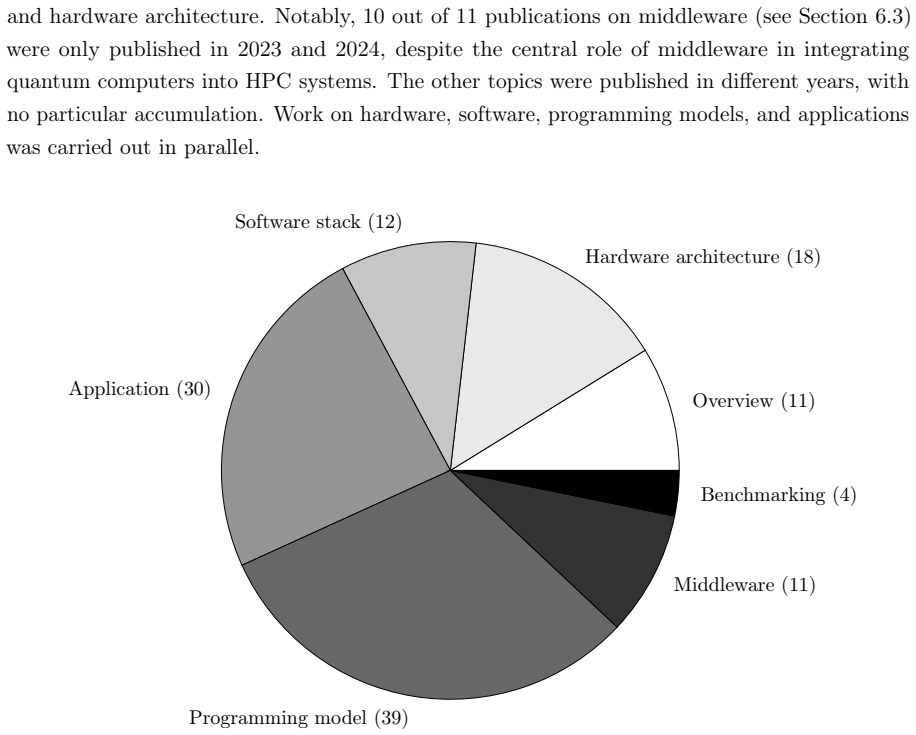
The machinery has two parts. The first is a literature-search protocol: keyword queries combining HPC terms with quantum-computing terms on Web of Science and arXiv, deduplication, manual screening of titles and abstracts, and a reference-expansion pass that added 27 further papers, yielding 107 publications that were manually classified into seven categories. The second is a conceptual taxonomy that gives the survey its structure: the loose versus tight integration distinction, refined into remote, co-located, and on-node placement, plus a layered hybrid software stack running from applications and programming models down through middleware to firmware and hardware, with scheduling singled out as the core middleware problem.
What would settle it
A targeted search using a different keyword vocabulary (for example, terms common in industry white papers, non-English literature, or databases beyond Web of Science and arXiv) that surfaces a substantial body of pre-2023 integration work, especially middleware or scheduling papers the survey does not categorize, would undercut the quantitative trends the conclusions rest on.
Extended reading notes
Core claim
The paper claims that the integration of quantum computers into HPC systems has become a substantial research field with a recognizable shape: quantum computers are best understood as accelerators, today's deployed systems are loosely integrated (either remote or co-located), the middleware layer whose absence was noted in 2016 has since been built by several independent projects with a heavy focus on scheduling, and the field's next big step should be standardizing protocols and tools so that hardware from different vendors can join existing infrastructures without bespoke software. The review grounds this picture in a quantitative analysis of the 107 collected publications, which shows the field gaining traction from 2023 onward and finds that 10 of the 11 middleware publications appeared in 2023 and 2024.
Load-bearing premise
The completeness and representativeness of the literature search: the authors assume that keyword queries on Web of Science and arXiv, plus a reference-expansion pass, captured all or a representative sample of the relevant publications, so the observed trends reflect the field rather than artifacts of the search.
Editorial extensions
If this is right
- HPC centers planning to host quantum computers can choose among documented integration models (remote, co-located, and on-node), with on-premises co-location identified as the most promising near-term option.
- The middleware gap that earlier work noted has been filled by multiple independent projects, so the field's next big step should be standardization of protocols, interfaces, and scheduling methods rather than more singular solutions.
- Because most programming models operate at the circuit level, wider uptake of quantum acceleration by HPC users will depend on higher-level, hardware-agnostic frameworks that fit existing HPC tools.
- Hybrid-system benchmarking is underdeveloped; without accepted benchmarks comparable to LINPACK and the TOP500 list, comparing integrated systems and ranking them will stay difficult.
- In the loose integration model, quantum computers are scarce shared resources, so scheduling and resource management (not raw quantum speed) determine how useful an integrated system is.
Reading between the lines
- If standardization follows, the first targets are likely the interfaces this survey finds thinnest: quantum job queues, telemetry-based schedulers, and the handoff between batch schedulers and quantum queues, since those are where integration pain concentrates today.
- The survey's latency discussion implies that the main payoff of moving from co-located to on-node integration is not raw speed but unified scheduling and tighter classical feedback loops; that claim sits in the cited literature but the survey does not fully develop it.
- Re-running the same search protocol on a fixed later date would test whether the 2023-2024 concentration of middleware work was a genuine phase shift in the field or an artifact of the keyword search.
Editorial analysis
A structured set of objections, weighed in public.
Referee Report
Summary. The paper presents a structured literature review of integrating quantum computers into HPC systems, based on a keyword search in Web of Science and arXiv performed on March 11, 2025, followed by manual selection and reference expansion, yielding 107 publications. The survey categorizes the literature into seven topics (overview, hardware architecture, software stack, applications, programming models, middleware, benchmarking), provides a quantitative analysis of publication years and topic distribution, and discusses each category with a focus on hardware and software aspects. The authors conclude that substantial work exists and that standardization of protocols and tools is the next big step.
Significance. If the survey's sample is representative, the paper provides a valuable and timely overview of a rapidly evolving area, with a useful taxonomy and synthesis of recent developments. The explicit description of the search process and the categorization tables (Tables 2 and 3) are strengths that make the work citable as a starting point. The main limitation is the absence of an auditable list of included studies, which restricts the verifiability of the quantitative claims.
major comments (3)
- [Section 2, Figure 1] The paper claims a 'comprehensive structured overview' (Abstract) and draws quantitative conclusions (Section 3), but it does not provide the full list of the 107 included publications or the reasons for excluding the 375 papers discarded in the manual selection. Without a PRISMA-style flow diagram with exclusion reasons or a supplementary list of included studies, the selection is not reproducible and the completeness claim cannot be audited. This is load-bearing because the observed trend of middleware work concentrated in 2023–2024 (Section 3) could change if the selection were different.
- [Section 2, Table 1] The keyword groups in Table 1 omit integration-related terms such as 'quantum-centric supercomputing', 'hybrid scheduler', 'orchestration', and 'QPU integration', and the search is limited to Web of Science and arXiv. As a consequence, the representativeness of the 107-publication sample is questionable; relevant work not using the exact chosen terms may be missing, and the temporal and topical distributions in Section 3 could be artifacts of the search rather than properties of the field. The authors should justify the keyword selection (e.g., by reporting hit counts per keyword) or broaden the search with additional terms and databases.
- [Section 3] The quantitative analysis does not separate the 80 papers from the initial search from the 27 papers added via reference expansion, nor does it report the year distribution of these two subsets. Since the reference expansion starts from the manually selected papers, older or unrelated works may be over- or under-represented. To support the claim that '10 out of 11 publications on middleware ... were only published in 2023 and 2024', the authors should provide a per-paper list of affiliations to topics and publication years, allowing readers to verify the count.
minor comments (5)
- [Section 6.2.5] In the sentence 'Introduced in 2018 [131], it was described in more detail in a subsequent publication [131]', the second citation should refer to a different reference (likely [136], the 2020 XACC paper), not the same [131].
- [Section 5.2] In the sentence 'the computational space is 2N ninstead of N 2n', the exponents are not typeset correctly; please clarify whether the intended comparison is 2^(N·n) versus N·2^n.
- [Section 2] The statement 'It is interesting to note that there is not much overlap between the two databases' would benefit from a quantitative figure (e.g., the number of duplicates removed, which is 43 based on the numbers in Figure 1).
- [Figure 3] The categories 'Software stack' and 'Applications'/'Programming model'/'Middleware' overlap in Section 2's definition (Software stack includes the other three as sub-topics), but Figure 3 treats them as separate categories; please clarify the relationship.
- [Figure 1] Some figures (e.g., Figures 5–7) are schematic and fine, but Figure 1 is difficult to read at the printed size; consider a larger font or a table version.
Circularity Check
No significant circularity: the survey's conclusions are descriptive syntheses of an independently collected literature corpus.
full rationale
This paper is a structured literature review, not a derivation chain. Its central claims—that substantial work on integrating quantum computers into HPC systems exists and that standardization of protocols and tools is the next step—are descriptive summaries of the 107 publications collected through the search procedure described in Section 2 and Figures 1–3. The quantitative observations, such as the 2023–2024 concentration of middleware publications, are direct counts of the found corpus rather than quantities fitted from it. The only self-citation, reference [107] (the authors' OmpSs-2 quantum extension), appears in Section 6.2.3 and Table 3 as one example among many programming-model extensions; the survey's conclusions do not depend on the validity of that specific framework, and no load-bearing argument reduces to it. The reviewer-flagged concern about search completeness (e.g., the full list of 107 papers not being provided and possible omitted keywords) is an auditability or representativeness issue, not circularity: it does not make any conclusion equivalent to its own input by construction. No equation in the paper is shown to reproduce its own input, no fitted parameter is relabeled as a prediction, and no uniqueness or external-support theorem is imported from the authors' own prior work.
Assumptions & free parameters
assumptions (3)
- domain assumption The defined keyword search on Web of Science and arXiv, combined with reference expansion, identifies all relevant publications on quantum-HPC integration.
- domain assumption Manual classification of publications into the seven topic categories is consistent and meaningful.
- domain assumption The analyzed publications are representative of the overall field, including work not indexed in the selected databases.
Cite this review
Pith. "Pith review of A Survey on Integrating Quantum Computers into High Performance Computing Systems." pith.science (2026). https://pith.science/paper/554BT7KY
@misc{pith2026250703540,
  author       = {Pith},
  title        = {Pith review of: A Survey on Integrating Quantum Computers into High Performance Computing Systems},
  year         = {2026},
  howpublished = {\url{https://pith.science/paper/554BT7KY}},
  note         = {Machine review of arXiv:2507.03540}
}
read the original abstract
Quantum computers use quantum mechanical phenomena to perform conventionally intractable calculations for specific problems. Despite being universal machines, quantum computers are not expected to replace classical computers, but rather, to complement them and form hybrid systems. This makes integrating quantum computers into high performance computing (HPC) systems an increasingly relevant topic. We present a structured literature review on the integration aspect. We methodologically search literature databases and manually evaluate 107 publications. These publications are divided into seven categories that describe the state of the art in each category. After a brief quantitative analysis of the literature, this survey deals with the hardware architecture of hybrid quantum-classical systems, as well as the software stack. We observe the development of a wide range of tools enabling hybrid systems and emphasize the need for future standardization of interfaces and methods to foster synergy.
Figures


Figures from the paper (9 more)


Forward citations
Cited by 3 Pith papers
-
Performance Model for Hybrid Quantum-Classical Workflows
A two-level runtime model decomposes hybrid quantum-classical cycles into quantum, classical, and communication time, allowing a communication-to-computation ratio to classify workflows as compute- or communication-bound.
-
HybridQC: Hardware-Grounded Simulation of Tightly Integrated Hybrid Quantum-Classical Systems
HybridQC is a hardware-calibrated, topology-aware simulator that predicts hybrid quantum-classical system bottlenecks, finding that balanced 10x scaling yields only 2.19x-3.42x makespan improvement and that workload g...
-
StreamingQEC: Streaming Quantum Error Correction in Tightly Integrated Quantum-Classical Systems via Certified Recurrence
A new simulator shows that quantum error correction's classical pipeline can be compressed exactly with a certified recurrence and approximated with a staged-fluid model, and that transfer and decoder bottlenecks shif...
Reference graph
Works this paper leans on
-
[107]
Extending the OmpSs-2 Programming Model for Hybrid Quantum-Classical Programming
P. Döbler, D. Álvarez, L. J. Menger, T. Lippert, V. Beltran, and M. S. Jattana,Extending the ompss-2 programming model for hybrid quantum-classical programming, 2025. arXiv: 2502.21104 [cs.ET]. [Online]. Available:https://arxiv.org/abs/2502.21104
work page Pith review arXiv 2025
-
[1]
Cramming more components onto integrated circuits,
G. E. Moore, “Cramming more components onto integrated circuits,”Electronics, vol. 38, no. 8, pp. 114–117, Apr. 1965
1965
-
[2]
Algorithms for quantum computation: Discrete logarithms and factoring,
P. W. Shor, “Algorithms for quantum computation: Discrete logarithms and factoring,” in Proceedings 35th annual symposium on foundations of computer science, Ieee, 1994, pp. 124–134
1994
-
[3]
A fast quantum mechanical algorithm for database search,
L. K. Grover, “A fast quantum mechanical algorithm for database search,” inProceedings of the Twenty-Eighth Annual ACM Symposium on Theory of Computing, ser. STOC ’96, Philadelphia, Pennsylvania, USA: Association for Computing Machinery, 1996, pp. 212– 219, isbn: 0897917855. doi: 10.1145/237814.237866. [Online]. Available:https://doi .org/10.1145/237814.237866
arXiv 1996
-
[4]
Web of science
Clarivate. “Web of science.” Available:https://www.webofscience.com. (2025), (visited on 03/11/2025)
2025
-
[5]
CornellUniversity.“Arxiv.” Available: https://arxiv.org/.(2025),(visitedon03/11/2025). 25
2025
-
[6]
M. Möller and C. Vuik, “On the impact of quantum computing technology on future de- velopments in high-performance scientific computing,”Ethics and Information Technology, vol. 19, no. 4, pp. 253–269, Dec. 2017,issn: 1572-8439.doi: 10.1007/s10676-017-9438-0. [Online]. Available:https://doi.org/10.1007/s10676-017-9438-0
-
[7]
N. Garcia-Buendia, A. J. Muñoz-Montoro, R. Cortina, J. M. Maqueira-Marín, and J. Moyano-Fuentes, “Mapping the landscape of quantum computing and high performance computing research over the last decade,”IEEE Access, vol. 12, pp. 106107–106120, 2024. doi: 10.1109/ACCESS.2024.3411307
arXiv 2024
Show all 163 references
-
[8]
Trends in high performance computing and quantum computing,
A. Pousa, V. M. Sanz, M. Naiouf, and A. De Giusti, “Trends in high performance computing and quantum computing,” Journal of Computer Science and Technology, vol. 24, no. 2, e11, Oct. 2024.doi: 10.24215/16666038.24.e11 . [Online]. Available: https://journal.info.unlp.edu.ar/JCS...
2024 doi
-
[9]
Mohseni, A
M. Mohseni, A. Scherer, K. G. Johnson, O. Wertheim, M. Otten, N. A. Aadit, Y. Alexeev, K. M. Bresniker, K. Y. Camsari, B. Chapman, S. Chatterjee, G. A. Dagnew, A. Esposito, F. Fahim, M. Fiorentino, A. Gajjar, A. Khalid, X. Kong, B. Kulchytskyy, E. Kyoseva, R. Li, P. A. Lott, I...
2025 arXiv
-
[10]
Giusto, S
E. Giusto, S. Nuñez-Corrales, P. Cao, A. Cilardo, R. K. Iyer, W. Jiang, P. Rech, F. Vella, B. Montrucchio, S. Dasgupta, and T. S. Humble,Dependable classical-quantum computer systems engineering, 2024. arXiv:2408.10484 [quant-ph]. [Online]. Available: https://arxiv.org/abs/2408.10484
2024
-
[12]
Training computer scientists for the challenges of hybrid quantum-classical computing,
V. De Maio, M. Kanatbekova, F. Zilk, N. Friis, T. Guggemos, and I. Brandic, “Training computer scientists for the challenges of hybrid quantum-classical computing,” in2024 IEEE 24th International Symposium on Cluster, Cloud and Internet Computing (CCGrid), 2024, pp. 626–635.do...
2024
-
[14]
Quantumacceleratedcomputer architectures,
L. Riesebos, X. Fu, A. A. Moueddenne, L. Lao, S. Varsamopoulos, I. Ashraf, J. van Someren,N.Khammassi,C.G.Almudever,andK.Bertels,“Quantumacceleratedcomputer architectures,” in2019 IEEE International Symposium on Circuits and Systems (ISCAS), 2019, pp. 1–4.doi: 10.1109/ISCAS.20...
2019
-
[15]
Quantum accelerator stack: A research roadmap,
K. Bertels, A. Sarkar, A. Krol, R. Budhrani, J. Samadi, E. Geoffroy, J. Matos, R. Abreu, G. Gielen, and I. Ashraf, “Quantum accelerator stack: A research roadmap,” 2021
2021
-
[16]
High-performance computing with quantum processing units,
K. A. Britt and T. S. Humble, “High-performance computing with quantum processing units,” J. Emerg. Technol. Comput. Syst., vol. 13, no. 3, Mar. 2017,issn: 1550-4832. doi: 10.1145/3007651. [Online]. Available:https://doi.org/10.1145/3007651
2017 doi
-
[17]
Bringing quantum acceleration to supercomputers,
M. Ruefenacht, B. G. Taketani, P. Lähteenmäki, V. Bergholm, D. Kranzlmüller, L. Schulz, and M. Schulz, “Bringing quantum acceleration to supercomputers,”IQM/LRZ Technical Report, https://www. quantu m. lrz. de/fileadmin/QIC/Downloads/IQM HPC- QC-Integration-White paper. pdf, 2022
2022
-
[18]
Carugno, J
C. Carugno, J. Muff, M. P. Johansson, S. Karlsson, and A. Lanzanova,Nordiquest: The nordic-estonian quantum computing e-infrastructure quest, 2024. arXiv:2406.02216 [cs.DC]. [Online]. Available:https://arxiv.org/abs/2406.02216
2024 arXiv
-
[19]
“Lumi.” Available:https://www.lumi-supercomputer.eu/
LUMI consortium. “Lumi.” Available:https://www.lumi-supercomputer.eu/. (2025), (visited on 06/20/2025)
2025
-
[20]
Hybrid quantum-classical work- flows in modular supercomputing architectures with the julich unified infrastructure for quantum computing,
G. Cavallaro, M. Riedel, T. Lippert, and K. Michielsen, “Hybrid quantum-classical work- flows in modular supercomputing architectures with the julich unified infrastructure for quantum computing,” inIGARSS 2022 - 2022 IEEE International Geoscience and Remote Sensing Symposium,...
2022
-
[21]
JUNIQ - Jülich UNified Infrastructure for Quantum computing,
K. Michielsen and N. Küchler, “JUNIQ - Jülich UNified Infrastructure for Quantum computing,” ML4Q Conference 2022, Oberlahr (Germany), 31 Aug 2022 - 2 Sep 2022, Aug. 31, 2022. [Online]. Available:https://juser.fz-juelich.de/record/916919
2022
-
[22]
JUNIQ facility
Forschungszentrum Jülich. “JUNIQ facility.” Available:https://www.fz- juelich.d e / en / ias / jsc / systems / quantum - computing / juniq - facility. (2025), (visited on 07/01/2025)
2025
-
[24]
Qpu-system co-design for quantum hpc accel- erators,
K. Wintersperger, H. Safi, and W. Mauerer, “Qpu-system co-design for quantum hpc accel- erators,” in Architecture of Computing Systems, M. Schulz, C. Trinitis, N. Papadopoulou, and T. Pionteck, Eds., Cham: Springer International Publishing, 2022, pp. 100–114,isbn: 978-3-031-21867-5
2022
-
[25]
Farhi, J
E. Farhi, J. Goldstone, and S. Gutmann,A quantum approximate optimization algorithm,
-
[26]
A review on quantum approximate optimization algorithm and its variants,
K. Blekos, D. Brand, A. Ceschini, C.-H. Chou, R.-H. Li, K. Pandya, and A. Summer, “A review on quantum approximate optimization algorithm and its variants,”Physics Reports, vol. 1068, pp. 1–66, 2024, A review on Quantum Approximate Optimization Algorithm and its variants,issn:...
2024 doi
-
[27]
Distributed quantum computing: A survey,
M. Caleffi, M. Amoretti, D. Ferrari, J. Illiano, A. Manzalini, and A. S. Cacciapuoti, “Distributed quantum computing: A survey,”Computer Networks, vol. 254, p. 110672, 2024, issn: 1389-1286.doi: https://doi.org/10.1016/j.comnet.2024.110672. [Online]. Available: https://www.sci...
2024
-
[28]
A heterogeneous quantum computer architecture,
X. Fu, L. Riesebos, L. Lao, C. G. Almudever, F. Sebastiano, R. Versluis, E. Charbon, and K. Bertels, “A heterogeneous quantum computer architecture,” inProceedings of the ACM International Conference on Computing Frontiers, ser. CF ’16, Como, Italy: Association for Computing M...
2016
-
[29]
Hisep-q: A highly scalable and efficient quantum control processor for superconducting qubits,
X. Guo, K. Qin, and M. Schulz, “Hisep-q: A highly scalable and efficient quantum control processor for superconducting qubits,” in2023 IEEE 41st International Conference on Computer Design (ICCD), 2023, pp. 86–93.doi: 10.1109/ICCD58817.2023.00023
2023
-
[30]
Eqasm: An executable quantum instruction set architecture,
X. Fu, L. Riesebos, M. A. Rol, J. van Straten, J. van Someren, N. Khammassi, I. Ashraf, R. F. L. Vermeulen, V. Newsum, K. K. L. Loh, J. C. de Sterke, W. J. Vlothuizen, R. N. Schouten, C. G. Almudever, L. DiCarlo, and K. Bertels, “Eqasm: An executable quantum instruction set ar...
2019
-
[31]
Accelerating hpc with quantum computing: It is a software challenge too,
M. Schulz, M. Ruefenacht, D. Kranzlmüller, and L. B. Schulz, “Accelerating hpc with quantum computing: It is a software challenge too,”Computing in Science & Engineering, vol. 24, no. 4, pp. 60–64, 2022.doi: 10.1109/MCSE.2022.3221845
2022
-
[32]
Softwaresystemsforhigh-performancequantumcomputing,
T.S.HumbleandK.A.Britt,“Softwaresystemsforhigh-performancequantumcomputing,” in 2016 IEEE High Performance Extreme Computing Conference (HPEC), 2016, pp. 1–8. doi: 10.1109/HPEC.2016.7761628
2016
-
[33]
Integrating quantum computing resources into scientific hpc ecosystems,
T. Beck, A. Baroni, R. Bennink, G. Buchs, E. A. C. Pérez, M. Eisenbach, R. F. da Silva, M. G. Meena, K. Gottiparthi, P. Groszkowski, T. S. Humble, R. Landfield, K. Maheshwari, S. Oral, M. A. Sandoval, A. Shehata, I.-S. Suh, and C. Zimmer, “Integrating quantum computing resourc...
2024 doi
-
[34]
Shehata, P
A. Shehata, P. Groszkowski, T. Naughton, M. G. Meena, E. Wong, D. Claudino, R. F. da Silvaa, and T. Beck,Building a software stack for quantum-hpc integration, 2025. arXiv: 2503.01787 [quant-ph]. [Online]. Available:https://arxiv.org/abs/2503.01787
2025 arXiv
-
[35]
Integration of quantum accelerators into hpc: Toward a unified quantum platform,
A. Elsharkawy, X. Guo, and M. Schulz, “Integration of quantum accelerators into hpc: Toward a unified quantum platform,” in2024 IEEE International Conference on Quantum Computing and Engineering (QCE), vol. 01, 2024, pp. 774–783.doi: 10.1109/QCE60285 .2024.00097. 28
2024
-
[37]
A software platform to support disaggregated quantum accelerators,
E. Kaya, J. Echavarria, M. N. Farooqi, A. Swierkowska, P. Hopf, B. Mete, L. Burgholzer, R. Wille, L. Schulz, and M. Schulz, “A software platform to support disaggregated quantum accelerators,” inSC24-W: Workshops of the International Conference for High Performance Computing, ...
2024
-
[40]
Quantum computer architecture toward full-stack quantum accelerators,
K. Bertels, A. Sarkar, T. Hubregtsen, M. Serrao, A. Mouedenne, A. Yadav, A. Krol, I. Ashraf, and C. G. Almudever, “Quantum computer architecture toward full-stack quantum accelerators,” IEEE Transactions on Quantum Engineering, vol. 1, pp. 1–17, 2020.doi: 10.1109/TQE.2020.2981074
2020
-
[41]
Quantum computing and high-performance computing: Compilation stack similarities,
S. L. Alarcon and A. C. Elster, “Quantum computing and high-performance computing: Compilation stack similarities,” Computing in Science & Engineering, vol. 24, no. 6, pp. 66–71, 2022.doi: 10.1109/MCSE.2023.3269645
2022
-
[42]
Quantum algorithms for scientific computing,
R. Au-Yeung, B. Camino, O. Rathore, and V. Kendon, “Quantum algorithms for scientific computing,” Reports on Progress in Physics, vol. 87, no. 11, p. 116001, Oct. 2024.doi: 10.1088/1361-6633/ad85f0. [Online]. Available:https://dx.doi.org/10.1088/1361- 6633/ad85f0
2024 doi
-
[43]
Quantum-centric high performance computing for quantum chemistry,
J. Liu, H. Ma, H. Shang, Z. Li, and J. Yang, “Quantum-centric high performance computing for quantum chemistry,”Physical Chemistry Chemical Physics, vol. 26, no. 22, pp. 15831– 15843, 2024
2024
-
[44]
van Dam, H
W. van Dam, H. Liu, G. H. Low, A. Paetznick, A. Paz, M. Silva, A. Sundaram, K. Svore, and M. Troyer,End-to-end quantum simulation of a chemical system, 2024. arXiv: 2409.05835 [quant-ph]. [Online]. Available:https://arxiv.org/abs/2409.05835
2024 arXiv
-
[45]
Is it coming soon to power systems: Quantum computing and its early exploration,
Y. Chen, S. Stein, A. Li, and Z. H. Huang, “Is it coming soon to power systems: Quantum computing and its early exploration,” in2023 IEEE Power & Energy Society General Meeting (PESGM), 2023, pp. 1–5.doi: 10.1109/PESGM52003.2023.10252721. 29
2023
-
[46]
Exploiting quantum power flow in smart grid co-simulation,
D. Vereno, A. Khodaei, C. Neureiter, and S. Lehnhoff, “Exploiting quantum power flow in smart grid co-simulation,” in2023 11th Workshop on Modelling and Simulation of Cyber-Physical Energy Systems (MSCPES), 2023, pp. 1–6.doi: 10.1109/MSCPES58582.2 023.10123431
2023 doi
-
[47]
Quantum computing in the nisq era and beyond,
J. Preskill, “Quantum computing in the nisq era and beyond,”Quantum, vol. 2, p. 79,
-
[48]
Hybridquantum-classicalalgorithmsinthenoisyintermediate- scale quantum era and beyond,
A.CallisonandN.Chancellor,“Hybridquantum-classicalalgorithmsinthenoisyintermediate- scale quantum era and beyond,”Phys. Rev. A, vol. 106, p. 010101, 1 Jul. 2022.doi: 10.1103/PhysRevA.106.010101. [Online]. Available:https://link.aps.org/doi/10.1 103/PhysRevA.106.010101
2022 doi
-
[49]
Beyond the buzz: Strategic paths for enabling useful nisq applications,
P. R. Hegde, O. Kyriienko, H. Heimonen, P. Tolias, G. Netzer, P. Barkoutsos, R. Vinuesa, I. Peng, and S. Markidis, “Beyond the buzz: Strategic paths for enabling useful nisq applications,” in Proceedings of the 21st ACM International Conference on Computing Frontiers, ser. CF ...
2024
-
[50]
Applying quantum approximate optimization to the heterogeneous vehicle routing problem,
D. Fitzek, T. Ghandriz, L. Laine, M. Granath, and A. F. Kockum, “Applying quantum approximate optimization to the heterogeneous vehicle routing problem,”Scientific Reports, vol. 14, no. 1, p. 25415, Oct. 2024,issn: 2045-2322. doi: 10.1038/s41598-024-76967-w. [Online]. Availabl...
2024 doi
-
[51]
Kim and I.-S
S. Kim and I.-S. Suh, Distributed variational quantum algorithm with many-qubit for optimization challenges, 2025. arXiv:2503.00221 [quant-ph]. [Online]. Available:https ://arxiv.org/abs/2503.00221
2025 arXiv
-
[52]
Acosta, C
E. Acosta, C. C. Gutierrez, G. Botella, and R. Campos,Adiabatic training for variational quantum algorithms, 2024. arXiv: 2410.18618 [quant-ph] . [Online]. Available:https: //arxiv.org/abs/2410.18618
2024 arXiv
-
[53]
S. Kim, V. R. Pascuzzi, Z. Xu, T. Luo, E. Lee, and I.-S. Suh, Distributed quantum approximate optimization algorithm on a quantum-centric supercomputing architecture,
-
[54]
Patwardhan and A
I. Patwardhan and A. Akkapelli,Hybrid quantum-hpc solutions for max-cut: Bridging clas- sical and quantum algorithms, 2024. arXiv:2410.15626 [quant-ph]. [Online]. Available: https://arxiv.org/abs/2410.15626
2024 arXiv
-
[55]
Molecular dynamics workflow decomposition for hybrid classic/quantum systems,
S. S. Cranganore, V. De Maio, I. Brandic, T. M. A. Do, and E. Deelman, “Molecular dynamics workflow decomposition for hybrid classic/quantum systems,” in2022 IEEE 18th International Conference on e-Science (e-Science), 2022, pp. 346–356.doi: 10.1109 /eScience55777.2022.00048. 30
2022
-
[56]
A hybrid quantum-classical framework for computational fluid dynamics,
C.-C. Ye, N.-B. An, T.-Y. Ma, M.-H. Dou, W. Bai, D.-J. Sun, Z.-Y. Chen, and G.-P. Guo, “A hybrid quantum-classical framework for computational fluid dynamics,”Physics of Fluids, vol. 36, no. 12, p. 127111, Dec. 2024,issn: 1070-6631. doi: 10.1063/5.0238193. eprint: https://pubs...
2024 doi
-
[57]
Quantum computing based collaborative optimum mission allocation approach for heterogeneous multi unmanned vehicles,
N. Furkan Bar, H. Yetíş, N. Özbey, and M. Karaköse, “Quantum computing based collaborative optimum mission allocation approach for heterogeneous multi unmanned vehicles,” IEEE Access, vol. 12, pp. 169069–169078, 2024.doi: 10.1109/ACCESS.2024.3 498345
2024 doi
-
[58]
Dimitrov, G
E. Dimitrov, G. Sanchez-Sanz, J. Nelson, L. O’Riordan, M. Doyle, S. Courtney, V. Kannan, H. Naseri, A. G. Garcia, J. Tricker, M. Faraggi, J. Goings, and L. Zhao,Pushing the limits of quantum computing for simulating pfas chemistry, 2023. arXiv: 2311.01242 [quant-ph]. [Online]....
2023 arXiv
-
[59]
Multilevel combinatorial optimization across quantum architectures,
H. Ushijima-Mwesigwa, R. Shaydulin, C. F. A. Negre, S. M. Mniszewski, Y. Alexeev, and I. Safro, “Multilevel combinatorial optimization across quantum architectures,”ACM Transactions on Quantum Computing, vol. 2, no. 1, Feb. 2021.doi: 10.1145/3425607. [Online]. Available:https:...
2021 doi
-
[60]
Systematic literature review: Quantum machine learning and its applications,
D. Peral-García, J. Cruz-Benito, and F. J. García-Peñalvo, “Systematic literature review: Quantum machine learning and its applications,”Computer Science Review, vol. 51, p. 100619, 2024, issn: 1574-0137. doi: https://doi.org/10.1016/j.cosrev.2024.100
2024 doi
-
[61]
Exploiting the quantum advantage for satellite image processing: Review and assessment,
S. Otgonbaatar and D. Kranzlmüller, “Exploiting the quantum advantage for satellite image processing: Review and assessment,”IEEE Transactions on Quantum Engineering, vol. 5, pp. 1–9, 2024.doi: 10.1109/TQE.2023.3338970
2024
-
[62]
Hasm quantum machine learning,
T. Yue, C. Wu, Y. Liu, Z. Du, N. Zhao, Y. Jiao, Z. Xu, and W. Shi, “Hasm quantum machine learning,”Science China Earth Sciences, vol. 66, no. 9, pp. 1937–1945, Sep. 2023, issn: 1869-1897. doi: 10.1007/s11430-022-1144-7. [Online]. Available:https://doi.o rg/10.1007/s11430-022-1144-7
1937 doi
-
[63]
A hybrid classical-quantum workflow for natural language processing,
L. J. O’Riordan, M. Doyle, F. Baruffa, and V. Kannan, “A hybrid classical-quantum workflow for natural language processing,”Machine Learning: Science and Technology, vol. 2, no. 1, p. 015011, Dec. 2020.doi: 10.1088/2632-2153/abbd2e. [Online]. Available: https://dx.doi.org/10.1...
2020 doi
-
[64]
A classical-quantum hybrid approach for unsupervised probabilistic machine learning,
P. Date, C. Schuman, R. Patton, and T. Potok, “A classical-quantum hybrid approach for unsupervised probabilistic machine learning,” inAdvances in Information and Commu- nication, K. Arai and R. Bhatia, Eds., Cham: Springer International Publishing, 2020, pp. 98–117, isbn: 978...
2020
-
[65]
K.-C. Chen, S. Y.-C. Chen, C.-Y. Liu, and K. K. Leung,Quantum-train-based distributed multi-agent reinforcement learning, 2024. arXiv:2412.08845 [quant-ph]. [Online]. Avail- able: https://arxiv.org/abs/2412.08845
2024 arXiv
-
[66]
S. T. Bieberich and M. A. Sandoval,Analyzing machine learning performance in a hybrid quantum computing and hpc environment, 2024. arXiv: 2407.07294 [cs.ET] . [Online]. Available: https://arxiv.org/abs/2407.07294
2024 arXiv
-
[67]
Kim and I.-S
S. Kim and I.-S. Suh,Performance analysis of an optimization algorithm for metamaterial design on the integrated high-performance computing and quantum systems, 2024. arXiv: 2405.02211 [quant-ph]. [Online]. Available:https://arxiv.org/abs/2405.02211
2024 arXiv
-
[68]
K.-C. Chen, X. Li, X. Xu, Y.-Y. Wang, and C.-Y. Liu,Multi-gpu-enabled hybrid quantum- classical workflow in quantum-hpc middleware: Applications in quantum simulations, 2024. arXiv: 2403.05828 [quant-ph]. [Online]. Available:https://arxiv.org/abs/2403.058 28
2024 arXiv
-
[69]
Solving a real-world package delivery routing problem using quantum annealers,
E. Osaba, E. Villar-Rodriguez, and A. Asla, “Solving a real-world package delivery routing problem using quantum annealers,”Scientific Reports, vol. 14, no. 1, p. 24791, Oct. 2024, issn: 2045-2322. doi: 10.1038/s41598-024-75572-1. [Online]. Available:https://doi .org/10.1038/s...
2024 doi
-
[70]
Solving logistic-oriented bin packing problems through a hybrid quantum-classical approach,
S. V. Romero, E. Osaba, E. Villar-Rodriguez, and A. Asla, “Solving logistic-oriented bin packing problems through a hybrid quantum-classical approach,” in2023 IEEE 26th International Conference on Intelligent Transportation Systems (ITSC), 2023, pp. 2239–
2023
-
[71]
Graph partitioning using quantum annealing on the d-wave system,
H. Ushijima-Mwesigwa, C. F. A. Negre, and S. M. Mniszewski, “Graph partitioning using quantum annealing on the d-wave system,” inProceedings of the Second International Workshop on Post Moores Era Supercomputing, ser. PMES’17, Denver, CO, USA: Associa- tion for Computing Machi...
2017
-
[72]
An fpga-quantum annealer hybrid system for wide-band rf detection,
Z. K. Baker, “An fpga-quantum annealer hybrid system for wide-band rf detection,” in 2017 IEEE International Conference on Rebooting Computing (ICRC), 2017, pp. 1–8.doi: 10.1109/ICRC.2017.8123651
2017
-
[74]
Quantum programming languages,
B. Heim, M. Soeken, S. Marshall, C. Granade, M. Roetteler, A. Geller, M. Troyer, and K. Svore, “Quantum programming languages,”Nature Reviews Physics, vol. 2, no. 12, pp. 709–722, Dec. 2020,issn: 2522-5820. doi: 10.1038/s42254-020-00245-7. [Online]. Available: https://doi.org/...
2020 doi
-
[75]
Quantum programming paradigms and description languages,
S. Lopez Alarcón, E. Wong, T. S. Humble, and E. Dumitrescu, “Quantum programming paradigms and description languages,”Computing in Science & Engineering, vol. 25, no. 6, pp. 33–38, 2023.doi: 10.1109/MCSE.2024.3375432
2023
-
[76]
Quantum computers for high-performance computing,
T. S. Humble, A. McCaskey, D. I. Lyakh, M. Gowrishankar, A. Frisch, and T. Monz, “Quantum computers for high-performance computing,”IEEE Micro, vol. 41, no. 5, pp. 15– 23, 2021. doi: 10.1109/MM.2021.3099140
2021
-
[77]
Elsharkawy, X.-T
A. Elsharkawy, X.-T. M. To, P. Seitz, Y. Chen, Y. Stade, M. Geiger, Q. Huang, X. Guo, M. A. Ansari, C. B. Mendl, D. Kranzlmüller, and M. Schulz,Integration of quantum accelerators with high performance computing – a review of quantum programming tools,
-
[78]
Meller, V
M. Meller, V. Szeremi, and O. T. Brown,Programming tools for analogue quantum computing in the high-performance computing context – a review, 2025. arXiv:2501.16943 [quant-ph]. [Online]. Available:https://arxiv.org/abs/2501.16943
2025
-
[79]
Workflow management coalition: The workflow reference model,
D. Hollingsworth, “Workflow management coalition: The workflow reference model,” 1995
1995
-
[80]
Scientific workflow: A survey and research directions,
A. Barker and J. van Hemert, “Scientific workflow: A survey and research directions,” in Parallel Processing and Applied Mathematics, R. Wyrzykowski, J. Dongarra, K. Karczewski, and J. Wasniewski, Eds., Berlin, Heidelberg: Springer Berlin Heidelberg, 2008, pp. 746–753, isbn: 9...
2008
-
[81]
Methods included: Standardizing computational reuse and portability with the common workflow language,
M. R. Crusoe, S. Abeln, A. Iosup, P. Amstutz, J. Chilton, N. Tijanić, H. Ménager, S. Soiland-Reyes, B. Gavrilović, C. Goble, and T. C. Community, “Methods included: Standardizing computational reuse and portability with the common workflow language,” Commun. ACM, vol. 65, no. ...
2022 doi
-
[82]
Full-stack genomics pipelining with gatk4 + wdl + cromwell [version 1; not peer reviewed],
K. Voss, G. Van Der Auwera, and J. Gentry, “Full-stack genomics pipelining with gatk4 + wdl + cromwell [version 1; not peer reviewed],”F1000Research, 2017. doi: 10.7490/f100 0research.1114634.1
2017 doi
-
[83]
Nextflow enables reproducible computational workflows,
P. Di Tommaso, M. Chatzou, E. W. Floden, P. P. Barja, E. Palumbo, and C. Notredame, “Nextflow enables reproducible computational workflows,”Nature Biotechnology, vol. 35, no. 4, pp. 316–319, Apr.2017,issn: 1546-1696.doi: 10.1038/nbt.3820. [Online]. Available: https://doi.org/1...
2017 doi
-
[84]
Sustainable data analysis with snakemake [version 1; peer review: 1 approved, 1 approved with reservations],
F. Mölder, K. Jablonski, B. Letcher, M. Hall, C. Tomkins-Tinch, V. Sochat, J. Forster, S. Lee, S. Twardziok, A. Kanitz, A. Wilm, M. Holtgrewe, S. Rahmann, S. Nahnsen, and J. Köster, “Sustainable data analysis with snakemake [version 1; peer review: 1 approved, 1 approved with ...
2021 doi
-
[85]
Rethinking programming paradigms in the qc-hpc context,
S. Caino-Lores, D. Claudino, E. Dumitrescu, T. S. Humble, S. L. Alarcon, and E. Wong, “Rethinking programming paradigms in the qc-hpc context,” inAsynchronous Many-Task Systems and Applications, P. Diehl, J. Schuchart, P. Valero-Lara, and G. Bosilca, Eds., Cham: Springer Natur...
2024
-
[87]
Integrating quantum computing into workflow modeling and execution,
B. Weder, U. Breitenbücher, F. Leymann, and K. Wild, “Integrating quantum computing into workflow modeling and execution,” in2020 IEEE/ACM 13th International Conference on Utility and Cloud Computing (UCC), 2020, pp. 279–291.doi: 10.1109/UCC48980.202 0.00046
2020 doi
-
[88]
The business process modeling notation,
G. Decker, R. Dijkman, M. Dumas, and L. García-Bañuelos, “The business process modeling notation,” in Sep. 2010, pp. 347–368,isbn: 978-3-642-03122-9. doi: 10.1007/97 8-3-642-03121-2_13
2010 doi
-
[89]
Hybrid Quantum Applications Need Two Orchestrations in Superposition: A Software Architecture Perspective,
B. Weder, J. Barzen, F. Leymann, and M. Zimmermann, “Hybrid Quantum Applications Need Two Orchestrations in Superposition: A Software Architecture Perspective,” in Proceedings of the 18IEEE International Conference on Web Services (ICWS 2021), IEEE, 2021, pp. 1–13.doi: 10.1109...
2021
-
[90]
Provenance-preserving analysis and rewrite of quantum workflows for hybrid quantum algorithms,
B. Weder, J. Barzen, M. Beisel, and F. Leymann, “Provenance-preserving analysis and rewrite of quantum workflows for hybrid quantum algorithms,”SN Computer Science, vol. 4, no. 3, p. 233, Feb. 2023,issn: 2661-8907. doi: 10.1007/s42979-022-01625-9 . [Online]. Available:https://...
2023 doi
-
[91]
Quokka: A service ecosystem for workflow-based execution of variational quantum algo- rithms,
M. Beisel, J. Barzen, S. Garhofer, F. Leymann, F. Truger, B. Weder, and V. Yussupov, “Quokka: A service ecosystem for workflow-based execution of variational quantum algo- rithms,” inService-Oriented Computing – ICSOC 2022 Workshops, J. Troya, R. Mirandola, E. Navarro, A. Delg...
2022
-
[92]
Tierkreis: a Dataflow Frame- work for Hybrid Quantum-Classical Computing,
S. Sivarajah, L. Heidemann, A. Lawrence, and R. Duncan, “Tierkreis: a Dataflow Frame- work for Hybrid Quantum-Classical Computing,” in2022 IEEE/ACM Third International Workshop on Quantum Computing Software (QCS), Los Alamitos, CA, USA: IEEE Com- puter Society, Nov. 2022, pp. ...
2022
-
[93]
Grpc: A high performance, open source universal rpc framework
gRPC Authors. “Grpc: A high performance, open source universal rpc framework.” Avail- able: https://grpc.io/. (2025), (visited on 05/06/2025)
2025
-
[94]
Tierkreis
tierkreis contributors. “Tierkreis.” Available: https://github.com/cqcl/tierkreis . (2025), (visited on 05/06/2025). 34
2025
-
[95]
S. T. Bieberich, K. C. Maheshwari, S. R. Wilkinson, P. Date, I.-S. Suh, and R. F. da Silva, Bridging hpc and quantum systems using scientific workflows, 2023. arXiv:2310.03286 [cs.ET]. [Online]. Available:https://arxiv.org/abs/2310.03286
2023 arXiv
-
[96]
Qccp: A taskflow programming model for emerging computing scenario,
Q. Du, J. Xu, Y. Zhu, H. Lian, Q. Xiong, D. Zheng, Y. Liu, Z. Tu, and Z. Shan, “Qccp: A taskflow programming model for emerging computing scenario,”EPJ Quantum Technology, vol. 12, no. 1, p. 23, Feb. 2025,issn: 2196-0763. doi: 10.1140/epjqt/s40507-025-00318 -5. [Online]. Avail...
2025 doi
-
[97]
Giortamis, F
E. Giortamis, F. Romão, N. Tornow, D. Lugovoy, and P. Bhatotia,Orchestrating quan- tum cloud environments with qonductor, 2024. arXiv:2408.04312 [quant-ph]. [Online]. Available: https://arxiv.org/abs/2408.04312
2024
-
[98]
Qfaas: A serverless function-as-a-service framework for quantum computing,
H. T. Nguyen, M. Usman, and R. Buyya, “Qfaas: A serverless function-as-a-service framework for quantum computing,” Future Generation Computer Systems, vol. 154, pp. 281–300, 2024,issn: 0167-739X. doi: https://doi.org/10.1016/j.future.2024 .01.018. [Online]. Available:https://w...
2024 doi
- [99]
-
[100]
Qfaas: A quantum function-as-a-service framework
QFaaS Development Team. “Qfaas: A quantum function-as-a-service framework.” (2024), [Online]. Available:https://github.com/Cloudslab/qfaas (visited on 05/19/2025)
2024
-
[101]
H. T. Nguyen, B. B. A. Pham, M. Usman, and R. Buyya,Quantum serverless paradigm and application development using the qfaas framework, 2024. arXiv:2407.02828 [cs.ET]. [Online]. Available:https://arxiv.org/abs/2407.02828
2024 arXiv
-
[102]
Kernel-as-a-service: A serverless programming model for heterogeneous hardware accelerators,
T. Pfandzelter, A. Dhakal, E. Frachtenberg, S. R. Chalamalasetti, D. Emmot, N. Hogade, R. P. H. Enriquez, G. Rattihalli, D. Bermbach, and D. Milojicic, “Kernel-as-a-service: A serverless programming model for heterogeneous hardware accelerators,” inProceedings of the 24th Inte...
2023
-
[103]
Khalate, X.-C
P. Khalate, X.-C. Wu, S. Premaratne, J. Hogaboam, A. Holmes, A. Schmitz, G. G. Guerreschi, X. Zou, and A. Y. Matsuura,An llvm-based c++ compiler toolchain for variational hybrid quantum-classical algorithms and quantum accelerators, 2022. arXiv: 2202.11142 [quant-ph]. [Online]...
2022 arXiv
-
[104]
A pragma based c++ framework for hybrid quantum/classical computation,
A. Gazda and O. Koska, “A pragma based c++ framework for hybrid quantum/classical computation,” Science of Computer Programming, vol. 236, p. 103119, 2024,issn: 0167-
2024
-
[105]
team, Clang: A c language family frontend for llvm, https : / / clang
C. team, Clang: A c language family frontend for llvm, https : / / clang . llvm . org/ [Accessed: Jun 15, 2025], 2025
2025
-
[106]
J. K. L. Lee, O. T. Brown, M. Bull, M. Ruefenacht, J. Doerfert, M. Klemm, and M. Schulz, Quantum task offloading with the openmp api, 2023. arXiv:2311.03210 [cs.DC]. [Online]. Available: https://arxiv.org/abs/2311.03210
2023 arXiv
-
[108]
Openmp: An industry standard api for shared-memory pro- gramming,
L. Dagum and R. Menon, “Openmp: An industry standard api for shared-memory pro- gramming,” IEEE Computational Science and Engineering, vol. 5, no. 1, pp. 46–55, 1998. doi: 10.1109/99.660313
1998 doi
-
[109]
Improving the integration of task nesting and dependencies in openmp,
J. M. Perez, V. Beltran, J. Labarta, and E. Ayguadé, “Improving the integration of task nesting and dependencies in openmp,” in2017 IEEE International Parallel and Distributed Processing Symposium (IPDPS), 2017, pp. 809–818.doi: 10.1109/IPDPS.2017.69
2017 doi
-
[110]
A. W. Cross, L. S. Bishop, J. A. Smolin, and J. M. Gambetta,Open quantum assembly language, 2017. arXiv:1707.03429 [quant-ph]. [Online]. Available:https://arxiv.org /abs/1707.03429
2017 arXiv
-
[111]
Opencl: A parallel programming standard for heterogeneous computing systems,
J. E. Stone, D. Gohara, and G. Shi, “Opencl: A parallel programming standard for heterogeneous computing systems,” vol. 12, no. 3, pp. 66–73, May 2010,issn: 1521-9615
2010
-
[112]
Scalable parallel programming with cuda: Is cuda the parallel programming model that application developers have been waiting for?
J. Nickolls, I. Buck, M. Garland, and K. Skadron, “Scalable parallel programming with cuda: Is cuda the parallel programming model that application developers have been waiting for?”Queue, vol. 6, no. 2, pp. 40–53, 2008
2008
-
[113]
[Online]
ISO, C99 standard, ISO/IEC 9899:1999, 1999. [Online]. Available:https://www.iso.org /standard/29237.html
1999
-
[114]
Qpu integration in opencl for heterogeneous programming,
J. Vázquez-Pérez, C. Piñeiro, J. C. Pichel, T. F. Pena, and A. Gómez, “Qpu integration in opencl for heterogeneous programming,”The Journal of Supercomputing, vol. 80, no. 8, pp. 11682–11703, May 2024, issn: 1573-0484. doi: 10 . 1007 / s11227 - 023 - 05879 - 9. [Online]. Avail...
2024 doi
-
[115]
Qulacs: A fast and versatile quantum circuit simulator for research purpose,
Y. Suzuki, Y. Kawase, Y. Masumura, Y. Hiraga, M. Nakadai, J. Chen, K. M. Nakanishi, K. Mitarai, R. Imai, S. Tamiya, T. Yamamoto, T. Yan, T. Kawakubo, Y. O. Nakagawa, Y. Ibe, Y. Zhang, H. Yamashita, H. Yoshimura, A. Hayashi, and K. Fujii, “Qulacs: A fast and versatile quantum c...
2021 doi
-
[116]
Opencl qpu
J. Vázquez-Pérez. “Opencl qpu.” Available:https://github.com/jorgevazquezperez /OpenCLQPU. (2025), (visited on 06/16/2025). 36
2025
-
[117]
Cuda quantum: The platform for integrated quantum-classical computing,
J.-S. Kim, A. McCaskey, B. Heim, M. Modani, S. Stanwyck, and T. Costa, “Cuda quantum: The platform for integrated quantum-classical computing,” in2023 60th ACM/IEEE Design Automation Conference (DAC), 2023, pp. 1–4.doi: 10.1109/DAC56929.2023.102 47886
2023
-
[118]
Advancing hybrid quantum–classical computation with real-time execution,
T. Lubinski, C. Granade, A. Anderson, A. Geller, M. Roetteler, A. Petrenko, and B. Heim, “Advancing hybrid quantum–classical computation with real-time execution,”Frontiers in Physics, vol. 10, 2022,issn: 2296-424X. doi: 10.3389/fphy.2022.940293. [Online]. Available: https://w...
2022
-
[120]
Quingo: A programming framework for heterogeneous quantum- classical computing with nisq features,
X. Fu, J. Yu, X. Su, H. Jiang, H. Wu, F. Cheng, X. Deng, J. Zhang, L. Jin, Y. Yang, L. Xu, C. Hu, A. Huang, G. Huang, X. Qiang, M. Deng, P. Xu, W. Xu, W. Liu, Y. Zhang, Y. Deng, J. Wu, and Y. Feng, “Quingo: A programming framework for heterogeneous quantum- classical computing...
2021 doi
-
[121]
Conventions for quantum pseudocode,
E. Knill, “Conventions for quantum pseudocode,” Los Alamos National Lab. (LANL), Los Alamos, NM (United States), Tech. Rep., Jun. 1996.doi: 10.2172/366453. [Online]. Available: https://www.osti.gov/biblio/366453
1996 doi
-
[122]
Quingo repository
QuingoAdmin and J. YU. “Quingo repository.” Available:https://github.com/quingo. (2024), (visited on 08/30/2024)
2024
-
[123]
Bergholm, J
V. Bergholm, J. Izaac, M. Schuld, C. Gogolin, S. Ahmed, V. Ajith, M. S. Alam, G. Alonso-Linaje, B. AkashNarayanan, A. Asadi, J. M. Arrazola, U. Azad, S. Banning, C. Blank, T. R. Bromley, B. A. Cordier, J. Ceroni, A. Delgado, O. D. Matteo, A. Dusko, T. Garg, D. Guala, A. Hayes,...
2022 arXiv
-
[124]
Asadi, A
A. Asadi, A. Dusko, C.-Y. Park, V. Michaud-Rioux, I. Schoch, S. Shu, T. Vincent, and L. J. O’Riordan,Hybrid quantum programming with pennylane lightning on hpc platforms,
-
[125]
Paszke, S
A. Paszke, S. Gross, F. Massa, A. Lerer, J. Bradbury, G. Chanan, T. Killeen, Z. Lin, N. Gimelshein, L. Antiga, A. Desmaison, A. Köpf, E. Yang, Z. DeVito, M. Raison, A. Tejani, S. Chilamkurthy, B. Steiner, L. Fang, J. Bai, and S. Chintala,Pytorch: An imperative style, high-perf...
2019 arXiv
-
[126]
Corrado, Andy Davis, Jeffrey Dean, Matthieu Devin, Sanjay Ghemawat, Ian Goodfellow, Andrew Harp, Geoffrey Irving, Michael Isard, Y
Martín Abadi, Ashish Agarwal, Paul Barham, Eugene Brevdo, Zhifeng Chen, Craig Citro, Greg S. Corrado, Andy Davis, Jeffrey Dean, Matthieu Devin, Sanjay Ghemawat, Ian Goodfellow, Andrew Harp, Geoffrey Irving, Michael Isard, Y. Jia, Rafal Jozefowicz, Lukasz Kaiser, Manjunath Kudl...
2015
-
[127]
Amazon aws
Amazon. “Amazon aws.” Available: https : / / aws . amazon . com/. (2025), (visited on 06/17/2025)
2025
-
[128]
Amazon braket
Amazon. “Amazon braket.” Available:https://aws.amazon.com/de/braket/ . (2025), (visited on 06/17/2025)
2025
-
[129]
Introducing amazon braket hybrid jobs – set up, monitor, and efficiently run hybrid quantum-classical workloads
D. Poccia. “Introducing amazon braket hybrid jobs – set up, monitor, and efficiently run hybrid quantum-classical workloads.” Available:https://aws.amazon.com/blogs/aws/i ntroducing-amazon-braket-hybrid-jobs-set-up-monitor-and-efficiently-run-h ybrid-quantum-classical-workload...
2021
-
[130]
Quantum computing technology,
H. Riel, “Quantum computing technology,” in2021 IEEE International Electron Devices Meeting (IEDM), 2021, pp. 1.3.1–1.3.7.doi: 10.1109/IEDM19574.2021.9720538
2021
-
[131]
A language and hardware independent approach to quantum–classical computing,
A. McCaskey, E. Dumitrescu, D. Liakh, M. Chen, W. Feng, and T. Humble, “A language and hardware independent approach to quantum–classical computing,”SoftwareX, vol. 7, pp. 245–254, 2018,issn: 2352-7110. doi: https://doi.org/10.1016/j.softx.2018.07 .007. [Online]. Available:htt...
2018 doi
-
[133]
Hybrid programming for near- term quantum computing systems,
A. McCaskey, E. Dumitrescu, D. Liakh, and T. Humble, “Hybrid programming for near- term quantum computing systems,” in2018 IEEE International Conference on Rebooting Computing (ICRC), 2018, pp. 1–12.doi: 10.1109/ICRC.2018.8638598. 38
2018
-
[134]
A backend-agnostic, quantum-classical framework for simulations of chemistry in c++,
D. Claudino, A. J. McCaskey, and D. I. Lyakh, “A backend-agnostic, quantum-classical framework for simulations of chemistry in c++,”ACM Transactions on Quantum Com- puting, vol. 4, no. 1, Oct. 2022.doi: 10.1145/3523285. [Online]. Available:https://doi .org/10.1145/3523285
2022 doi
-
[135]
Validating quantum- classical programming models with tensor network simulations,
A. McCaskey, E. Dumitrescu, M. Chen, D. Lyakh, and T. Humble, “Validating quantum- classical programming models with tensor network simulations,”PLOS ONE, vol. 13, no. 12, pp. 1–19, Dec. 2018.doi: 10.1371/journal.pone.0206704. [Online]. Available: https://doi.org/10.1371/journ...
2018 doi
-
[137]
R. S. Smith, M. J. Curtis, and W. J. Zeng,A practical quantum instruction set architecture,
-
[138]
Qcor: A language extension specification for the heterogeneous quantum-classical model of computation,
T. M. Mintz, A. J. McCaskey, E. F. Dumitrescu, S. V. Moore, S. Powers, and P. Lougovski, “Qcor: A language extension specification for the heterogeneous quantum-classical model of computation,” J. Emerg. Technol. Comput. Syst., vol. 16, no. 2, Mar. 2020,issn: 1550-4832. doi: 1...
2020 doi
-
[139]
Extending c++ for heterogeneous quantum-classical computing,
A. Mccaskey, T. Nguyen, A. Santana, D. Claudino, T. Kharazi, and H. Finkel, “Extending c++ for heterogeneous quantum-classical computing,”ACM Transactions on Quantum Computing, vol. 2, no. 2, Jul. 2021.doi: 10.1145/3462670. [Online]. Available:https: //doi.org/10.1145/3462670
2021 doi
-
[140]
Enabling multi-threading in heterogeneous quantum-classical programming models,
A. Hayashi, A. Adams, J. Young, A. McCaskey, E. Dumitrescu, V. Sarkar, and T. M. Conte, “Enabling multi-threading in heterogeneous quantum-classical programming models,” in 2023 IEEE International Parallel and Distributed Processing Symposium Workshops (IPDPSW), 2023, pp. 509–...
2023
-
[141]
Extending python for quantum-classical computing via quantum just-in-time compilation,
T. Nguyen and A. J. McCaskey, “Extending python for quantum-classical computing via quantum just-in-time compilation,”ACM Transactions on Quantum Computing, vol. 3, no. 4, Jul. 2022.doi: 10.1145/3544496. [Online]. Available:https://doi.org/10.1145 /3544496
2022 doi
-
[142]
Middleware in modern high performance computing system architectures,
C. Engelmann, H. Ong, and S. L. Scott, “Middleware in modern high performance computing system architectures,” inComputational Science – ICCS 2007, Y. Shi, G. D. van Albada, J. Dongarra, and P. M. A. Sloot, Eds., Berlin, Heidelberg: Springer Berlin Heidelberg, 2007, pp. 784–79...
2007
-
[143]
Architecture of the slurm workload manager,
M. A. Jette and T. Wickberg, “Architecture of the slurm workload manager,” inJob Scheduling Strategies for Parallel Processing, D. Klusáček, J. Corbalán, and G. P. Rodrigo, Eds., Cham: Springer Nature Switzerland, 2023, pp. 3–23,isbn: 978-3-031-43943-8. 39
2023
-
[144]
Demistifying hpc-quantum integration: It’s all about scheduling,
P. Viviani, “Demistifying hpc-quantum integration: It’s all about scheduling,” inProceed- ings of the 2024 Workshop on High Performance and Quantum Computing Integration, ser. HPQCI ’24, Pisa, Italy: Association for Computing Machinery, 2024, pp. 1–3,isbn: 9798400706431. doi: ...
2024
-
[146]
Architectural styles and the design of network -based software archi- tectures,
R. T. Fielding, “Architectural styles and the design of network -based software archi- tectures,” English, Ph.D. dissertation, 2000, p. 162,isbn: 978-0-599-87118-2. [Online]. Available: https://www.proquest.com/dissertations-theses/architectural-style s-design-network-based/do...
2000
-
[147]
Towards a dutch hybrid quantum/hpc infrastructure,
O. Schüsler, A. Torres-Knoop, J. Dijkshoorn, C. Hollemans, B. van der Vlies, and R. Ver- sluis, “Towards a dutch hybrid quantum/hpc infrastructure,” in2023 IEEE International Conference on Quantum Computing and Engineering (QCE), vol. 02, 2023, pp. 148–153. doi: 10.1109/QCE577...
2023
-
[148]
Quantum Inspire: QuTech’s platform for co-development and collaboration in quantumcomputing,
T. Last, N. Samkharadze, P. Eendebak, R. Versluis, X. Xue, A. Sammak, D. Brousse, K. Loh, H. Polinder, G. Scappucci, M. Veldhorst, L. Vandersypen, K. Maturová, J. Veltin, and G. Alberts, “Quantum Inspire: QuTech’s platform for co-development and collaboration in quantumcomputi...
2020 doi
-
[150]
Middleware building blocks for workflow systems,
M. Turilli, V. Balasubramanian, A. Merzky, I. Paraskevakos, and S. Jha, “Middleware building blocks for workflow systems,”Computing in Science & Engineering, vol. 21, no. 4, pp. 62–75, 2019.doi: 10.1109/MCSE.2019.2920048
2019
-
[151]
Mantha, F
P. Mantha, F. J. Kiwit, N. Saurabh, S. Jha, and A. Luckow,Pilot-quantum: A quantum- hpc middleware for resource, workload and task management, 2024. arXiv:2412.18519 [quant-ph]. [Online]. Available:https://arxiv.org/abs/2412.18519
2024 arXiv
-
[152]
A comprehensive perspective on pilot-job systems,
M. Turilli, M. Santcroos, and S. Jha, “A comprehensive perspective on pilot-job systems,” ACM Comput. Surv., vol. 51, no. 2, Apr. 2018,issn: 0360-0300. doi: 10.1145/3177851. [Online]. Available:https://doi.org/10.1145/3177851
2018 doi
-
[153]
Middleware for quantum: An orchestration of hybrid quantum-classical systems,
I.Faro,I.Sitdikov,D.G.Valiñas,F.J.M.Fernandez,C.Codella,andJ.Glick,“Middleware for quantum: An orchestration of hybrid quantum-classical systems,” in2023 IEEE International Conference on Quantum Software (QSW), 2023, pp. 1–8.doi: 10.1109 /QSW59989.2023.00011. 40
2023
-
[154]
Qiskit serverless
P. Aragón Moreno, D. García Valiñas, G. Iniesta Ovejero, S. Panda, and E. Peña Tapia. “Qiskit serverless.” Available:https://github.com/Qiskit/qiskit-serverless. (2023), (visited on 06/05/2025)
2023
-
[155]
How to simulate a universal quantum computer using negative probabili- ties,
H. F. Hofmann, “How to simulate a universal quantum computer using negative probabili- ties,” Journal of Physics A: Mathematical and Theoretical, vol. 42, no. 27, p. 275304, Jun
-
[156]
Scim milq: An hpc quantum scheduler,
P. Seitz, M. Geiger, C. Ufrecht, A. Plinge, C. Mutschler, D. D. Scherer, and C. B. Mendl, “Scim milq: An hpc quantum scheduler,” in2024 IEEE International Conference on Quantum Computing and Engineering (QCE), vol. 02, 2024, pp. 292–298.doi: 10.1109 /QCE60285.2024.10294
2024
-
[157]
Seitz, M
P. Seitz, M. Geiger, and C. B. Mendl. “Milq.” Available:https://github.com/qc-tum/m ilq. (2024), (visited on 06/01/2025)
2024
-
[158]
J. J. Dongarra, C. B. Moler, J. R. Bunch, and G. W. Stewart,LINPACK users’ guide. SIAM, 1979
1979
-
[159]
Top500 the list
E. Strohmaier, J. Dongarra, H. Simon, M. Meuer, and H. Meuer. “Top500 the list.” (2025), [Online]. Available:https://top500.org (visited on 02/17/2025)
2025
-
[160]
Validating quantum computers using randomized model circuits,
A. W. Cross, L. S. Bishop, S. Sheldon, P. D. Nation, and J. M. Gambetta, “Validating quantum computers using randomized model circuits,”Phys. Rev. A, vol. 100, p. 032328, 3 Sep. 2019.doi: 10.1103/PhysRevA.100.032328. [Online]. Available:https://link.ap s.org/doi/10.1103/PhysRe...
2019 doi
-
[161]
J. M. Lorenz, T. Monz, J. Eisert, D. Reitzner, F. Schopfer, F. Barbaresco, K. Kurowski, W. van der Schoot, T. Strohm, J. Senellart, C. M. Perrault, M. Knufinke, Z. Amodjee, and M. Giardini, Systematic benchmarking of quantum computers: Status and recommendations,
-
[162]
Quantum mini-apps: A framework for developing and benchmarking quantum-hpc applications,
N. Saurabh, P. Mantha, F. J. Kiwit, S. Jha, and A. Luckow, “Quantum mini-apps: A framework for developing and benchmarking quantum-hpc applications,” ser. HPQCI ’24, Pisa, Italy: Association for Computing Machinery, 2024, pp. 11–18,isbn: 9798400706431. doi: 10.1145/3659996.366...
2024
-
[163]
Quantum mini-app framework implementation
P. Mantha. “Quantum mini-app framework implementation.” (2024), [Online]. Available:ht tps://github.com/radical-cybertools/quantum-mini-apps (visited on 03/31/2025)
2024
-
[164]
A quantum-classical cloud platform optimized for variational hybrid algorithms,
P. J. Karalekas, N. A. Tezak, E. C. Peterson, C. A. Ryan, M. P. da Silva, and R. S. Smith, “A quantum-classical cloud platform optimized for variational hybrid algorithms,” Quantum Science and Technology, vol. 5, no. 2, p. 024003, Mar. 2020.doi: 10.1088/2058 -9565/ab7559. [Onl...
2020 doi
- [173]
-
[619]
Available:https://www.sciencedirect.com/science/article/pii/S15 74013724000030
[Online]. Available:https://www.sciencedirect.com/science/article/pii/S15 74013724000030
- [897]
-
[2009]
[Online]
doi: 10.1088/1751-8113/42/27/275304. [Online]. Available:https://dx.doi.or g/10.1088/1751-8113/42/27/275304
- [2014]
- [2017]
-
[2018]
doi: https://doi.org/10.22331/q-2018-08-06-79
2018 doi
-
[2023]
[Online]
arXiv: 2309.06167 [cs.ET]. [Online]. Available:https://arxiv.org/abs/2309.0 6167
- [2024]
- [2025]
-
[2245]
doi: 10.1109/ITSC57777.2023.10422581
2023
-
[6423]
org / 10
doi: https : / / doi . org / 10 . 1016 / j . scico . 2024 . 103119. [Online]. Available: https://www.sciencedirect.com/science/article/pii/S016764232400042X. 35
2024
Reviewed August 6, 2026 · model on record in the stance chip above.
Discussion (0). Continue with ORCID to comment.