REVIEW 4 major objections 5 minor 1 cited by
CSI-Free Symbol Detection for Atomic MIMO Receivers via In-Context Learning
T0 review · 4 major / 5 minor · reviewed 2026-08-06 · deepseek-v4-flash
Pith's one-line read A compact transformer maps pilot-response pairs directly to symbol vectors for atomic MIMO receivers, beating two-step optimization baselines in BER and runtime without explicit channel estimation.
desk verdict A useful, clearly written application of the authors' existing ICL detection framework to atomic MIMO, but the headline BER gains rest on a linearized measurement model that is never checked against the exact magnitude-only model. read the letter →
The pith
A machine-rendered reading of the paper's core claim, the machinery that carries it, and where it could break.
The reading
What carries the argument
The argument is carried by three components. First, the linearized measurement model of Eq. (9): under a strong local oscillator, $y - |r| \approx \Re(D H s) + \bar{w}$, where $D$ is the diagonal matrix of conjugate reference phases; this converts magnitude-only atomic measurements into a real linear system without phase ambiguity, and it is the model on which the detector is trained and tested. Second, prompt tokenization: pilot-response pairs and the query are embedded as fixed-size real tokens, with zero-padding to dimension $\max(N, 2K)$, so the transformer sees the context as a sequence. Third, a causal-masked transformer decoder: each token attends only to earlier tokens, the query cannot influence the context, and the last output token is the symbol estimate. The causal mask enforces the few-shot inference structure, and key-value caching makes each subsequent query cost $O(N_L P D_E)$ instead of $O(N_L P^2 D_E)$.
What would settle it
Simulate the exact nonlinear measurement model (7) with the same channel, noise, and LO parameters, drawing $|r_n|$ not overwhelmingly larger than $|h_n^H s + w_n|$ at some antennas, and feed the resulting magnitude-only measurements to the ICL detector (with prompts generated from the exact model). If the BER degrades substantially relative to the linearized-model results, the central claim is limited to the strong-LO regime and the one-step CSI-free advantage may not carry over to the true atomic receiver model.
Extended reading notes
Core claim
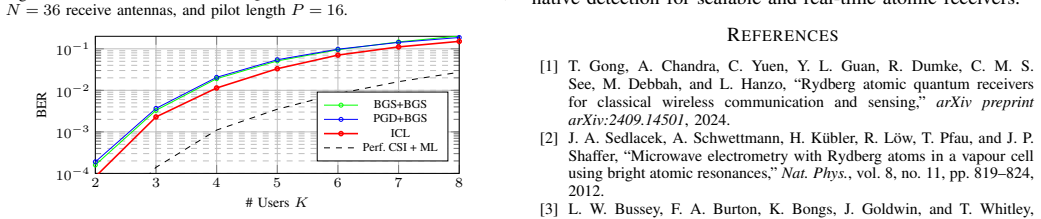
The central result is that a sequence model trained on synthetic channel realizations can perform few-shot, in-context symbol detection for atomic multi-user MIMO. Given a prompt of P pairs of pilot measurements and known transmitted symbols, plus a new query measurement, the model outputs a soft estimate of the symbol vector; the last output token is the detected symbol. The model is trained end-to-end by minimizing average MSE over prompt positions, and it generalizes to arbitrary context lengths without fine-tuning. In the reported simulations, the ICL detector attains 12–14% lower BER than the optimization baselines at 0 dB SNR and 39–44% lower at 7 dB; as the number of users grows from 2 to 8 at 5 dB, its BER advantage ranges from 48–56% down to 19–26%. On an A100 GPU, per-frame detection takes 0.075 ms, compared with 1.043 ms for BGS+BGS and 0.246 ms for PGD+BGS.
Load-bearing premise
The entire training and evaluation rely on the linearized measurement model of Eq. (9), which assumes the local oscillator field is much stronger than the combined signal and noise at every antenna; the paper does not simulate the exact magnitude-only model (7), so the reported results stand only if that strong-LO approximation holds under the simulated conditions.
Editorial extensions
If this is right
- One-step, CSI-free detection is viable for atomic MIMO receivers under the linearized strong-LO model, eliminating the cascaded error of channel estimation followed by equalization.
- Runtime per detection frame drops to 0.075 ms on an A100 GPU, 14x faster than BGS+BGS and 3x faster than PGD+BGS, because the transformer's attention is parallelizable while the baselines need hundreds of serial iterations.
- The same trained model can handle arbitrary context lengths P beyond those seen in training, so pilot overhead can be adapted at inference time without retraining.
- The ICL detector maintains a BER advantage as the number of users K grows from 2 to 8, indicating the learned inverse mapping scales with interference.
Reading between the lines
- If the strong-LO linearization is accurate in hardware, the same prompt-based detection recipe could generalize to other magnitude-only, phase-insensitive sensor arrays, not just Rydberg vapor cells.
- The paper's claim is bounded to the linearized model; a natural test is training and evaluating on the exact magnitude-only model (7), where the strong-LO condition may fail for weak LO power or large constellations.
- The causal-mask structure suggests the model is effectively performing a learned one-step approximate maximum-likelihood estimation conditioned on pilot data; inspecting attention patterns could reveal whether it forms an implicit channel estimate internally.
- Testable extension: vary the LO strength r relative to signal and noise in simulation and measure the degradation point; this would map the regime where the ICL advantage survives.
Editorial analysis
A structured set of objections, weighed in public.
Referee Report
Summary. The paper proposes a CSI-free symbol detector for atomic MIMO receivers based on in-context learning (ICL). A transformer-based sequence model maps a prompt of P pilot-response pairs plus a query magnitude measurement directly to the transmitted symbol vector, bypassing explicit channel estimation. Simulations compare the ICL detector against BGS+BGS and PGD+BGS baselines under 4-QAM, N=36 antennas, and K=2-8 users, reporting lower BER and faster runtime, especially on GPU. The underlying measurement model is the strong-local-oscillator linearization of the atomic magnitude-only channel.
Significance. If validated on the actual nonlinear atomic measurement model, the paper would make a useful contribution: a one-step, GPU-friendly alternative to iterative two-step estimation-and-detection pipelines, with a clear complexity argument based on key-value caching. The manuscript is clearly structured, and the proposed architecture and training procedure are described in enough detail to be reproducible. The significance is however qualified by the fact that all numerical evidence is obtained on the linearized model (9), not on the raw magnitude-only model (7), and by the absence of statistical uncertainty quantification.
major comments (4)
- [Sec. II-A, Eq. (9)] The entire numerical evaluation (tokenization in Eq. (18), training loss in Eq. (25), the BER results in Figs. 3 and 4, and the runtime study in Table I) is carried out on the linearized model \tilde{y} = Re(DHs) + \bar{w}, not on the magnitude-only model y = |Hs + r + w| in Eq. (7). The linearization requires |r_n| >> |h_n^H s + w_n| at every antenna, but no LO amplitude, LO-to-signal margin, or linearization residual is reported. Since BGS+BGS is designed for the nonlinear magnitude-only model, evaluating on the linearized model may bias the comparison in favor of the ICL detector, which is trained and tested on the same linearized distribution. Please simulate the exact model (7) or provide a quantitative verification that the linearization error is negligible under the simulated parameters, and report the LO strength used.
- [Sec. V, Figs. 3 and 4] The BER curves appear to be point estimates with no error bars, no number of Monte Carlo trials, and no information about random seeds. The headline improvements, e.g., 12-14% at 0 dB and 39-44% at 7 dB in Fig. 3, or 19-26% at K=8 in Fig. 4, are small enough that they could lie within Monte Carlo noise. Please add confidence intervals or multiple-seed results and state the number of independent channel and symbol realizations per point.
- [Sec. IV-C, Eq. (25)] The ICL model is pre-trained on channels drawn from a synthetic distribution D and, based on the numerical section, evaluated on draws from the same distribution. The claim in Sec. IV-C that the detector 'can generalize to new prompts of arbitrary context length without further fine-tuning' is therefore not demonstrated for distribution shift, which is the practically relevant scenario for a CSI-free receiver. Please include an evaluation under a different channel distribution (e.g., different SNR statistics, LO strength, or spatial correlation) or restrict the generalization claim accordingly.
- [Sec. V, Table I] The runtime comparison is not fully controlled. The baselines are run with 'minimum iterations to reach the converged BER,' but the actual iteration counts are not reported. The GPU implementations of BGS and PGD are described as manual low-level implementations, citing a blog post [18] rather than a standardized library, so the reported 14x and 3x speedups may reflect implementation effort rather than algorithmic advantage. Please report the iteration counts, provide the implementation details, and, if possible, benchmark all methods with comparable optimized numerical routines.
minor comments (5)
- [Abstract/Conclusion] The abstract says ICL achieves 'competitive accuracy,' while the introduction and conclusion say 'higher accuracy'; please harmonize the wording to avoid overclaiming.
- [Sec. II-A, Eq. (9)] The phrase 'we use the equality sign to simplify the notation' after Eq. (9) should be replaced with an explicit statement that this is an approximation, ideally with an expression for the neglected second-order term.
- [Fig. 3 and Fig. 4 captions] The captions contain a missing space ('N = 36receive antennas') and inconsistent capitalization of the pilot length ('p = 16' vs. 'P = 16' in the text).
- [Sec. IV-C, Eq. (25)] The expectation notation E_{\tau \sim U(T_{tr}), P_{tr} \sim D_{P|\tau}} is nonstandard for an empirical training loss; please clarify that this denotes an empirical average over a finite training set.
- [Reference [18]] Reference [18] is an informal blog post; if GPU implementations of BGS are needed for the runtime comparison, please cite a peer-reviewed implementation or describe the custom implementation in enough detail for reproducibility.
Circularity Check
No significant circularity: the ICL detector is an empirical, independently benchmarked learning system, not a derivation that reduces to its own inputs.
full rationale
The paper's contribution is empirical rather than analytic: the ICL detector is trained by minimizing the MSE loss in Eq. (25) on prompts generated from the linearized atomic measurement model (9), and it is then evaluated on independently generated test prompts from the same model. No predicted quantity is defined in terms of fitted parameters, no fitted parameter is renamed as a prediction, and no uniqueness theorem is imported from prior work. The linearized model (9) is adopted from reference [16], which is not by the present authors, and the optimization baselines BGS+BGS [5] and PGD+BGS [6] are external references with independent provenance. The authors' own prior ICL papers, cited as [9] through [14], are used only as background for in-context learning capabilities and previous applications; they do not supply the load-bearing evidence for the numerical gains, which are generated in this paper via simulation. The main validation gap, namely that training and testing both use the same strong-LO linearized model (9) while the exact magnitude-only model (7) is never simulated, is a modeling-assumption risk rather than a circularity: Eq. (9) is an input modeling assumption, not a restatement of the paper's output claim. No circular step can be exhibited by quoting the paper's equations, so the appropriate finding is no significant circularity.
Assumptions & free parameters
free parameters (2)
- Transformer weights =
Approx. 16M parameters (not released)
- Architecture hyperparameters (NL, DE) =
NL=4, DE=256; number of heads and FFN dimension not stated
assumptions (4)
- domain assumption Measurement model y = |Hs + r + w| (Eq. 7) with w ~ CN(0, sigma^2 I)
- domain assumption Strong-LO linearization: |r_n| >> |h_n^H s + w_n|, giving Eq. (9)
- domain assumption Training and test channels are drawn from the same pre-training distribution D (Sec. IV-C)
- domain assumption Known LO phases and constellation; D = diag(e^{-j angle r}) is known to the receiver
Cite this review
Pith. "Pith review of CSI-Free Symbol Detection for Atomic MIMO Receivers via In-Context Learning." pith.science (2026). https://pith.science/paper/Y34MHWH5
@misc{pith2026250704040,
  author       = {Pith},
  title        = {Pith review of: CSI-Free Symbol Detection for Atomic MIMO Receivers via In-Context Learning},
  year         = {2026},
  howpublished = {\url{https://pith.science/paper/Y34MHWH5}},
  note         = {Machine review of arXiv:2507.04040}
}
read the original abstract
Atomic receivers based on Rydberg vapor cells as sensors of electromagnetic fields offer a promising alternative to conventional radio frequency front-ends. In multi-antenna configurations, the magnitude-only, phase-insensitive measurements produced by atomic receivers pose challenges for traditional detection methods. Existing solutions rely on two-step iterative optimization processes, which suffer from cascaded channel estimation errors and high computational complexity. We propose a channel state information (CSI)-free symbol detection method based on in-context learning (ICL), which directly maps pilot-response pairs to data symbol predictions without explicit channel estimation. Simulation results show that ICL achieves competitive accuracy with {higher computational efficiency} compared to existing solutions.
Figures


Figures from the paper (1 more)
Forward citations
Cited by 1 Pith paper
-
Rydberg Atomic Quantum Radio: A Comprehensive Survey From Wireless Communication Perspective
A wireless-communications-oriented survey of Rydberg atomic quantum radios covering physics, architectures, sensitivity-bandwidth-frequency trade-offs, channel models, and SAGSIN use cases.
Reference graph
Works this paper leans on
-
[9]
In-context learning for MIMO equalization using transformer-based sequence models,
M. Zecchin, K. Yu, and O. Simeone, “In-context learning for MIMO equalization using transformer-based sequence models,” in Proc. IEEE Int. Conf. Commun. Workshops , Denver, USA, 2024, pp. 1573–1578
work page 2024
-
[14]
Turbo-ICL: In-context learning-based turbo equalization,
——, “Turbo-ICL: In-context learning-based turbo equalization,” arXiv preprint arXiv:2505.06175, 2025
arXiv 2025
-
[18]
PyCUDA, the FFT, and the Ger- chberg–Saxton algorithm,
Vitality Learning, “PyCUDA, the FFT, and the Ger- chberg–Saxton algorithm,” https://medium.com/codex/ pycuda-the-fft-and-the-gerchberg-saxton-algorithm-35fb7bceb62f, 2022
work page 2022
-
[1]
Rydberg atomic quantum receivers for classical wireless communication and sensing,
T. Gong, A. Chandra, C. Yuen, Y . L. Guan, R. Dumke, C. M. S. See, M. Debbah, and L. Hanzo, “Rydberg atomic quantum receivers for classical wireless communication and sensing,” arXiv preprint arXiv:2409.14501, 2024
-
[2]
Microwave electrometry with Rydberg atoms in a vapour cell using bright atomic resonances,
J. A. Sedlacek, A. Schwettmann, H. K ¨ubler, R. L ¨ow, T. Pfau, and J. P. Shaffer, “Microwave electrometry with Rydberg atoms in a vapour cell using bright atomic resonances,” Nat. Phys., vol. 8, no. 11, pp. 819–824, 2012
work page 2012
-
[3]
L. W. Bussey, F. A. Burton, K. Bongs, J. Goldwin, and T. Whitley, “Quantum shot noise limit in a Rydberg RF receiver compared to thermal noise limit in a conventional receiver,” IEEE Sens. Lett. , vol. 6, no. 9, pp. 1–4, 2022
work page 2022
-
[4]
Noncoherent mimo communications: Theoretical foundation, design approaches, and future challenges,
K.-H. Ngo, D. Cuevas, R. d. M. Gil, V . M. Baeza, A. G. Armada, and I. Santamaria, “Noncoherent mimo communications: Theoretical foundation, design approaches, and future challenges,” arXiv preprint arXiv:2505.23172, 2025
arXiv 2025
-
[5]
Towards atomic MIMO receivers,
M. Cui, Q. Zeng, and K. Huang, “Towards atomic MIMO receivers,” IEEE J. Sel. Areas Commun. , vol. 43, no. 3, pp. 659–673, 2025
work page 2025
Show all 18 references
-
[6]
Channel estimation for Rydberg atomic receivers,
B. Xu, J. Zhang, Z. Chen, B. Cheng, Z. Liu, Y .-C. Wu, and B. Ai, “Channel estimation for Rydberg atomic receivers,” arXiv preprint arXiv:2503.08985, 2025
2025 arXiv
-
[7]
Intelli- gence and learning in o-ran for data-driven nextg cellular networks,
L. Bonati, S. D’Oro, M. Polese, S. Basagni, and T. Melodia, “Intelli- gence and learning in o-ran for data-driven nextg cellular networks,” IEEE Commun. Mag. , vol. 59, no. 10, pp. 21–27, 2021
2021
-
[8]
What can transformers learn in-context? a case study of simple function classes,
S. Garg, D. Tsipras, P. S. Liang, and G. Valiant, “What can transformers learn in-context? a case study of simple function classes,” in Adv. Neural Inf. Process. Syst. (NeurIPS) , vol. 35, New Orleans, LA, USA, 2022, pp. 30 583–30 598
2022
-
[10]
Cell-free multi-user MIMO equalization via in-context learning,
——, “Cell-free multi-user MIMO equalization via in-context learning,” in Proc. IEEE 25th Int. Workshop Signal Process. Adv. Wireless Com- mun. (SPA WC), Lucca, Italy, 2024, pp. 646–650
2024
-
[11]
Transformer- based adaptive OFDM MIMO equalization in intelligence-native RAN,
Z. Song, Y . Ma, C. You, H. Yuan, J. Peng, and Y . Gao, “Transformer- based adaptive OFDM MIMO equalization in intelligence-native RAN,” in Proc. IEEE/CIC Int. Conf. Commun. China (ICCC), Hangzhou, China, 2024, pp. 179–184
2024
-
[12]
Neuromorphic in-context learning for energy-efficient MIMO symbol detection,
Z. Song, O. Simeone, and B. Rajendran, “Neuromorphic in-context learning for energy-efficient MIMO symbol detection,” in Proc. IEEE 25th Int. Workshop Signal Process. Adv. Wireless Commun. (SPA WC) , Lucca, Italy, 2024, pp. 1–5
2024
-
[13]
In-context learned equalization in cell-free massive MIMO via state-space models,
Z. Song, M. Zecchin, B. Rajendran, and O. Simeone, “In-context learned equalization in cell-free massive MIMO via state-space models,” inProc. IEEE Int. Conf. Mach. Learn. Commun. Netw. , Barcelona, Spain, 2025
2025
-
[15]
Rydberg atoms for radio- frequency communications and sensing: Atomic receivers for pulsed rf field and phase detection,
D. A. Anderson, R. E. Sapiro, and G. Raithel, “Rydberg atoms for radio- frequency communications and sensing: Atomic receivers for pulsed rf field and phase detection,” IEEE Aerosp. Electron. Syst. Mag. , vol. 35, no. 4, pp. 48–56, 2020
2020
-
[16]
MIMO precoding for Rydberg atomic receivers,
M. Cui, Q. Zeng, and K. Huang, “MIMO precoding for Rydberg atomic receivers,” arXiv preprint arXiv:2408.14366 , 2024
2024 arXiv
-
[17]
Attention is all you need,
A. Vaswani, N. Shazeer, N. Parmar, J. Uszkoreit, L. Jones, A. N. Gomez, Ł. Kaiser, and I. Polosukhin, “Attention is all you need,” in Adv. Neural Inf. Process. Syst. (NeurIPS) , vol. 30, Long Beach, CA, USA, 2017
2017
Reviewed August 6, 2026 · model on record in the stance chip above.
Discussion (0). Continue with ORCID to comment.