Rydberg Atomic Quantum Radio: A Comprehensive Survey From Wireless Communication Perspective
Reviewed by Pith T0 review T1 audit T2 compute T3 formal T4 kernel 2026-07-08 20:06 UTCgrok-4.5pith:QMMLDRA6record.jsonopen to challenge →
The pith
Rydberg atomic quantum radios can relieve next-generation RF front-end limits by mapping electromagnetic fields straight onto atomic quantum states.
A machine-rendered reading of the paper's core claim, the machinery that carries it, and where it could break.
Core claim
Rydberg atomic quantum radio is a viable quantum-enabled receiver paradigm that directly maps electromagnetic fields onto atomic quantum states, and a wireless-communications-oriented survey of its mechanisms, performance trade-offs, equivalent channel models, and enabling technologies can organize a clear research roadmap from laboratory atomic electrometry to next-generation SAGSIN receivers.
What carries the argument
The Rydberg atomic quantum (RAQ) radio: an atom-based transducer that uses the extreme electric-field sensitivity of highly excited Rydberg states to convert RF signals into measurable changes in atomic quantum states (typically read out via electromagnetically induced transparency or related spectroscopy), replacing conventional RF front-end electronics with a physics-limited atomic sensor.
If this is right
- Equivalent channel models built from atomic response functions can bound RAQ link capacity, sensitivity, and bandwidth the way classical noise models bound electronic receivers.
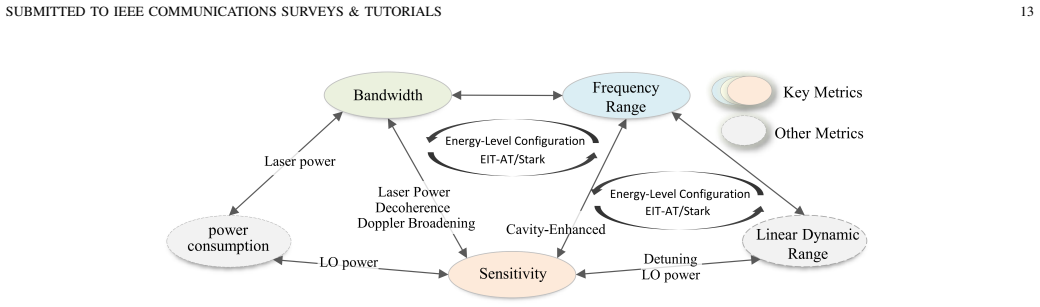
- Trade-offs among sensitivity, instantaneous bandwidth, and operating frequency become explicit design knobs for multi-band SAGSIN terminals rather than hard electronic ceilings.
- Cognitive and interference-resilient reception can exploit the atom’s narrow, tunable spectral response instead of relying only on electronic filtering and digital cancellation.
- Low-frequency and MIMO links gain continuous DC-to-THz coverage and atomic-array sensing paths that electronic mixers and RF chains cannot match without hardware swaps.
- Satellite, integrated sensing-and-communications, and RIS-assisted systems can treat the atomic field map as both a communications front end and a co-located sensor.
Where Pith is reading between the lines
- If multi-atom arrays scale cleanly, RAQ MIMO may sidestep classical RF-chain count and mutual-coupling limits that dominate electronic arrays.
- Laser stability, vacuum packaging, and environmental shielding are likely to replace LNA noise figure and mixer linearity as the practical engineering ceiling.
- A standardized RAQ channel-model suite, analogous to cellular channel models, would be a natural next step for system evaluation and standardization.
- Hybrid atomic-electronic receivers could use the Rydberg path for sensing and anti-jamming while retaining electronic paths for high-rate demodulation until pure atomic bandwidth catches up.
Load-bearing premise
The survey assumes laboratory Rydberg electrometry results and atomic response models will transfer into practical wireless receivers that meet SAGSIN-scale agility, sensitivity, and anti-jamming needs better than conventional electronics once channel models and architectures are organized.
What would settle it
A packaged RAQ receiver fails a head-to-head comparison against a state-of-the-art electronic front end on simultaneous sensitivity, instantaneous bandwidth, and multi-band agility under realistic temperature, vibration, and jamming conditions of satellite or mobile SAGSIN terminals.
Figures




read the original abstract
Next-generation space-air-ground-sea integrated networks (SAGSIN) impose unprecedented demands on advanced radio frequency (RF) receivers for full-spectrum agility, ultra-high sensitivity, and anti-jamming resilience, pushing conventional electronic receivers to their physical limits. To address these challenges, the Rydberg atomic quantum (RAQ) radio has emerged as a promising quantum-enabled receiver paradigm that directly maps electromagnetic fields onto atomic quantum states, offering an alternative to alleviate bottlenecks of conventional RF front ends. To provide a clear research roadmap, this survey presents a comprehensive review of RAQ radios by bridging atomic physics and wireless communications. Specifically, we first introduce the underlying quantum mechanisms, representative architectures, and atomic response models of RAQ radio. On this basis, state-of-the-art techniques for enhancing sensitivity, instantaneous bandwidth, and operating frequency are systematically reviewed, with particular emphasis on the inherent trade-offs among these key metrics. To connect quantum response with communication theory, we further analyze equivalent channel modeling frameworks for characterizing systematic performance limits. From the wireless communication perspective, some RAQ-enabled advanced technologies including cognitive, interference-resilient, low-frequency and multiple-input multiple-output (MIMO) communications are reviewed, alongside emerging deployment scenarios such as satellite networks, integrated sensing and communications, and reconfigurable intelligent surface-assisted systems. Finally, we identify open challenges and provide potential future directions of RAQ radio to inspire the further exploration.
Editorial analysis
A structured set of objections, weighed in public.
Referee Report
Summary. This manuscript is a wireless-communications-oriented survey of Rydberg atomic quantum (RAQ) radio receivers. It argues that RAQ systems, which map RF fields onto atomic quantum states, can alleviate physical bottlenecks of conventional electronic front ends for next-generation SAGSIN requirements (full-spectrum agility, ultra-high sensitivity, anti-jamming). The survey reviews quantum mechanisms, representative architectures, and atomic response models; organizes techniques for sensitivity, instantaneous bandwidth, and operating frequency with emphasis on trade-offs; develops equivalent channel-modeling frameworks that link atomic response to communication-theoretic performance limits; surveys RAQ-enabled technologies (cognitive, interference-resilient, low-frequency, and MIMO communications); discusses deployment scenarios (satellite, ISAC, RIS-assisted systems); and closes with open challenges and future directions.
Significance. If the synthesis is accurate and the physics-to-communications bridge is carefully qualified, the paper would be a useful roadmap for the communications community: it organizes a rapidly growing electrometry literature around receiver metrics, trade-offs, and equivalent channel models, and it surfaces RAQ-enabled architectures (cognitive, anti-jam, low-frequency, MIMO) and SAGSIN-relevant scenarios. The explicit treatment of sensitivity–bandwidth–frequency trade-offs and the attempt to cast atomic response as communication channel models are the main potential contributions of a survey of this type. Those contributions remain contingent on fair treatment of first-order engineering limits when claims of bottleneck alleviation and near-term deployability are made.
major comments (4)
- [Abstract; trade-off and channel-modeling sections] The abstract and framing claim that RAQ radio can 'alleviate bottlenecks of conventional RF front ends' for SAGSIN-scale full-spectrum agility, ultra-high sensitivity, and anti-jamming. Laboratory Rydberg electrometry (typically narrowband CW or controlled tones in shielded vapor cells) does not automatically transfer to practical receivers. First-order constraints—optical LO phase noise and intensity stability, blackbody/thermal shifts, finite Rabi-frequency and transit-time bandwidth, decoherence under realistic field strengths, vapor-cell SWaP, and multi-cell array scaling for MIMO—can dominate equivalent noise temperature, instantaneous bandwidth, and array factor. The survey must treat these as binding limits on the system metrics used for cognitive, interference-resilient, and satellite scenarios, not as secondary engineering details. If the trade-off and channel-modeling sections
- [Equivalent channel modeling frameworks] Equivalent channel models are presented as the bridge from atomic response to communication-theoretic performance limits. For that bridge to support the SAGSIN and advanced-technology claims, the models must make explicit which noise and bandwidth mechanisms are included (shot noise, laser intensity/phase noise, transit-time and Rabi limits, thermal/blackbody shifts, Doppler and collisional dephasing) and which are idealized away. Without a clear statement of model scope and validity regime, subsequent claims about cognitive, interference-resilient, low-frequency, and MIMO performance rest on unstated assumptions and cannot be used as system-level limits.
- [MIMO and interference-resilient communications] The sections on RAQ-enabled MIMO and multi-receiver architectures need a concrete treatment of multi-atom / multi-cell scaling. Array factor, mutual coupling via shared optical fields or vapor-cell geometry, differential laser noise, and the difficulty of dense packing are first-order for any MIMO or spatial anti-jam claim. If these are only mentioned qualitatively, the MIMO and interference-resilient subsections do not yet support the roadmap-level conclusions drawn from them.
- [Emerging deployment scenarios] Deployment scenarios (satellite networks, ISAC, RIS-assisted systems) should separate demonstrated laboratory capability from projected system performance. For each scenario, state which RAQ metrics are currently measured (e.g., field sensitivity in a shielded cell) versus which require unproven advances (long-term laser stability in platform environments, instantaneous bandwidth for wideband waveforms, multi-cell phase coherence). Without that separation, the scenario discussion reads as aspirational rather than as a calibrated research roadmap.
minor comments (5)
- [Abstract and introduction] Define acronyms (SAGSIN, RAQ, ISAC, RIS, MIMO) at first use in the main text as well as in the abstract, and keep a consistent expansion of 'Rydberg atomic quantum radio' versus shorter forms.
- [Techniques for sensitivity, bandwidth, and frequency] When reviewing sensitivity, bandwidth, and frequency-enhancement techniques, a compact comparison table (metric, method, reported value, conditions, reference) would make the trade-off discussion easier to use and would reduce the risk of selective citation.
- [Atomic response models and channel modeling] Clarify notation for atomic response quantities (Rabi frequencies, polarizabilities, Autler–Townes splitting, EIT linewidth) when they are mapped into equivalent channel parameters (noise temperature, SNR, bandwidth), so that communications readers can follow the mapping without re-deriving the atomic physics.
- [Open challenges and future directions] Ensure that open challenges are tied back to specific gaps in the surveyed literature (e.g., missing wideband modulated-signal experiments, missing multi-cell phase-noise measurements) rather than only listing generic future work.
- [Figures throughout] Check figure captions and axis labels for units and for distinction between simulated, calculated, and experimentally measured curves, especially in any trade-off or architecture figures.
Simulated Author's Rebuttal
We thank the referee for a careful and constructive review. The report correctly identifies that a communications-oriented survey of Rydberg atomic quantum (RAQ) radios must qualify claims of bottleneck alleviation against first-order engineering limits, make the scope of equivalent channel models explicit, treat multi-cell/MIMO scaling concretely, and separate laboratory metrics from projected SAGSIN performance. We agree that these points are central to the paper’s usefulness as a roadmap and will revise the abstract, framing, trade-off sections, channel-modeling frameworks, MIMO/interference-resilient discussions, and deployment scenarios accordingly. Below we respond point by point and indicate the revisions planned for the next manuscript version.
read point-by-point responses
-
Referee: The abstract and framing claim that RAQ radio can 'alleviate bottlenecks of conventional RF front ends' for SAGSIN-scale full-spectrum agility, ultra-high sensitivity, and anti-jamming. Laboratory Rydberg electrometry does not automatically transfer to practical receivers. First-order constraints—optical LO phase noise and intensity stability, blackbody/thermal shifts, finite Rabi-frequency and transit-time bandwidth, decoherence under realistic field strengths, vapor-cell SWaP, and multi-cell array scaling for MIMO—can dominate equivalent noise temperature, instantaneous bandwidth, and array factor. The survey must treat these as binding limits on the system metrics used for cognitive, interference-resilient, and satellite scenarios, not as secondary engineering details.
Authors: We agree. The current abstract and framing overstate transfer from laboratory electrometry to practical receivers and under-emphasize binding engineering limits. In revision we will: (i) rephrase the abstract and introduction so that RAQ is presented as a candidate paradigm whose potential to ease conventional front-end bottlenecks is contingent on overcoming the listed constraints, not as an automatic solution; (ii) elevate optical LO phase/intensity noise, blackbody and thermal shifts, Rabi and transit-time bandwidth limits, decoherence at realistic field strengths, vapor-cell SWaP, and multi-cell scaling from secondary remarks into first-order limits in the sensitivity–bandwidth–frequency trade-off sections; and (iii) tie cognitive, interference-resilient, and satellite metric discussions explicitly to these limits (e.g., how laser stability and transit-time bandwidth bound equivalent noise temperature and instantaneous bandwidth). We will retain the physics-to-communications organization but qualify every system-level claim against these constraints. revision: yes
-
Referee: Equivalent channel models are presented as the bridge from atomic response to communication-theoretic performance limits. For that bridge to support the SAGSIN and advanced-technology claims, the models must make explicit which noise and bandwidth mechanisms are included (shot noise, laser intensity/phase noise, transit-time and Rabi limits, thermal/blackbody shifts, Doppler and collisional dephasing) and which are idealized away. Without a clear statement of model scope and validity regime, subsequent claims about cognitive, interference-resilient, low-frequency, and MIMO performance rest on unstated assumptions and cannot be used as system-level limits.
Authors: The referee is correct that model scope and validity were insufficiently stated. We will revise the equivalent channel-modeling section to include an explicit scope table (or equivalent structured statement) listing, for each framework: included mechanisms (e.g., photon shot noise, laser intensity/phase noise, transit-time and Rabi bandwidth, thermal/blackbody shifts, Doppler and collisional dephasing), idealized or omitted mechanisms, and the laboratory/operating regime in which the model is intended to apply. We will then annotate subsequent cognitive, interference-resilient, low-frequency, and MIMO performance discussions with cross-references to that scope, so that communication-theoretic limits are not presented as unconditional system bounds. Where the literature only provides idealized atomic-response models, we will state that limitation clearly rather than extrapolating to SAGSIN-scale claims. revision: yes
-
Referee: The sections on RAQ-enabled MIMO and multi-receiver architectures need a concrete treatment of multi-atom / multi-cell scaling. Array factor, mutual coupling via shared optical fields or vapor-cell geometry, differential laser noise, and the difficulty of dense packing are first-order for any MIMO or spatial anti-jam claim. If these are only mentioned qualitatively, the MIMO and interference-resilient subsections do not yet support the roadmap-level conclusions drawn from them.
Authors: We accept this criticism. The MIMO and multi-receiver material is currently too qualitative to underwrite roadmap-level conclusions. In revision we will add a dedicated multi-cell/multi-atom scaling discussion covering: (i) array factor under realistic cell geometry and optical readout; (ii) mutual coupling and crosstalk via shared optical fields and vapor-cell walls; (iii) differential laser intensity/phase noise across cells and its impact on spatial degrees of freedom; and (iv) dense-packing and SWaP constraints that limit aperture and element count. We will restate MIMO and spatial anti-jam claims as contingent on progress against these factors, and where quantitative multi-cell results are scarce in the literature we will mark them as open research rather than established capability. Interference-resilient subsections will be aligned with the same scaling limits. revision: yes
-
Referee: Deployment scenarios (satellite networks, ISAC, RIS-assisted systems) should separate demonstrated laboratory capability from projected system performance. For each scenario, state which RAQ metrics are currently measured (e.g., field sensitivity in a shielded cell) versus which require unproven advances (long-term laser stability in platform environments, instantaneous bandwidth for wideband waveforms, multi-cell phase coherence). Without that separation, the scenario discussion reads as aspirational rather than as a calibrated research roadmap.
Authors: We agree that the scenario discussion currently mixes demonstrated and projected performance. For satellite, ISAC, and RIS-assisted subsections we will restructure each around an explicit separation: (a) metrics that have been measured in the laboratory (e.g., field sensitivity and spectral response in shielded vapor cells under controlled tones); versus (b) capabilities that remain unproven for the scenario (long-term laser frequency/intensity stability on platforms, instantaneous bandwidth for wideband/modulated waveforms, multi-cell phase coherence, thermal and vibration tolerance, and SWaP-compatible packaging). Projected system performance will be labeled as such and linked to the open challenges section. This will convert the scenarios into a calibrated research roadmap rather than an aspirational list. revision: yes
Circularity Check
Survey synthesis of external RAQ literature; no self-derived predictions or definitional reductions found.
full rationale
This is a comprehensive survey that organizes external atomic-physics and electrometry literature into wireless-communications framing (mechanisms, trade-offs, equivalent channel models, RAQ-enabled techniques, and deployment scenarios). It does not claim a first-principles numerical derivation, uniqueness theorem, or fitted parameter that is then re-presented as a prediction. Abstract and body language (“promising,” “to inspire further exploration,” “systematically reviewed”) is synthesis and roadmap language, not a closed derivation chain. Self-citations, if any, are normal survey practice and are not load-bearing for a uniqueness or forced-choice claim. No equation reduces by construction to an author-fitted input; no ansatz is smuggled in as an external theorem; no known empirical pattern is merely renamed as a new result. Residual risks (lab-to-system transfer, engineering limits) are correctness/scope issues, not circularity. Score 0 is the honest finding for a self-contained survey against external benchmarks.
Axiom & Free-Parameter Ledger
axioms (4)
- domain assumption Rydberg atoms exhibit field-dependent quantum-state shifts that can be optically read out as a usable RF receiver response.
- domain assumption Conventional electronic RF front ends are at or near physical limits for the simultaneous SAGSIN requirements of full-spectrum agility, ultra-high sensitivity, and anti-jamming.
- domain assumption Atomic response can be cast as equivalent communication channel models that meaningfully bound system performance.
- ad hoc to paper Literature synthesis and taxonomy constitute a valid research contribution without new experimental validation in this manuscript.
Reference graph
Works this paper leans on
-
[1]
A survey on space-air- ground-sea integrated network security in 6G,
H. Guo, J. Li, J. Liu, N. Tian, and N. Kato, “A survey on space-air- ground-sea integrated network security in 6G,”IEEE Commun. Surveys Tuts., vol. 24, no. 1, pp. 53–87, 2022
work page 2022
-
[2]
Space-air- ground integrated wireless networks for 6G: Basics, key technologies, and future trends,
Y . Xiao, Z. Ye, M. Wu, H. Li, M. Xiao, and M.-S. Alouini, “Space-air- ground integrated wireless networks for 6G: Basics, key technologies, and future trends,”IEEE J. Sel. Areas Commun., vol. 42, no. 12, pp. 3327–3354, 2024
work page 2024
-
[3]
X. Luo, H.-H. Chen, and Q. Guo, “LEO/VLEO satellite communications in 6G and beyond networks–technologies, applications, and challenges,” IEEE Netw., vol. 38, no. 5, pp. 273–285, 2024
work page 2024
-
[4]
A survey on millimeter-wave beamforming enabled UA V communications and networking,
Z. Xiao, L. Zhu, Y . Liu, P. Yi, R. Zhang, and X.-G. Xia, “A survey on millimeter-wave beamforming enabled UA V communications and networking,”IEEE Commun. Surveys Tuts., vol. 24, no. 1, pp. 557–610, 2022
work page 2022
-
[5]
C. Lin, G. Han, J. Jiang, C. Li, S. B. H. Shah, and Q. Liu, “Underwater pollution tracking based on software-defined multi-tier edge computing in 6G-based underwater wireless networks,”IEEE J. Sel. Areas Commun., vol. 41, no. 2, pp. 491–503, 2023
work page 2023
-
[6]
Extremely low frequency (ELF) communication to submarines,
H. E. Rowe, “Extremely low frequency (ELF) communication to submarines,”IEEE Trans. Commun., vol. 22, no. 4, pp. 371–385, Apr. 1974
work page 1974
-
[7]
T. Rossi, M. De Sanctis, M. Ruggieri, C. Riva, L. Luini, and G. Codispoti, “Satellite communication and propagation experiments through the Alphasat Q/V band aldo paraboni technology demonstration payload,”IEEE Aerosp. Electron. Syst. Mag., vol. 31, no. 3, pp. 18–27, 2016
work page 2016
-
[8]
Ueber strahlen electrischer kraft,
H. Hertz, “Ueber strahlen electrischer kraft,”Ann. Phys., vol. 272, pp. 769–783, 1889
-
[9]
Guglielmo Marconi: The father of long distance radio communication: An engineer’s tribute,
P. K. Bondyopadhyay, “Guglielmo Marconi: The father of long distance radio communication: An engineer’s tribute,” inProc. 25th Eur. Microw. Conf., vol. 2, 1995, pp. 879–885
work page 1995
-
[10]
The software radio architecture,
J. Mitola, “The software radio architecture,”IEEE Commun. Mag., vol. 33, no. 5, pp. 26–38, 1995
work page 1995
-
[11]
D. J. Griffiths,Introduction to Electrodynamics, 4th ed. Cambridge: Cambridge University Press, 2017
work page 2017
-
[12]
C. A. Balanis,Antenna Theory: Analysis and Design, 3rd ed. New York: Wiley-Interscience, 2005. SUBMITTED TO IEEE COMMUNICATIONS SURVEYS & TUTORIALS 27
work page 2005
-
[13]
Multifunction, multiband, and multimode wireless receivers: A path toward the future,
J. Moghaddasi and K. Wu, “Multifunction, multiband, and multimode wireless receivers: A path toward the future,”IEEE Microw. Mag., vol. 21, no. 12, pp. 104–125, 2020
work page 2020
-
[14]
Razavi,RF Microelectronics, 2nd ed
B. Razavi,RF Microelectronics, 2nd ed. Prentice Hall, 2011
work page 2011
-
[15]
Physical limitations of omni-directional antennas,
L. J. Chu, “Physical limitations of omni-directional antennas,”J. Appl. Phys., vol. 19, no. 12, pp. 1163–1175, 1948
work page 1948
-
[16]
Rydberg atomic receiver: Next frontier of wireless communications,
M. Cui, Q. Zeng, and K. Huang, “Rydberg atomic receiver: Next frontier of wireless communications,”IEEE Commun. Mag., vol. 64, no. 1, pp. 146–152, 2026
work page 2026
-
[17]
Watch NIST’s “atomic television
National Institute of Standards and Technology, “Watch NIST’s “atomic television” live and in color,” [Online]. Available: https://www.nist.gov/news-events/news/2022/08/ watch-nists-atomic-television-live-and-color, Aug. 2022, [Accessed: May 19, 2026]
work page 2022
-
[18]
Sub-1-ms instinctual interference adaptive GaN LNA front end with power and linearity tuning,
J. Yang, B. Chatterjee, M. Abu Khater, M. Thorsell, S. E. Gunnarsson, T. Kiuruet al., “Sub-1-ms instinctual interference adaptive GaN LNA front end with power and linearity tuning,”IEEE Trans. Microw. Theory Techn., vol. 71, no. 9, pp. 4037–4051, Sep. 2023
work page 2023
-
[19]
Digital com- munication with Rydberg atoms and amplitude-modulated microwave fields,
D. H. Meyer, K. C. Cox, F. K. Fatemi, and P. D. Kunz, “Digital com- munication with Rydberg atoms and amplitude-modulated microwave fields,”Appl. Phys. Lett., vol. 112, no. 21, 2018
work page 2018
-
[20]
watch NIST’s ’atomic television’ live and in color
National Institute of Standards and Technology. (2022) “watch NIST’s ’atomic television’ live and in color”. National Institute of Standards and Technology. [Accessed: May 19, 2026]. [Online]. Available: https://www.nist.gov/news-events/news/2022/08/ watch-nists-atomic-television-live-and-color
work page 2022
-
[21]
US army tests world’s first long-range quantum radio communication
The Defense Post. (2023) “US army tests world’s first long-range quantum radio communication”. The Defense Post. [Accessed: May 18, 2026]. [Online]. Available: https://thedefensepost.com/2023/12/22/ us-army-quantum-communication/
work page 2023
-
[22]
Satellite Signal Detection via Rydberg-Atom Receiver
M. Lei, J. Zhang, Q. Luo, Z. Zhang, M. Wang, and M. Shi, “Satellite signal detection via Rydberg-atom receiver,”arXiv preprint arXiv:2506.15439, 2025
work page internal anchor Pith review Pith/arXiv arXiv 2025
-
[23]
Broadband Rydberg atom-based electric- field probe for SI-traceable, self-calibrated measurements,
C. L. Holloway, J. A. Gordon, S. Jefferts, A. Schwarzkopf, D. A. Anderson, S. A. Milleret al., “Broadband Rydberg atom-based electric- field probe for SI-traceable, self-calibrated measurements,”IEEE Trans. Antennas Propag., vol. 62, no. 12, pp. 6169–6182, 2014
work page 2014
-
[24]
Quantum- limited atomic receiver in the electrically small regime,
K. C. Cox, D. H. Meyer, F. K. Fatemi, and P. D. Kunz, “Quantum- limited atomic receiver in the electrically small regime,”Phys. Rev. Lett., vol. 121, no. 11, p. 110502, 2018
work page 2018
-
[25]
Quantum- based amplitude modulation radio receiver using Rydberg atoms,
Z. Song, W. Zhang, X. Liu, H. Zou, J. Zhang, Z. Jianget al., “Quantum- based amplitude modulation radio receiver using Rydberg atoms,” in Proc. IEEE Globecom Workshops (GC Wkshps). IEEE, 2018, pp. 1–6
work page 2018
-
[26]
Rydberg- atom-based digital communication using a continuously tunable radio- frequency carrier,
Z. Song, H. Liu, X. Liu, W. Zhang, H. Zou, J. Zhanget al., “Rydberg- atom-based digital communication using a continuously tunable radio- frequency carrier,”Opt. Express, vol. 27, no. 6, pp. 8848–8857, Mar. 2019
work page 2019
-
[27]
An atomic receiver for AM and FM radio communication,
D. A. Anderson, R. E. Sapiro, and G. Raithel, “An atomic receiver for AM and FM radio communication,”IEEE Trans. Antennas Propag., vol. 69, no. 5, pp. 2455–2462, May 2021
work page 2021
-
[28]
A multiple-band Rydberg atom-based receiver: AM/FM stereo reception,
C. L. Holloway, M. T. Simons, A. H. Haddab, J. A. Gordon, D. A. Anderson, G. Raithelet al., “A multiple-band Rydberg atom-based receiver: AM/FM stereo reception,”IEEE Antennas Propag. Mag., vol. 63, no. 3, pp. 63–76, 2021
work page 2021
-
[29]
Detecting and receiving phase-modulated signals with a Rydberg atom-based receiver,
C. L. Holloway, M. T. Simons, J. A. Gordon, and D. Novotny, “Detecting and receiving phase-modulated signals with a Rydberg atom-based receiver,”IEEE Antennas Wirel. Propag. Lett, vol. 18, no. 9, pp. 1853– 1857, 2019
work page 2019
-
[30]
Warm Rydberg atom-based quadrature amplitude- modulated receiver,
J. Nowosielski, M. Jastrz˛ ebski, P. Halavach, K. Łukanowski, M. Jarzyna, M. Mazelaniket al., “Warm Rydberg atom-based quadrature amplitude- modulated receiver,”Opt. Express, vol. 32, no. 17, pp. 30 027–30 039, 2024
work page 2024
-
[31]
Atomic superheterodyne receiver based on microwave-dressed Rydberg spec- troscopy,
M. Jing, Y . Hu, J. Ma, H. Zhang, L. Zhang, L. Xiaoet al., “Atomic superheterodyne receiver based on microwave-dressed Rydberg spec- troscopy,”Nat. Phys., vol. 16, no. 9, pp. 911–915, 2020
work page 2020
-
[32]
N. Prajapati, A. P. Rotunno, S. Berweger, M. T. Simons, A. B. Artusio- Glimpse, S. D. V oranet al., “TV and video game streaming with a quantum receiver: A study on a Rydberg atom-based receiver’s bandwidth and reception clarity,”AVS Quantum Sci., vol. 4, no. 3, 2022
work page 2022
-
[33]
Vapor-cell-based atomic electrometry for detection frequencies below 1 kHz,
Y .-Y . Jau and T. Carter, “Vapor-cell-based atomic electrometry for detection frequencies below 1 kHz,”Phys. Rev. Appl., vol. 13, no. 5, p. 054034, 2020
work page 2020
-
[34]
Assessment of Rydberg atoms for wideband electric field sensing,
D. H. Meyer, Z. A. Castillo, K. C. Cox, and P. D. Kunz, “Assessment of Rydberg atoms for wideband electric field sensing,”J. Phys. B: At. Mol. Opt. Phys., vol. 53, no. 3, p. 034001, 2020
work page 2020
-
[35]
Rydberg atom electric field sensors for communications and sensing,
C. T. Fancher, D. R. Scherer, M. C. S. John, and B. L. S. Marlow, “Rydberg atom electric field sensors for communications and sensing,” IEEE Trans. Quantum Eng., vol. 2, pp. 1–13, 2021
work page 2021
-
[36]
A. Artusio-Glimpse, M. T. Simons, N. Prajapati, and C. L. Holloway, “Modern RF measurements with hot atoms: A technology review of Rydberg atom-based radio frequency field sensors,”IEEE Microw. Mag., vol. 23, no. 5, pp. 44–56, 2022
work page 2022
-
[37]
Electric field measurement and application based on Rydberg atoms,
B. Liu, L. Zhang, Z. Liu, Z. Deng, D. Ding, B. Shiet al., “Electric field measurement and application based on Rydberg atoms,”Electromagn. Sci., vol. 1, no. 2, p. 0020151, 2023
work page 2023
-
[38]
N. Schlossberger, N. Prajapati, S. Berweger, A. P. Rotunno, A. B. Artusio-Glimpse, M. T. Simonset al., “Rydberg states of alkali atoms in atomic vapour as SI-traceable field probes and communications receivers,”Nat. Rev. Phys., vol. 6, no. 10, pp. 606–620, 2024
work page 2024
-
[39]
Rydberg atom electric field sensing for metrology, communication and hybrid quantum systems,
H. Zhang, Y . Ma, K. Liao, W. Yang, Z. Liu, D. Dinget al., “Rydberg atom electric field sensing for metrology, communication and hybrid quantum systems,”Sci. Bull., vol. 69, no. 10, pp. 1515–1535, 2024
work page 2024
-
[40]
Rydberg atom RF sensing: State of the art, principles, metrics and roadmaps,
A. Babusenan, F. Munoz, J.-B. Quéleneet al., “Rydberg atom RF sensing: State of the art, principles, metrics and roadmaps,”IEEE Sensors Reviews, pp. 1–24, 2026
work page 2026
-
[41]
Rydberg atomic quantum receivers for classical wireless communication and sensing,
T. Gong, A. Chandra, C. Yuen, Y . L. Guan, R. Dumke, C. M. S. Seeet al., “Rydberg atomic quantum receivers for classical wireless communication and sensing,”IEEE Wirel. Commun., 2025
work page 2025
-
[42]
New paradigm for integrated sensing and communication with Rydberg atomic receiver,
M. Chen, T. Mao, Y . Zhao, W. Xiao, D. Zheng, Z. Wanget al., “New paradigm for integrated sensing and communication with Rydberg atomic receiver,”arXiv preprint arXiv:2506.13304, 2025, submitted to IEEE Communications Magazine
- [43]
-
[44]
T. F. Gallagher, “Rydberg atoms,”Rep. Prog. Phys., vol. 51, no. 2, p. 143, 1988
work page 1988
-
[45]
Role of dressed-state interference in electromagnetically induced transparency,
S. Khan, V . Bharti, and V . Natarajan, “Role of dressed-state interference in electromagnetically induced transparency,”Phys. Lett. A, vol. 380, no. 48, pp. 4100–4104, 2016
work page 2016
-
[46]
Electromagnetically induced transparency: Optics in coherent media,
M. Fleischhauer, A. Imamo˘glu, and J. P. Marangos, “Electromagnetically induced transparency: Optics in coherent media,”Rev. Mod. Phys., vol. 77, no. 2, pp. 633–673, 2005
work page 2005
-
[47]
Electromagnetically induced transparency quantum memory for non-classical states of light,
X. Lei, L. Ma, J. Yan, X. Zhou, Z. Yan, and X. Jia, “Electromagnetically induced transparency quantum memory for non-classical states of light,” Adv. Phys. X, vol. 7, no. 1, p. 2060133, 2022
work page 2022
-
[48]
Y .-q. Liu, Zhanget al., “Magnetically tuned single-Zeeman-sublevel Rydberg EIT of a 87Rb 38F state for resonant L-band microwave electric field sensing,”Opt. Express, vol. 34, no. 1, pp. 651–660, 2026
work page 2026
-
[49]
A simple derivation of the Lindblad equation,
C. A. Brasil, F. F. Fanchini, and R. d. J. Napolitano, “A simple derivation of the Lindblad equation,”Rev. Bras. Ensino Física, vol. 35, no. 1, p. 1303, 2013
work page 2013
-
[50]
A Rydberg atom- based mixer: Measuring the phase of a radio frequency wave,
M. T. Simons, J. A. Gordon, and C. L. Holloway, “A Rydberg atom- based mixer: Measuring the phase of a radio frequency wave,”Appl. Phys. Lett., vol. 114, no. 11, p. 114101, 2019
work page 2019
-
[51]
Linear dynamic range of a Rydberg- atom microwave superheterodyne receiver,
F. Wu, Q. An, Z. Sun, and Y . Fu, “Linear dynamic range of a Rydberg- atom microwave superheterodyne receiver,”Phys. Rev. A, vol. 107, no. 4, p. 043108, 2023
work page 2023
-
[52]
Harnessing Rydberg Atomic Receivers: From Quantum Physics to Wireless Communications
Y . Chen, X. Guo, C. Yuen, Y . Zhao, Y . L. Guan, C. M. S. Seeet al., “Harnessing Rydberg atomic receivers: From quantum physics to wireless communications,”arXiv preprint arXiv:2501.11842, 2025
work page internal anchor Pith review Pith/arXiv arXiv 2025
-
[53]
Atomic superheterodyne receiver sensitivity estimation based on homodyne readout,
S. Wu, R. Ni, C. Gong, Q. Zhu, G. Jiang, and G. Yang, “Atomic superheterodyne receiver sensitivity estimation based on homodyne readout,” inProc. IEEE INC-USNC-URSI Radio Sci. Meeting. IEEE, 2024, pp. 193–194
work page 2024
-
[54]
Atom-based sensing of weak radio frequency electric fields using homodyne readout,
S. Kumar, H. Fan, H. Kübler, J. Sheng, and J. P. Shaffer, “Atom-based sensing of weak radio frequency electric fields using homodyne readout,” Sci. Rep., vol. 7, no. 1, p. 42981, 2017
work page 2017
-
[55]
W. Yang, M. Jing, H. Zhanget al., “Enhancing the sensitivity of atom-based microwave-field electrometry using a Mach-Zehnder interferometer,”Phys. Rev. Appl., vol. 19, p. 064021, 2023
work page 2023
-
[56]
T. Gong, J. Sun, C. Yuen, G. Hu, Y . Zhao, Y . L. Guanet al., “Rydberg atomic quantum receivers for classical wireless communications and sensing: Their models and performance,”IEEE Transactions on Communications, 2026
work page 2026
-
[57]
From atom-based RF metrology to quantum RF receivers and emitters,
D. Latypov, “From atom-based RF metrology to quantum RF receivers and emitters,” inProc. IEEE Nat. Aerosp. Electron. Conf. (NAECON), 2024, pp. 80–82
work page 2024
-
[58]
Compact quantum VLF/ELF sources for submarine to air communication,
——, “Compact quantum VLF/ELF sources for submarine to air communication,” inProc. Sixth Underwater Commun. Netw. Conf. (UComms), 2022, pp. 1–4. SUBMITTED TO IEEE COMMUNICATIONS SURVEYS & TUTORIALS 28
work page 2022
-
[59]
L. Ma, D. A. Anderson, and G. Raithel, “Paschen-back effects and Rydberg-state diamagnetism in vapor-cell electromagnetically induced transparency,”Phys. Rev. A, vol. 95, no. 6, p. 061804, 2017
work page 2017
-
[60]
L. Ma, M. A. Viray, D. A. Anderson, and G. Raithel, “Measurement of DC and AC electric fields inside an atomic vapor cell with wall- integrated electrodes,”Phys. Rev. Appl., vol. 18, no. 2, p. 024001, 2022
work page 2022
-
[61]
Rydberg RF receiver operation to track RF signal fading and frequency drift,
L. W. Bussey, A. Winterburn, M. Menchetti, F. Burton, and T. Whitley, “Rydberg RF receiver operation to track RF signal fading and frequency drift,”J. Lightw. Technol., vol. 39, no. 24, pp. 7813–7820, 2021
work page 2021
-
[62]
Microwave electrometry via electromagnetically induced absorption in cold Rydberg atoms,
K.-Y . Liao, H.-T. Tu, S.-Z. Yang, C.-J. Chen, X.-H. Liu, J. Lianget al., “Microwave electrometry via electromagnetically induced absorption in cold Rydberg atoms,”Phys. Rev. A, vol. 101, no. 5, p. 053432, 2020
work page 2020
-
[63]
Properties and utilization in time-dependent Rydberg EIT,
Z. Jia, Q. Li, Y . Wang, Y . You, B. Chen, and Y . Peng, “Properties and utilization in time-dependent Rydberg EIT,”Opt. Continuum, vol. 3, no. 2, pp. 135–147, 2024
work page 2024
-
[64]
S. M. Bohaichuk, D. Booth, K. Nickerson, H. Tai, and J. P. Shaffer, “Origins of Rydberg-atom electrometer transient response and its impact on radio-frequency pulse sensing,”Phys. Rev. Appl., vol. 18, no. 3, p. 034030, 2022
work page 2022
-
[65]
Analytical model for transient evolution of an EIT-AT spectrum with Rydberg atoms,
F. Li, “Analytical model for transient evolution of an EIT-AT spectrum with Rydberg atoms,”Opt. Lett., vol. 50, no. 4, pp. 1369–1372, 2025
work page 2025
-
[66]
S. Ren, Y . Tang, C. Yang, H. Zhou, and S. Wang, “Research on dynamic solution analysis and applications based on the Rydberg atom superheterodyne structure,”Opt. Express, vol. 32, no. 24, pp. 42 397– 42 417, 2024
work page 2024
-
[67]
General signal model and capacity limit for Rydberg quantum information system,
J. Zhu and L. Dai, “General signal model and capacity limit for Rydberg quantum information system,”IEEE Trans. Wireless Commun., vol. 25, pp. 8292–8307, 2026
work page 2026
-
[68]
Response analysis of four-level heterodyne Rydberg atom receiver,
Y . Tang, S. Wang, S. Ren, C. Yang, H. Zhou, and C. Lu, “Response analysis of four-level heterodyne Rydberg atom receiver,”IEEE Trans. Antennas Propag., 2026
work page 2026
-
[69]
Tight capacity bounds for indoor visible light communications with signal-dependent noise,
J.-Y . Wang, X.-T. Fu, R.-R. Lu, J.-B. Wang, M. Lin, and J. Cheng, “Tight capacity bounds for indoor visible light communications with signal-dependent noise,”IEEE Trans. Wireless Commun., Nov. 2020
work page 2020
-
[70]
M. T. Simons, M. D. Kautz, C. L. Holloway, D. A. Anderson, G. Raithel, D. Stacket al., “Electromagnetically induced transparency and autler- townes splitting in the presence of band-limited white gaussian noise,” J. Appl. Phys., vol. 123, no. 20, 2018
work page 2018
-
[71]
Comparison of Noise Temperature of Rydberg-Atom and Electronic Microwave Receivers
G. S. Botello, S. Verploegh, E. Bottomley, and Z. Popovi´c, “Comparison of Noise Temperature of Rydberg-Atom and Electronic Microwave Receivers,”arXiv preprint arXiv:2209.00908v2, Oct. 2022
work page internal anchor Pith review Pith/arXiv arXiv 2022
-
[72]
Noise performance of a Rydberg atomic receiver,
Y . Tang, H. Zhou, C. Yang, S. Ren, S. Wang, and C. Lu, “Noise performance of a Rydberg atomic receiver,”Phys. Rev. Appl., vol. 112, no. 4, p. 043106, Oct. 2025
work page 2025
-
[73]
Highly sensitive microwave electrometry with enhanced instantaneous bandwidth,
B. Yang, Y . Yan, X. Li, L. Xiao, X. Li, L. Chenet al., “Highly sensitive microwave electrometry with enhanced instantaneous bandwidth,”Phys. Rev. Appl., vol. 21, no. 3, p. L031003, 2024
work page 2024
-
[74]
M. T. Simons, J. A. Gordon, C. L. Holloway, D. A. Anderson, S. A. Miller, and G. Raithel, “Using frequency detuning to improve the sensitivity of electric field measurements via electromagnetically induced transparency and autler-townes splitting in Rydberg atoms,”Appl. Phys. Lett., vol. 108, no. 17, 2016
work page 2016
-
[75]
S. Wu, C. Gong, S. Li, R. Ni, and J. Zhu, “Theoretical analysis of het- erodyne Rydberg atomic receiver sensitivity based on transit relaxation effect and frequency detuning,”arXiv preprint arXiv:2306.17790, 2023
work page internal anchor Pith review Pith/arXiv arXiv 2023
-
[76]
Numerical model of n-level cascade systems for atomic radio frequency sensing applications,
L. W. Bussey, Y . B. Kale, S. Winter, F. A. Burton, Y .-H. Lien, K. Bongs et al., “Numerical model of n-level cascade systems for atomic radio frequency sensing applications,”EPJ Quantum Technol., vol. 11, no. 1, p. 77, 2024
work page 2024
-
[77]
D. A. Anderson, E. G. Paradis, and G. Raithel, “A vapor-cell atomic sensor for radio-frequency field detection using a polarization-selective field enhancement resonator,”Appl. Phys. Lett., vol. 113, no. 7, 2018
work page 2018
-
[78]
Deep-subwavelength resonator based Rydberg atomic receiver for HF band enhanced sensing,
W. Wan, Y . Linet al., “Deep-subwavelength resonator based Rydberg atomic receiver for HF band enhanced sensing,”IEEE Antennas Wireless Propag. Lett., vol. 25, no. 1, pp. 19–23, 2026
work page 2026
-
[79]
A photonic crystal receiver for Rydberg atom-based sensing,
H. Amarloo, M. Noaman, S.-P. Yu, D. Booth, S. Mirzaee, R. Pandiyan et al., “A photonic crystal receiver for Rydberg atom-based sensing,” Commun. Eng., vol. 4, no. 1, p. 70, 2025
work page 2025
-
[80]
Field enhancement for sensitivity improvement of a room-temperature Rydberg-atom receiver,
G. Sandidge, G. S. Botello, and Z. Popovi ´c, “Field enhancement for sensitivity improvement of a room-temperature Rydberg-atom receiver,” inProc. IEEE/MTT-S Int. Microw. Symp. (IMS). IEEE, 2023, pp. 553–556
work page 2023
discussion (0)
Sign in with ORCID, Apple, or X to comment. Anyone can read and Pith papers without signing in.